
Basic Concepts of Infant Behavior and Development Fogel
Basic Concepts of Infant Behavior and Development Fogel, Chapter 1 Created by Ilse De. Koeyer-Laros, Ph. D.
Overview Chapter 1 ¢ The Importance of Infancy ¢ A Brief History of Babies ¢ Infants Enter the World of Science ¢ Research Methods in Developmental Science ¢ Experimental Research Methods ¢ Observational Research Methods ¢ Qualitative Research Methods
The Importance of Infancy ¢ ¢ ¢ ¢ The experience of the body (movements & senses) Infants have complex emotional lives Education for parents, caregivers, & clinicians Improving health by early prevention Reexperiencing infant-like states can be healing & rejuvenating Informed public policy Origins of individual differences
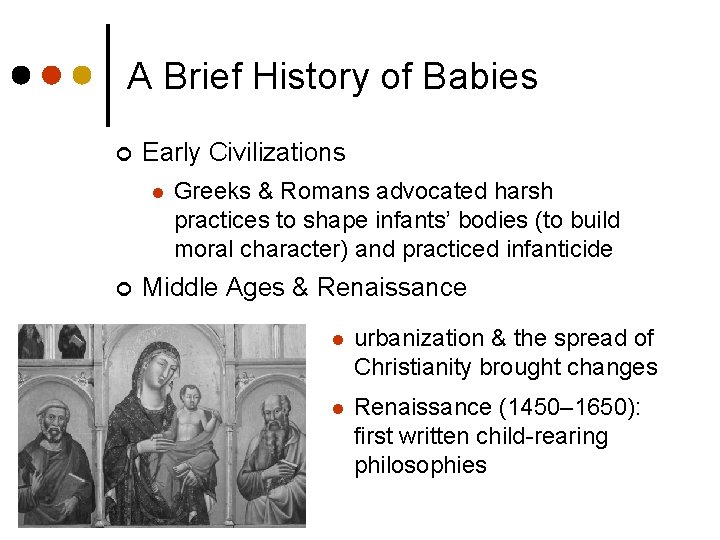
A Brief History of Babies ¢ Early Civilizations l ¢ Greeks & Romans advocated harsh practices to shape infants’ bodies (to build moral character) and practiced infanticide Middle Ages & Renaissance l urbanization & the spread of Christianity brought changes l Renaissance (1450– 1650): first written child-rearing philosophies
A Brief History of Babies ¢ ¢ The Enlightenment (18 th century) l Romanticism (Rousseau) & Empiricism (Locke) l both emphasized the value of children & revived the importance of the body 19 th century l the nuclear family emerged (mainly in white ethnic groups) l social changes related to medical advances in infant care
Infants Enter the World of Science Nature-nurture debate sparked scientific study l Arnold Gesell (1880 -1961) • believed in genetic maturation (nature) • focused on the “average” child l John B. Watson (1878– 1958) • children can be trained to do almost anything (nurture) • lasting imprint on North American society l Sigmund Freud (1856– 1939) • focused on psychological experience • recognized that infants experience emotions, feel the need for love, & possess powerful desires
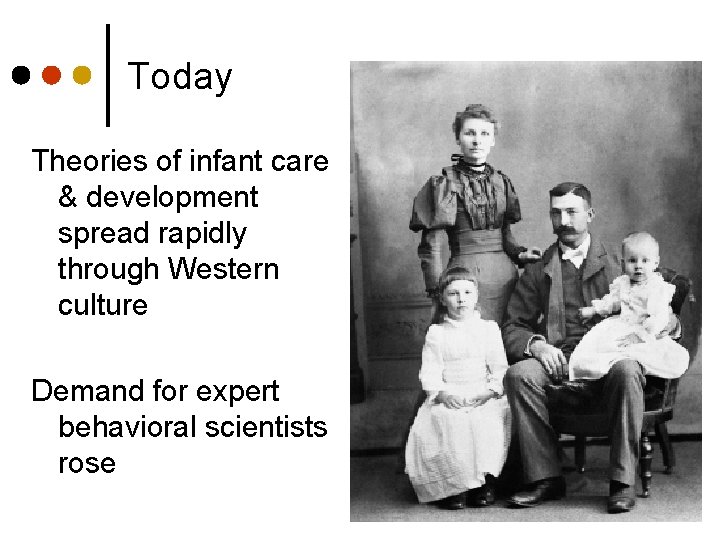
Today Theories of infant care & development spread rapidly through Western culture Demand for expert behavioral scientists rose
Today 1970 s research was in the empiricist tradition, but focused on learning & cognitive development – not the whole child • The Competent Infant (1973) reflected desire to discover the earliest signs of intelligence & belief that education is the best guarantee of child success • The individual child became lost • Emphasis on mental development led to a less balanced view of the whole child (body, emotions & social connections)
Today Since 1990 s, shift back to the whole child l parent-child relationships l emotional development l the role of the body & touch l communication & language; l focus on neuroscience, behavior genetics
The Scientific Perspective on Infancy Scientists strive to understand infants in their own right, detached from social & cultural conceptions about infancy – but this is not completely possible
Stages & Changes Developmental changes ¢ ¢ ¢ are not reversible – earlier patterns of behavior, thought, & feeling cannot be easily recognized are stable – new organized patterns that persist over relatively long periods of months or years occur in a sequence that is similar across infants
Stages & Changes The division of infancy into stages of development is somewhat arbitrary & depends on the purposes of the culture or group
Research Methods in Developmental Science Scientists l rely on many sources of evidence l try to separate what is repeatable & stable from what is coincidental l attempt to rid observations of bias
Research Methods in Developmental Science Research methods l Quantitative – representing complex behavioral processes with a numerical index (a variable) l Qualitative – attempting to capture the meaning or quality of the behavior while maintaining a scientific stance
Experimental Research Methods Experiment – a study in which one aspect of the situation is manipulated while all other aspects are held constant or controlled l independent variable: that which is controlled or manipulated – the presumed cause of the phenomenon l dependent variable: the outcome behavior that is observed in response to the changes in the independent variable
Experimental Research Methods Standard experimental procedures l control groups that do not receive any manipulation are compared to groups that receive the experimental manipulation l contrast groups: different groups that each receive a different type of manipulation are compared l random assignment: a random process, like a flip of a coin, used to assign subjects to groups
Experimental Research Methods Testing perception & cognition in infants l paired-preference tests: researchers determine which of two stimuli is preferred by the infants l habituation procedures: decline in looking time over repeated trials of the same stimulus • recovery: the abrupt increase in looking time after a change in the stimulus l response-contingent procedures: infants are trained to change their behavior if they can detect certain features of stimuli & will alter their behavior in order to receive their favorite stimulus (e. g. , a certain taste)
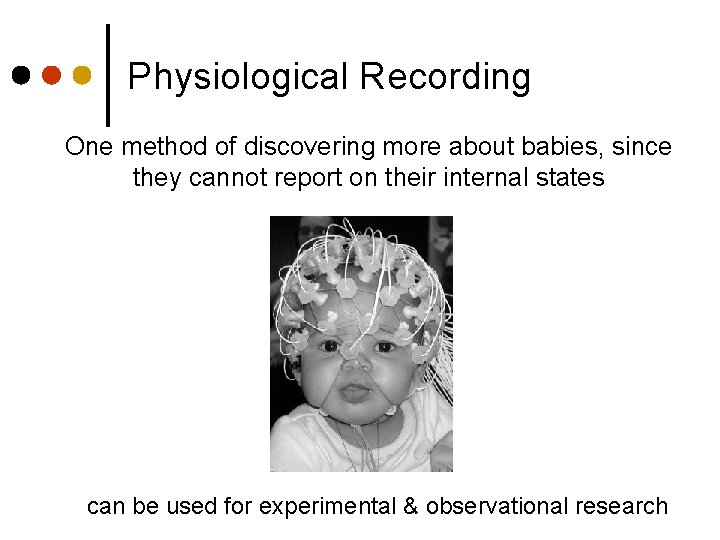
Physiological Recording One method of discovering more about babies, since they cannot report on their internal states can be used for experimental & observational research
Physiological Recording Automatic recording of behavior includes l measurements of heart rate, respiration, brain activity, hormonal activity, & aspects of behavior (movement, gaze direction) Limitations l hard to know the precise meaning of a change in a physiological measure l physiological activity is itself a response; it is impossible to say when & where a response originates or is encoded in the body
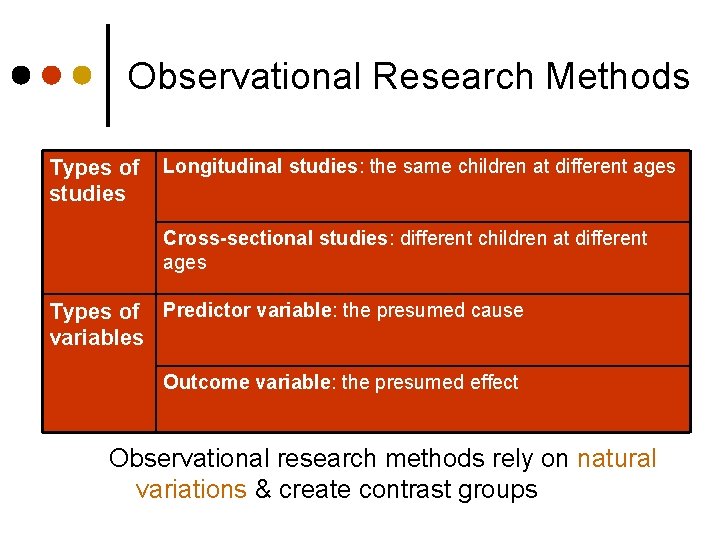
Observational Research Methods Types of studies Longitudinal studies: the same children at different ages Cross-sectional studies: different children at different ages Types of Predictor variable: the presumed cause variables Outcome variable: the presumed effect Observational research methods rely on natural variations & create contrast groups
Observational Research Methods ¢ Microanalysis focuses on minute changes in behavior l ¢ For example, coding emotional expressions of an infant second by second Macroanalysis focuses on the overall or summary features of behavior, usually with the use of rating scales l For example, rating the main emotional quality of an infant’s expression over a 10 -minute period
Bias & Research Ethics ¢ Bias is reduced by attention to reliability, validity, observer bias, & representative samples ¢ Researchers need to observe ethical guidelines when using human subjects in research l since infants cannot provide informed consent to participate in research, their parents must do so l researchers must pledge to keep the subjects’ identity confidential & to limit access to their data only to those persons directly involved with the research
Qualitative Research Methods ¢ Characterized by one or both of the following 1. the observers focus on the meaning of the situation for the participants 2. the role of the researcher is taken explicitly into account ¢ Examines the situation in its broader context ¢ Credibility depends upon researcher’s skill, experience, & rigor
Qualitative Research Methods ¢ Constant comparative method – the same observers go over the data many times to check & revise their interpretation ¢ Case study: the same child is observed over a long period of time l more information about individual children, but not generalizable to larger groups
To conclude Research on infants is above all a human enterprise, a relationship between scientistpersons and subject-persons. Every research study is, therefore, a particular point of view on nature (p. 37)
Observing Children using Naturalistic Qualitative Methods ¢ Naturalistic observation is the practice of studying real-world situations as they unfold naturally ¢ Arrange to observe at a day care center, nursery school or home where there are children aged 2 -4 years ¢ During your observation or following your participation at one of the sites, record field notes about your observations l emphasize your experience as a participant and as an observer (even if you are not in direct contact with the children) l report any insights that you may have about personal experiences or memories that are elicited through your observations
- Slides: 26