
Basic Concepts of Genome and its Organization Nilansu
Basic Concepts of Genome and its Organization Nilansu Das Department of Molecular Biology Surendranath College
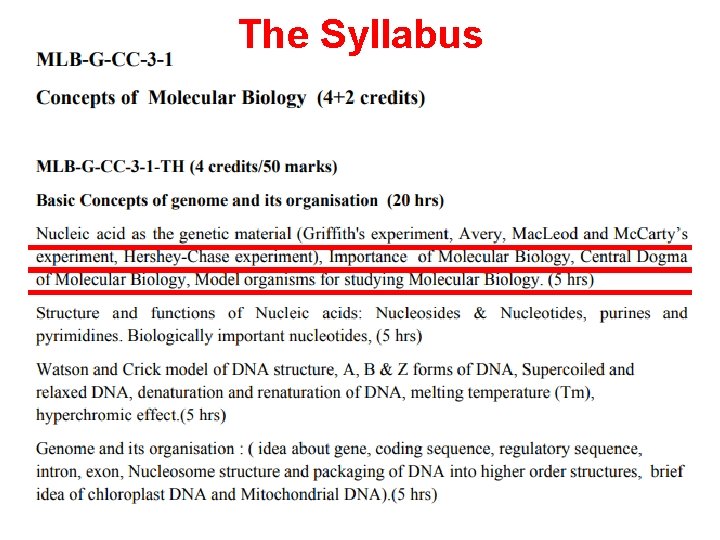
The Syllabus
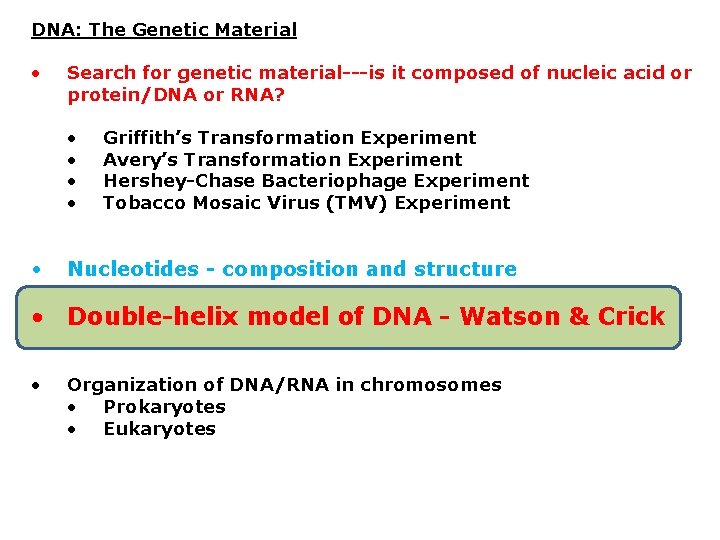
DNA: The Genetic Material • Search for genetic material---is it composed of nucleic acid or protein/DNA or RNA? • • • Griffith’s Transformation Experiment Avery’s Transformation Experiment Hershey-Chase Bacteriophage Experiment Tobacco Mosaic Virus (TMV) Experiment Nucleotides - composition and structure • Double-helix model of DNA - Watson & Crick • Organization of DNA/RNA in chromosomes • Prokaryotes • Eukaryotes
Friedrich Miescher in 1869 • isolated what he called nuclein from the nuclei of pus cells • Nuclein was shown to have acidic properties, hence it became called nucleic acid
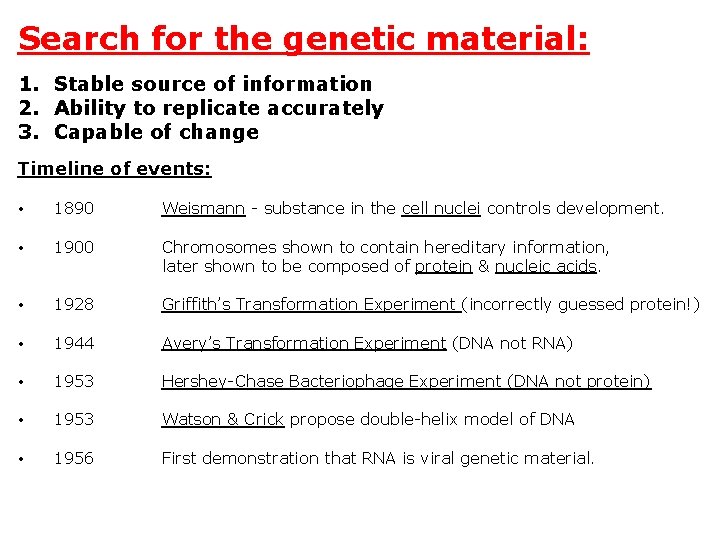
Search for the genetic material: 1. Stable source of information 2. Ability to replicate accurately 3. Capable of change Timeline of events: • 1890 Weismann - substance in the cell nuclei controls development. • 1900 Chromosomes shown to contain hereditary information, later shown to be composed of protein & nucleic acids. • 1928 Griffith’s Transformation Experiment (incorrectly guessed protein!) • 1944 Avery’s Transformation Experiment (DNA not RNA) • 1953 Hershey-Chase Bacteriophage Experiment (DNA not protein) • 1953 Watson & Crick propose double-helix model of DNA • 1956 First demonstration that RNA is viral genetic material.
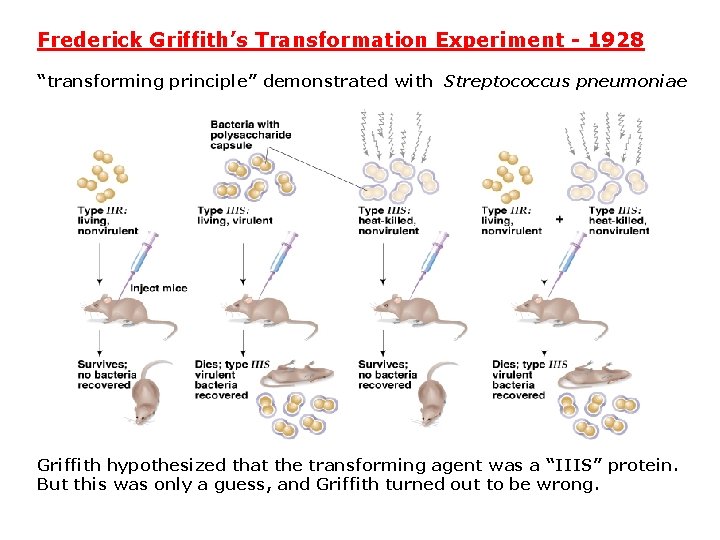
Frederick Griffith’s Transformation Experiment - 1928 “transforming principle” demonstrated with Streptococcus pneumoniae Griffith hypothesized that the transforming agent was a “IIIS” protein. But this was only a guess, and Griffith turned out to be wrong.
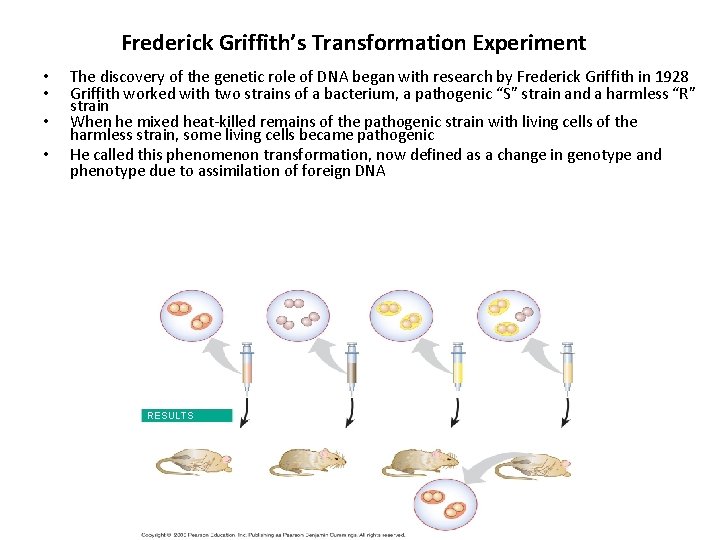
Frederick Griffith’s Transformation Experiment • • The discovery of the genetic role of DNA began with research by Frederick Griffith in 1928 Griffith worked with two strains of a bacterium, a pathogenic “S” strain and a harmless “R” strain When he mixed heat-killed remains of the pathogenic strain with living cells of the harmless strain, some living cells became pathogenic He called this phenomenon transformation, now defined as a change in genotype and phenotype due to assimilation of foreign DNA Living S cells (control) Living R cells (control) Heat-killed S cells (control) Mixture of heat-killed S cells and living R cells RESULTS Mouse dies Mouse healthy Mouse dies Living S cells are found in blood sample
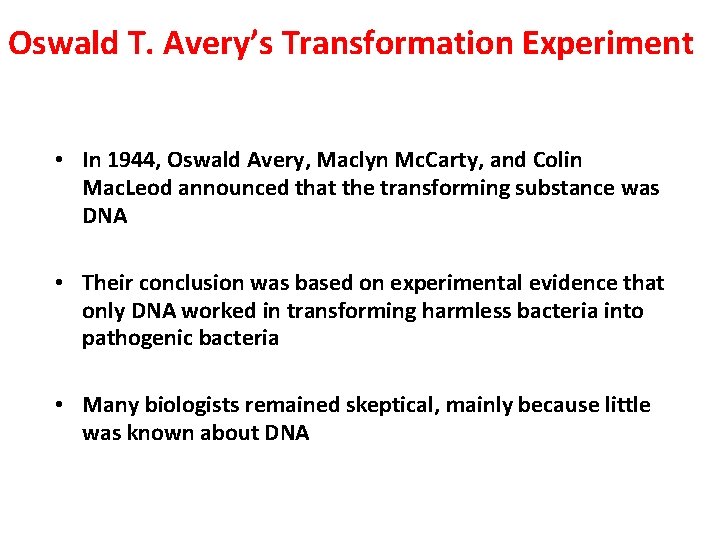
Oswald T. Avery’s Transformation Experiment • In 1944, Oswald Avery, Maclyn Mc. Carty, and Colin Mac. Leod announced that the transforming substance was DNA • Their conclusion was based on experimental evidence that only DNA worked in transforming harmless bacteria into pathogenic bacteria • Many biologists remained skeptical, mainly because little was known about DNA
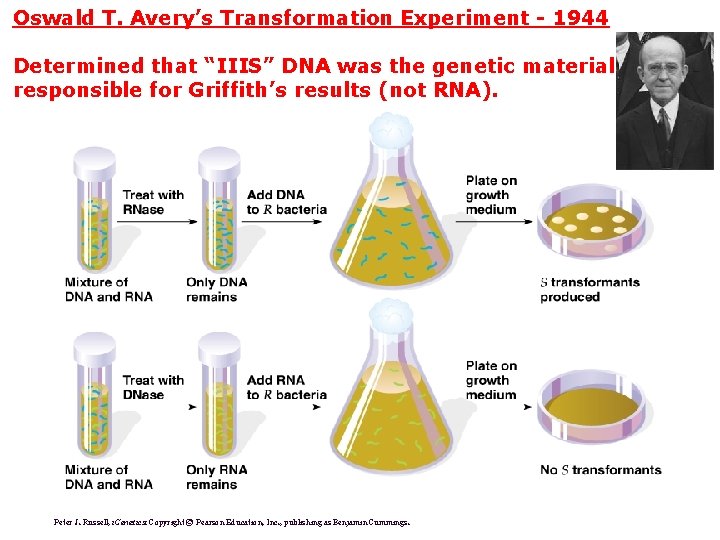
Oswald T. Avery’s Transformation Experiment - 1944 Determined that “IIIS” DNA was the genetic material responsible for Griffith’s results (not RNA). Peter J. Russell, i. Genetics: Copyright © Pearson Education, Inc. , publishing as Benjamin Cummings.
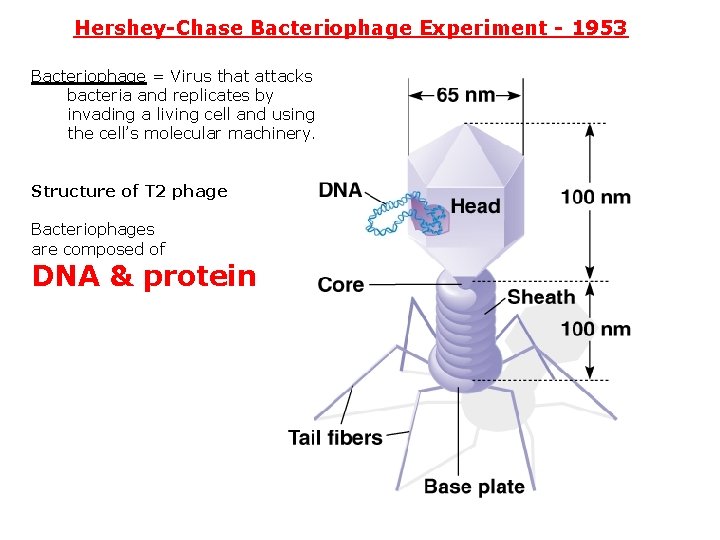
Hershey-Chase Bacteriophage Experiment - 1953 Bacteriophage = Virus that attacks bacteria and replicates by invading a living cell and using the cell’s molecular machinery. Structure of T 2 phage Bacteriophages are composed of DNA & protein
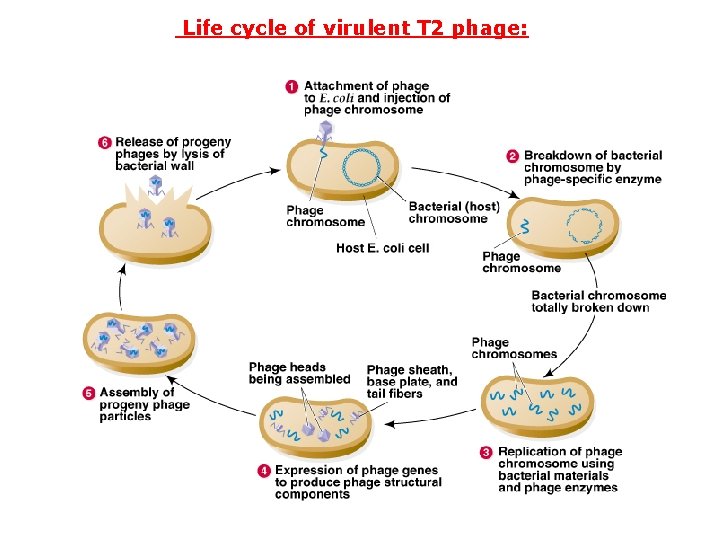
Life cycle of virulent T 2 phage:
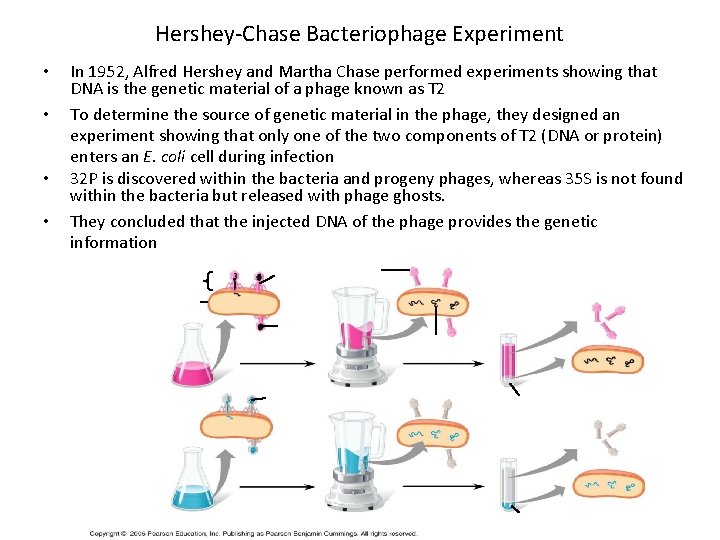
Hershey-Chase Bacteriophage Experiment • • In 1952, Alfred Hershey and Martha Chase performed experiments showing that DNA is the genetic material of a phage known as T 2 To determine the source of genetic material in the phage, they designed an experiment showing that only one of the two components of T 2 (DNA or protein) enters an E. coli cell during infection 32 P is discovered within the bacteria and progeny phages, whereas 35 S is not found within the bacteria but released with phage ghosts. They concluded that the injected DNA of the phage provides the genetic information Phage Radioactive protein Empty protein shell Radioactivity (phage protein) in liquid Bacterial cell Batch 1: Sulfur (35 S) DNA Phage DNA Centrifuge Pellet (bacterial cells and contents) Radioactive DNA Batch 2: Phosphorus (32 P) Centrifuge Pellet Radioactivity (phage DNA) in pellet
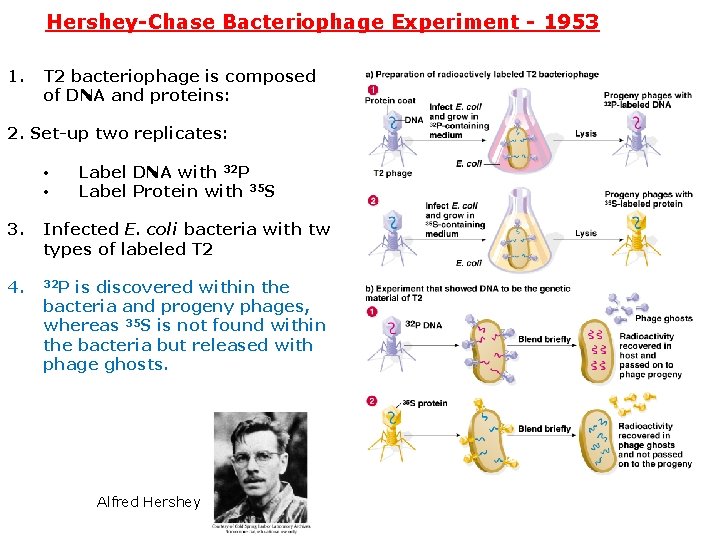
Hershey-Chase Bacteriophage Experiment - 1953 1. T 2 bacteriophage is composed of DNA and proteins: 2. Set-up two replicates: • • Label DNA with 32 P Label Protein with 35 S 3. Infected E. coli bacteria with two types of labeled T 2 4. 32 P is discovered within the bacteria and progeny phages, whereas 35 S is not found within the bacteria but released with phage ghosts. Alfred Hershey
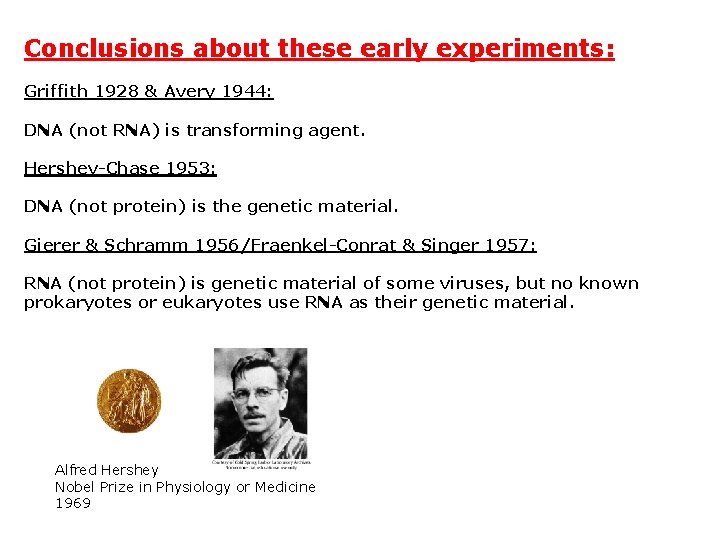
Conclusions about these early experiments: Griffith 1928 & Avery 1944: DNA (not RNA) is transforming agent. Hershey-Chase 1953: DNA (not protein) is the genetic material. Gierer & Schramm 1956/Fraenkel-Conrat & Singer 1957: RNA (not protein) is genetic material of some viruses, but no known prokaryotes or eukaryotes use RNA as their genetic material. Alfred Hershey Nobel Prize in Physiology or Medicine 1969
Additional Evidence That DNA Is the Genetic Material • In 1947, Erwin Chargaff reported that DNA composition varies from one species to the next • This evidence of diversity made DNA a more credible candidate for the genetic material • By the 1950 s, it was already known that DNA is a polymer of nucleotides, each consisting of a nitrogenous base, a sugar, and a phosphate group • Franklin’s X-ray crystallographic images of DNA enabled Watson to deduce that DNA was helical • The X-ray images also enabled Watson to deduce the width of the helix and the spacing of the nitrogenous bases
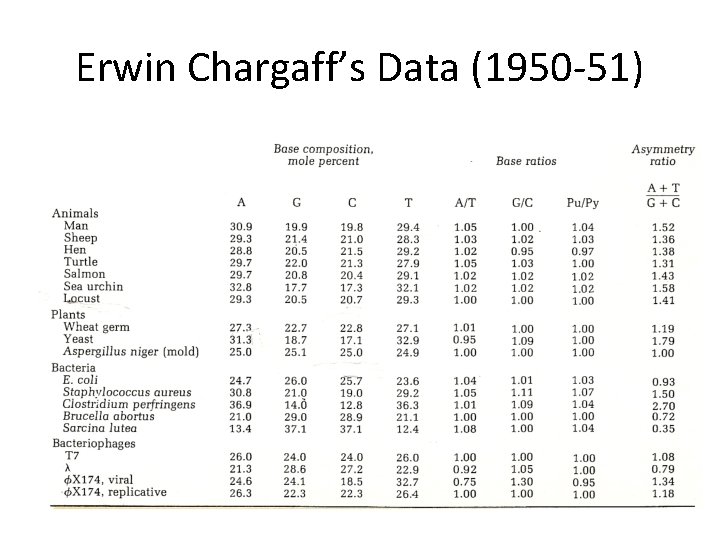
Erwin Chargaff’s Data (1950 -51)
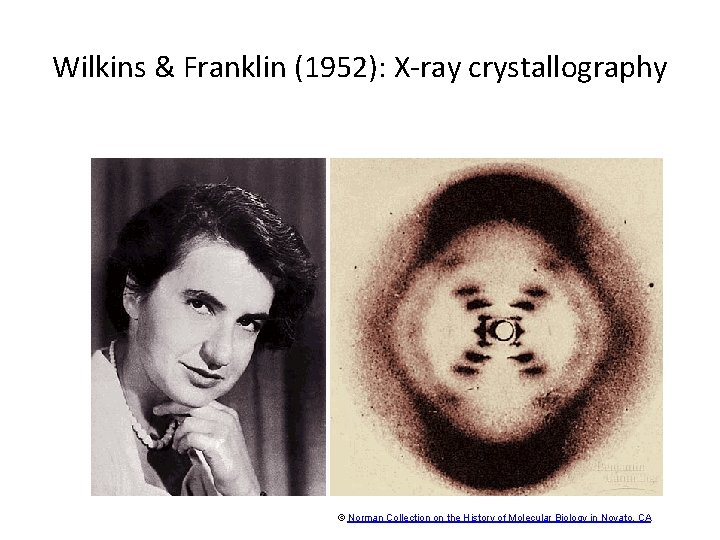
Wilkins & Franklin (1952): X-ray crystallography © Norman Collection on the History of Molecular Biology in Novato, CA
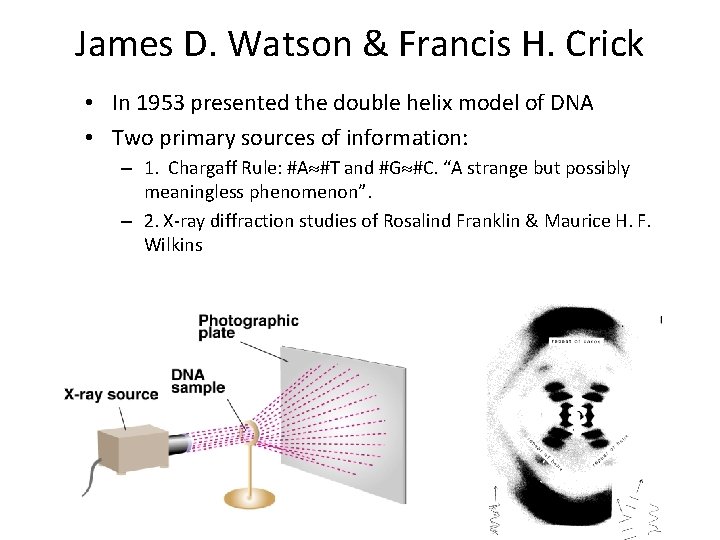
James D. Watson & Francis H. Crick • In 1953 presented the double helix model of DNA • Two primary sources of information: – 1. Chargaff Rule: #A #T and #G #C. “A strange but possibly meaningless phenomenon”. – 2. X-ray diffraction studies of Rosalind Franklin & Maurice H. F. Wilkins
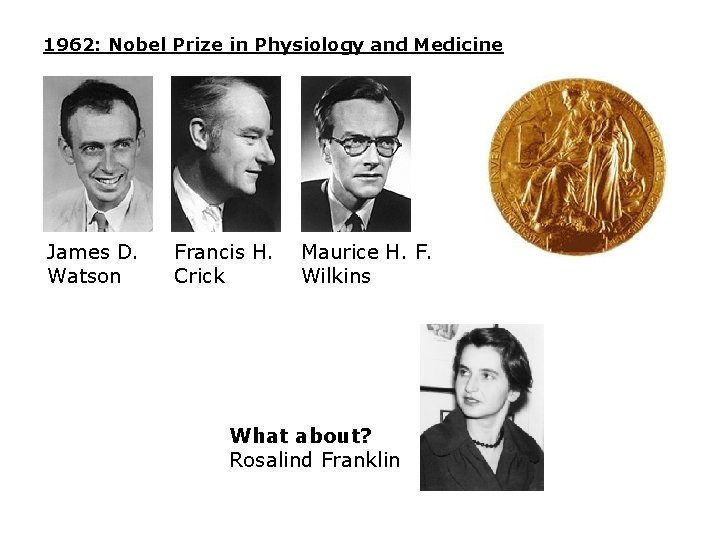
1962: Nobel Prize in Physiology and Medicine James D. Watson Francis H. Crick Maurice H. F. Wilkins What about? Rosalind Franklin
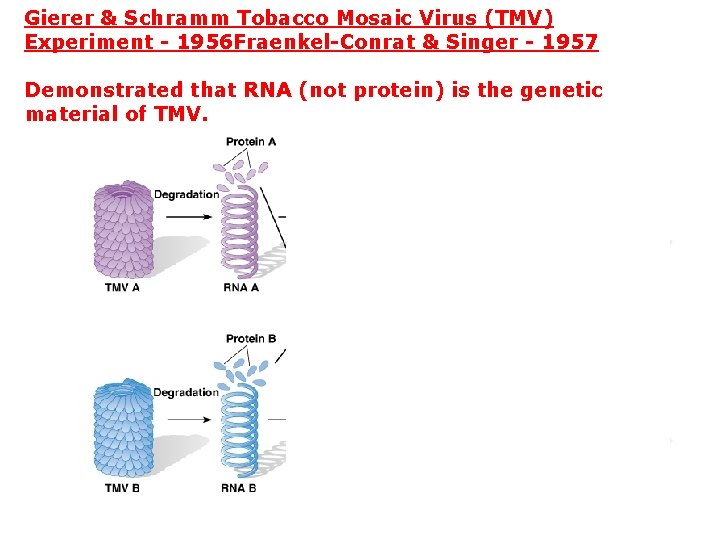
Gierer & Schramm Tobacco Mosaic Virus (TMV) Experiment - 1956 Fraenkel-Conrat & Singer - 1957 Demonstrated that RNA (not protein) is the genetic material of TMV.
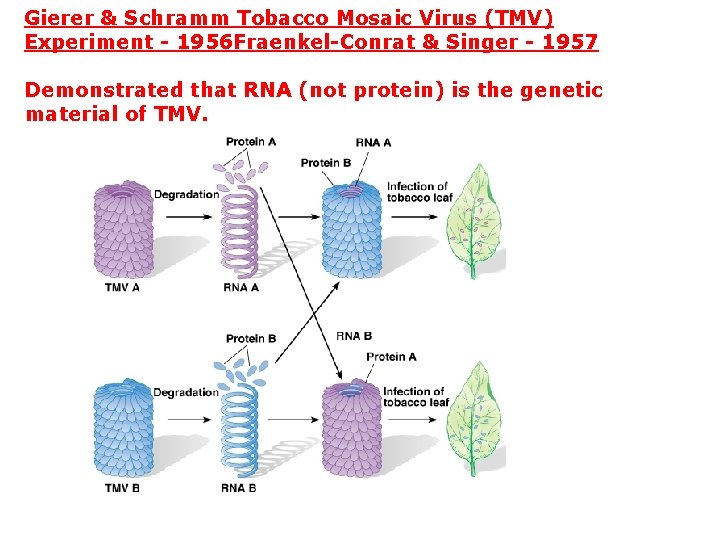
Gierer & Schramm Tobacco Mosaic Virus (TMV) Experiment - 1956 Fraenkel-Conrat & Singer - 1957 Demonstrated that RNA (not protein) is the genetic material of TMV.
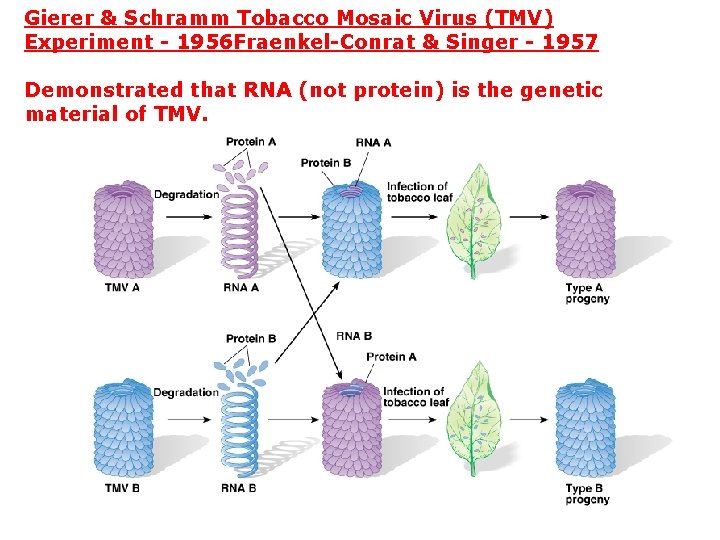
Gierer & Schramm Tobacco Mosaic Virus (TMV) Experiment - 1956 Fraenkel-Conrat & Singer - 1957 Demonstrated that RNA (not protein) is the genetic material of TMV.
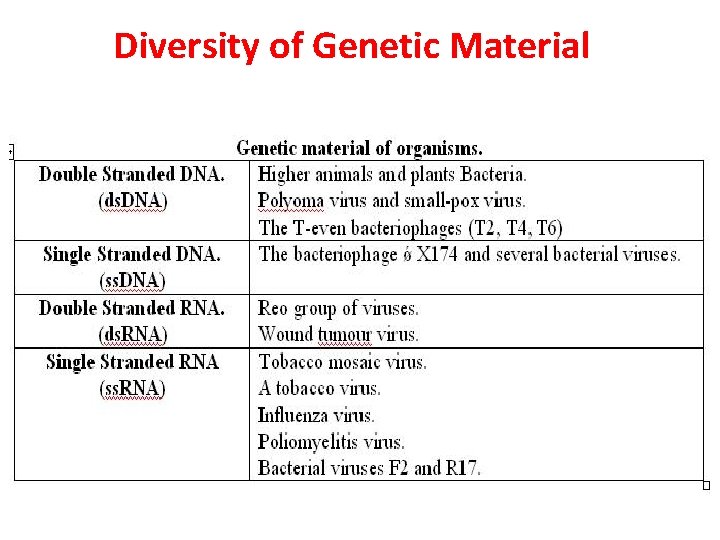
Diversity of Genetic Material
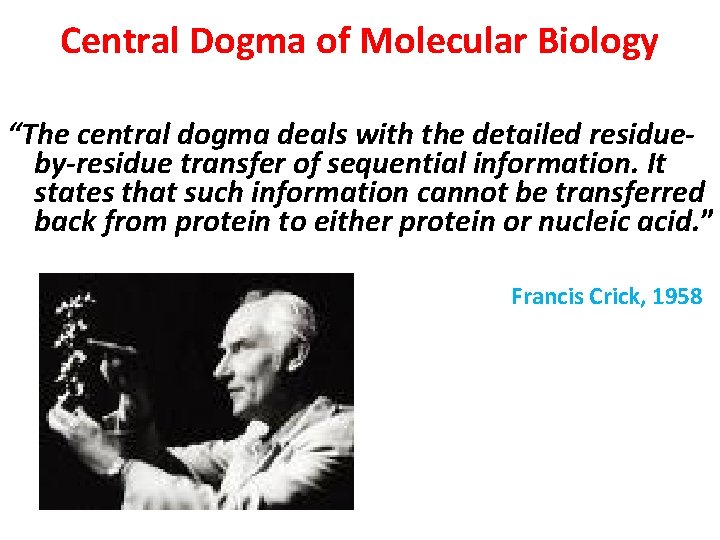
Central Dogma of Molecular Biology “The central dogma deals with the detailed residueby-residue transfer of sequential information. It states that such information cannot be transferred back from protein to either protein or nucleic acid. ” Francis Crick, 1958
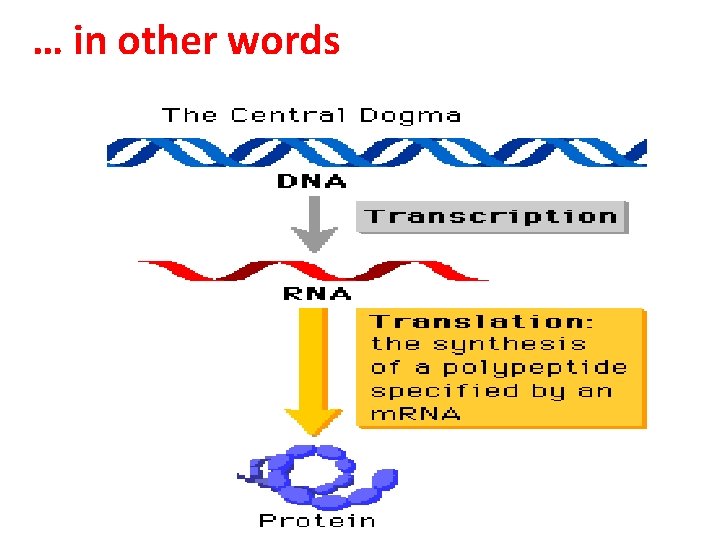
… in other words • Protein information cannot flow back to nucleic acids • Fundamental framework to understanding the transfer of sequence information between biopolymers
Thank You
- Slides: 26