
Basic Concepts of Epidemiology Part 1 Nina Gunnes
Basic Concepts of Epidemiology – Part 1 Nina Gunnes August 27, 2020 8/27/2020 Lecture 1 - Fall 2020 1

What is epidemiology? • “Epidemiology is the study and analysis of the distribution (who, when, and where), patterns and determinants of health and disease conditions in defined populations. ” https: //en. wikipedia. org/wiki/Epidemiology • Study of diseases and other health outcomes • Occurrence and distribution • Course of disease • Risk factors and causes • The five Ws: who, what, when, where, and why? 8/27/2020 Lecture 1 - Fall 2020 2
What is epidemiology? , cont. • Not restricted to infectious diseases and epidemics • Epidemiological data forming the basis of several activities • Public health policy • Disease prevention • Clinical work • Relatively young science • However, origin dating back several centuries 8/27/2020 Lecture 1 - Fall 2020 3

Modern epidemiology • Dated back to the mid-20 th century • Increased occurrences of cardiovascular diseases and cancer • Development of new designs and analytical methods • Study of diseases influenced by several factors over a long period of time • Mainly observational studies • Experimental studies not always ethical (e. g. , influence of tobacco or alcohol) 8/27/2020 Lecture 1 - Fall 2020 4
Important contributions • John Graunt in the 17 th century • Introducing quantitative methods in epidemiology • Analyzing mortality in London • Pioneering work on the construction of lifetime tables • William Farr in the 19 th century • Responsible for health statistics in England Wales • Systematic collection and analysis of population data • Providing new insight into the population’s health and diseases 8/27/2020 Lecture 1 - Fall 2020 5
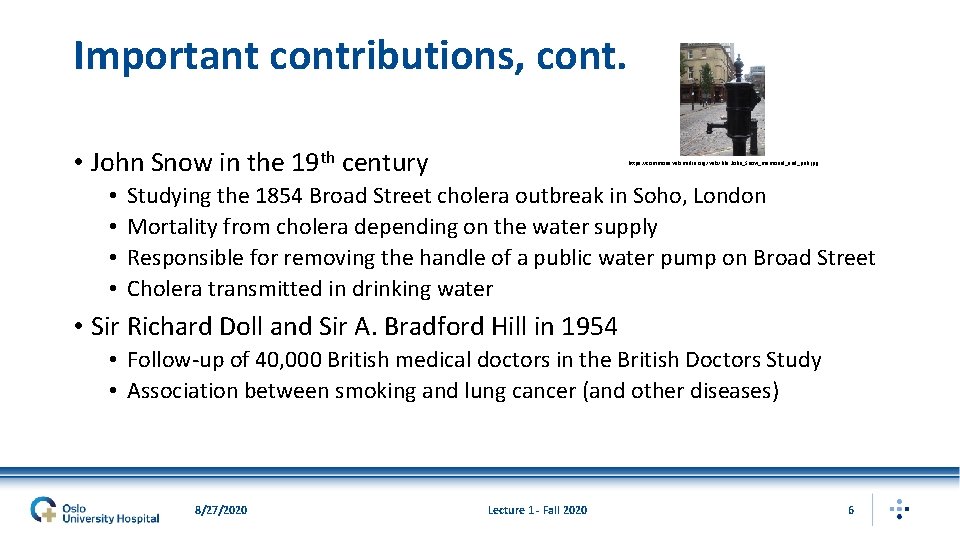
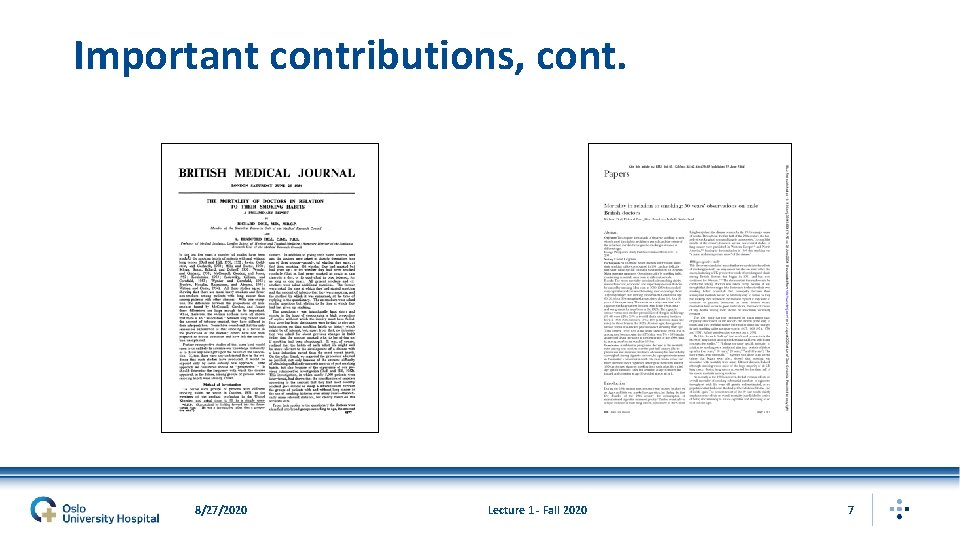
Important contributions, cont. • John Snow in the 19 th century • • https: //commons. wikimedia. org/wiki/File: John_Snow_memorial_and_pub. jpg Studying the 1854 Broad Street cholera outbreak in Soho, London Mortality from cholera depending on the water supply Responsible for removing the handle of a public water pump on Broad Street Cholera transmitted in drinking water • Sir Richard Doll and Sir A. Bradford Hill in 1954 • Follow-up of 40, 000 British medical doctors in the British Doctors Study • Association between smoking and lung cancer (and other diseases) 8/27/2020 Lecture 1 - Fall 2020 6
Important contributions, cont. 8/27/2020 Lecture 1 - Fall 2020 7
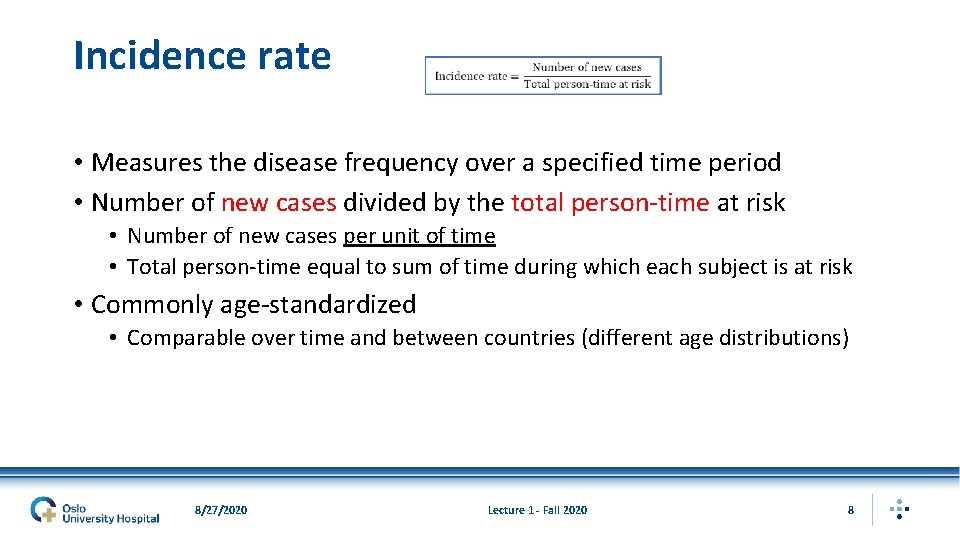
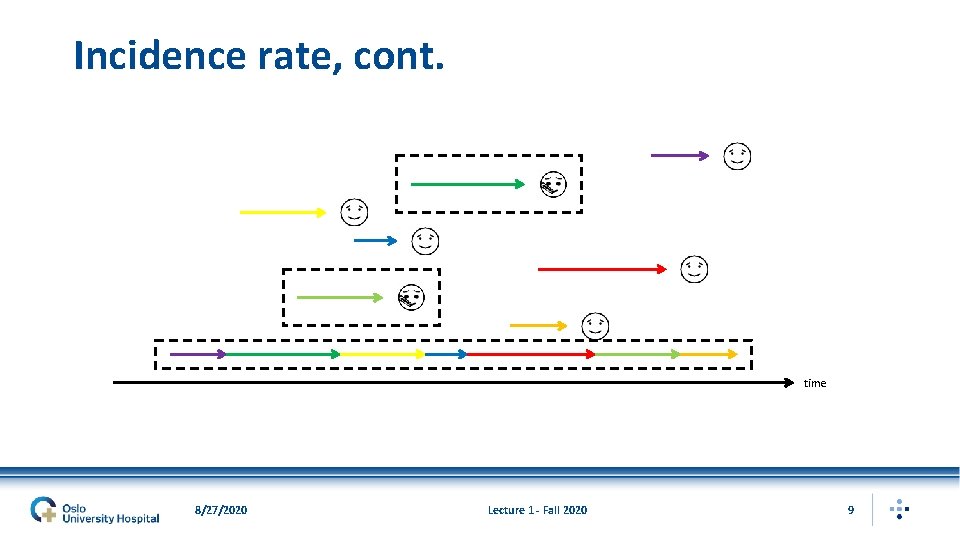
Incidence rate • Measures the disease frequency over a specified time period • Number of new cases divided by the total person-time at risk • Number of new cases per unit of time • Total person-time equal to sum of time during which each subject is at risk • Commonly age-standardized • Comparable over time and between countries (different age distributions) 8/27/2020 Lecture 1 - Fall 2020 8
Incidence rate, cont. time 8/27/2020 Lecture 1 - Fall 2020 9
Example 10. 1 in Aalen et al. (2006) • Incidence rate of malignant melanoma among women • Data from the Cancer Registry of Norway (www. kreftregisteret. no) • First time period: 1977– 1981 • Number of new cases of malignant melanoma: 1, 321 • Mean population of women (from Statistics Norway): 2, 053, 138 • Second time period: 1997– 2001 • Number of new cases of malignant melanoma: 2, 559 • Mean population of women (from Statistics Norway): 2, 252, 622 8/27/2020 Lecture 1 - Fall 2020 10
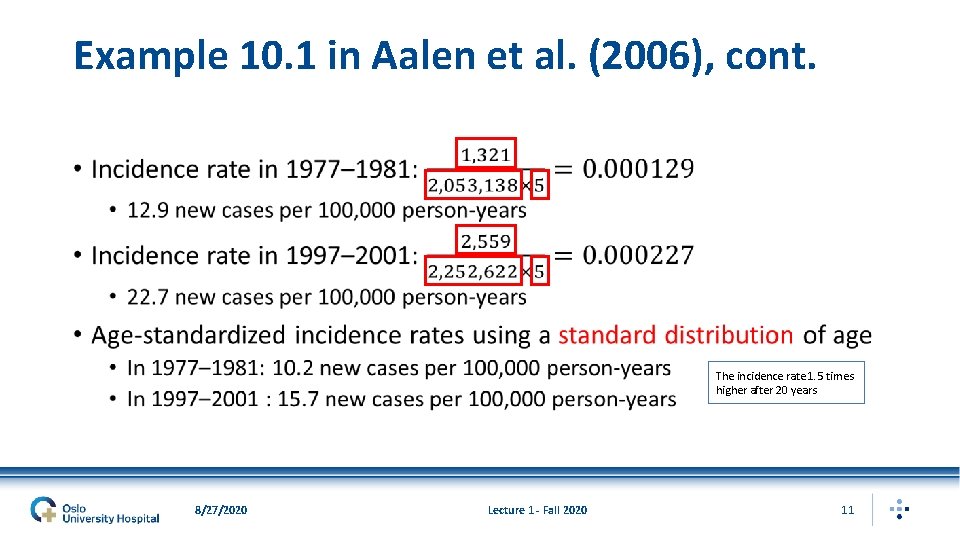
Example 10. 1 in Aalen et al. (2006), cont. • The incidence rate 1. 5 times higher after 20 years 8/27/2020 Lecture 1 - Fall 2020 11
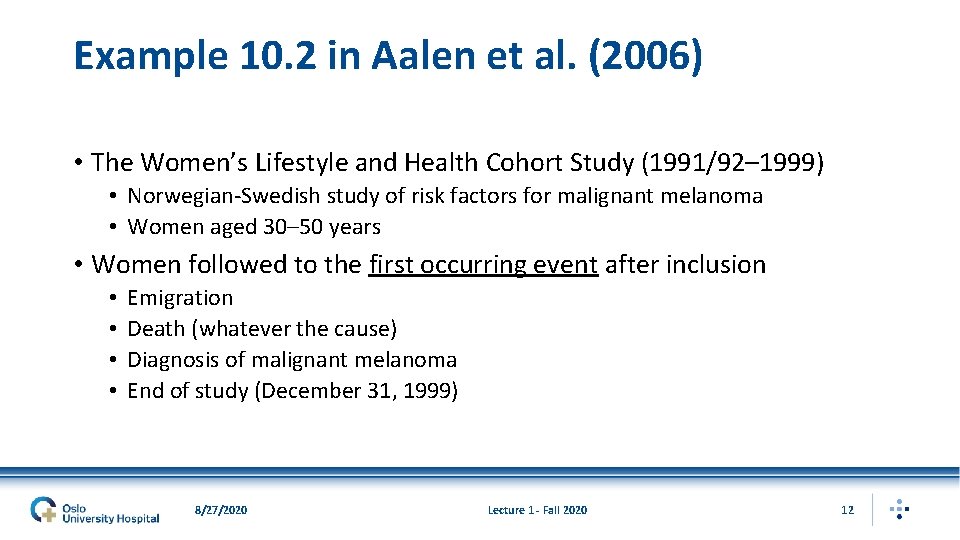
Example 10. 2 in Aalen et al. (2006) • The Women’s Lifestyle and Health Cohort Study (1991/92– 1999) • Norwegian-Swedish study of risk factors for malignant melanoma • Women aged 30– 50 years • Women followed to the first occurring event after inclusion • • Emigration Death (whatever the cause) Diagnosis of malignant melanoma End of study (December 31, 1999) 8/27/2020 Lecture 1 - Fall 2020 12
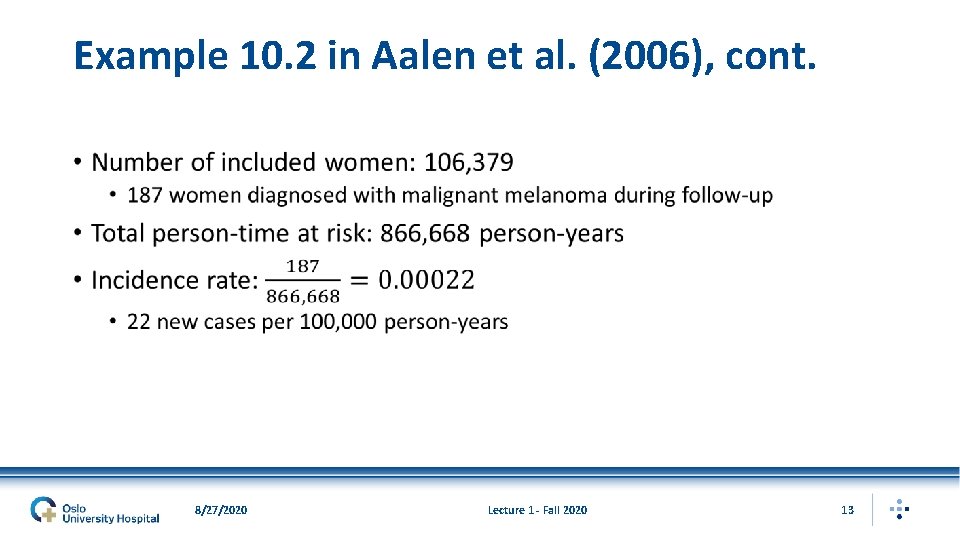
Example 10. 2 in Aalen et al. (2006), cont. • 8/27/2020 Lecture 1 - Fall 2020 13
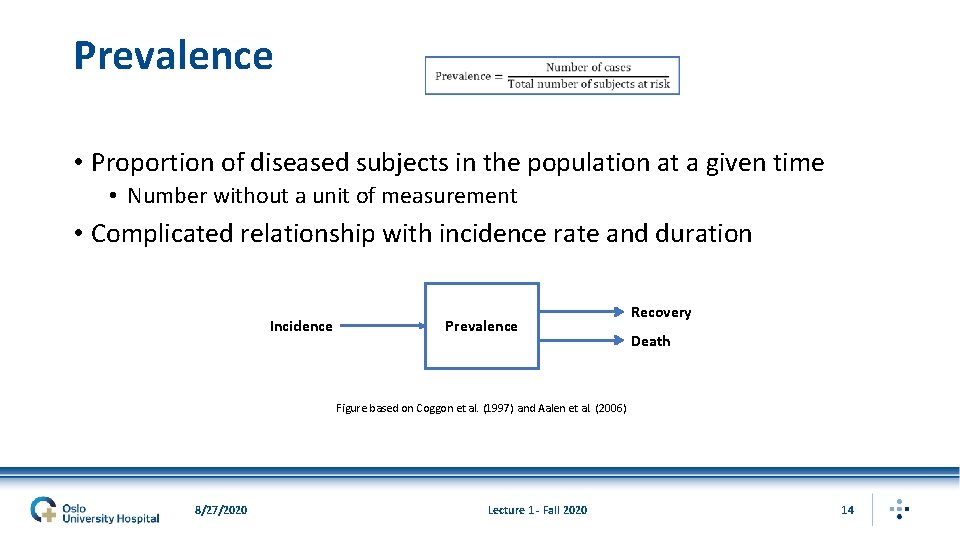
Prevalence • Proportion of diseased subjects in the population at a given time • Number without a unit of measurement • Complicated relationship with incidence rate and duration Incidence Prevalence Recovery Death Figure based on Coggon et al. (1997) and Aalen et al. (2006) 8/27/2020 Lecture 1 - Fall 2020 14
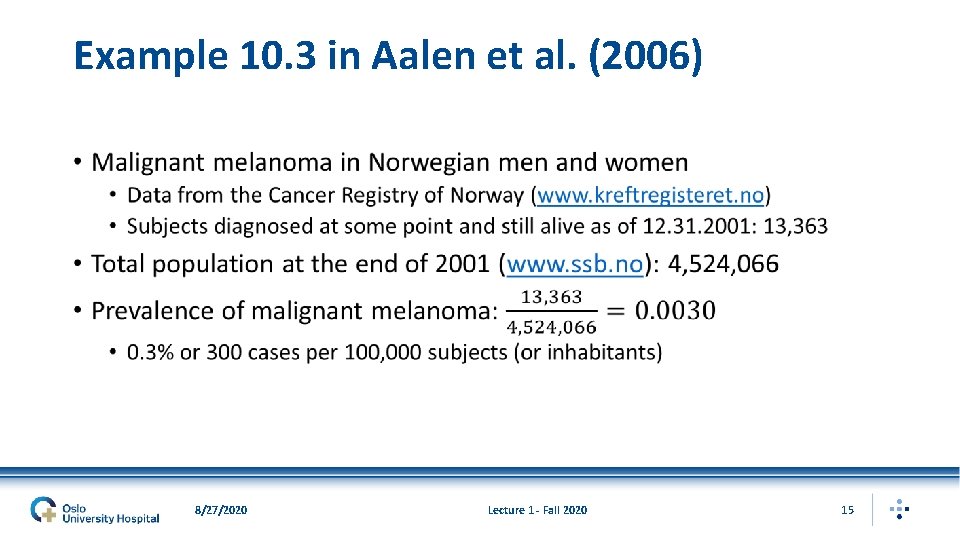
Example 10. 3 in Aalen et al. (2006) • 8/27/2020 Lecture 1 - Fall 2020 15
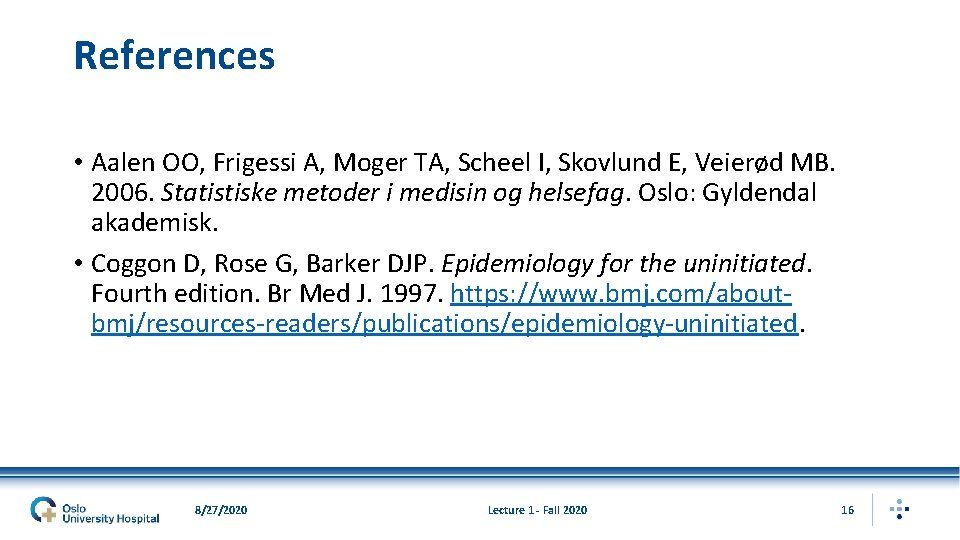
References • Aalen OO, Frigessi A, Moger TA, Scheel I, Skovlund E, Veierød MB. 2006. Statistiske metoder i medisin og helsefag. Oslo: Gyldendal akademisk. • Coggon D, Rose G, Barker DJP. Epidemiology for the uninitiated. Fourth edition. Br Med J. 1997. https: //www. bmj. com/aboutbmj/resources-readers/publications/epidemiology-uninitiated. 8/27/2020 Lecture 1 - Fall 2020 16
- Slides: 16