
Basic Concepts of Charged Particle Detection Part 2
Basic Concepts of Charged Particle Detection: Part 2 David Futyan Charged Particle Detection 2 1

Overview Lecture 1: Concepts of particle detection: what can we detect? Basic design of particle detectors Energy loss of charged particles in matter: Bethe Bloch formula Lecture 2: Energy loss through Bremsstrahlung radiation (electrons) Momentum measurement in a magnetic field Multiple Coulomb scattering - effect on momentum resolution Interaction of photons David Futyan Charged Particle Detection 2 2
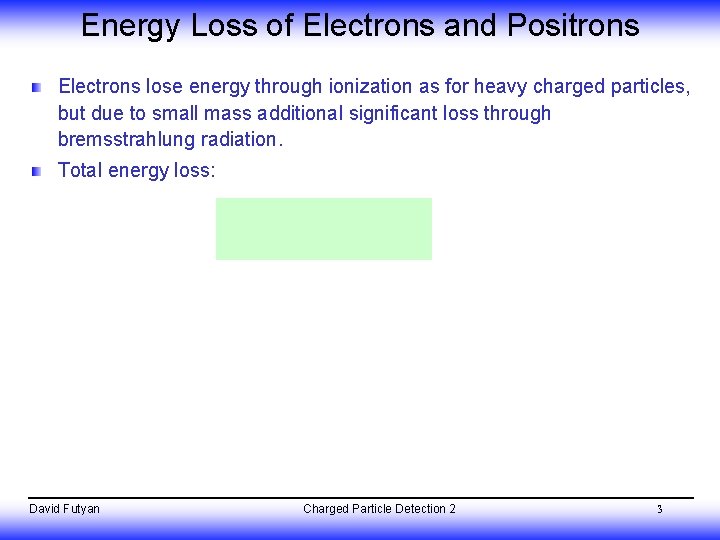
Energy Loss of Electrons and Positrons Electrons lose energy through ionization as for heavy charged particles, but due to small mass additional significant loss through bremsstrahlung radiation. Total energy loss: David Futyan Charged Particle Detection 2 3
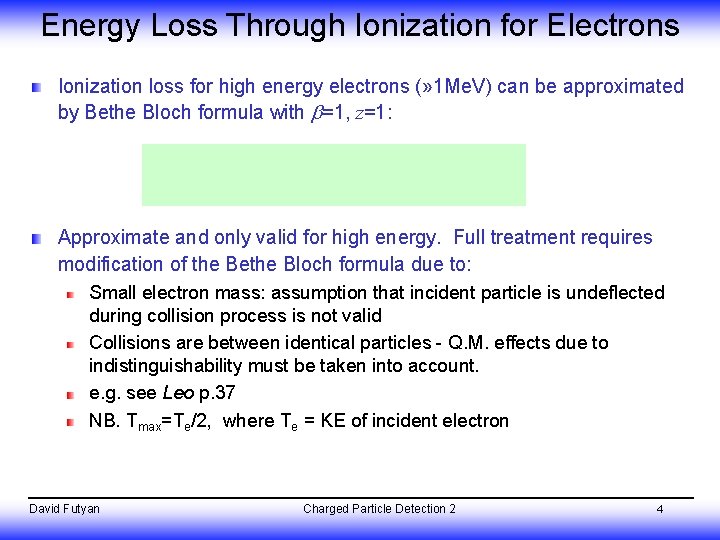
Energy Loss Through Ionization for Electrons Ionization loss for high energy electrons (» 1 Me. V) can be approximated by Bethe Bloch formula with =1, z=1: Approximate and only valid for high energy. Full treatment requires modification of the Bethe Bloch formula due to: Small electron mass: assumption that incident particle is undeflected during collision process is not valid Collisions are between identical particles - Q. M. effects due to indistinguishability must be taken into account. e. g. see Leo p. 37 NB. Tmax=Te/2, where Te = KE of incident electron David Futyan Charged Particle Detection 2 4

Bremsstrahlung Radiation Emission of e. m. radiation arising from scattering in the E field of a nucleus in the absorber medium. Classically, can be seen as radiation due to acceleration of e+ or e- due to electrical attraction to a nucleus. Radiative energy loss dominates for electrons for E > few 10 s of Me. V. David Futyan Charged Particle Detection 2 5
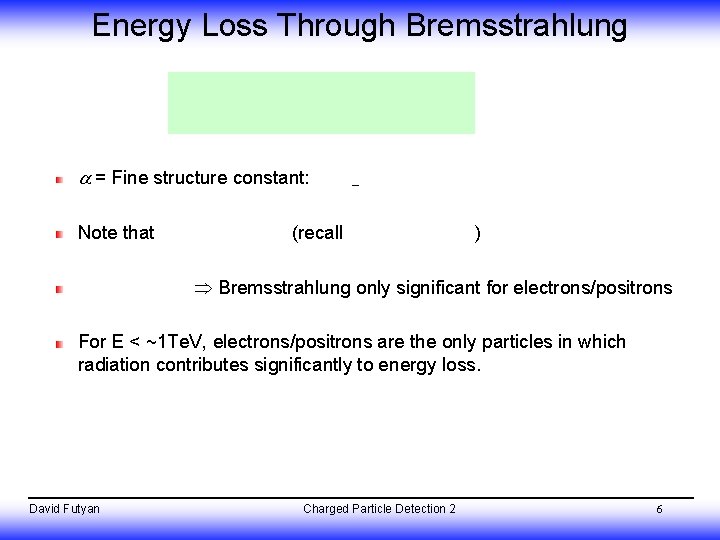
Energy Loss Through Bremsstrahlung = Fine structure constant: Note that (recall ) Bremsstrahlung only significant for electrons/positrons For E < ~1 Te. V, electrons/positrons are the only particles in which radiation contributes significantly to energy loss. David Futyan Charged Particle Detection 2 6

Radiation Length Define Radiation Length, X 0: where Units of X 0: g cm-2 Divide by density to get X 0 in cm Radiation length is the mean distance over which a high-energy electron loses all but 1/e of its energy by bremsstrahlung. e. g. Pb: Z=82, A=207, =11. 4 g/cm 3: X 0 ≈ 5. 9 g/cm 2 Mean penetration distance: x = X 0/ = 5. 9/11. 4 = 5. 2 mm David Futyan Charged Particle Detection 2 7
Comparison with Energy Loss Through Ionization Compare: Rapid rise of radiation loss with electron energy Almost all energy of electron can be radiated in one or two photons! In contrast ionization loss quasi-continuous along path of particle. David Futyan Charged Particle Detection 2 8
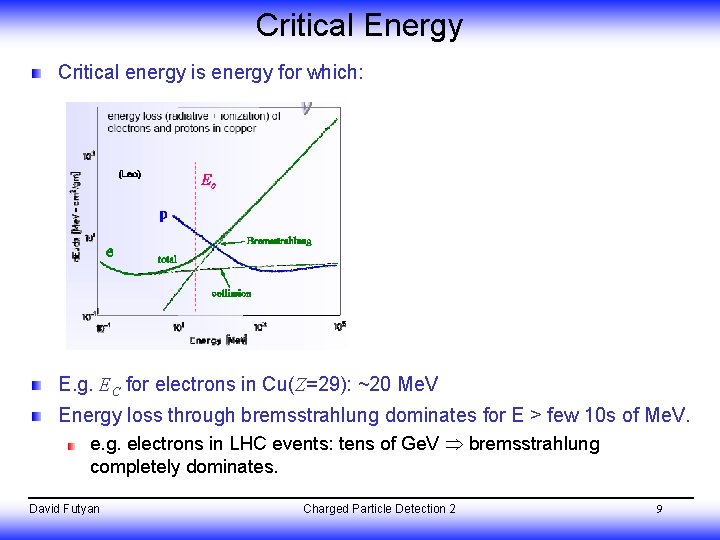
Critical Energy Critical energy is energy for which: E. g. EC for electrons in Cu(Z=29): ~20 Me. V Energy loss through bremsstrahlung dominates for E > few 10 s of Me. V. e. g. electrons in LHC events: tens of Ge. V bremsstrahlung completely dominates. David Futyan Charged Particle Detection 2 9
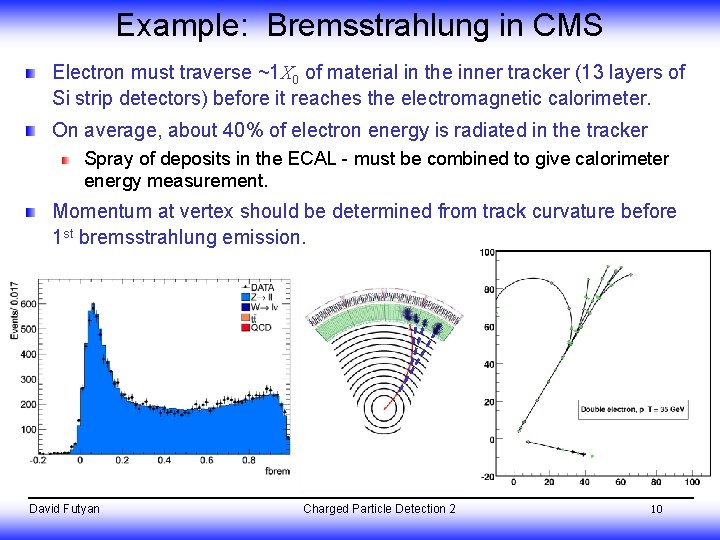
Example: Bremsstrahlung in CMS Electron must traverse ~1 X 0 of material in the inner tracker (13 layers of Si strip detectors) before it reaches the electromagnetic calorimeter. On average, about 40% of electron energy is radiated in the tracker Spray of deposits in the ECAL - must be combined to give calorimeter energy measurement. Momentum at vertex should be determined from track curvature before 1 st bremsstrahlung emission. David Futyan Charged Particle Detection 2 10
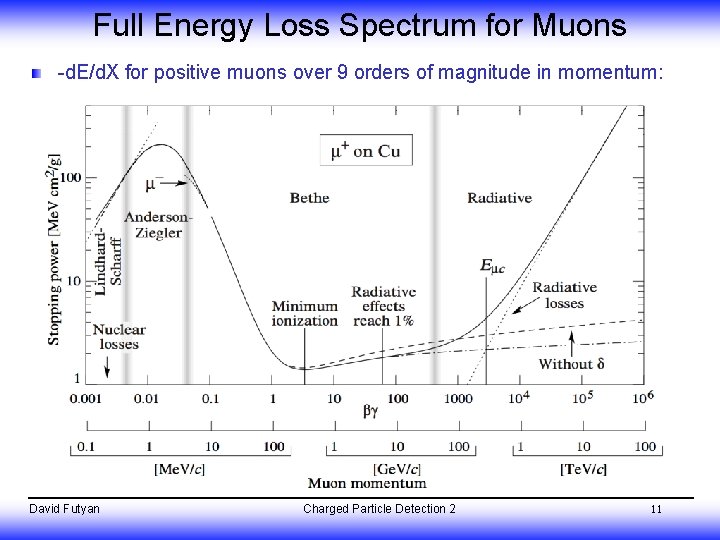
Full Energy Loss Spectrum for Muons -d. E/d. X for positive muons over 9 orders of magnitude in momentum: David Futyan Charged Particle Detection 2 11
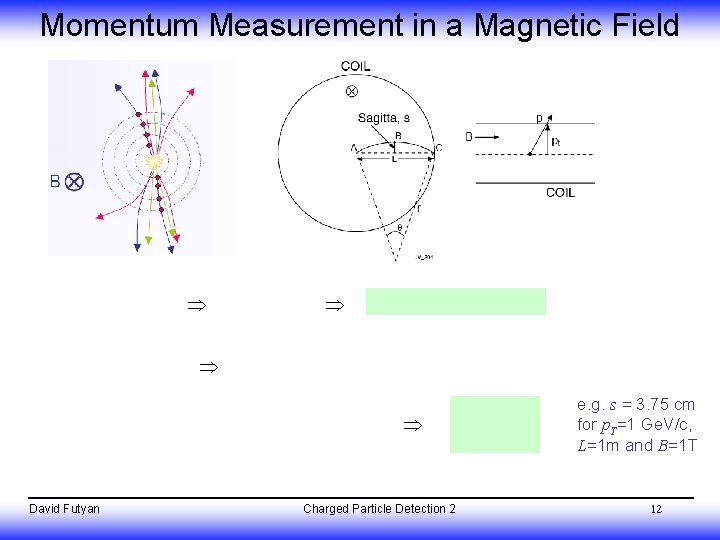
Momentum Measurement in a Magnetic Field David Futyan Charged Particle Detection 2 e. g. s = 3. 75 cm for p. T=1 Ge. V/c, L=1 m and B=1 T 12

Momentum Measurement Error Determination of sagitta from 3 measurements: x 2 1 s 3 Momentum resolution: Momentum resolution degrades linearly with increasing momentum, and improves quadratically with the radial size of tracking cavity. For N equidistant measurements, one obtains (R. L. Gluckstern, NIM 24 (1963) 381): e. g. (p. T)/p. T = 0. 5% for p. T=1 Ge. V/c, L=1 m, B=1 T, x = 200 m and N=10 David Futyan Charged Particle Detection 2 13
Multiple Coulomb Scattering In addition to inelastic collisions with atomic electrons (i. e. ionization Bethe Bloch), charged particles passing through matter also suffer repeated elastic Coulomb scattering from nuclei. Elastic Coulomb scattering produces a change in the particle direction without any significant energy loss. Change in direction caused by multiple Coulomb scattering degrades the momentum measurement. David Futyan Charged Particle Detection 2 14
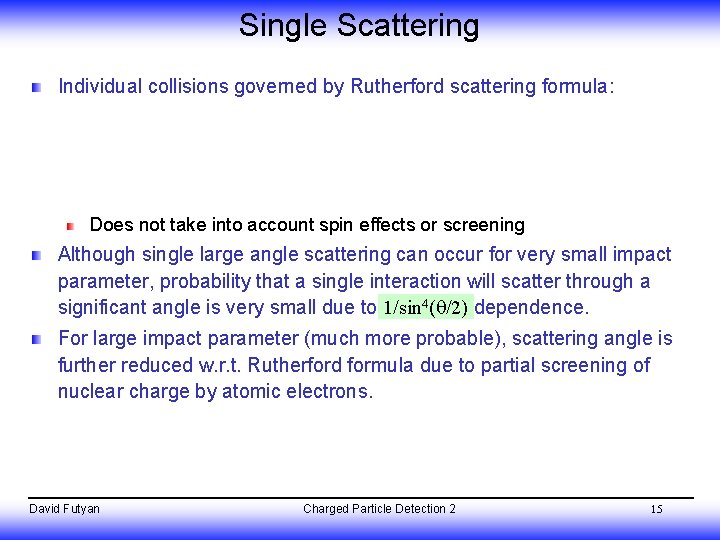
Single Scattering Individual collisions governed by Rutherford scattering formula: Does not take into account spin effects or screening Although single large angle scattering can occur for very small impact parameter, probability that a single interaction will scatter through a significant angle is very small due to 1/sin 4( /2) dependence. For large impact parameter (much more probable), scattering angle is further reduced w. r. t. Rutherford formula due to partial screening of nuclear charge by atomic electrons. David Futyan Charged Particle Detection 2 15

Multiple Coulomb Scattering As a particle passes through a thickness of material, combination of a very large number of small deflections results in a significant net deviation - multiple coulomb scattering Small contributions combine randomly to give a Gaussian probability distribution: where Plane of incident particle ( to B field) (Gaussian) plane is projection of true space scattering angle onto plane of incident particle. plane David Futyan Charged Particle Detection 2 16
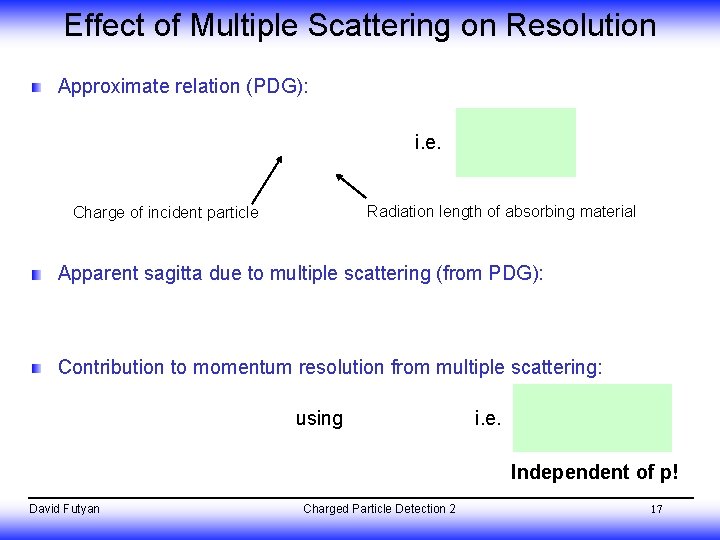
Effect of Multiple Scattering on Resolution Approximate relation (PDG): i. e. Radiation length of absorbing material Charge of incident particle Apparent sagitta due to multiple scattering (from PDG): Contribution to momentum resolution from multiple scattering: using i. e. Independent of p! David Futyan Charged Particle Detection 2 17

Effect of Multiple Scattering on Resolution Estimated Momentum Resolution vs p. T in CMS Example: p. T = 1 Ge. V/c, L = 1 m, B = 1 T, = 10, x = 200 m: N For detector filled with Ar, X 0 = 110 m: David Futyan Charged Particle Detection 2 18
Momentum Measurement Summary Tracking detector design: High B field. e. g. CMS: 4 Tesla Large size e. g. CMS tracker radius = 1. 2 m Low Z, low mass material. Gaseous detectors frequently chosen e. g. ATLAS Ar (91% of gas mixture) X 0=110 m David Futyan Charged Particle Detection 2 19
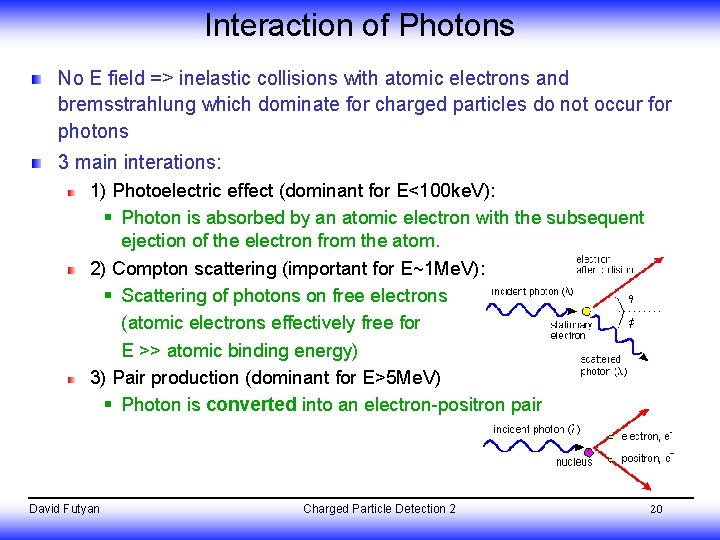
Interaction of Photons No E field => inelastic collisions with atomic electrons and bremsstrahlung which dominate for charged particles do not occur for photons 3 main interations: 1) Photoelectric effect (dominant for E<100 ke. V): § Photon is absorbed by an atomic electron with the subsequent ejection of the electron from the atom. 2) Compton scattering (important for E~1 Me. V): § Scattering of photons on free electrons (atomic electrons effectively free for E >> atomic binding energy) 3) Pair production (dominant for E>5 Me. V) § Photon is converted into an electron-positron pair David Futyan Charged Particle Detection 2 20
Interaction of Photons Result of these 3 interactions: 1) Photons (x-rays, -rays) much more penetrating in matter than charged particles § Cross-section for the 3 interactions much less than inelastic collision cross-section for charged particles 2) A beam of photons is not degraded in energy as it passes through a thickness of matter, only in intensity § The 3 processes remove the photon from the beam entirely (absorbed or scattered out). § Photons which pass straight through have suffered no interaction so retain their original energy, but no. of photons is reduced. Attenuation is exponential w. r. t. material thickness: Absorption coefficient David Futyan Charged Particle Detection 2 21
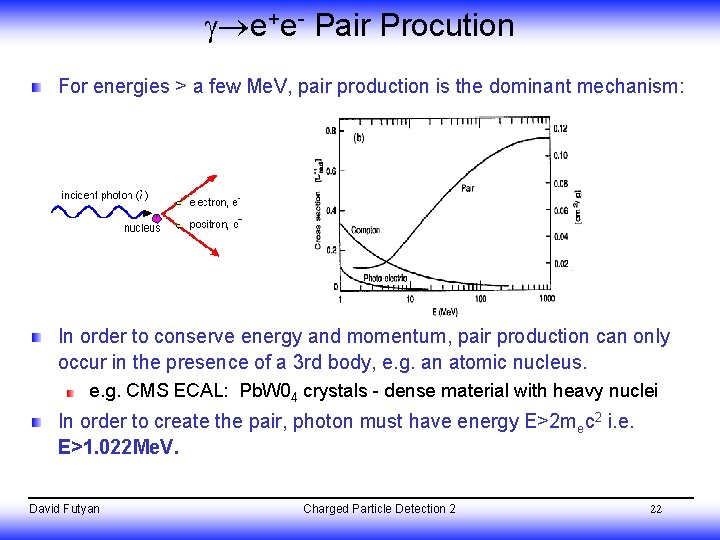
e+e- Pair Procution For energies > a few Me. V, pair production is the dominant mechanism: In order to conserve energy and momentum, pair production can only occur in the presence of a 3 rd body, e. g. an atomic nucleus. e. g. CMS ECAL: Pb. W 04 crystals - dense material with heavy nuclei In order to create the pair, photon must have energy E>2 mec 2 i. e. E>1. 022 Me. V. David Futyan Charged Particle Detection 2 22
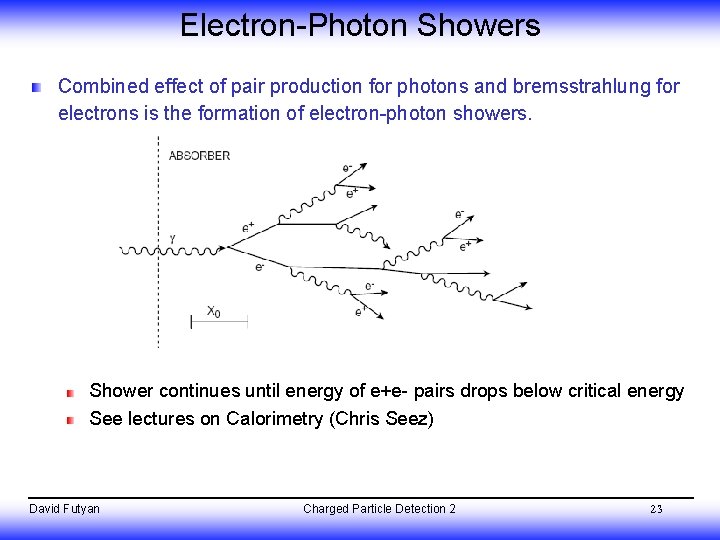
Electron-Photon Showers Combined effect of pair production for photons and bremsstrahlung for electrons is the formation of electron-photon showers. Shower continues until energy of e+e- pairs drops below critical energy See lectures on Calorimetry (Chris Seez) David Futyan Charged Particle Detection 2 23
- Slides: 23