
BASIC CONCEPTS OF BRAIN DEVELOPMENT Applications to Teaching

BASIC CONCEPTS OF BRAIN DEVELOPMENT Applications to Teaching Young Children
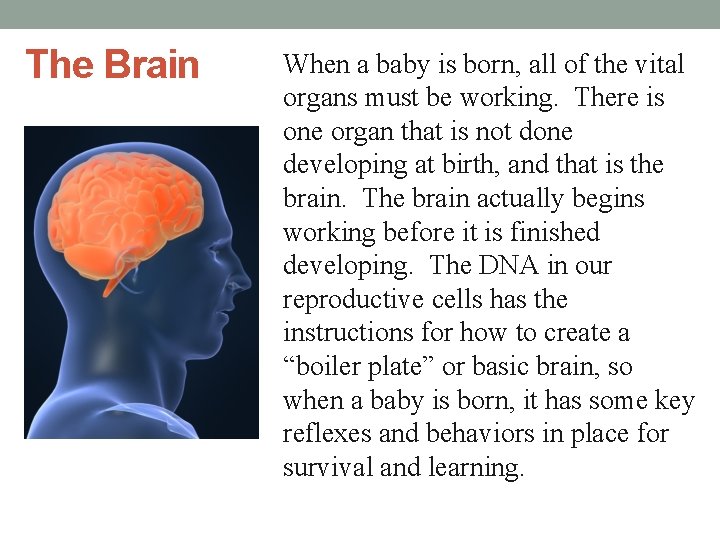
The Brain When a baby is born, all of the vital organs must be working. There is one organ that is not done developing at birth, and that is the brain. The brain actually begins working before it is finished developing. The DNA in our reproductive cells has the instructions for how to create a “boiler plate” or basic brain, so when a baby is born, it has some key reflexes and behaviors in place for survival and learning.

The Brain The brain actually takes 20 -25 years to finish developing. During this time, the brain finishes developing based on what this individual needs to know – the specific language and customs of their culture, the knowledge that is passed down through generations. Thus, when a baby is born, the brain has to figure out what it needs to know to survive, and it goes about learning these things from the very first moment.
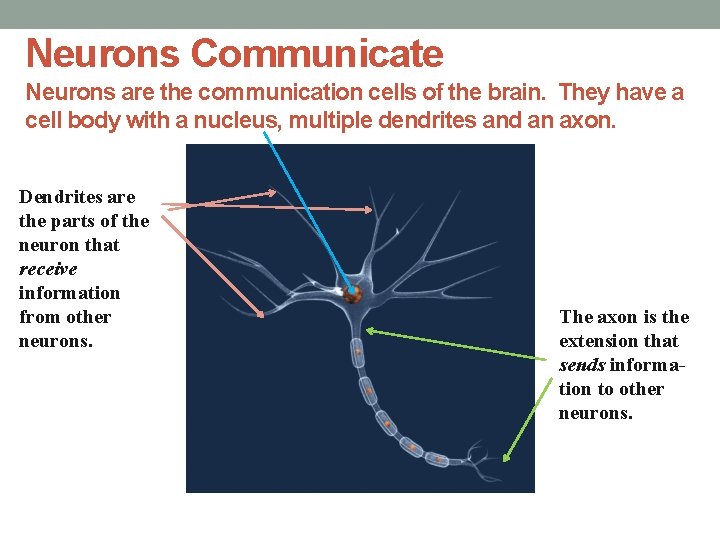
Neurons Communicate Neurons are the communication cells of the brain. They have a cell body with a nucleus, multiple dendrites and an axon. Dendrites are the parts of the neuron that receive information from other neurons. The axon is the extension that sends information to other neurons.
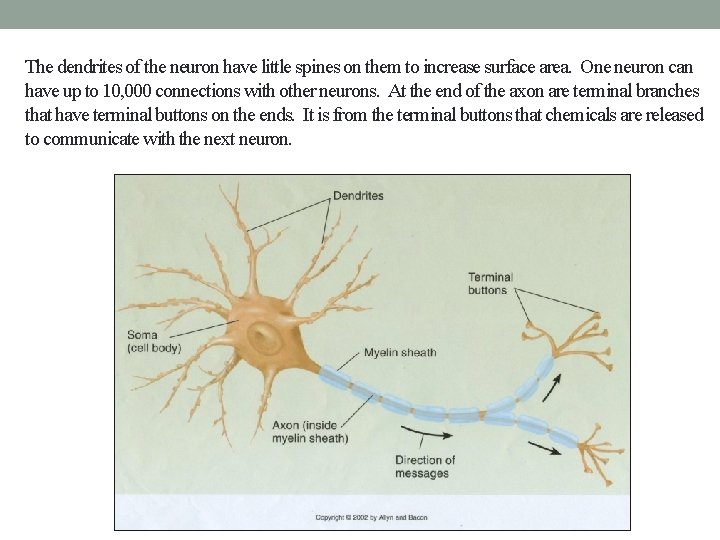
The dendrites of the neuron have little spines on them to increase surface area. One neuron can have up to 10, 000 connections with other neurons. At the end of the axon are terminal branches that have terminal buttons on the ends. It is from the terminal buttons that chemicals are released to communicate with the next neuron.

There is an electrical signal that travels from the neuron’s cell body down the axon and then to the terminal buttons where it stimulates the release of the chemical neurotransmitters. A substance called myelin insulates the axon of the neuron so that the signal travels faster down the axon. Myelin is composed of lipid or fat, and thus while the brain is actively myelinating during the first two years of life, babies should be given only “full fat” milk. Breast milk has the ideal ratio of fat to protein for this process of myelination.
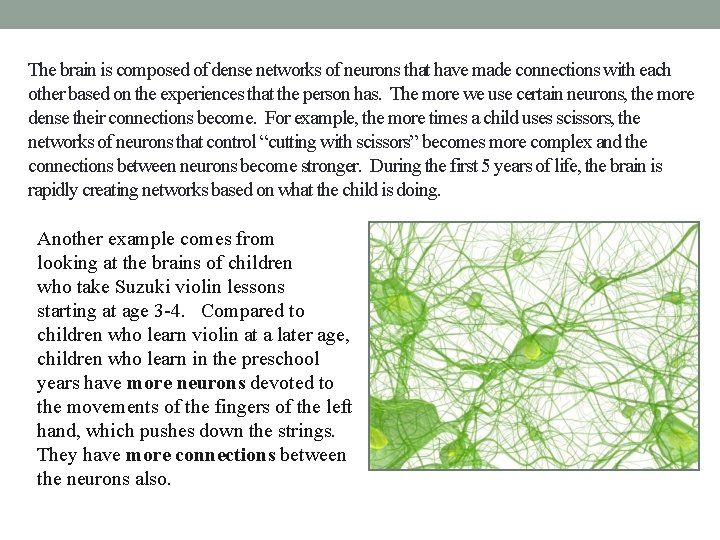
The brain is composed of dense networks of neurons that have made connections with each other based on the experiences that the person has. The more we use certain neurons, the more dense their connections become. For example, the more times a child uses scissors, the networks of neurons that control “cutting with scissors” becomes more complex and the connections between neurons become stronger. During the first 5 years of life, the brain is rapidly creating networks based on what the child is doing. Another example comes from looking at the brains of children who take Suzuki violin lessons starting at age 3 -4. Compared to children who learn violin at a later age, children who learn in the preschool years have more neurons devoted to the movements of the fingers of the left hand, which pushes down the strings. They have more connections between the neurons also.
Major concept: The Brain is Plastic Think about things in our world that are made of plastic. We have hard plastic pens and soft plastic bags. Plastic comes in many forms, depending on what we do to it. Well, the brain is also “plastic” in that it creates its’ shape or architecture based on what we “do” to it. The role of plasticity in understanding the brain is critical. Our brains change as we learn. They make more connections when we learn or let go of connections that are unused. Some connections are strengthened, some are weakened. Plasticity is a major concept in early childhood development: • The experiences that a child has “shape” the brain itself, changing it. • Plasticity is greatest early in development, thus the recent emphasis on the early years of development. • Since each person has unique experiences, each person has a unique brain. • Plasticity of the brain allows it to reorganize if it gets damaged. As we get older, it is harder to repair damage to the brain because we are no longer in a “growth” mode.
There are three basic principles of brain function that address how experience shapes the structure of the brain. These principles have great implications for early childhood education. They tell us about the impact that teachers and parents have on the brains of young children. 1. Use it or lose it. This is the first principle and it tells us that cells and connections between cells will be kept (or become “committed”) if they are used. Those cells and those connections that are not used will be “pruned out” or lost. 2. Repetition strengthens connections. This principle tells us that the more a child practices doing something, the stronger the connections will be in the brain that are dedicated to that skill or knowledge. 3. Cells that fire together, wire together. This third principles says that when experiences happen together, at the same time, they make connections in our brains between neurons and networks of neurons. Thus, when we think of one of the experiences we will often connect it to the other. Let’s look at some examples:
Examples of the Three Principles 1. Use it or lose it. The example of Suzuki violin lessons in the preschool years is a prime example of use it or lose it. There are times when children are most open to learning certain skills and knowledge. When they DO have these experiences during these “sensitive” periods, they learn the knowledge or acquire the skill BETTER than if they learned it later or earlier. Second language acquisition is another good example. The first 5 -7 years of life are a time when children “naturally” can learn a new language. After age 12 years, it becomes much more difficult. 2. Repetition strengthens connections. This tells us that children need to do things over and over again, in the same and different ways to fully master the skill or knowledge. Therefore, it is not a good idea to have something “new and exciting” for children every day. If they never get to practice, they never achieve mastery. Coloring, cutting, pasting, building, running, jumping, throwing and catching a ball cannot be done too much in the preschool years. Varying “what” a child cuts (paper, string, tape, play dough) broadens the skill of cutting, while the repetition strengthens it.
Examples of the Three Principles 3. Cells that fire together, wire together. This tells us that everything we do with children impacts how they view and feel about learning, about school, about being with other people, etc. If story time is a relaxed, comfortable time for children, they will come to associate “good feelings” every time they pick up a book. The positive emotions come to be associated with the experience of reading; they get literally “wired” together in the brain. If we express interest and enthusiasm about what children are thinking and doing, we will teach them that their ideas and actions are seen as valuable and important.
Pruning – a closer look When we talk about “use it or lose it”, this can sound “terrible”! There is both a “good” side and a “bad” side to pruning of brain cells and connections between cells. Pruning is defined as a loss of connections between cells or a loss of actual cells, due to lack of use. On the one hand, pruning makes the brain more efficient, more powerful. When we are born, we have way more neurons and way more connections between neurons than we will ever use. This is because the brain doesn’t “know” which ones it will need to keep. Thus, the brain lets go of connections and cells that are not needed or are redundant. This makes the brain more streamlined. On the other hand, though, lack of stimulation in a critical time of development can cause loss of neurons and loss of connections that WERE needed, but had gone unused. For example, if a child is kept in an isolated condition and never hears language for the first 12 years of life, this child will never be able to fully learn language and be fluent in it.
Mirror Neurons: special types of networks that allow us to be social Our brains contain multiple networks of mirror neurons which are neurons that allow us to do some critical social tasks: • Mirror neurons allow us to read other people’s emotions, as if they were our own. We can literally feel what they feel. • Mirror neurons allow us to know the intent of another person’s actions. When our brain sees someone bringing a glass of water toward their lips, our brain “infers” that they are about to take a drink. • Mirror neurons allow us to “read people’s minds“ – we can imagine what they are thinking, feeling, and intending. • Mirror neurons also allow us to detect “fakes” – we know when others are insincere, as we can “mirror” their behavior and know that if we were doing it, we would be faking!!
The Brain is Emotional Every thought and every behavior has an emotion connected to it, be it positive, negative, or neutral. Emotions give us enormous amounts of information about situations – they are a key part of memory and of learning. As teachers and parents of young children, it is critical that we be emotionally available to children and that we help children develop their “emotional intelligence” – their knowledge about feelings and what they mean. Finally, we must always be aware of the emotional environment of a classroom or home! The feelings that pervade these places will become attached to the child’s memories of childhood and to all they learned!
- Slides: 14