
BASIC CONCEPTS OF BIOMECHANICS MOTION MOVEMENT MOTIO N
BASIC CONCEPTS OF BIOMECHANICS MOTION & MOVEMENT
MOTIO N
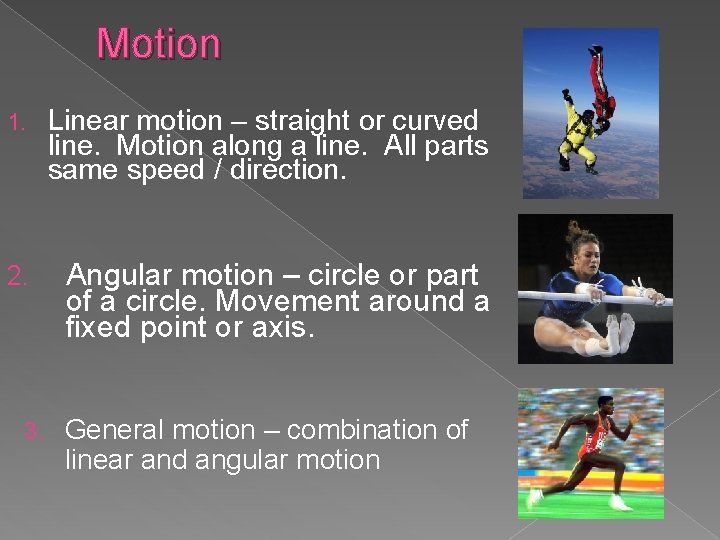
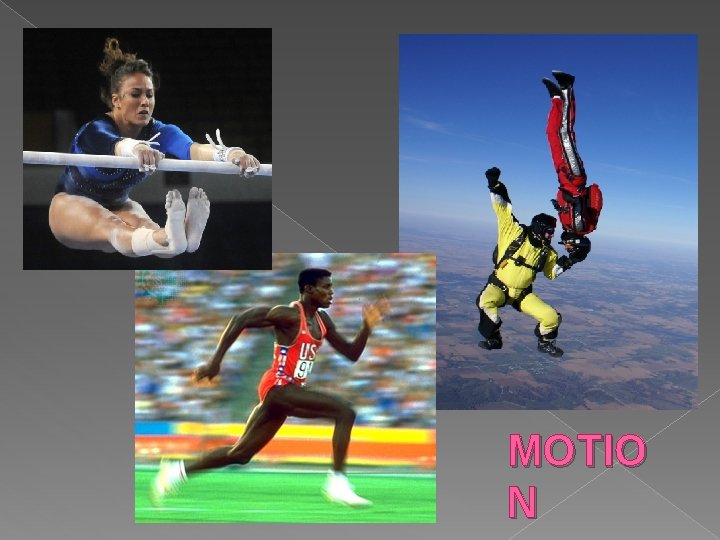
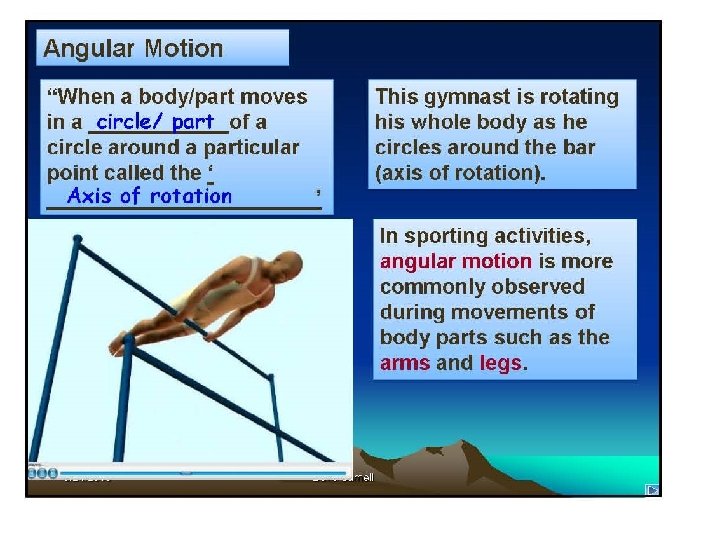
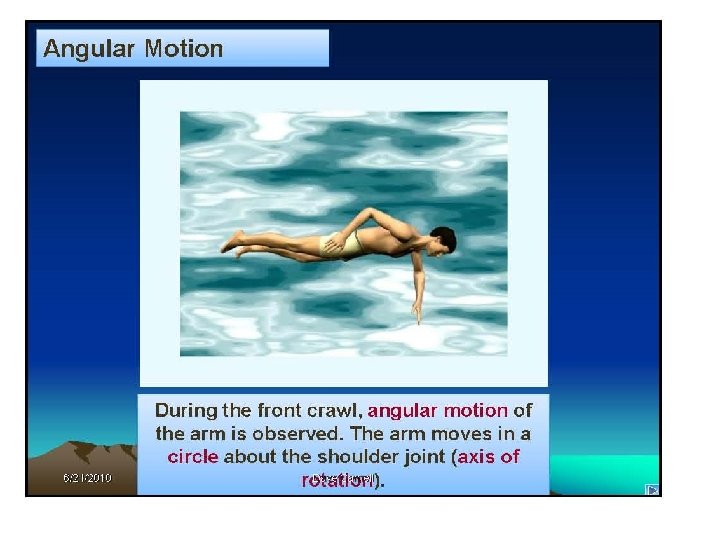
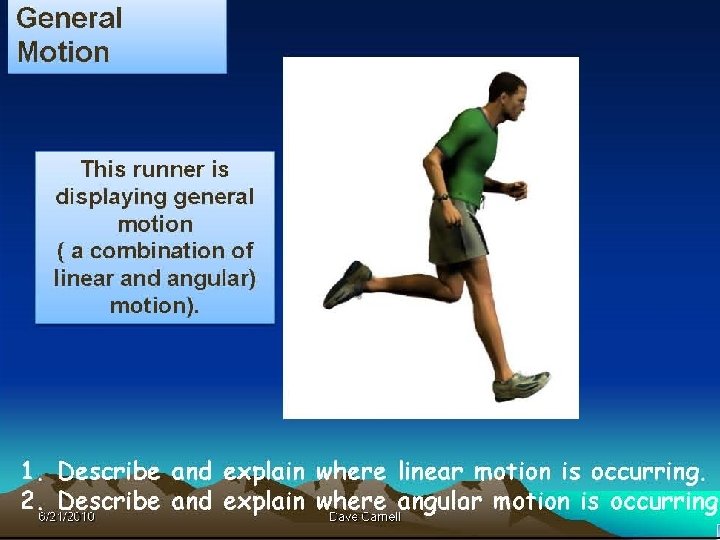
Motion 1. Linear motion – straight or curved line. Motion along a line. All parts same speed / direction. 2. Angular motion – circle or part of a circle. Movement around a fixed point or axis. 3. General motion – combination of linear and angular motion
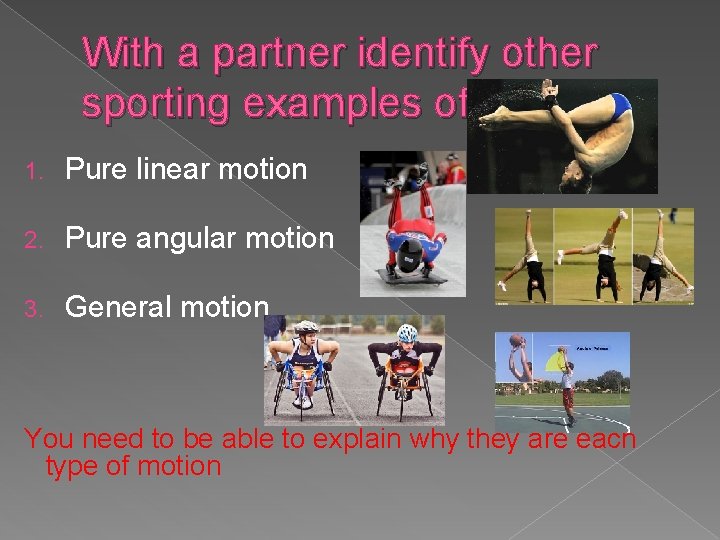
With a partner identify other sporting examples of: 1. Pure linear motion 2. Pure angular motion 3. General motion You need to be able to explain why they are each type of motion
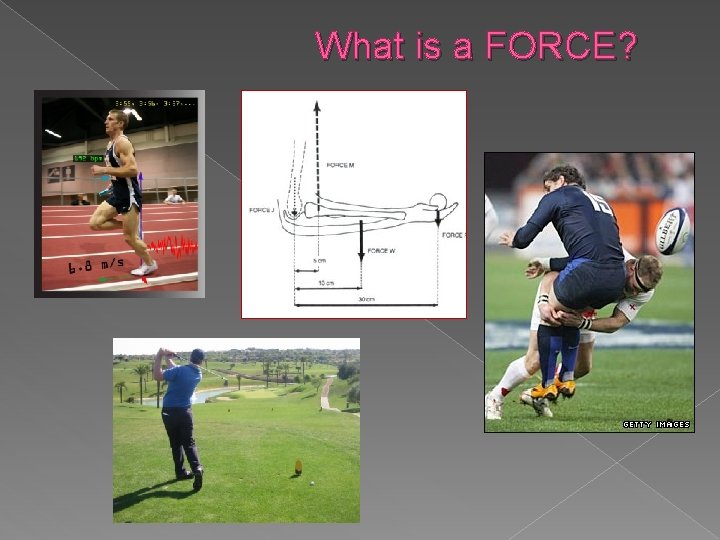
What is a FORCE?
Forces A push or pull that alters or tends to alter, the state of motion of a body “A force is that which alters or tends to alter a body’s state of rest or of uniform motion in a straight line. ” If a body changes direction or speed, a force has been applied
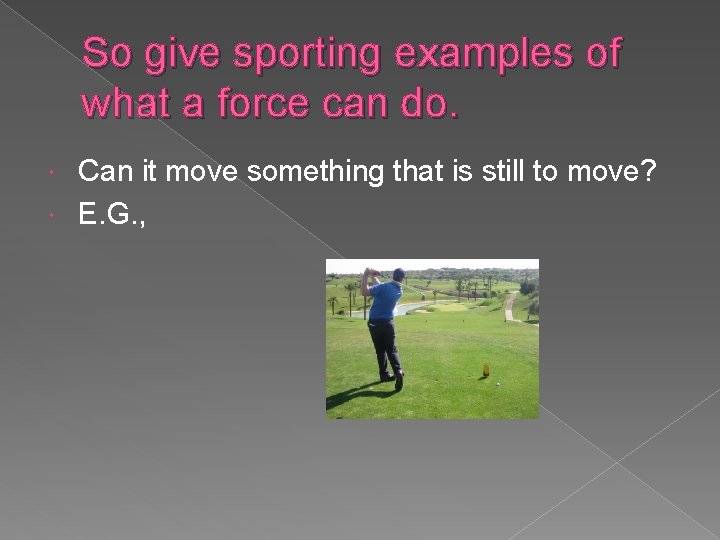
So give sporting examples of what a force can do. Can it move something that is still to move? E. G. ,
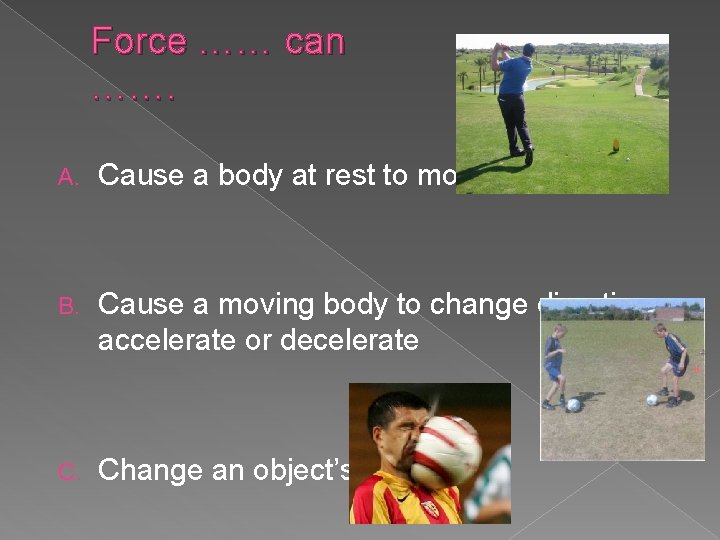
Force …… can ……. A. Cause a body at rest to move B. Cause a moving body to change direction, accelerate or decelerate C. Change an object’s shape.
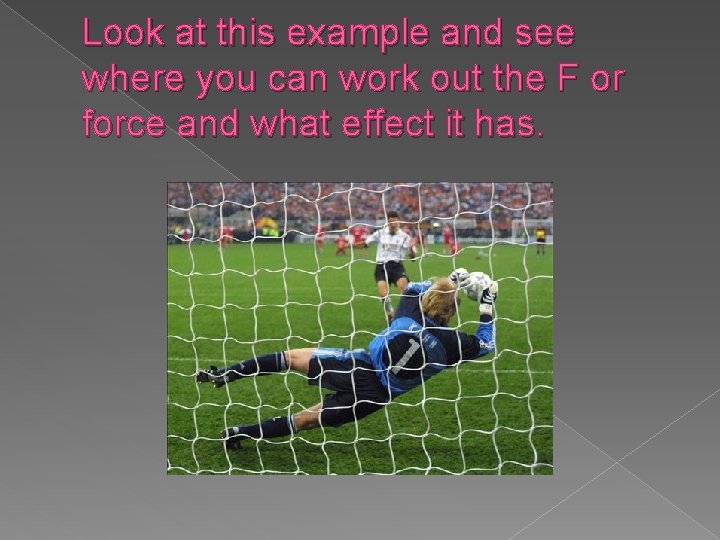
Look at this example and see where you can work out the F or force and what effect it has.
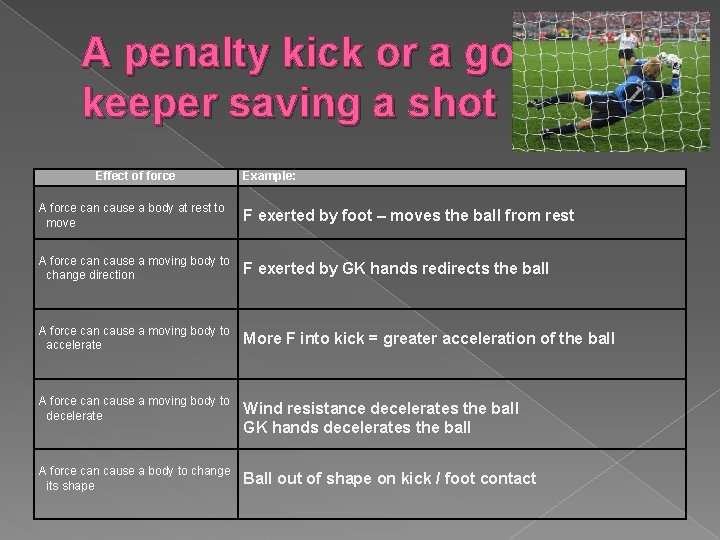
A penalty kick or a goal keeper saving a shot Effect of force Example: A force can cause a body at rest to move F exerted by foot – moves the ball from rest A force can cause a moving body to change direction F exerted by GK hands redirects the ball A force can cause a moving body to accelerate More F into kick = greater acceleration of the ball A force can cause a moving body to decelerate Wind resistance decelerates the ball GK hands decelerates the ball A force can cause a body to change its shape Ball out of shape on kick / foot contact
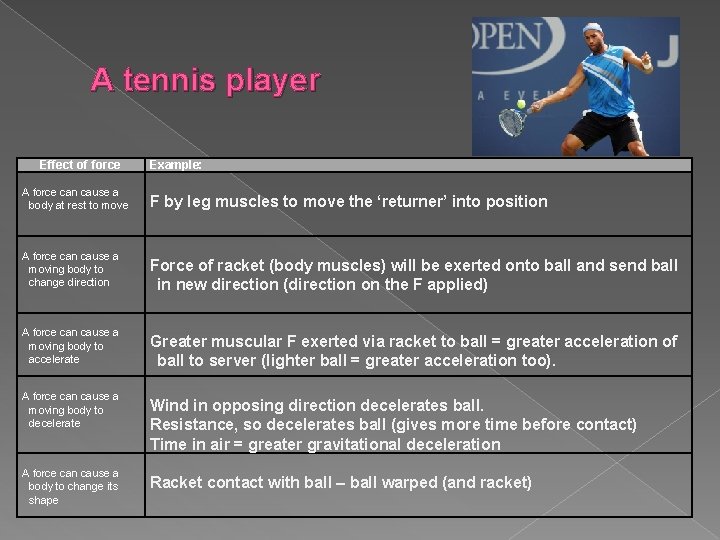
A tennis player Effect of force Example: A force can cause a body at rest to move F by leg muscles to move the ‘returner’ into position A force can cause a moving body to change direction Force of racket (body muscles) will be exerted onto ball and send ball in new direction (direction on the F applied) A force can cause a moving body to accelerate Greater muscular F exerted via racket to ball = greater acceleration of ball to server (lighter ball = greater acceleration too). A force can cause a moving body to decelerate A force can cause a body to change its shape Wind in opposing direction decelerates ball. Resistance, so decelerates ball (gives more time before contact) Time in air = greater gravitational deceleration Racket contact with ball – ball warped (and racket)
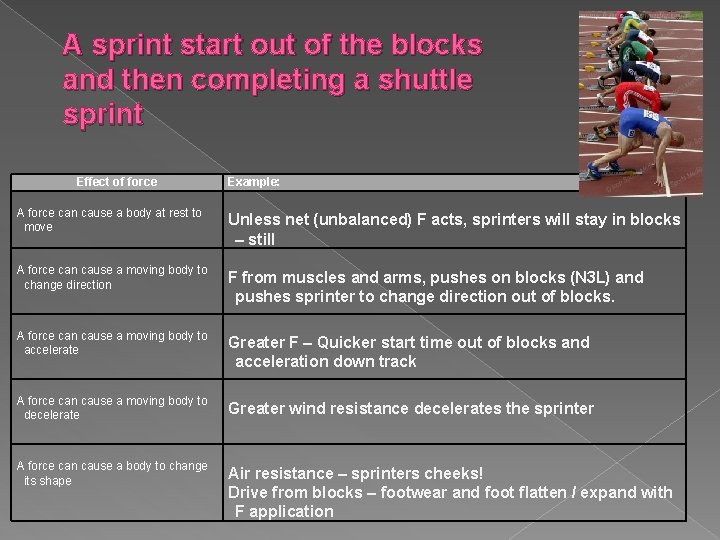
A sprint start out of the blocks and then completing a shuttle sprint Effect of force Example: A force can cause a body at rest to move Unless net (unbalanced) F acts, sprinters will stay in blocks – still A force can cause a moving body to change direction F from muscles and arms, pushes on blocks (N 3 L) and pushes sprinter to change direction out of blocks. A force can cause a moving body to accelerate Greater F – Quicker start time out of blocks and acceleration down track A force can cause a moving body to decelerate Greater wind resistance decelerates the sprinter A force can cause a body to change its shape Air resistance – sprinters cheeks! Drive from blocks – footwear and foot flatten / expand with F application
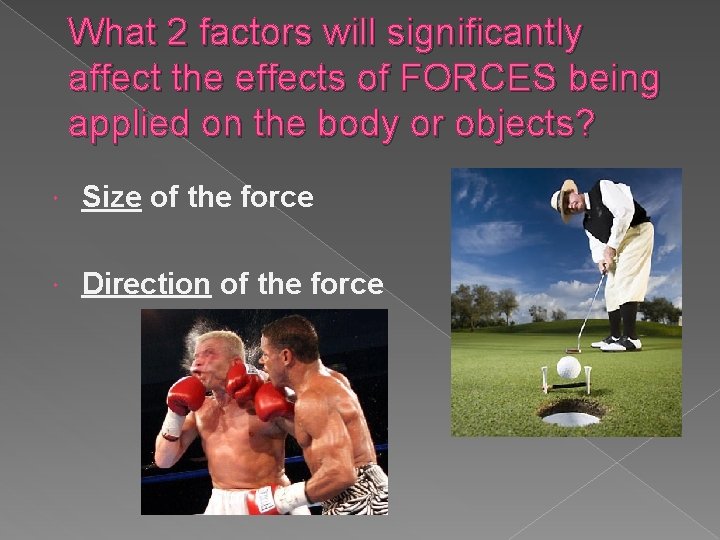
What 2 factors will significantly affect the effects of FORCES being applied on the body or objects? Size of the force Direction of the force
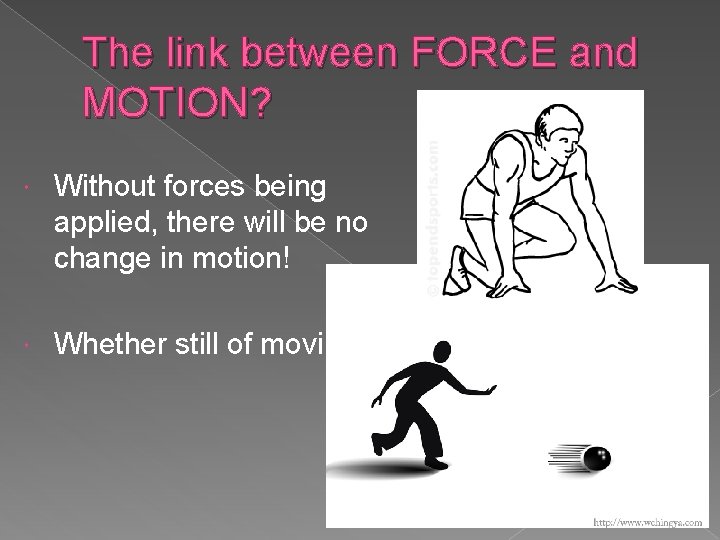
The link between FORCE and MOTION? Without forces being applied, there will be no change in motion! Whether still of moving.
Laws of Motion Sir Isaac Newton 3 Laws of Motion : 1 INERTIA 2 ACCELERATION 3 ACTION & REACTION
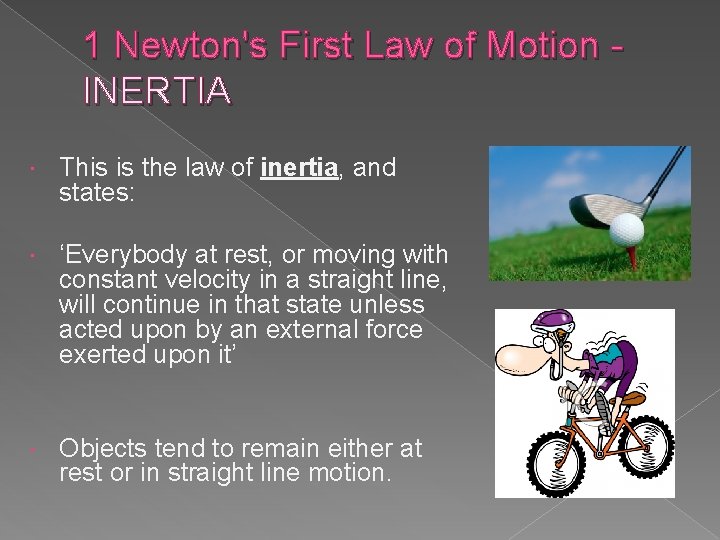
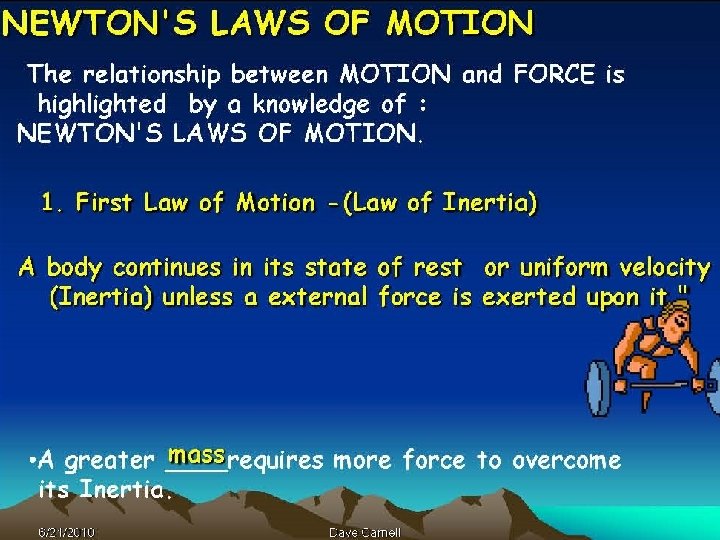
1 Newton's First Law of Motion - INERTIA This is the law of inertia, and states: ‘Everybody at rest, or moving with constant velocity in a straight line, will continue in that state unless acted upon by an external force exerted upon it’ Objects tend to remain either at rest or in straight line motion.
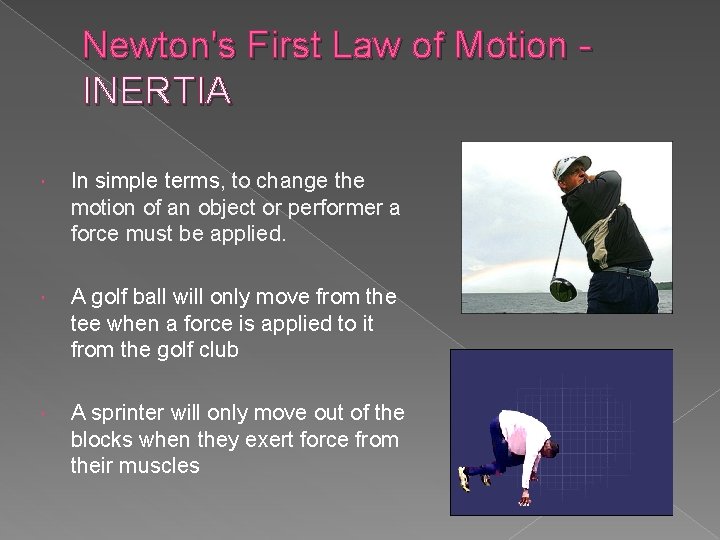
Newton's First Law of Motion - INERTIA In simple terms, to change the motion of an object or performer a force must be applied. A golf ball will only move from the tee when a force is applied to it from the golf club A sprinter will only move out of the blocks when they exert force from their muscles
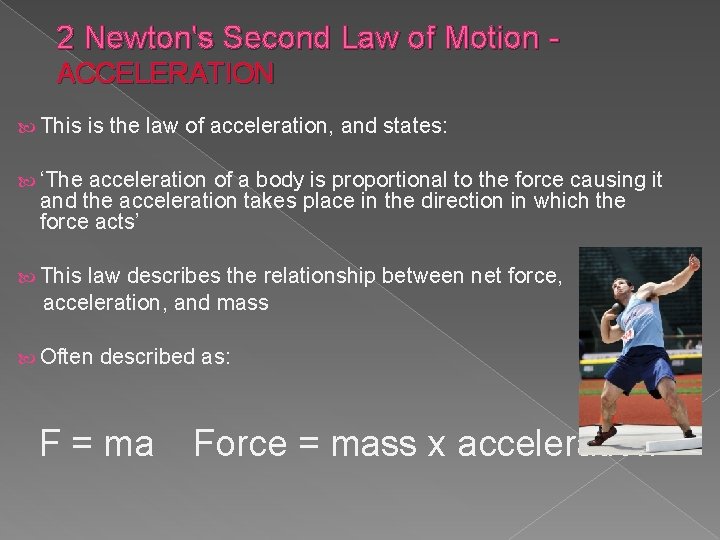
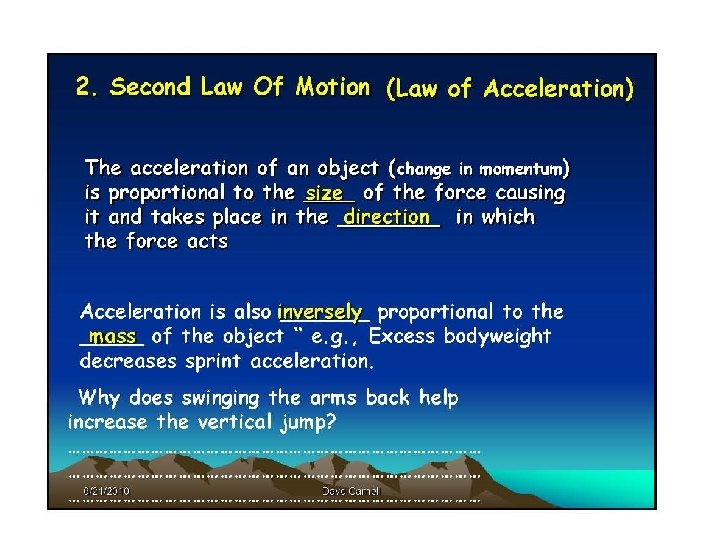
2 Newton's Second Law of Motion - ACCELERATION This is the law of acceleration, and states: ‘The acceleration of a body is proportional to the force causing it and the acceleration takes place in the direction in which the force acts’ This law describes the relationship between net force, acceleration, and mass Often described as: F = ma Force = mass x acceleration
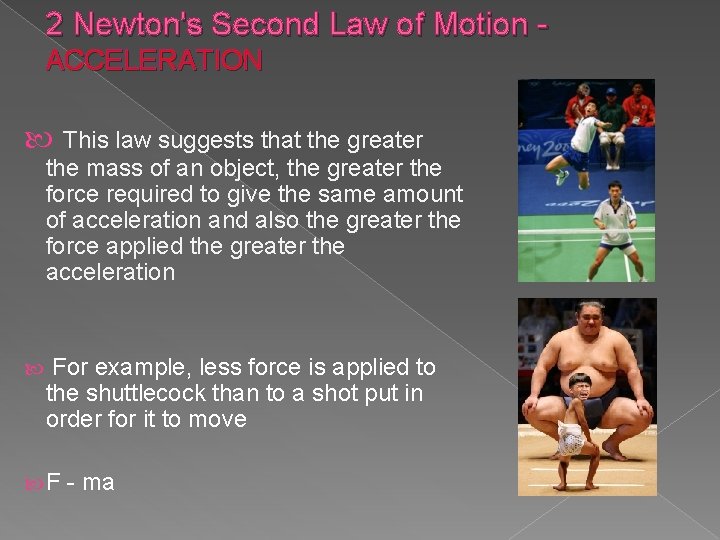
2 Newton's Second Law of Motion - ACCELERATION This law suggests that the greater the mass of an object, the greater the force required to give the same amount of acceleration and also the greater the force applied the greater the acceleration For example, less force is applied to the shuttlecock than to a shot put in order for it to move F - ma
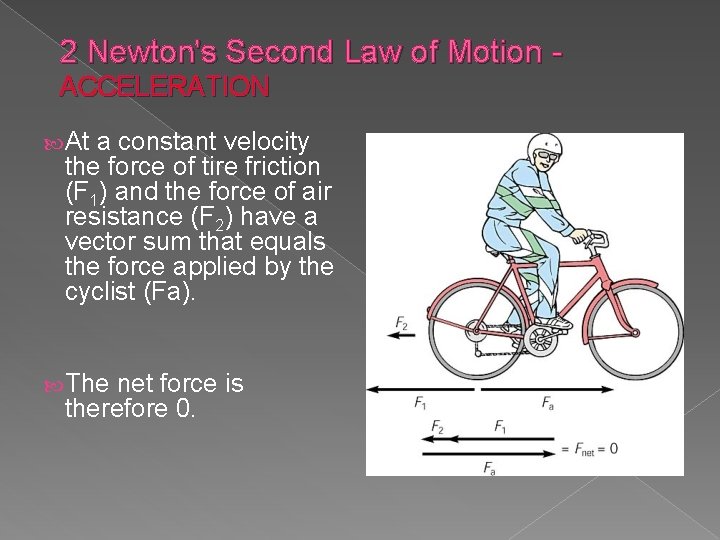
2 Newton's Second Law of Motion - ACCELERATION At a constant velocity the force of tire friction (F 1) and the force of air resistance (F 2) have a vector sum that equals the force applied by the cyclist (Fa). The net force is therefore 0.
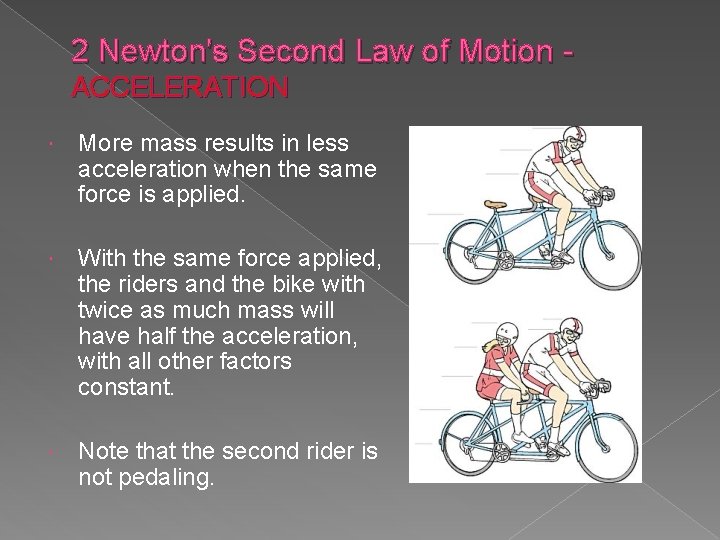
2 Newton's Second Law of Motion - ACCELERATION More mass results in less acceleration when the same force is applied. With the same force applied, the riders and the bike with twice as much mass will have half the acceleration, with all other factors constant. Note that the second rider is not pedaling.
In small groups Newton’s 2 nd law One person is to Those taking part use the bats and can only agree or balls to devise a disagree. sporting example to explain how mass If you do disagree and acceleration you take over as the affect each other. teacher.
In small groups Newton’s 3 nd law Are you able to do the same for the third Law? Those taking part can only agree or disagree. If you do disagree you take over as the teacher.
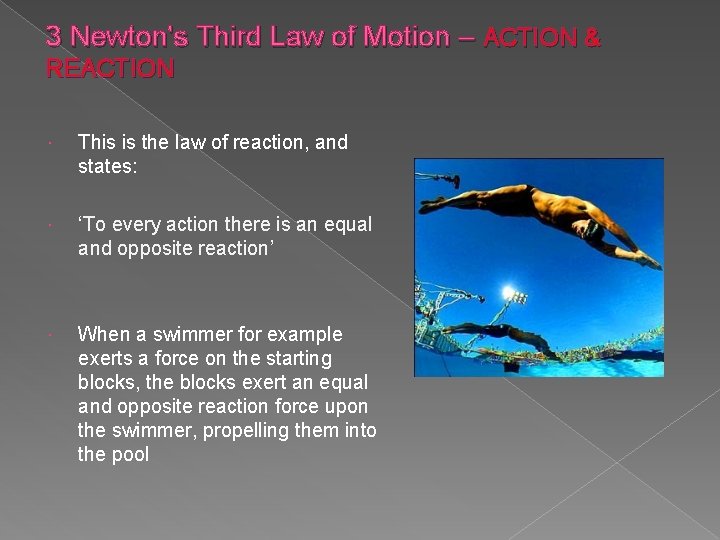
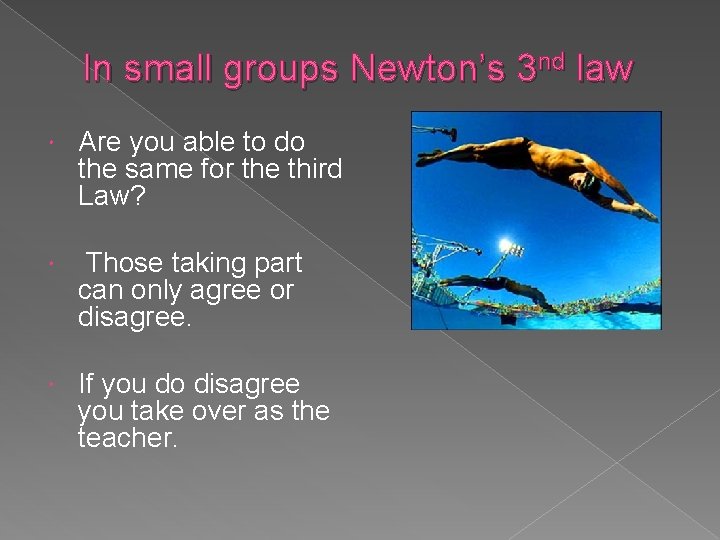
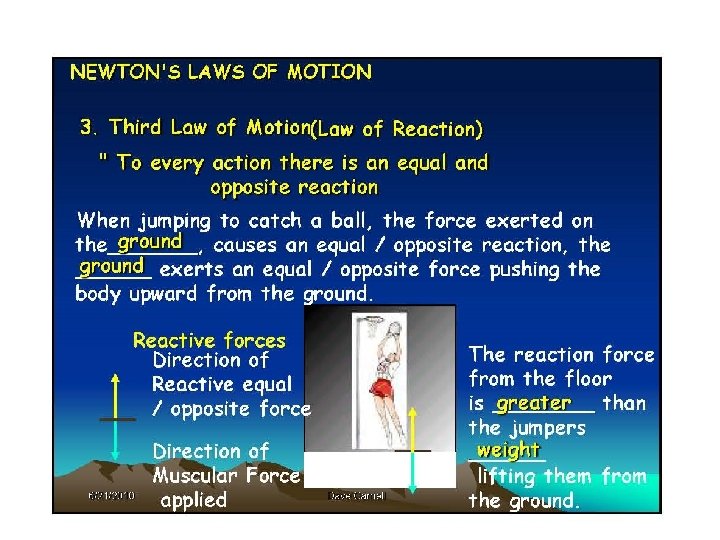
3 Newton's Third Law of Motion – ACTION & REACTION This is the law of reaction, and states: ‘To every action there is an equal and opposite reaction’ When a swimmer for example exerts a force on the starting blocks, the blocks exert an equal and opposite reaction force upon the swimmer, propelling them into the pool
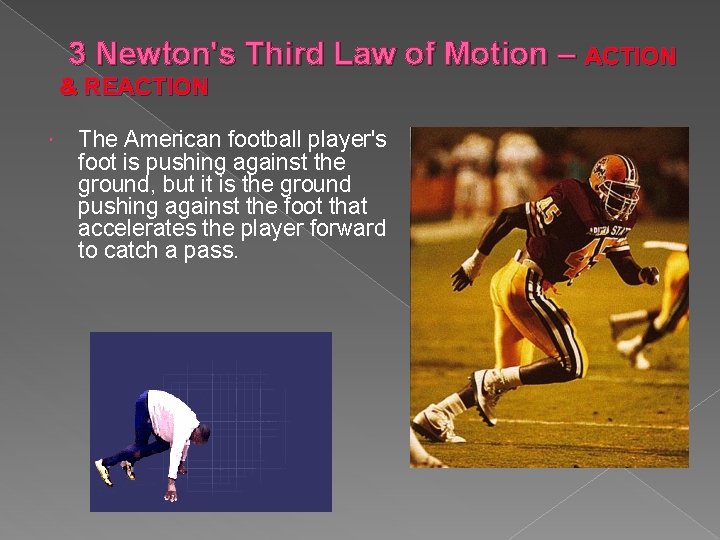
3 Newton's Third Law of Motion – ACTION & REACTION The American football player's foot is pushing against the ground, but it is the ground pushing against the foot that accelerates the player forward to catch a pass.
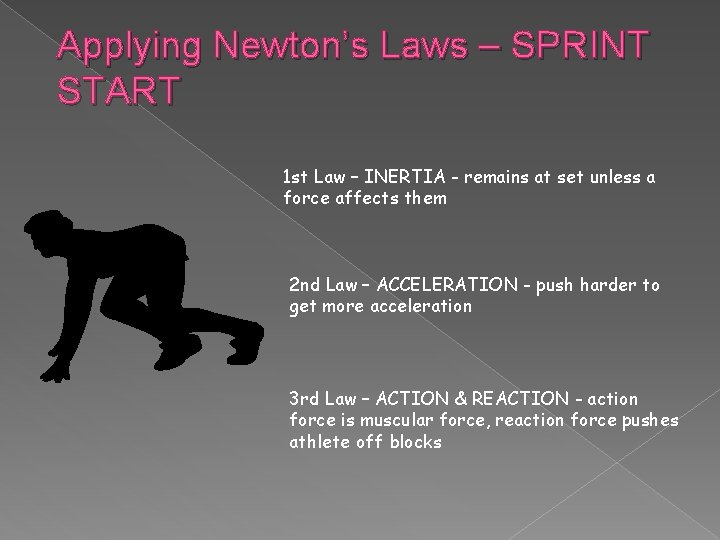
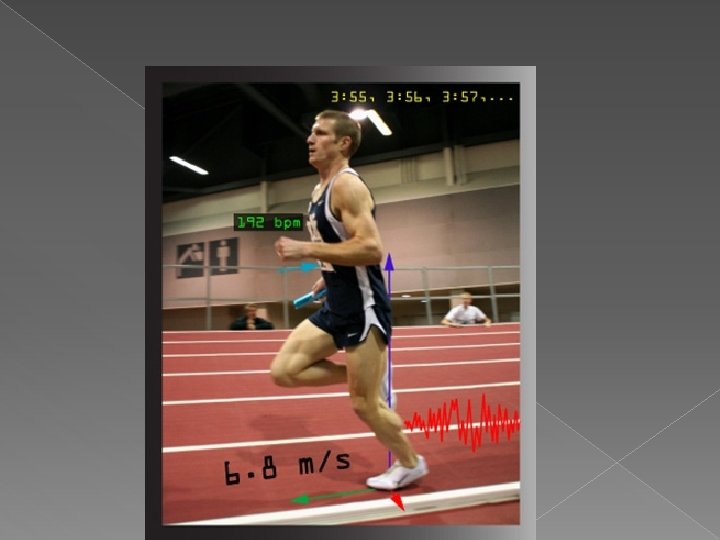
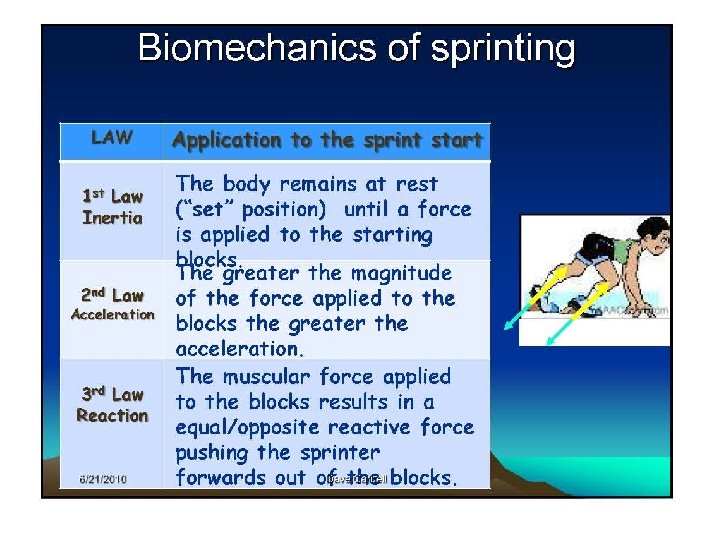
Applying Newton’s Laws – SPRINT START 1 st Law – INERTIA - remains at set unless a force affects them 2 nd Law – ACCELERATION - push harder to get more acceleration 3 rd Law – ACTION & REACTION - action force is muscular force, reaction force pushes athlete off blocks
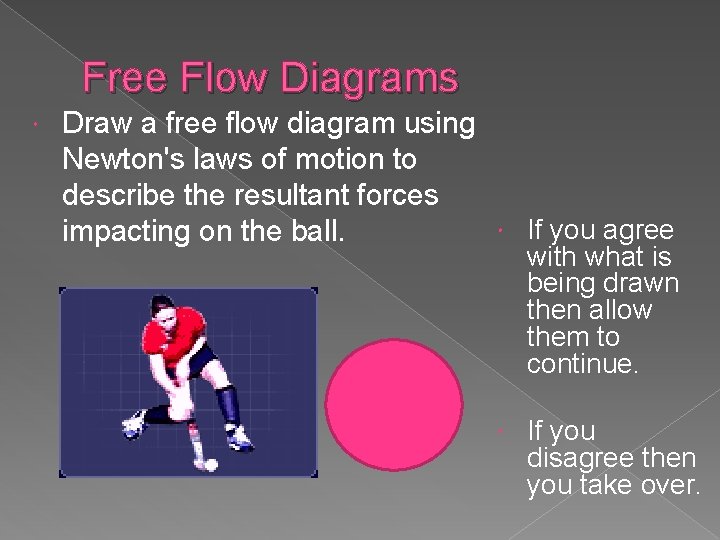
Free Flow Diagrams Draw a free flow diagram using Newton's laws of motion to describe the resultant forces impacting on the ball. If you agree with what is being drawn then allow them to continue. If you disagree then you take over.
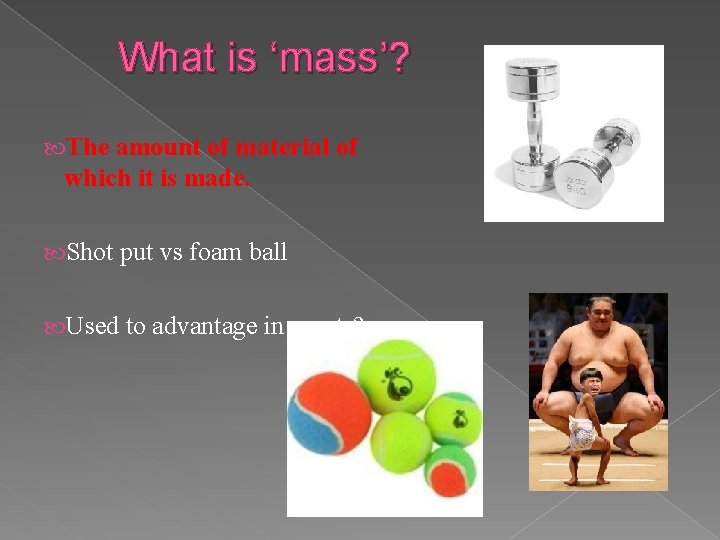
What is ‘mass’? The amount of material of which it is made. Shot put vs foam ball Used to advantage in sports?
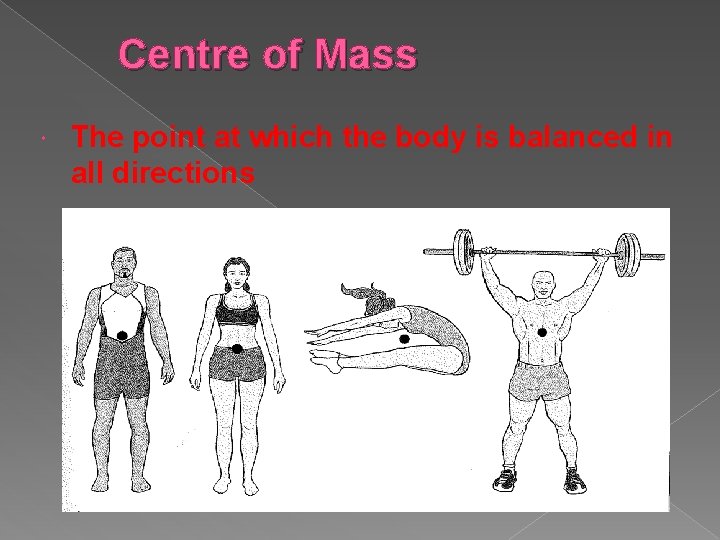
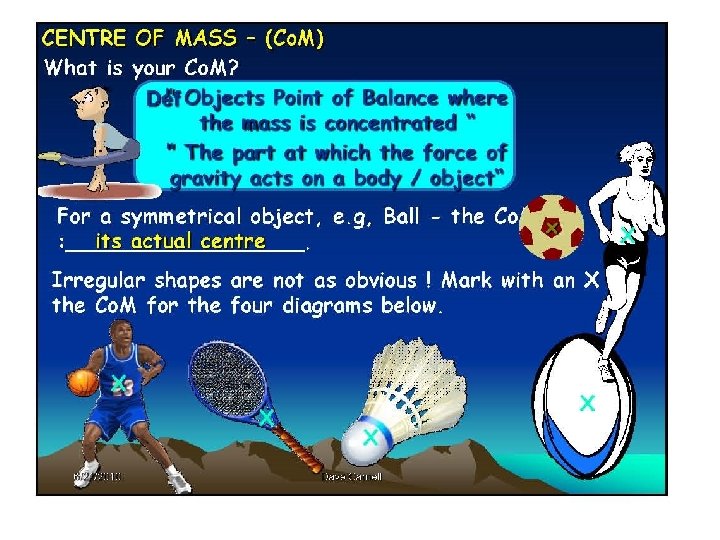
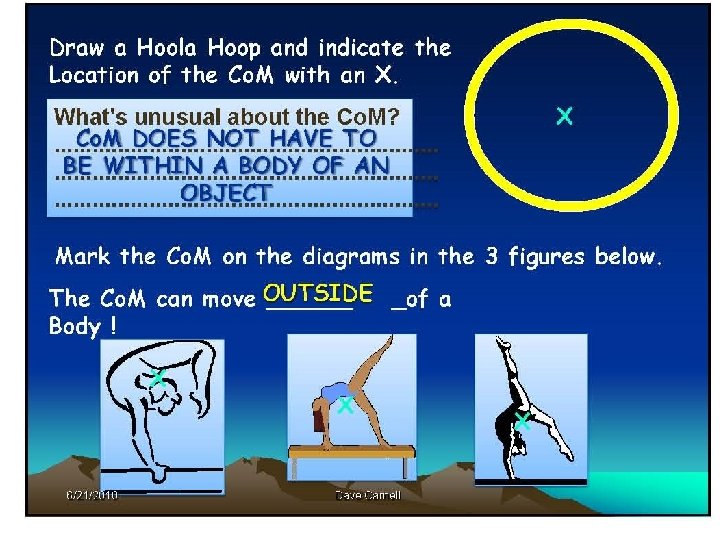
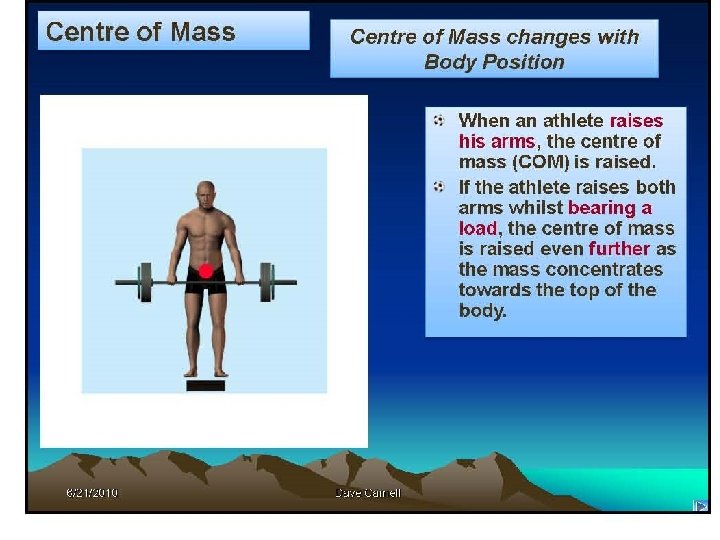
Centre of Mass The point at which the body is balanced in all directions
What factors affect the centre of mass? Distribution of mass – symmetrical Body position and shape – unsymmetrical; males vs females Changing positions – HJ (Western Roll vs Fosbury Flop
Class task With a partner one of you stand with your back against a wall. Your heels against the wall Try and place a ball down on the floor without moving your feet. See if your partner can place the ball further away? Why do you fall forwards? Or if you don’t fall why do you feel like falling?
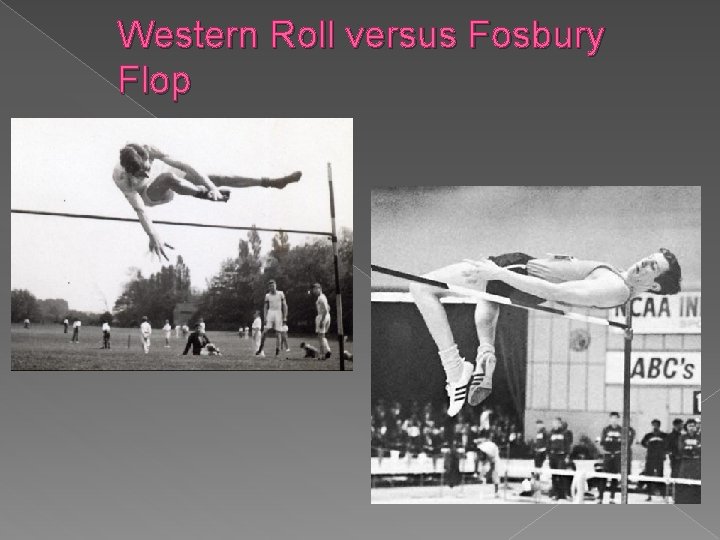
Western Roll versus Fosbury Flop
Centre of Mass - summary Distribution of weight around a balance point The centre of a body's mass. In the human body it is the point, which all parts are in balance with one another. It is dependant on current position in space, anatomical structure, gender.
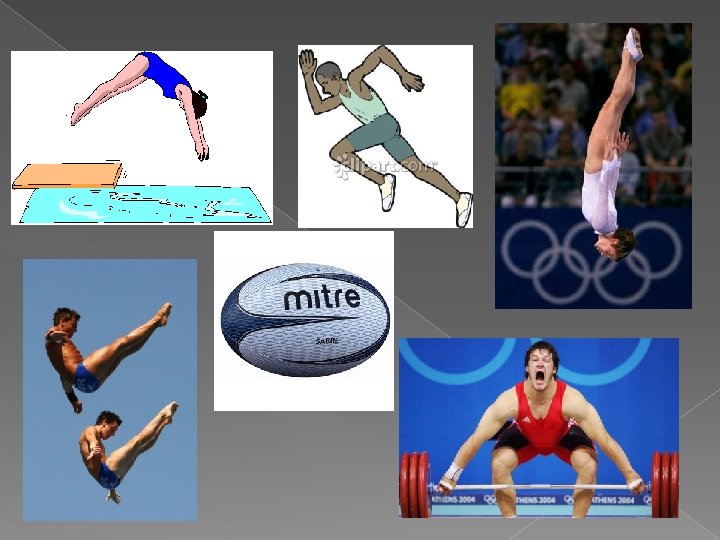
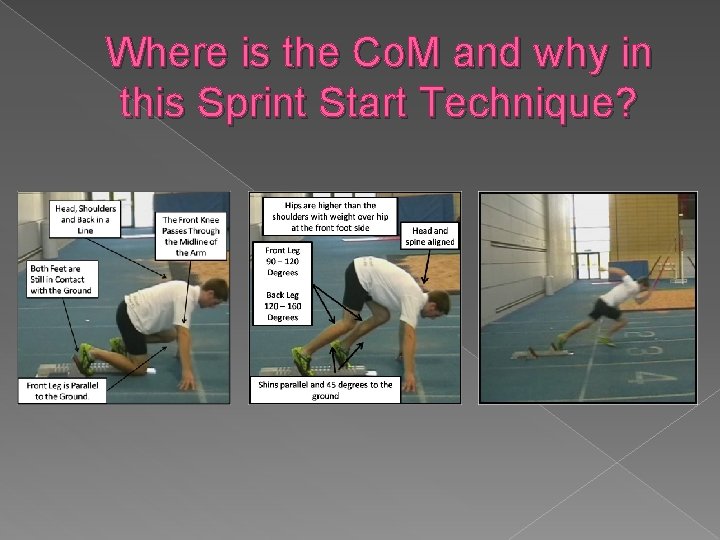
Where is the Co. M and why in this Sprint Start Technique?
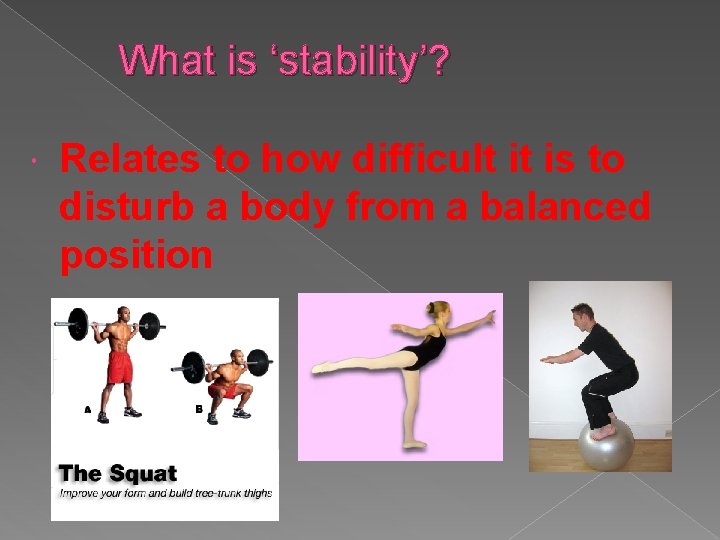
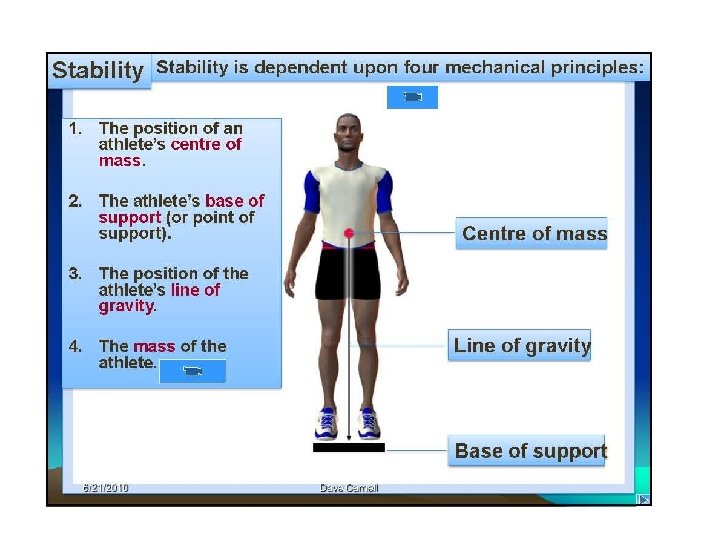
What is ‘stability’? Relates to how difficult it is to disturb a body from a balanced position
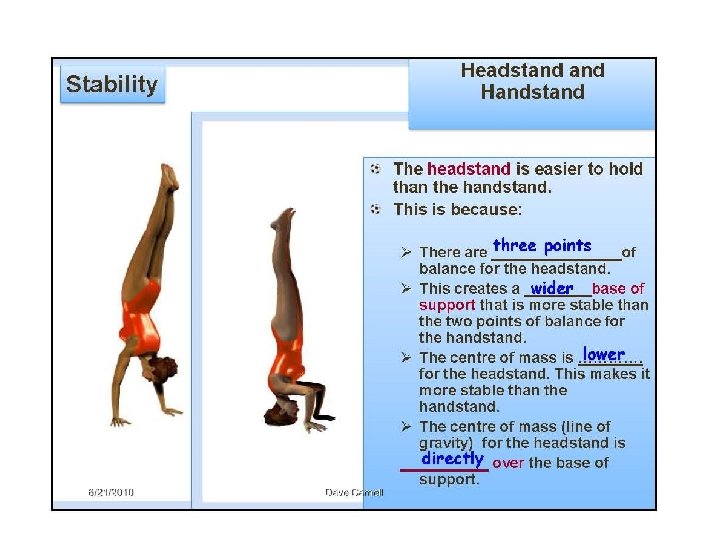
Stability Is determined by : Position of athlete’s centre of mass Position of the athlete’s line of gravity= a line extending from the centre of mass vertically down to the ground. Size of the athlete’s area of support
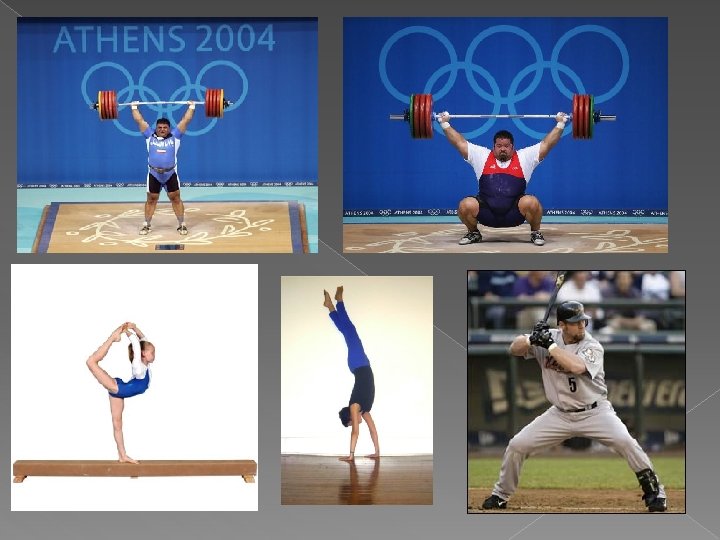
Task gently apply a force to move the person adopting different stances. Adopt a wide stance arms down Adopt a wide stance arms up Feet together arms down Feet together arms up Is there a difference in how easy it was to move the person?
Application of force. We talked about angular and linear motion at the beginning of the class, so how can we create these types of motions? Investigate how you can cause these actions using the tennis ball. Think about the force that you are applying and the centre of mass.
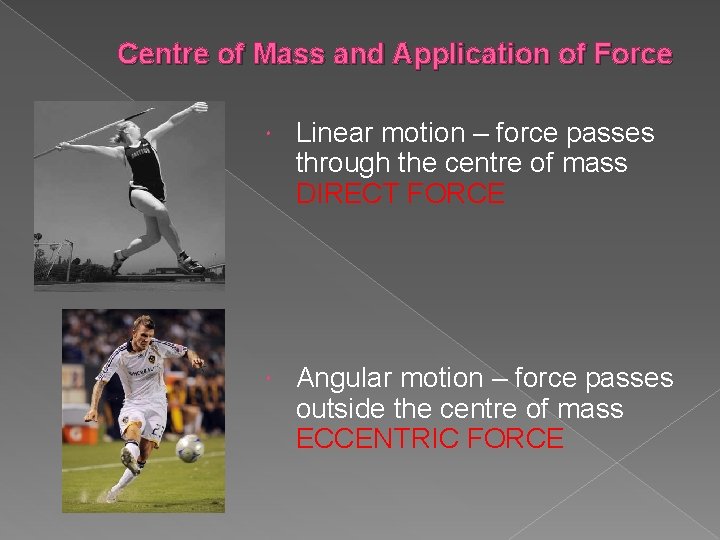
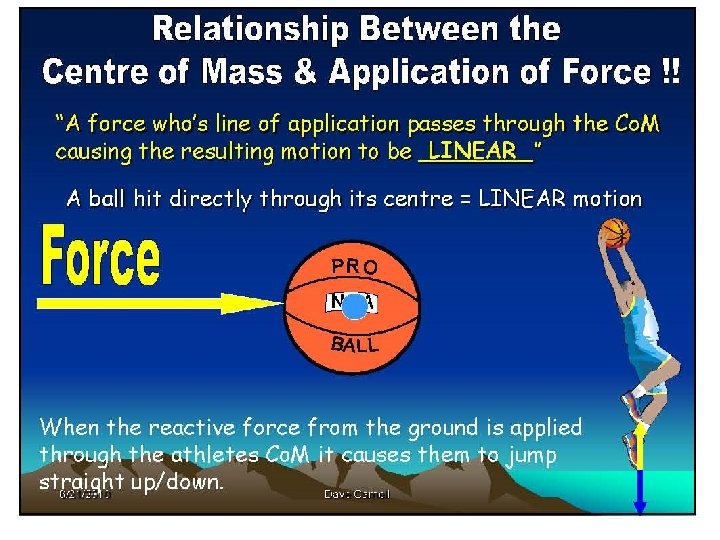
Centre of Mass and Application of Force Linear motion – force passes through the centre of mass DIRECT FORCE Angular motion – force passes outside the centre of mass ECCENTRIC FORCE
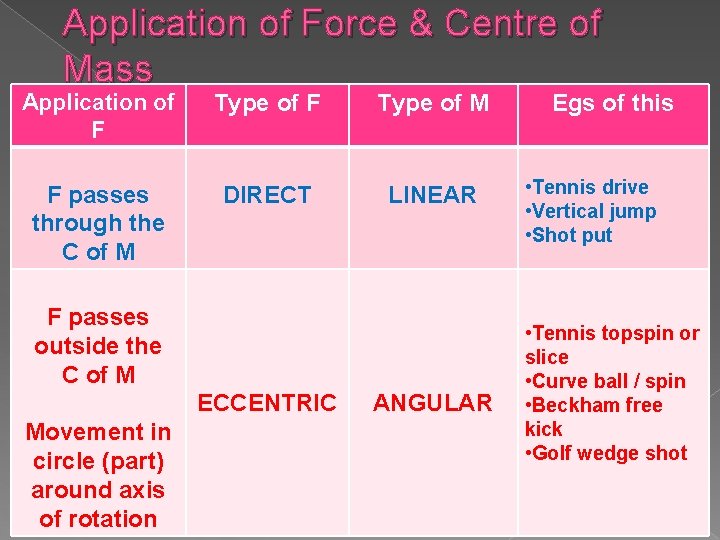
Application of Force & Centre of Mass Application of F Type of M F passes through the C of M DIRECT LINEAR F passes outside the C of M ECCENTRIC Movement in circle (part) around axis of rotation ANGULAR Egs of this • Tennis drive • Vertical jump • Shot put • Tennis topspin or slice • Curve ball / spin • Beckham free kick • Golf wedge shot
Class task throwing a tennis ball. Throw a tennis ball into the air making it spin. Draw a diagram that shows the centre of mass, the point of application of Force Action/Reaction Direction of force. What is the scientific name given to the force resulting in the angular motion.
Task Using the bat and ball in your groups can you cause the ball to move in a linear motion by applying a direct force? Can you apply an eccentric force to cause the body to move with an angular motion. What would be a really good sporting example?

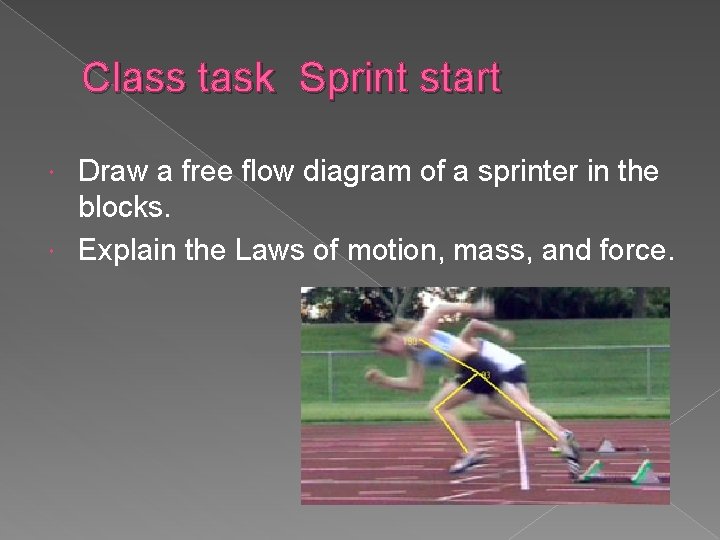
Class task Sprint start Draw a free flow diagram of a sprinter in the blocks. Explain the Laws of motion, mass, and force.
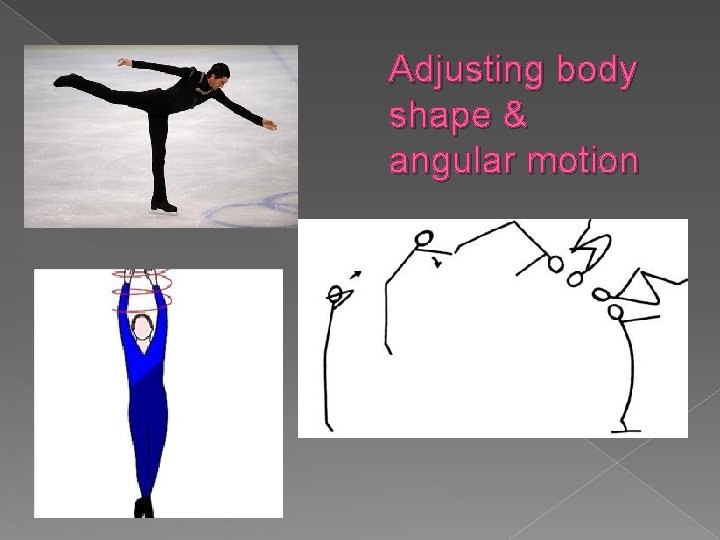
Adjusting body shape & angular motion
- Slides: 62