
BASIC CONCEPTS IN MIS System concepts A system
BASIC CONCEPTS IN MIS … • System concepts – A system can be described as a set of elements joined together for a common objective. A system is defined as a number of components, entities that form a whole. These entities interact in such a way as to achieve a common goal. – Systems boundary: A boundary delineates an area of responsibility. It sets the scope of activities to be supported by the system. It separates the system from its environment. – Systems and subsystems: A subsystem is a component of a system which performs its own specialized task that is related to the overall objective of the total system. – Outputs and Inputs: The inner workings of a system or subsystem are organized to produce outputs from inputs.
BASIC CONCEPTS IN MIS … – An interface is a connection at system or subsystems boundaries. – Systems and Their Environment: The system's environment consists of its goals, needs and activities. – Open and closed Systems: Open systems operate in an external environment and exchange information and material with that environment. The external environment consists of the activities external to the system boundary with which the system can interact. • An open system needs to receive feedback to change and continue to exist in its environment. • A closed system is relatively self-contained; exchange with its environment does not occur. – Closed systems do not get the feedback they need from the external environment and tend to deteriorate. – Systems Feedback: Feedback is required to show whether the system is performing as expected. It tells whether the objective set for the system are met or not. That is, feedback is form of control, because it requires continuing adjustments in the activities of the system. The good thing about feedback it that it usually increases effort.
BASIC CONCEPTS IN MIS … – System Entropy and Negative Entropy: Entropy is a measure of disorder that exists in systems. Systems can become run down if they are not maintained. The process of maintaining a system is negative entropy. – Abstract and physical systems. An abstract system is conceptual, a product of the human mind. • Social, theological, cultural systems are abstract systems. – A physical system is a set of elements--- rather than ideas or constructs--- that operate in relation to one another to accomplish a common goal or purpose. • Examples of physical systems include: – Computer systems: Collection of hardware elements that work interdependently under some means to control, to process data, and produce output reports.
BASIC CONCEPTS IN MIS … • Communication system: Collections of components that can represent and transmit bits of information from one point to another . • Marketing systems: Collection of people, equipment, and procedures that develop, produce, and distribute commodities, ideas and other entities to consumers or users. – A system must have an objective or goal.
BASIC CONCEPTS IN MIS … • Information systems – An information system is an information processing system that: • Receives information and requests for information from its environment and • provides information and answers to requests to its environment. – The environment can include the user, developer, other systems, etc. • can store information in time; • can derive a new information from a given information;
BASIC CONCEPTS IN MIS … – An Information System consists of the following components: • Messages - The information exchange between the users and the information system is accomplished by means of messages. These messages involve: – - Questions the users have about the information described by the information base or the grammar. – - Requests from the users to change the information base. – - Answers and questions from the information system in response to the questions – and other requests of the users.
BASIC CONCEPTS IN MIS … • Information base state - The contents of the information base at a certain moment. • Information base state transition - A change in the • • contents of the information base. Grammar - The description of all the rules which prescribe which information base states and information base state transitions may occur and the meaning of the data stored in the information base. Information processor - The active component of an information system which: – - Interprets and executes the questions and requests of the users. – - Addresses questions and answers to the users. – - Checks that the rules of grammar are not violated in carrying out these operations.
BASIC CONCEPTS IN MIS … • Put in a more general form, an information system: – Takes in data from the environment using one of the sensing and communication technologies (INPUT); – Analyzes this information using computer hardware and software (PROCESS); – Displays the product as useful information (OUTPUT); – Either you or the computer uses this information to act on the environment (FEEDBACK).
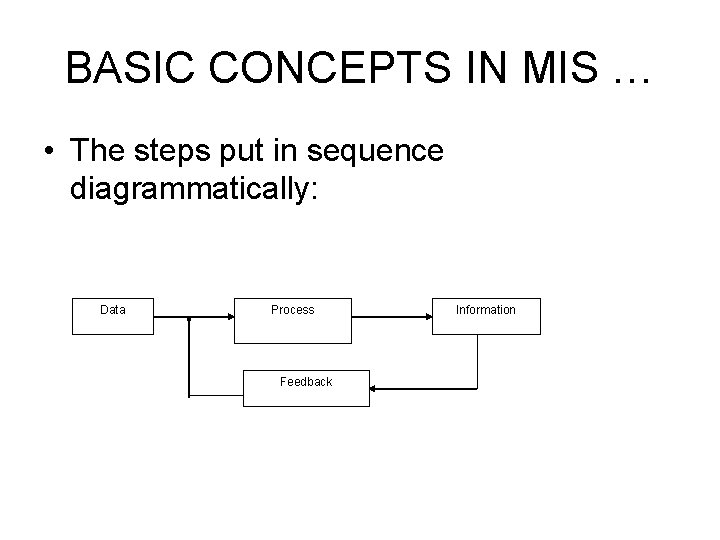
BASIC CONCEPTS IN MIS … • The steps put in sequence diagrammatically: Data Process Feedback Information
BASIC CONCEPTS IN MIS … • Elements of an information system – Computer Hardware • • Microcomputers Desktops Portables Workstations Minicomputers Mainframes Supercomputers
BASIC CONCEPTS IN MIS … – Software • System software • Applications software – Procedures • Formal operating procedures are physical components because they exist in a physical form such as a manual or instruction booklet. Three major types of procedures are required: – User instructions (for users of the application to record data, employ a terminal to enter or retrieve data, or use the result) – Instructions for preparation of input by data preparation personnel – Operating instructions for computer operations personnel
BASIC CONCEPTS IN MIS … – Human Resources • • • computer operators, systems analysts, programmers, data preparation personnel, information systems management, data administrators, etc.
BASIC CONCEPTS IN MIS … • Classification of information systems – Transaction Processing Systems (TPS) • Transaction processing systems’ focus is data. • Transaction processing systems (TPS) form the basis of many of the information processing applications in organizations of today. • The processing of transactions can be accomplished in a – batch mode, wherein all similar items are grouped or bundled and processed together daily or weekly, – or on-line, wherein each transaction is processed as it is generated. – The essential activities of transaction processing system includes data capture and validation, transaction-dependent processing steps, and database maintenance.
BASIC CONCEPTS IN MIS … – Knowledge Work Systems (KWS) • Serve information needs at the knowledge and other levels of the organization. • Knowledge work systems, such as scientific or engineering design applications, – promote the creation of new knowledge and – ensure that new knowledge and technical expertise are properly integrated into the business.
BASIC CONCEPTS IN MIS … – Office Automation Systems (OAS) • Office automation systems are information technology applications designed to – increase data workers’ productivity by supporting the coordinating and communicating activities of the typical office.
BASIC CONCEPTS IN MIS … – Management Reporting Systems • The focus of these systems is information. • They are designed to supply information for routine responsibility reporting from databases. • The principal identifying attribute of management reporting systems (MRS) are: – they are built for situations where information requirements are reasonably well known, – they are oriented toward reporting on the past and present, and, – they generally report on internal operations. • These characteristics clearly deal with operational and tactical types of activities.
BASIC CONCEPTS IN MIS … – Decision Support System (DSS) • Decision support systems provide managers with opportunities to evaluate alternatives related to a given problem or task. • The principal identifying attributes of decision support systems (DSS) are: – directly support the decision-making process permitting projection. – clearly relate to managers, their information needs, and activities. • Group decision support systems (GDSS) use computer mediated-communication tools, such as networks, anonymous input and voting, and whiteboards, to support groups as they make decisions.
BASIC CONCEPTS IN MIS … – Executive information systems • The focus of these systems is accessibility. That is, senior executives need access to internal and external information. • Principal identifying attributes of executive information system (EIS) are: – they provide immediate access to information reflecting: » Key success factors and access to internal and external information – easily tailored to user’s preferences. – critical for senior executive’s types of activities and decisions.
BASIC CONCEPTS IN MIS … – Expert Systems • Are computer programs designed to operate within a narrow problem domain and to capture and present to the user expert knowledge. • These systems can be developed to assist decision- makers in such diverse areas as classification, diagnosis, and monitoring, among others. • Consist of – a knowledge base, – a friendly user interface, – an inference engine to control the system operation as well as the application of the system’s knowledge, – and an explanation subsystem to permit the system to explain to the user how it arrived at conclusions.
- Slides: 19