
Basic Concepts in Assessment of Learning Definitions of
Basic Concepts in Assessment of Learning Definitions of Important Concepts LOADING COMPLETE!
Evaluation
Measurement � Process of quantifying an individual’s achievement, personality and attitudes among others by means of appropriate measuring instruments.
Measurement � Measurable dimensions in the educative process: ○ Intelligence ○ Interest ○ Aptitudes ○ Values ○ Health ○ Scholastic achievements
Evaluation Process of systematic collection and analysis of both qualitative and quantitative data for the purpose of making some decision and judgments. � Process of determining the quality or worth of achievement in terms of certain standards � Process of determining the quality of results of the measurement with the end in view of improving and maximizing the acquisition of desirable outcomes �
Assessment � Any variety of procedures used to obtain information about student performance -Linn and Miller (2005) � Answers the question “How well does the individual perform? ”
Assessment � Refers to the full range of information gathered and synthesized by teachers about their students and their classrooms. -Arends, 1994 � Method for analyzing and evaluating student achievement or program success

Assessment � Process of gathering and discussing information from multiple and diverse sources in order to develop a deep understanding of what students know, understand can do with their knowledge as a result of their educational experience -Huba, 2000
Assessment � Assessment includes: ○ Paper-and-pencil test ○ Extended response (essays) ○ Performances of authentic tasks (laboratory experiments) ○ Teacher observations ○ Student self-report
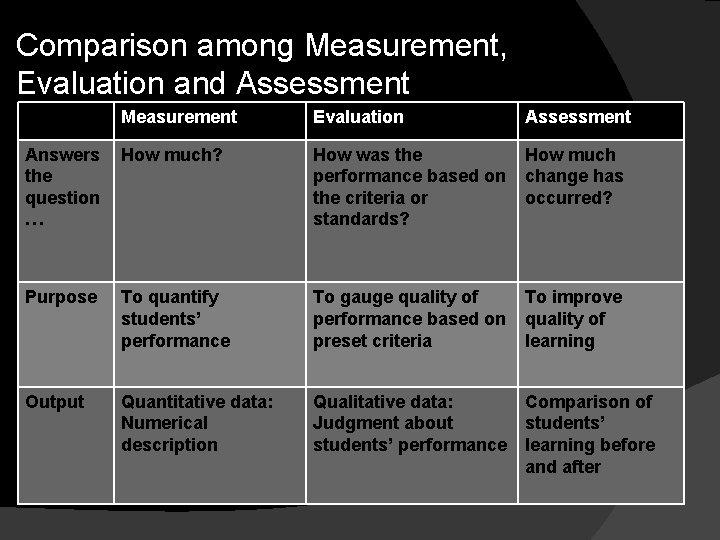
Comparison among Measurement, Evaluation and Assessment Measurement Evaluation Assessment Answers the question … How much? How was the performance based on the criteria or standards? How much change has occurred? Purpose To quantify students’ performance To gauge quality of performance based on preset criteria To improve quality of learning Output Quantitative data: Numerical description Qualitative data: Comparison of Judgment about students’ performance learning before and after
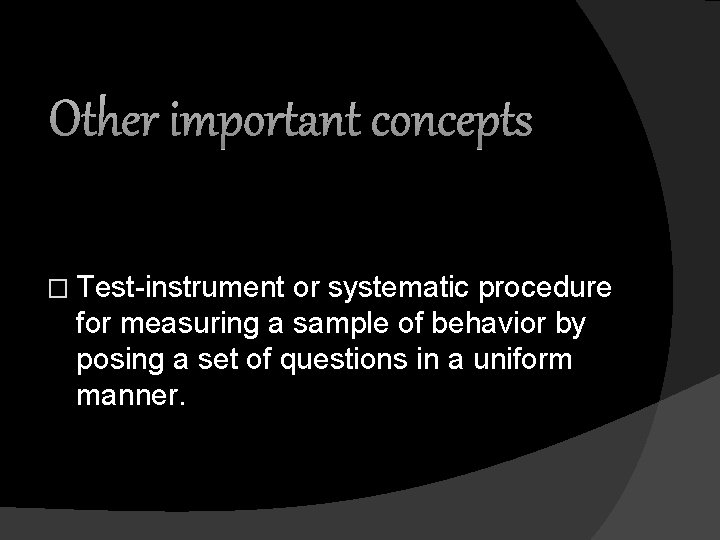
Other important concepts � Test-instrument or systematic procedure for measuring a sample of behavior by posing a set of questions in a uniform manner.

Test, Non-Test, Examination, Test Item and Quiz � Test- question or series of questions which aims to determine how well a student learned from a subject or topic taught � Non-Test- question or activity that determines the interests, attitude and other student’s characteristics whose answer or answers is/are not judged wrong/ incorrect
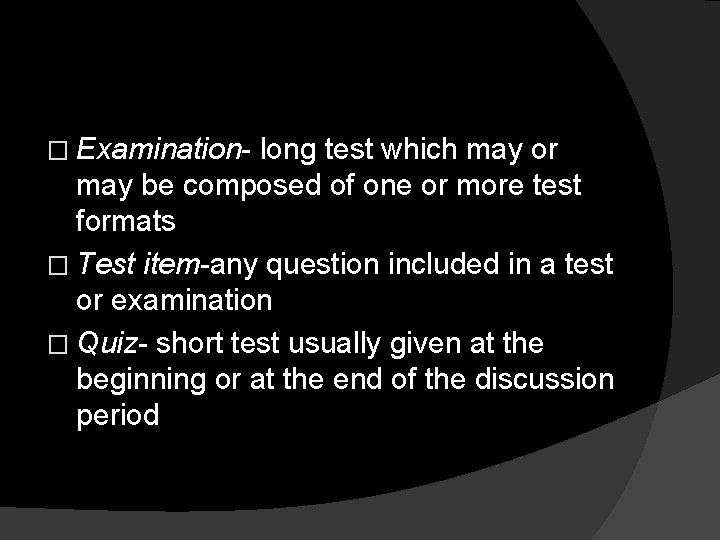
� Examination- long test which may or may be composed of one or more test formats � Test item-any question included in a test or examination � Quiz- short test usually given at the beginning or at the end of the discussion period

Le. T’s test your knowledge!
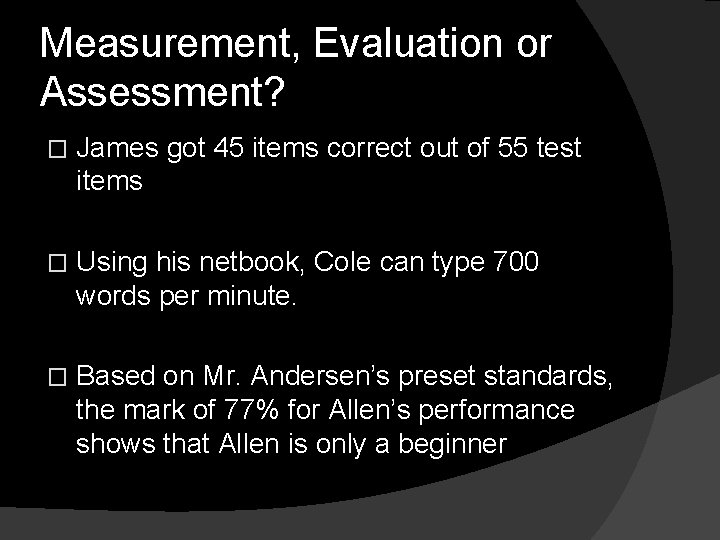
Measurement, Evaluation or Assessment? � James got 45 items correct out of 55 test items � Using his netbook, Cole can type 700 words per minute. � Based on Mr. Andersen’s preset standards, the mark of 77% for Allen’s performance shows that Allen is only a beginner
Measurement, Evaluation or Assessment? � For a 10 over 10 score, Mr. Anthony give an equivalent A+ mark for Mr. Miller’s demo teaching which means that he’s excellent. � Before the lecture, Mr. Spoelstra can answer only 1 algorithm problem out of 5 items. But after the lecture, he can already answer 5 out of 5 algorithm problems. Based on these, Mr. Chalmers had determined that Mr. Spoelstra became more skilled after his instruction as compared to his skills before the instruction occurs.
- Slides: 16