
Basic Concepts for Development of a National Strategy
Basic Concepts for Development of a National Strategy for Improvement of Agricultural and Rural Statistics Ø Ø Ø Statistics vs. Information What is a Strategy? How do we proceed to develop this? Integration Mukesh K Srivastava Statistics Division FAO, Rome
Challenges of a Statistician • Key persons do not understand the importance of Statistics • Demand is always more than the available resources can provide – human resources – financial resources • Administrative processes or interested agencies continue to produce “some numbers” which are used as statistics for lack of an alternative. – lack of coordination between agencies. – turf protection
Statistics or information • Is a Rapid Report on the persons affected by a natural calamity an statistics? – Level of Confidence/ Credibility – It is necessary to get this information rapidly even though it may be somewhat less reliable than that will be available from a door to survey. • Administrative Reports: coming out of established systems (relevant for only short time but is needed urgently for quick intervention) – Crop Area sown – Crop condition • Statistics from administrative sources – Export/ Import – Migration • Historical Statistical Series: Census and Surveys – Many users different levels of tolerance of credibility ü The Statistics come with ü A Seal of Quality (confidence) ü Well established calendar (expectation) ü Neutral Source (unbiased)
Distinguish • Official Statistics – multi-purpose – reliable, unbiased, produced by neutral agency • Monitoring reports – special purpose – Limited to project areas • Forecasts – based on assumptions, – available information • Assessments ü Statistical methods can improve the quality of information generation.
¿What is a National Strategy? § It is a road map for development to achieve certain Goals ü Optimum: with in the constraints of budget and human resources ü Feasible: not ideal ü Flexible: could accelerate or decelerate inmplementation without changing the direction § It tell us: ü ü For whom to produce? : priority clients Who does what? Priority needs of the country How to do it? : sound methodology, best use of resources § A plan of action follows from the Strategy

Steps to develop a strategic vision § The Goals § The problems (Challenges) – Identification: real vs. imaginary – Define precisely the issues to be focused § Analysis of present situation – – Strengths, Weaknesses, Opportunities and Threats § Brain Storming involving all stake holders, without prejudice § Search for solutions (options) § Evaluations of options from different angles – (users, interest groups, donors, government, public, implementers. . . )
§ Develop a shared National Vision § Strategy: a vision to follow for long term (10 -15 years) – – From where to begin? What road to follow? Consider scenarios (most favorable and the worst) Flexibility: preparatory action for risks § Planning: for both scenarios (5 year) – Long term and short term – Concrete objectives and resources § Implementation: on the basis of available resources – year by year § Revision of Plans: according to changes in priority, maintaining the strategy (ex. high way, livestock)
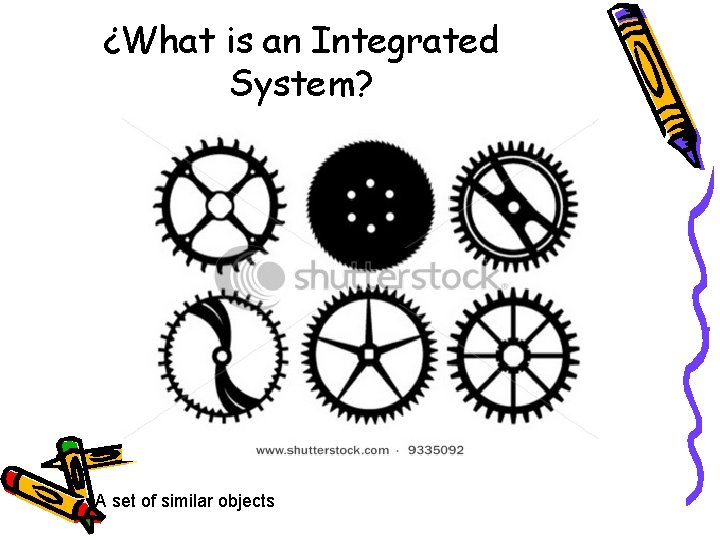
¿What is an Integrated System? A set of similar objects

Savings of efforts and resource Move together in synergy and efficiently And this one?
Integration of Statistics • ¿Why? – Cost-efective production and avoidance of duplication of efforts – Coherent Statistics – Greater Scope of Analysis • ¿How? – Shared cartographic material, classification, standards, concepts, definitions…. – Planinning of all the surveys in an integrated manner: A national calender of surveys – Integrated Samping design for all the surveys in the calender.
¿Does there exist a ready made product? The design is developed as per: - the national requirements and - the available resources
More benefits • Flexibility Ø differnt agencies can implement the module in which they are interested, Ø at differnt times, Ø in differnt zones of their choice, Ø according to avaialbility of resources, Ø Leave the door open for Ø more survey modules to be added to the plan based upon already existing master sample frame, or Ø to drop modules in case of budget cut.
Shukaran Jazeelan.
- Slides: 13