
Basic Concept of the JCM Facilitating diffusion of
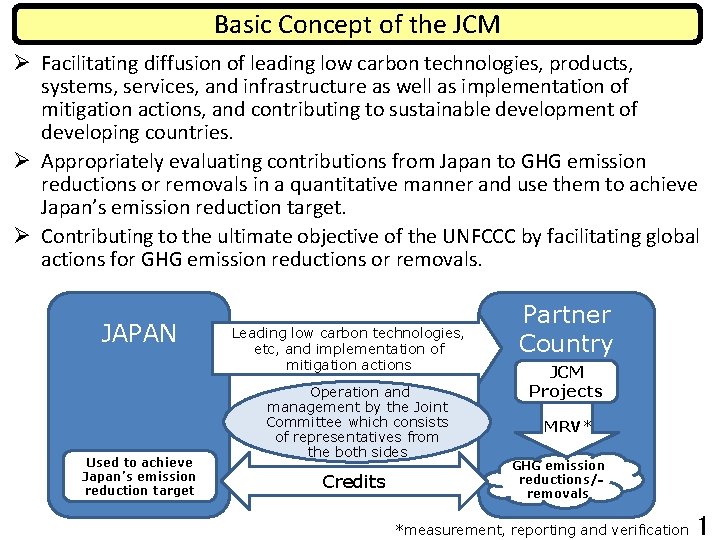
Basic Concept of the JCM Ø Facilitating diffusion of leading low carbon technologies, products, systems, services, and infrastructure as well as implementation of mitigation actions, and contributing to sustainable development of developing countries. Ø Appropriately evaluating contributions from Japan to GHG emission reductions or removals in a quantitative manner and use them to achieve Japan’s emission reduction target. Ø Contributing to the ultimate objective of the UNFCCC by facilitating global actions for GHG emission reductions or removals. JAPAN Used to achieve Japan’s emission reduction target Leading low carbon technologies, etc, and implementation of mitigation actions Operation and management by the Joint Committee which consists of representatives from the both sides Credits Partner Country JCM Projects MRV* GHG emission reductions/ removals *measurement, reporting and verification 1
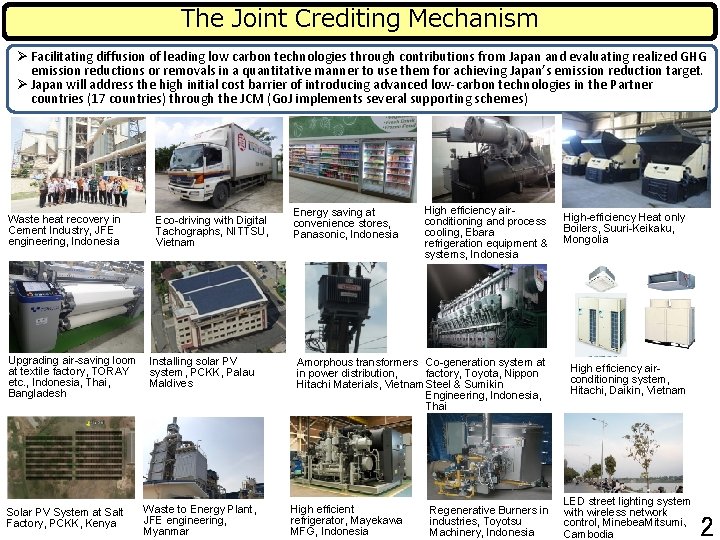
The Joint Crediting Mechanism Ø Facilitating diffusion of leading low carbon technologies through contributions from Japan and evaluating realized GHG emission reductions or removals in a quantitative manner to use them for achieving Japan’s emission reduction target. Ø Japan will address the high initial cost barrier of introducing advanced low-carbon technologies in the Partner countries (17 countries) through the JCM (Go. J implements several supporting schemes) Waste heat recovery in Cement Industry, JFE engineering, Indonesia Upgrading air-saving loom at textile factory, TORAY etc. , Indonesia, Thai, Bangladesh Solar PV System at Salt Factory, PCKK, Kenya Eco-driving with Digital Tachographs, NITTSU, Vietnam Installing solar PV system, PCKK, Palau Maldives Waste to Energy Plant, JFE engineering, Myanmar High efficiency airconditioning and process cooling, Ebara refrigeration equipment & systems, Indonesia High-efficiency Heat only Boilers, Suuri-Keikaku, Mongolia Amorphous transformers Co-generation system at in power distribution, factory, Toyota, Nippon Hitachi Materials, Vietnam Steel & Sumikin Engineering, Indonesia, Thai High efficiency airconditioning system, Hitachi, Daikin, Vietnam Energy saving at convenience stores, Panasonic, Indonesia High efficient refrigerator, Mayekawa MFG, Indonesia Regenerative Burners in industries, Toyotsu Machinery, Indonesia LED street lighting system with wireless network control, Minebea. Mitsumi、 Cambodia 2
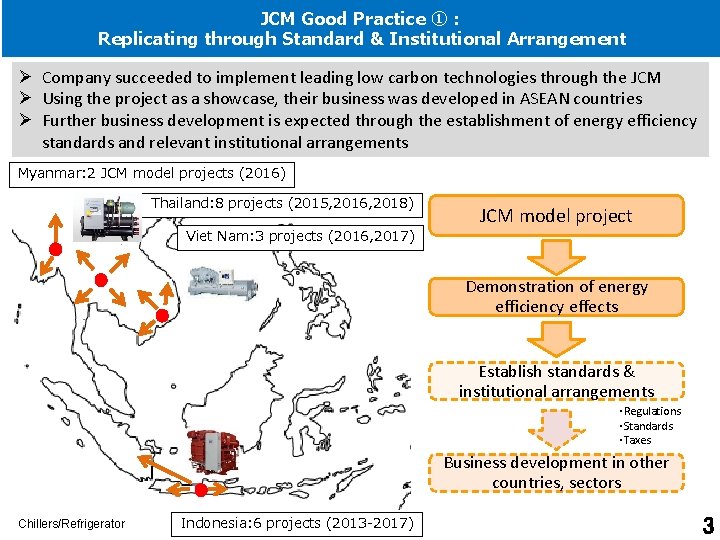
JCM Good Practice ①: Replicating through Standard & Institutional Arrangement Ø Company succeeded to implement leading low carbon technologies through the JCM Ø Using the project as a showcase, their business was developed in ASEAN countries Ø Further business development is expected through the establishment of energy efficiency standards and relevant institutional arrangements Myanmar: 2 JCM model projects (2016) Thailand: 8 projects (2015, 2016, 2018) Viet Nam: 3 projects (2016, 2017) JCM model project Demonstration of energy efficiency effects Establish standards & institutional arrangements ・Regulations ・Standards ・Taxes Business development in other countries, sectors Chillers/Refrigerator Indonesia: 6 projects (2013 -2017) 3
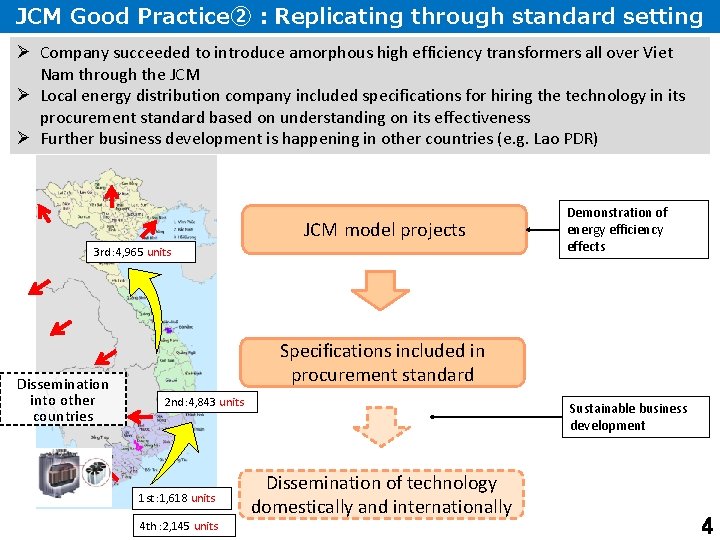
JCM Good Practice②:Replicating through standard setting Ø Company succeeded to introduce amorphous high efficiency transformers all over Viet Nam through the JCM Ø Local energy distribution company included specifications for hiring the technology in its procurement standard based on understanding on its effectiveness Ø Further business development is happening in other countries (e. g. Lao PDR) JCM model projects 3 rd: 4, 965 units Dissemination into other countries Demonstration of energy efficiency effects Specifications included in procurement standard 2 nd: 4, 843 units 1 st: 1, 618 units 4 th: 2, 145 units Sustainable business development Dissemination of technology domestically and internationally 4
- Slides: 4