
Basic Coding Documentation Daniel Stulberg MD Dept of

Basic Coding & Documentation Daniel Stulberg, MD Dept. of Family & Community Medicine University of New Mexico Adapted by Daniel Stulberg from Thomas J. Weida, M. D. 6/4/2021 1
Goals & Objectives • How to appropriately bill and code for levels of the visit. • What needs to be included in the chart to back up the billing/coding. • What NOT to do! 6/4/2021 Adapted by Daniel Stulberg from Thomas J. Weida, M. D. 2
Disclosures • No known conflicts of interest • Not a certified coder • I code as part of my work • A few slides used from – Thomas Weida, MD – STFM 2012 – FP Management – Jo Ann Martinez CPC UNM Compliance Educator 6/4/2021 Adapted by Daniel Stulberg from Thomas J. Weida, M. D. 3
What is Coding & Documentation & Why is it Important? • • Your patient’s time and care is important Document what you did for patient care Your time and work is valuable Document what you did for your billing 6/4/2021 Adapted by Daniel Stulberg from Thomas J. Weida, M. D. 4
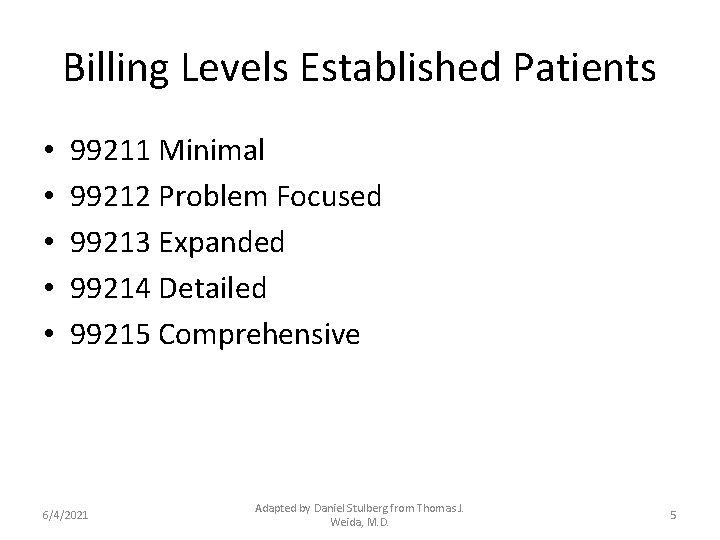
Billing Levels Established Patients • • • 99211 Minimal 99212 Problem Focused 99213 Expanded 99214 Detailed 99215 Comprehensive 6/4/2021 Adapted by Daniel Stulberg from Thomas J. Weida, M. D. 5
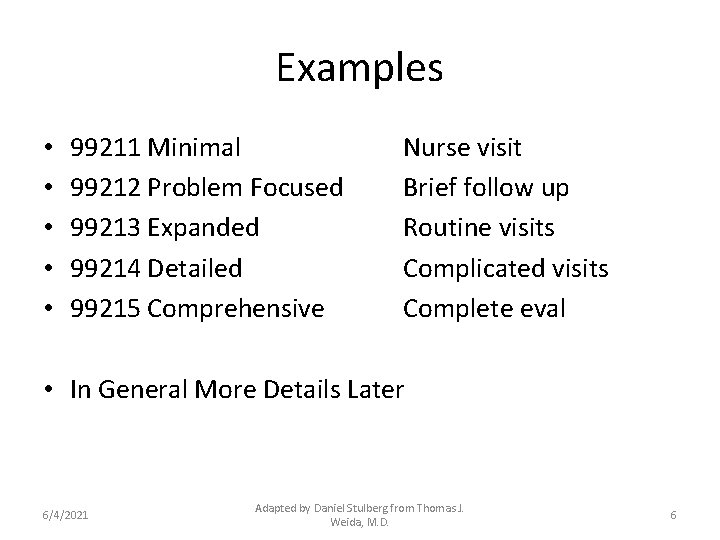
Examples • • • 99211 Minimal 99212 Problem Focused 99213 Expanded 99214 Detailed 99215 Comprehensive Nurse visit Brief follow up Routine visits Complicated visits Complete eval • In General More Details Later 6/4/2021 Adapted by Daniel Stulberg from Thomas J. Weida, M. D. 6
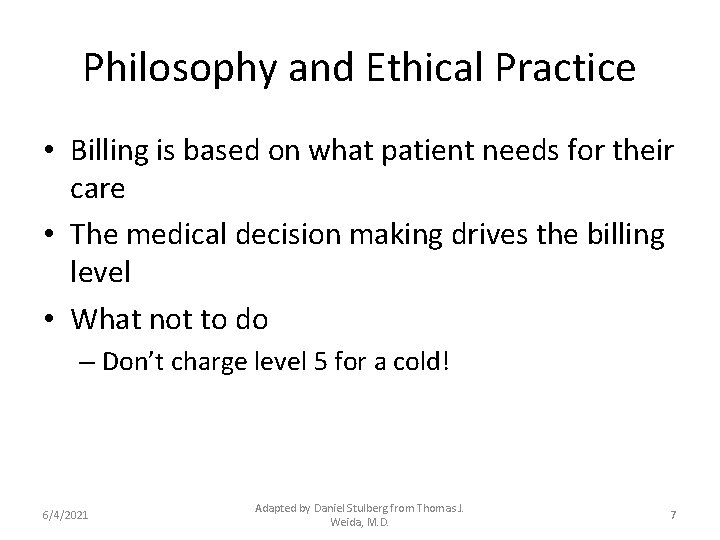
Philosophy and Ethical Practice • Billing is based on what patient needs for their care • The medical decision making drives the billing level • What not to do – Don’t charge level 5 for a cold! 6/4/2021 Adapted by Daniel Stulberg from Thomas J. Weida, M. D. 7
Go for the Easy Stuff! • Time Based • 3 or More Chronic Problems 6/4/2021 Adapted by Daniel Stulberg from Thomas J. Weida, M. D. 8
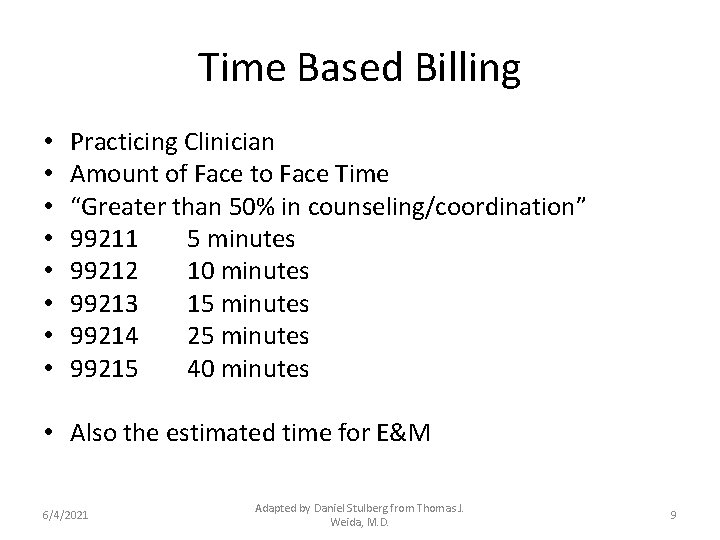
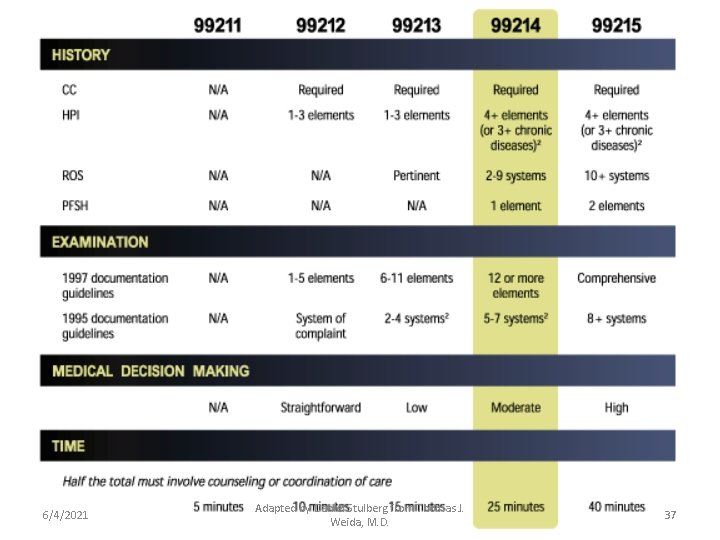
Time Based Billing • • Practicing Clinician Amount of Face to Face Time “Greater than 50% in counseling/coordination” 99211 5 minutes 99212 10 minutes 99213 15 minutes 99214 25 minutes 99215 40 minutes • Also the estimated time for E&M 6/4/2021 Adapted by Daniel Stulberg from Thomas J. Weida, M. D. 9
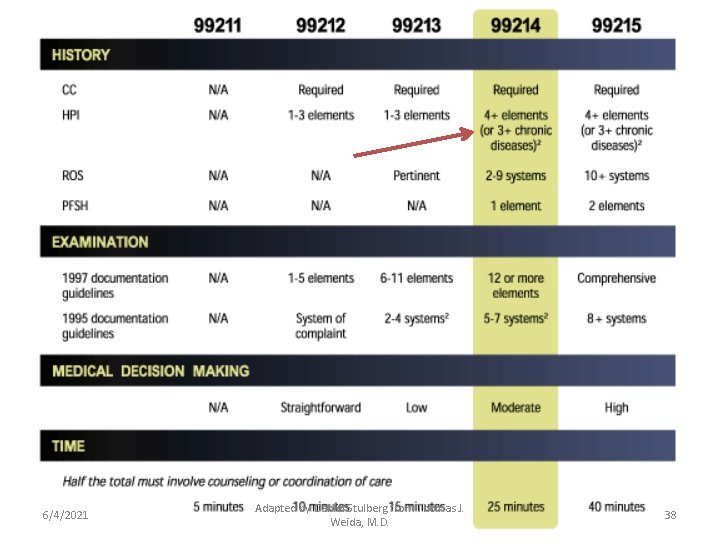
3 or More Chronic Problems • 99214 • Getting all the 99214’s You Deserve – http: //www. aafp. org/fpm/2003/1000/p 31. html • Addressing/Managing 3 Chronic problems • Enough Hx • Enough Complexity 6/4/2021 Adapted by Daniel Stulberg from Thomas J. Weida, M. D. 10
Billing for Tobacco Cessation Counseling – CPT codes • 99406 - Smoke/Tobacco Counseling >3 -10 min • 99407 - Smoke/Tobacco Counseling > 10 min • 8 visits annually allowed in 12 mo period (4 sessions per attempt) • Separate E/M service on same day, use modifier -25 6/4/2021 Adapted by Daniel Stulberg from Thomas J. Weida, M. D. 11
Advanced Care Planning Discussions • Medicare 2016 • Inpt or Outpt • 99497 – first 30 minutes – Face-to-face time w pt, family if pt unable – Discussion – Completion of forms • 99498 – Each additional 30 minutes FAQ’s https: //www. cms. gov/Medicare-Fee-for-Service. Payment/Physician. Fee. Sched/Downloads/FAQ-Advance-Care. Planning. pdf 6/4/2021 Adapted by Daniel Stulberg from Thomas J. Weida, M. D. 12

Now For Something Different 6/4/2021 Adapted by Daniel Stulberg from Thomas J. Weida, M. D. 13
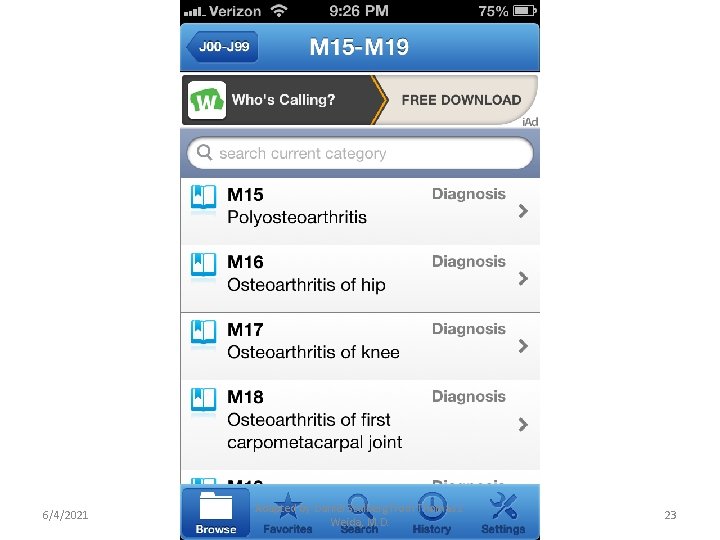
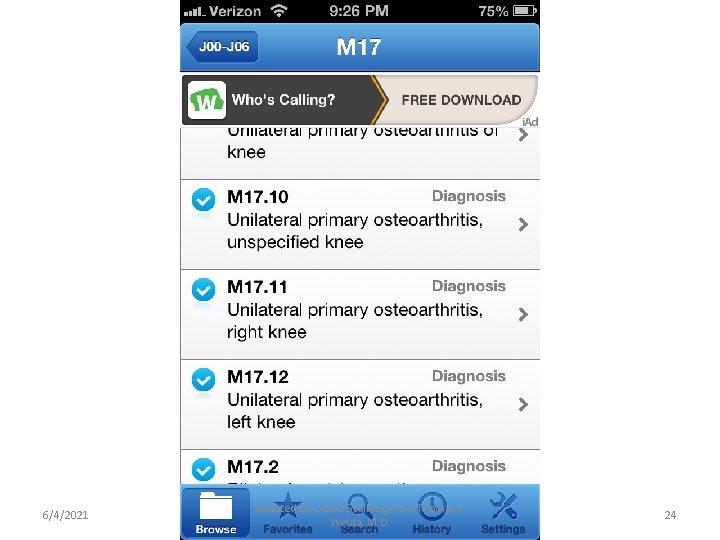
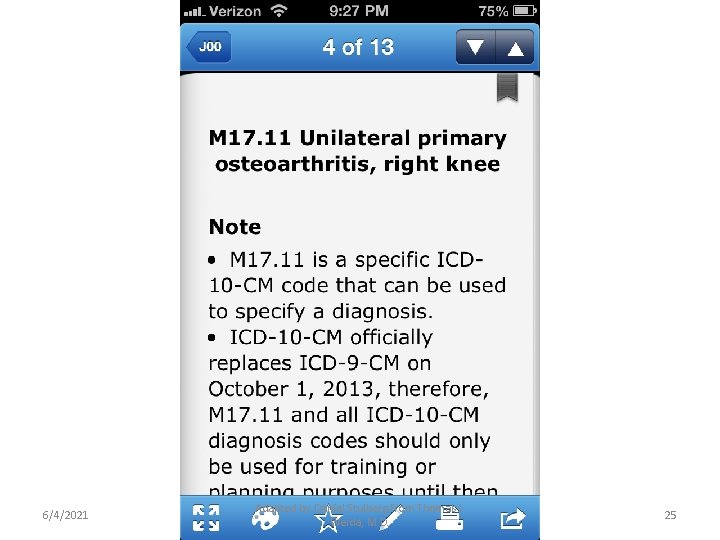
Diagnosis Codes • ICD-10 International Classification of Diseases • SNOMED Systematized Nomenclature of Medicine • Can look up in Powerchart Dx list, or coding book or online 6/4/2021 Adapted by Daniel Stulberg from Thomas J. Weida, M. D. 14
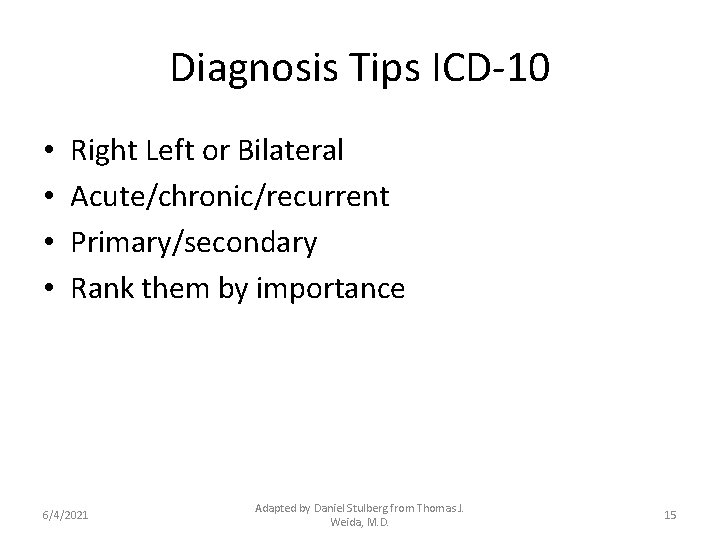
Diagnosis Tips ICD-10 • • Right Left or Bilateral Acute/chronic/recurrent Primary/secondary Rank them by importance 6/4/2021 Adapted by Daniel Stulberg from Thomas J. Weida, M. D. 15
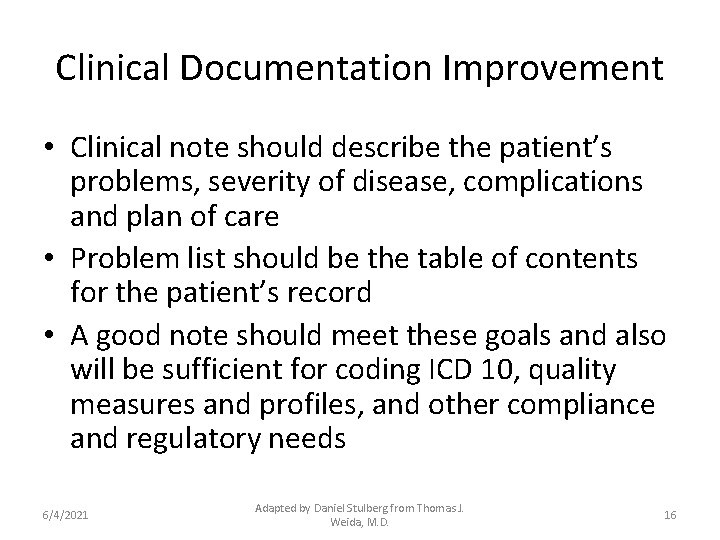
Clinical Documentation Improvement • Clinical note should describe the patient’s problems, severity of disease, complications and plan of care • Problem list should be the table of contents for the patient’s record • A good note should meet these goals and also will be sufficient for coding ICD 10, quality measures and profiles, and other compliance and regulatory needs 6/4/2021 Adapted by Daniel Stulberg from Thomas J. Weida, M. D. 16
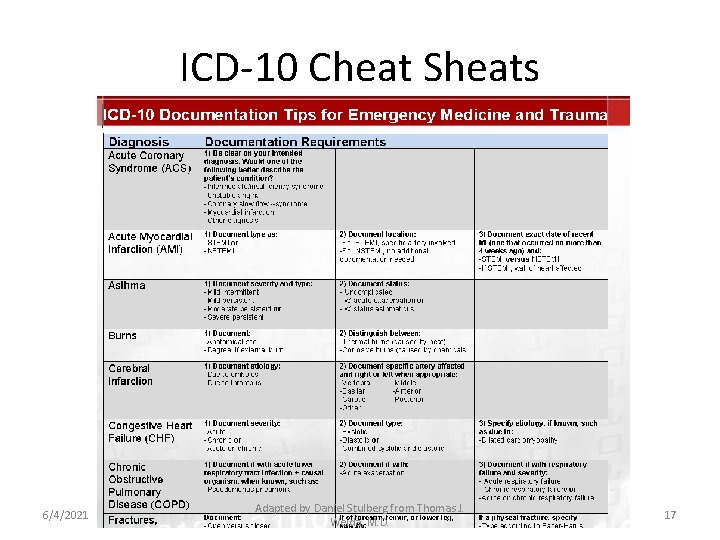
ICD-10 Cheat Sheats 6/4/2021 Adapted by Daniel Stulberg from Thomas J. Weida, M. D. 17
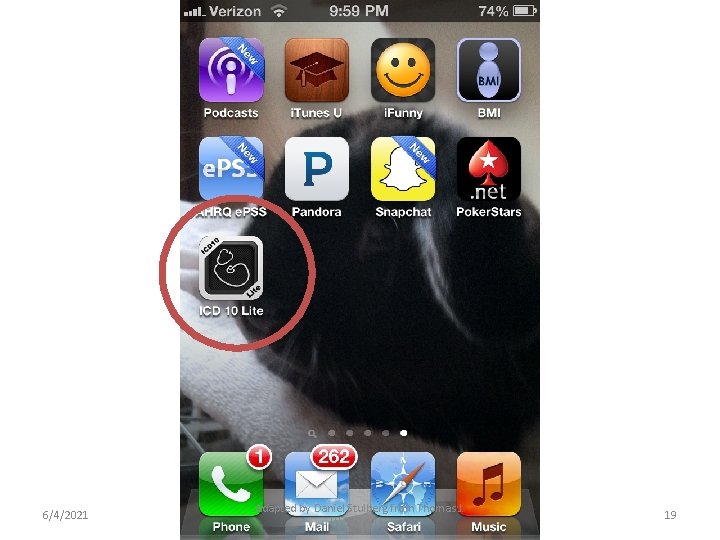
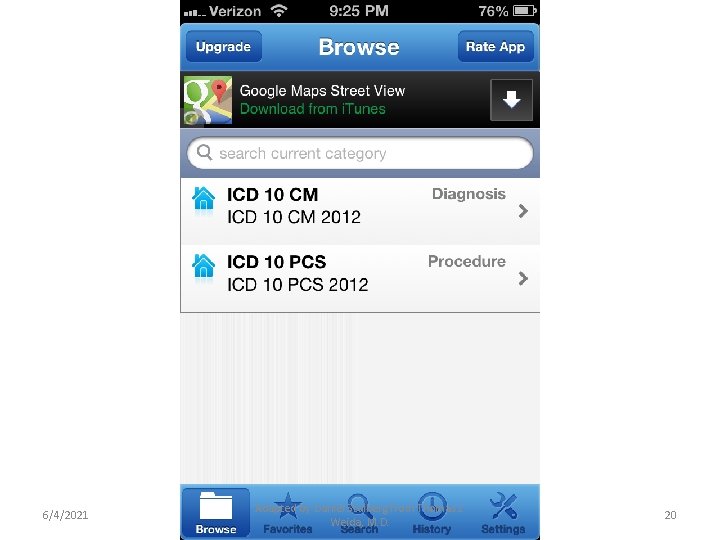
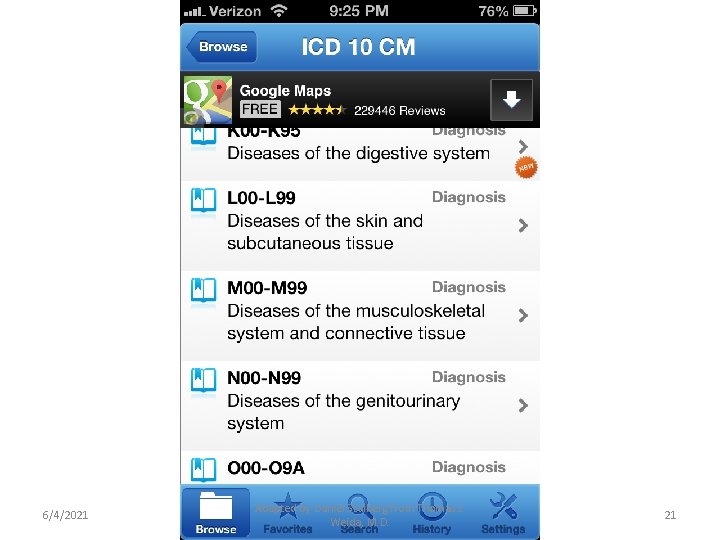
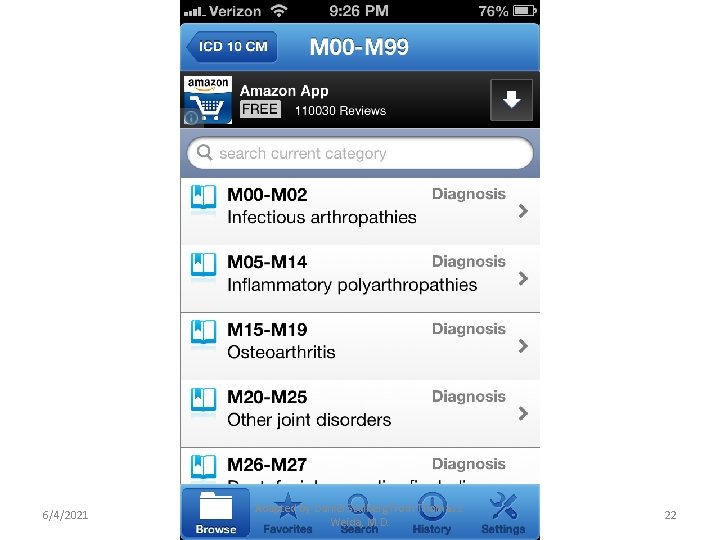
ICD-10 Apps or EHR’s 6/4/2021 Adapted by Daniel Stulberg from Thomas J. Weida, M. D. 18
6/4/2021 Adapted by Daniel Stulberg from Thomas J. Weida, M. D. 19
6/4/2021 Adapted by Daniel Stulberg from Thomas J. Weida, M. D. 20
6/4/2021 Adapted by Daniel Stulberg from Thomas J. Weida, M. D. 21
6/4/2021 Adapted by Daniel Stulberg from Thomas J. Weida, M. D. 22
6/4/2021 Adapted by Daniel Stulberg from Thomas J. Weida, M. D. 23
6/4/2021 Adapted by Daniel Stulberg from Thomas J. Weida, M. D. 24
6/4/2021 Adapted by Daniel Stulberg from Thomas J. Weida, M. D. 25
Now Things Get A Bit Complicated 6/4/2021 Adapted by Daniel Stulberg from Thomas J. Weida, M. D. 26
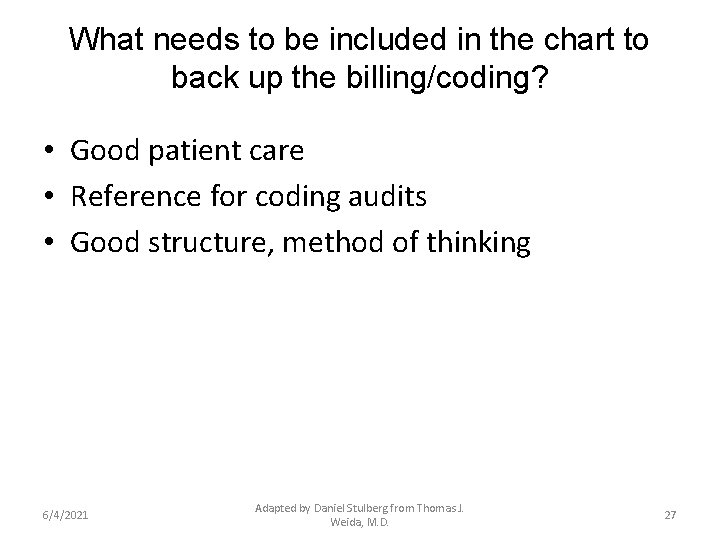
What needs to be included in the chart to back up the billing/coding? • Good patient care • Reference for coding audits • Good structure, method of thinking 6/4/2021 Adapted by Daniel Stulberg from Thomas J. Weida, M. D. 27

Main Components • History • Physical Exam • Medical Decision Making 6/4/2021 Adapted by Daniel Stulberg from Thomas J. Weida, M. D. 28
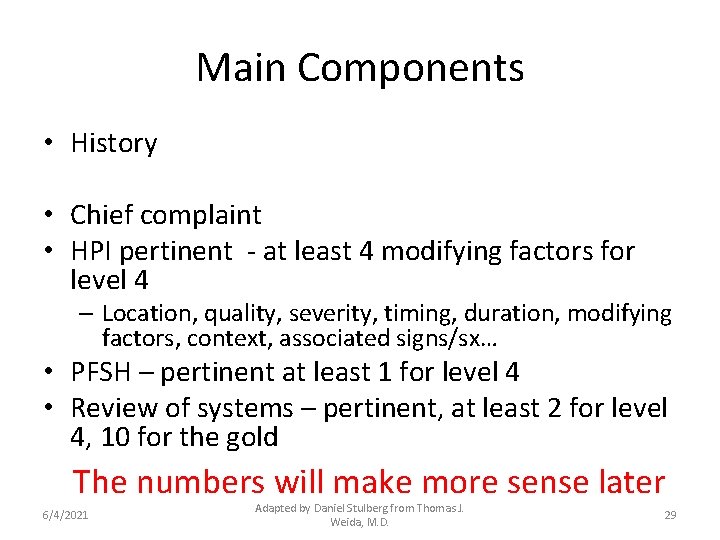
Main Components • History • Chief complaint • HPI pertinent - at least 4 modifying factors for level 4 – Location, quality, severity, timing, duration, modifying factors, context, associated signs/sx… • PFSH – pertinent at least 1 for level 4 • Review of systems – pertinent, at least 2 for level 4, 10 for the gold The numbers will make more sense later 6/4/2021 Adapted by Daniel Stulberg from Thomas J. Weida, M. D. 29
Unable to obtain • List what • List why – Unconscious – Adopted 6/4/2021 Adapted by Daniel Stulberg from Thomas J. Weida, M. D. 30
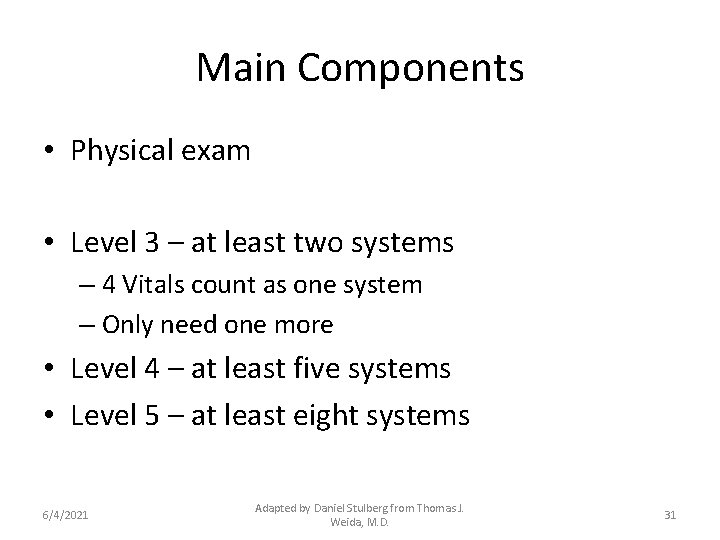
Main Components • Physical exam • Level 3 – at least two systems – 4 Vitals count as one system – Only need one more • Level 4 – at least five systems • Level 5 – at least eight systems 6/4/2021 Adapted by Daniel Stulberg from Thomas J. Weida, M. D. 31
Main Components -Medical Decision Making 6/4/2021 Adapted by Daniel Stulberg from Thomas J. Weida, M. D. 32
Medical Decision Making • • Number of problems addressed Length of differential diagnosis Complexity or risk Data reviewed, requesting old records, reviewing labs, reviewing previous studies, reviewing images, ordering labs, ordering tests 6/4/2021 Adapted by Daniel Stulberg from Thomas J. Weida, M. D. 33
New Patients vs. Established • Never seen in this practice • Never seen in this specialty • Not seen in > three years • Paid for extra work to practice • Paid for extra work in getting more information 6/4/2021 Adapted by Daniel Stulberg from Thomas J. Weida, M. D. 34
Billing Levels New Patients • • • 99201 Minimal 99202 Problem Focused 99203 Expanded 99204 Detailed 99205 Comprehensive 6/4/2021 Adapted by Daniel Stulberg from Thomas J. Weida, M. D. 35
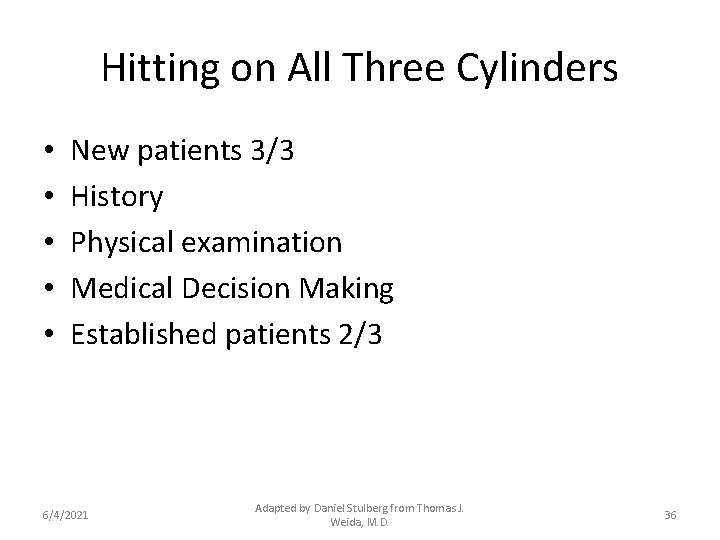
Hitting on All Three Cylinders • • • New patients 3/3 History Physical examination Medical Decision Making Established patients 2/3 6/4/2021 Adapted by Daniel Stulberg from Thomas J. Weida, M. D. 36
6/4/2021 Adapted by Daniel Stulberg from Thomas J. Weida, M. D. 37
6/4/2021 Adapted by Daniel Stulberg from Thomas J. Weida, M. D. 38

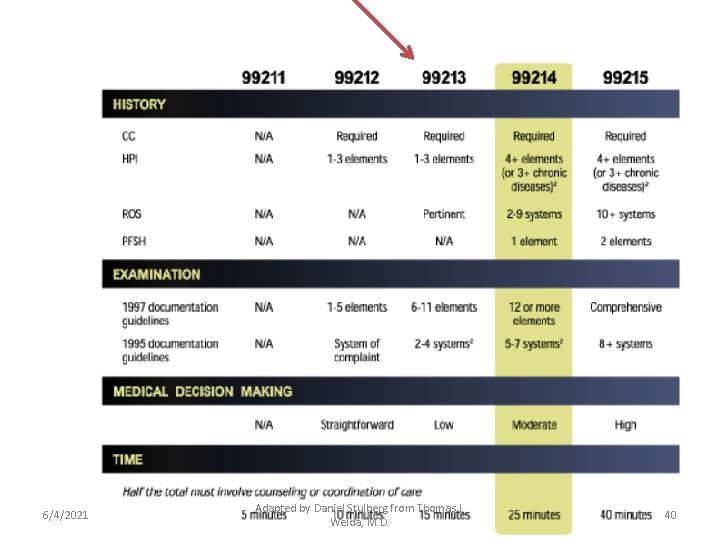
Easy Pickings • 99213 6/4/2021 Adapted by Daniel Stulberg from Thomas J. Weida, M. D. 39
6/4/2021 Adapted by Daniel Stulberg from Thomas J. Weida, M. D. 40
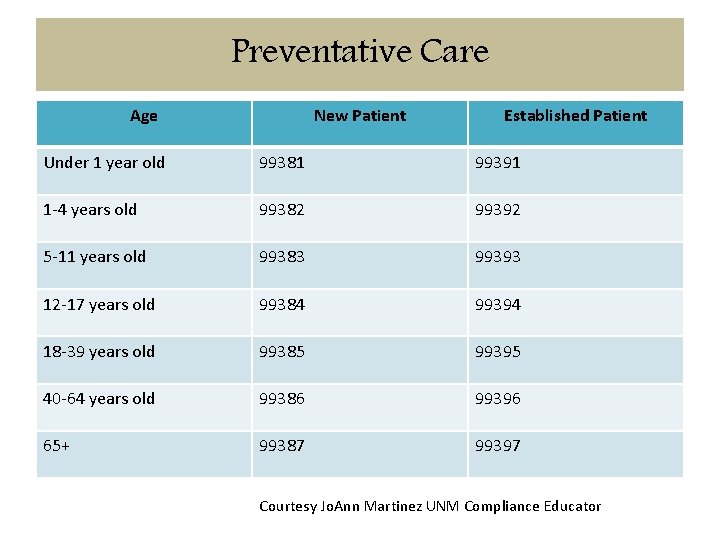
Preventative Care Age New Patient Established Patient Under 1 year old 99381 99391 1 -4 years old 99382 99392 5 -11 years old 99383 99393 12 -17 years old 99384 99394 18 -39 years old 99385 99395 40 -64 years old 99386 99396 65+ 99387 99397 Courtesy Jo. Ann Martinez UNM Compliance Educator
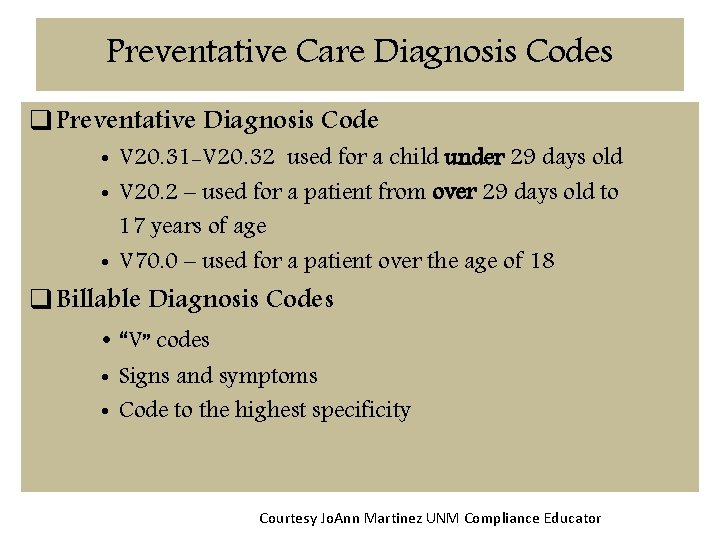
Preventative Care Diagnosis Codes q Preventative Diagnosis Code • V 20. 31 -V 20. 32 used for a child under 29 days old • V 20. 2 – used for a patient from over 29 days old to 17 years of age • V 70. 0 – used for a patient over the age of 18 q Billable Diagnosis Codes • “V” codes • Signs and symptoms • Code to the highest specificity Courtesy Jo. Ann Martinez UNM Compliance Educator
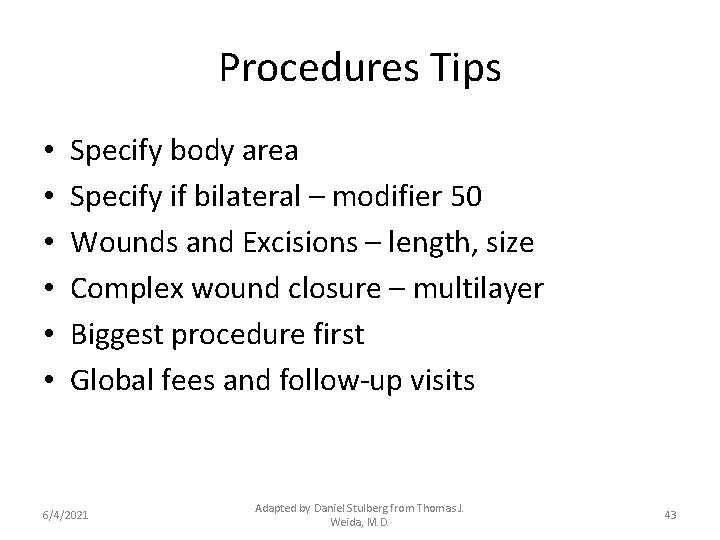
Procedures Tips • • • Specify body area Specify if bilateral – modifier 50 Wounds and Excisions – length, size Complex wound closure – multilayer Biggest procedure first Global fees and follow-up visits 6/4/2021 Adapted by Daniel Stulberg from Thomas J. Weida, M. D. 43
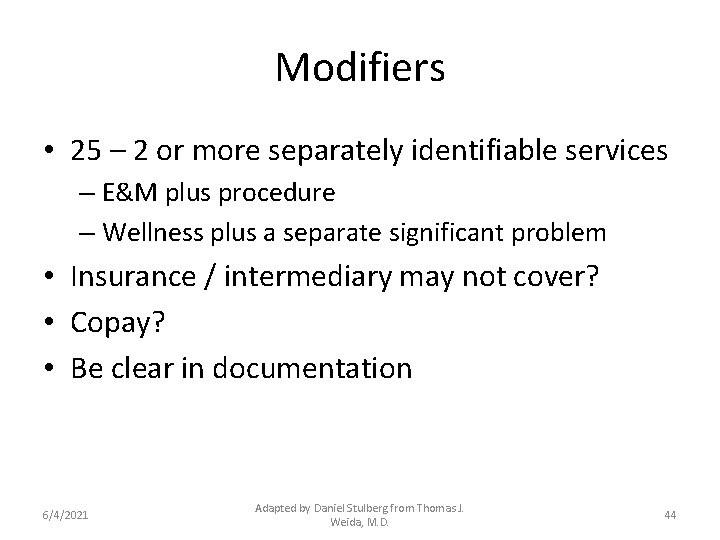
Modifiers • 25 – 2 or more separately identifiable services – E&M plus procedure – Wellness plus a separate significant problem • Insurance / intermediary may not cover? • Copay? • Be clear in documentation 6/4/2021 Adapted by Daniel Stulberg from Thomas J. Weida, M. D. 44
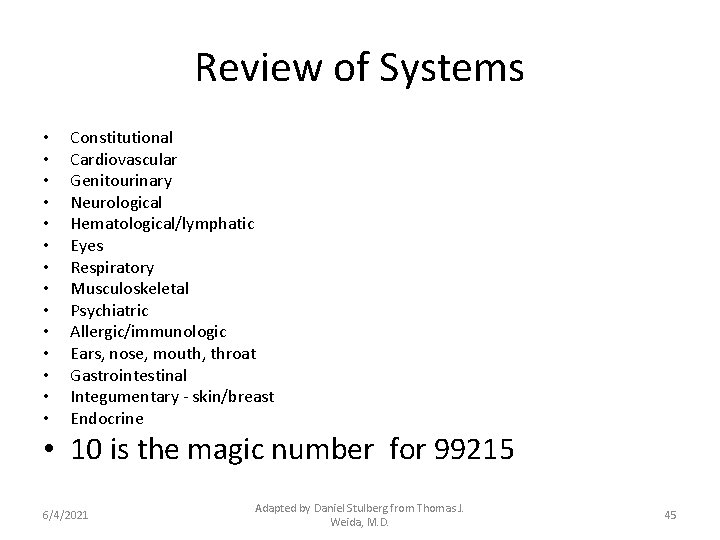
Review of Systems • • • • Constitutional Cardiovascular Genitourinary Neurological Hematological/lymphatic Eyes Respiratory Musculoskeletal Psychiatric Allergic/immunologic Ears, nose, mouth, throat Gastrointestinal Integumentary - skin/breast Endocrine • 10 is the magic number for 99215 6/4/2021 Adapted by Daniel Stulberg from Thomas J. Weida, M. D. 45
Review of Systems • Non-Contributory for… • Positive for… • Review of Systems “otherwise 10 point ROS was negative” 6/4/2021 Adapted by Daniel Stulberg from Thomas J. Weida, M. D. 46
Pre – Printed Forms • • History “Instant medical history” New Patient Forms Combined History and PE forms Check lists for ROS, PE 6/4/2021 Adapted by Daniel Stulberg from Thomas J. Weida, M. D. 47
What Not To Do • Don’t bill based on what you did vs what pt needed • Don’t rely on other’s CC or HPI, can rely on forms or staff for PFSH and ROS • Document work you didn’t do – IE templates • Alarming rise in hermaphrodites! 6/4/2021 Adapted by Daniel Stulberg from Thomas J. Weida, M. D. 48
Supplies • HCPCS - Healthcare Common Procedure Coding System • List supplies used • Checkbox or billing staff complete • Facility fees 6/4/2021 Adapted by Daniel Stulberg from Thomas J. Weida, M. D. 49
Inpatient Services 6/4/2021 Adapted by Daniel Stulberg from Thomas J. Weida, M. D. 50
Inpatient Services • • Admissions - 3 levels Follow-up visits - 3 levels Observation status Discharge – < 30 min. – > 30 min. 6/4/2021 Adapted by Daniel Stulberg from Thomas J. Weida, M. D. 51
Initial Hospital Care – New or Established: 3 Key Components • 99221: Ave 30 min bedside or floor – Decision making – low complexity – Detailed history, detailed physical • 99222: Ave 50 min bedside or floor – Decision making moderate complexity – Comprehensive history, comprehensive physical • 99223: Ave 70 min bedside or floor – Decision making of high complexity – Comprehensive history, comprehensive physical 6/4/2021 Adapted by Daniel Stulberg from Thomas J. Weida, M. D. 52
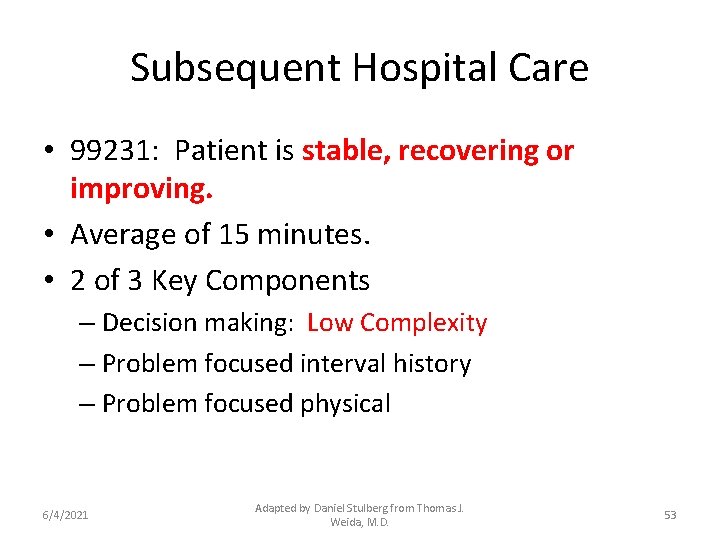
Subsequent Hospital Care • 99231: Patient is stable, recovering or improving. • Average of 15 minutes. • 2 of 3 Key Components – Decision making: Low Complexity – Problem focused interval history – Problem focused physical 6/4/2021 Adapted by Daniel Stulberg from Thomas J. Weida, M. D. 53
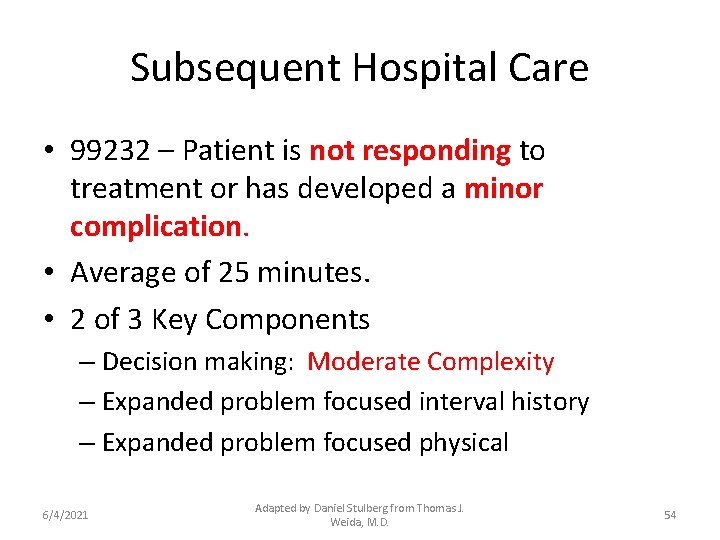
Subsequent Hospital Care • 99232 – Patient is not responding to treatment or has developed a minor complication. • Average of 25 minutes. • 2 of 3 Key Components – Decision making: Moderate Complexity – Expanded problem focused interval history – Expanded problem focused physical 6/4/2021 Adapted by Daniel Stulberg from Thomas J. Weida, M. D. 54
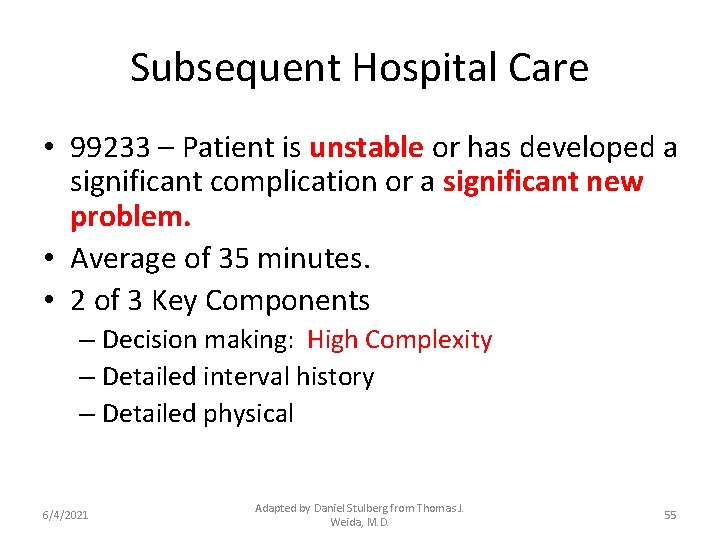
Subsequent Hospital Care • 99233 – Patient is unstable or has developed a significant complication or a significant new problem. • Average of 35 minutes. • 2 of 3 Key Components – Decision making: High Complexity – Detailed interval history – Detailed physical 6/4/2021 Adapted by Daniel Stulberg from Thomas J. Weida, M. D. 55
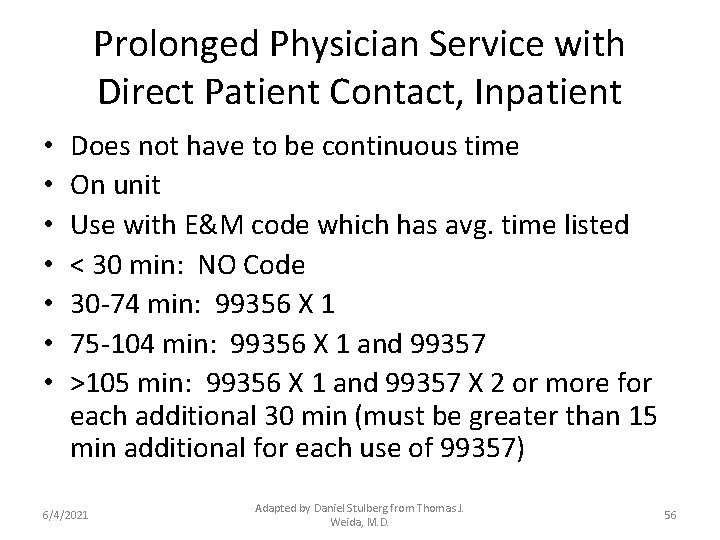
Prolonged Physician Service with Direct Patient Contact, Inpatient • • Does not have to be continuous time On unit Use with E&M code which has avg. time listed < 30 min: NO Code 30 -74 min: 99356 X 1 75 -104 min: 99356 X 1 and 99357 >105 min: 99356 X 1 and 99357 X 2 or more for each additional 30 min (must be greater than 15 min additional for each use of 99357) 6/4/2021 Adapted by Daniel Stulberg from Thomas J. Weida, M. D. 56
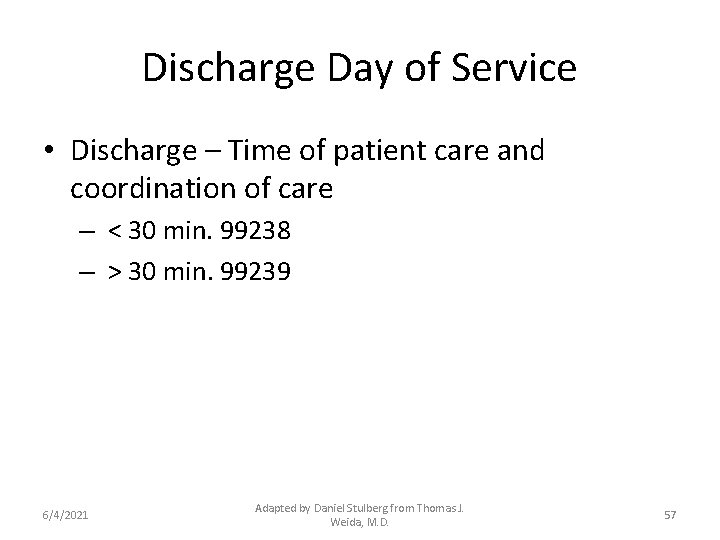
Discharge Day of Service • Discharge – Time of patient care and coordination of care – < 30 min. 99238 – > 30 min. 99239 6/4/2021 Adapted by Daniel Stulberg from Thomas J. Weida, M. D. 57
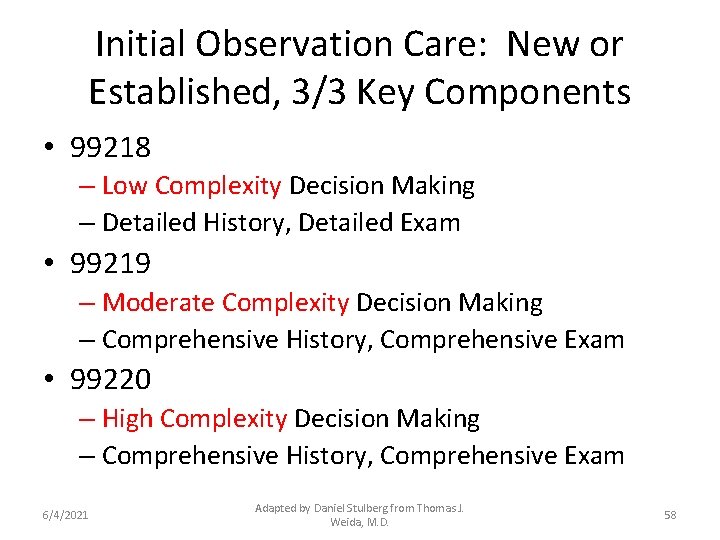
Initial Observation Care: New or Established, 3/3 Key Components • 99218 – Low Complexity Decision Making – Detailed History, Detailed Exam • 99219 – Moderate Complexity Decision Making – Comprehensive History, Comprehensive Exam • 99220 – High Complexity Decision Making – Comprehensive History, Comprehensive Exam 6/4/2021 Adapted by Daniel Stulberg from Thomas J. Weida, M. D. 58
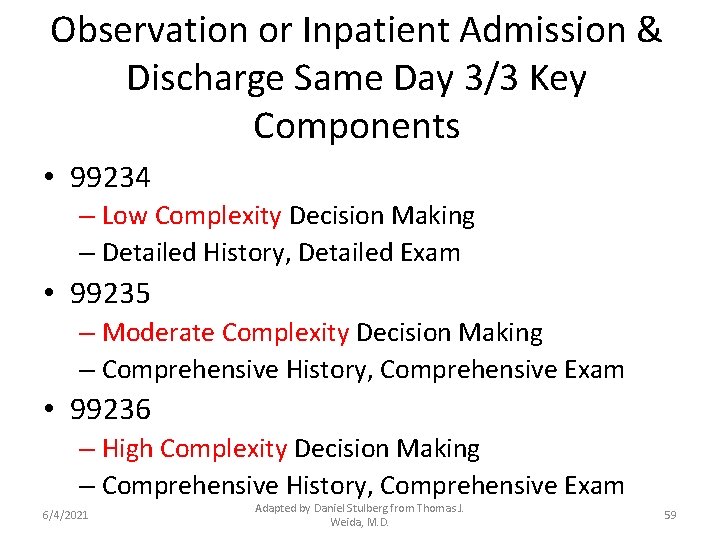
Observation or Inpatient Admission & Discharge Same Day 3/3 Key Components • 99234 – Low Complexity Decision Making – Detailed History, Detailed Exam • 99235 – Moderate Complexity Decision Making – Comprehensive History, Comprehensive Exam • 99236 – High Complexity Decision Making – Comprehensive History, Comprehensive Exam 6/4/2021 Adapted by Daniel Stulberg from Thomas J. Weida, M. D. 59
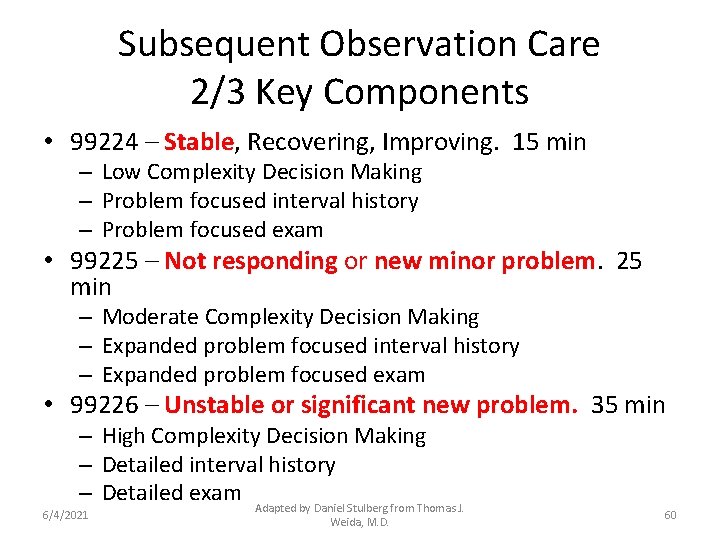
Subsequent Observation Care 2/3 Key Components • 99224 – Stable, Recovering, Improving. 15 min – Low Complexity Decision Making – Problem focused interval history – Problem focused exam • 99225 – Not responding or new minor problem. 25 min – Moderate Complexity Decision Making – Expanded problem focused interval history – Expanded problem focused exam • 99226 – Unstable or significant new problem. 35 min – High Complexity Decision Making – Detailed interval history – Detailed exam Adapted by Daniel Stulberg from Thomas J. 6/4/2021 Weida, M. D. 60
Observation Care Discharge Services • Discharge on separate day than admission to observation status • 99217 6/4/2021 Adapted by Daniel Stulberg from Thomas J. Weida, M. D. 61
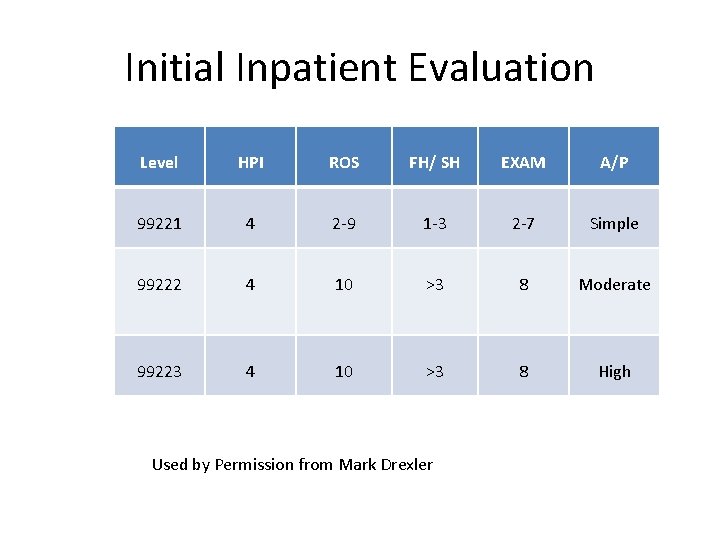
Initial Inpatient Evaluation Level HPI ROS FH/ SH EXAM A/P 99221 4 2 -9 1 -3 2 -7 Simple 99222 4 10 >3 8 Moderate 99223 4 10 >3 8 High Used by Permission from Mark Drexler
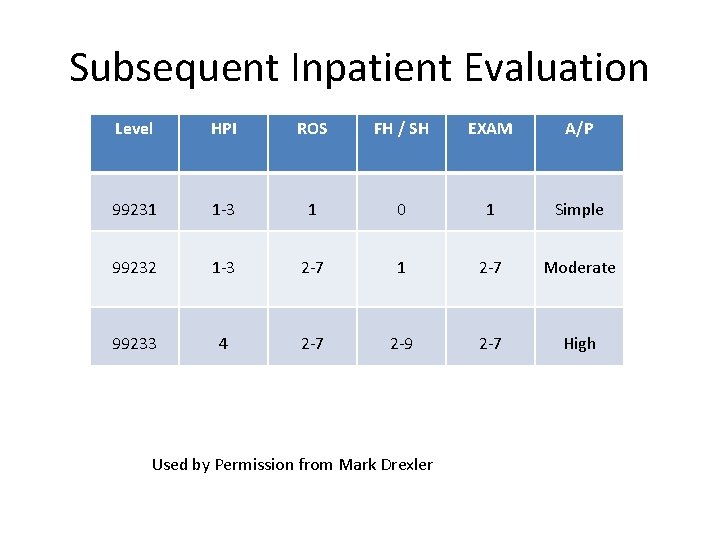
Subsequent Inpatient Evaluation Level HPI ROS FH / SH EXAM A/P 99231 1 -3 1 0 1 Simple 99232 1 -3 2 -7 1 2 -7 Moderate 99233 4 2 -7 2 -9 2 -7 High Used by Permission from Mark Drexler
Concurrent Care • Multiple services, including the primary service and any sub specialists, providing care for a patient. • Each service must document and bill only for the condition they are treating. • On the day of initial consultation, the primary service may bill for the condition pertinent to the consultation. • On days subsequent to the initial consultation, the primary service is unlikely to capture charges related to the condition being treated by any sub specialists. Used by Permission from Mark Drexler
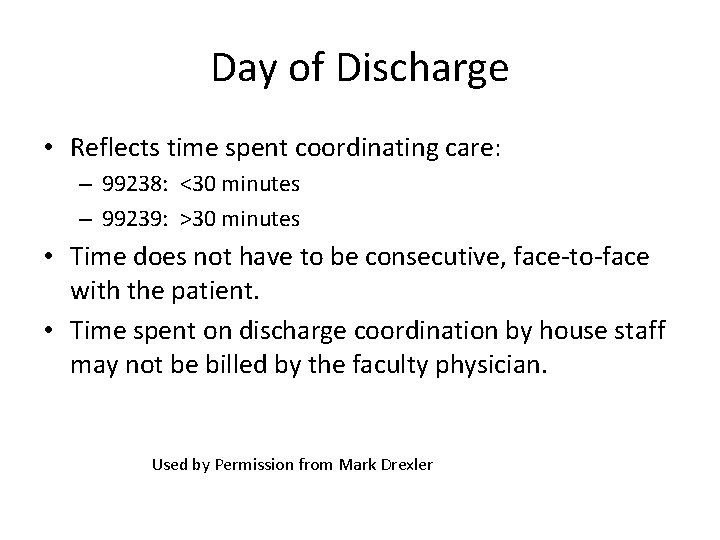
Day of Discharge • Reflects time spent coordinating care: – 99238: <30 minutes – 99239: >30 minutes • Time does not have to be consecutive, face-to-face with the patient. • Time spent on discharge coordination by house staff may not be billed by the faculty physician. Used by Permission from Mark Drexler
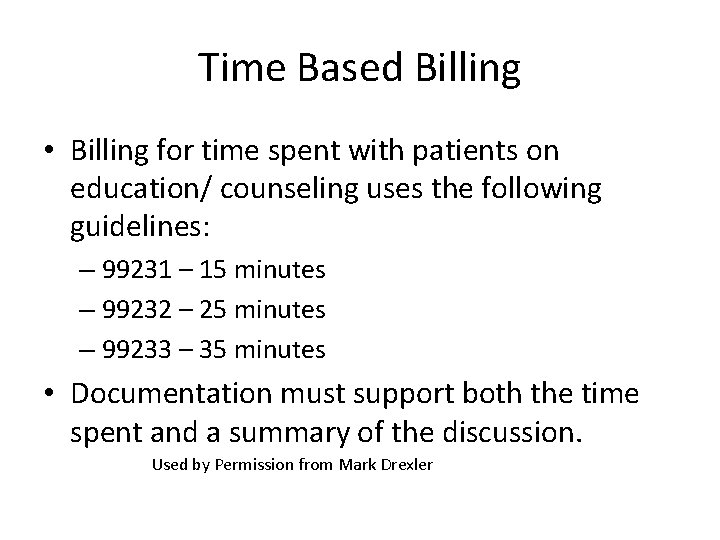
Time Based Billing • Billing for time spent with patients on education/ counseling uses the following guidelines: – 99231 – 15 minutes – 99232 – 25 minutes – 99233 – 35 minutes • Documentation must support both the time spent and a summary of the discussion. Used by Permission from Mark Drexler
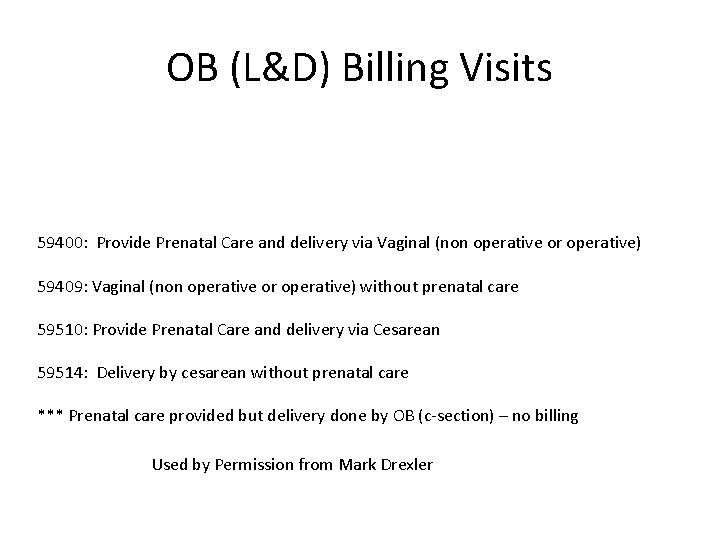
OB (L&D) Billing Visits 59400: Provide Prenatal Care and delivery via Vaginal (non operative or operative) 59409: Vaginal (non operative or operative) without prenatal care 59510: Provide Prenatal Care and delivery via Cesarean 59514: Delivery by cesarean without prenatal care *** Prenatal care provided but delivery done by OB (c-section) – no billing Used by Permission from Mark Drexler
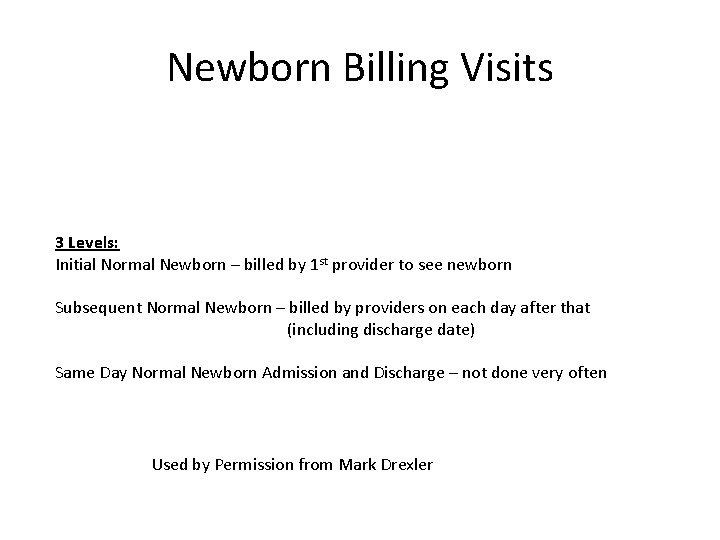
Newborn Billing Visits 3 Levels: Initial Normal Newborn – billed by 1 st provider to see newborn Subsequent Normal Newborn – billed by providers on each day after that (including discharge date) Same Day Normal Newborn Admission and Discharge – not done very often Used by Permission from Mark Drexler
Newborn Coding: Initial Care • Evaluation and management services provided to normal newborns in the first days of life prior to hospital discharge are reported with Newborn Care Services codes. Codes for initial care of the normal newborn include: – 99460: Initial hospital or birthing center care, per day, for evaluation and management of normal newborn infants. – 99461: Initial care, per day, for evaluation and managmeent of normal newborn infant seen in other than hospital or birthing center. – 99463: Initial hospital or birthing center care, per day, for evaluation and management of normal newborn infant admitted and discharged on the same date. Used by Permission from Mark Drexler
Newborn Coding: Subsequent Care • 99462: Subsequent hospital care for the normal newborn is reported once per day. • 99238 or 99239: Discharge services provided on a date subsequent to admission. Used by Permission from Mark Drexler
Wrap Up • Goals and Objective – How to appropriately bill and code for levels of the visit. – What needs to be included in the chart to back up the billing/coding. – What NOT to do! • “Two out of three ain’t bad” 6/4/2021 Adapted by Daniel Stulberg from Thomas J. Weida, M. D. 71
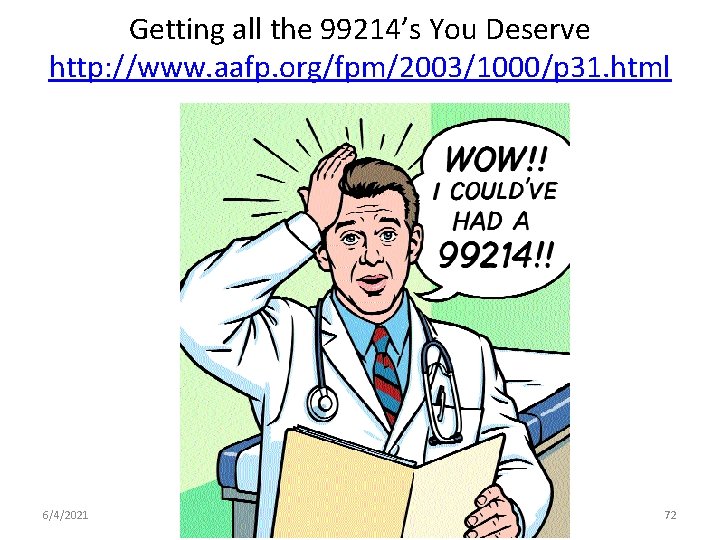
Getting all the 99214’s You Deserve http: //www. aafp. org/fpm/2003/1000/p 31. html 6/4/2021 Adapted by Daniel Stulberg from Thomas J. Weida, M. D. 72
References and Resources • FP Management monthly coding tips and queries • Powerchart Problem List for ICD-9 and SNOMED • UNMG Compliance Coordinator - Glenda Harris 815 Vassar NE / MSC 11 -6150 Albuquerque, NM 87131 Phone 505 -925 -6053 Fax 505 -272 -3354 gvharris@unmmg. org 6/4/2021 Adapted by Daniel Stulberg from Thomas J. Weida, M. D. 73
- Slides: 73