
BASIC CHEMISTRY CHM 138 CHAPTER 8 INTRODUCTION TO
BASIC CHEMISTRY CHM 138 CHAPTER 8 INTRODUCTION TO ORGANIC CHEMISTRY NOR AKMALAZURA JANI
ORGANIC CHEMISTRY • Organic chemistry: -The branch of chemistry that deals with carbons compounds. • ‘Organic’ – derived from living organisms • Study of compounds extracted from living organisms and their natural products. • Examples: sugar, starch, urea, waxes, carbohydrates, fats and etc • Human are composed of organic molecules – proteins in skin, lipid in cell membranes, glycogen in livers and the DNA in the nuclei of cells.
Chemistry of carbon: - Two stable isotops (13 C and 12 C) - electron configuration: 1 s 2 2 p 2 - four valence electrons - can form more compounds than any other element - able to form single, double and triple carbon bonds, and to link up with each other in chains and ring structures l
HOMOLOGUE SERIES AND FUNCTIONAL GROUPS l Functional group: A group of atoms that is largely responsible for the chemical behavior of the parent molecule. Functional groups: - hydrocarbons - alcohols - aldehydes - ketones - carboxylic acids - alkyl halides l

HYDROCARBONS • Made up of only hydrogen and carbon
ALKANES General formula: Cn. H 2 n+2, where n = 1, 2, …. l l Only single covalent bonds are present l Known as saturated hydrocarbons because contain the maximum number of hydrogen atoms that can bond with the number of carbon atoms present. l Can be assumed to be sp 3 -hydridized
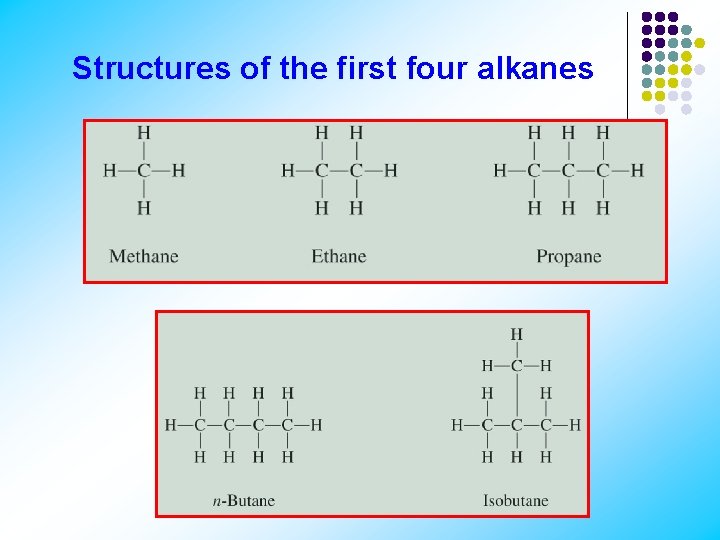
Structures of the first four alkanes
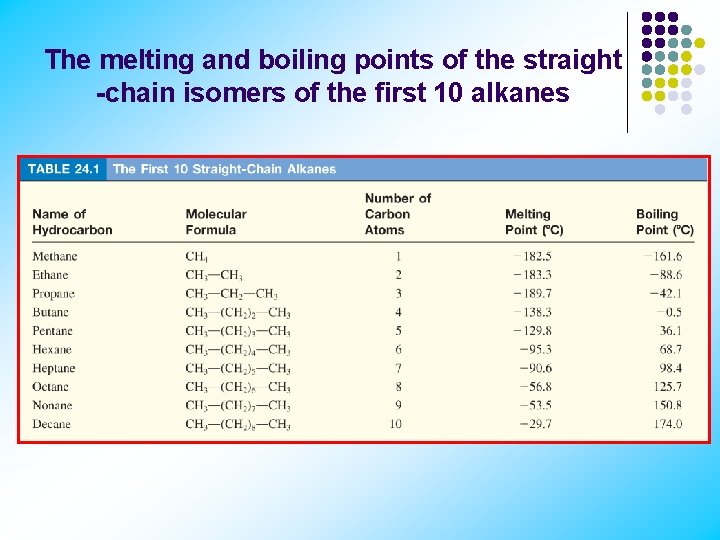
The melting and boiling points of the straight -chain isomers of the first 10 alkanes
Homologous Series 1. 2. 3. Definition: A series of compounds in which each member differs from the next by a specific number and kind of atoms. Alkanes: Differ only at number of (CH 2) Series of compounds that has the same functional group.
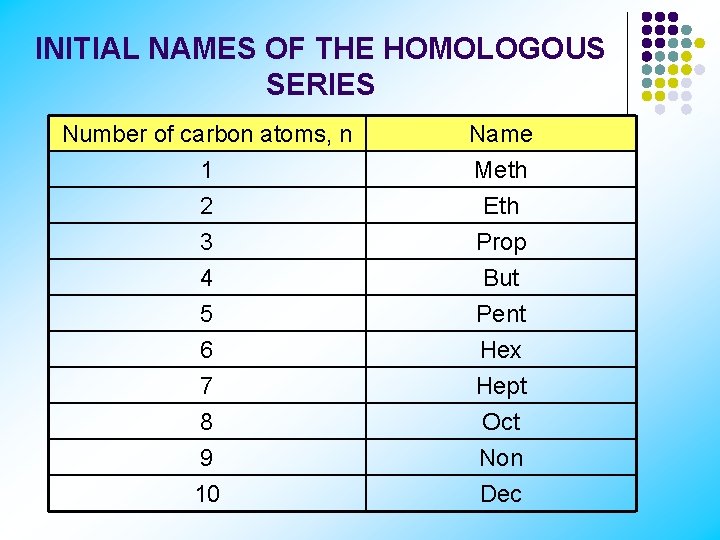
INITIAL NAMES OF THE HOMOLOGOUS SERIES Number of carbon atoms, n 1 2 3 Name Meth Eth Prop 4 5 6 7 8 9 10 But Pent Hex Hept Oct Non Dec
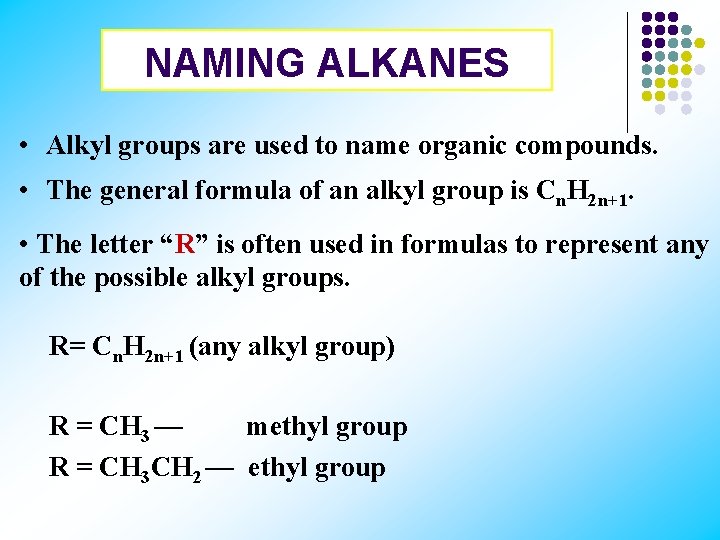
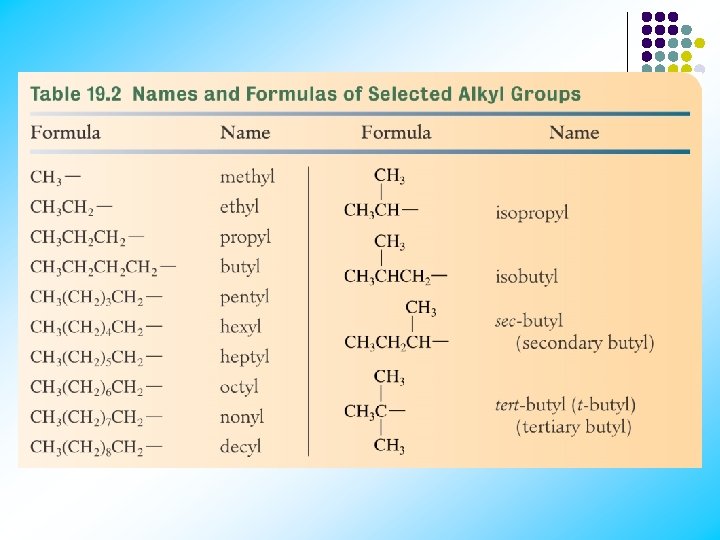
NAMING ALKANES • Alkyl groups are used to name organic compounds. • The general formula of an alkyl group is Cn. H 2 n+1. • The letter “R” is often used in formulas to represent any of the possible alkyl groups. R= Cn. H 2 n+1 (any alkyl group) R = CH 3 — methyl group R = CH 3 CH 2 — ethyl group
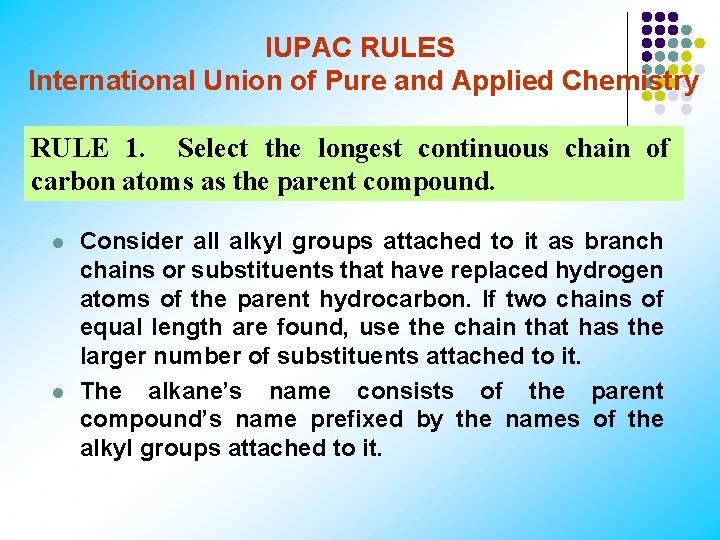
IUPAC RULES International Union of Pure and Applied Chemistry RULE 1. Select the longest continuous chain of carbon atoms as the parent compound. l l Consider all alkyl groups attached to it as branch chains or substituents that have replaced hydrogen atoms of the parent hydrocarbon. If two chains of equal length are found, use the chain that has the larger number of substituents attached to it. The alkane’s name consists of the parent compound’s name prefixed by the names of the alkyl groups attached to it.
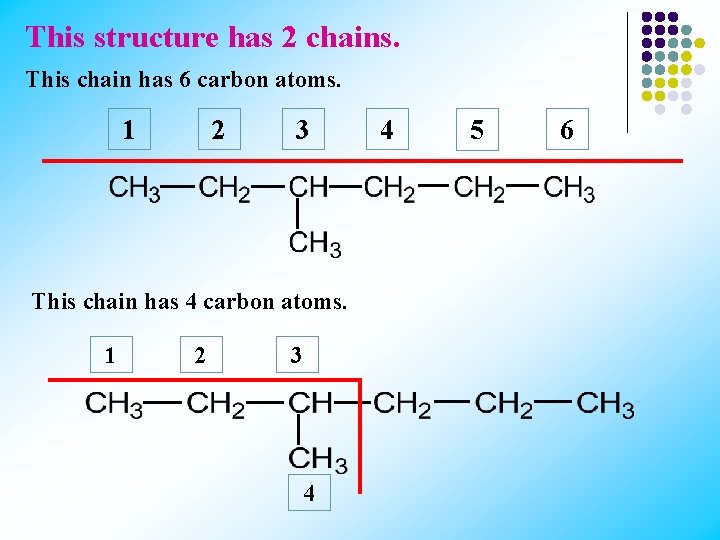
This structure has 2 chains. This chain has 6 carbon atoms. 1 2 3 This chain has 4 carbon atoms. 1 2 3 4 4 5 6
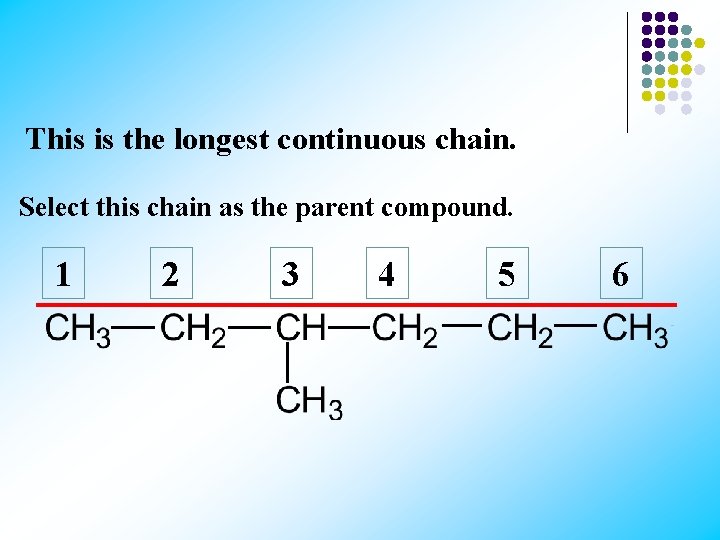
This is the longest continuous chain. Select this chain as the parent compound. 1 2 3 4 5 6
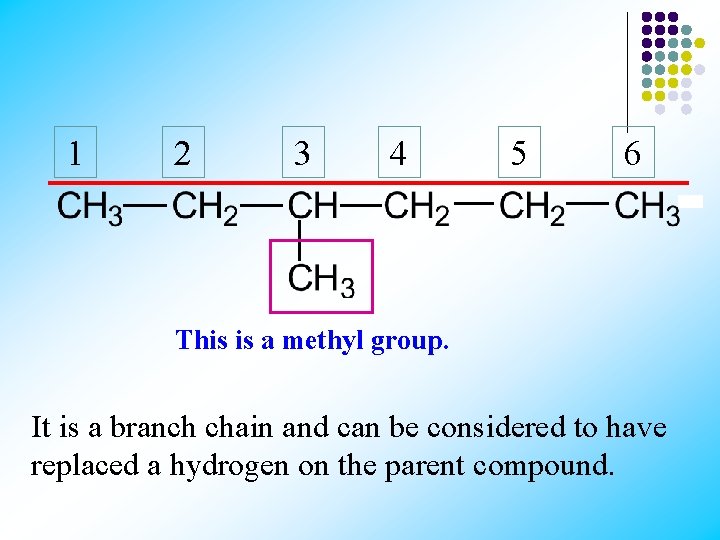
1 2 3 4 5 6 This is a methyl group. It is a branch chain and can be considered to have replaced a hydrogen on the parent compound.
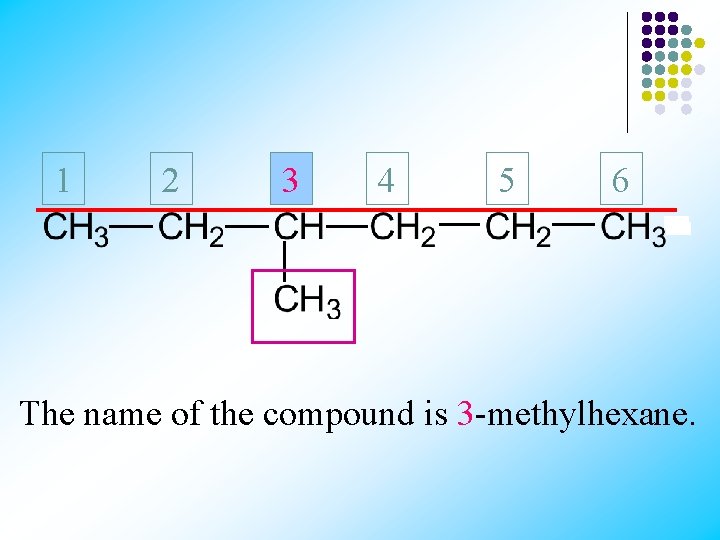
1 2 3 4 5 6 The name of the compound is 33 -methylhexane.
IUPAC RULES RULE 2. Number the carbon atoms in the parent carbon chain starting from the end closest to the first carbon atom that has an alkyl group substituted for a hydrogen atom. l If the first subsitutent from each end is on the samenumbered carbon, go to the next substituent to determine which end of the chain to start numbering.
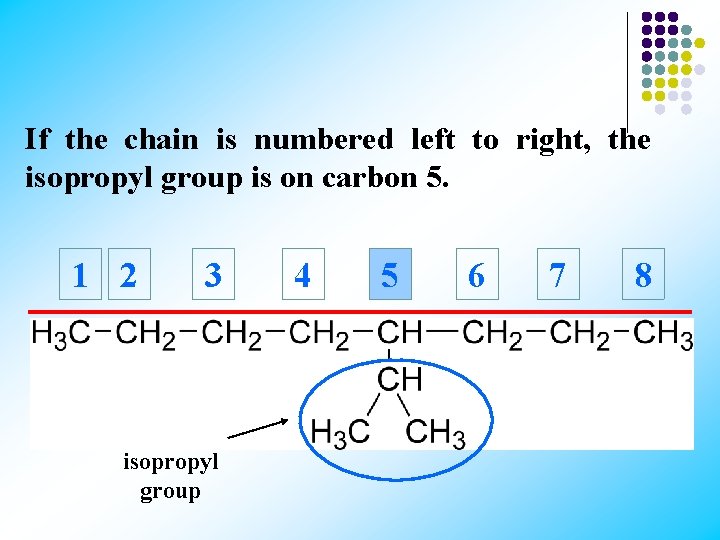
If the chain is numbered left to right, the isopropyl group is on carbon 5. 1 2 3 isopropyl group 4 5 6 7 8
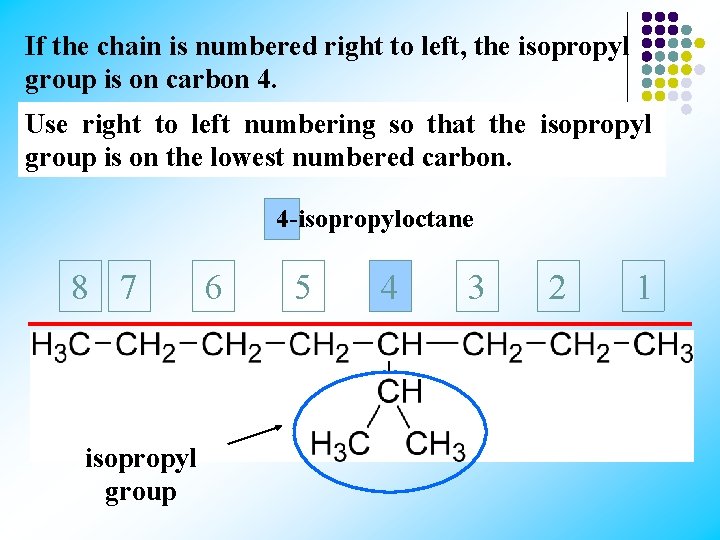
If the chain is numbered right to left, the isopropyl group is on carbon 4. Use right to left numbering so that the isopropyl group is on the lowest numbered carbon. 4 -isopropyloctane 8 7 isopropyl group 6 5 4 3 2 1
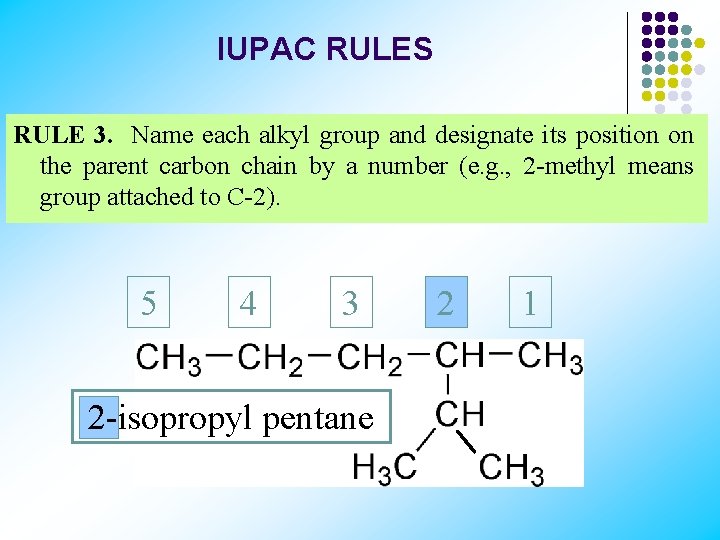
IUPAC RULES RULE 3. Name each alkyl group and designate its position on the parent carbon chain by a number (e. g. , 2 -methyl means group attached to C-2). 5 4 3 2 -isopropyl pentane 2 1
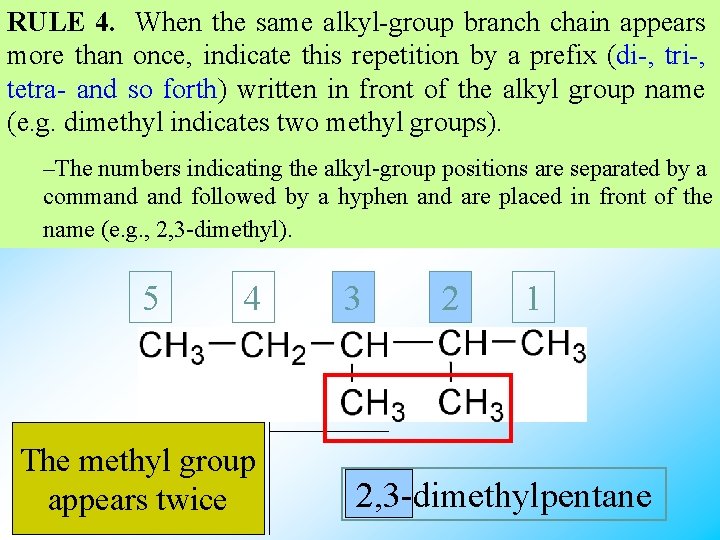
RULE 4. When the same alkyl-group branch chain appears more than once, indicate this repetition by a prefix (di-, tri-, tetra- and so forth) written in front of the alkyl group name (e. g. dimethyl indicates two methyl groups). –The numbers indicating the alkyl-group positions are separated by a command followed by a hyphen and are placed in front of the name (e. g. , 2, 3 -dimethyl). 5 4 The methyl group appears twice 3 2 1 2, 3 -dimethylpentane
RULE 5. When several different alkyl groups are attached to the parent compound, list them in alphabetical order (e. g. ethyl before methyl in 3 -ethyl-4 -methyloctane). Prefixes are not included in alphabetical ordering (ethyl comes before dimethyl).
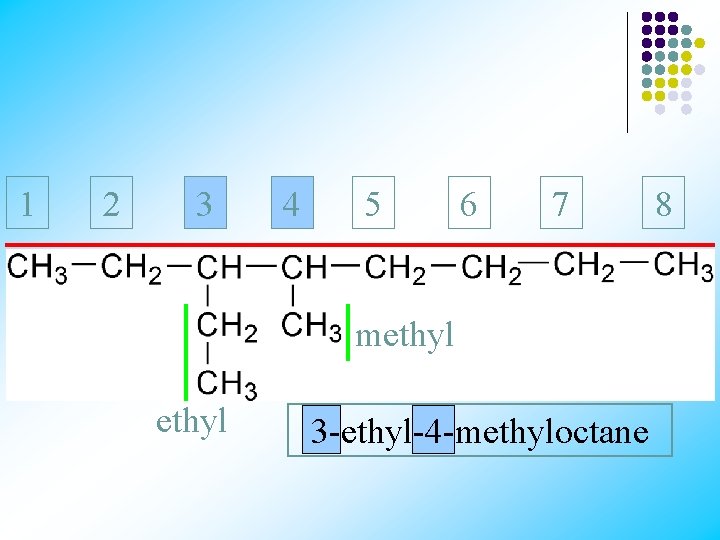
1 2 3 4 5 6 7 methyl 3 -ethyl-4 -methyloctane 8
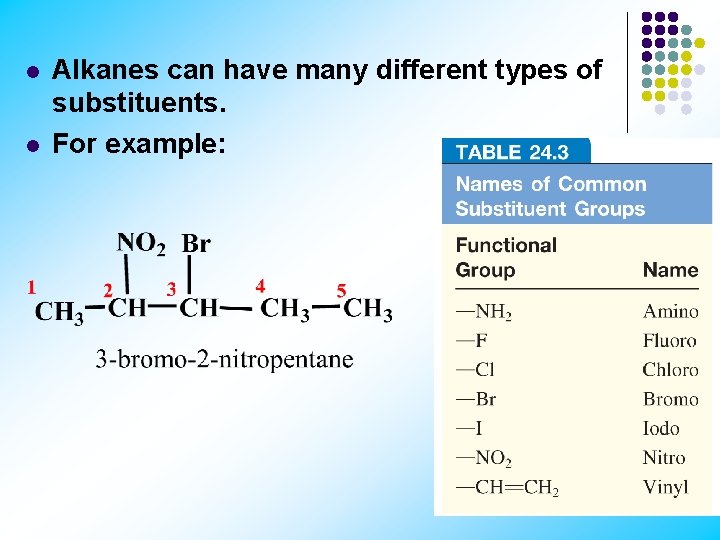
l l Alkanes can have many different types of substituents. For example:
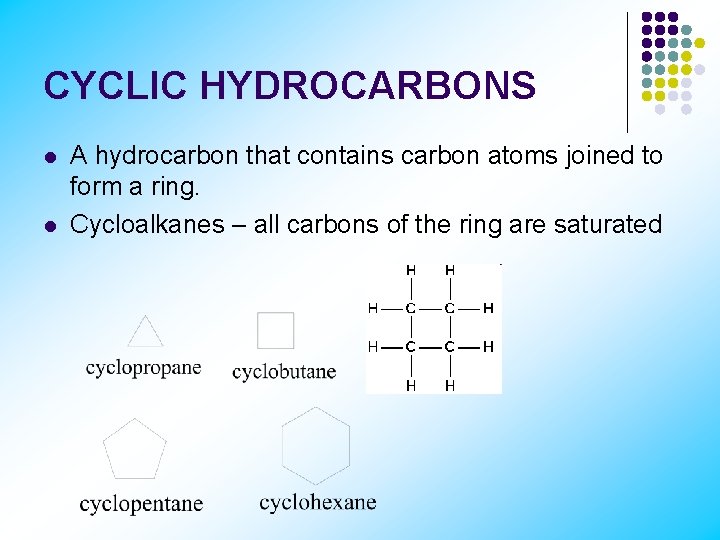
CYCLIC HYDROCARBONS l l A hydrocarbon that contains carbon atoms joined to form a ring. Cycloalkanes – all carbons of the ring are saturated
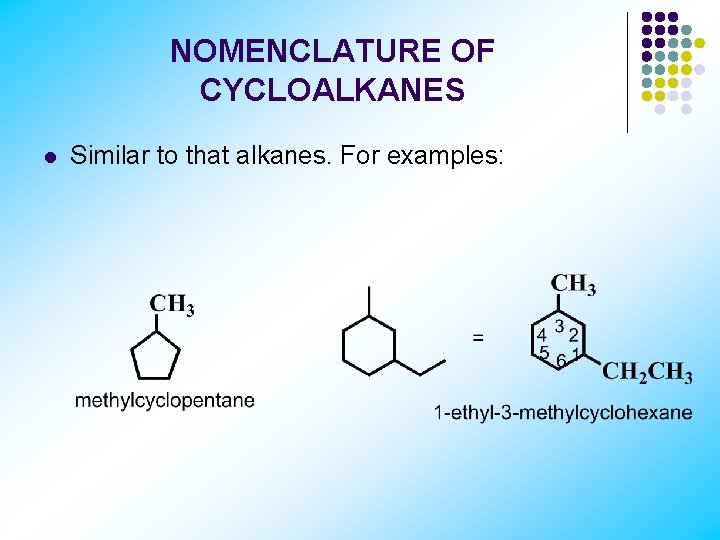
NOMENCLATURE OF CYCLOALKANES l Similar to that alkanes. For examples:
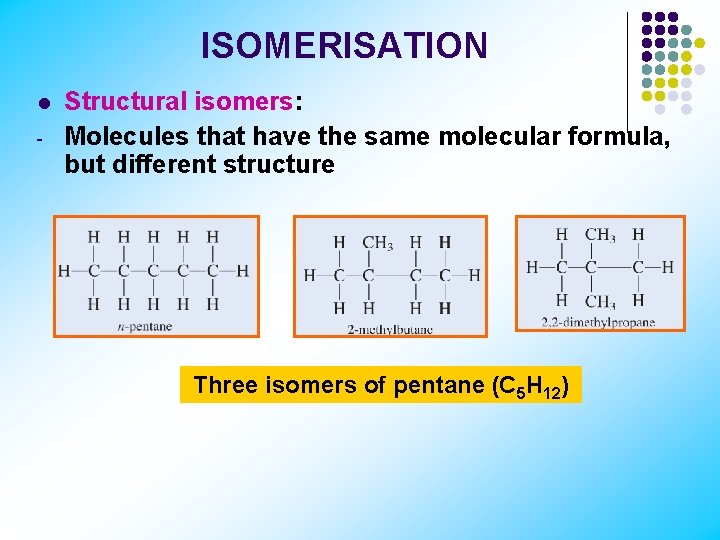
ISOMERISATION l - Structural isomers: Molecules that have the same molecular formula, but different structure Three isomers of pentane (C 5 H 12)
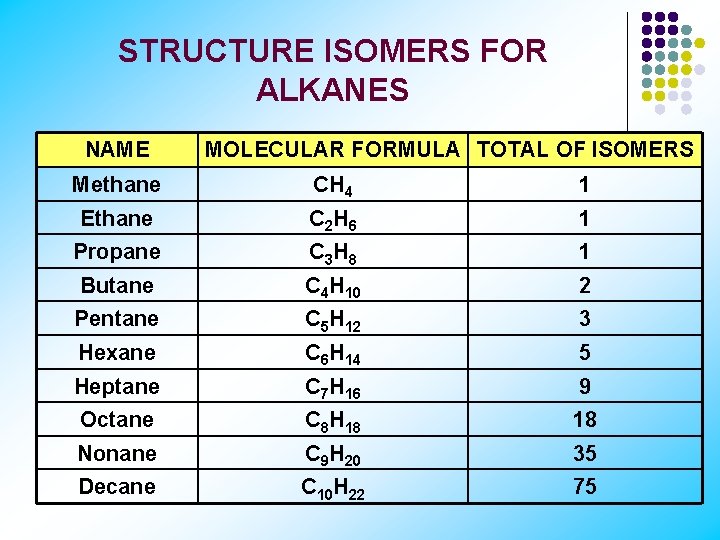
STRUCTURE ISOMERS FOR ALKANES NAME MOLECULAR FORMULA TOTAL OF ISOMERS Methane CH 4 1 Ethane C 2 H 6 1 Propane C 3 H 8 1 Butane C 4 H 10 2 Pentane C 5 H 12 3 Hexane C 6 H 14 5 Heptane C 7 H 16 9 Octane C 8 H 18 18 Nonane C 9 H 20 35 Decane C 10 H 22 75
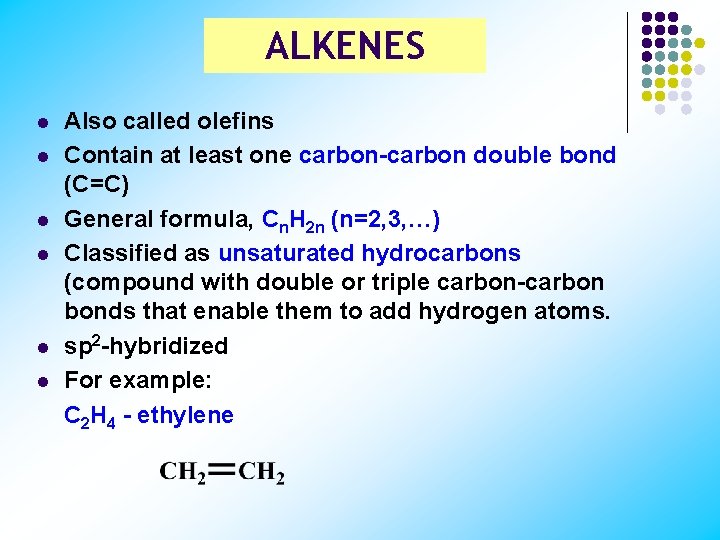
ALKENES Also called olefins l Contain at least one carbon-carbon double bond (C=C) l General formula, Cn. H 2 n (n=2, 3, …) l Classified as unsaturated hydrocarbons (compound with double or triple carbon-carbon bonds that enable them to add hydrogen atoms. l sp 2 -hybridized l For example: C 2 H 4 - ethylene l
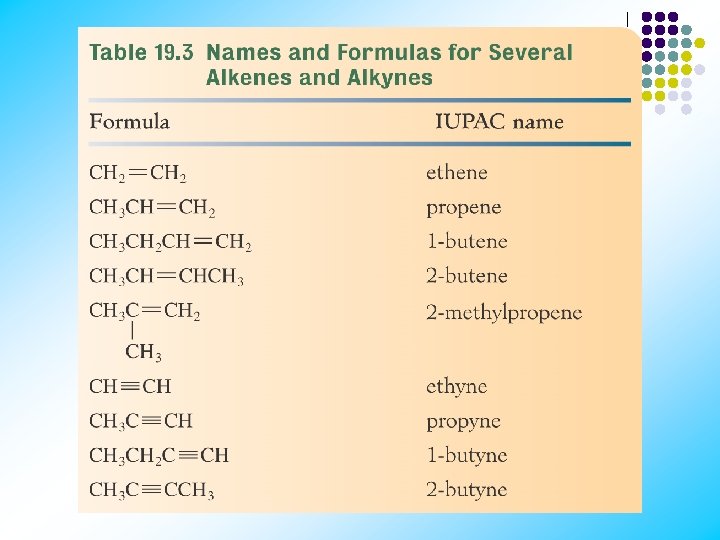
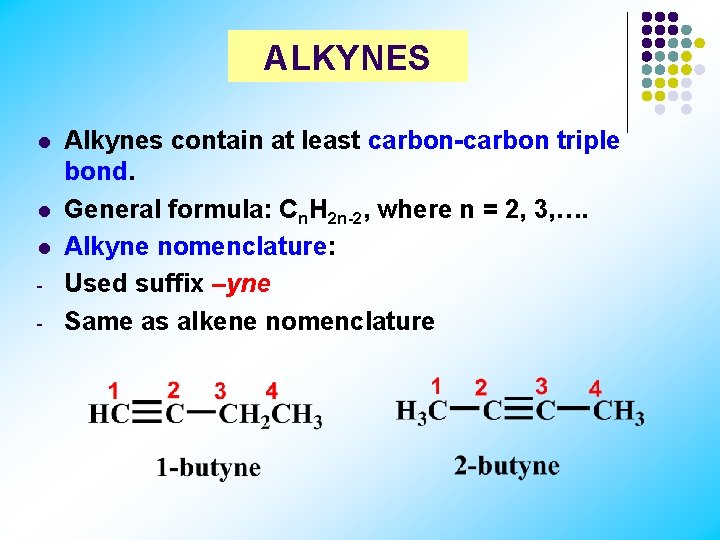
ALKYNES l l l - Alkynes contain at least carbon-carbon triple bond. General formula: Cn. H 2 n-2, where n = 2, 3, …. Alkyne nomenclature: Used suffix –yne Same as alkene nomenclature
Naming Alkenes and Alkynes
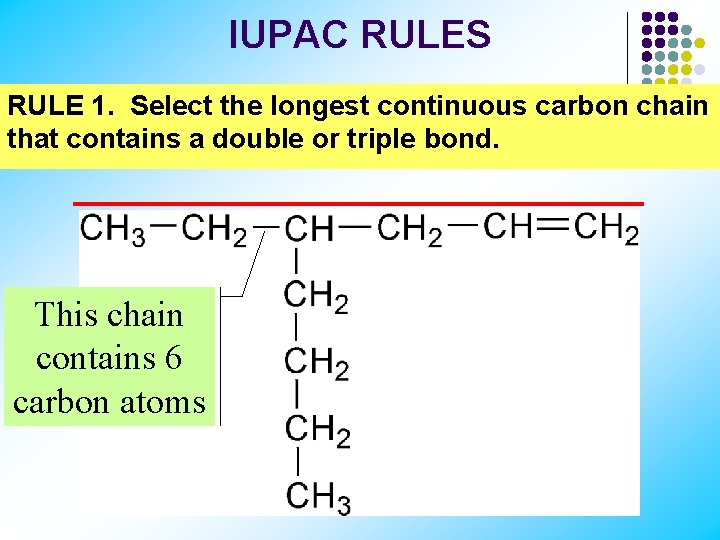
IUPAC RULES RULE 1. Select the longest continuous carbon chain that contains a double or triple bond. This chain contains 6 carbon atoms
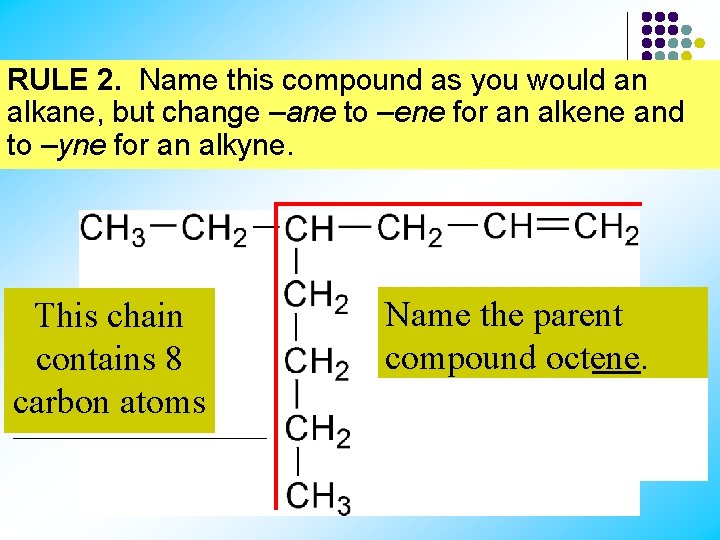
RULE 2. Name this compound as you would an alkane, but change –ane to –ene for an alkene and to –yne for an alkyne. This chain contains 8 carbon atoms Nameisthe This theparent longest continuous octene. compound chain. Select it as the parent compound.
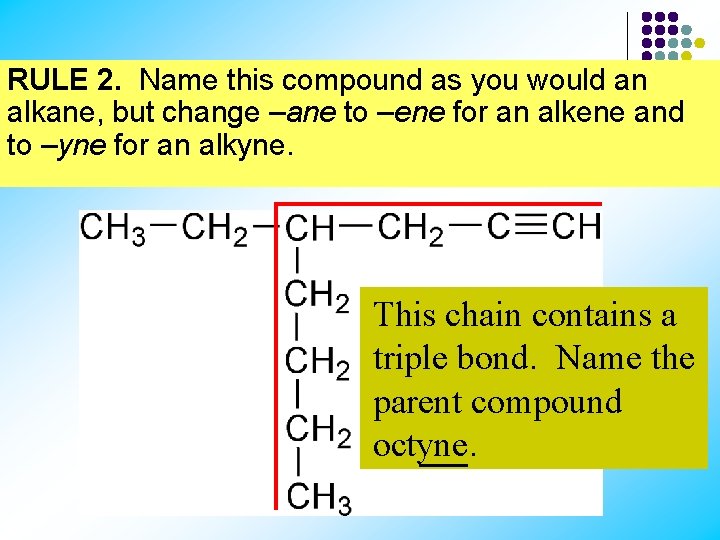
RULE 2. Name this compound as you would an alkane, but change –ane to –ene for an alkene and to –yne for an alkyne. This chain contains a triple bond. Name the parent compound octyne.
RULE 3. Number the carbon chain of the parent compound starting with the end nearer to the double or triple bond. Use the smaller of the two numbers on the double- or triple-bonded carbon to indicate the position of the double or triple bond. Place this number in front of the alkene or alkyne name.
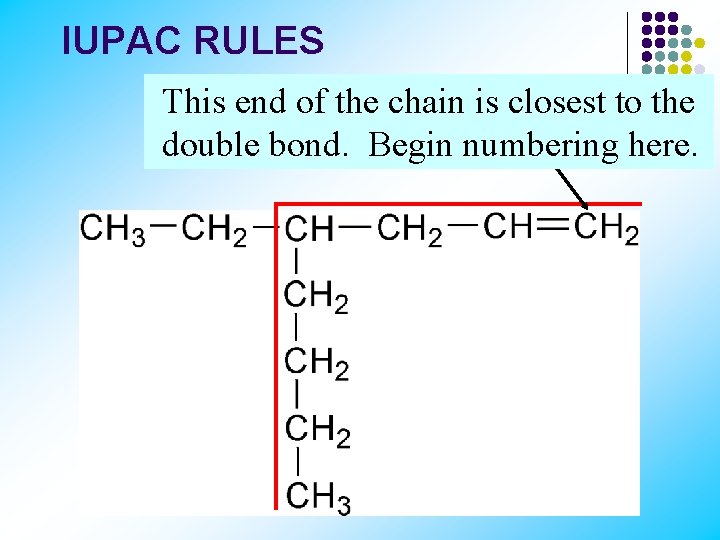
IUPAC RULES This end of the chain is closest to the double bond. Begin numbering here.
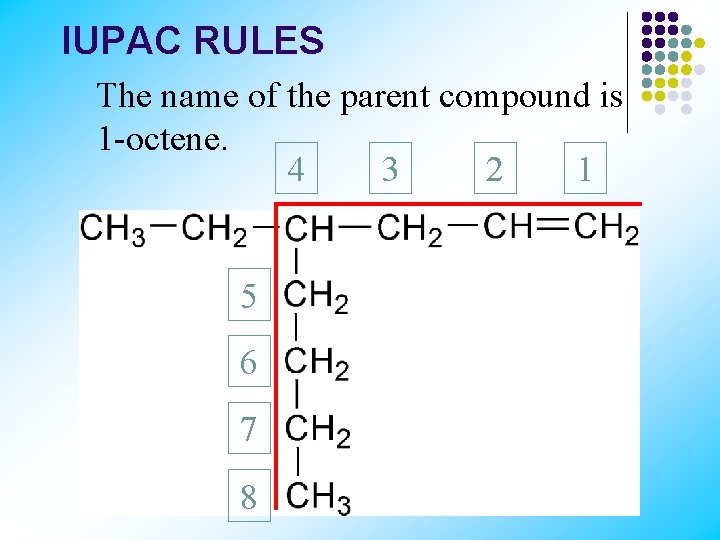
IUPAC RULES The name of the parent compound is 1 -octene. 4 3 2 1 5 6 7 8
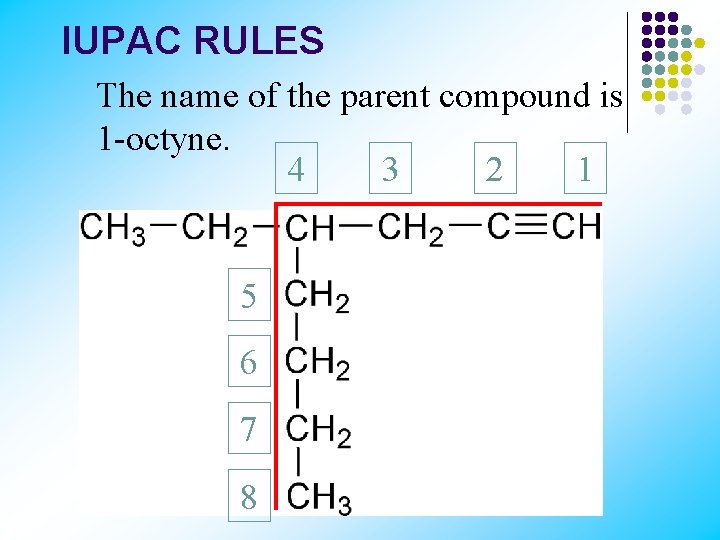
IUPAC RULES The name of the parent compound is 1 -octyne. 4 3 2 1 5 6 7 8
RULE 4. Branched chains and other groups are treated as in naming alkanes. Name the substituent group, and designate its position on the parent chain with a number.
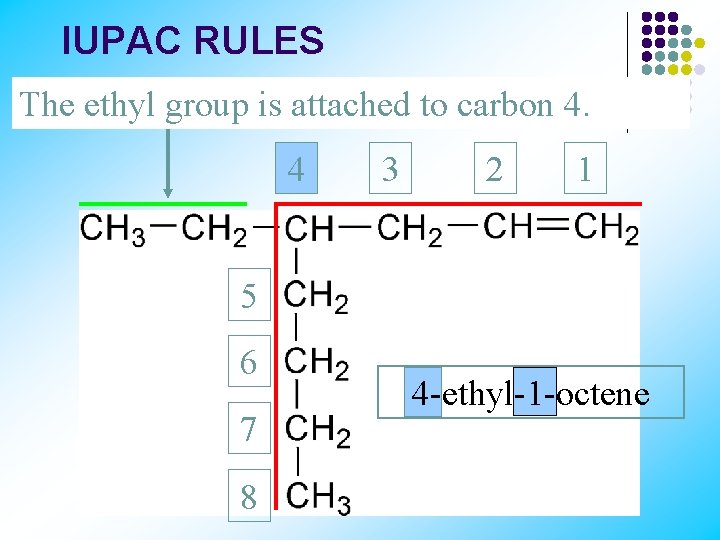
IUPAC RULES The ethyl is attached to carbon 4. This is an group ethyl group. 4 3 2 1 5 6 7 8 4 -ethyl-1 -octene
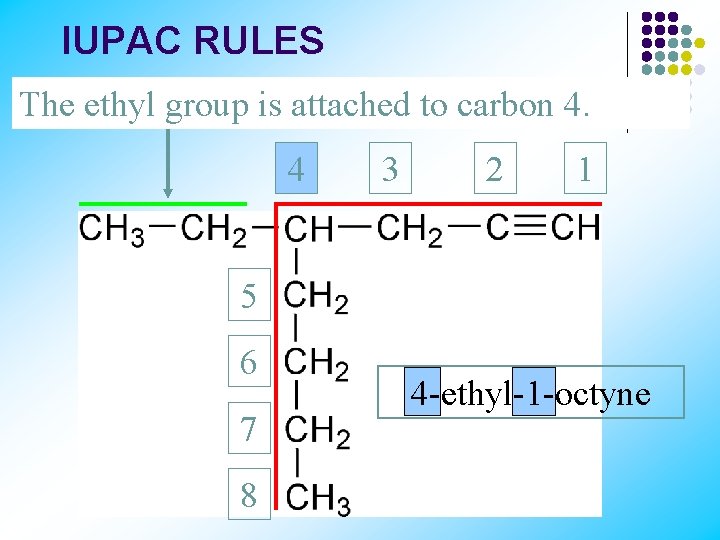
IUPAC RULES The ethyl group is attached to carbon 4. 4 3 2 1 5 6 7 8 4 -ethyl-1 -octyne
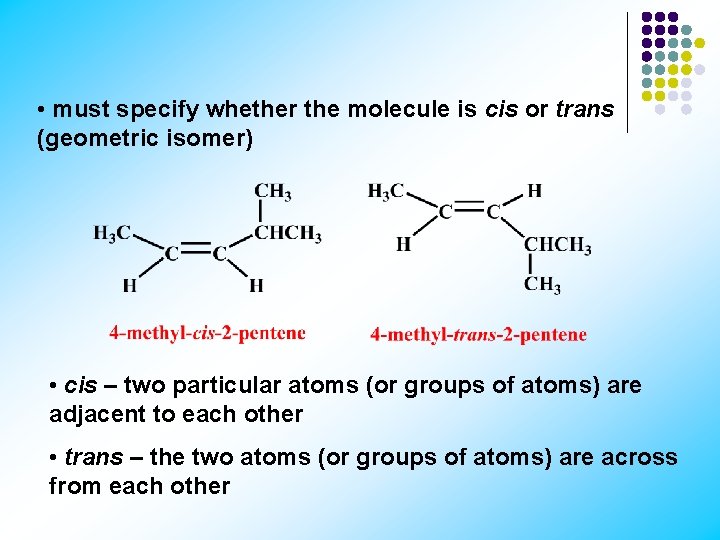
• must specify whether the molecule is cis or trans (geometric isomer) • cis – two particular atoms (or groups of atoms) are adjacent to each other • trans – the two atoms (or groups of atoms) are across from each other
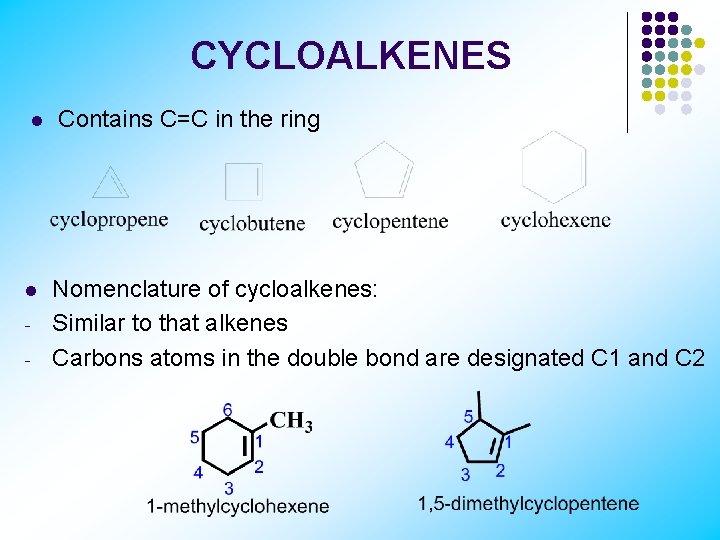
CYCLOALKENES l l - Contains C=C in the ring Nomenclature of cycloalkenes: Similar to that alkenes Carbons atoms in the double bond are designated C 1 and C 2
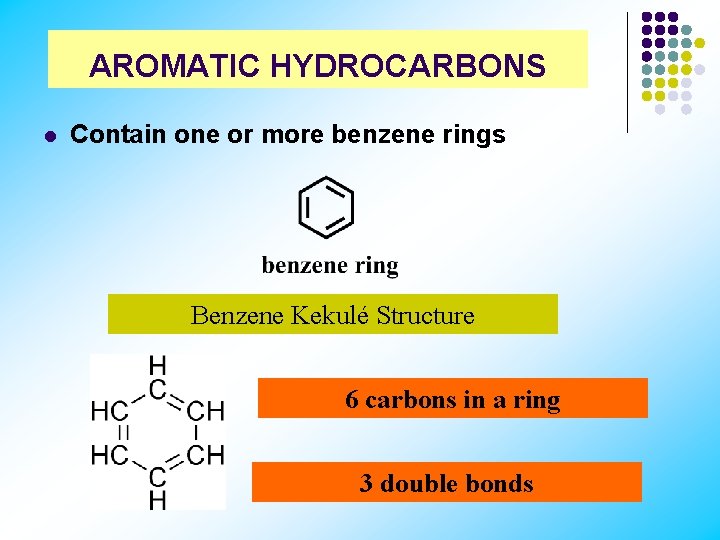
AROMATIC HYDROCARBONS l Contain one or more benzene rings Benzene Kekulé Structure 6 carbons in a ring 3 double bonds
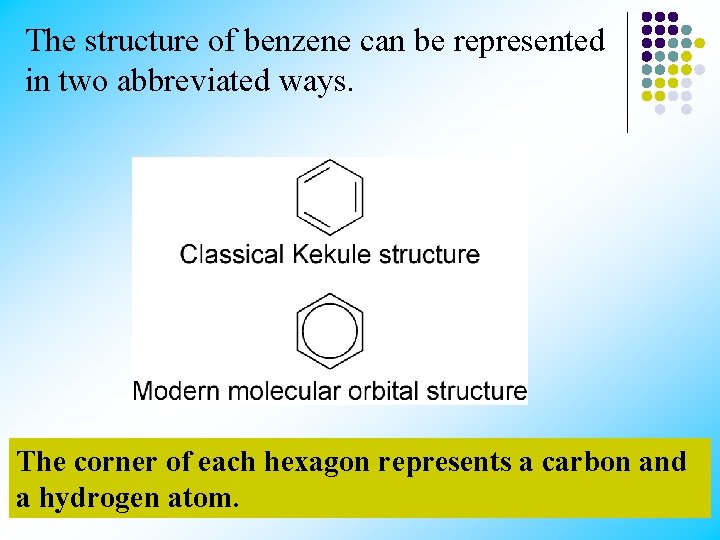
The structure of benzene can be represented in two abbreviated ways. The corner of each hexagon represents a carbon and a hydrogen atom.
Naming Aromatic Compounds
• A substituted benzene is derived by replacing one or more of benzene’s hydrogen atoms with an atom or group of atoms. l A monosubstituted benzene has the formula C 6 H 5 G where G is the group that replaces a hydrogen atom. l All hydrogens in benzene are equivalent. l It does not matter which hydrogen is replaced by G.
Monosubstituted Benzenes
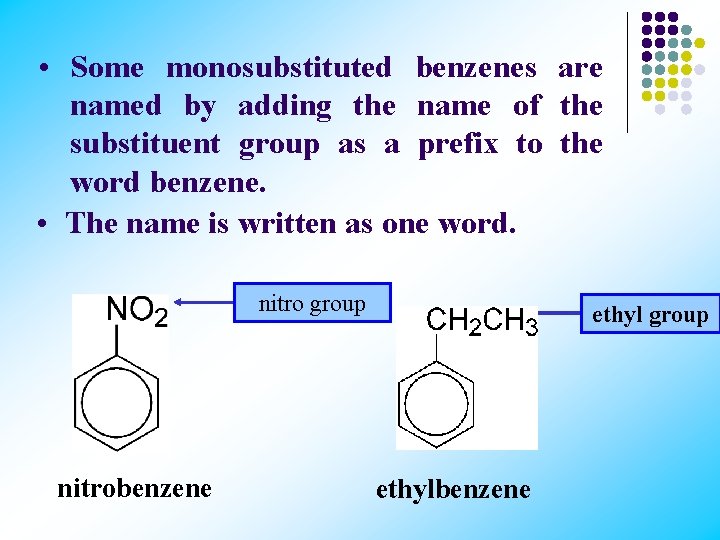
• Some monosubstituted benzenes are named by adding the name of the substituent group as a prefix to the word benzene. • The name is written as one word. nitro group nitrobenzene ethyl group ethylbenzene
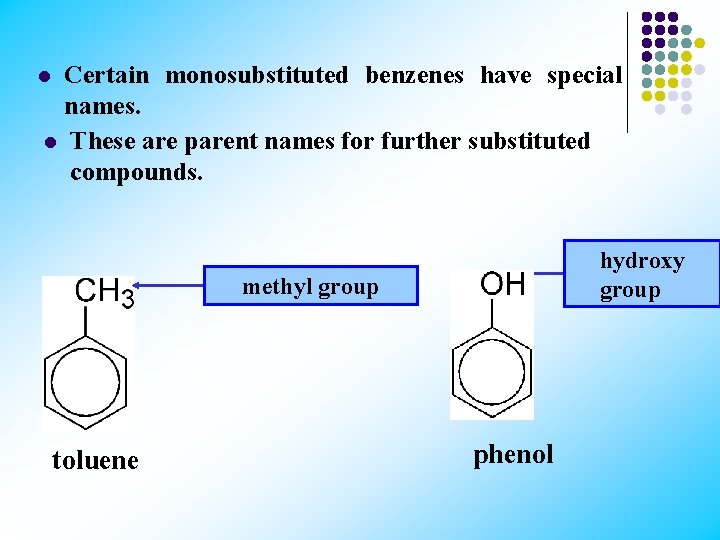
Certain monosubstituted benzenes have special names. l These are parent names for further substituted compounds. l hydroxy group methyl group toluene phenol
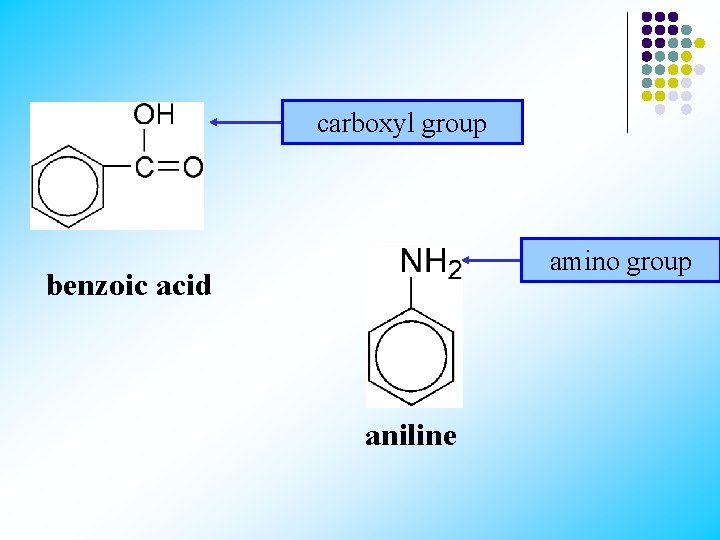
carboxyl group amino group benzoic acid aniline
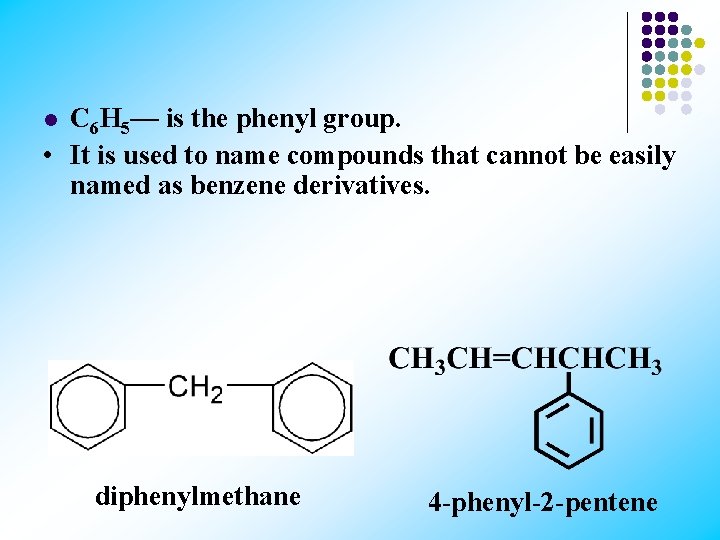
C 6 H 5— is the phenyl group. • It is used to name compounds that cannot be easily named as benzene derivatives. l diphenylmethane 4 -phenyl-2 -pentene

Disubstituted Benzenes
l Three isomers are possible when two substituents replace hydrogen in a benzene molecule. • The prefixes ortho-, meta- and para- (o-, mand p-) are used to name these disubstituted benzenes.
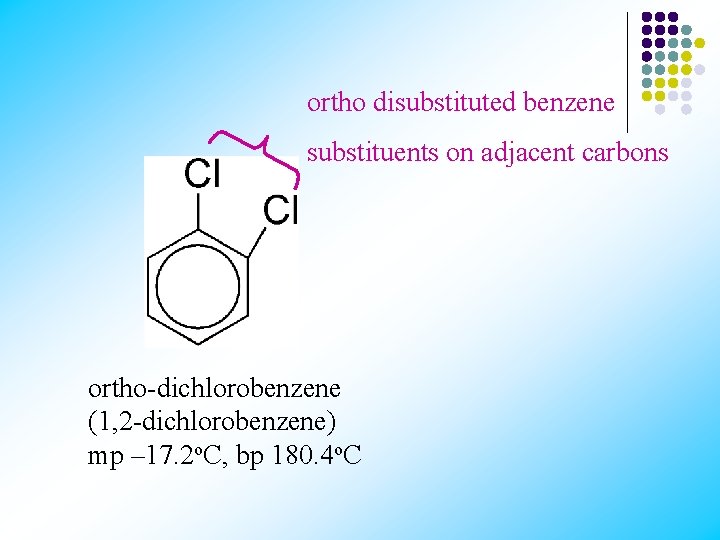
ortho disubstituted benzene substituents on adjacent carbons ortho-dichlorobenzene (1, 2 -dichlorobenzene) mp – 17. 2 o. C, bp 180. 4 o. C
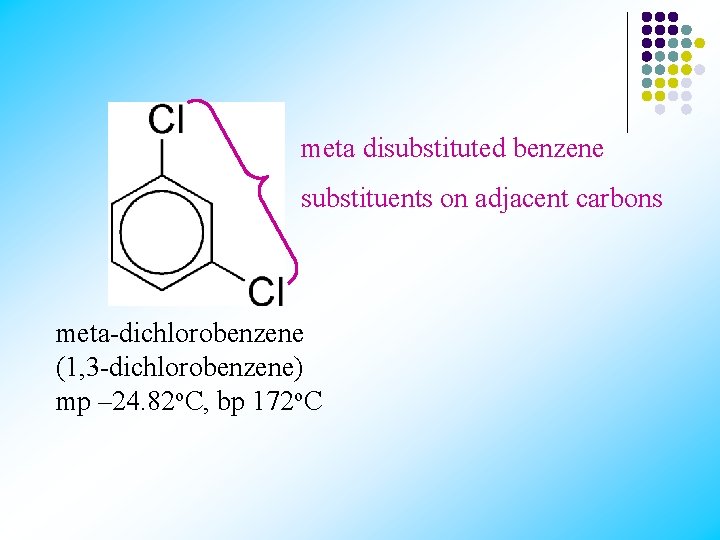
meta disubstituted benzene substituents on adjacent carbons meta-dichlorobenzene (1, 3 -dichlorobenzene) mp – 24. 82 o. C, bp 172 o. C
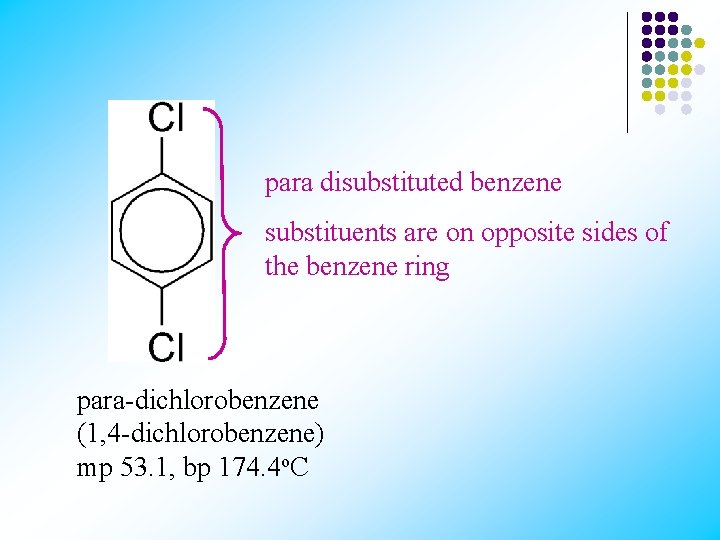
para disubstituted benzene substituents are on opposite sides of the benzene ring para-dichlorobenzene (1, 4 -dichlorobenzene) mp 53. 1, bp 174. 4 o. C
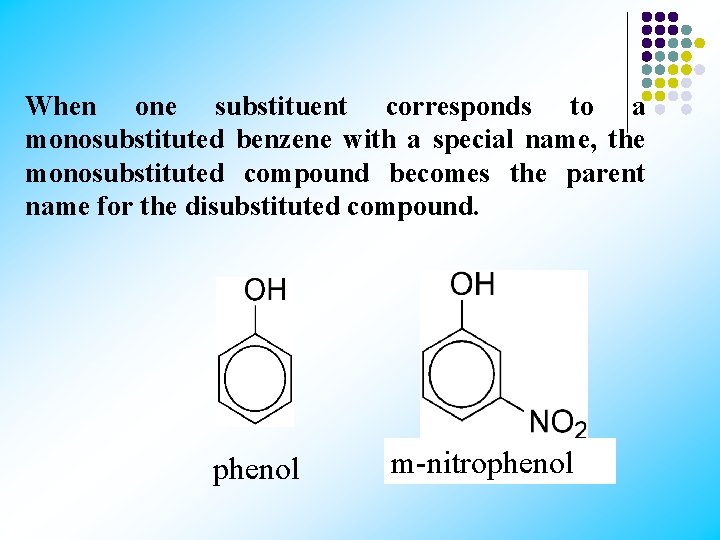
When one substituent corresponds to a monosubstituted benzene with a special name, the monosubstituted compound becomes the parent name for the disubstituted compound. phenol m-nitrophenol
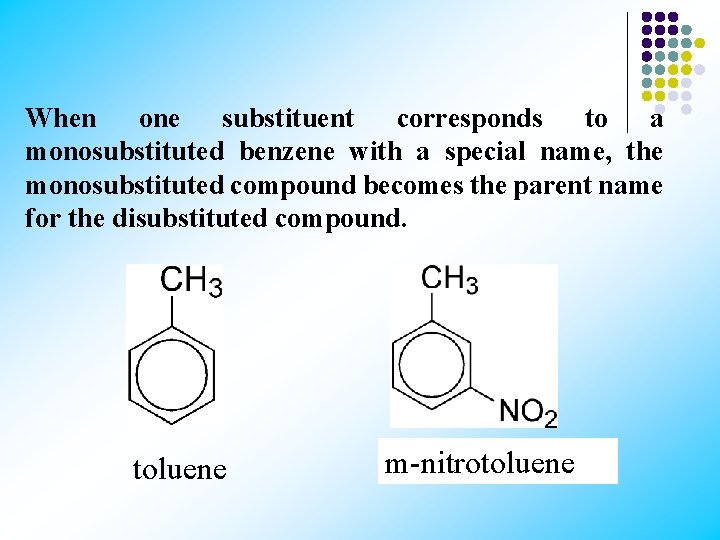
When one substituent corresponds to a monosubstituted benzene with a special name, the monosubstituted compound becomes the parent name for the disubstituted compound. toluene m-nitrotoluene
Tri- and Polysubstituted Benzenes
• When a benzene ring has three or more substituents, the carbon atoms in the ring are numbered. l l l Numbering starts at one of the substituent groups. The numbering direction can be clockwise or counterclockwise. Numbering must be in the direction that gives the substituent groups the lowest numbers.
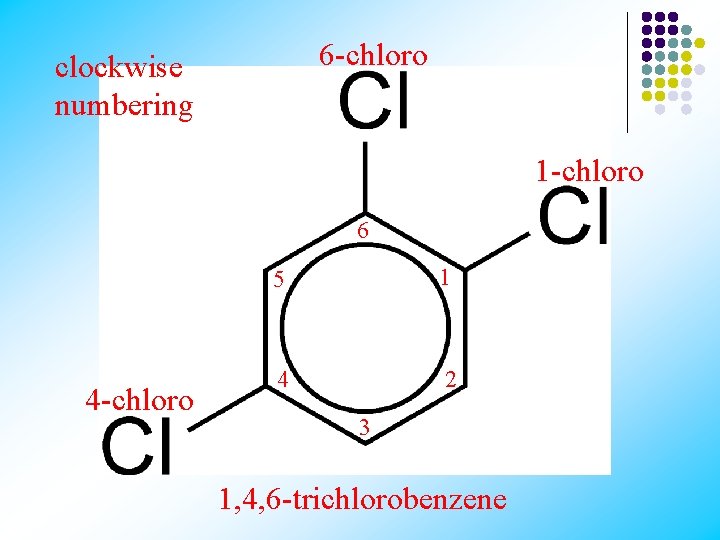
6 -chloro clockwise numbering 1 -chloro 6 4 -chloro 5 1 4 2 3 1, 4, 6 -trichlorobenzene
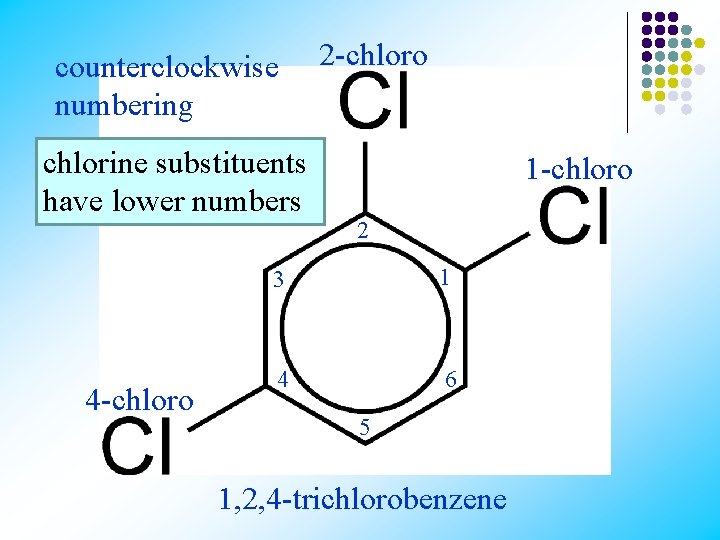
counterclockwise numbering chlorine substituents have lower numbers 4 -chloro 2 -chloro 1 -chloro 2 3 1 4 6 5 1, 2, 4 -trichlorobenzene
• When a compound is named as a derivative of the special parent compound, the substituent of the parent compound is considered to be C-1 of the ring.
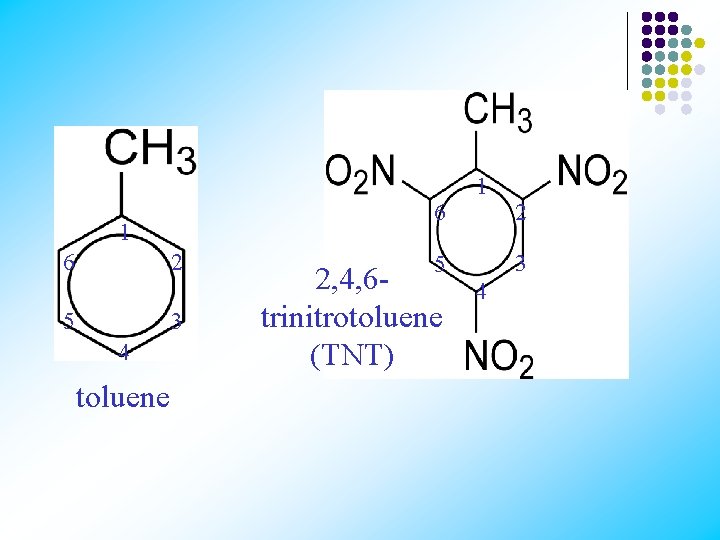
1 1 2 6 3 5 4 toluene 6 2 5 3 2, 4, 6 trinitrotoluene (TNT) 4
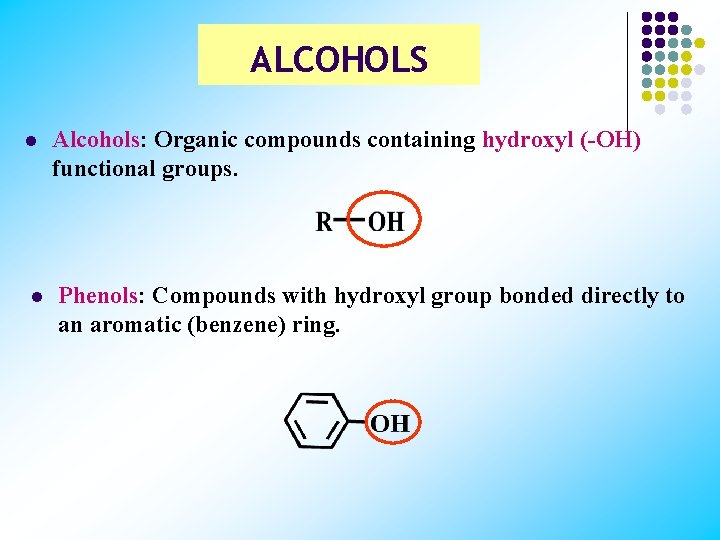
ALCOHOLS l l Alcohols: Organic compounds containing hydroxyl (-OH) functional groups. Phenols: Compounds with hydroxyl group bonded directly to an aromatic (benzene) ring.
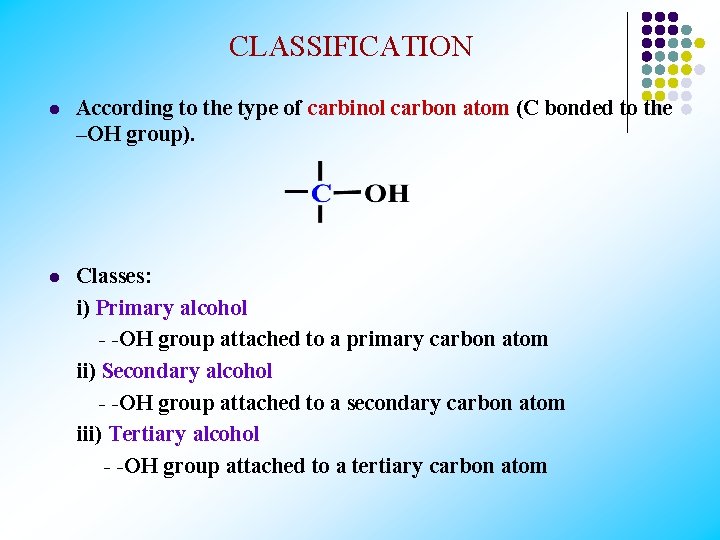
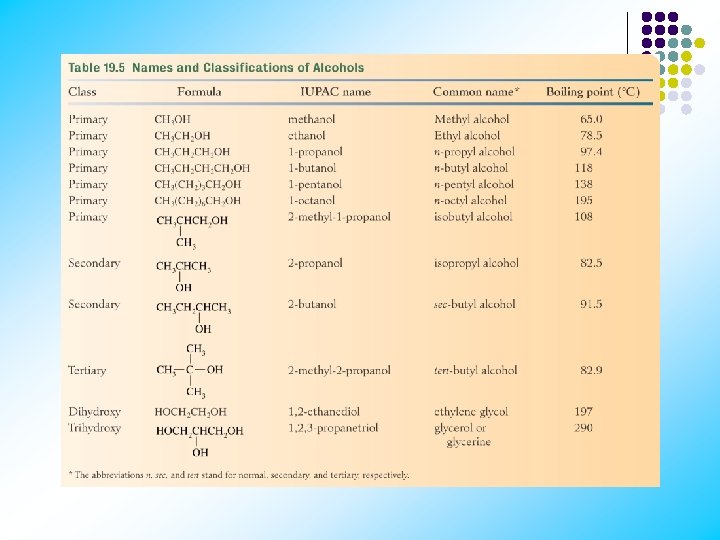
CLASSIFICATION l According to the type of carbinol carbon atom (C bonded to the –OH group). l Classes: i) Primary alcohol - -OH group attached to a primary carbon atom ii) Secondary alcohol - -OH group attached to a secondary carbon atom iii) Tertiary alcohol - -OH group attached to a tertiary carbon atom
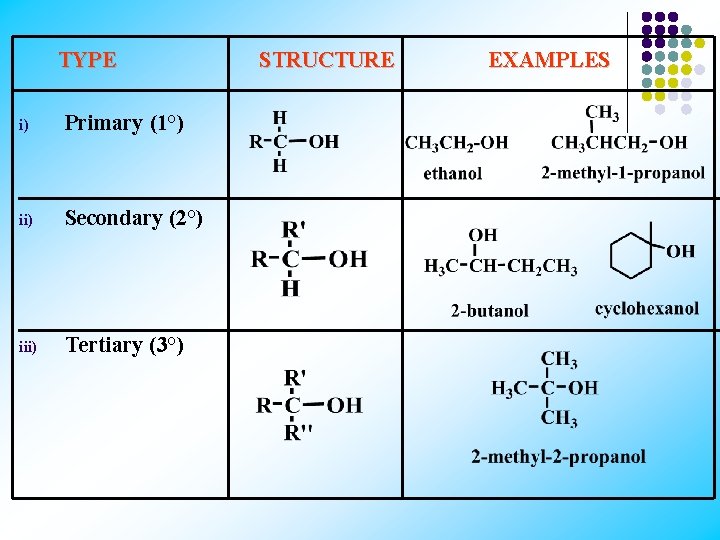
TYPE i) Primary (1°) ii) Secondary (2°) iii) Tertiary (3°) STRUCTURE EXAMPLES
Polyhydroxy Alcohols • Alcohols that contain more than one OH group attached to different carbons are called polyhydroxy alcohols. • Monohydroxy: one OH group per molecule. • Dihydroxy: two OH groups per molecule. • Trihydroxy: three OH groups per molecule.
Naming Alcohols
IUPAC RULES 1. 2. 3. 4. Select the longest continuous chain of carbon atoms containing the hydroxyl group. Number the carbon atoms in this chain so that the one bonded to the –OH group has the lowest possible number. Form the parent alcohol name by replacing the final –e of the corresponding alkane name by –ol. When isomers are possible, locate the position of the –OH by placing the number (hyphenated) of the carbon atom to which the –OH is bonded immediately before the parent alcohol name. Name each alkyl branch chain (or other group) and designate its position by number.
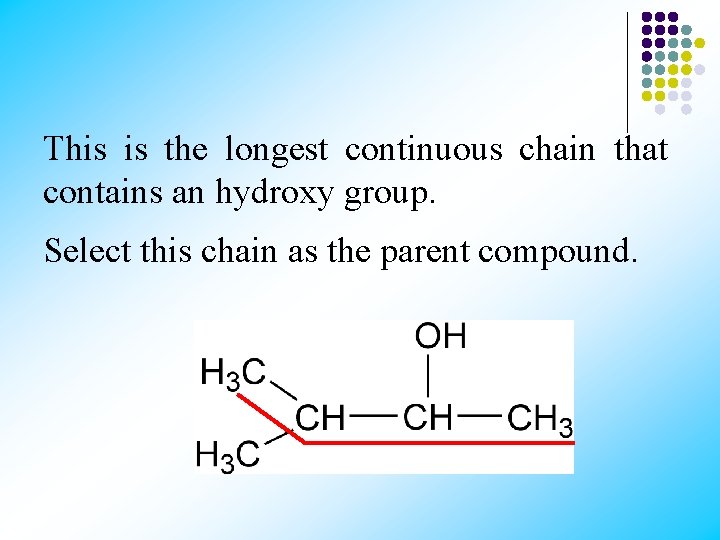
This is the longest continuous chain that contains an hydroxy group. Select this chain as the parent compound.
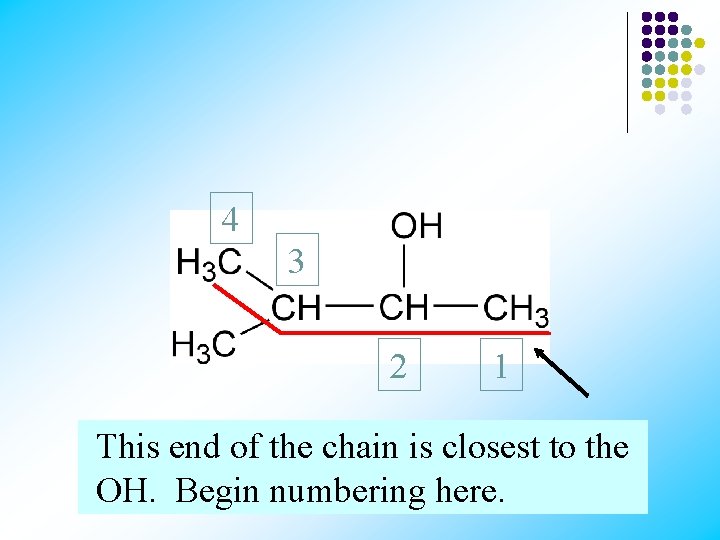
4 3 2 1 This end of the chain is closest to the OH. Begin numbering here.
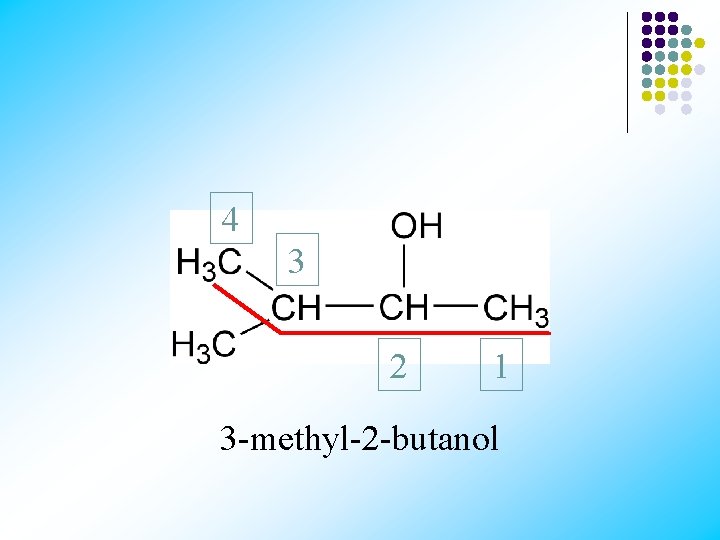
4 3 2 1 3 -methyl-2 -butanol
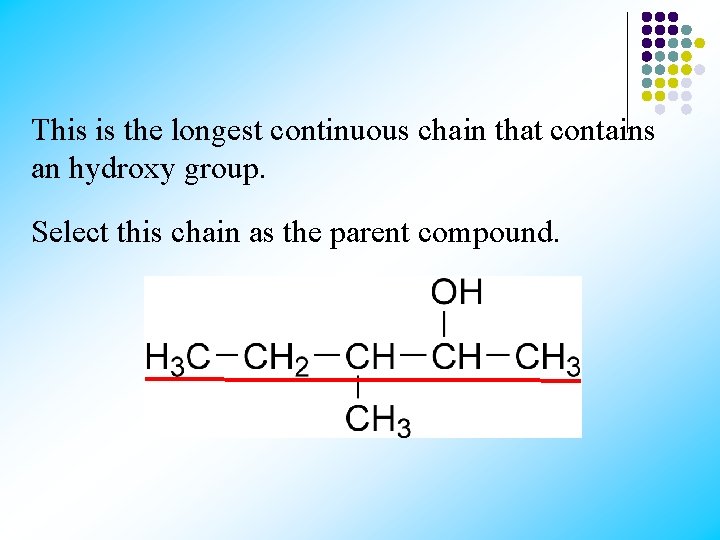
This is the longest continuous chain that contains an hydroxy group. Select this chain as the parent compound.
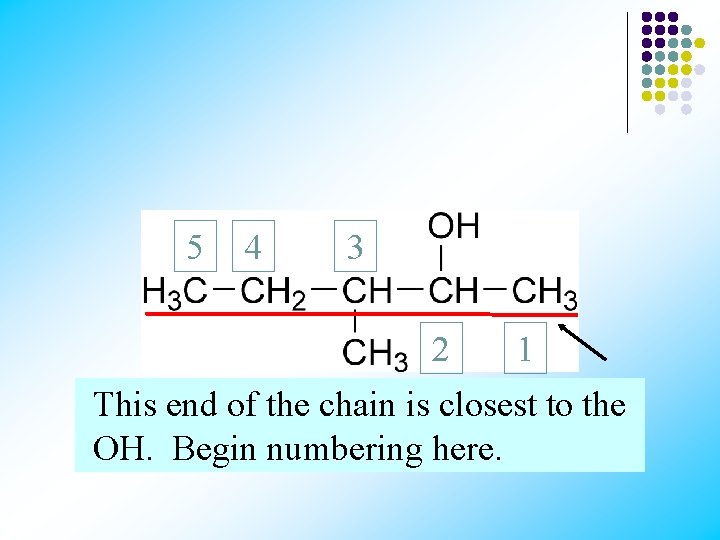
5 4 3 2 1 This end of the chain is closest to the OH. Begin numbering here.
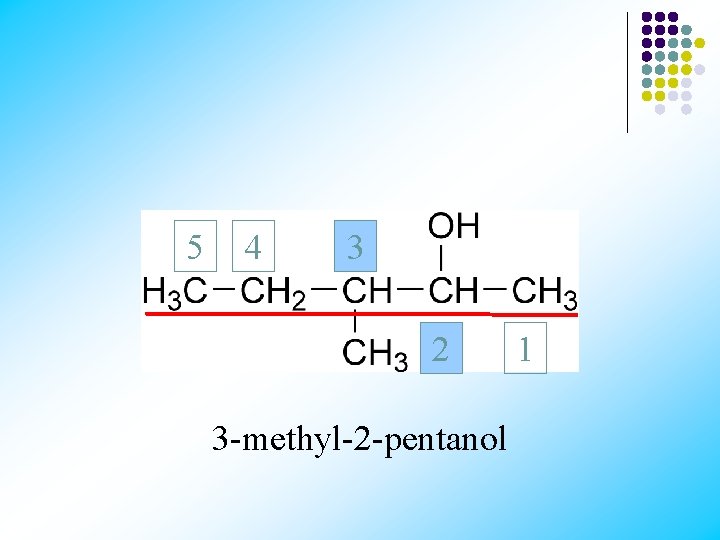
5 4 3 2 3 -methyl-2 -pentanol 1
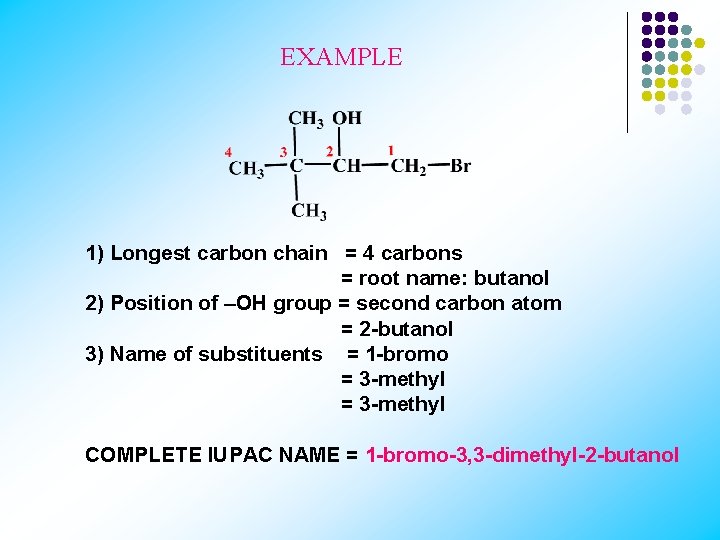
EXAMPLE 1) Longest carbon chain = 4 carbons = root name: butanol 2) Position of –OH group = second carbon atom = 2 -butanol 3) Name of substituents = 1 -bromo = 3 -methyl COMPLETE IUPAC NAME = 1 -bromo-3, 3 -dimethyl-2 -butanol
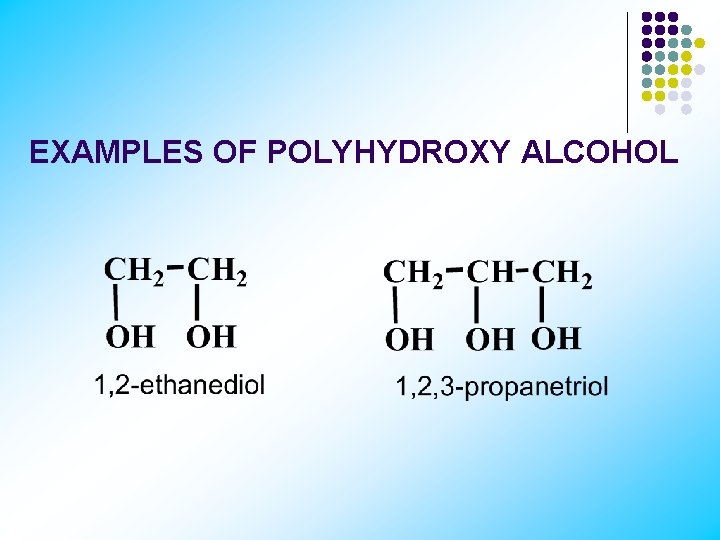
EXAMPLES OF POLYHYDROXY ALCOHOL
Ethers • An ether has the formula ROR´. • R and R´ can be the same or different groups. • R and R´ can be saturated, unsaturated or aromatic. • Saturated ethers have little chemical reactivity but are often used as solvents.
• Alcohols and ethers are isomeric. • They have the same molecular formula but different structural formulas. • An alcohol and its isomeric ether have different chemical and physical properties.
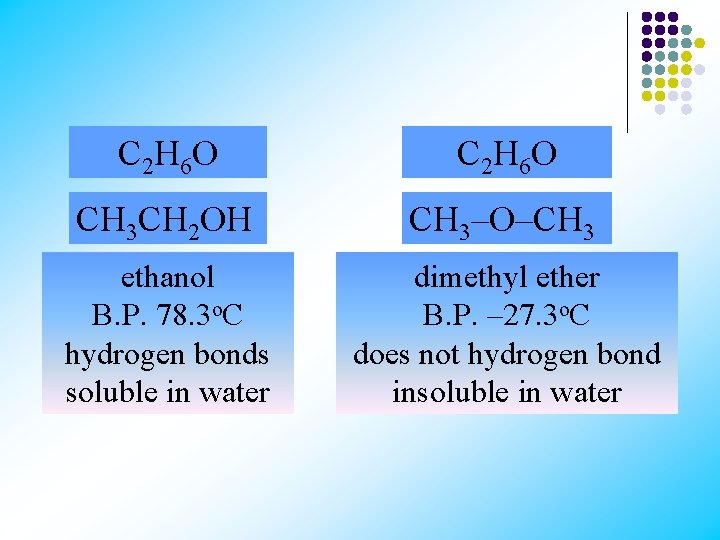
C 2 H 6 O CH 3 CH 2 OH CH 3–O–CH 3 ethanol B. P. 78. 3 o. C hydrogen bonds soluble in water dimethyl ether B. P. – 27. 3 o. C does not hydrogen bond insoluble in water

Naming Ethers
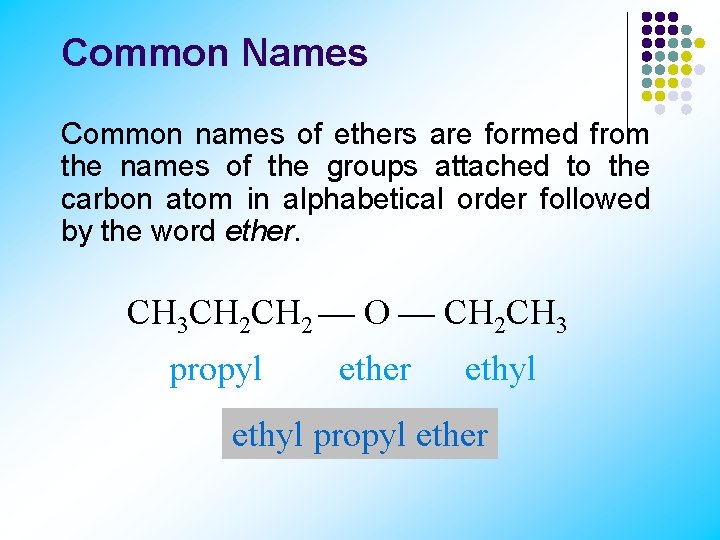
Common Names Common names of ethers are formed from the names of the groups attached to the carbon atom in alphabetical order followed by the word ether. CH 3 CH 2 — O — CH 2 CH 3 propyl ether ethyl propyl ether
IUPAC RULES l l RO– is an alkoxy group. Ethers are named as alkoxy derivatives of the longest carbon-carbon chain in the molecule
IUPAC RULES 1. Select the longest carbon-carbon chain and label it with the name of the corresponding alkane. 2. Change the –yl ending of the other hydrocarbon group to –oxy to obtain the alkoxy group name. 3. Combine the names from steps 1 and 2, giving the alkoxy name first, to form the ether name.
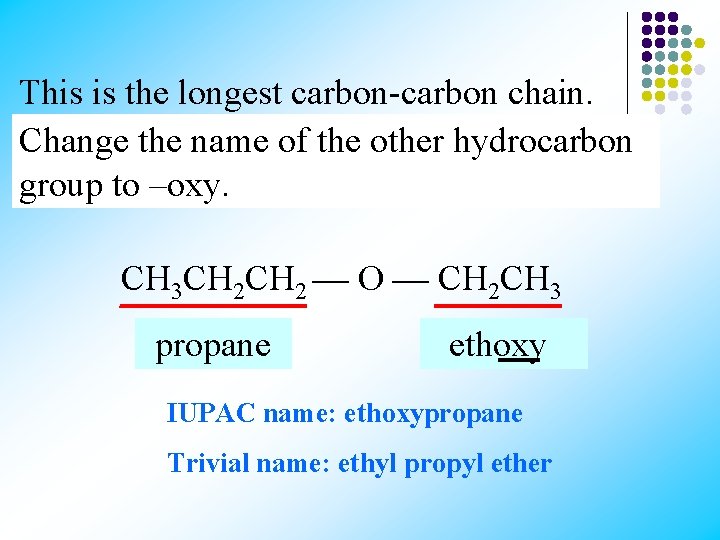
This is the longest carbon-carbon chain. Label it the Change withname the name of theofother the corresponding hydrocarbon alkane. to –oxy. group CH 3 CH 2 — O — CH 2 CH 3 propane ethoxy ethyl IUPAC name: ethoxypropane Trivial name: ethyl propyl ether
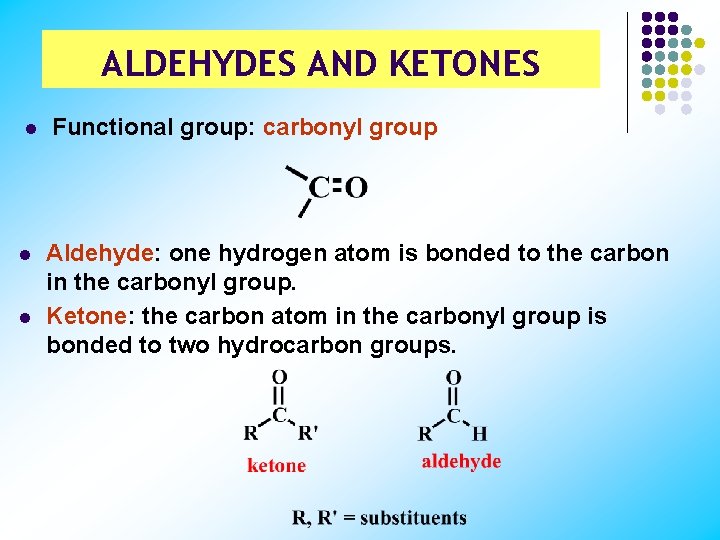
ALDEHYDES AND KETONES l l l Functional group: carbonyl group Aldehyde: one hydrogen atom is bonded to the carbon in the carbonyl group. Ketone: the carbon atom in the carbonyl group is bonded to two hydrocarbon groups.
Naming Aldehydes
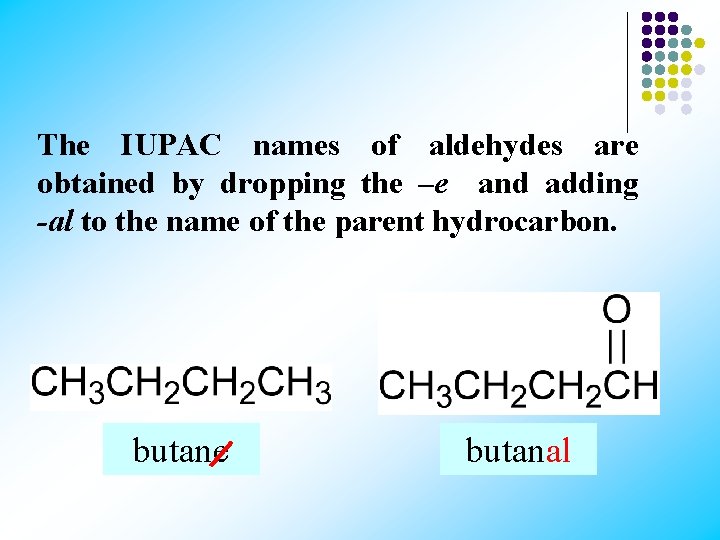
The IUPAC names of aldehydes are obtained by dropping the –e and adding -al to the name of the parent hydrocarbon. butane butanal al
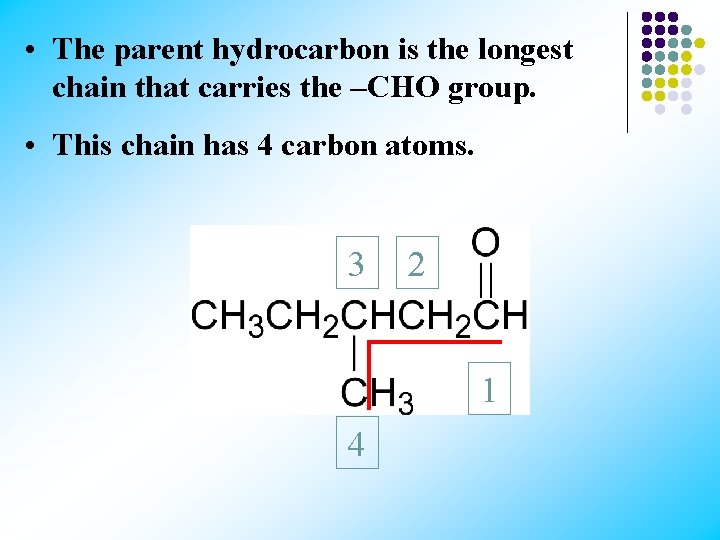
• The parent hydrocarbon is the longest chain that carries the –CHO group. • This chain has 4 carbon atoms. 3 2 1 4
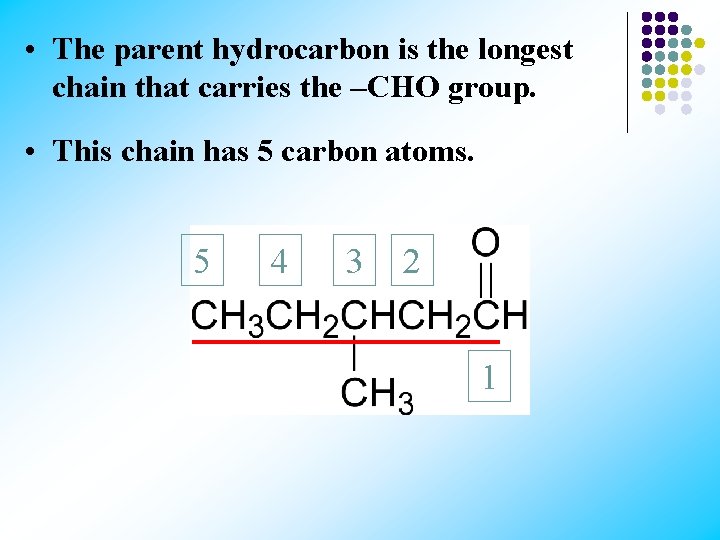
• The parent hydrocarbon is the longest chain that carries the –CHO group. • This chain has 5 carbon atoms. 5 4 3 2 1
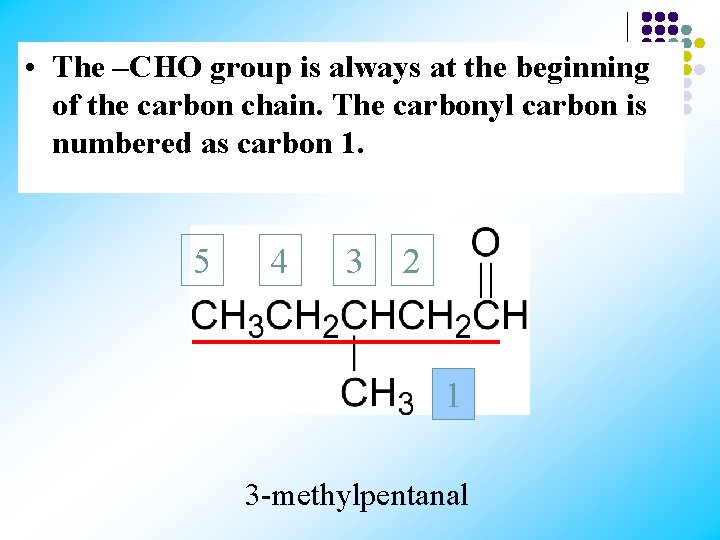
• The –CHO group is always at the beginning of the carbon chain. The carbonyl carbon is numbered as carbon 1. 5 4 3 2 1 3 -methylpentanal
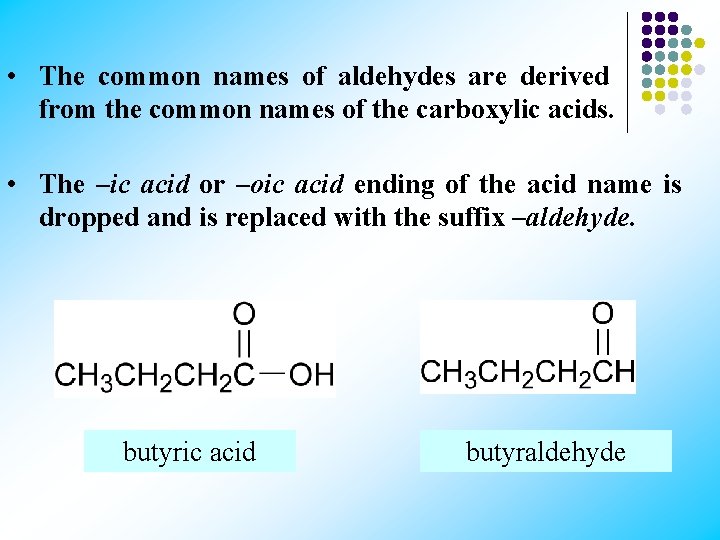
• The common names of aldehydes are derived from the common names of the carboxylic acids. • The –ic acid or –oic acid ending of the acid name is dropped and is replaced with the suffix –aldehyde. butyric acid butyraldehyde
Naming Ketones
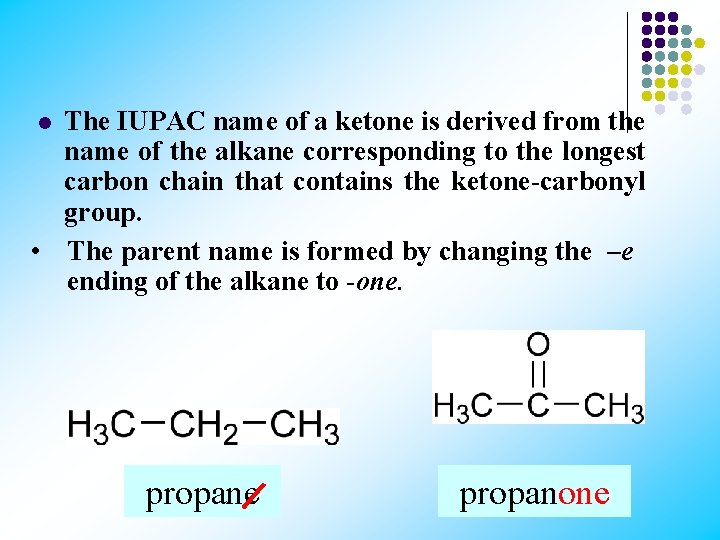
The IUPAC name of a ketone is derived from the name of the alkane corresponding to the longest carbon chain that contains the ketone-carbonyl group. • The parent name is formed by changing the –e ending of the alkane to -one. l propane propanone
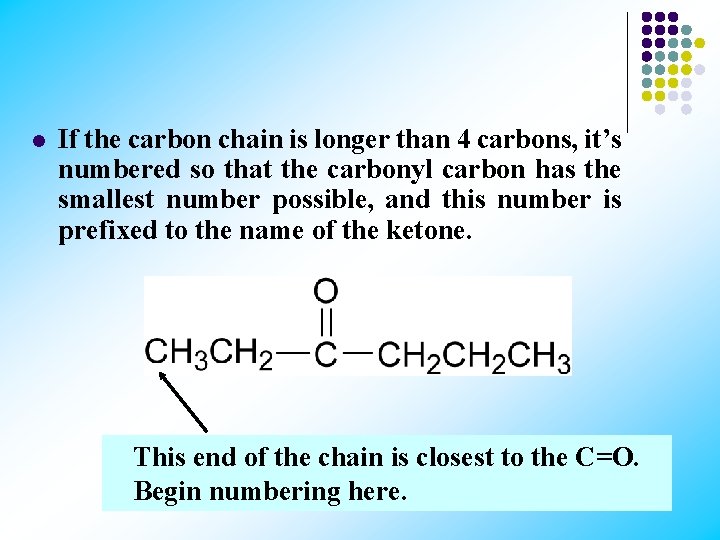
l If the carbon chain is longer than 4 carbons, it’s numbered so that the carbonyl carbon has the smallest number possible, and this number is prefixed to the name of the ketone. This end of the chain is closest to the C=O. Begin numbering here.
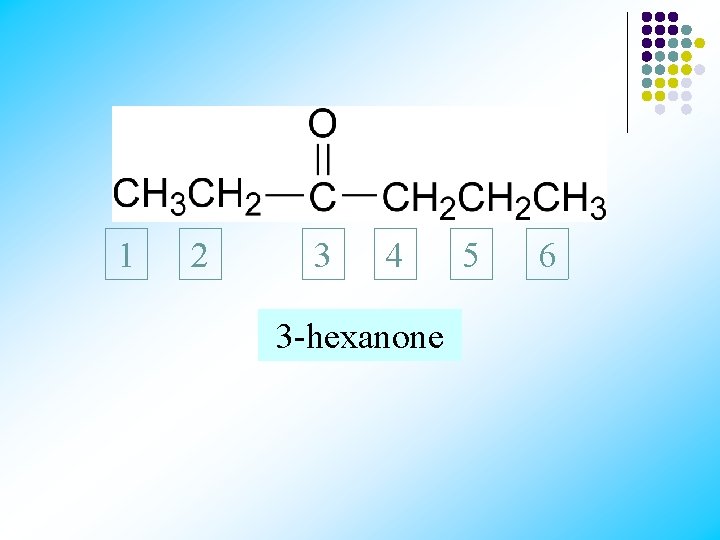
1 2 3 4 3 -hexanone 5 6
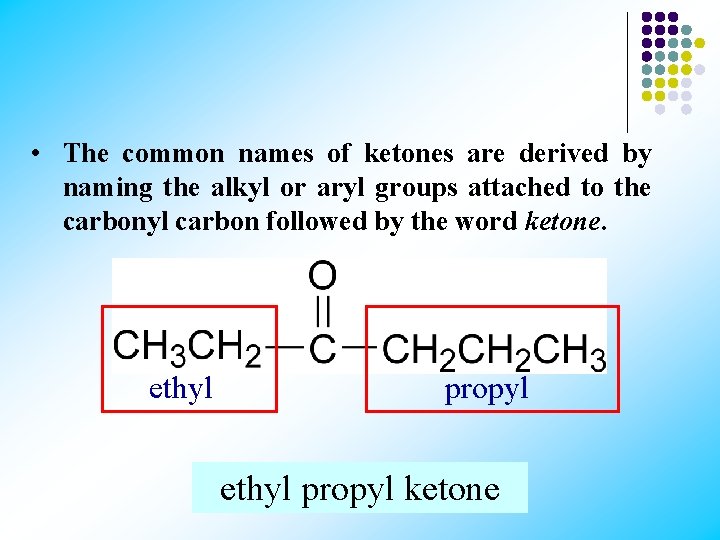
• The common names of ketones are derived by naming the alkyl or aryl groups attached to the carbonyl carbon followed by the word ketone. ethyl propyl ketone
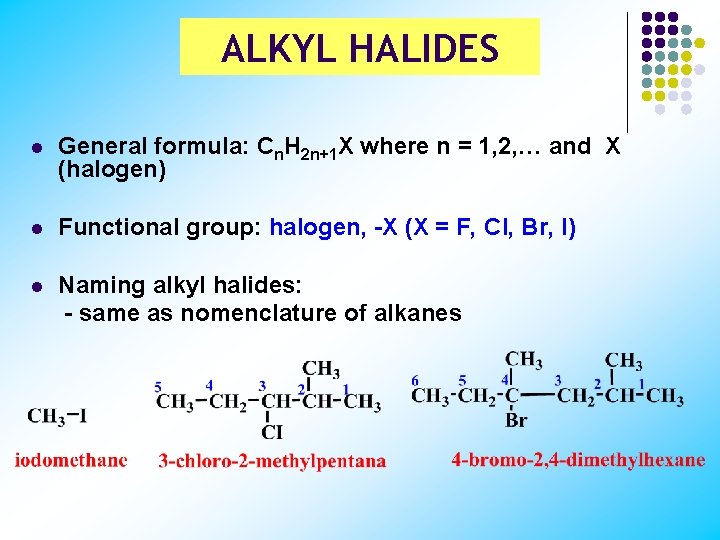
ALKYL HALIDES l General formula: Cn. H 2 n+1 X where n = 1, 2, … and X (halogen) l Functional group: halogen, -X (X = F, Cl, Br, I) Naming alkyl halides: - same as nomenclature of alkanes l
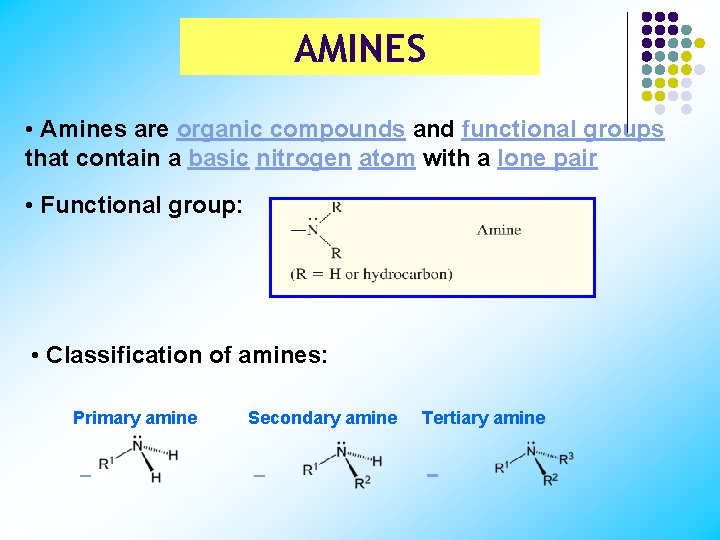
AMINES • Amines are organic compounds and functional groups that contain a basic nitrogen atom with a lone pair • Functional group: • Classification of amines: Primary amine Secondary amine Tertiary amine
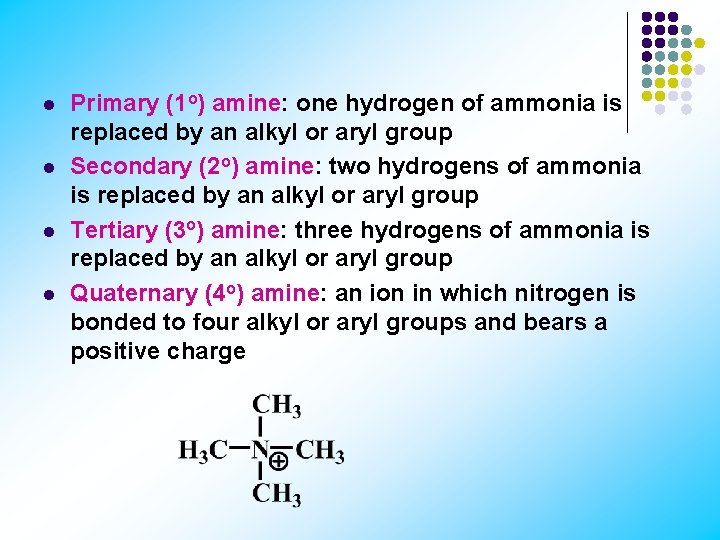
l l Primary (1 o) amine: one hydrogen of ammonia is replaced by an alkyl or aryl group Secondary (2 o) amine: two hydrogens of ammonia is replaced by an alkyl or aryl group Tertiary (3 o) amine: three hydrogens of ammonia is replaced by an alkyl or aryl group Quaternary (4 o) amine: an ion in which nitrogen is bonded to four alkyl or aryl groups and bears a positive charge
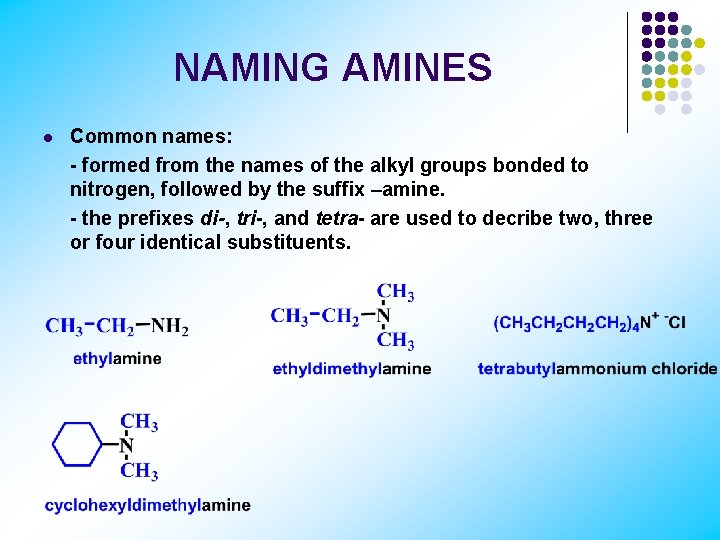
NAMING AMINES l Common names: - formed from the names of the alkyl groups bonded to nitrogen, followed by the suffix –amine. - the prefixes di-, tri-, and tetra- are used to decribe two, three or four identical substituents.
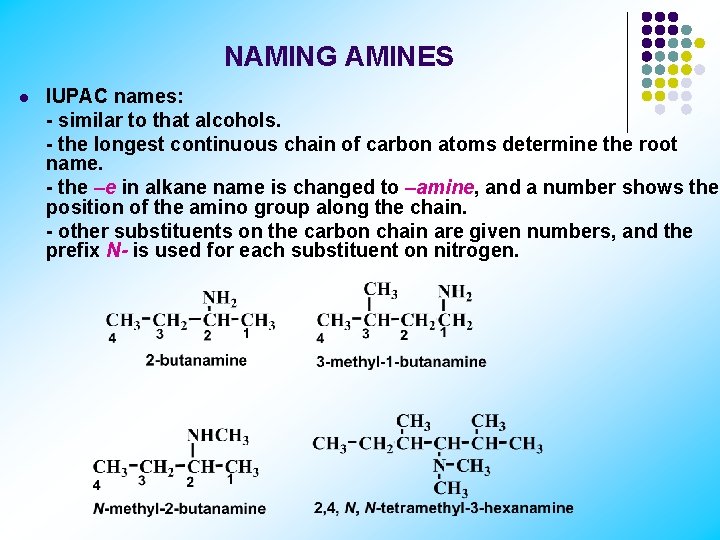
NAMING AMINES l IUPAC names: - similar to that alcohols. - the longest continuous chain of carbon atoms determine the root name. - the –e in alkane name is changed to –amine, and a number shows the position of the amino group along the chain. - other substituents on the carbon chain are given numbers, and the prefix N- is used for each substituent on nitrogen.
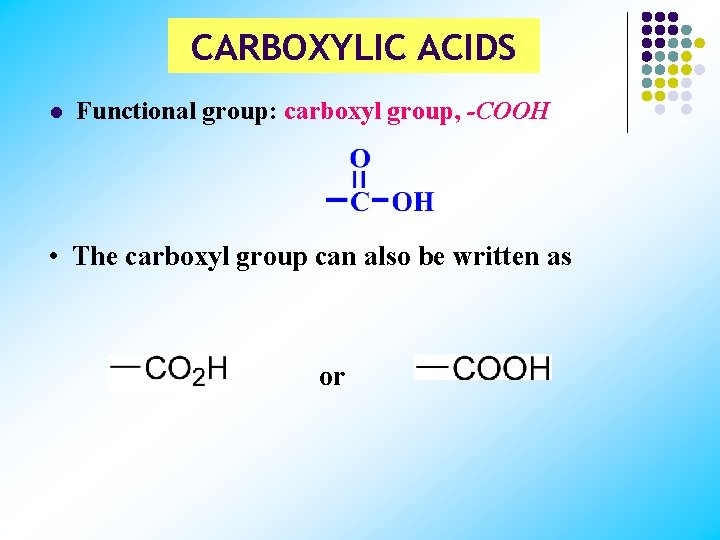
CARBOXYLIC ACIDS l Functional group: carboxyl group, -COOH • The carboxyl group can also be written as or
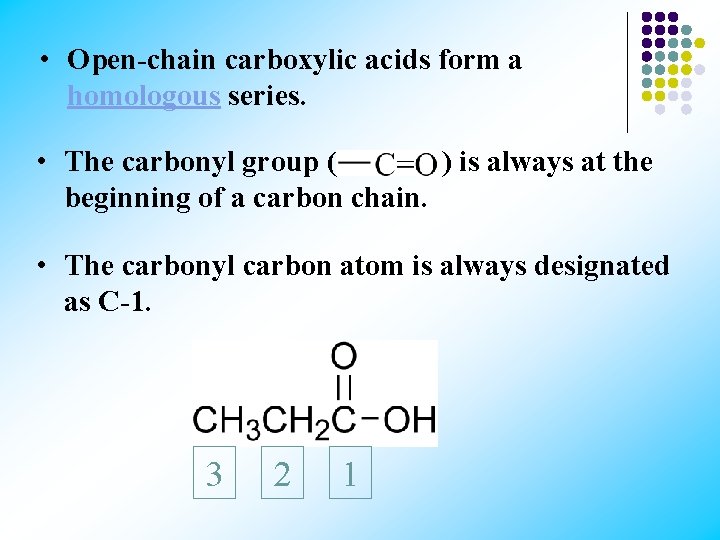
• Open-chain carboxylic acids form a homologous series. • The carbonyl group ( ) is always at the beginning of a carbon chain. • The carbonyl carbon atom is always designated as C-1. 3 2 1
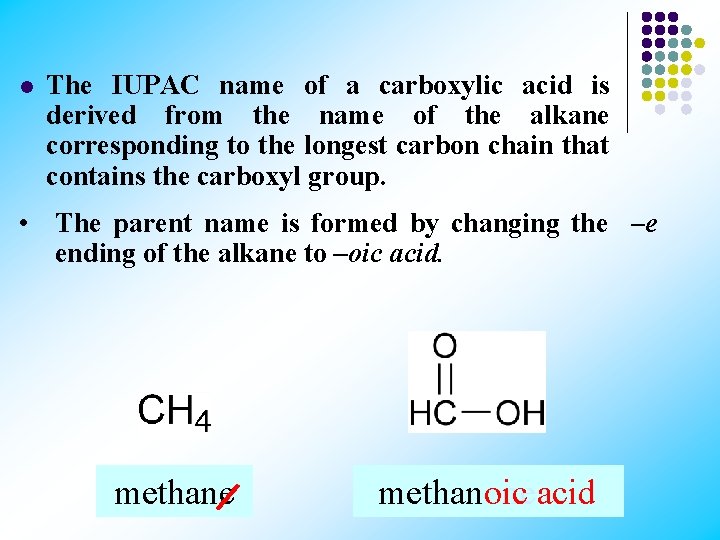
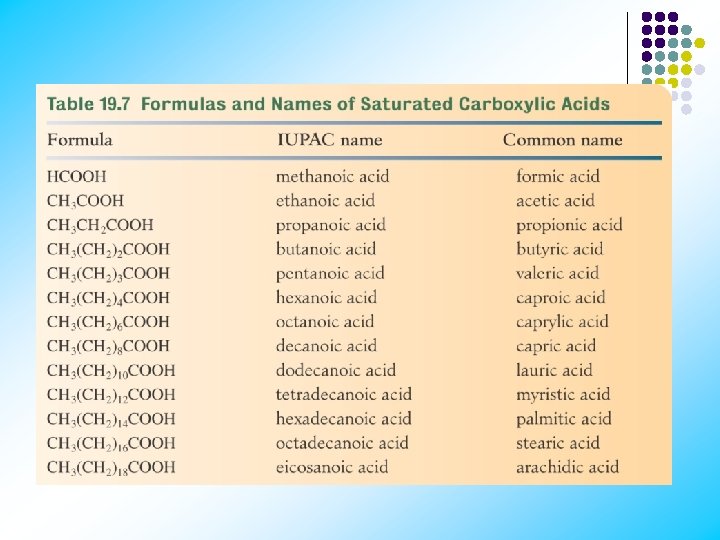
l The IUPAC name of a carboxylic acid is derived from the name of the alkane corresponding to the longest carbon chain that contains the carboxyl group. • The parent name is formed by changing the –e ending of the alkane to –oic acid. methane methanone oic acid
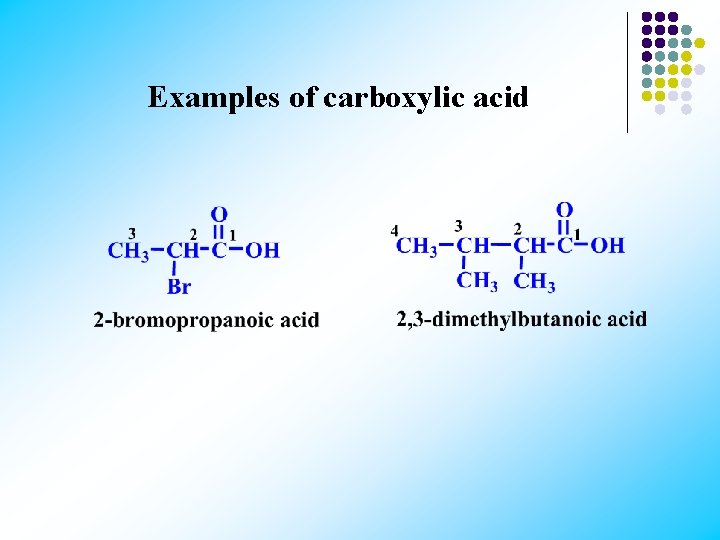
Examples of carboxylic acid
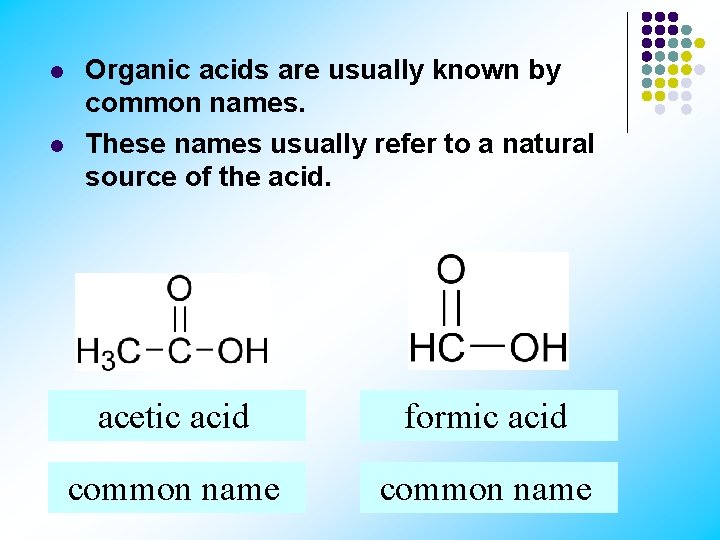
l l Organic acids are usually known by common names. These names usually refer to a natural source of the acid. ethanoic acetic acid methanoic formic acid common IUPAC name
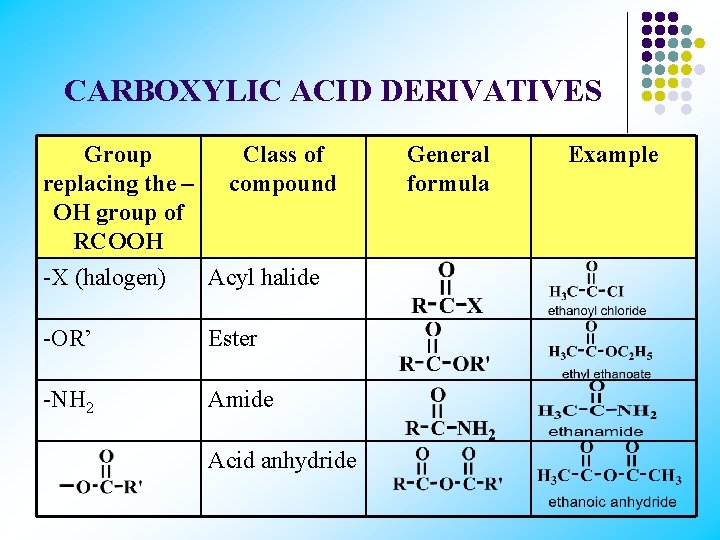
CARBOXYLIC ACID DERIVATIVES Group Class of replacing the – compound OH group of RCOOH -X (halogen) Acyl halide -OR’ Ester -NH 2 Amide Acid anhydride General formula Example

Esters
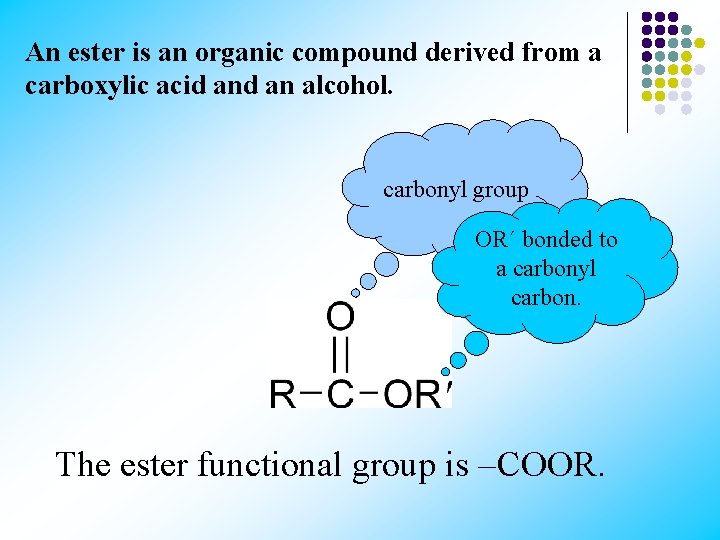
An ester is an organic compound derived from a carboxylic acid an alcohol. carbonyl group OR´ bonded to a carbonyl carbon. The ester functional group is –COOR.
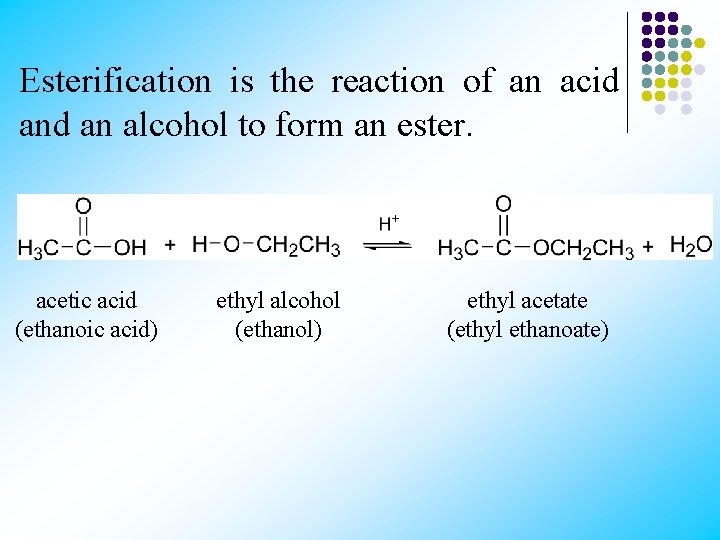
Esterification is the reaction of an acid an alcohol to form an ester. acetic acid (ethanoic acid) ethyl alcohol (ethanol) ethyl acetate (ethyl ethanoate)
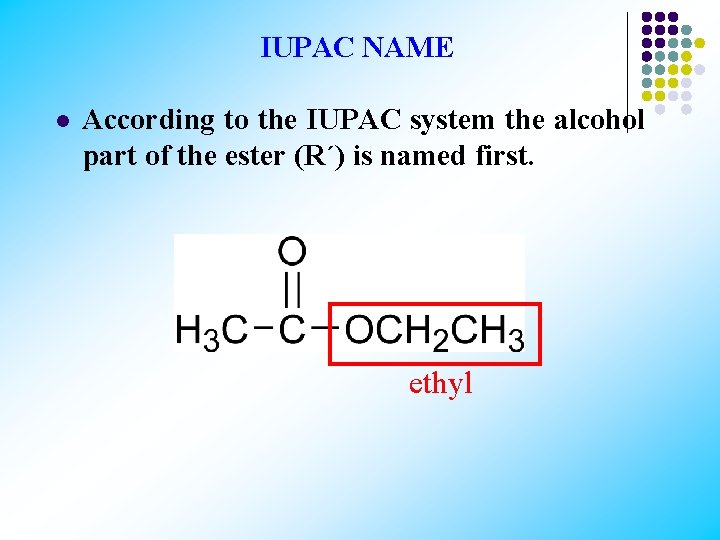
IUPAC NAME l According to the IUPAC system the alcohol part of the ester (R΄) is named first. ethyl
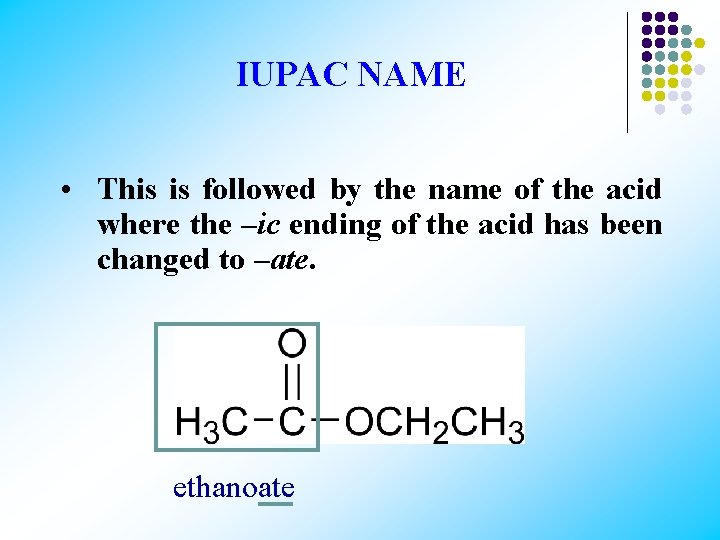
IUPAC NAME • This is followed by the name of the acid where the –ic ending of the acid has been changed to –ate. ethanoate
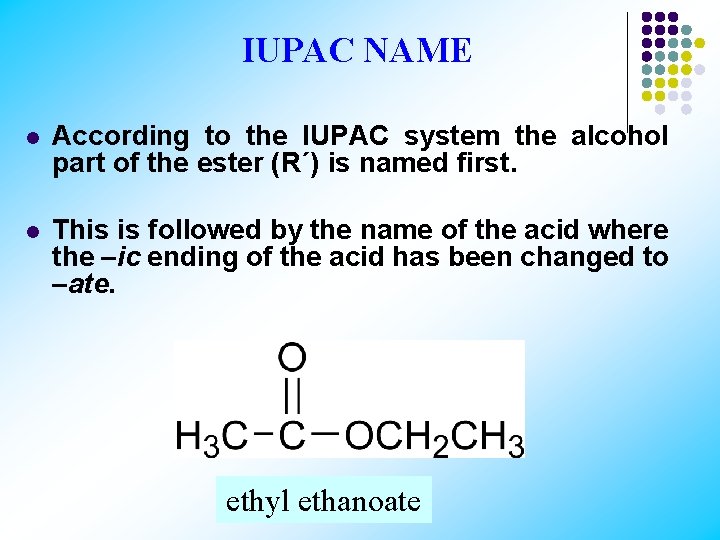
IUPAC NAME l According to the IUPAC system the alcohol part of the ester (R΄) is named first. l This is followed by the name of the acid where the –ic ending of the acid has been changed to –ate. ethyl ethanoate
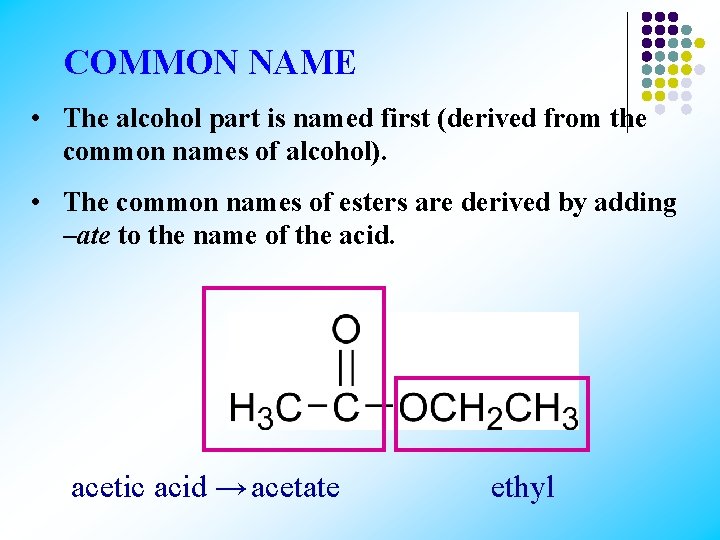
COMMON NAME • The alcohol part is named first (derived from the common names of alcohol). • The common names of esters are derived by adding –ate to the name of the acid. acetic acid → acetate ethyl
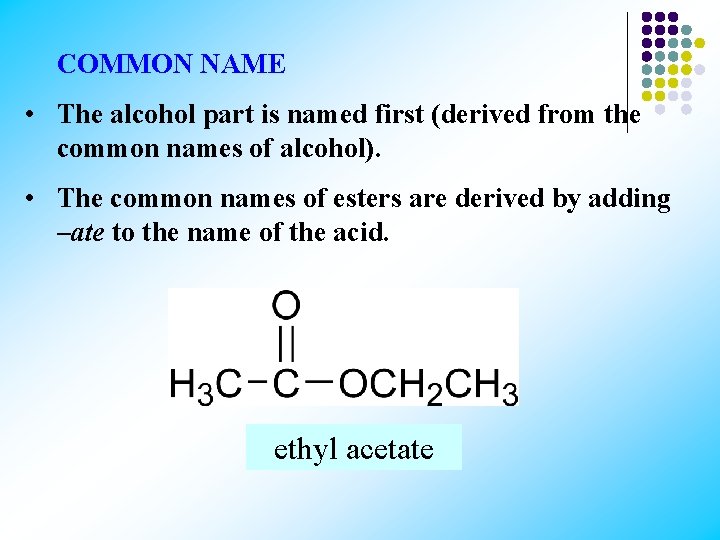
COMMON NAME • The alcohol part is named first (derived from the common names of alcohol). • The common names of esters are derived by adding –ate to the name of the acid. ethyl acetate
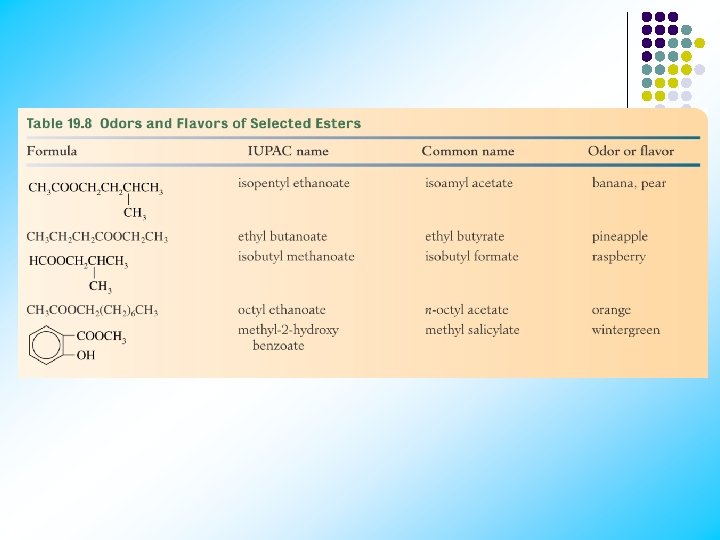
Amide l l Amide: a composite of a carboxylic acid and ammonia or an amine. Classification of amide: i) primary amide: RCONH 2 (two H atoms bonded to N atom) ii) secondary amide: RCONHR’ (one H atoms bonded to N atom) iii) tertiary amide: RCONR’R” (no H atoms bonded to N atom)
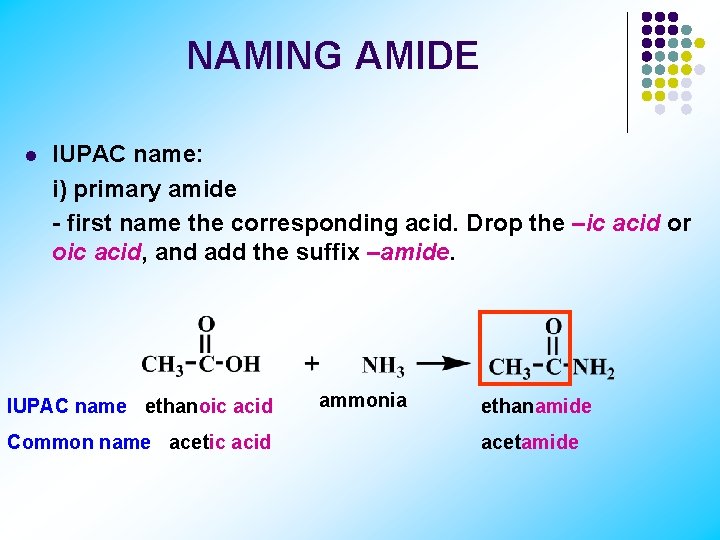
NAMING AMIDE l IUPAC name: i) primary amide - first name the corresponding acid. Drop the –ic acid or oic acid, and add the suffix –amide. IUPAC name ethanoic acid Common name acetic acid ammonia ethanamide acetamide
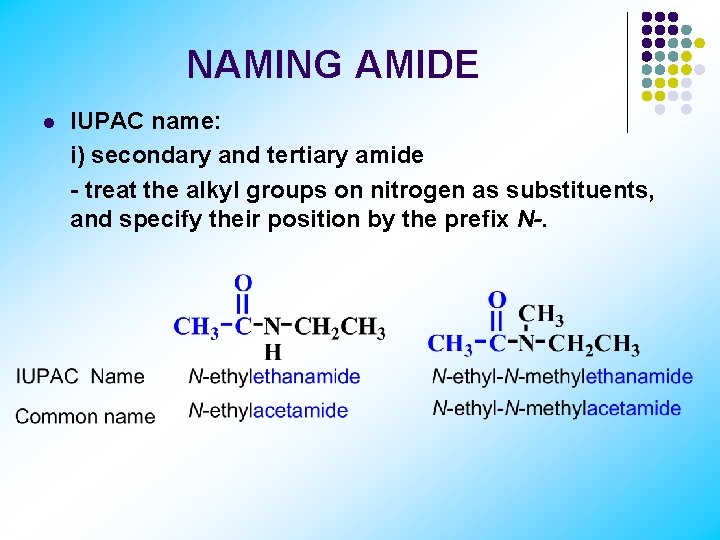
NAMING AMIDE l IUPAC name: i) secondary and tertiary amide - treat the alkyl groups on nitrogen as substituents, and specify their position by the prefix N-.
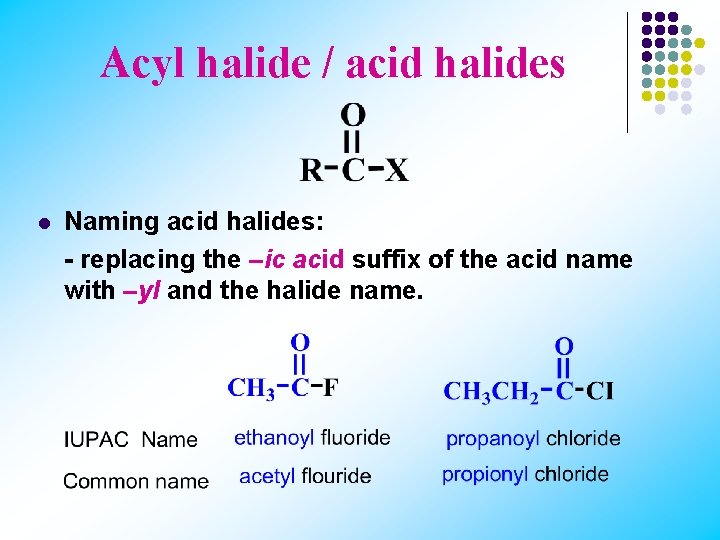
Acyl halide / acid halides l Naming acid halides: - replacing the –ic acid suffix of the acid name with –yl and the halide name.
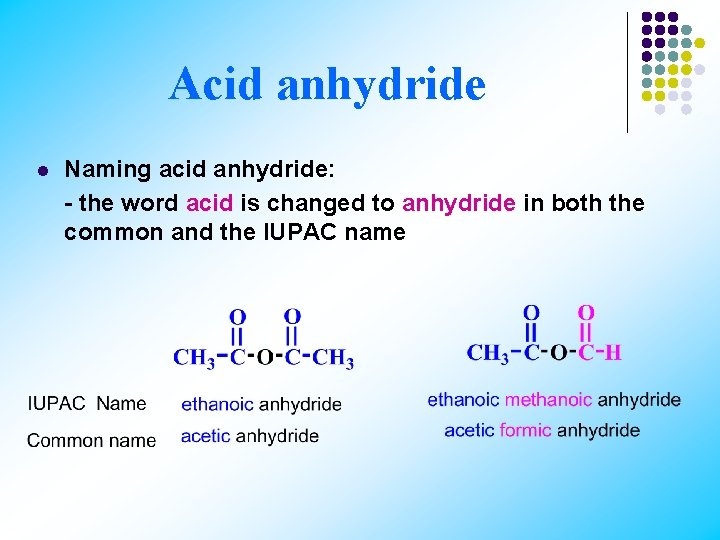
Acid anhydride l Naming acid anhydride: - the word acid is changed to anhydride in both the common and the IUPAC name
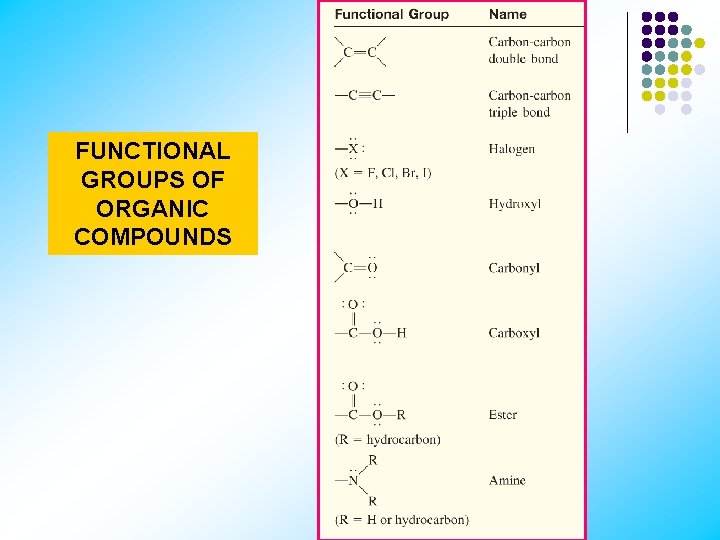
FUNCTIONAL GROUPS OF ORGANIC COMPOUNDS
POLYMERS • A polymer is a high molar mass molecular compound made up of many repeating chemical units. Naturally occurring polymers Synthetic polymers • Proteins • Nylon • Nucleic acids • Dacron • Cellulose • Lucite • Rubber
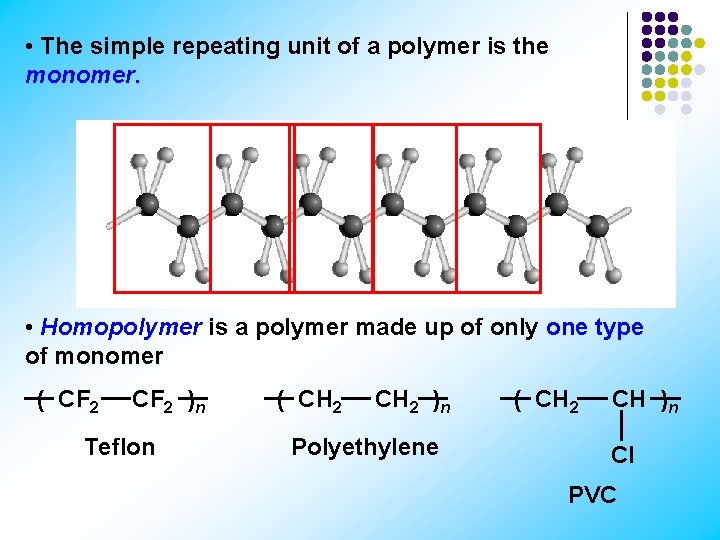
• The simple repeating unit of a polymer is the monomer. • Homopolymer is a polymer made up of only one type of monomer ( CF 2 )n ( CH 2 )n Teflon Polyethylene ( CH 2 CH )n Cl PVC
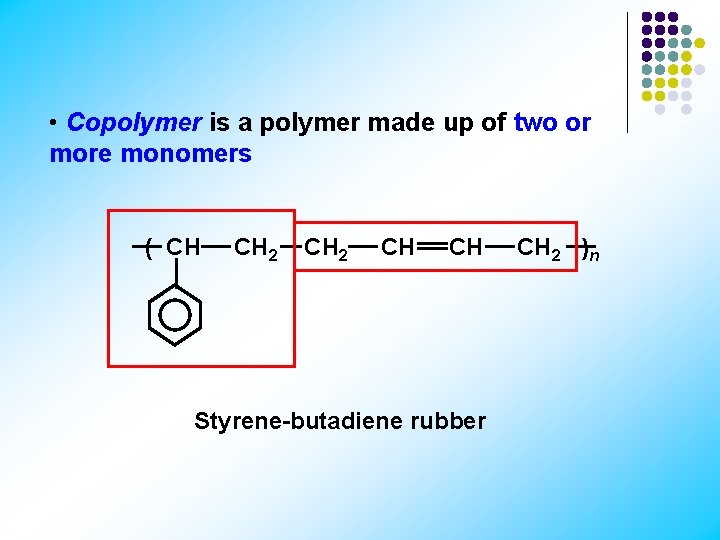
• Copolymer is a polymer made up of two or more monomers ( CH CH 2 CH CH CH 2 )n Styrene-butadiene rubber
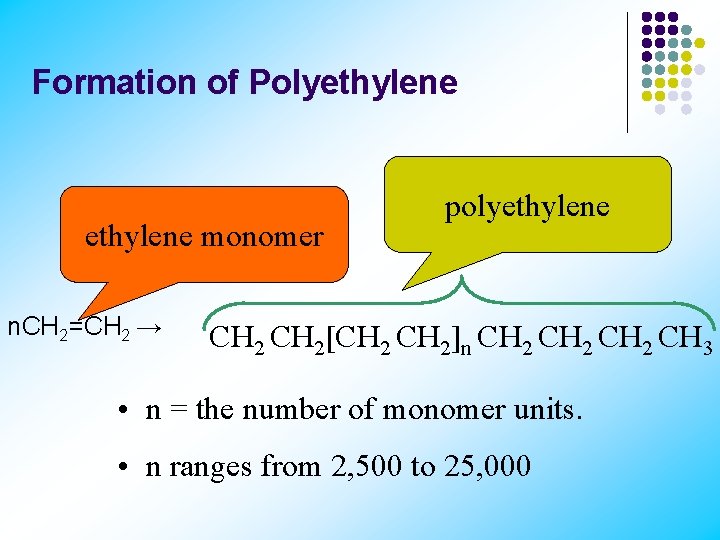
Formation of Polyethylene monomer n. CH 2=CH 2 → polyethylene CH 2[CH 2]n CH 2 CH 3 • n = the number of monomer units. • n ranges from 2, 500 to 25, 000
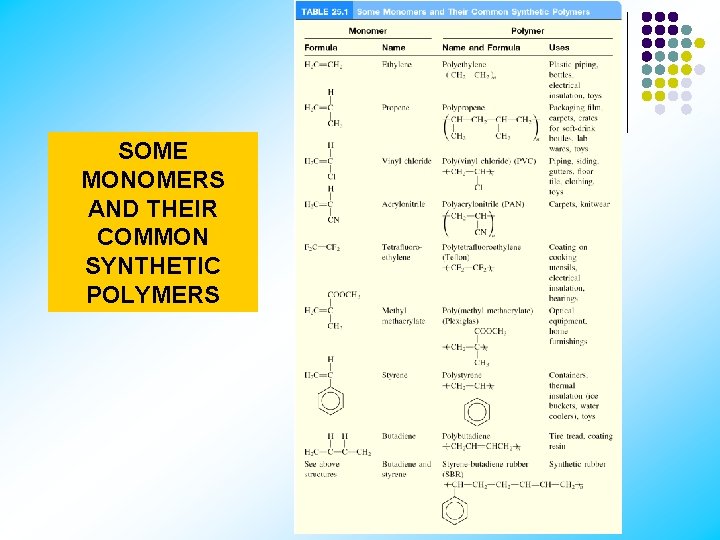
SOME MONOMERS AND THEIR COMMON SYNTHETIC POLYMERS
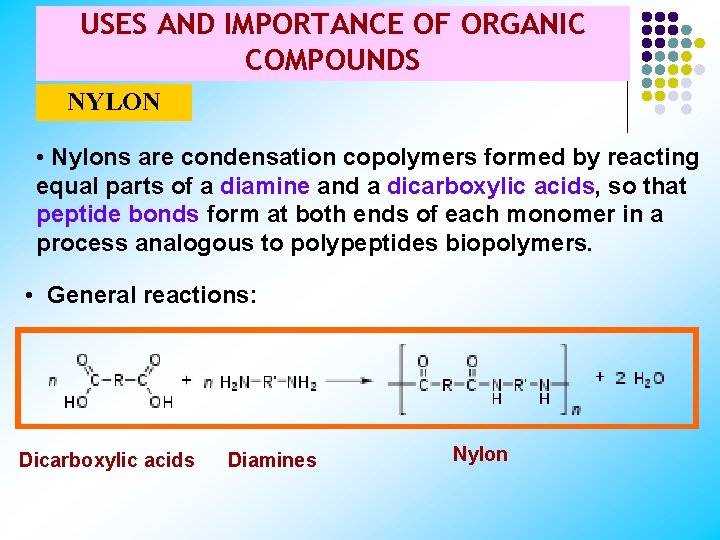
USES AND IMPORTANCE OF ORGANIC COMPOUNDS NYLON • Nylons are condensation copolymers formed by reacting equal parts of a diamine and a dicarboxylic acids, so that peptide bonds form at both ends of each monomer in a process analogous to polypeptides biopolymers. • General reactions: Dicarboxylic acids Diamines Nylon
Basic concepts of nylon production • The first approach: - combining molecules with an acid (COOH) group on each end are reacted with two chemicals that contain amine (NH 2) groups on each end. - Form nylon 6, 6, made of hexamethylene diamine with six carbon atoms and acidipic acid, as well as six carbon atoms. • The second approach: - a compound has an acid at one end an amine at the other and is polymerized to form a chain with repeating units of (-NH-[CH 2]n-CO-)x. - Form nylon 6, made from a single six-carbon substance called caprolactam.
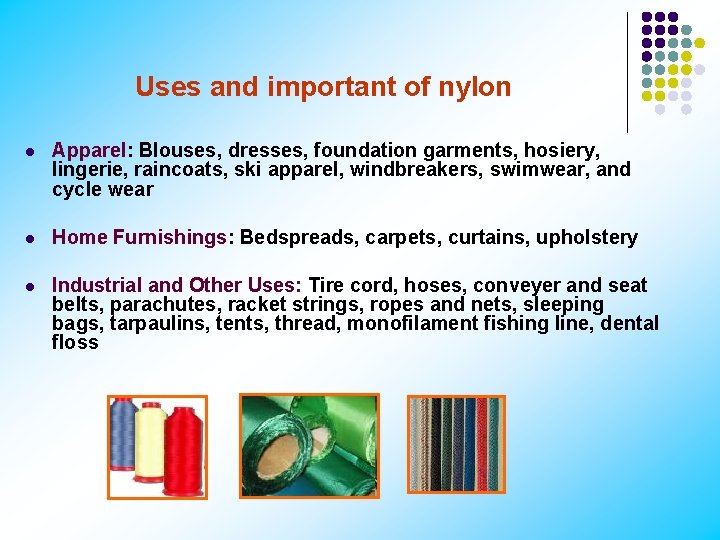
Uses and important of nylon l Apparel: Blouses, dresses, foundation garments, hosiery, lingerie, raincoats, ski apparel, windbreakers, swimwear, and cycle wear l Home Furnishings: Bedspreads, carpets, curtains, upholstery l Industrial and Other Uses: Tire cord, hoses, conveyer and seat belts, parachutes, racket strings, ropes and nets, sleeping bags, tarpaulins, tents, thread, monofilament fishing line, dental floss
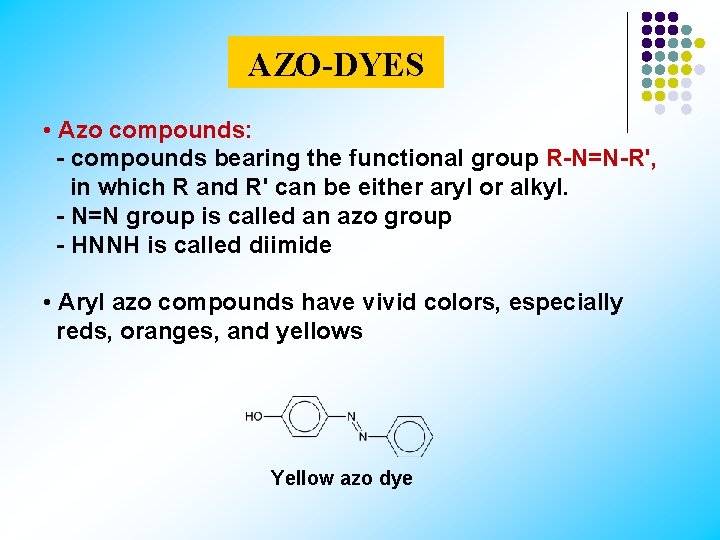
AZO-DYES • Azo compounds: - compounds bearing the functional group R-N=N-R', in which R and R' can be either aryl or alkyl. - N=N group is called an azo group - HNNH is called diimide • Aryl azo compounds have vivid colors, especially reds, oranges, and yellows Yellow azo dye
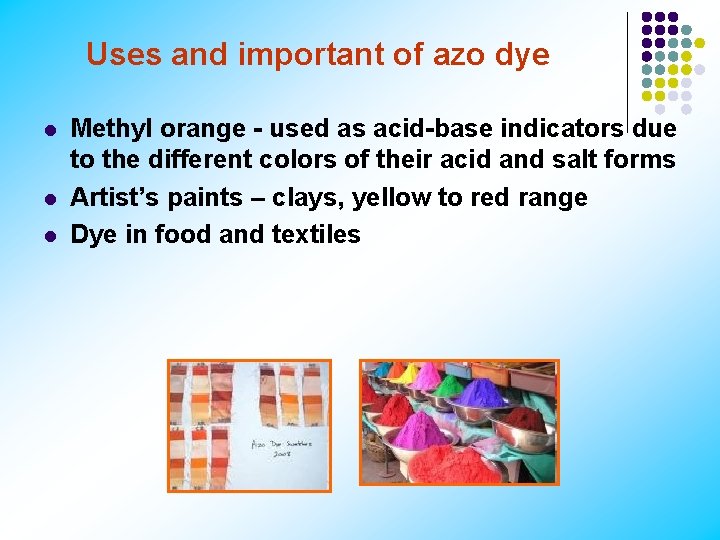
Uses and important of azo dye l l l Methyl orange - used as acid-base indicators due to the different colors of their acid and salt forms Artist’s paints – clays, yellow to red range Dye in food and textiles
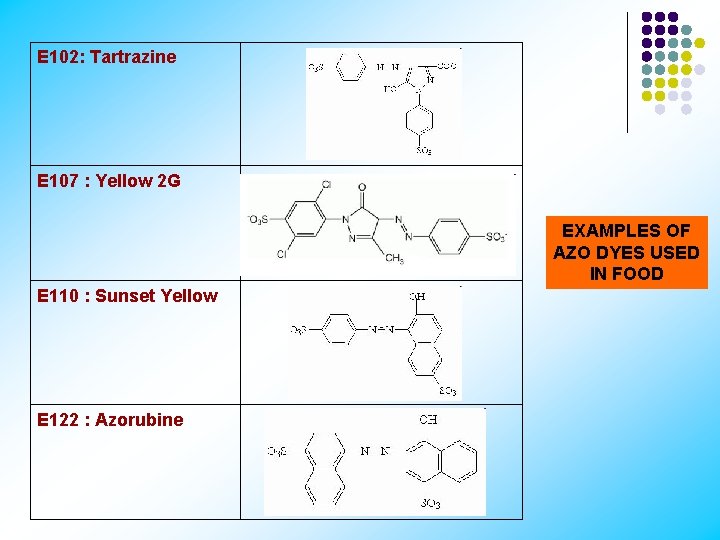
E 102: Tartrazine E 107 : Yellow 2 G EXAMPLES OF AZO DYES USED IN FOOD E 110 : Sunset Yellow E 122 : Azorubine
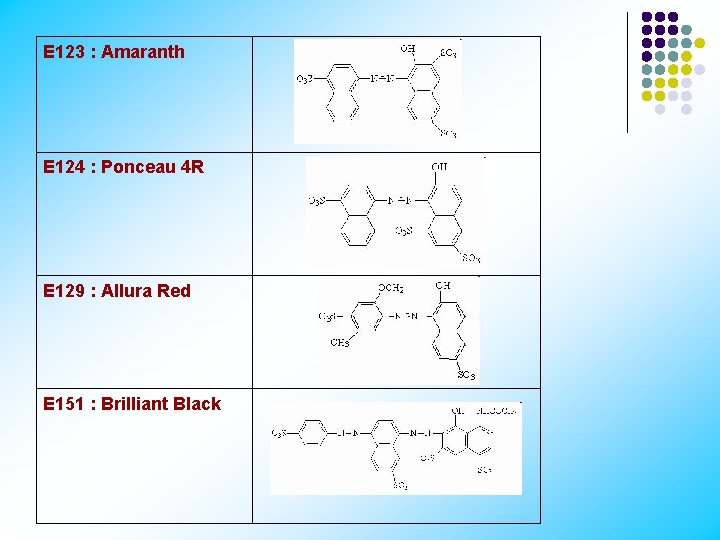
E 123 : Amaranth E 124 : Ponceau 4 R E 129 : Allura Red E 151 : Brilliant Black
FUEL Any material that is burned or altered to obtain energy and to heat or to move an object l Its energy can be stored to be released only when needed, and that the release is controlled in such a way that the energy can be harnessed to produce work l Examples: Methane, petrol and oil. l Application of energy released from fuels: - cooking - powering weapons to combustion - generation of electricity l Fuel oil: generate heat or used in an engine for the generation of power l
- Slides: 142