
Basic Chemistry 4e Chapter 12 Solutions Karen Timberlake
Basic Chemistry, 4/e Chapter 12: Solutions Karen Timberlake © 2014 Pearson Education, Inc.
Chapter 12 – Solutions 1. Which of the following acids is not a strong electrolyte? A. B. C. D. Sulfuric acid Hydrochloric acid Acetic acid Nitric acid © 2014 Pearson Education, Inc.
Chapter 12 – Solutions 1. Which of the following acids is not a strong electrolyte? A. B. C. D. Sulfuric acid Hydrochloric acid Acetic acid Nitric acid © 2014 Pearson Education, Inc.
Chapter 12 – Solutions 2. The process of water molecules being attracted to and surrounding solute particles is called A. B. C. D. solventation. hydrogenation. hydrolysis. solvation. © 2014 Pearson Education, Inc.
Chapter 12 – Solutions 2. The process of water molecules being attracted to and surrounding solute particles is called A. B. C. D. solventation. hydrogenation. hydrolysis. solvation. © 2014 Pearson Education, Inc.
Chapter 12 – Solutions 3. Which of the following statements best describes Henry’s Law? A. The amount of a solute that can dissolve in a given amount of solvent B. The solubility of a gas in a liquid is directly proportional to the partial pressure of the gas above the liquid. C. A solution that contains just as much solute as can be dissolved in the solvent by ordinary means D. The volume of a gas is directly related to the number of moles of a gas when the temperature and pressure are not changed. © 2014 Pearson Education, Inc.
Chapter 12 – Solutions 3. Which of the following statements best describes Henry’s Law? A. The amount of a solute that can dissolve in a given amount of solvent B. The solubility of a gas in a liquid is directly proportional to the partial pressure of the gas above the liquid. C. A solution that contains just as much solute as can be dissolved in the solvent by ordinary means D. The volume of a gas is directly related to the number of moles of a gas when the temperature and pressure are not changed. © 2014 Pearson Education, Inc.
Chapter 12 – Solutions 4. Salts that are soluble in water contain at least one of the following ions except A. B. C. D. Na+. Ag+. K +. Cl–. © 2014 Pearson Education, Inc.
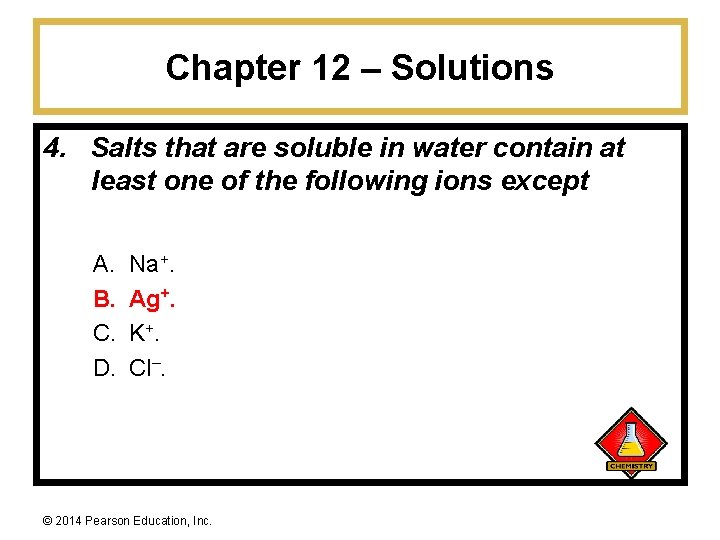
Chapter 12 – Solutions 4. Salts that are soluble in water contain at least one of the following ions except A. B. C. D. Na+. Ag+. K +. Cl–. © 2014 Pearson Education, Inc.
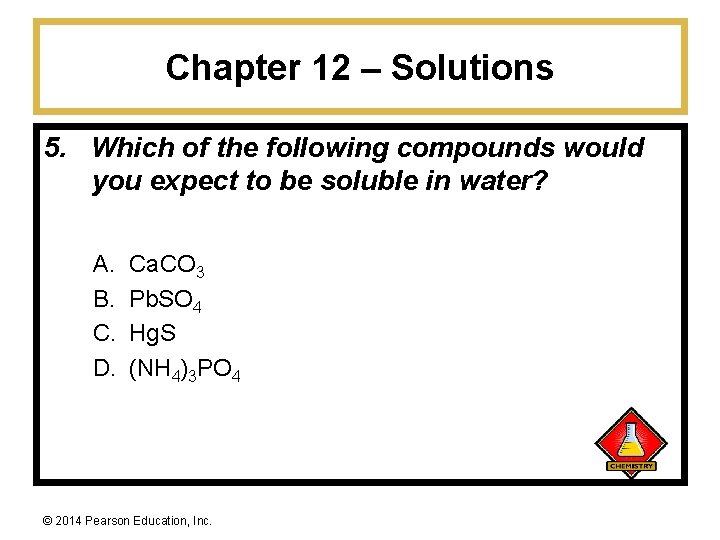
Chapter 12 – Solutions 5. Which of the following compounds would you expect to be soluble in water? A. B. C. D. Ca. CO 3 Pb. SO 4 Hg. S (NH 4)3 PO 4 © 2014 Pearson Education, Inc.
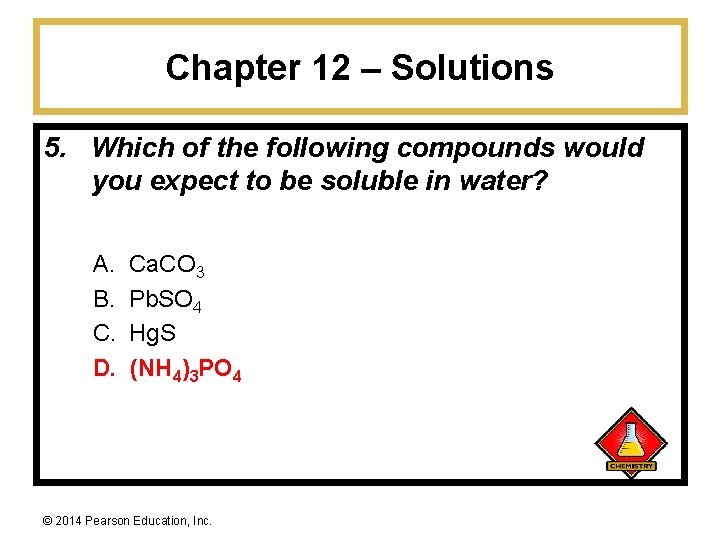
Chapter 12 – Solutions 5. Which of the following compounds would you expect to be soluble in water? A. B. C. D. Ca. CO 3 Pb. SO 4 Hg. S (NH 4)3 PO 4 © 2014 Pearson Education, Inc.
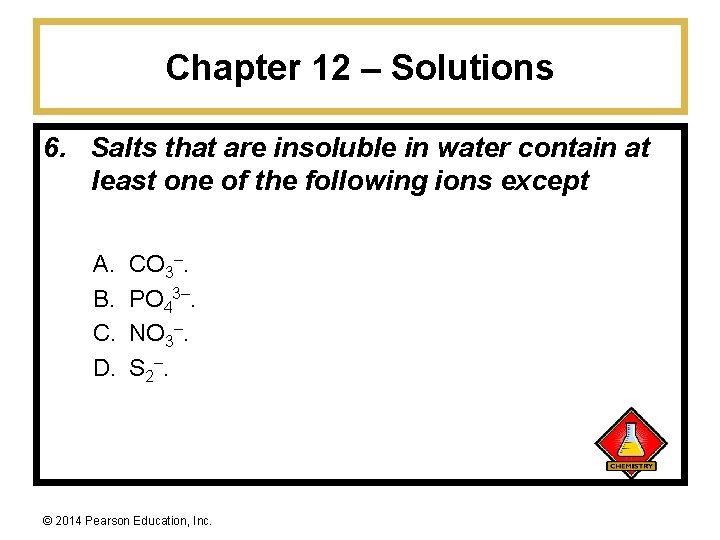
Chapter 12 – Solutions 6. Salts that are insoluble in water contain at least one of the following ions except A. B. C. D. CO 3–. PO 43–. NO 3–. S 2–. © 2014 Pearson Education, Inc.
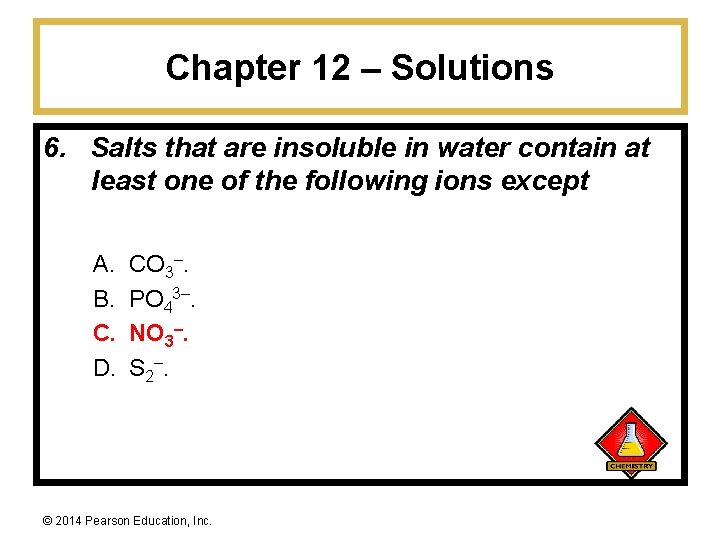
Chapter 12 – Solutions 6. Salts that are insoluble in water contain at least one of the following ions except A. B. C. D. CO 3–. PO 43–. NO 3–. S 2–. © 2014 Pearson Education, Inc.
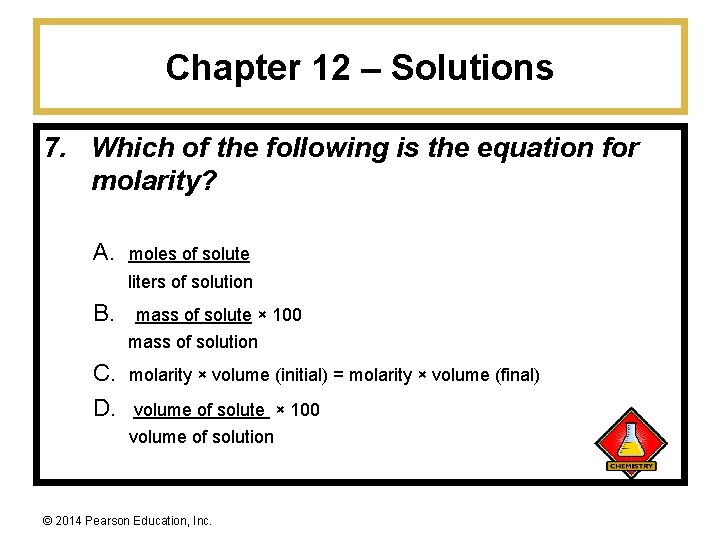
Chapter 12 – Solutions 7. Which of the following is the equation for molarity? A. moles of solute liters of solution B. mass of solute × 100 mass of solution C. D. molarity × volume (initial) = molarity × volume (final) volume of solute × 100 volume of solution © 2014 Pearson Education, Inc.
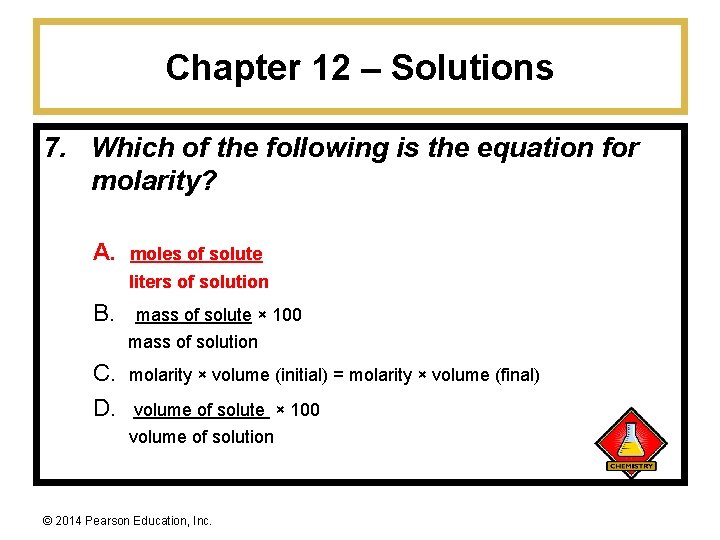
Chapter 12 – Solutions 7. Which of the following is the equation for molarity? A. moles of solute liters of solution B. mass of solute × 100 mass of solution C. D. molarity × volume (initial) = molarity × volume (final) volume of solute × 100 volume of solution © 2014 Pearson Education, Inc.
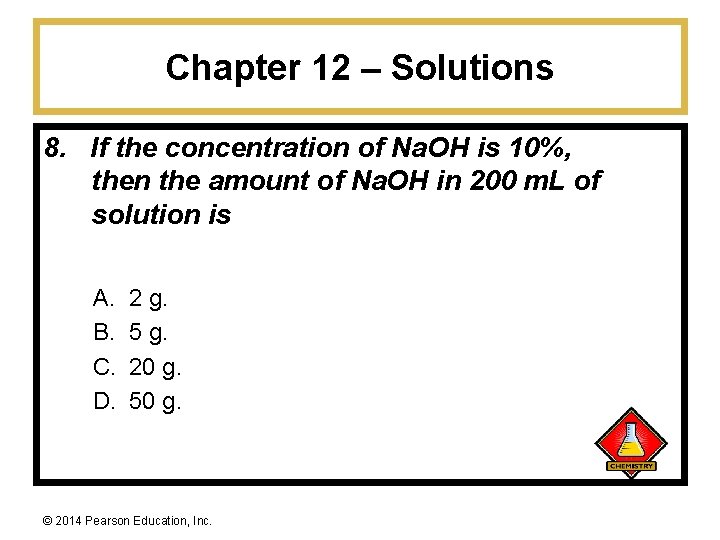
Chapter 12 – Solutions 8. If the concentration of Na. OH is 10%, then the amount of Na. OH in 200 m. L of solution is A. B. C. D. 2 g. 5 g. 20 g. 50 g. © 2014 Pearson Education, Inc.
Chapter 12 – Solutions 8. If the concentration of Na. OH is 10%, then the amount of Na. OH in 200 m. L of solution is A. B. C. D. 2 g. 5 g. 20 g. 50 g. © 2014 Pearson Education, Inc.
Chapter 12 – Solutions 9. The solubility of Na. Cl in water is 36% at 20 °C. At the same temperature, a solution of 30 g Na. Cl in 1 liter of water would be classified as A. B. C. D. dilute. concentrated. saturated. supersaturated. © 2014 Pearson Education, Inc.
Chapter 12 – Solutions 9. The solubility of Na. Cl in water is 36% at 20 °C. At the same temperature, a solution of 30 g Na. Cl in 1 liter of water would be classified as A. B. C. D. dilute. concentrated. saturated. supersaturated. © 2014 Pearson Education, Inc.
Chapter 12 – Solutions 10. In 400 m. L of a 0. 25 M solution of Na. OH, there are how many grams of Na. OH? A. B. C. D. 2 g 4 g 5 g 10 g © 2014 Pearson Education, Inc.
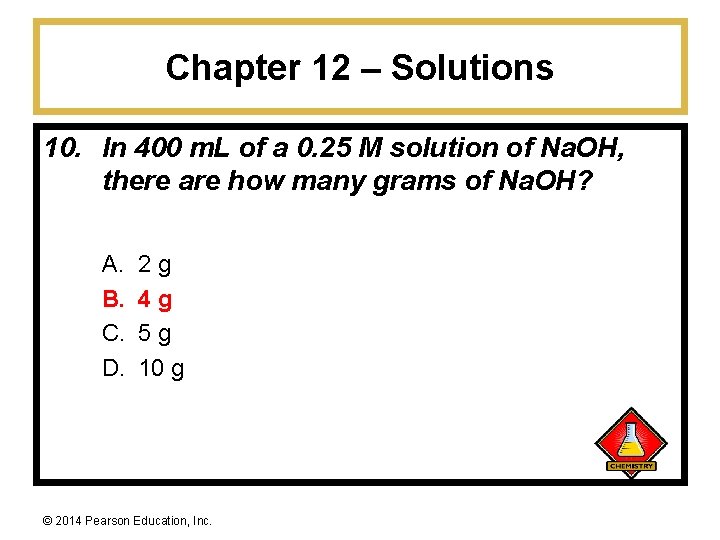
Chapter 12 – Solutions 10. In 400 m. L of a 0. 25 M solution of Na. OH, there are how many grams of Na. OH? A. B. C. D. 2 g 4 g 5 g 10 g © 2014 Pearson Education, Inc.
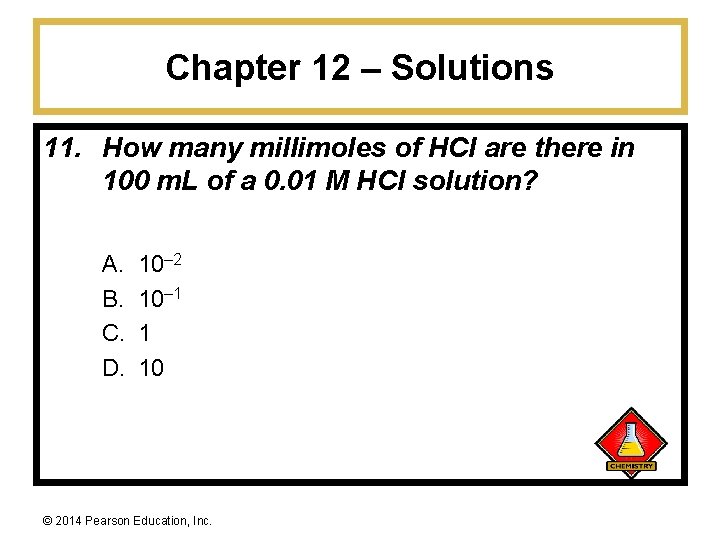
Chapter 12 – Solutions 11. How many millimoles of HCl are there in 100 m. L of a 0. 01 M HCl solution? A. B. C. D. 10– 2 10– 1 1 10 © 2014 Pearson Education, Inc.
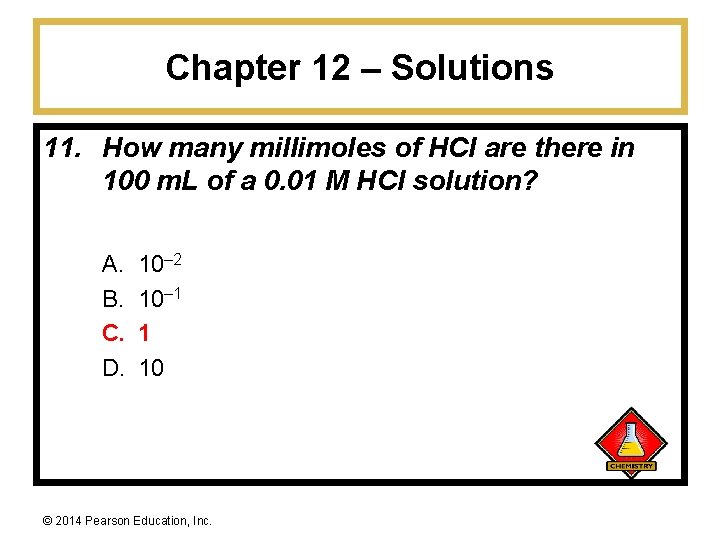
Chapter 12 – Solutions 11. How many millimoles of HCl are there in 100 m. L of a 0. 01 M HCl solution? A. B. C. D. 10– 2 10– 1 1 10 © 2014 Pearson Education, Inc.
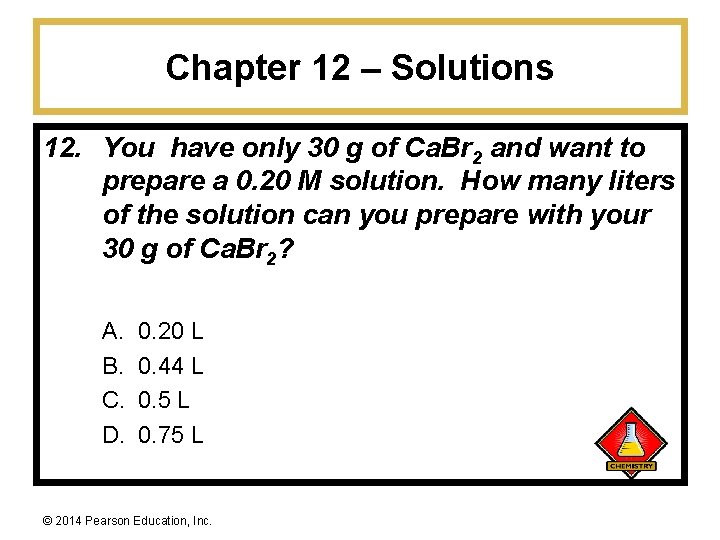
Chapter 12 – Solutions 12. You have only 30 g of Ca. Br 2 and want to prepare a 0. 20 M solution. How many liters of the solution can you prepare with your 30 g of Ca. Br 2? A. B. C. D. 0. 20 L 0. 44 L 0. 5 L 0. 75 L © 2014 Pearson Education, Inc.
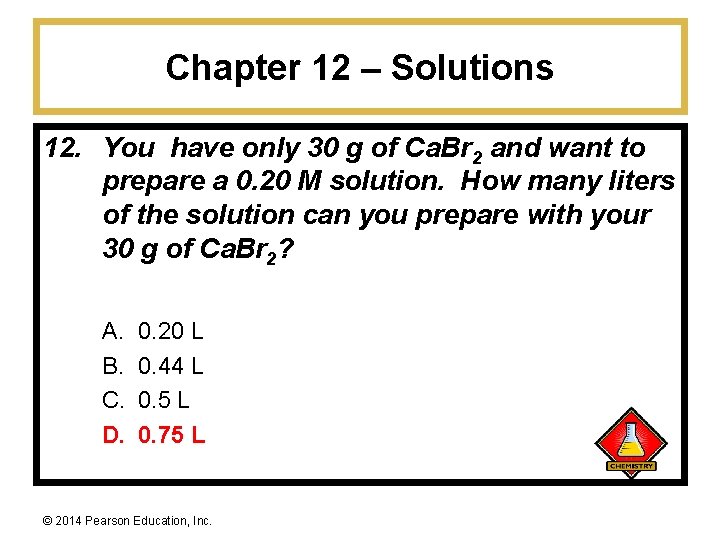
Chapter 12 – Solutions 12. You have only 30 g of Ca. Br 2 and want to prepare a 0. 20 M solution. How many liters of the solution can you prepare with your 30 g of Ca. Br 2? A. B. C. D. 0. 20 L 0. 44 L 0. 5 L 0. 75 L © 2014 Pearson Education, Inc.
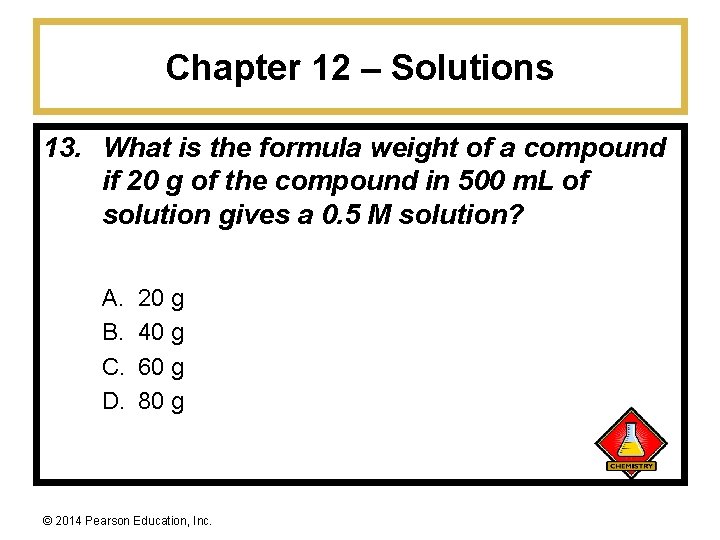
Chapter 12 – Solutions 13. What is the formula weight of a compound if 20 g of the compound in 500 m. L of solution gives a 0. 5 M solution? A. B. C. D. 20 g 40 g 60 g 80 g © 2014 Pearson Education, Inc.
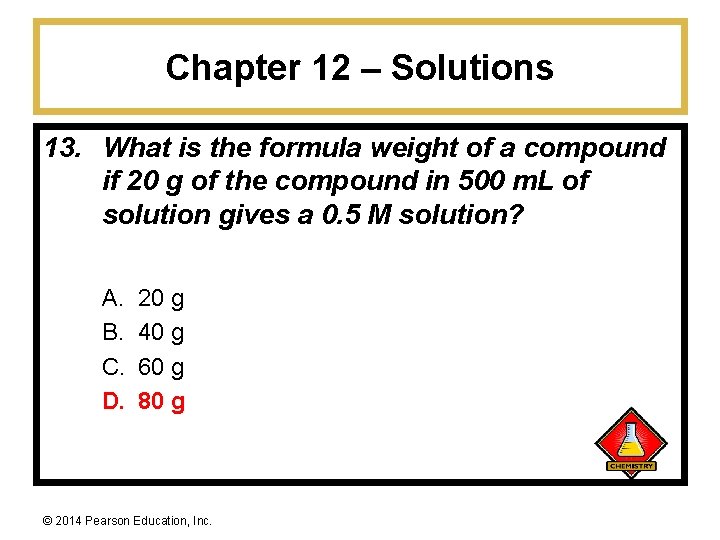
Chapter 12 – Solutions 13. What is the formula weight of a compound if 20 g of the compound in 500 m. L of solution gives a 0. 5 M solution? A. B. C. D. 20 g 40 g 60 g 80 g © 2014 Pearson Education, Inc.
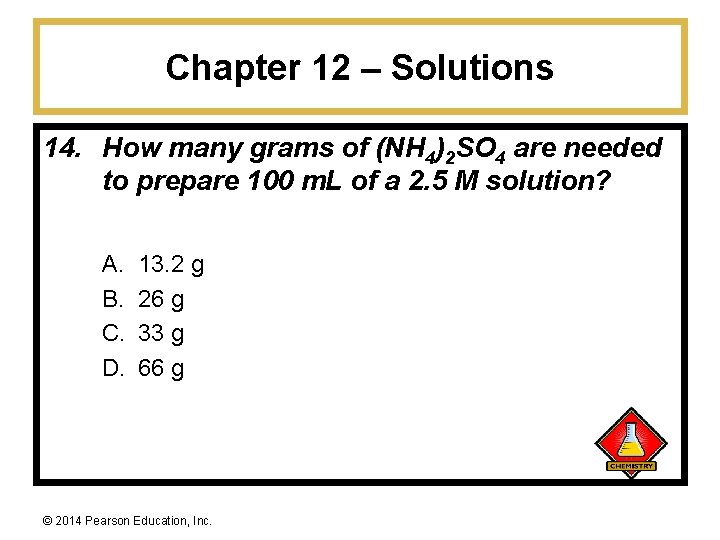
Chapter 12 – Solutions 14. How many grams of (NH 4)2 SO 4 are needed to prepare 100 m. L of a 2. 5 M solution? A. B. C. D. 13. 2 g 26 g 33 g 66 g © 2014 Pearson Education, Inc.
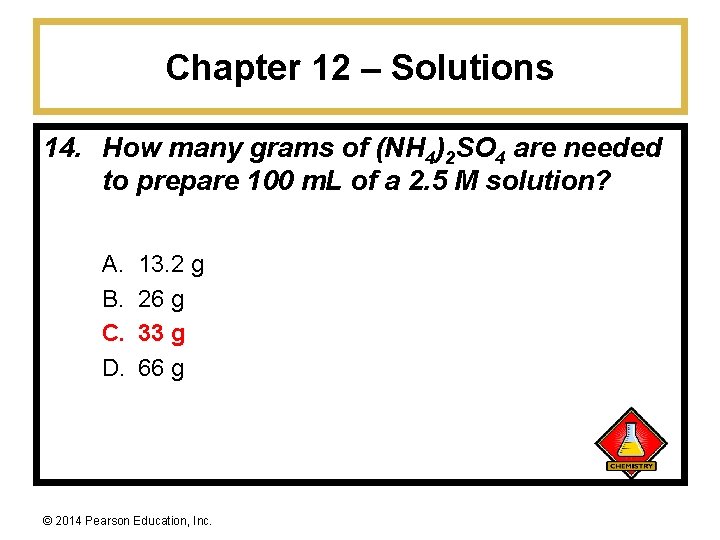
Chapter 12 – Solutions 14. How many grams of (NH 4)2 SO 4 are needed to prepare 100 m. L of a 2. 5 M solution? A. B. C. D. 13. 2 g 26 g 33 g 66 g © 2014 Pearson Education, Inc.
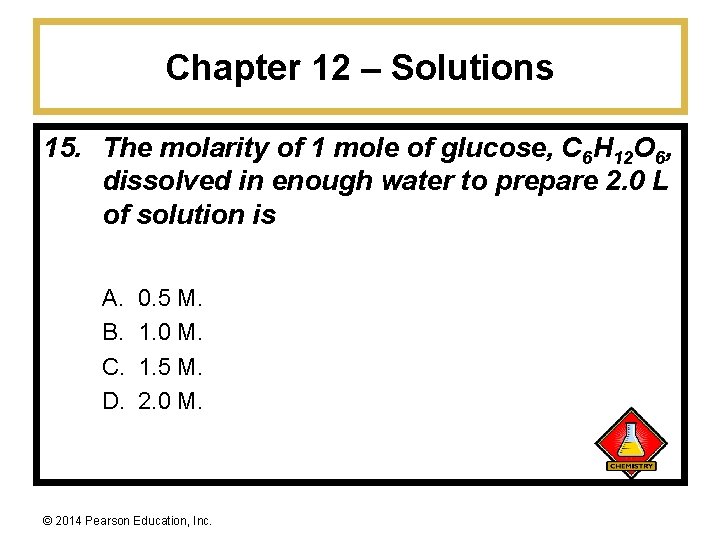
Chapter 12 – Solutions 15. The molarity of 1 mole of glucose, C 6 H 12 O 6, dissolved in enough water to prepare 2. 0 L of solution is A. B. C. D. 0. 5 M. 1. 0 M. 1. 5 M. 2. 0 M. © 2014 Pearson Education, Inc.
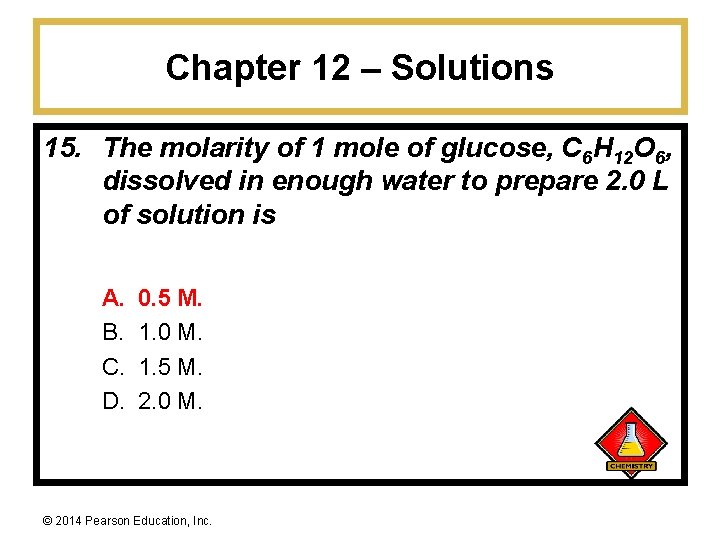
Chapter 12 – Solutions 15. The molarity of 1 mole of glucose, C 6 H 12 O 6, dissolved in enough water to prepare 2. 0 L of solution is A. B. C. D. 0. 5 M. 1. 0 M. 1. 5 M. 2. 0 M. © 2014 Pearson Education, Inc.
- Slides: 31