
Basic Cellular Network Design and Operations EECS 4215
Basic Cellular Network Design and Operations EECS 4215 – Mobile Communications York University 04 September 2021
Outline • • • Cellular system components Frequency re-use and planning The hexagon grid Distance-to-reuse ratio Call handoff Maps used in network design 2
Main Cellular Components • Five key components to any cellular network are: 1. 2. 3. 4. 5. Mobile Phone The Cell Base Station The Backhaul Network (also called fixed network) The Core Network Interconnection to the Public-Switched Telephone Network (PSTN) and the Internet 3
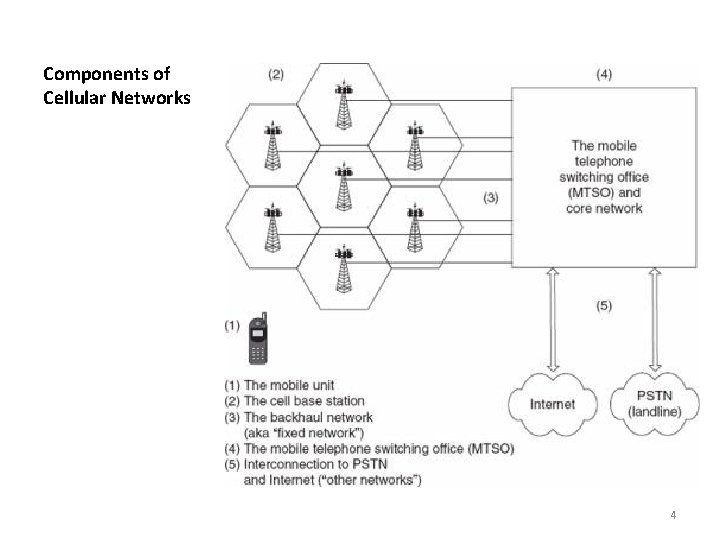
Components of Cellular Networks 4
1. Mobile Phones • Process millions of calculations per second in order to compress and decompress the voice stream. • Wireless subscriber traffic (voice, data, images, and video) is all in digital form today but the transmissions are sent through the air, and they’re still being transported as an analog signal on a specific frequency. 5
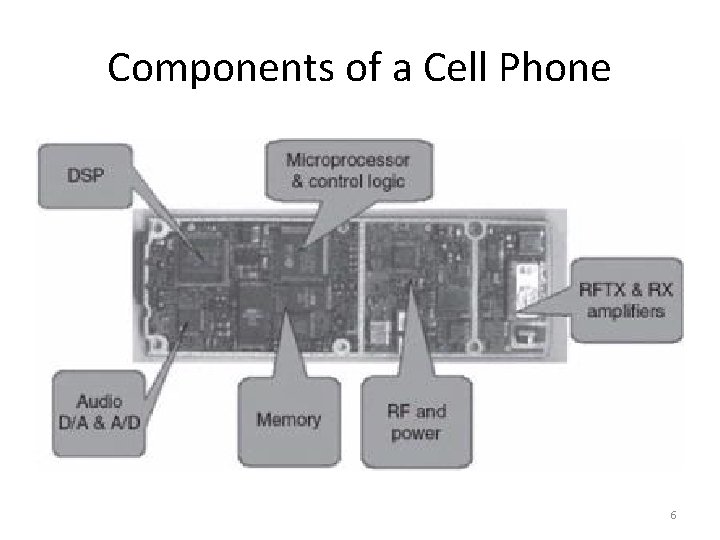
Components of a Cell Phone 6
2. The Cell Base Station • The cell base station is the physical location of the radios (also known as transceivers). 7
3. The Backhaul Network • Connects all cell base stations to the wireless core network. • It’s also known as the mobile telephone switching office (MTSO). 8
4. The Core Network • A large building which houses the switching equipment. • Manages all active phones and transmissions. • Monitors base stations and network elements. • Allows routing – Connects calls and data transmissions by switching conversations and digital data packets from one network path to another. 9
5. Interconnections (links) • High-capacity circuits between the wireless and landline networks. • Connect wireless calls to the landline public network. • Allows land-line callers to reach a mobile subscriber. 10
The Cell Base Station 11
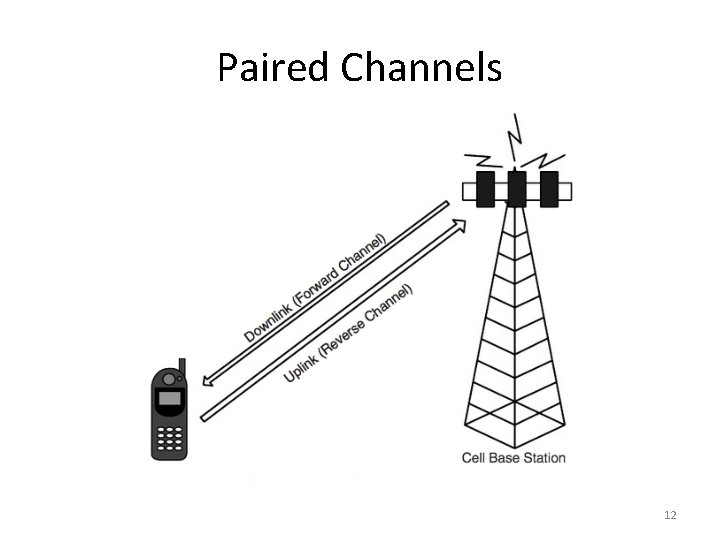
Paired Channels 12
Channel Spacing • Channel spacing refers to the actual bandwidth space that is allocated for every wireless channel out of the total amount of spectrum allocated to a wireless carrier by the FCC. • AMPS (oldest air interface): channel spacing is 30 KHz; 30 KHz for uplink and 30 KHz for downlink. • GSM systems allot their spectrum in 200 KHz carriers, where each carrier allocates 25 KHz to the uplink or downlink. • CDMA: channel spacing is 1. 25 MHz because all calls that are carried on a 1. 25 MHz CDMA carrier are spread out over that carrier. 13
Frequency Re-use and Planning • Frequency re-use: support concurrent transmissions • N=7 groups of cells re-used over and over again throughout a network. • 416 pairs of channels distributed throughout the 7 channel frequency re-use plan. • Higher-traffic cells had more radio channels assigned to them (based on “subscriber density”) • No longer used in today’s networks 14
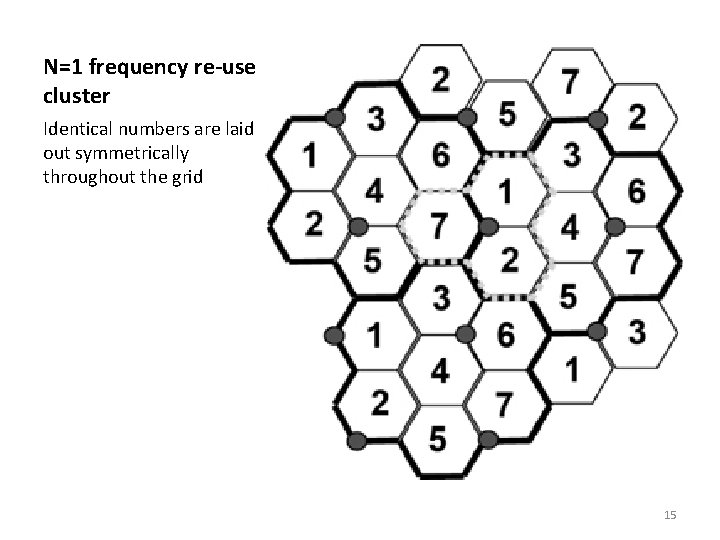
N=1 frequency re-use cluster Identical numbers are laid out symmetrically throughout the grid 15
Today’s Networks • Code re-use (CDMA) • Automatic frequency planning (AFP) tools: assign frequencies based on – Existing geographic frequency allocations – Interference avoidance algorithms – Geographic data – Market size 16
The Hexagon Grid • Overlapping circles: overlapping cell radio coverage, required for call handoff. • Handoff cannot occur unless there is some overlapping of radio coverage. • Size of each hex in a rural grid would be larger (based on “subscriber density”). 17
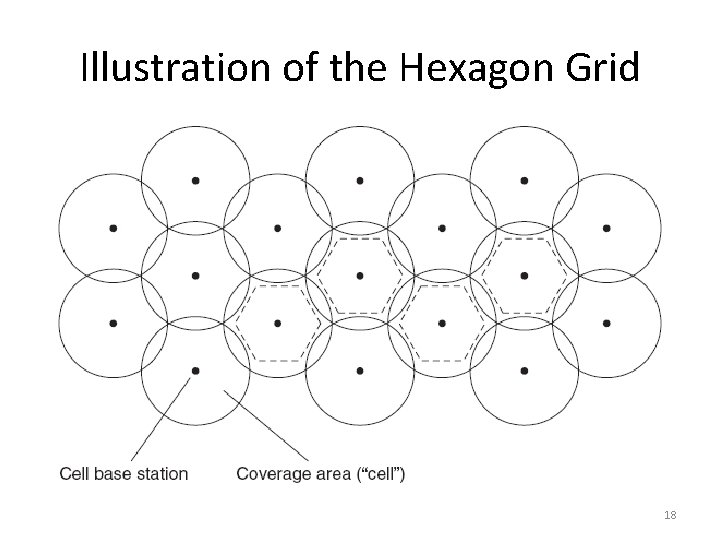
Illustration of the Hexagon Grid 18
Uses of the Hexagon Grid Solutions to reduce/eliminate signal interference Long-term frequency planning Easy additions of new cells into a wireless market Identifying call-handoff candidate cells for every given cell in the system • Traffic analysis purposes • Note: the hexagon grid is no longer used formally for system design and planning. • • 19
The Distance-to-Reuse Ratio • D/R: geographic distance required between cells using identical frequencies in order to avoid interference between the radio transmissions at these cells. • Determined by – Geographic coverage size of cell base stations – Radio power level used at cell base stations transmitting the same sets of frequencies • Computed by the software of propagation analysis tools. 20
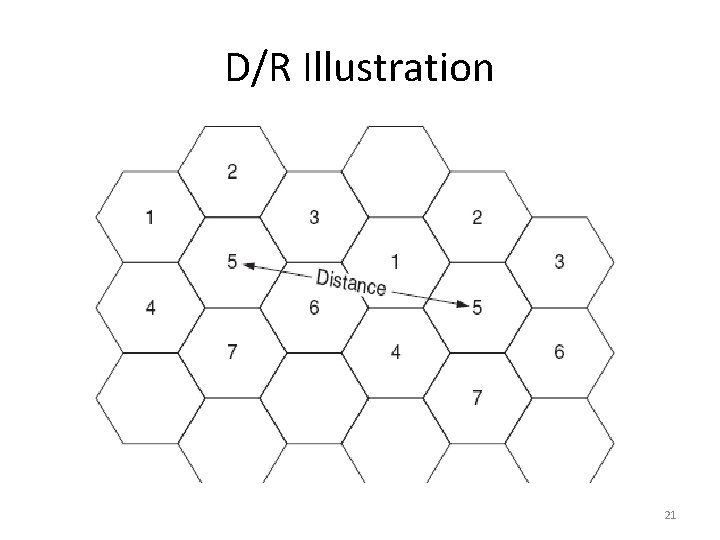
D/R Illustration 21
Frequency Agility • Capability of mobile phones to operate on any frequency in their carrier’s assigned radio spectrum. • Mobile phone has the ability to change frequencies instantly upon command from – Itself (based on signal strength tests) – the wireless system 22
Call Handoff • A process of a mobile phone’s operation being transferred from one cell to another cell— while changing frequencies. • It’s also known as call handover. 23
Call Handoff (2) • Mobile unit (cell phone) itself monitors its signal levels. • When signals are week, it scans the control channel signals of all its neighbor cells and requests a call-handoff with the strongest one. • Overlapping radio coverage allows for callhandoff to occur and is controlled by microprocessor. 24
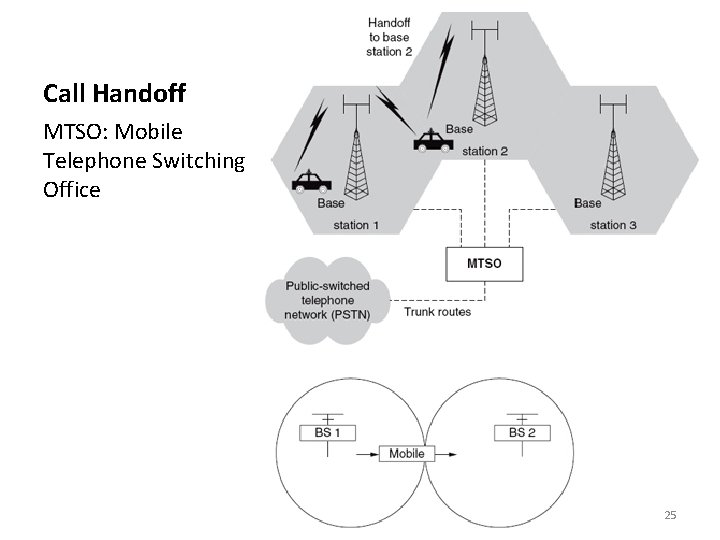
Call Handoff MTSO: Mobile Telephone Switching Office 25
Cell Technology a Reality • Frequency reuse, frequency agility and callhandoff are the technologies which work together to make cell technology a reality. 26
Maps • Originally, topography (“topo”) maps were used in cellular system design. • All cell site locations are denoted using polar coordinates (latitude and longitude). • Wireless system engineers needed to learn how to read ground elevations on maps, and the overall map symbology. • Today, software versions of topography maps are used. 27
Population (POP) Counts • Also known as POPs. • One person equals one POP count. • Wireless markets are bought, sold, valuated, and traded on the basis of POP counts. 28
Reference • Cellular Networks: Design and Operations (3 rd edition) by Paul Bedell, chapter 3 29
- Slides: 29