
BASIC CELL BIOLOGY I CHEMISTRY of LIFE CHEMICAL
BASIC CELL BIOLOGY I CHEMISTRY of LIFE CHEMICAL BONDS, INTERMOLECULAR FORCES, PROPERTIES OF WATER, BUFFER SOLUTIONS
Lecture 3 CHEMICAL BONDS, INTERMOLECULAR FORCES, PROPERTIES OF WATER, BUFFER SOLUTIONS • • Covalent bond Van der Waals forces Hydrophobic interactions Hydrogen bond Biologically important properties of water p. H, acids and bases Buffer solutions
Chemical bond Lecture 3 In forming chemical bonds, atoms donate, acquire, or share electrons.
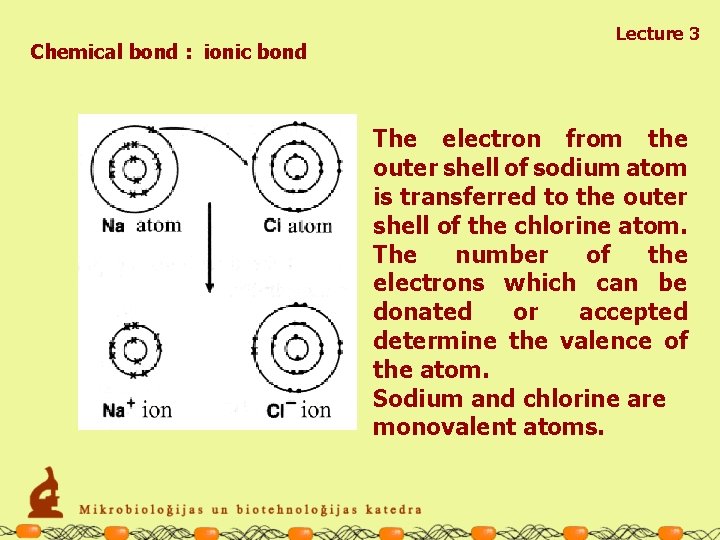
Chemical bond : ionic bond Lecture 3 The electron from the outer shell of sodium atom is transferred to the outer shell of the chlorine atom. The number of the electrons which can be donated or accepted determine the valence of the atom. Sodium and chlorine are monovalent atoms.
Chemical bond : ionic bond Lecture 3 Not only the atoms, also functional groups can be ionised through donation or acceptance of the proton.
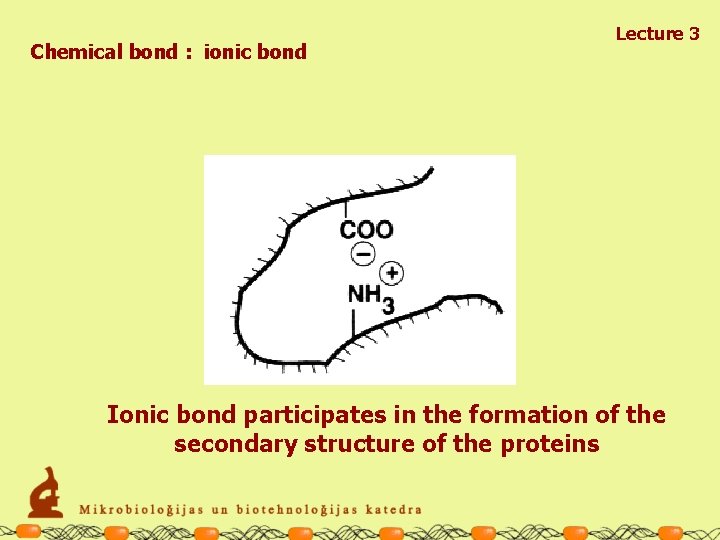
Chemical bond : ionic bond Lecture 3 Ionic bond participates in the formation of the secondary structure of the proteins
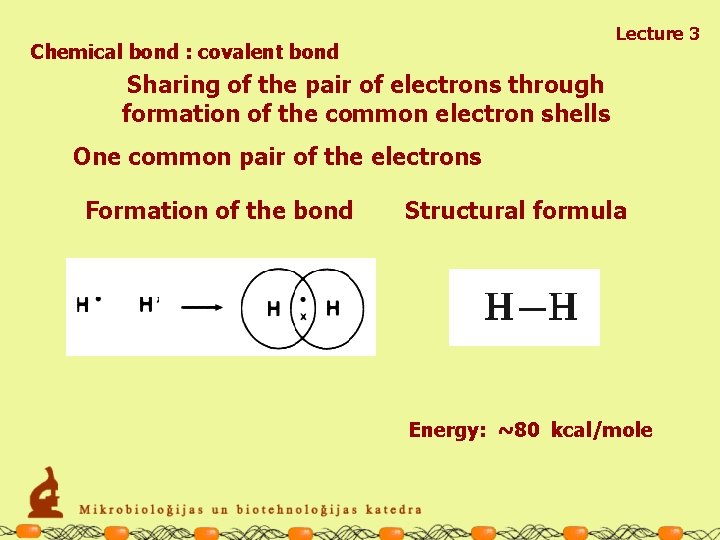
Lecture 3 Chemical bond : covalent bond Sharing of the pair of electrons through formation of the common electron shells One common pair of the electrons Formation of the bond Structural formula Energy: ~80 kcal/mole
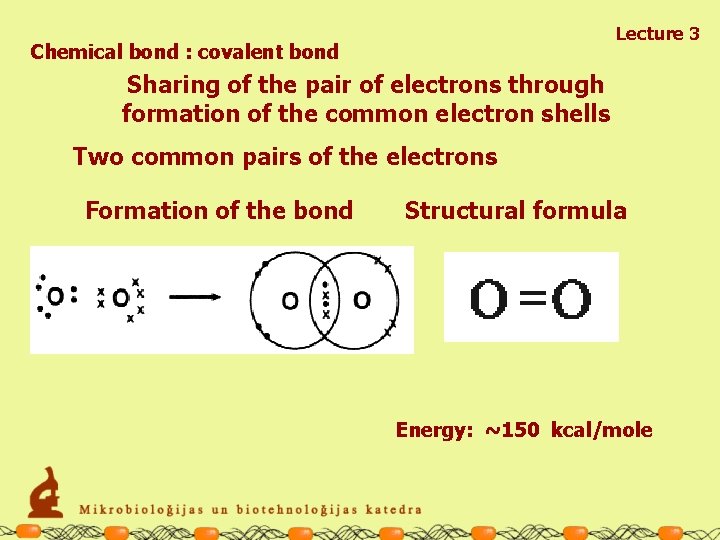
Lecture 3 Chemical bond : covalent bond Sharing of the pair of electrons through formation of the common electron shells Two common pairs of the electrons Formation of the bond Structural formula Energy: ~150 kcal/mole
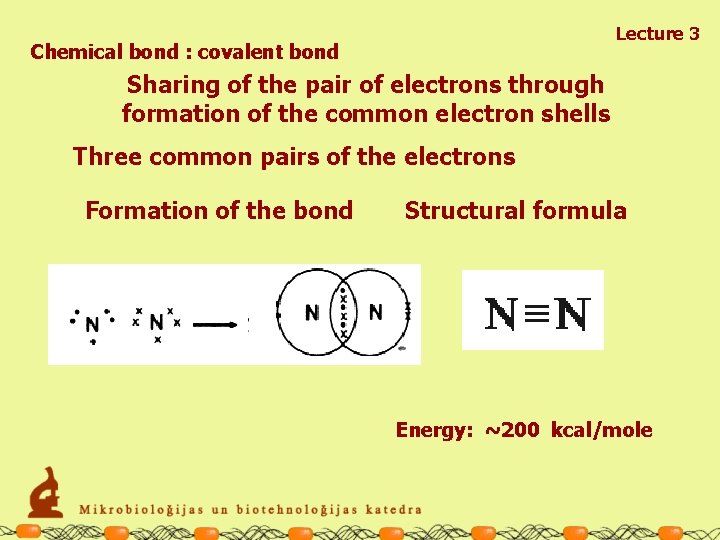
Lecture 3 Chemical bond : covalent bond Sharing of the pair of electrons through formation of the common electron shells Three common pairs of the electrons Formation of the bond Structural formula Energy: ~200 kcal/mole
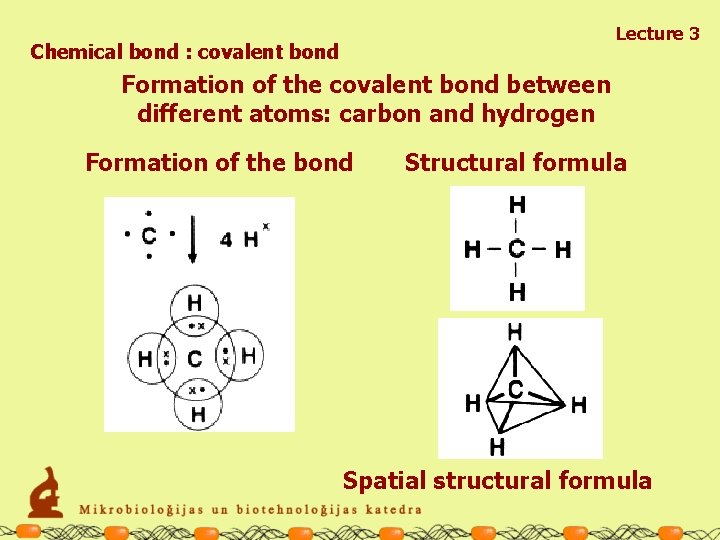
Lecture 3 Chemical bond : covalent bond Formation of the covalent bond between different atoms: carbon and hydrogen Formation of the bond Structural formula Spatial structural formula
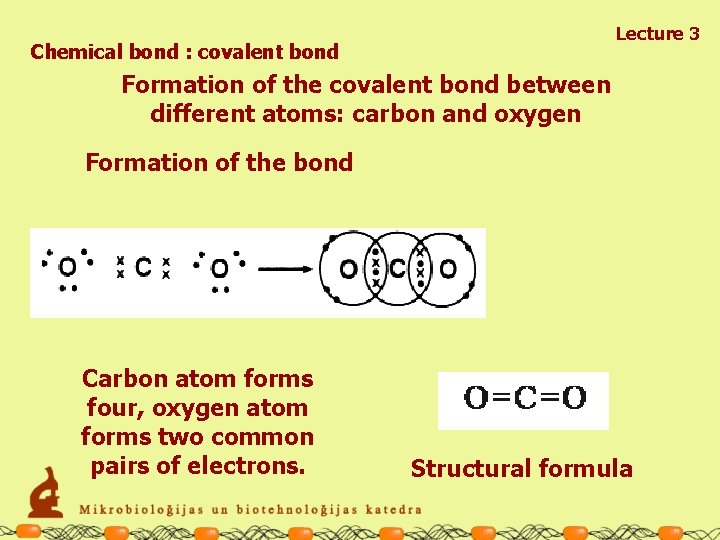
Lecture 3 Chemical bond : covalent bond Formation of the covalent bond between different atoms: carbon and oxygen Formation of the bond Carbon atom forms four, oxygen atom forms two common pairs of electrons. Structural formula
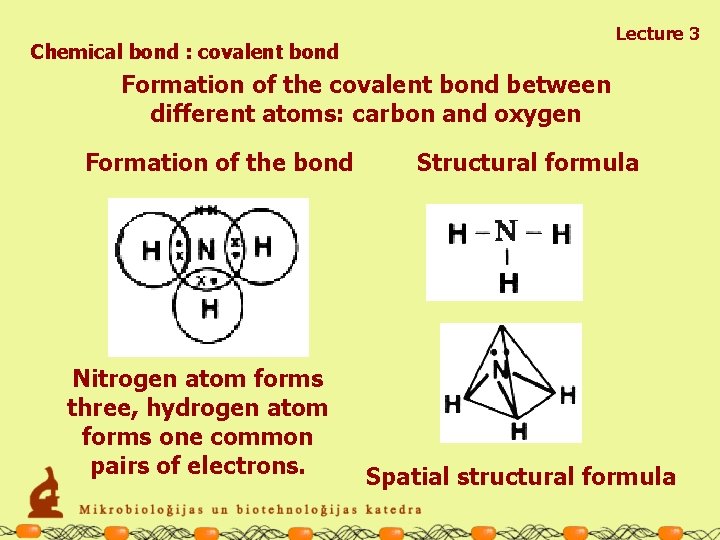
Lecture 3 Chemical bond : covalent bond Formation of the covalent bond between different atoms: carbon and oxygen Formation of the bond Nitrogen atom forms three, hydrogen atom forms one common pairs of electrons. Structural formula Spatial structural formula
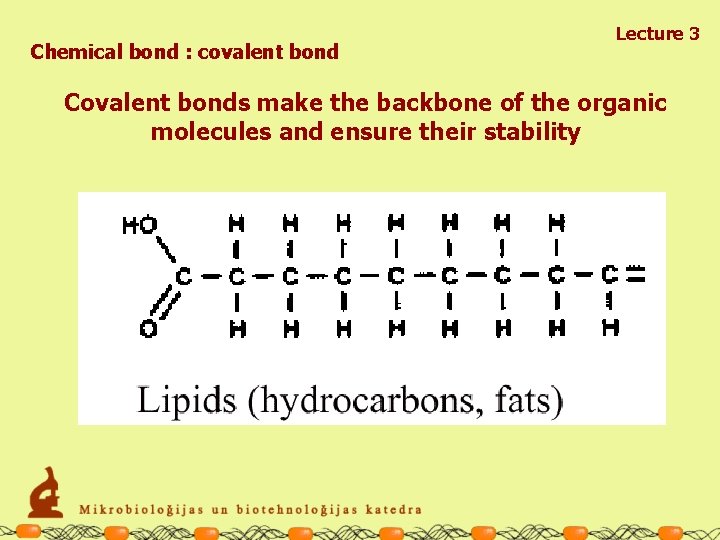
Chemical bond : covalent bond Lecture 3 Covalent bonds make the backbone of the organic molecules and ensure their stability
Chemical bonds Lecture 3 The valence of the atom at ionic bonding is determined by the number of donated or accepted electrons. The valance of the atom at covalent bonding is dertemined by the number of formed common electron pairs.
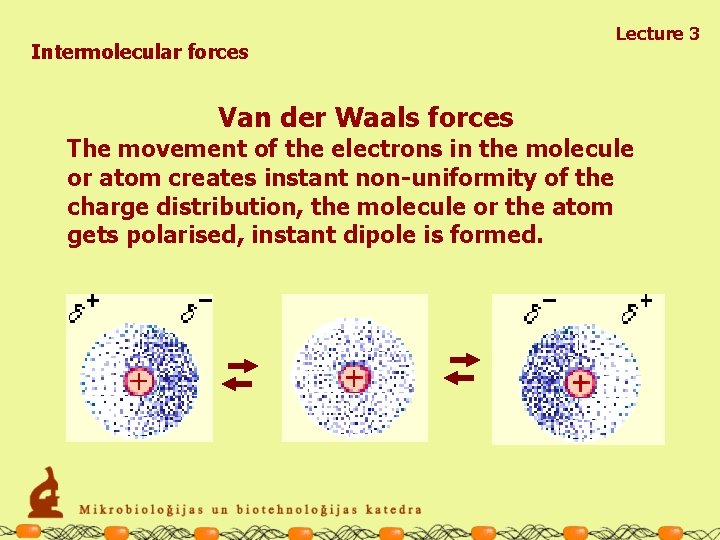
Intermolecular forces Van der Waals forces Lecture 3 The movement of the electrons in the molecule or atom creates instant non-uniformity of the charge distribution, the molecule or the atom gets polarised, instant dipole is formed.
Lecture 3 Intermolecular forces Van der Waals forces Instantly negative part of a molecule interacts with instantly positive part of another molecule or induces dipole in another electro-neutral molecule. Two dipoles are mutually stabilising. In macromolecules (polymers) the force of these electrostatic forces can reach considerable values. Van der Waals forces have essential role in the formation of the structure of biopolymers.
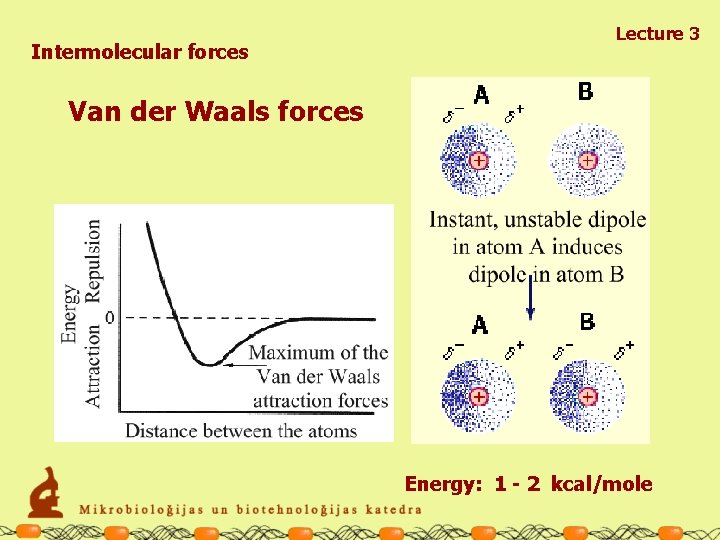
Intermolecular forces Lecture 3 Van der Waals forces Energy: 1 - 2 kcal/mole
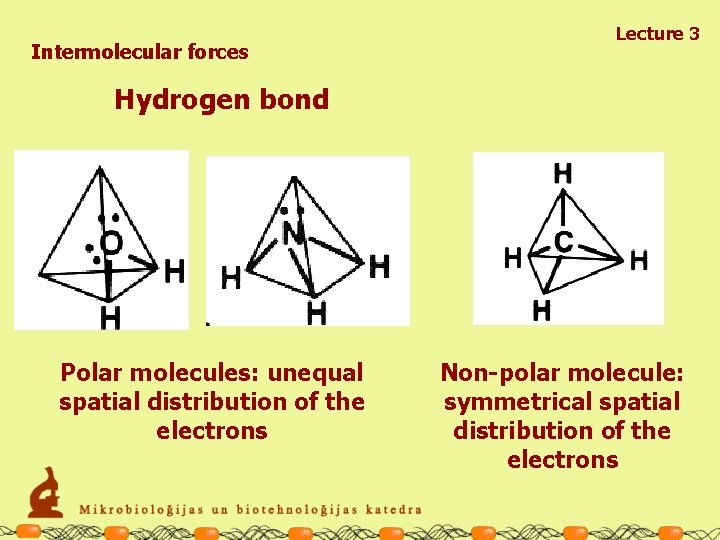
Intermolecular forces Lecture 3 Hydrogen bond Polar molecules: unequal spatial distribution of the electrons Non-polar molecule: symmetrical spatial distribution of the electrons
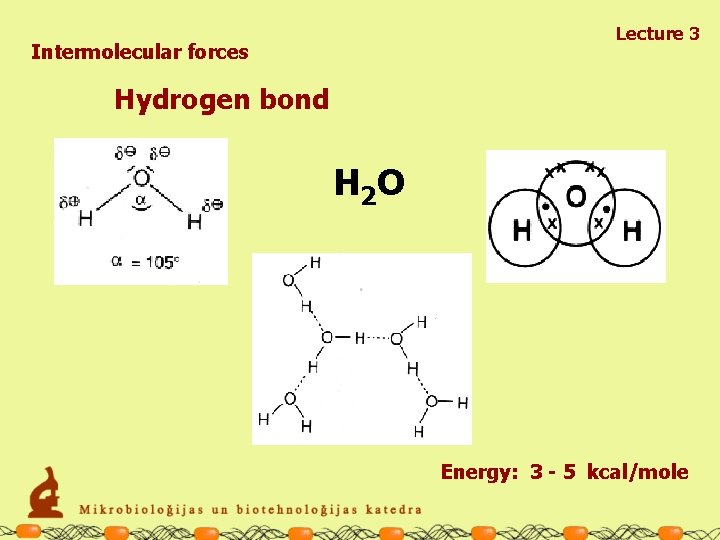
Lecture 3 Intermolecular forces Hydrogen bond H 2 O Energy: 3 - 5 kcal/mole
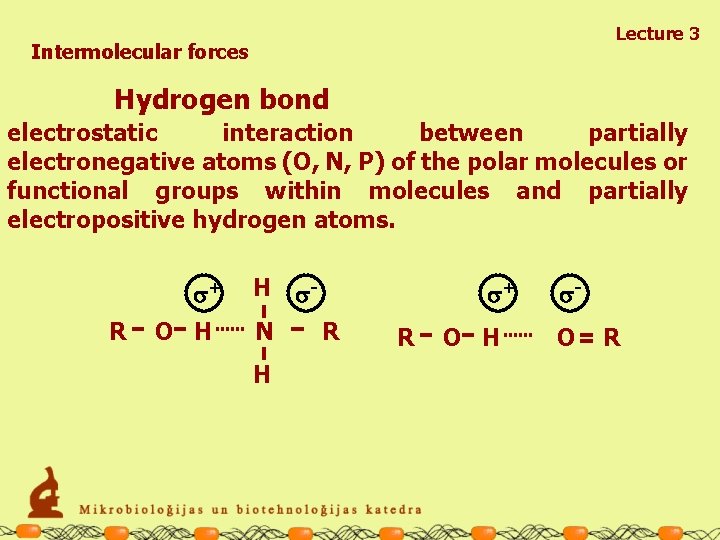
Lecture 3 Intermolecular forces Hydrogen bond electrostatic interaction between partially electronegative atoms (O, N, P) of the polar molecules or functional groups within molecules and partially electropositive hydrogen atoms. s+ R O H H s. N H s+ R R O H s. O R
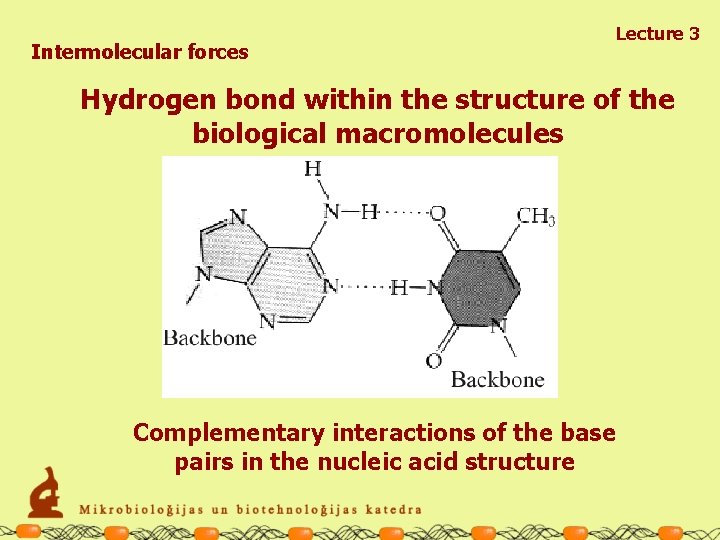
Intermolecular forces Lecture 3 Hydrogen bond within the structure of the biological macromolecules Complementary interactions of the base pairs in the nucleic acid structure
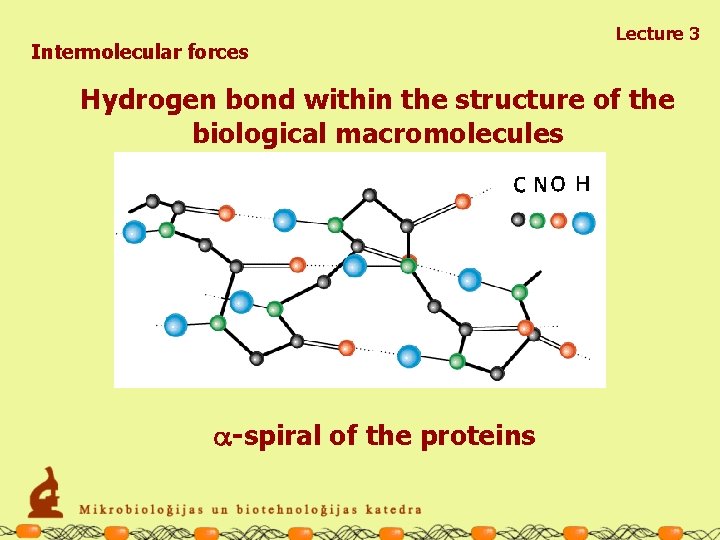
Intermolecular forces Lecture 3 Hydrogen bond within the structure of the biological macromolecules a-spiral of the proteins
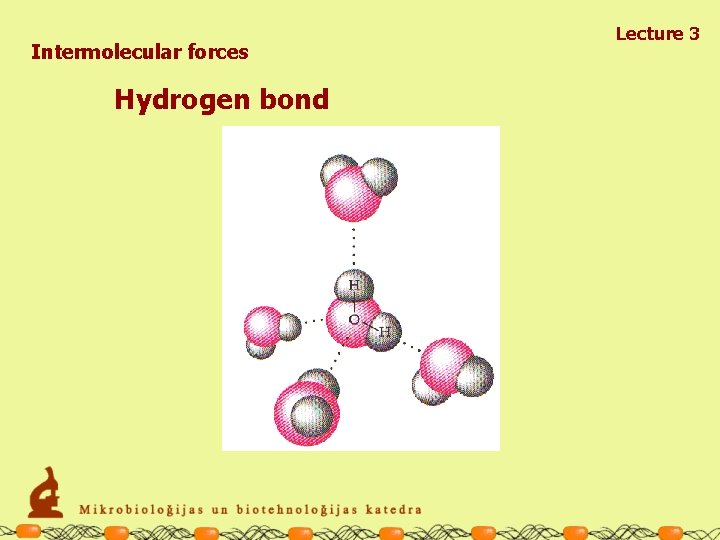
Intermolecular forces Hydrogen bond Lecture 3
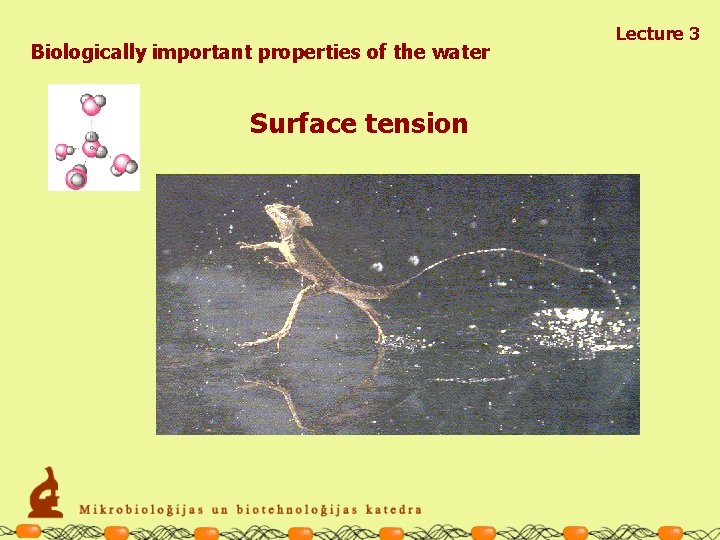
Biologically important properties of the water Surface tension Lecture 3
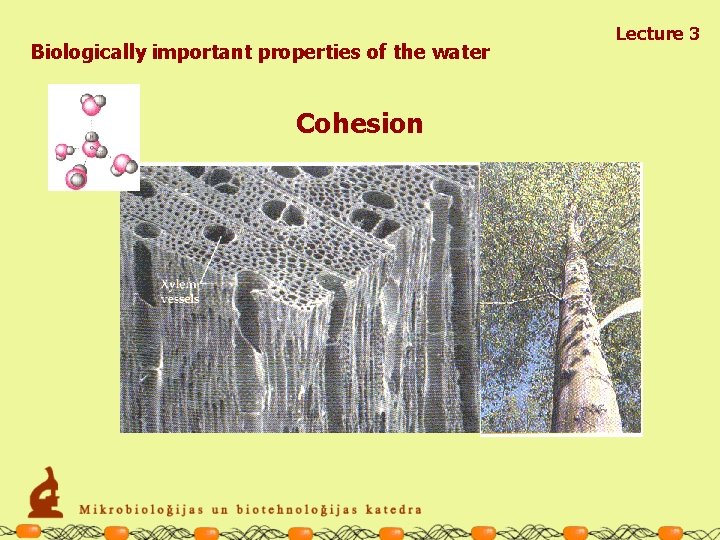
Biologically important properties of the water Cohesion Lecture 3
Biologically important properties of the water High heat capacity Lecture 3
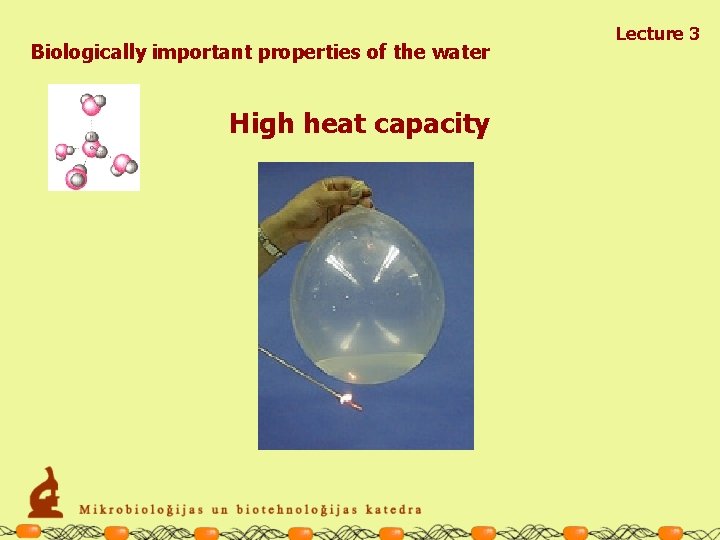
Biologically important properties of the water High heat capacity Lecture 3
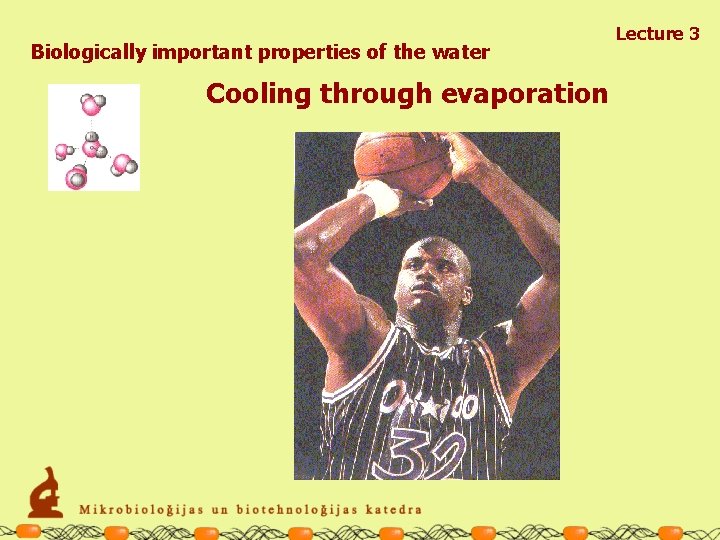
Biologically important properties of the water Cooling through evaporation Lecture 3
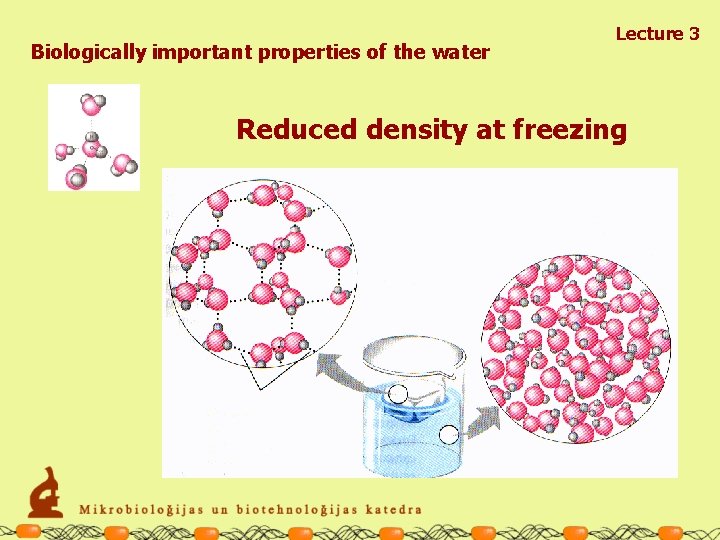
Biologically important properties of the water Lecture 3 Reduced density at freezing
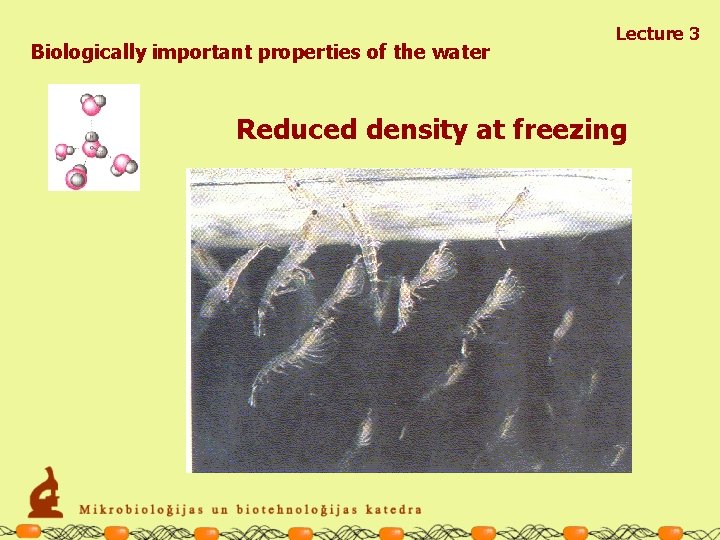
Biologically important properties of the water Lecture 3 Reduced density at freezing
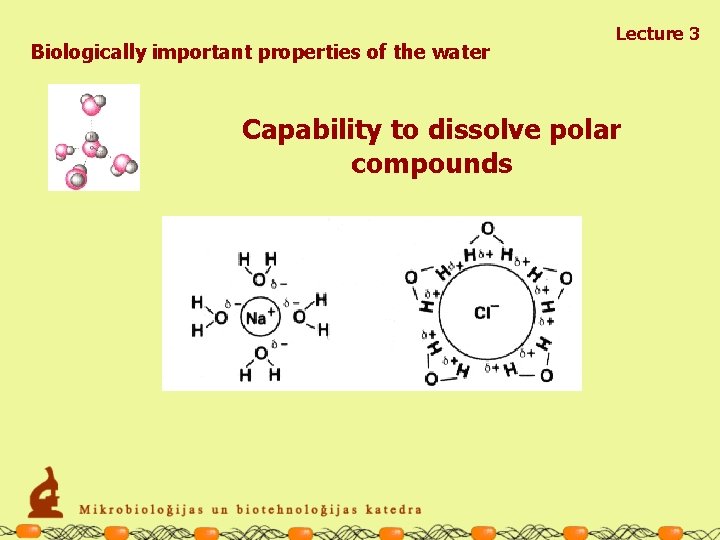
Biologically important properties of the water Lecture 3 Capability to dissolve polar compounds
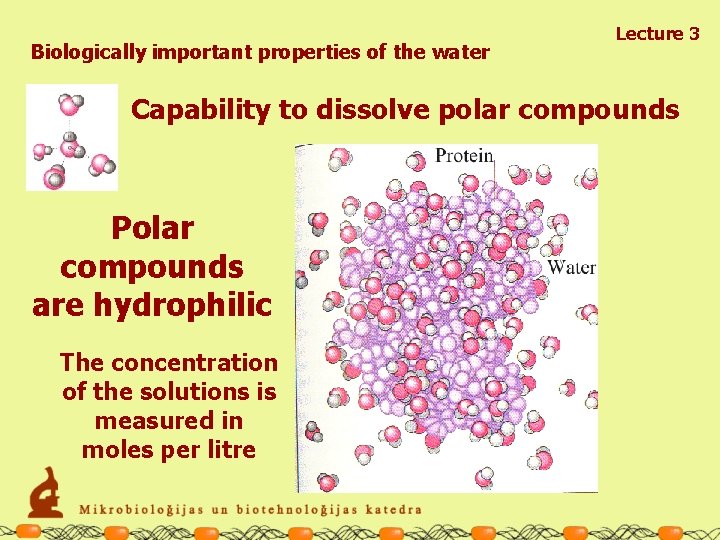
Biologically important properties of the water Lecture 3 Capability to dissolve polar compounds Polar compounds are hydrophilic The concentration of the solutions is measured in moles per litre
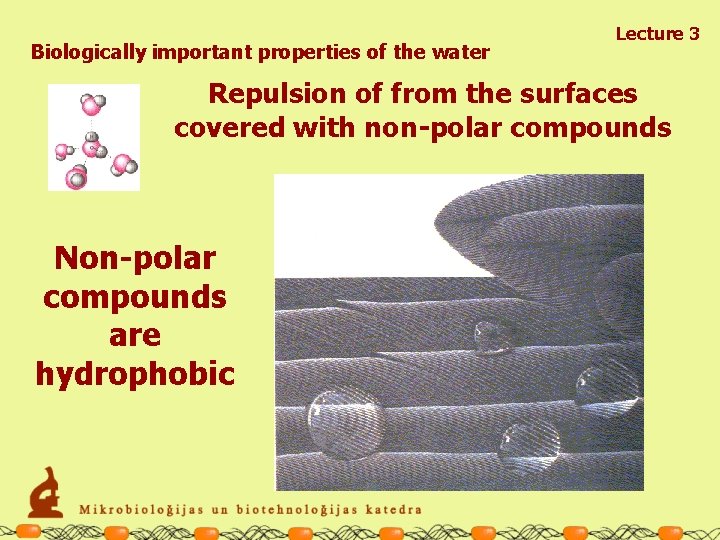
Biologically important properties of the water Lecture 3 Repulsion of from the surfaces covered with non-polar compounds Non-polar compounds are hydrophobic
Intermolecular forces Lecture 3 Hydrophobic interactions Many molecules are water-insoluble (hydrocarbons, fats) or contain hydrophobic parts (several amino acids). Such molecules tend to aggregate in the water environment and to diminish the surface which is exposed to the water (oil drops in the water). Minimal surface are which is exposed towards the water support the energetically favourable conformation of the hydrophobic (waterinsoluble) molecules.
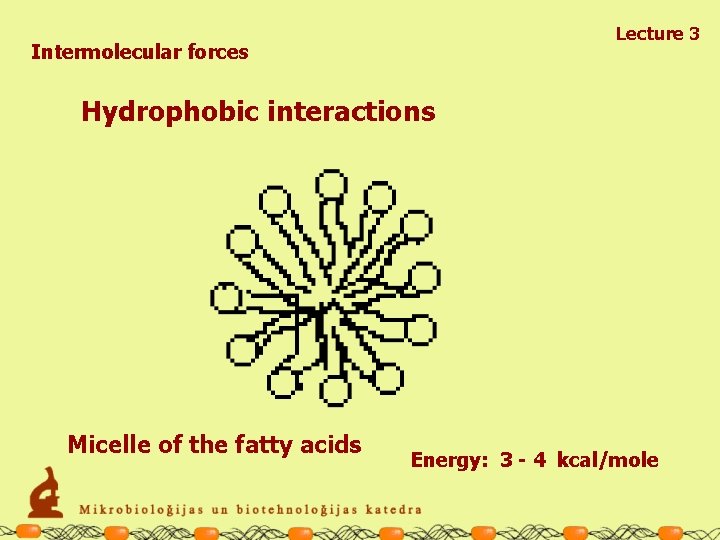
Lecture 3 Intermolecular forces Hydrophobic interactions Micelle of the fatty acids Energy: 3 - 4 kcal/mole
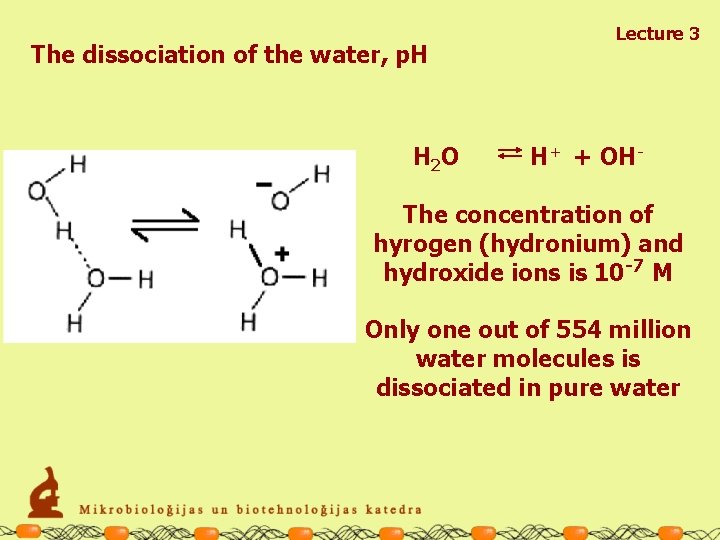
The dissociation of the water, p. H H 2 O Lecture 3 H+ + OH- The concentration of hyrogen (hydronium) and hydroxide ions is 10 -7 M Only one out of 554 million water molecules is dissociated in pure water
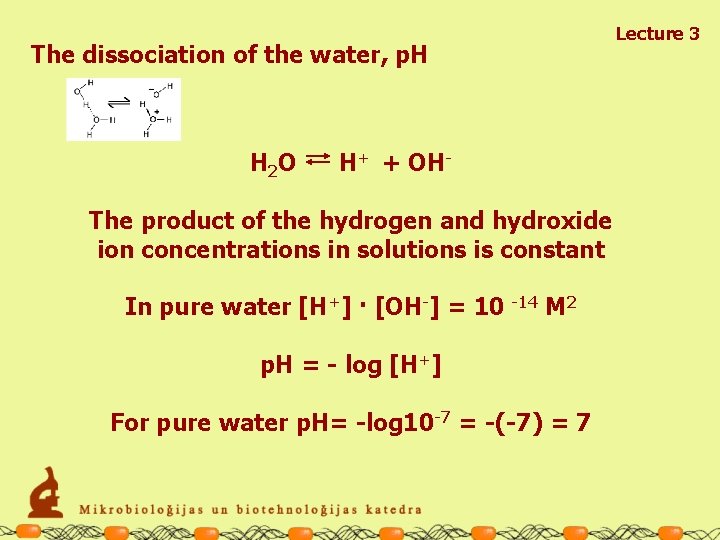
The dissociation of the water, p. H H 2 O H+ + OH- The product of the hydrogen and hydroxide ion concentrations in solutions is constant In pure water [H+] · [OH-] = 10 -14 M 2 p. H = - log [H+] For pure water p. H= -log 10 -7 = -(-7) = 7 Lecture 3
The dissociation of the water, p. H Lecture 3 p. H values of different solutions
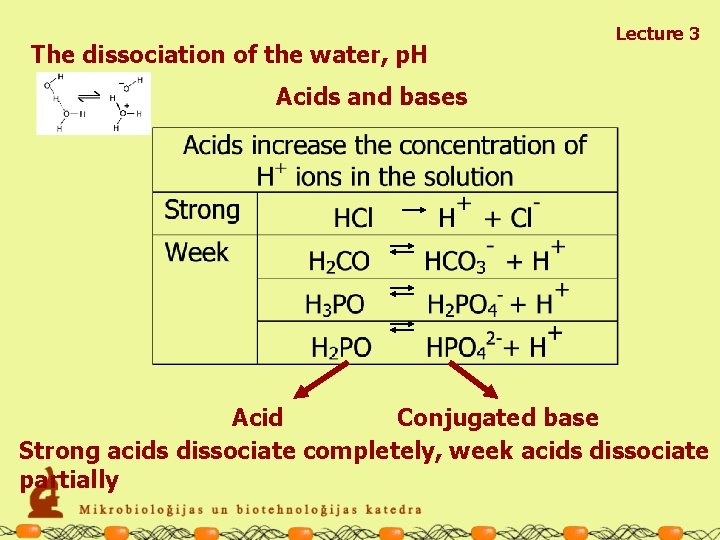
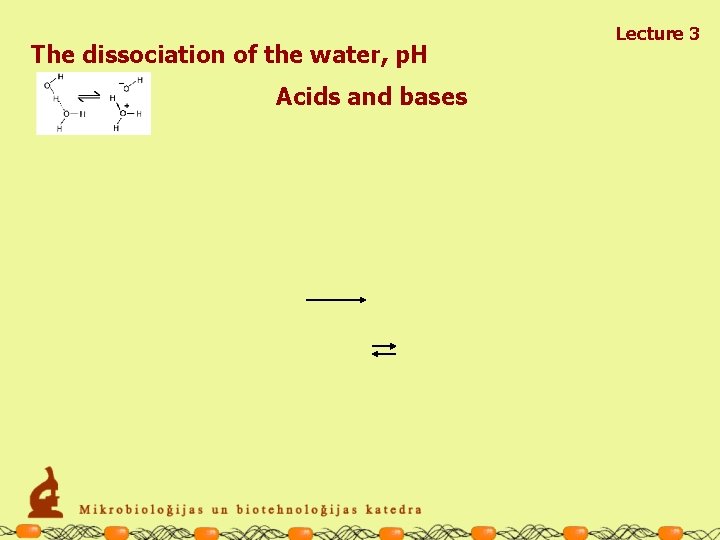
The dissociation of the water, p. H Lecture 3 Acids and bases Acid Conjugated base Strong acids dissociate completely, week acids dissociate partially
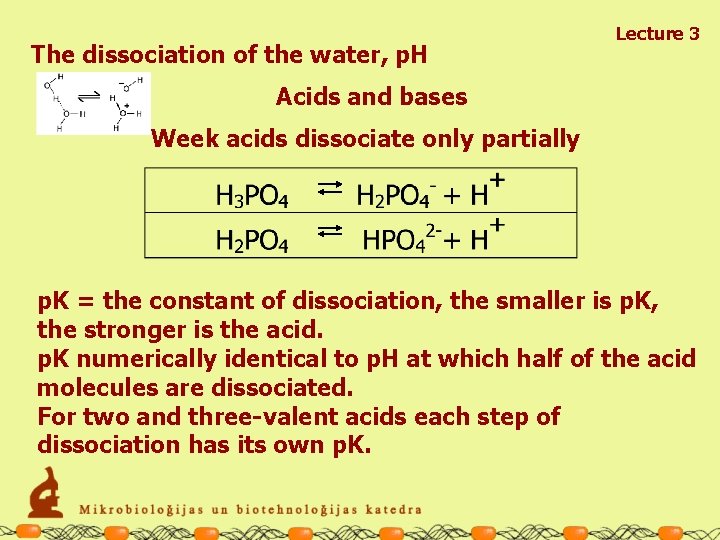
The dissociation of the water, p. H Lecture 3 Acids and bases Week acids dissociate only partially p. K = the constant of dissociation, the smaller is p. K, the stronger is the acid. p. K numerically identical to p. H at which half of the acid molecules are dissociated. For two and three-valent acids each step of dissociation has its own p. K.
The dissociation of the water, p. H Acids and bases Lecture 3
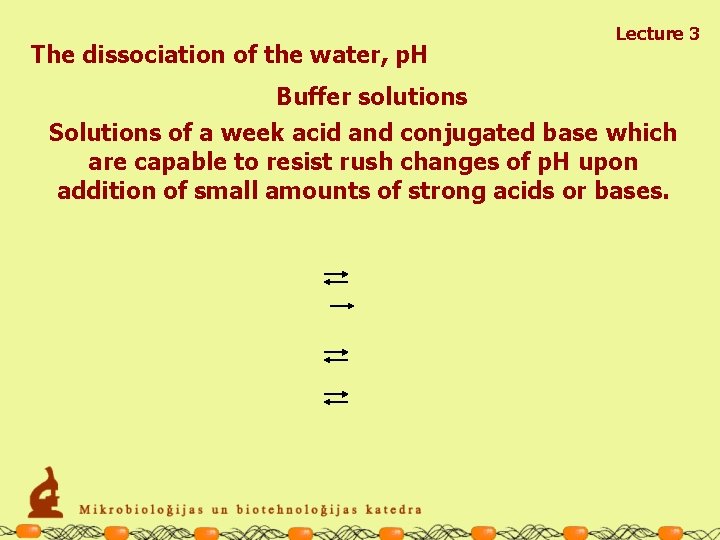
The dissociation of the water, p. H Lecture 3 Buffer solutions Solutions of a week acid and conjugated base which are capable to resist rush changes of p. H upon addition of small amounts of strong acids or bases.
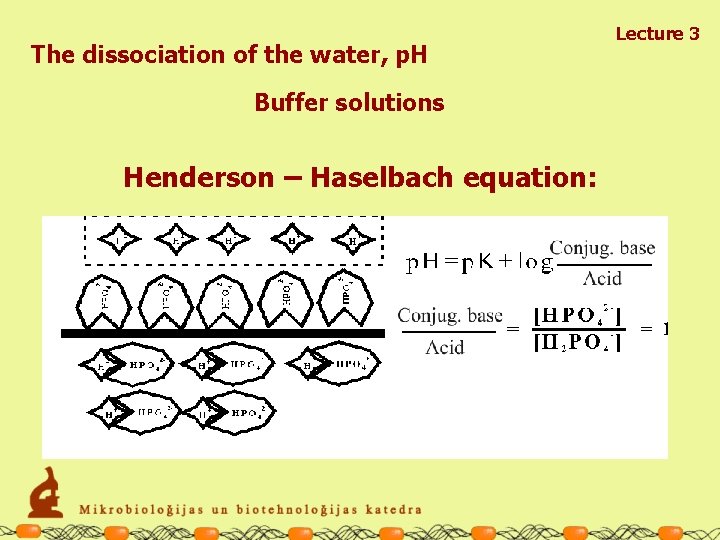
The dissociation of the water, p. H Buffer solutions Henderson – Haselbach equation: Lecture 3
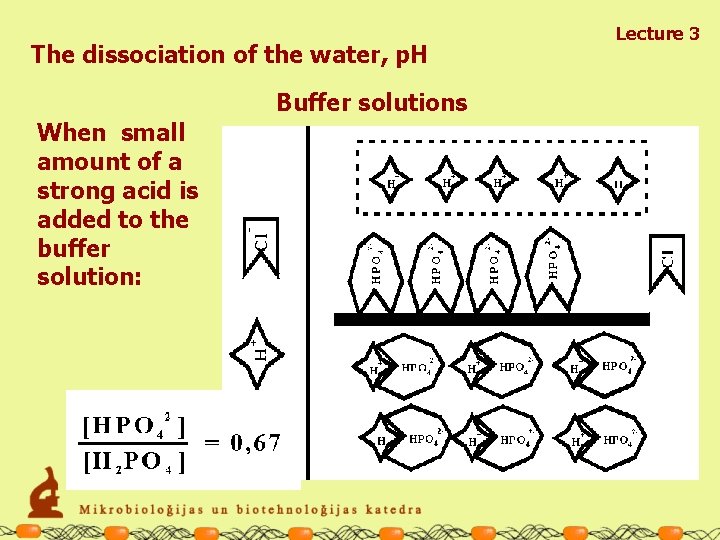
The dissociation of the water, p. H Buffer solutions When small amount of a strong acid is added to the buffer solution: Lecture 3
The dissociation of the water, p. H Lecture 3 If HCl to 0. 01 M final concentration is aded in water final p. H will be 2. If HCl is aded to 0. 01 M final concentration in 0. 05 M phosphate buffer solution at p. H 7. 2 final p. H will be : p. H = 7. 2 + log 0. 67 = 7. 2 + (-0. 174) = ~ 7. 0
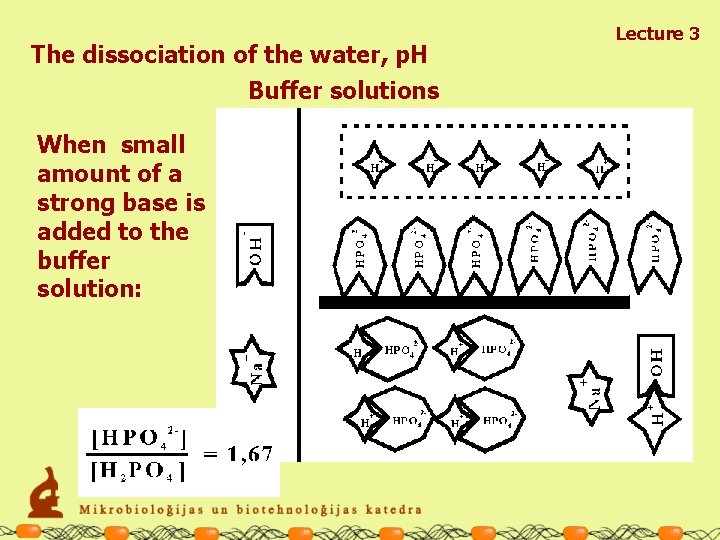
The dissociation of the water, p. H Buffer solutions When small amount of a strong base is added to the buffer solution: Lecture 3
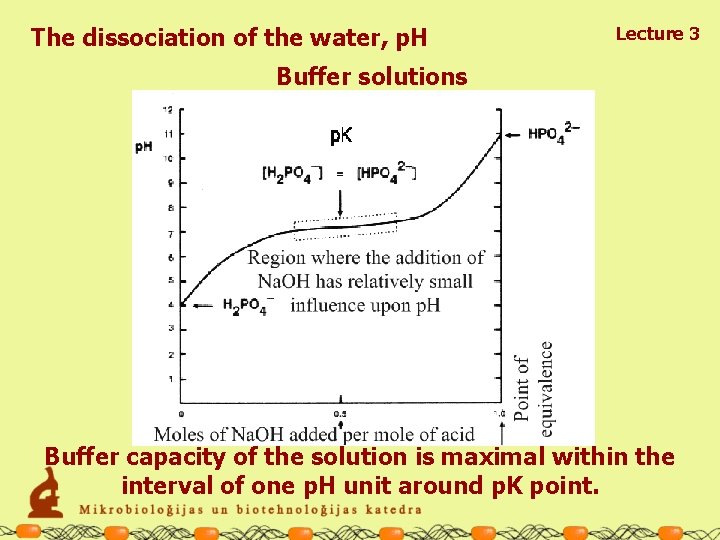
The dissociation of the water, p. H Lecture 3 Buffer solutions Buffer capacity of the solution is maximal within the interval of one p. H unit around p. K point.
- Slides: 47