
Bases of a biomechanics and a bioacoustics L
Bases of a biomechanics and a bioacoustics. L. D. Korovina For medical students 1
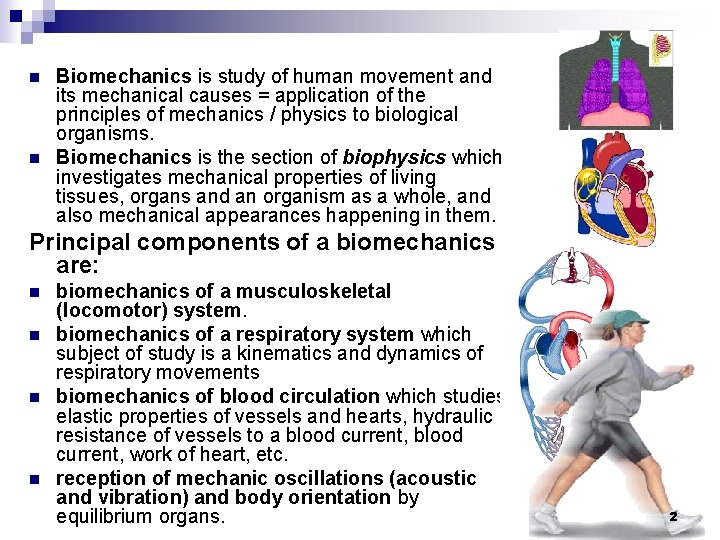
n n BIOMECHANICS. IT AREAS Biomechanics is study of human movement and its mechanical causes = application of the principles of mechanics / physics to biological organisms. Biomechanics is the section of biophysics which investigates mechanical properties of living tissues, organs and an organism as a whole, and also mechanical appearances happening in them. Principal components of a biomechanics are: n n biomechanics of a musculoskeletal (locomotor) system. biomechanics of a respiratory system which subject of study is a kinematics and dynamics of respiratory movements biomechanics of blood circulation which studies elastic properties of vessels and hearts, hydraulic resistance of vessels to a blood current, work of heart, etc. reception of mechanic oscillations (acoustic and vibration) and body orientation by equilibrium organs. 2
BIOMECHANICS OF a LOCOMOTOR SYSTEM The skeleton and skeletal muscles are components of locomotor system. Various specialties within biomechanics of locomotor system, and their purposes: ● Orthopedics: deals with prosthesis design. ● Highway Safety Biomechanics, Aerospace biomechanics. Goal: Provide safety to withstand large accelerations or decelerations. ● Ergonomics, Human Factors Goal: Provide safety and ease in the workplace. ● Exercise Science Biomechanics Goals: 1) to understand the mechanisms of motion in human activities; 2) to improve performance in sport; 3) to increase safety in sport and in other human activities. Ways: through changes in movements (technique); through changes in equipment design. 3
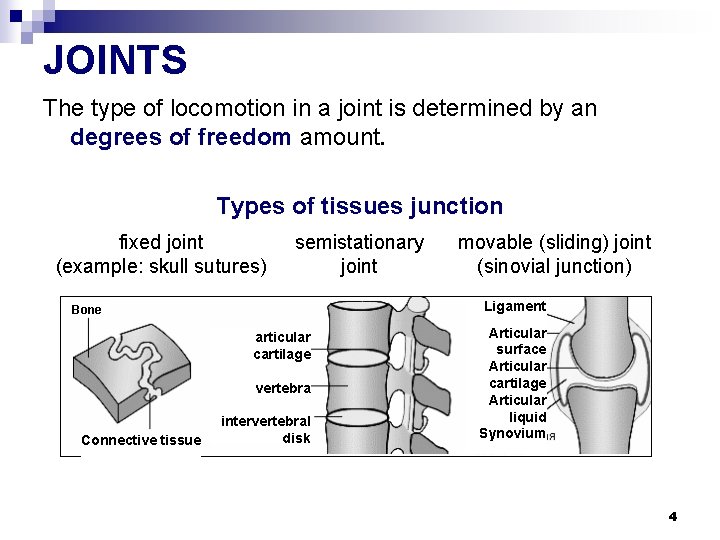
JOINTS The type of locomotion in a joint is determined by an degrees of freedom amount. Types of tissues junction fixed joint (example: skull sutures) semistationary joint Ligament Bone articular cartilage vertebra Connective tissue movable (sliding) joint (sinovial junction) intervertebral disk Articular surface Articular cartilage Articular liquid Synovium 4
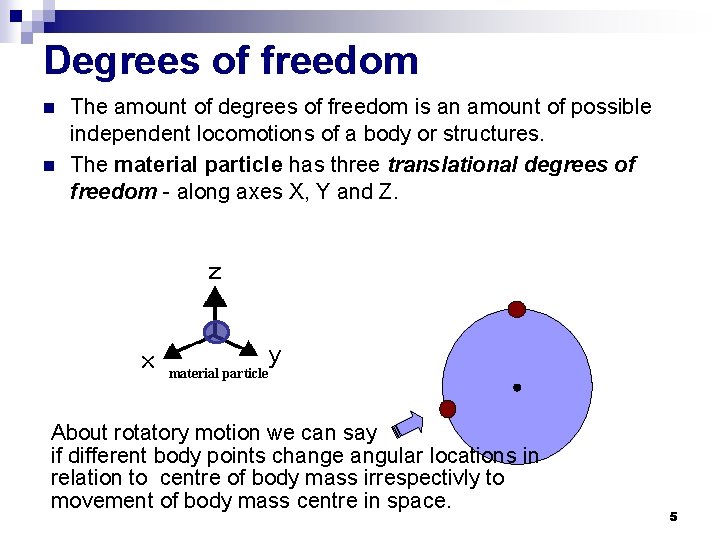
Degrees of freedom n n The amount of degrees of freedom is an amount of possible independent locomotions of a body or structures. The material particle has three translational degrees of freedom - along axes X, Y and Z. material particle About rotatory motion we can say if different body points change angular locations in relation to centre of body mass irrespectivly to movement of body mass centre in space. 5
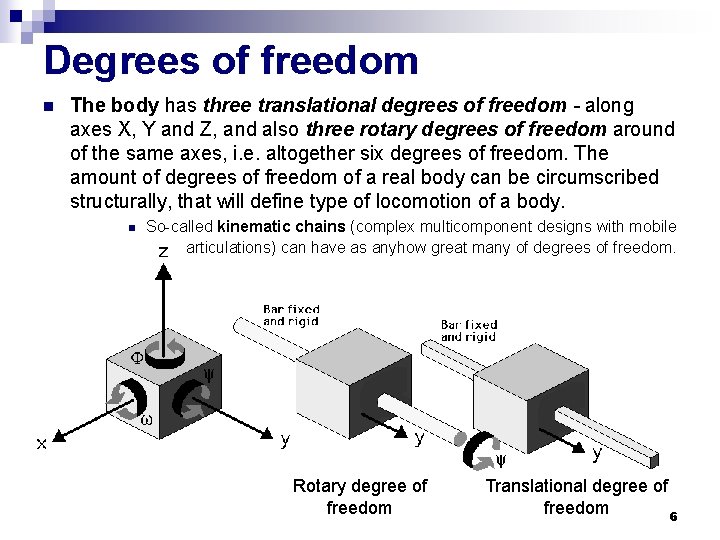
Degrees of freedom n The body has three translational degrees of freedom - along axes X, Y and Z, and also three rotary degrees of freedom around of the same axes, i. e. altogether six degrees of freedom. The amount of degrees of freedom of a real body can be circumscribed structurally, that will define type of locomotion of a body. n So-called kinematic chains (complex multicomponent designs with mobile articulations) can have as anyhow great many of degrees of freedom. Rotary degree of freedom Translational degree of freedom 6
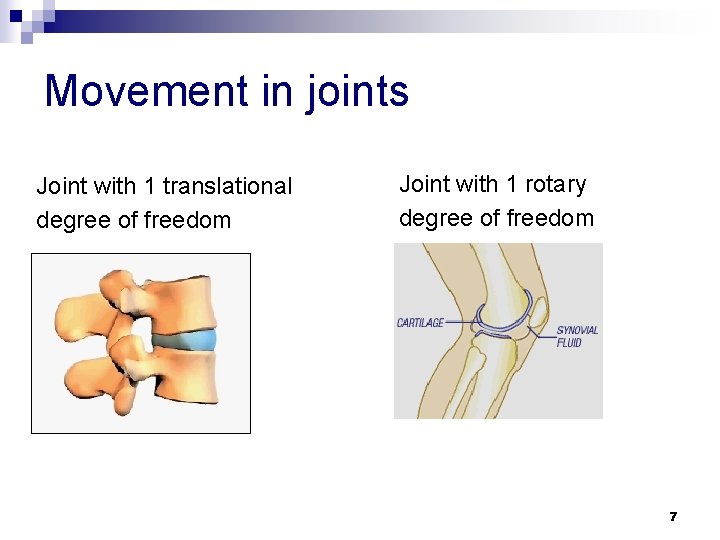
Movement in joints Joint with 1 translational degree of freedom Joint with 1 rotary degree of freedom 7

Degrees of freedom In human body various types of joints are present. Anatomic peculiarities (which formed as result of functional variability) are causes of existing mechanical differences by possible movements (and corresponding of freedom). fingers humerus knee elbow foot wrist 8
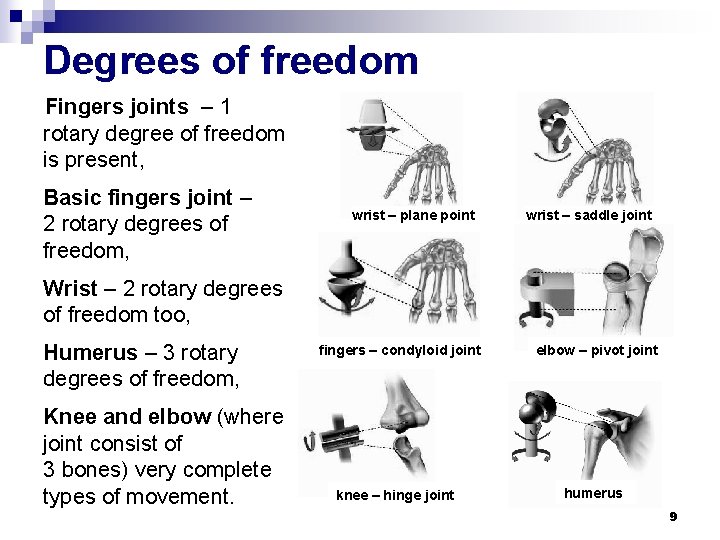
Degrees of freedom Fingers joints – 1 rotary degree of freedom is present, Basic fingers joint – 2 rotary degrees of freedom, wrist – plane point wrist – saddle joint Wrist – 2 rotary degrees of freedom too, Humerus – 3 rotary degrees of freedom, Knee and elbow (where joint consist of 3 bones) very complete types of movement. fingers – condyloid joint knee – hinge joint elbow – pivot joint humerus 9
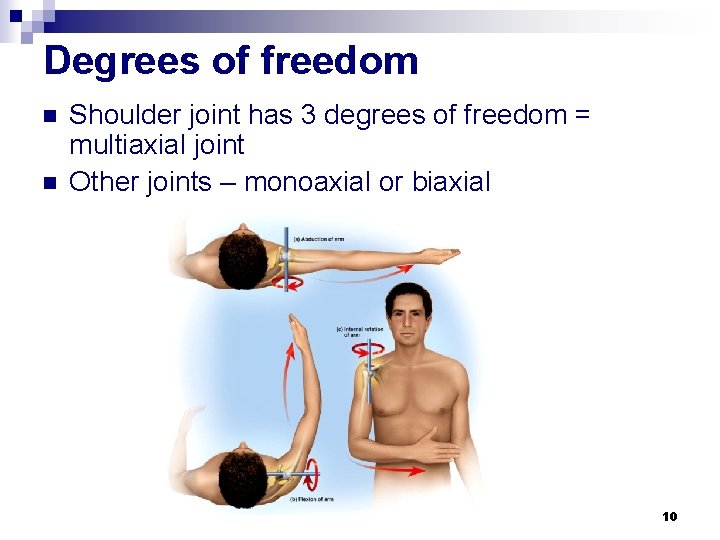
Degrees of freedom n n Shoulder joint has 3 degrees of freedom = multiaxial joint Other joints – monoaxial or biaxial 10
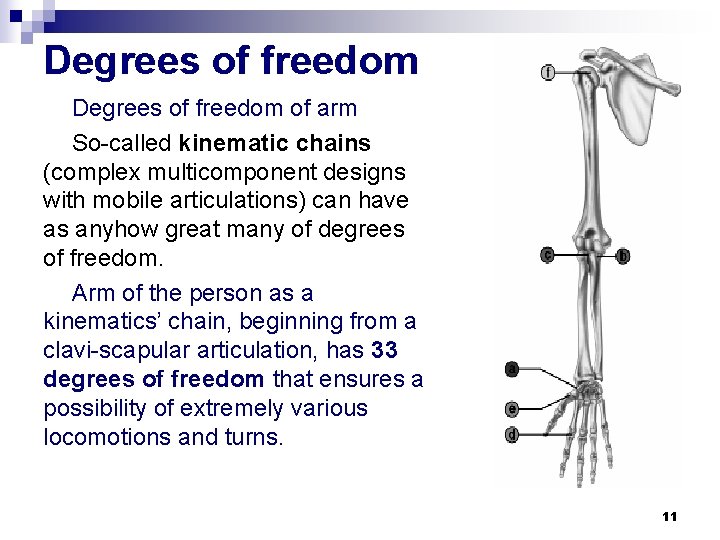
Degrees of freedom of arm So-called kinematic chains (complex multicomponent designs with mobile articulations) can have as anyhow great many of degrees of freedom. Arm of the person as a kinematics’ chain, beginning from a clavi-scapular articulation, has 33 degrees of freedom that ensures a possibility of extremely various locomotions and turns. 11
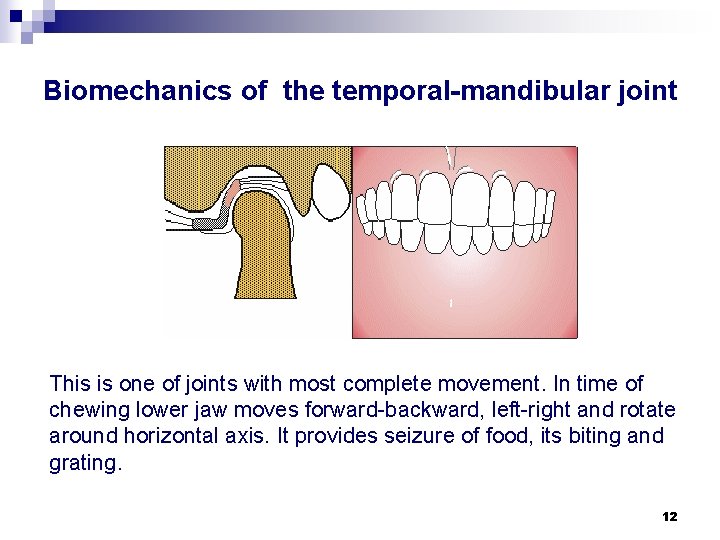
Biomechanics of the temporal-mandibular joint This is one of joints with most complete movement. In time of chewing lower jaw moves forward-backward, left-right and rotate around horizontal axis. It provides seizure of food, its biting and grating. 12
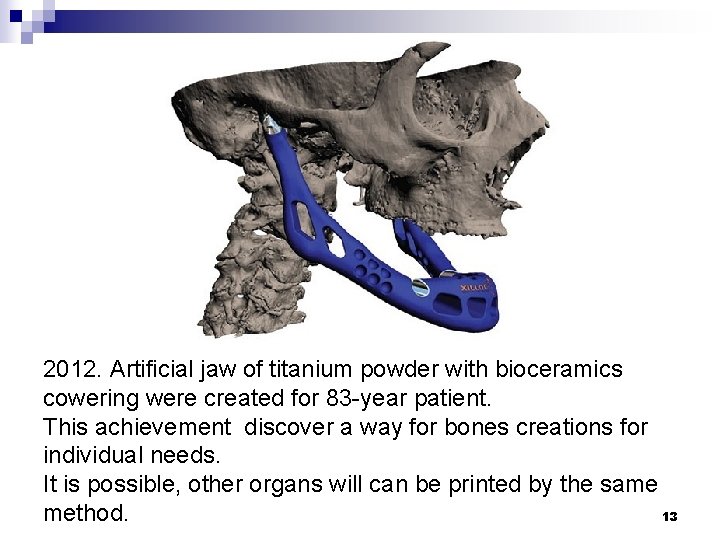
2012. Artificial jaw of titanium powder with bioceramics cowering were created for 83 -year patient. This achievement discover a way for bones creations for individual needs. It is possible, other organs will can be printed by the same method. 13
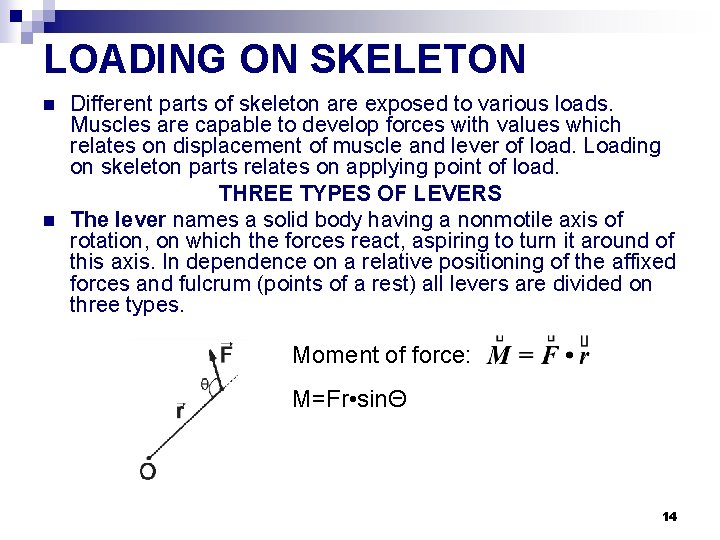
LOADING ON SKELETON n n Different parts of skeleton are exposed to various loads. Muscles are capable to develop forces with values which relates on displacement of muscle and lever of load. Loading on skeleton parts relates on applying point of load. THREE TYPES OF LEVERS The lever names a solid body having a nonmotile axis of rotation, on which the forces react, aspiring to turn it around of this axis. In dependence on a relative positioning of the affixed forces and fulcrum (points of a rest) all levers are divided on three types. Moment of force: M=Fr • sinΘ 14
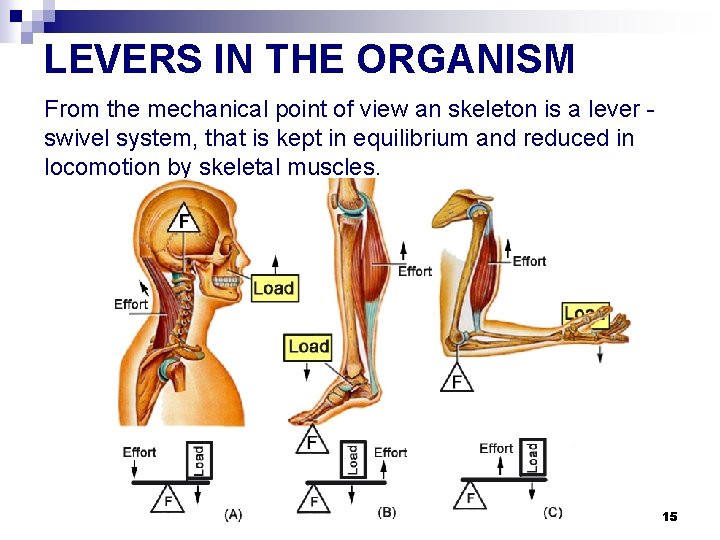
LEVERS IN THE ORGANISM From the mechanical point of view an skeleton is a lever swivel system, that is kept in equilibrium and reduced in locomotion by skeletal muscles. 15
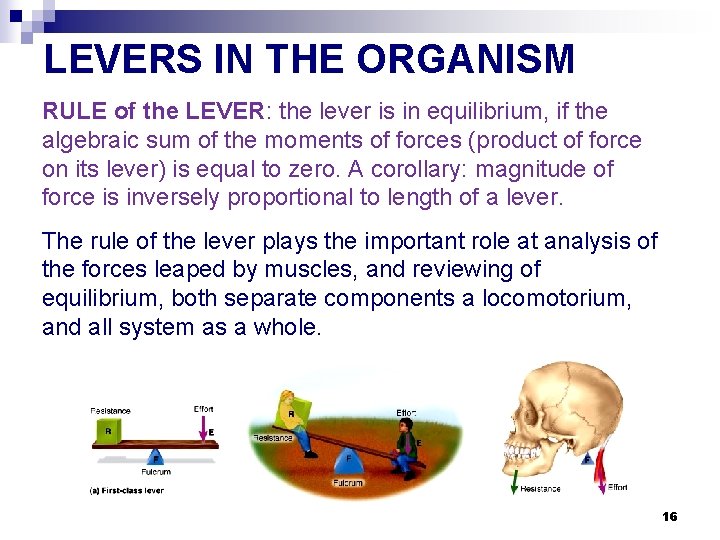
LEVERS IN THE ORGANISM RULE of the LEVER: the lever is in equilibrium, if the algebraic sum of the moments of forces (product of force on its lever) is equal to zero. A corollary: magnitude of force is inversely proportional to length of a lever. The rule of the lever plays the important role at analysis of the forces leaped by muscles, and reviewing of equilibrium, both separate components a locomotorium, and all system as a whole. 16
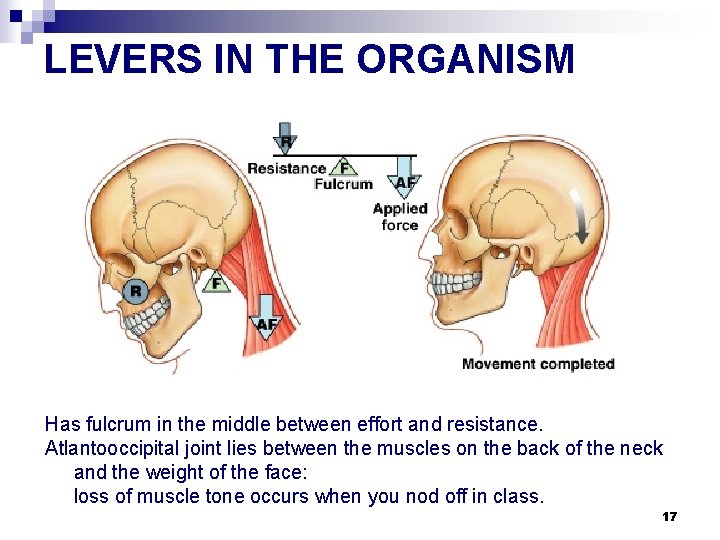
LEVERS IN THE ORGANISM Has fulcrum in the middle between effort and resistance. Atlantooccipital joint lies between the muscles on the back of the neck and the weight of the face: loss of muscle tone occurs when you nod off in class. 17
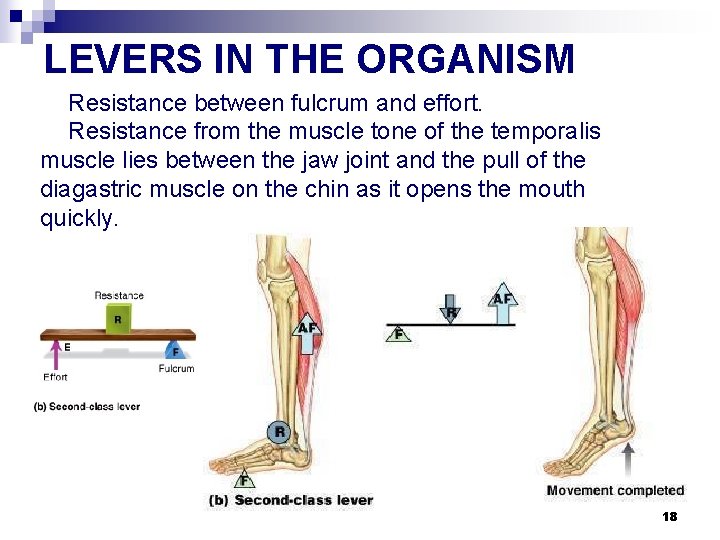
LEVERS IN THE ORGANISM Resistance between fulcrum and effort. Resistance from the muscle tone of the temporalis muscle lies between the jaw joint and the pull of the diagastric muscle on the chin as it opens the mouth quickly. 18
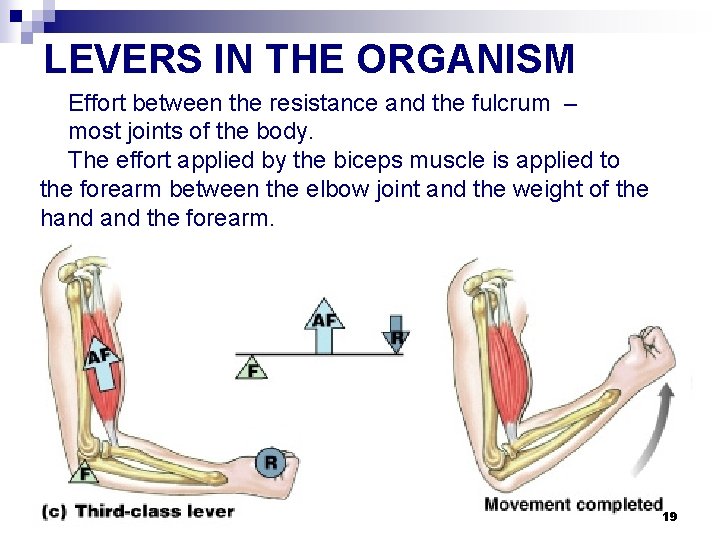
LEVERS IN THE ORGANISM Effort between the resistance and the fulcrum – most joints of the body. The effort applied by the biceps muscle is applied to the forearm between the elbow joint and the weight of the hand the forearm. 19
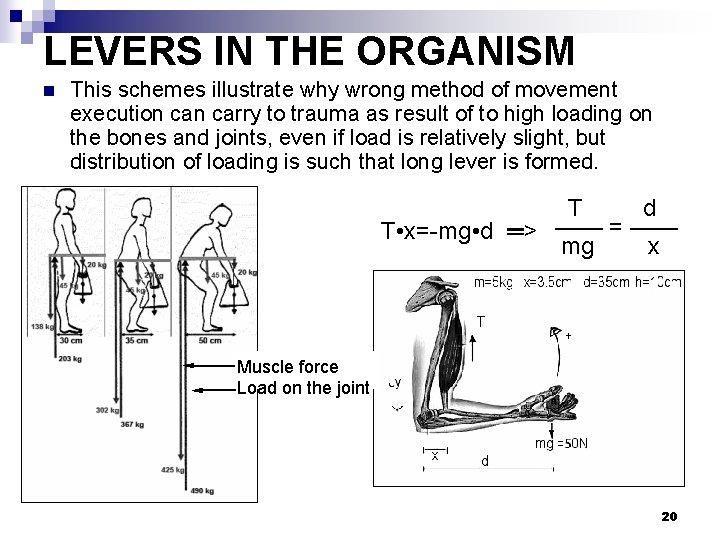
LEVERS IN THE ORGANISM n This schemes illustrate why wrong method of movement execution carry to trauma as result of to high loading on the bones and joints, even if load is relatively slight, but distribution of loading is such that long lever is formed. T d T • x=-mg • d ═> —— = —— mg x Muscle force Load on the joint 20
Composition and Structure of Bone Building Blocks of Bone Ø Minerals (calcium carbonate and calcium phosphate ~ 60 -70% of bone weight) n source of stiffness and compressive strength Ø Collagen (protein) ~ 10% n source of flexibility and tensile strength n aging causes decrease in collagen and, as a result, increase in fragility Ø Water ~ 25 -30% n important contributor to bone strength 21
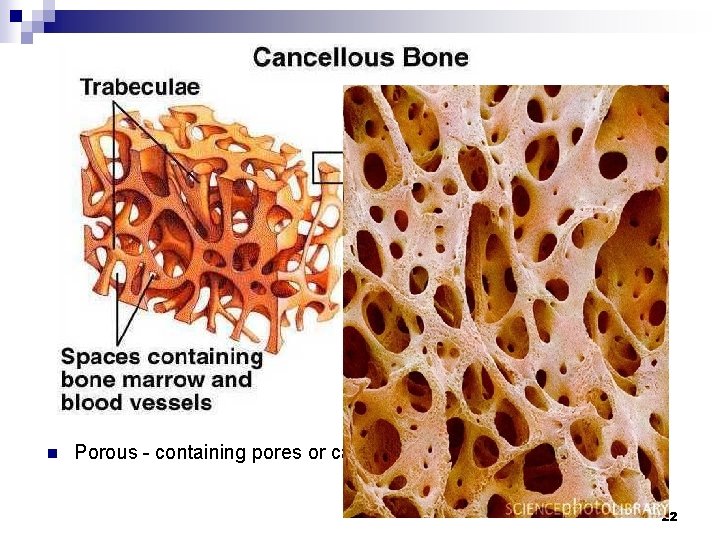
n Porous - containing pores or cavities 22
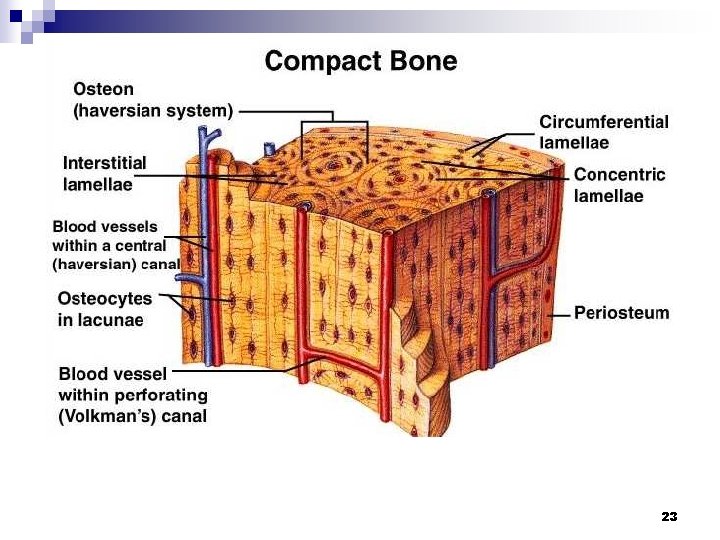
23
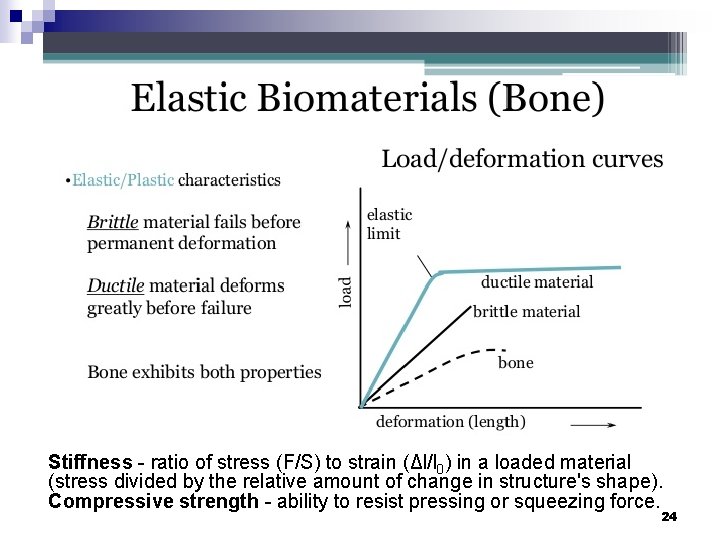
Stiffness - ratio of stress (F/S) to strain (Δl/l 0) in a loaded material (stress divided by the relative amount of change in structure's shape). Compressive strength - ability to resist pressing or squeezing force. 24
Responses to Stress n n Bone is Anisotropic (exhibits different mechanical properties in response to loads from different directions) Wolff's Law (1892): "Bone elements place or displace themselves in the direction of functional forces. " n n bone – alive and reacts to mechanical stress increase in functional force on bone = increase in bone strength increase in functional force = increase in bone mass bone density (function off magnitude and direction of the mechanical stresses) 25
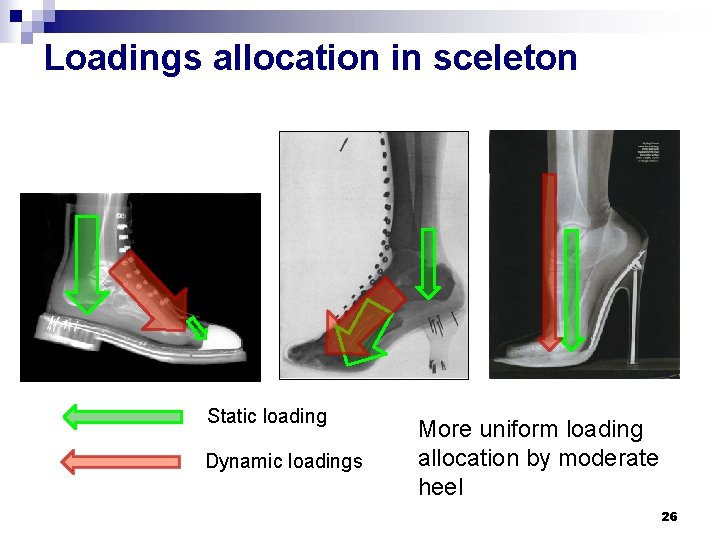
Loadings allocation in sceleton Static loading Dynamic loadings More uniform loading allocation by moderate heel 26
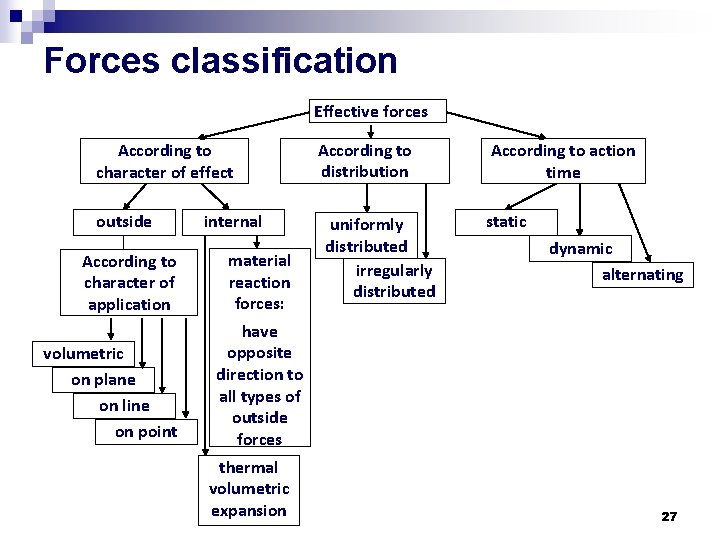
Forces classification Effective forces According to character of effect outside According to character of application volumetric on plane on line on point internal material reaction forces: According to distribution uniformly distributed irregularly distributed According to action time static dynamic alternating have opposite direction to all types of outside forces thermal volumetric expansion 27
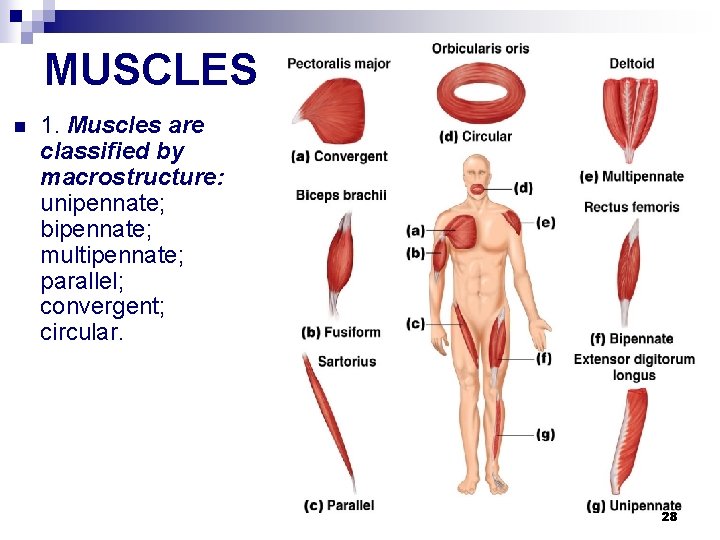
MUSCLES n 1. Muscles are classified by macrostructure: unipennate; bipennate; multipennate; parallel; convergent; circular. 28
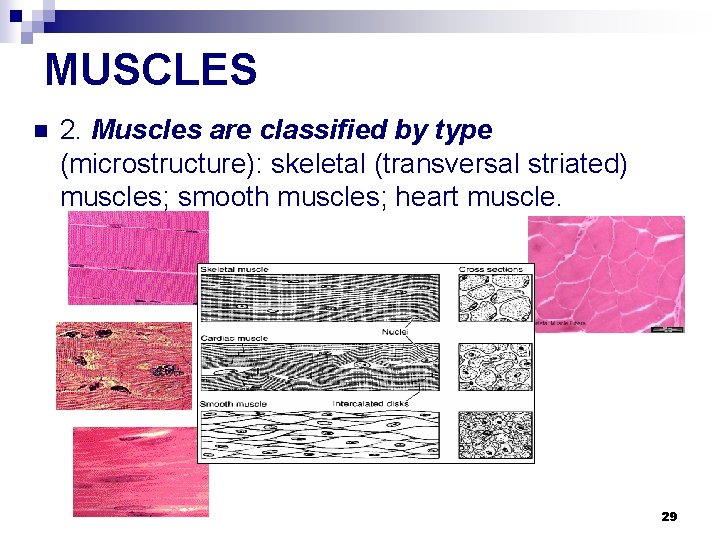
MUSCLES n 2. Muscles are classified by type (microstructure): skeletal (transversal striated) muscles; smooth muscles; heart muscle. 29
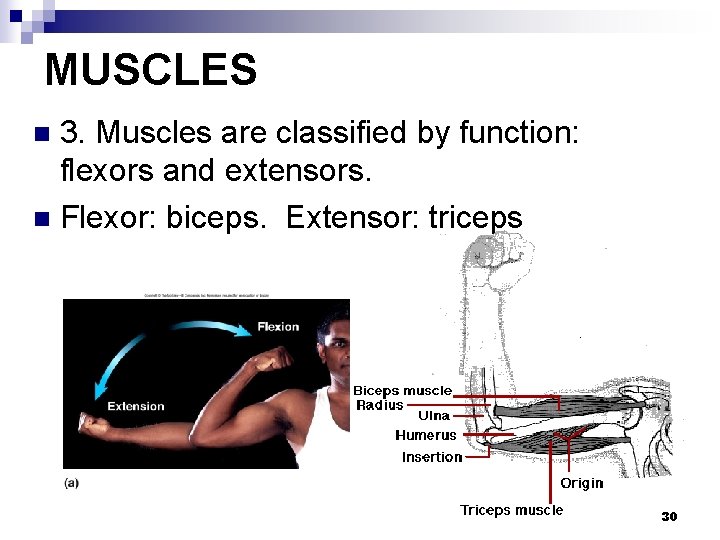
MUSCLES 3. Muscles are classified by function: flexors and extensors. n Flexor: biceps. Extensor: triceps n 30
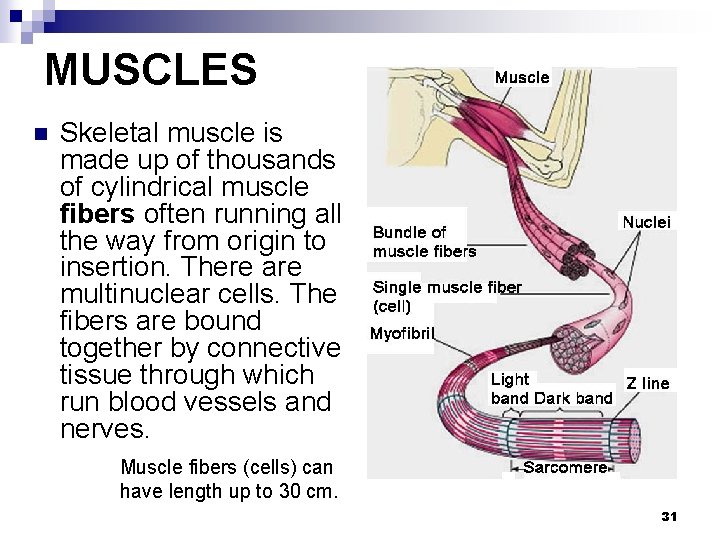
MUSCLES n Skeletal muscle is made up of thousands of cylindrical muscle fibers often running all the way from origin to insertion. There are multinuclear cells. The fibers are bound together by connective tissue through which run blood vessels and nerves. Muscle fibers (cells) can have length up to 30 cm. 31
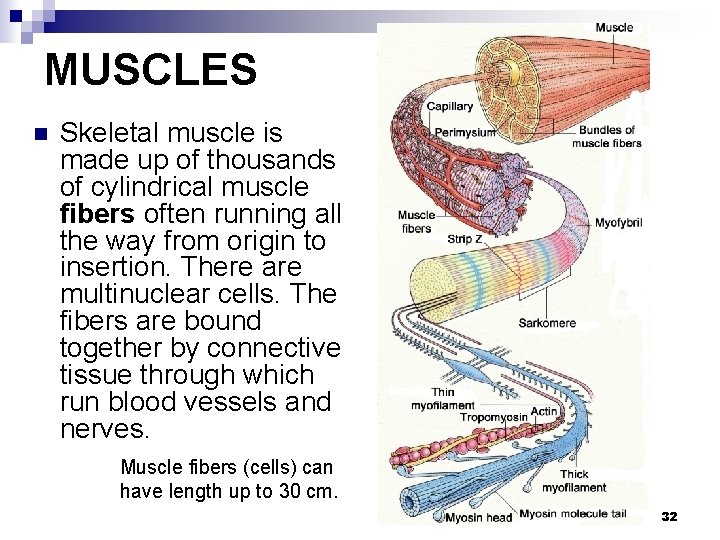
MUSCLES n Skeletal muscle is made up of thousands of cylindrical muscle fibers often running all the way from origin to insertion. There are multinuclear cells. The fibers are bound together by connective tissue through which run blood vessels and nerves. Muscle fibers (cells) can have length up to 30 cm. 32
33
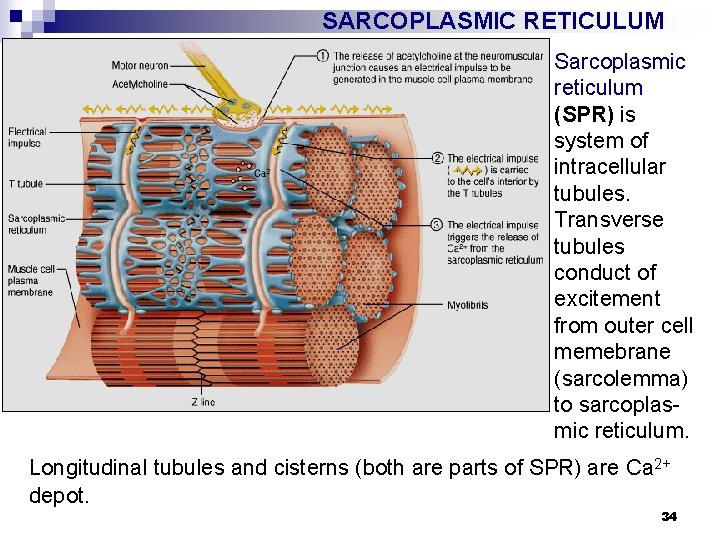
SARCOPLASMIC RETICULUM Sarcoplasmic reticulum (SPR) is system of intracellular tubules. Transverse tubules conduct of excitement from outer cell memebrane (sarcolemma) to sarcoplasmic reticulum. Longitudinal tubules and cisterns (both are parts of SPR) are Са 2+ depot. 34
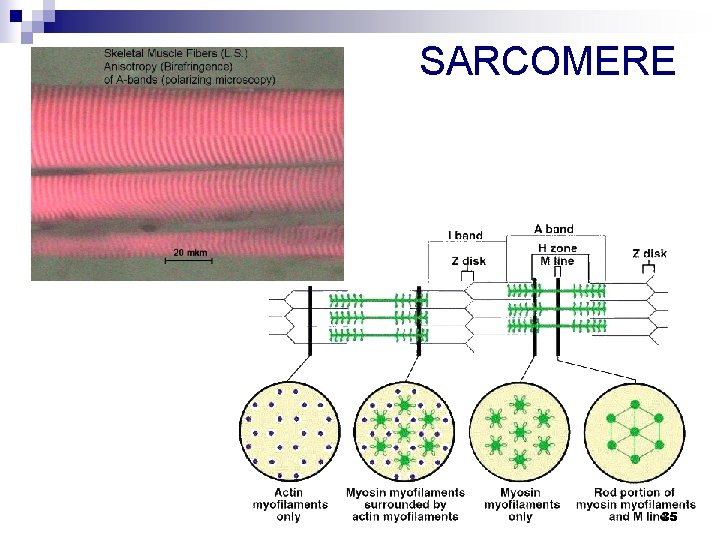
SARCOMERE 35
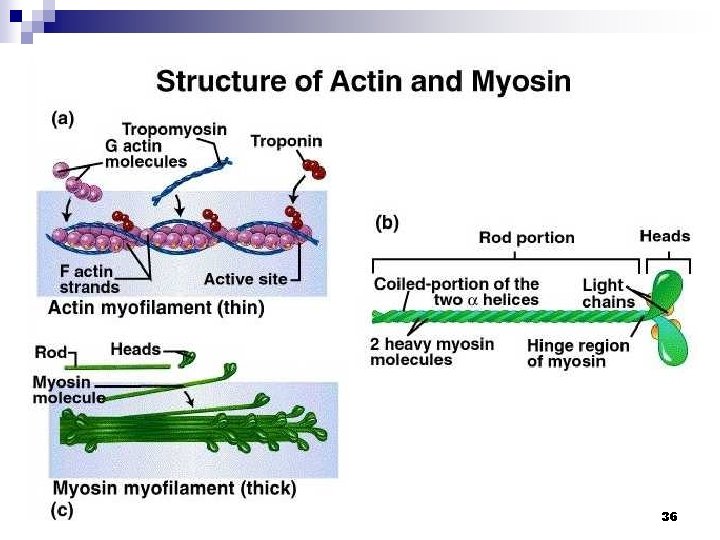
36
CONTRACTION Excitation (action potential) is generated in neuromuscular junction after coming of signal from central nervous system. Excitation spreads all along cell membrane, then along transverse tubules; in one's turn excited tubules provoke excitation of SPR cisterns which located close. In SPR membranes Са 2+-channels are; at depolarization of membrane Са 2+-channels open; Са 2+ ions come out SPR to sarcoplasm, diffuse to actin and myosin; Са 2+ high concentration provoke beginning of contraction. 37
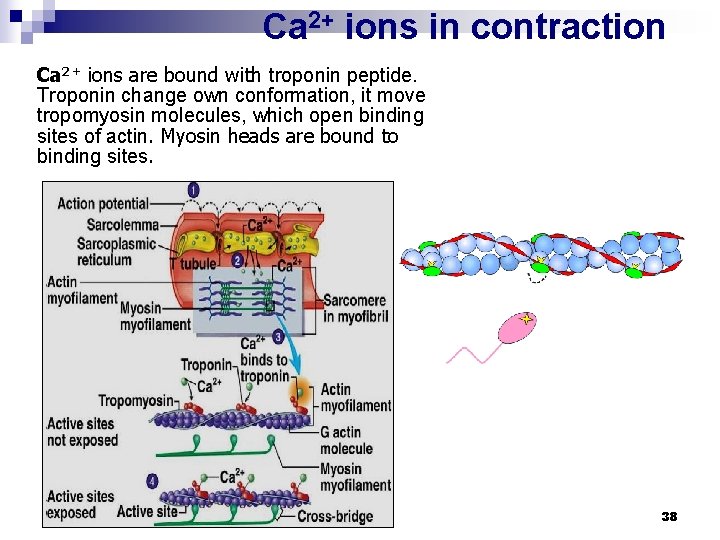
Са 2+ ions in contraction Са 2+ ions are bound with troponin peptide. Troponin change own conformation, it move tropomyosin molecules, which open binding sites of actin. Myosin heads are bound to binding sites. 38
Summary of Muscle Contraction 1. Brain – spinal cord – motor nerve – neuromuscular junction. 2. Acetylcholine(ACH) released by synaptic vesicles, crosses synaptic cleft – Acetylcholinesterase enzyme breaks down ACH, binds to receptors. 3. Sodium ions "leak" into muscle cell initiating action potential which travels T‑tubules to sarcoplasmic reticulum (SR). 4. Calcium ions released from SR. 5. Calcium (high affinity for troponin) binds with troponin. 6. Shift of tropomyosin, make sites available for myosin. 7. With ATP present, ATPase splits ATP to ADP + Energy. 8. Myosin combines with actin. 9. Sliding action of actin over myosin (Sliding filament theory). 10. Impulse stops, calcium or ATP depleted, calcium ions pumped to SR. 11. Tropomyosin returns over active sites on actin, myosin no longer bound. 39
BIOACOUSTICS studies: reception of mechanic oscillations (acoustic /sound and vibration) and body orientation by equilibrium organs. Human: Reception of sounds – ear; Reception of vibrations – skin mechanoreceptors. Mechanoreception includes also: Perception of pressure and its slow changes – skin mechanoreceptors. (low-frequency oscillations spreading in firm or a fluid medium); Muscular sense (kinesthesia).
SOUNDS Sounds term oscillations of the resilient mediums (gas, fluid or solid) spreading as waves. Proper sounds term oscillations with frequencies from 16 Hz up to 20 000 Hz. Ears of the human beings and other vertebrate animals are the specialized organs of sound perception. Oscillations with frequencies higher 20 000 Hz are ultrasounds, lower 16 Hz are infrasounds.
Vibrations (low-frequency oscillations spreading in firm or a fluid medium). Skin mechanoreceptors. Vibrissas – Specialized hairs about a mouth and on cheeks. Lateral line of fishes. Mechanoreception includes perception of pressure and its slow changes also. Influence of vibration on an organism can be the useful, but it is more often harmful, that depends on frequency. So, there is an occupational disease «vibratory illness» which is invoked by the long-term action of vibration on an organism; these are changes of blood vessels of extremities, the nervous-muscular and bone-joints apparatus.
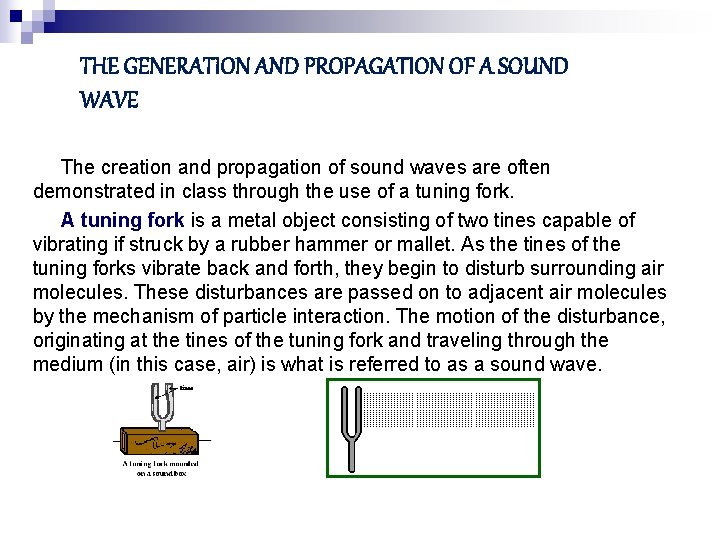
THE GENERATION AND PROPAGATION OF A SOUND WAVE The creation and propagation of sound waves are often demonstrated in class through the use of a tuning fork. A tuning fork is a metal object consisting of two tines capable of vibrating if struck by a rubber hammer or mallet. As the tines of the tuning forks vibrate back and forth, they begin to disturb surrounding air molecules. These disturbances are passed on to adjacent air molecules by the mechanism of particle interaction. The motion of the disturbance, originating at the tines of the tuning fork and traveling through the medium (in this case, air) is what is referred to as a sound wave.
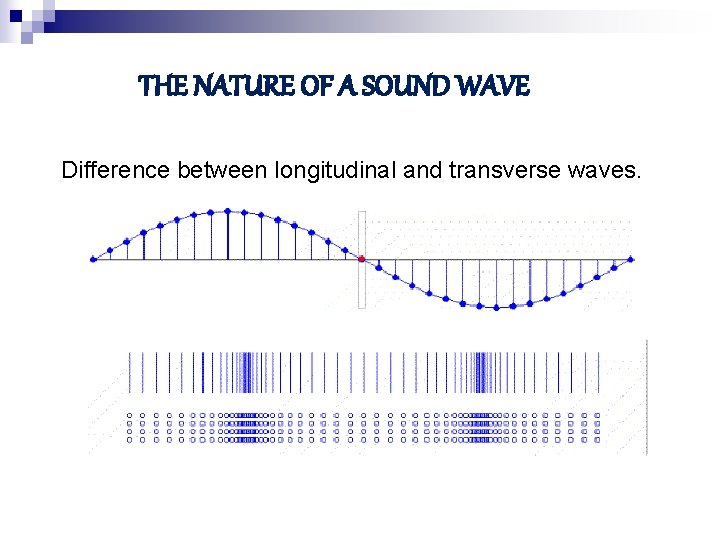
THE NATURE OF A SOUND WAVE Difference between longitudinal and transverse waves.
NATURAL FREQUENCIES Some objects tend to vibrate at a single frequency and they are often said to produce a pure tone. n A pure tone has a single frequency. n A rich sound (musical) has complex waves with a set of frequencies which have a whole number mathematical relationship between them. n A noise has a set of multiple frequencies which have no simple mathematical relationship between them.
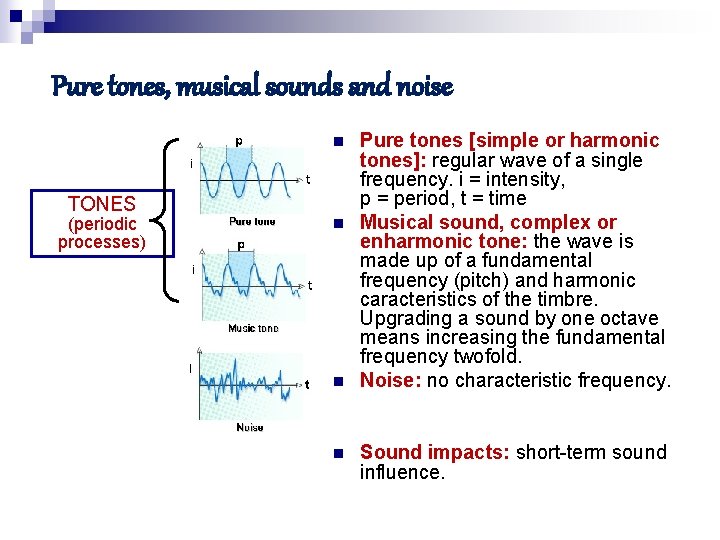
Pure tones, musical sounds and noise n TONES (periodic processes) n n n Pure tones [simple or harmonic tones]: regular wave of a single frequency. i = intensity, p = period, t = time Musical sound, complex or enharmonic tone: the wave is made up of a fundamental frequency (pitch) and harmonic caracteristics of the timbre. Upgrading a sound by one octave means increasing the fundamental frequency twofold. Noise: no characteristic frequency. Sound impacts: short-term sound influence.
NATURAL FREQUENCIES The natural frequency of the object – the frequency or frequencies at which an object tends to vibrate with when hit, struck, plucked, strummed or somehow disturbed. n All objects have a natural frequency or set of frequencies at which they vibrate. n The quality or timbre of the sound produced by a vibrating object is dependent upon the natural frequencies of the sound waves produced by the objects. n A rich sound is complex wave with a set of frequencies which have a whole number mathematical relationship between them. This set of frequencies has name spectrum. n
![Resonance Eigenfrequency [natural frequency] is frequency of characteristic oscillations. Characteristic oscillation [characteristic vibrations, natural](http://slidetodoc.com/presentation_image_h2/6056891265b49a6e75bd2c1583db4417/image-48.jpg "Resonance Eigenfrequency [natural frequency] is frequency of characteristic oscillations. Characteristic oscillation [characteristic vibrations, natural")
Resonance Eigenfrequency [natural frequency] is frequency of characteristic oscillations. Characteristic oscillation [characteristic vibrations, natural vibrations] - oscillations which can be raised in oscillatory system under action of an initial push. In real systems own fluctuations dump owing to losses of energy on friction. Examples: ringing of bell; string sound - guitar. Resonance is effect when one object vibrating at the same natural frequency of a second object forces that second object into vibrational motion.
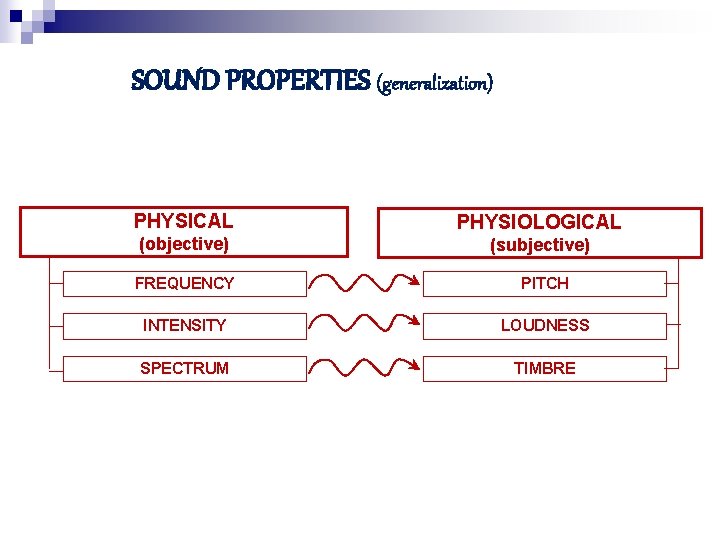
SOUND PROPERTIES (generalization) PHYSICAL PHYSIOLOGICAL (objective) (subjective) FREQUENCY PITCH INTENSITY LOUDNESS SPECTRUM TIMBRE
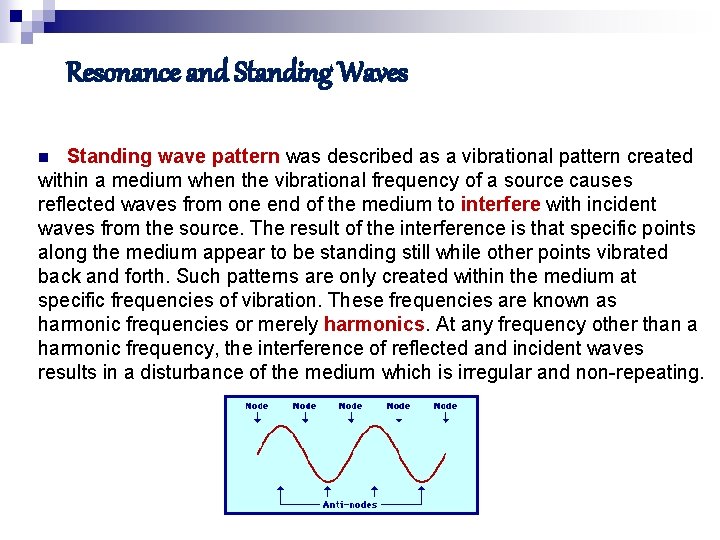
Resonance and Standing Waves Standing wave pattern was described as a vibrational pattern created within a medium when the vibrational frequency of a source causes reflected waves from one end of the medium to interfere with incident waves from the source. The result of the interference is that specific points along the medium appear to be standing still while other points vibrated back and forth. Such patterns are only created within the medium at specific frequencies of vibration. These frequencies are known as harmonic frequencies or merely harmonics. At any frequency other than a harmonic frequency, the interference of reflected and incident waves results in a disturbance of the medium which is irregular and non-repeating. n
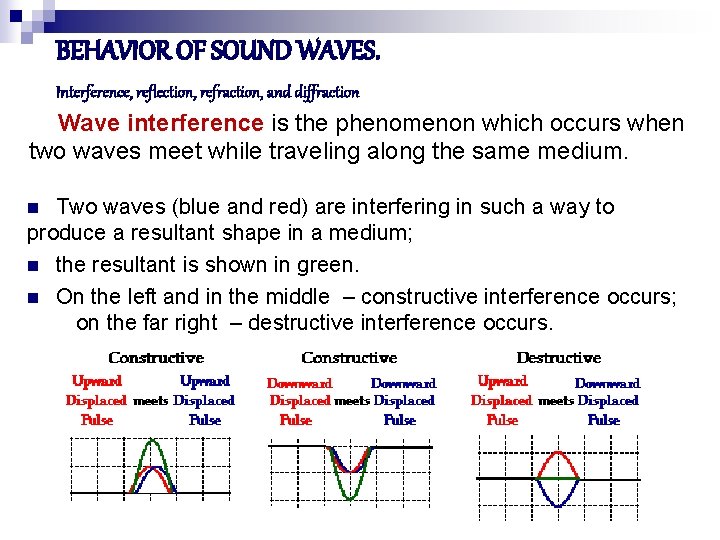
BEHAVIOR OF SOUND WAVES. Interference, reflection, refraction, and diffraction Wave interference is the phenomenon which occurs when two waves meet while traveling along the same medium. Two waves (blue and red) are interfering in such a way to produce a resultant shape in a medium; n the resultant is shown in green. n On the left and in the middle – constructive interference occurs; on the far right – destructive interference occurs. n
THE SPEED OF SOUND Rate of sound spreading depends on resilient properties of medium in which the sound wave is spread, from temperature and other factors. In air at t=18°C rate of a note is peer 340 km/s, in water at t=0°C – 1550 km/s. Factors Affecting Wave Speed. n The speed of any wave depends upon the properties of the medium through which the wave is traveling. Typically there are two essential types of properties which affect wave speed – inertial properties and elastic properties. n Elastic properties are those properties related to the tendency of a material to maintain its shape and not deform whenever a force or stress is applied to it. When a force is applied in an attempt to stretch or deform the material, its strong particle interactions prevent this deformation and help the material maintain its shape. Rigid materials such as steel are considered to have a high elasticity. (Elastic modulus is the technical term). n
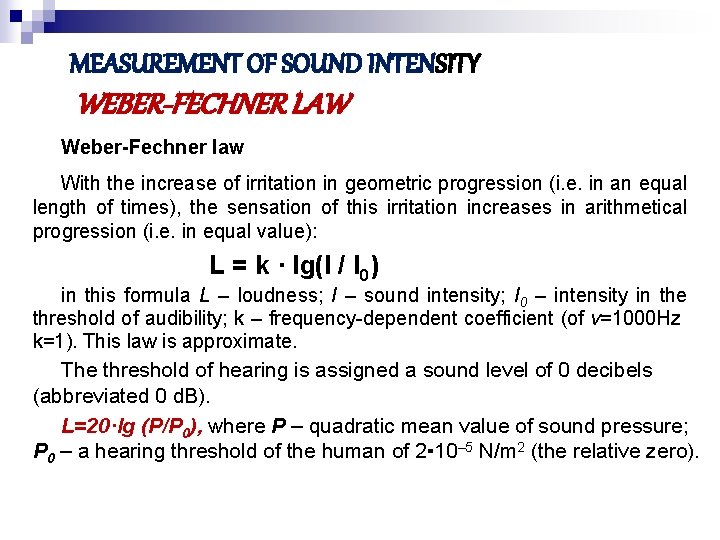
MEASUREMENT OF SOUND INTENSITY WEBER-FECHNER LAW Weber-Fechner law With the increase of irritation in geometric progression (i. e. in an equal length of times), the sensation of this irritation increases in arithmetical progression (i. e. in equal value): L = k · lg(I / I 0) in this formula L – loudness; I – sound intensity; I 0 – intensity in the threshold of audibility; k – frequency-dependent coefficient (of ν=1000 Hz k=1). This law is approximate. The threshold of hearing is assigned a sound level of 0 decibels (abbreviated 0 d. B). L=20·lg (P/P 0), where Р – quadratic mean value of sound pressure; Р 0 – a hearing threshold of the human of 2▪ 10– 5 N/m 2 (the relative zero).
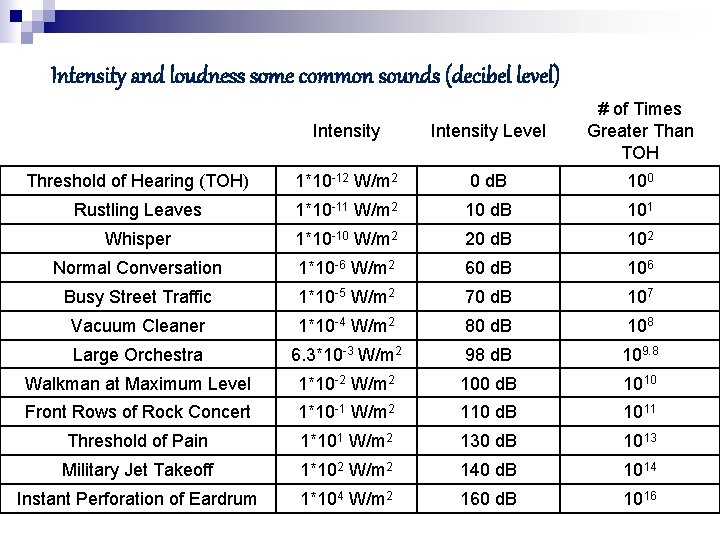
Intensity and loudness some common sounds (decibel level) Intensity Level # of Times Greater Than TOH Threshold of Hearing (TOH) 1*10 -12 W/m 2 0 d. B 100 Rustling Leaves 1*10 -11 W/m 2 10 d. B 101 Whisper 1*10 -10 W/m 2 20 d. B 102 Normal Conversation 1*10 -6 W/m 2 60 d. B 106 Busy Street Traffic 1*10 -5 W/m 2 70 d. B 107 Vacuum Cleaner 1*10 -4 W/m 2 80 d. B 108 Large Orchestra 6. 3*10 -3 W/m 2 98 d. B 109. 8 Walkman at Maximum Level 1*10 -2 W/m 2 100 d. B 1010 Front Rows of Rock Concert 1*10 -1 W/m 2 110 d. B 1011 Threshold of Pain 1*101 W/m 2 130 d. B 1013 Military Jet Takeoff 1*102 W/m 2 140 d. B 1014 Instant Perforation of Eardrum 1*104 W/m 2 160 d. B 1016
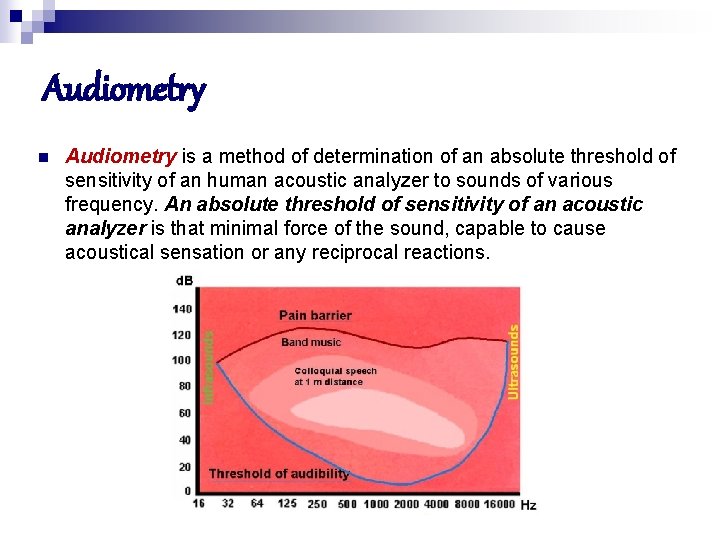
Audiometry n Audiometry is a method of determination of an absolute threshold of sensitivity of an human acoustic analyzer to sounds of various frequency. An absolute threshold of sensitivity of an acoustic analyzer is that minimal force of the sound, capable to cause acoustical sensation or any reciprocal reactions.
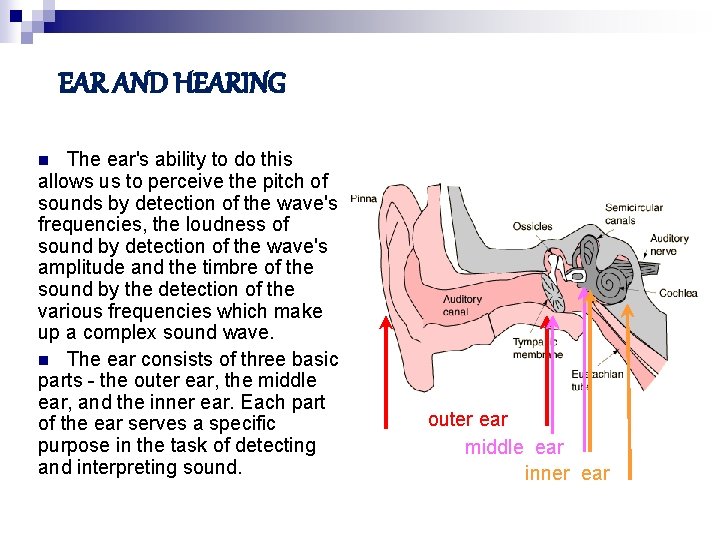
EAR AND HEARING The ear's ability to do this allows us to perceive the pitch of sounds by detection of the wave's frequencies, the loudness of sound by detection of the wave's amplitude and the timbre of the sound by the detection of the various frequencies which make up a complex sound wave. n The ear consists of three basic parts - the outer ear, the middle ear, and the inner ear. Each part of the ear serves a specific purpose in the task of detecting and interpreting sound. n outer ear middle ear inner ear
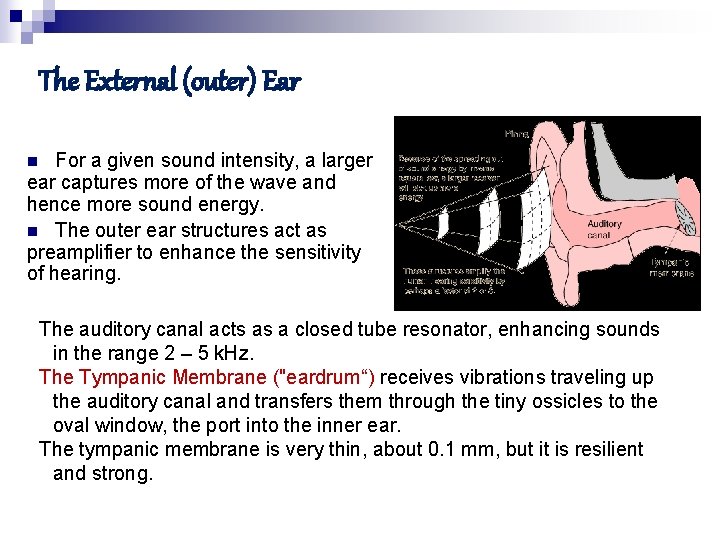
The External (outer) Ear For a given sound intensity, a larger ear captures more of the wave and hence more sound energy. n The outer ear structures act as preamplifier to enhance the sensitivity of hearing. n The auditory canal acts as a closed tube resonator, enhancing sounds in the range 2 – 5 k. Hz. The Tympanic Membrane ("eardrum“) receives vibrations traveling up the auditory canal and transfers them through the tiny ossicles to the oval window, the port into the inner ear. The tympanic membrane is very thin, about 0. 1 mm, but it is resilient and strong.
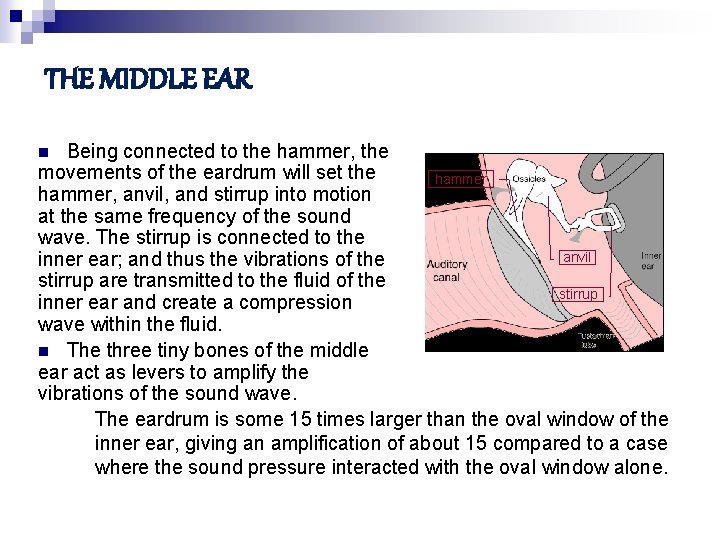
THE MIDDLE EAR Being connected to the hammer, the movements of the eardrum will set the hammer, anvil, and stirrup into motion at the same frequency of the sound wave. The stirrup is connected to the anvil inner ear; and thus the vibrations of the stirrup are transmitted to the fluid of the stirrup inner ear and create a compression wave within the fluid. n The three tiny bones of the middle ear act as levers to amplify the vibrations of the sound wave. The eardrum is some 15 times larger than the oval window of the inner ear, giving an amplification of about 15 compared to a case where the sound pressure interacted with the oval window alone. n
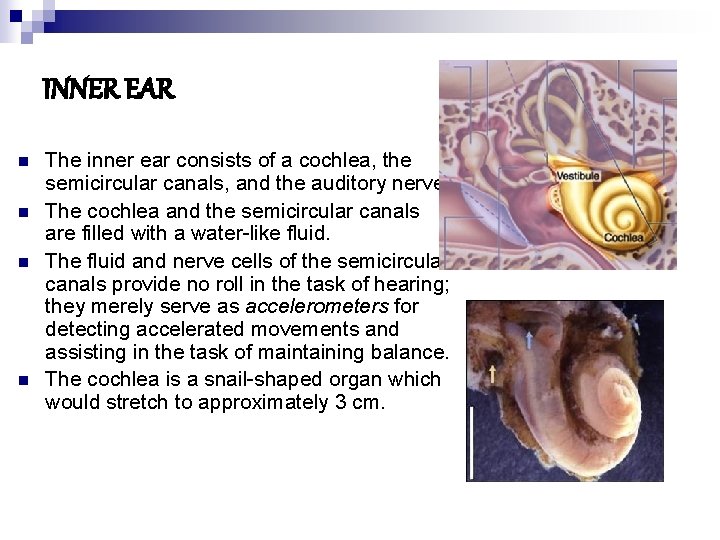
INNER EAR n n The inner ear consists of a cochlea, the semicircular canals, and the auditory nerve. The cochlea and the semicircular canals are filled with a water-like fluid. The fluid and nerve cells of the semicircular canals provide no roll in the task of hearing; they merely serve as accelerometers for detecting accelerated movements and assisting in the task of maintaining balance. The cochlea is a snail-shaped organ which would stretch to approximately 3 cm.
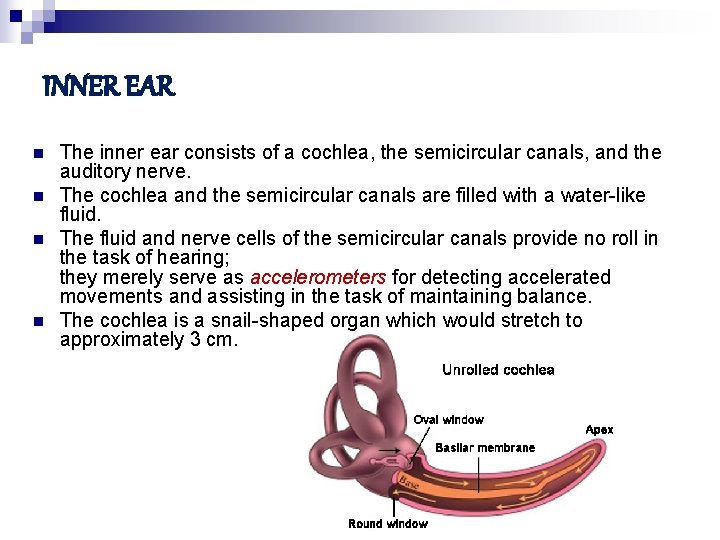
INNER EAR n n The inner ear consists of a cochlea, the semicircular canals, and the auditory nerve. The cochlea and the semicircular canals are filled with a water-like fluid. The fluid and nerve cells of the semicircular canals provide no roll in the task of hearing; they merely serve as accelerometers for detecting accelerated movements and assisting in the task of maintaining balance. The cochlea is a snail-shaped organ which would stretch to approximately 3 cm.
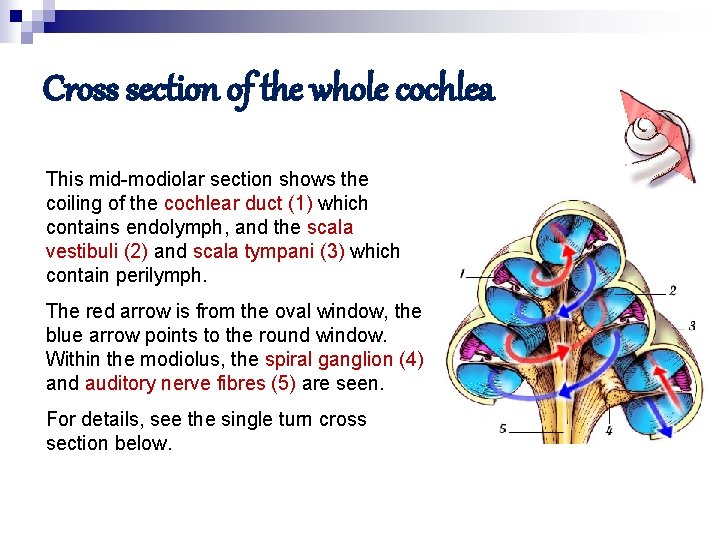
Cross section of the whole cochlea This mid-modiolar section shows the coiling of the cochlear duct (1) which contains endolymph, and the scala vestibuli (2) and scala tympani (3) which contain perilymph. The red arrow is from the oval window, the blue arrow points to the round window. Within the modiolus, the spiral ganglion (4) and auditory nerve fibres (5) are seen. For details, see the single turn cross section below.
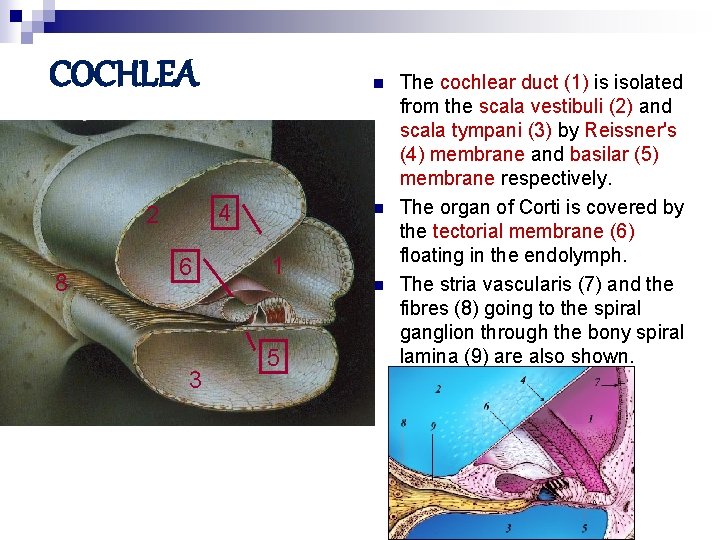
COCHLEA 4 2 8 n 6 3 n 1 5 n The cochlear duct (1) is isolated from the scala vestibuli (2) and scala tympani (3) by Reissner's (4) membrane and basilar (5) membrane respectively. The organ of Corti is covered by the tectorial membrane (6) floating in the endolymph. The stria vascularis (7) and the fibres (8) going to the spiral ganglion through the bony spiral lamina (9) are also shown.
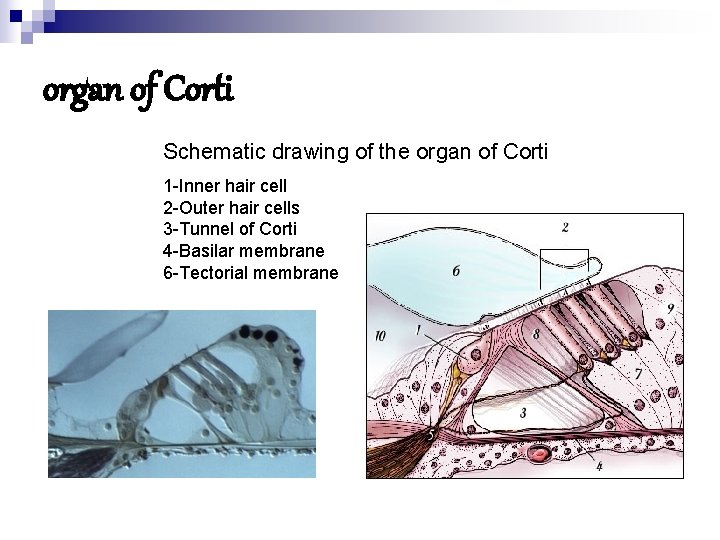
organ of Corti Schematic drawing of the organ of Corti 1 -Inner hair cell 2 -Outer hair cells 3 -Tunnel of Corti 4 -Basilar membrane 6 -Tectorial membrane
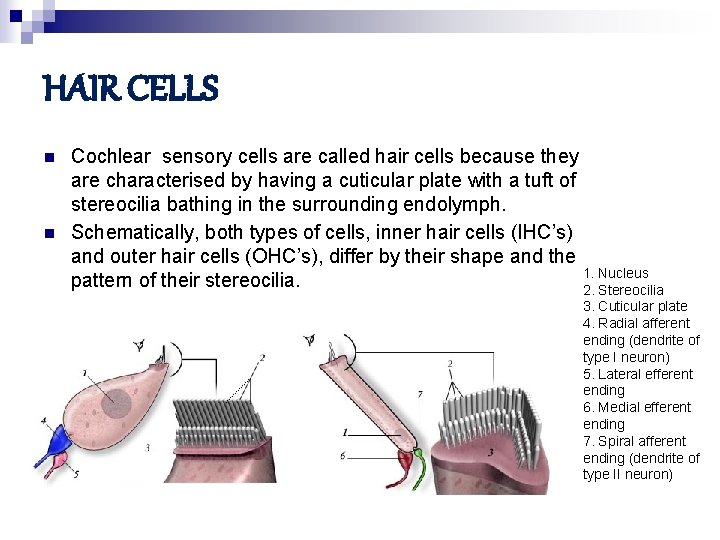
HAIR CELLS n n Cochlear sensory cells are called hair cells because they are characterised by having a cuticular plate with a tuft of stereocilia bathing in the surrounding endolymph. Schematically, both types of cells, inner hair cells (IHC’s) and outer hair cells (OHC’s), differ by their shape and the 1. Nucleus pattern of their stereocilia. 2. Stereocilia 3. Cuticular plate 4. Radial afferent ending (dendrite of type I neuron) 5. Lateral efferent ending 6. Medial efferent ending 7. Spiral afferent ending (dendrite of type II neuron)
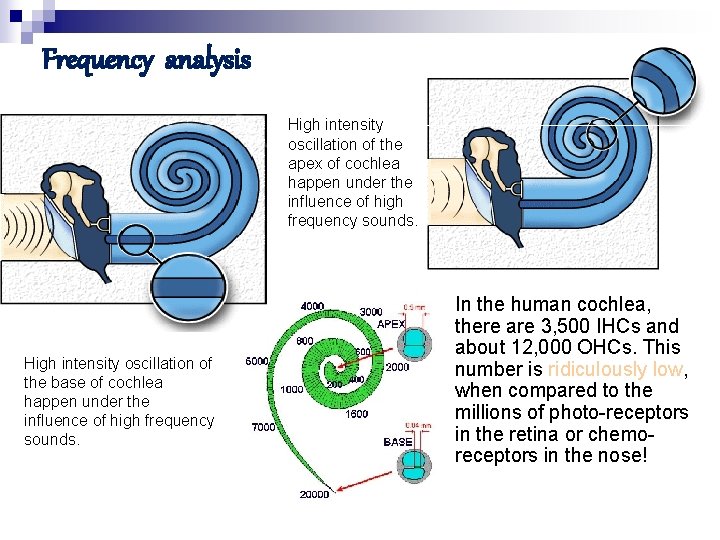
Frequency analysis High intensity oscillation of the apex of cochlea happen under the influence of high frequency sounds. High intensity oscillation of the base of cochlea happen under the influence of high frequency sounds. In the human cochlea, there are 3, 500 IHCs and about 12, 000 OHCs. This number is ridiculously low, when compared to the millions of photo-receptors in the retina or chemoreceptors in the nose!
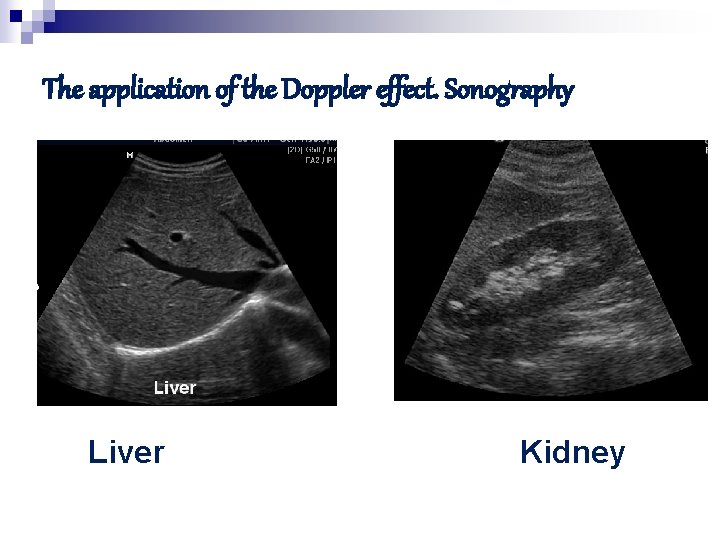
The application of the Doppler effect. Sonography Liver Kidney
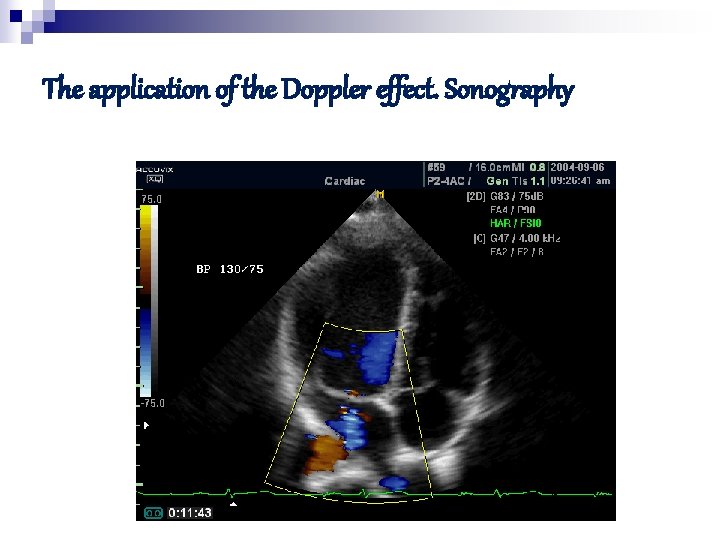
The application of the Doppler effect. Sonography
- Slides: 67