
Baseline and track performance usage KPIs and metrics
Baseline and track performance, usage KPIs, and metrics Document last updated in Q 3 2020—see the new Performance Management Workbook for the latest content.
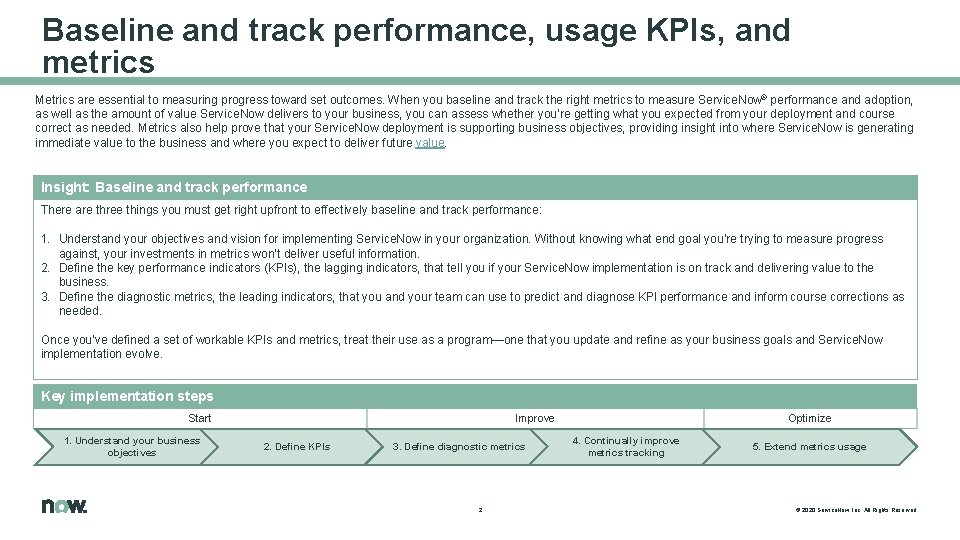
Baseline and track performance, usage KPIs, and metrics Metrics are essential to measuring progress toward set outcomes. When you baseline and track the right metrics to measure Service. Now® performance and adoption, as well as the amount of value Service. Now delivers to your business, you can assess whether you’re getting what you expected from your deployment and course correct as needed. Metrics also help prove that your Service. Now deployment is supporting business objectives, providing insight into where Service. Now is generating immediate value to the business and where you expect to deliver future value. Insight: Baseline and track performance There are three things you must get right upfront to effectively baseline and track performance: 1. Understand your objectives and vision for implementing Service. Now in your organization. Without knowing what end goal you’re trying to measure progress against, your investments in metrics won’t deliver useful information. 2. Define the key performance indicators (KPIs), the lagging indicators, that tell you if your Service. Now implementation is on track and delivering value to the business. 3. Define the diagnostic metrics, the leading indicators, that you and your team can use to predict and diagnose KPI performance and inform course corrections as needed. Once you’ve defined a set of workable KPIs and metrics, treat their use as a program—one that you update and refine as your business goals and Service. Now implementation evolve. Key implementation steps Start 1. Understand your business objectives Improve 2. Define KPIs 3. Define diagnostic metrics 2 Optimize 4. Continually improve metrics tracking 5. Extend metrics usage © 2020 Service. Now, Inc. All Rights Reserved.
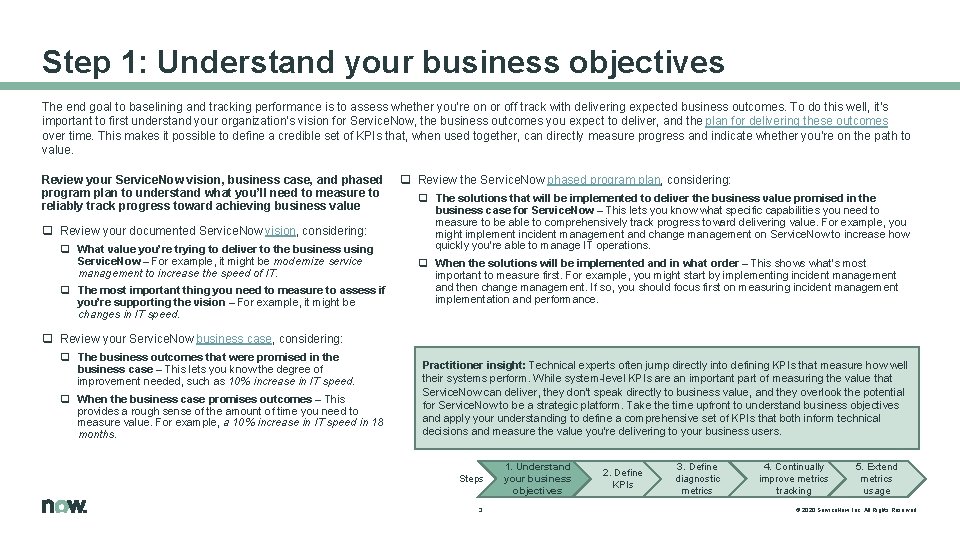
Step 1: Understand your business objectives The end goal to baselining and tracking performance is to assess whether you’re on or off track with delivering expected business outcomes. To do this well, it’s important to first understand your organization’s vision for Service. Now, the business outcomes you expect to deliver, and the plan for delivering these outcomes over time. This makes it possible to define a credible set of KPIs that, when used together, can directly measure progress and indicate whether you’re on the path to value. Review your Service. Now vision, business case, and phased program plan to understand what you’ll need to measure to reliably track progress toward achieving business value q Review your documented Service. Now vision, considering: q What value you’re trying to deliver to the business using Service. Now – For example, it might be modernize service management to increase the speed of IT. q The most important thing you need to measure to assess if you’re supporting the vision – For example, it might be changes in IT speed. q Review the Service. Now phased program plan, considering: q The solutions that will be implemented to deliver the business value promised in the business case for Service. Now – This lets you know what specific capabilities you need to measure to be able to comprehensively track progress toward delivering value. For example, you might implement incident management and change management on Service. Now to increase how quickly you’re able to manage IT operations. q When the solutions will be implemented and in what order – This shows what’s most important to measure first. For example, you might start by implementing incident management and then change management. If so, you should focus first on measuring incident management implementation and performance. q Review your Service. Now business case, considering: q The business outcomes that were promised in the business case – This lets you know the degree of improvement needed, such as 10% increase in IT speed. q When the business case promises outcomes – This provides a rough sense of the amount of time you need to measure value. For example, a 10% increase in IT speed in 18 months. Practitioner insight: Technical experts often jump directly into defining KPIs that measure how well their systems perform. While system-level KPIs are an important part of measuring the value that Service. Now can deliver, they don’t speak directly to business value, and they overlook the potential for Service. Now to be a strategic platform. Take the time upfront to understand business objectives and apply your understanding to define a comprehensive set of KPIs that both inform technical decisions and measure the value you're delivering to your business users. Steps 3 1. Understand your business objectives 2. Define KPIs 3. Define diagnostic metrics 4. Continually improve metrics tracking 5. Extend metrics usage © 2020 Service. Now, Inc. All Rights Reserved.
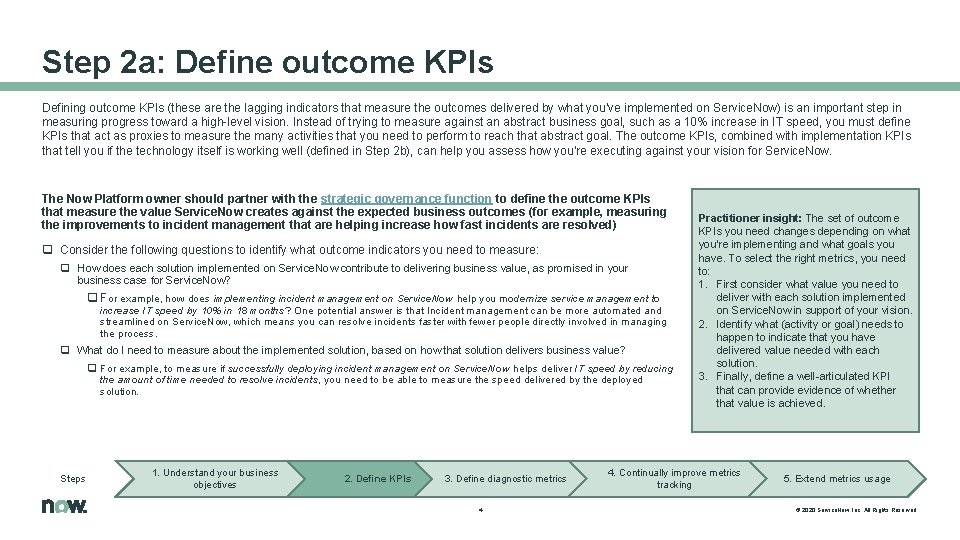
Step 2 a: Define outcome KPIs Defining outcome KPIs (these are the lagging indicators that measure the outcomes delivered by what you’ve implemented on Service. Now) is an important step in measuring progress toward a high-level vision. Instead of trying to measure against an abstract business goal, such as a 10% increase in IT speed, you must define KPIs that act as proxies to measure the many activities that you need to perform to reach that abstract goal. The outcome KPIs, combined with implementation KPIs that tell you if the technology itself is working well (defined in Step 2 b), can help you assess how you’re executing against your vision for Service. Now. The Now Platform owner should partner with the strategic governance function to define the outcome KPIs that measure the value Service. Now creates against the expected business outcomes (for example, measuring the improvements to incident management that are helping increase how fast incidents are resolved) q Consider the following questions to identify what outcome indicators you need to measure: q How does each solution implemented on Service. Now contribute to delivering business value, as promised in your business case for Service. Now? q For example, how does implementing incident management on Service. Now help you modernize service management to increase IT speed by 10% in 18 months? One potential answer is that Incident management can be more automated and streamlined on Service. Now, which means you can resolve incidents faster with fewer people directly involved in managing the process. q What do I need to measure about the implemented solution, based on how that solution delivers business value? q For example, to measure if successfully deploying incident management on Service. Now helps deliver IT speed by reducing the amount of time needed to resolve incidents, you need to be able to measure the speed delivered by the deployed solution. Steps 1. Understand your business objectives 2. Define KPIs 3. Define diagnostic metrics 4 Practitioner insight: The set of outcome KPIs you need changes depending on what you’re implementing and what goals you have. To select the right metrics, you need to: 1. First consider what value you need to deliver with each solution implemented on Service. Now in support of your vision. 2. Identify what (activity or goal) needs to happen to indicate that you have delivered value needed with each solution. 3. Finally, define a well-articulated KPI that can provide evidence of whether that value is achieved. 4. Continually improve metrics tracking 5. Extend metrics usage © 2020 Service. Now, Inc. All Rights Reserved.
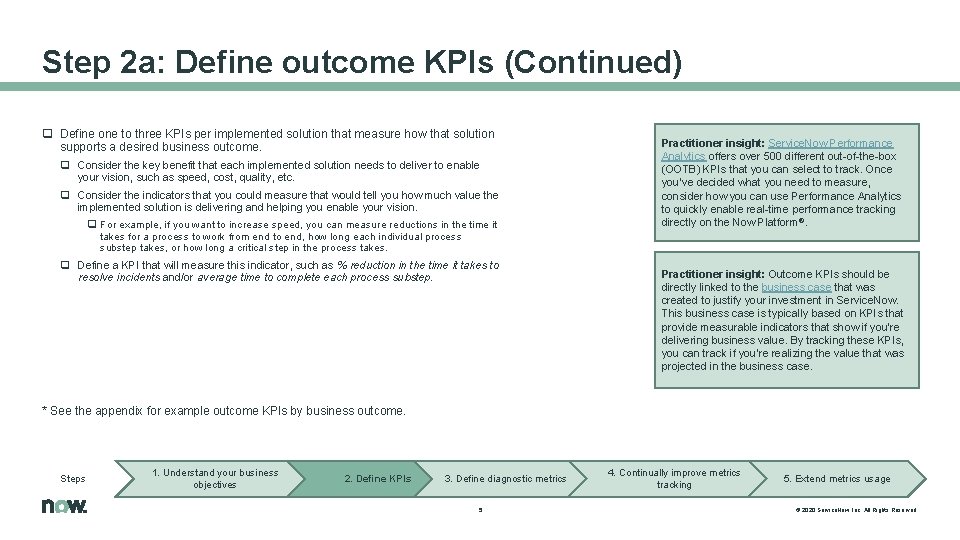
Step 2 a: Define outcome KPIs (Continued) q Define one to three KPIs per implemented solution that measure how that solution supports a desired business outcome. q Consider the key benefit that each implemented solution needs to deliver to enable your vision, such as speed, cost, quality, etc. q Consider the indicators that you could measure that would tell you how much value the implemented solution is delivering and helping you enable your vision. q For example, if you want to increase speed, you can measure reductions in the time it takes for a process to work from end to end, how long each individual process substep takes, or how long a critical step in the process takes. q Define a KPI that will measure this indicator, such as % reduction in the time it takes to resolve incidents and/or average time to complete each process substep. Practitioner insight: Service. Now Performance Analytics offers over 500 different out-of-the-box (OOTB) KPIs that you can select to track. Once you’ve decided what you need to measure, consider how you can use Performance Analytics to quickly enable real-time performance tracking directly on the Now Platform®. Practitioner insight: Outcome KPIs should be directly linked to the business case that was created to justify your investment in Service. Now. This business case is typically based on KPIs that provide measurable indicators that show if you’re delivering business value. By tracking these KPIs, you can track if you’re realizing the value that was projected in the business case. * See the appendix for example outcome KPIs by business outcome. Steps 1. Understand your business objectives 2. Define KPIs 3. Define diagnostic metrics 5 4. Continually improve metrics tracking 5. Extend metrics usage © 2020 Service. Now, Inc. All Rights Reserved.
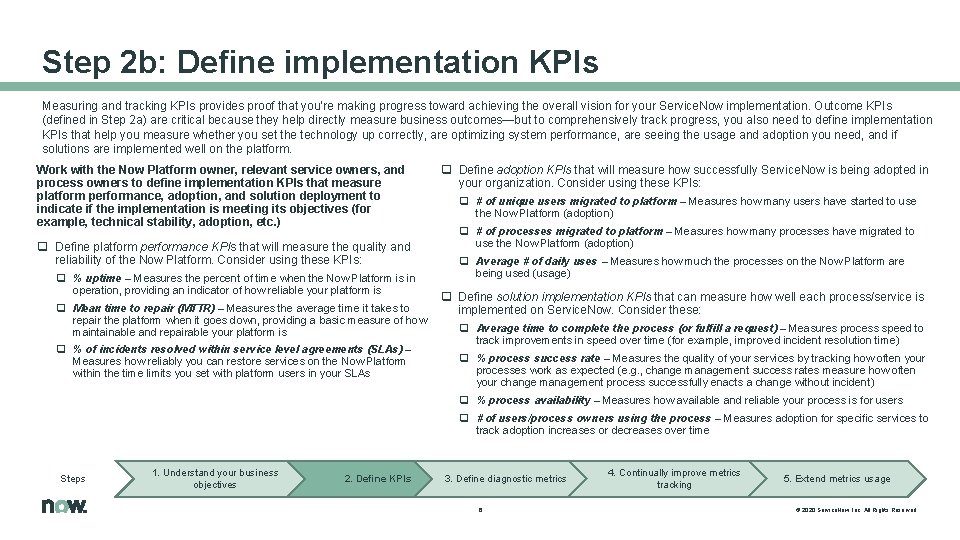
Step 2 b: Define implementation KPIs Measuring and tracking KPIs provides proof that you’re making progress toward achieving the overall vision for your Service. Now implementation. Outcome KPIs (defined in Step 2 a) are critical because they help directly measure business outcomes—but to comprehensively track progress, you also need to define implementation KPIs that help you measure whether you set the technology up correctly, are optimizing system performance, are seeing the usage and adoption you need, and if solutions are implemented well on the platform. Work with the Now Platform owner, relevant service owners, and process owners to define implementation KPIs that measure platform performance, adoption, and solution deployment to indicate if the implementation is meeting its objectives (for example, technical stability, adoption, etc. ) q Define platform performance KPIs that will measure the quality and reliability of the Now Platform. Consider using these KPIs: q % uptime – Measures the percent of time when the Now Platform is in operation, providing an indicator of how reliable your platform is q Mean time to repair (MTTR) – Measures the average time it takes to repair the platform when it goes down, providing a basic measure of how maintainable and repairable your platform is q % of incidents resolved within service level agreements (SLAs) – Measures how reliably you can restore services on the Now Platform within the time limits you set with platform users in your SLAs q Define adoption KPIs that will measure how successfully Service. Now is being adopted in your organization. Consider using these KPIs: q # of unique users migrated to platform – Measures how many users have started to use the Now Platform (adoption) q # of processes migrated to platform – Measures how many processes have migrated to use the Now Platform (adoption) q Average # of daily uses – Measures how much the processes on the Now Platform are being used (usage) q Define solution implementation KPIs that can measure how well each process/service is implemented on Service. Now. Consider these: q Average time to complete the process (or fulfill a request) – Measures process speed to track improvements in speed over time (for example, improved incident resolution time) q % process success rate – Measures the quality of your services by tracking how often your processes work as expected (e. g. , change management success rates measure how often your change management process successfully enacts a change without incident) q % process availability – Measures how available and reliable your process is for users q # of users/process owners using the process – Measures adoption for specific services to track adoption increases or decreases over time Steps 1. Understand your business objectives 2. Define KPIs 3. Define diagnostic metrics 6 4. Continually improve metrics tracking 5. Extend metrics usage © 2020 Service. Now, Inc. All Rights Reserved.
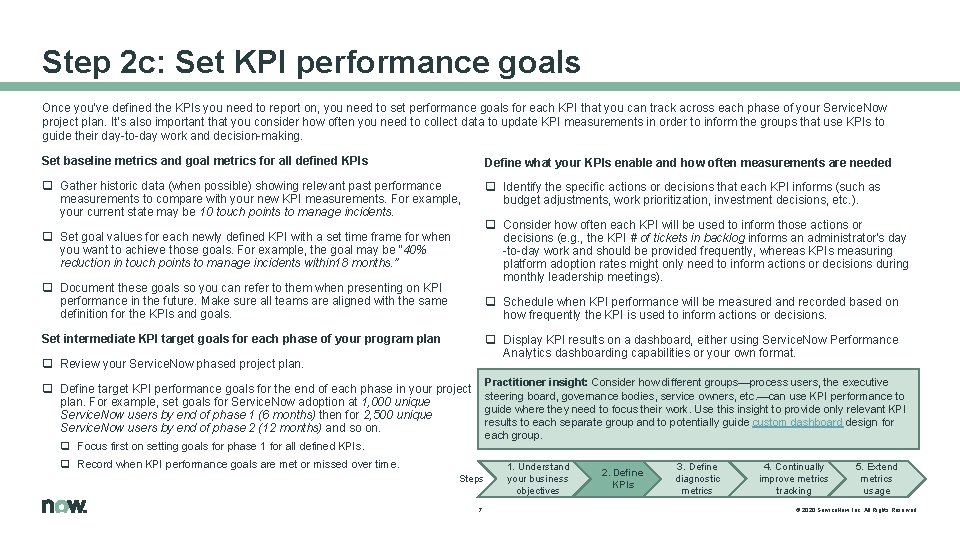
Step 2 c: Set KPI performance goals Once you’ve defined the KPIs you need to report on, you need to set performance goals for each KPI that you can track across each phase of your Service. Now project plan. It’s also important that you consider how often you need to collect data to update KPI measurements in order to inform the groups that use KPIs to guide their day-to-day work and decision-making. Set baseline metrics and goal metrics for all defined KPIs Define what your KPIs enable and how often measurements are needed q Gather historic data (when possible) showing relevant past performance measurements to compare with your new KPI measurements. For example, your current state may be 10 touch points to manage incidents. q Identify the specific actions or decisions that each KPI informs (such as budget adjustments, work prioritization, investment decisions, etc. ). q Consider how often each KPI will be used to inform those actions or decisions (e. g. , the KPI # of tickets in backlog informs an administrator's day -to-day work and should be provided frequently, whereas KPIs measuring platform adoption rates might only need to inform actions or decisions during monthly leadership meetings). q Set goal values for each newly defined KPI with a set time frame for when you want to achieve those goals. For example, the goal may be “ 40% reduction in touch points to manage incidents within 18 months. ” q Document these goals so you can refer to them when presenting on KPI performance in the future. Make sure all teams are aligned with the same definition for the KPIs and goals. q Schedule when KPI performance will be measured and recorded based on how frequently the KPI is used to inform actions or decisions. Set intermediate KPI target goals for each phase of your program plan q Display KPI results on a dashboard, either using Service. Now Performance Analytics dashboarding capabilities or your own format. q Review your Service. Now phased project plan. Practitioner insight: Consider how different groups—process users, the executive q Define target KPI performance goals for the end of each phase in your project steering board, governance bodies, service owners, etc. —can use KPI performance to plan. For example, set goals for Service. Now adoption at 1, 000 unique guide where they need to focus their work. Use this insight to provide only relevant KPI Service. Now users by end of phase 1 (6 months) then for 2, 500 unique results to each separate group and to potentially guide custom dashboard design for Service. Now users by end of phase 2 (12 months) and so on. each group. q Focus first on setting goals for phase 1 for all defined KPIs. q Record when KPI performance goals are met or missed over time. Steps 7 1. Understand your business objectives 2. Define KPIs 3. Define diagnostic metrics 4. Continually improve metrics tracking 5. Extend metrics usage © 2020 Service. Now, Inc. All Rights Reserved.
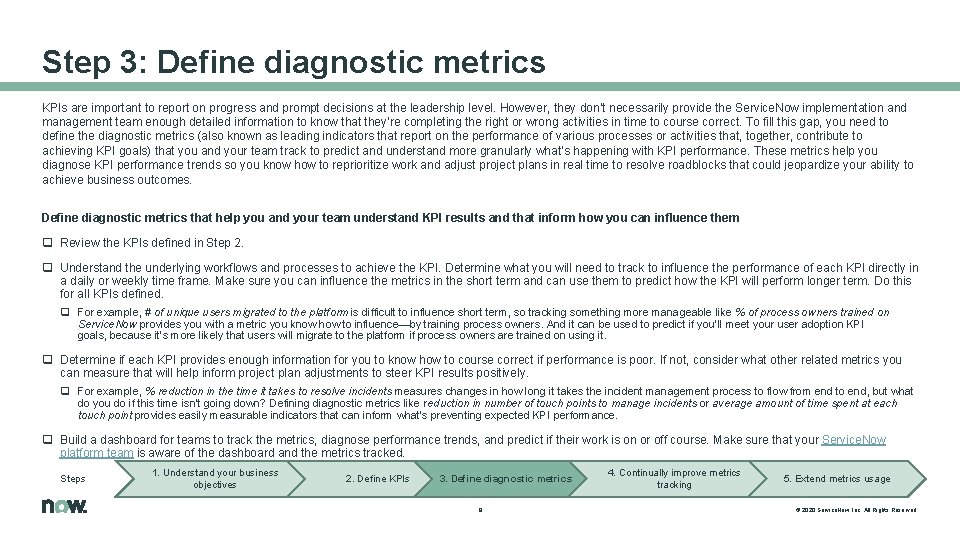
Step 3: Define diagnostic metrics KPIs are important to report on progress and prompt decisions at the leadership level. However, they don’t necessarily provide the Service. Now implementation and management team enough detailed information to know that they’re completing the right or wrong activities in time to course correct. To fill this gap, you need to define the diagnostic metrics (also known as leading indicators that report on the performance of various processes or activities that, together, contribute to achieving KPI goals) that you and your team track to predict and understand more granularly what’s happening with KPI performance. These metrics help you diagnose KPI performance trends so you know how to reprioritize work and adjust project plans in real time to resolve roadblocks that could jeopardize your ability to achieve business outcomes. Define diagnostic metrics that help you and your team understand KPI results and that inform how you can influence them q Review the KPIs defined in Step 2. q Understand the underlying workflows and processes to achieve the KPI. Determine what you will need to track to influence the performance of each KPI directly in a daily or weekly time frame. Make sure you can influence the metrics in the short term and can use them to predict how the KPI will perform longer term. Do this for all KPIs defined. q For example, # of unique users migrated to the platform is difficult to influence short term, so tracking something more manageable like % of process owners trained on Service. Now provides you with a metric you know how to influence—by training process owners. And it can be used to predict if you’ll meet your user adoption KPI goals, because it’s more likely that users will migrate to the platform if process owners are trained on using it. q Determine if each KPI provides enough information for you to know how to course correct if performance is poor. If not, consider what other related metrics you can measure that will help inform project plan adjustments to steer KPI results positively. q For example, % reduction in the time it takes to resolve incidents measures changes in how long it takes the incident management process to flow from end to end, but what do you do if this time isn’t going down? Defining diagnostic metrics like reduction in number of touch points to manage incidents or average amount of time spent at each touch point provides easily measurable indicators that can inform what’s preventing expected KPI performance. q Build a dashboard for teams to track the metrics, diagnose performance trends, and predict if their work is on or off course. Make sure that your Service. Now platform team is aware of the dashboard and the metrics tracked. Steps 1. Understand your business objectives 2. Define KPIs 1. Understand 3. Define diagnostic metrics Steps business objectives 8 3. Define 2. Define 4. Continually improve metrics diagnostic KPIs tracking metrics 4. Continually 5. Extend improve metrics 5. Extend metrics usage metrics tracking usage © 2020 Service. Now, Inc. All Rights Reserved.
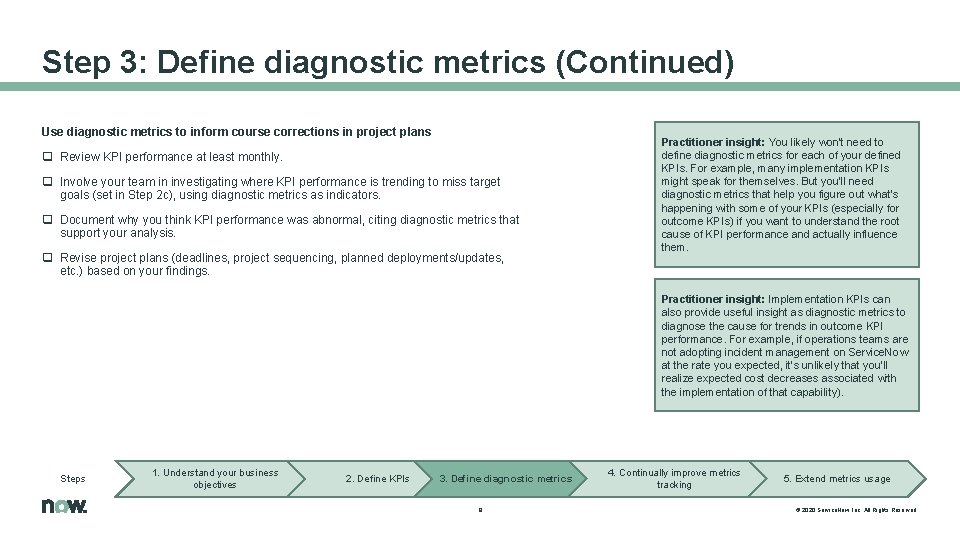
Step 3: Define diagnostic metrics (Continued) Use diagnostic metrics to inform course corrections in project plans q Review KPI performance at least monthly. q Involve your team in investigating where KPI performance is trending to miss target goals (set in Step 2 c), using diagnostic metrics as indicators. q Document why you think KPI performance was abnormal, citing diagnostic metrics that support your analysis. q Revise project plans (deadlines, project sequencing, planned deployments/updates, etc. ) based on your findings. Practitioner insight: You likely won’t need to define diagnostic metrics for each of your defined KPIs. For example, many implementation KPIs might speak for themselves. But you’ll need diagnostic metrics that help you figure out what’s happening with some of your KPIs (especially for outcome KPIs) if you want to understand the root cause of KPI performance and actually influence them. Practitioner insight: Implementation KPIs can also provide useful insight as diagnostic metrics to diagnose the cause for trends in outcome KPI performance. For example, if operations teams are not adopting incident management on Service. Now at the rate you expected, it’s unlikely that you’ll realize expected cost decreases associated with the implementation of that capability). Steps 1. Understand your business objectives 2. Define KPIs 1. Understand 3. Define diagnostic metrics Steps business objectives 9 3. Define 2. Define 4. Continually improve metrics diagnostic KPIs tracking metrics 4. Continually 5. Extend improve metrics 5. Extend metrics usage metrics tracking usage © 2020 Service. Now, Inc. All Rights Reserved.
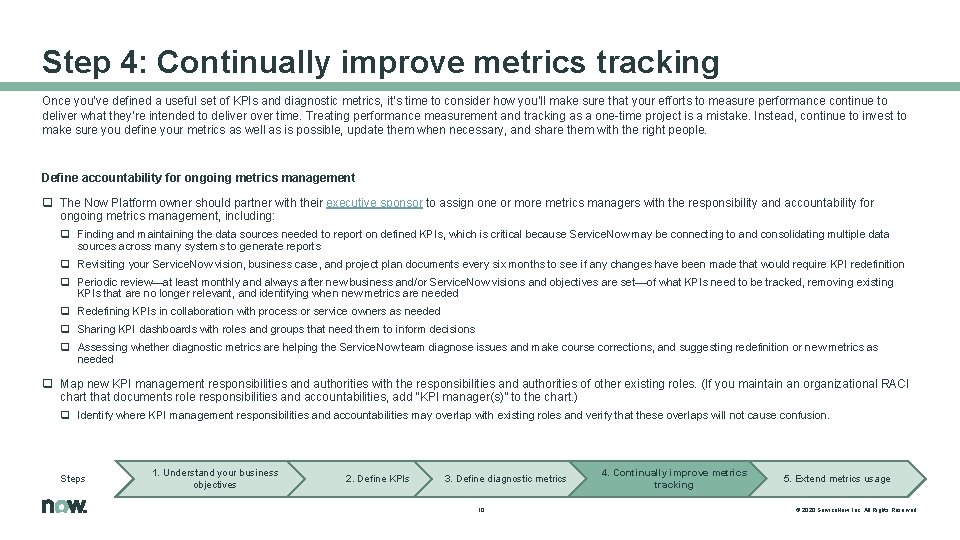
Step 4: Continually improve metrics tracking Once you’ve defined a useful set of KPIs and diagnostic metrics, it’s time to consider how you’ll make sure that your efforts to measure performance continue to deliver what they’re intended to deliver over time. Treating performance measurement and tracking as a one-time project is a mistake. Instead, continue to invest to make sure you define your metrics as well as is possible, update them when necessary, and share them with the right people. Define accountability for ongoing metrics management q The Now Platform owner should partner with their executive sponsor to assign one or more metrics managers with the responsibility and accountability for ongoing metrics management, including: q Finding and maintaining the data sources needed to report on defined KPIs, which is critical because Service. Now may be connecting to and consolidating multiple data sources across many systems to generate reports q Revisiting your Service. Now vision, business case, and project plan documents every six months to see if any changes have been made that would require KPI redefinition q Periodic review—at least monthly and always after new business and/or Service. Now visions and objectives are set—of what KPIs need to be tracked, removing existing KPIs that are no longer relevant, and identifying when new metrics are needed q Redefining KPIs in collaboration with process or service owners as needed q Sharing KPI dashboards with roles and groups that need them to inform decisions q Assessing whether diagnostic metrics are helping the Service. Now team diagnose issues and make course corrections, and suggesting redefinition or new metrics as needed q Map new KPI management responsibilities and authorities with the responsibilities and authorities of other existing roles. (If you maintain an organizational RACI chart that documents role responsibilities and accountabilities, add “KPI manager(s)” to the chart. ) q Identify where KPI management responsibilities and accountabilities may overlap with existing roles and verify that these overlaps will not cause confusion. Steps 1. Understand your business objectives 2. Define KPIs 1. Understand 3. Define diagnostic metrics Steps business objectives 10 3. Define 4. Continually 5. Extend 4. Continually improve metrics 2. Define diagnostic improve metrics 5. Extend metrics usage metrics KPIs tracking metrics tracking usage © 2020 Service. Now, Inc. All Rights Reserved.
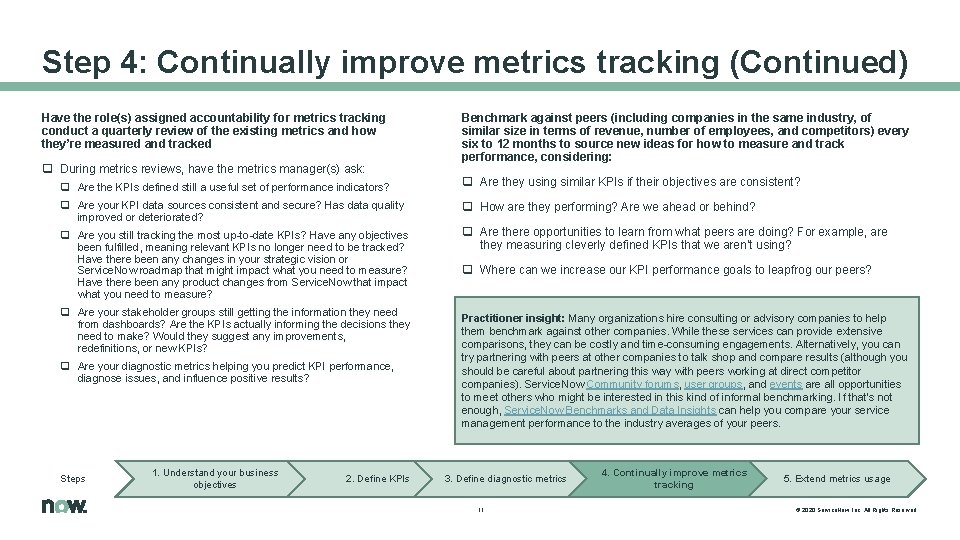
Step 4: Continually improve metrics tracking (Continued) Have the role(s) assigned accountability for metrics tracking conduct a quarterly review of the existing metrics and how they’re measured and tracked q During metrics reviews, have the metrics manager(s) ask: Benchmark against peers (including companies in the same industry, of similar size in terms of revenue, number of employees, and competitors) every six to 12 months to source new ideas for how to measure and track performance, considering: q Are the KPIs defined still a useful set of performance indicators? q Are they using similar KPIs if their objectives are consistent? q Are your KPI data sources consistent and secure? Has data quality improved or deteriorated? q How are they performing? Are we ahead or behind? q Are you still tracking the most up-to-date KPIs? Have any objectives been fulfilled, meaning relevant KPIs no longer need to be tracked? Have there been any changes in your strategic vision or Service. Now roadmap that might impact what you need to measure? Have there been any product changes from Service. Now that impact what you need to measure? q Are there opportunities to learn from what peers are doing? For example, are they measuring cleverly defined KPIs that we aren’t using? q Are your stakeholder groups still getting the information they need from dashboards? Are the KPIs actually informing the decisions they need to make? Would they suggest any improvements, redefinitions, or new KPIs? q Are your diagnostic metrics helping you predict KPI performance, diagnose issues, and influence positive results? Steps 1. Understand your business objectives 2. Define KPIs q Where can we increase our KPI performance goals to leapfrog our peers? Practitioner insight: Many organizations hire consulting or advisory companies to help them benchmark against other companies. While these services can provide extensive comparisons, they can be costly and time-consuming engagements. Alternatively, you can try partnering with peers at other companies to talk shop and compare results (although you should be careful about partnering this way with peers working at direct competitor companies). Service. Now Community forums, user groups, and events are all opportunities to meet others who might be interested in this kind of informal benchmarking. If that’s not enough, Service. Now Benchmarks and Data Insights can help you compare your service management performance to the industry averages of your peers. 1. Understand 3. Define diagnostic metrics Steps business objectives 11 3. Define 4. Continually 5. Extend 4. Continually improve metrics 2. Define diagnostic improve metrics 5. Extend metrics usage metrics KPIs tracking metrics tracking usage © 2020 Service. Now, Inc. All Rights Reserved.
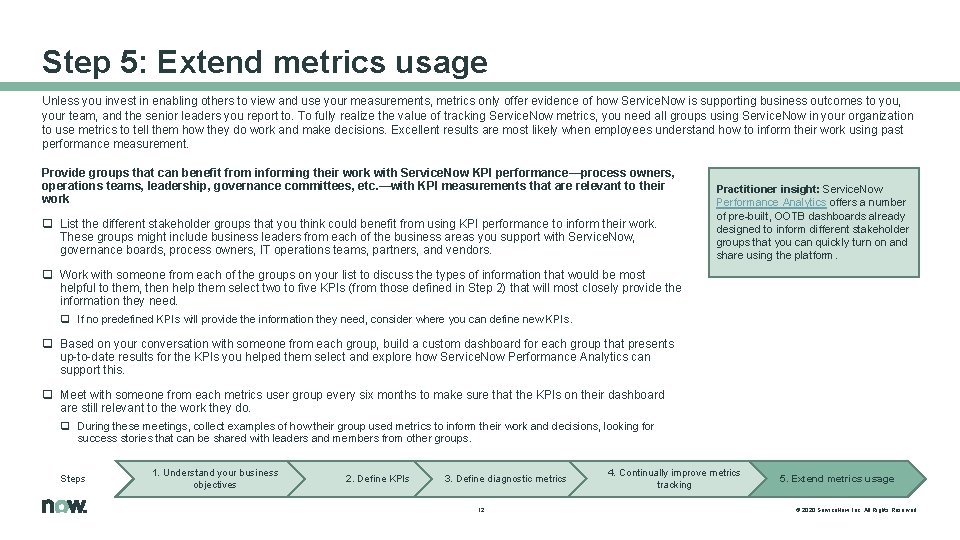
Step 5: Extend metrics usage Unless you invest in enabling others to view and use your measurements, metrics only offer evidence of how Service. Now is supporting business outcomes to you, your team, and the senior leaders you report to. To fully realize the value of tracking Service. Now metrics, you need all groups using Service. Now in your organization to use metrics to tell them how they do work and make decisions. Excellent results are most likely when employees understand how to inform their work using past performance measurement. Provide groups that can benefit from informing their work with Service. Now KPI performance—process owners, operations teams, leadership, governance committees, etc. —with KPI measurements that are relevant to their work q List the different stakeholder groups that you think could benefit from using KPI performance to inform their work. These groups might include business leaders from each of the business areas you support with Service. Now, governance boards, process owners, IT operations teams, partners, and vendors. Practitioner insight: Service. Now Performance Analytics offers a number of pre-built, OOTB dashboards already designed to inform different stakeholder groups that you can quickly turn on and share using the platform. q Work with someone from each of the groups on your list to discuss the types of information that would be most helpful to them, then help them select two to five KPIs (from those defined in Step 2) that will most closely provide the information they need. q If no predefined KPIs will provide the information they need, consider where you can define new KPIs. q Based on your conversation with someone from each group, build a custom dashboard for each group that presents up-to-date results for the KPIs you helped them select and explore how Service. Now Performance Analytics can support this. q Meet with someone from each metrics user group every six months to make sure that the KPIs on their dashboard are still relevant to the work they do. q During these meetings, collect examples of how their group used metrics to inform their work and decisions, looking for success stories that can be shared with leaders and members from other groups. Steps 1. Understand your business objectives 2. Define KPIs 1. Understand 3. Define diagnostic metrics Steps business objectives 12 3. Define 2. Define 4. Continually improve metrics diagnostic KPIs tracking metrics 4. Continually 5. Extend improve metrics 5. Extend metrics usage metrics tracking usage © 2020 Service. Now, Inc. All Rights Reserved.
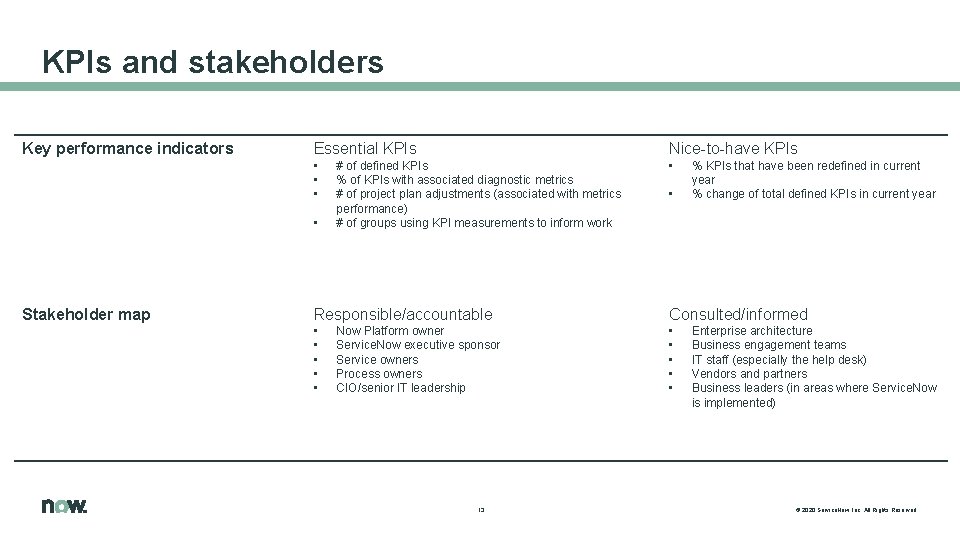
KPIs and stakeholders Key performance indicators Essential KPIs Nice-to-have KPIs • • • Stakeholder map # of defined KPIs % of KPIs with associated diagnostic metrics # of project plan adjustments (associated with metrics performance) # of groups using KPI measurements to inform work • % KPIs that have been redefined in current year % change of total defined KPIs in current year Responsible/accountable Consulted/informed • • • Now Platform owner Service. Now executive sponsor Service owners Process owners CIO/senior IT leadership 13 Enterprise architecture Business engagement teams IT staff (especially the help desk) Vendors and partners Business leaders (in areas where Service. Now is implemented) © 2020 Service. Now, Inc. All Rights Reserved.

Appendix 14 © 2020 Service. Now, Inc. All Rights Reserved.
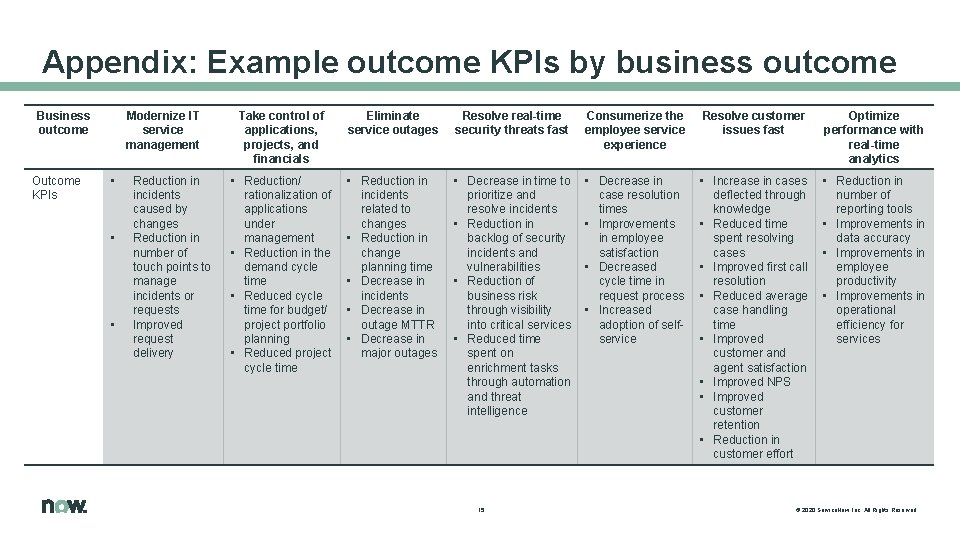
Appendix: Example outcome KPIs by business outcome Business outcome Outcome KPIs Modernize IT service management • • • Reduction in incidents caused by changes Reduction in number of touch points to manage incidents or requests Improved request delivery Take control of applications, projects, and financials Eliminate service outages Resolve real-time security threats fast Consumerize the employee service experience Resolve customer issues fast Optimize performance with real-time analytics • Reduction/ rationalization of applications under management • Reduction in the demand cycle time • Reduced cycle time for budget/ project portfolio planning • Reduced project cycle time • Reduction in incidents related to changes • Reduction in change planning time • Decrease in incidents • Decrease in outage MTTR • Decrease in major outages • Decrease in time to prioritize and resolve incidents • Reduction in backlog of security incidents and vulnerabilities • Reduction of business risk through visibility into critical services • Reduced time spent on enrichment tasks through automation and threat intelligence • Decrease in case resolution times • Improvements in employee satisfaction • Decreased cycle time in request process • Increased adoption of selfservice • Increase in cases deflected through knowledge • Reduced time spent resolving cases • Improved first call resolution • Reduced average case handling time • Improved customer and agent satisfaction • Improved NPS • Improved customer retention • Reduction in customer effort • Reduction in number of reporting tools • Improvements in data accuracy • Improvements in employee productivity • Improvements in operational efficiency for services 15 © 2020 Service. Now, Inc. All Rights Reserved.
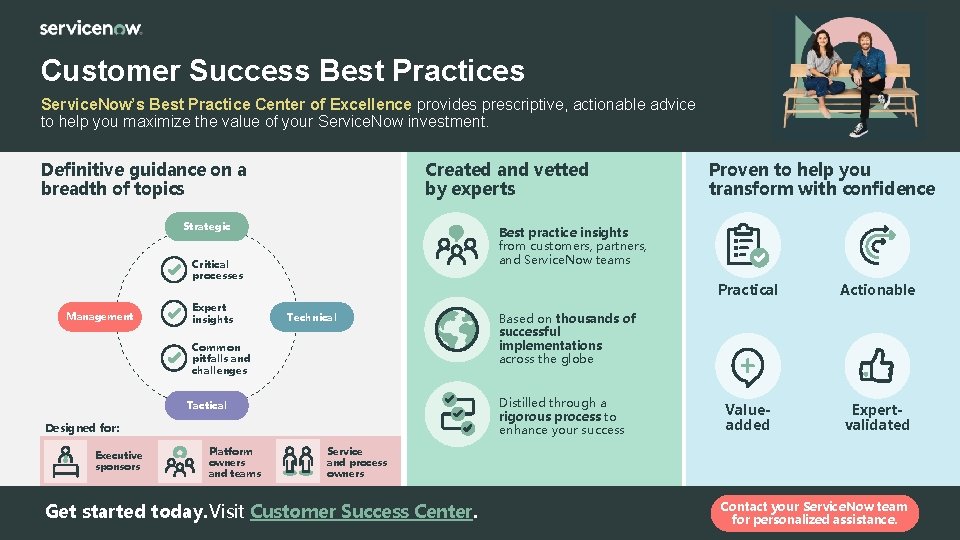
Customer Success Best Practices Service. Now’s Best Practice Center of Excellence provides prescriptive, actionable advice to help you maximize the value of your Service. Now investment. Definitive guidance on a breadth of topics Created and vetted by experts Strategic Best practice insights from customers, partners, and Service. Now teams Critical processes Management Expert insights Distilled through a rigorous process to enhance your success Tactical Designed for: Platform owners and teams Practical Actionable Valueadded Expertvalidated Based on thousands of successful implementations across the globe Technical Common pitfalls and challenges Executive sponsors Proven to help you transform with confidence Service and process owners Get started today. Visit Customer Success Center. 16 Contact your Service. Now team for personalized assistance. © 2020 Service. Now, Inc. All Rights Reserved.
- Slides: 16