
Baseband LTE Compression Jinseok Choi and Brian L
Baseband LTE Compression Jinseok Choi and Brian L. Evans Wireless Networking & Communication Group The University of Texas as Austin Collaboration with Robert W. Heath, Jr. , and Jeonghun Park 1
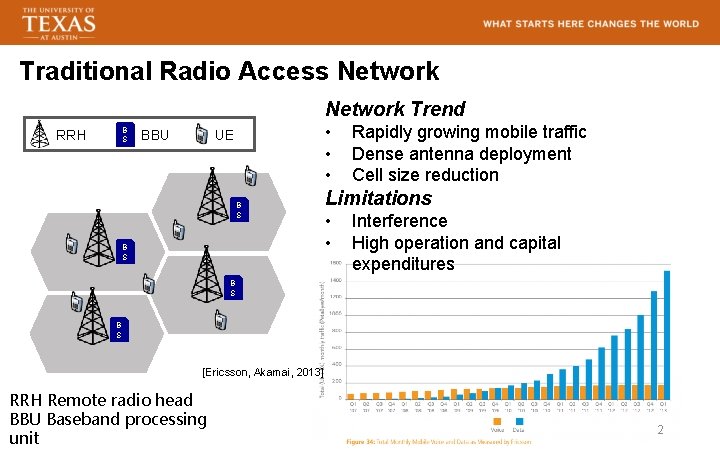
Traditional Radio Access Network Trend B S RRH BBU • • • UE B S Rapidly growing mobile traffic Dense antenna deployment Cell size reduction Limitations • • Interference High operation and capital expenditures B S [Ericsson, Akamai, 2013] RRH Remote radio head BBU Baseband processing unit 2
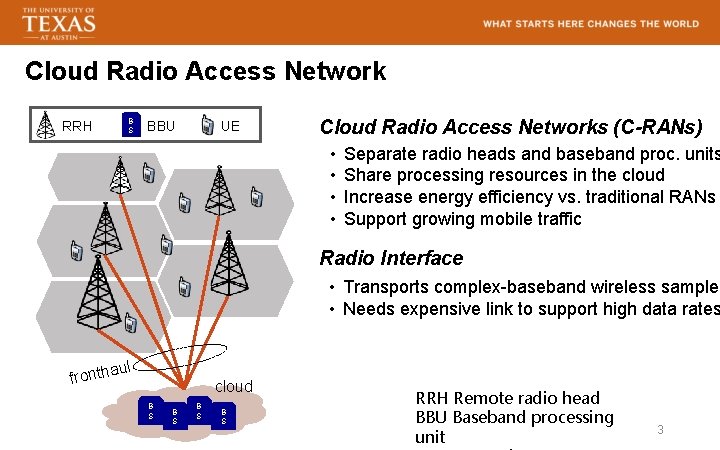
Cloud Radio Access Network RRH B S BBU UE Cloud Radio Access Networks (C-RANs) • • Separate radio heads and baseband proc. units Share processing resources in the cloud Increase energy efficiency vs. traditional RANs Support growing mobile traffic Radio Interface • Transports complex-baseband wireless samples • Needs expensive link to support high data rates fronth aul cloud B S B S RRH Remote radio head BBU Baseband processing unit 3
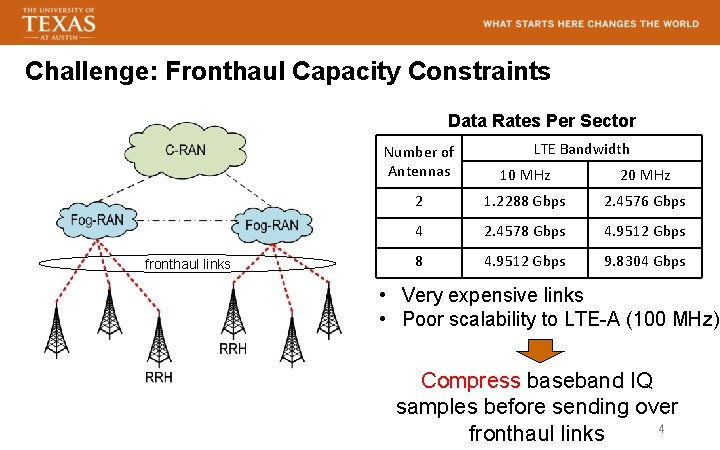
Challenge: Fronthaul Capacity Constraints Data Rates Per Sector fronthaul links LTE Bandwidth Number of Antennas 10 MHz 2 1. 2288 Gbps 2. 4576 Gbps 4 2. 4578 Gbps 4. 9512 Gbps 8 4. 9512 Gbps 9. 8304 Gbps • Very expensive links • Poor scalability to LTE-A (100 MHz) Compress baseband IQ samples before sending over 4 fronthaul links
![Solution 1: Time-Domain Lloyd-Max quantization Compression [Nieman & Evans, 2013] MMSE quantization for Gaussian](http://slidetodoc.com/presentation_image_h/77fc23895fa03bcbe17b3c0cd367c061/image-5.jpg "Solution 1: Time-Domain Lloyd-Max quantization Compression [Nieman & Evans, 2013] MMSE quantization for Gaussian")
Solution 1: Time-Domain Lloyd-Max quantization Compression [Nieman & Evans, 2013] MMSE quantization for Gaussian signals Noise shaping filter th 5 -order IIR Chebychev Type II filter that pushes noise power to the guard band W antennas *Operations in uplink are reciprocal Lloyd-Max Quantization • Minimizes MSE for a probability density function • Derives quantization levels in closed-form Noise Shaping • Shapes quantization noise to guard band • Increases SQNR Noise Shaping Effect 5
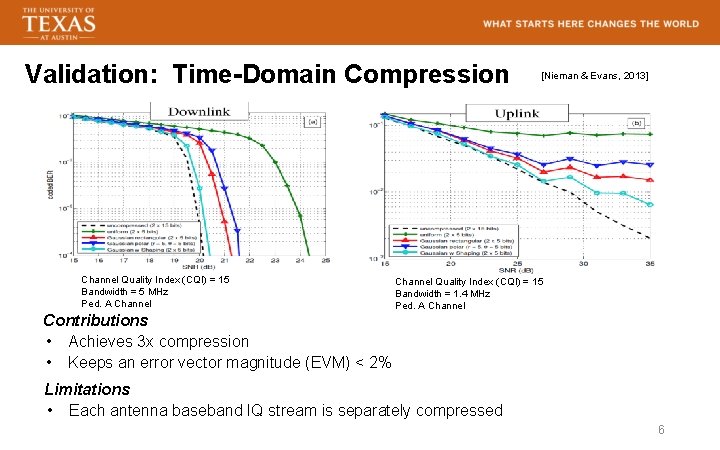
Validation: Time-Domain Compression Channel Quality Index (CQI) = 15 Bandwidth = 5 MHz Ped. A Channel [Nieman & Evans, 2013] Channel Quality Index (CQI) = 15 Bandwidth = 1. 4 MHz Ped. A Channel Contributions • Achieves 3 x compression • Keeps an error vector magnitude (EVM) < 2% Limitations • Each antenna baseband IQ stream is separately compressed 6
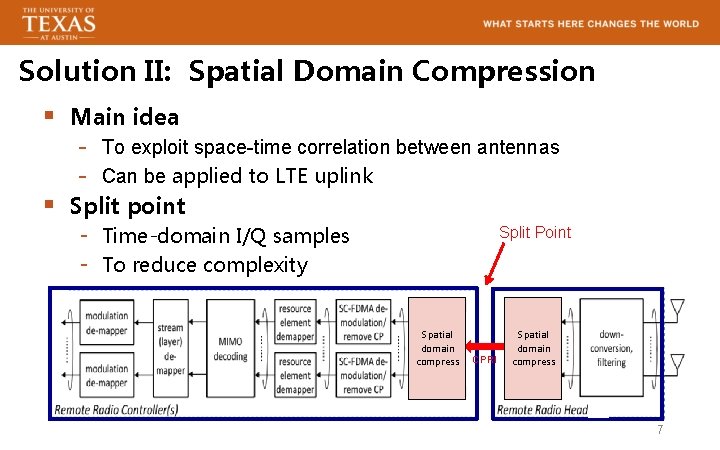
Solution II: Spatial Domain Compression § Main idea - To exploit space-time correlation between antennas - Can be applied to LTE uplink § Split point - Time-domain I/Q samples - To reduce complexity Split Point Spatial domain compress CPRI Spatial domain compress 7
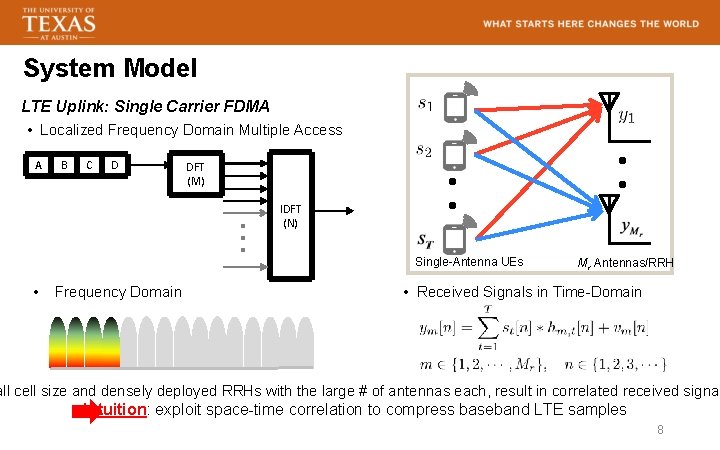
System Model LTE Uplink: Single Carrier FDMA • Localized Frequency Domain Multiple Access A B C D DFT (M) IDFT (N) Single-Antenna UEs • Frequency Domain Mr Antennas/RRH • Received Signals in Time-Domain all cell size and densely deployed RRHs with the large # of antennas each, result in correlated received signal Intuition: exploit space-time correlation to compress baseband LTE samples 8

Solution II: Spatial Domain Compression Remote Radio Equipment (a) A F E Base Station Processor Compression Block PCA Dimensio n Reductio n (b) Adaptive Quantization PHY Proces s Dequantizatio n + PCA Link PHY Proces s Decompression Joint Symbol Detectio n (a) = x Principal Component Analysis (PCA) • Forms received signal matrix of OFDM samples • V is an eigenvector matrix • Original received signal matrix • T is a de-correlated matrix • Achieves low-rank approximation by keeping • Low-rank approximation for data only major principal components matrix 9
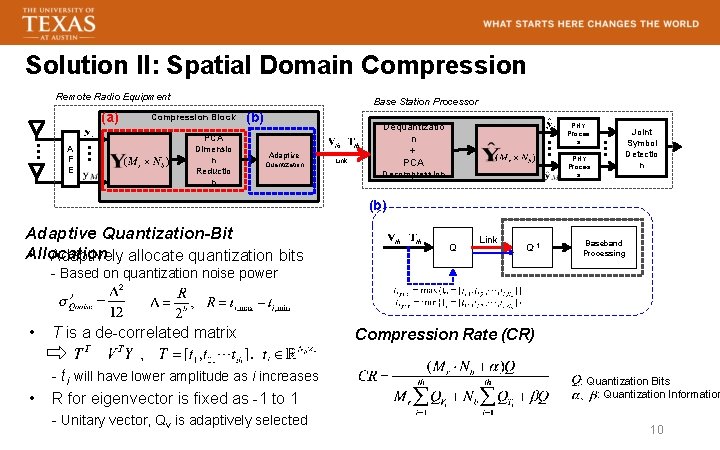
Solution II: Spatial Domain Compression Remote Radio Equipment (a) A F E Base Station Processor Compression Block PCA Dimensio n Reductio n (b) Adaptive Quantization Link PHY Proces s Dequantizatio n + PCA PHY Proces s Decompression Joint Symbol Detectio n (b) Adaptive Quantization-Bit Allocation • Adaptively allocate quantization bits Q Link Q-1 Baseband Processing - Based on quantization noise power • T is a de-correlated matrix • - ti will have lower amplitude as i increases R for eigenvector is fixed as -1 to 1 - Unitary vector, Qv is adaptively selected Compression Rate (CR) : Quantization Bits : Quantization Information 10
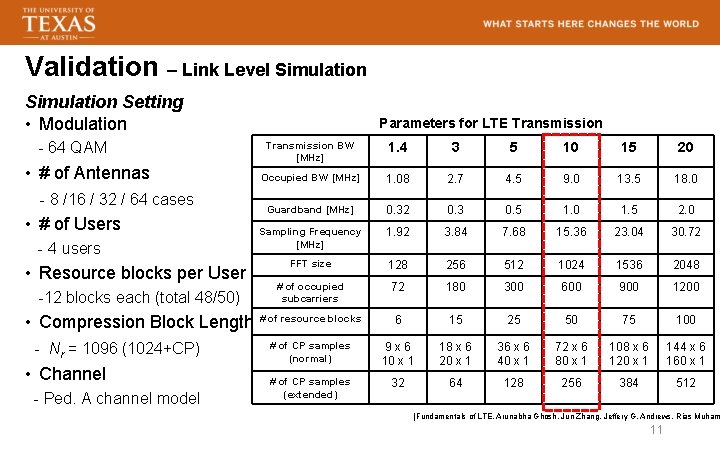
Validation – Link Level Simulation Setting • Modulation - 64 QAM Parameters for LTE Transmission BW [MHz] 1. 4 3 5 10 15 20 Occupied BW [MHz] 1. 08 2. 7 4. 5 9. 0 13. 5 18. 0 Guardband [MHz] 0. 32 0. 3 0. 5 1. 0 1. 5 2. 0 Sampling Frequency [MHz] 1. 92 3. 84 7. 68 15. 36 23. 04 30. 72 FFT size 128 256 512 1024 1536 2048 -12 blocks each (total 48/50) # of occupied subcarriers 72 180 300 600 900 1200 • Compression Block Length # of resource blocks 6 15 25 50 75 100 # of CP samples (normal) 9 x 6 10 x 1 18 x 6 20 x 1 36 x 6 40 x 1 72 x 6 80 x 1 108 x 6 120 x 1 144 x 6 160 x 1 # of CP samples (extended) 32 64 128 256 384 512 • # of Antennas - 8 /16 / 32 / 64 cases • # of Users - 4 users • Resource blocks per User - Nr = 1096 (1024+CP) • Channel - Ped. A channel model [Fundamentals of LTE, Arunabha Ghosh, Jun Zhang, Jeffery G. Andrews, Rias Muham 11
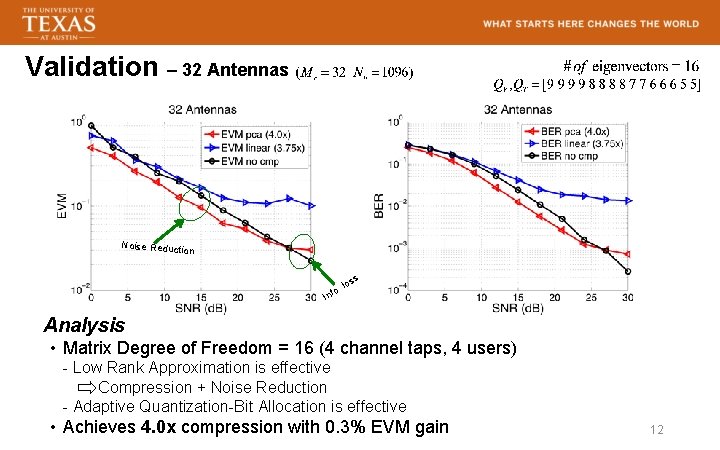
Validation – 32 Antennas Noise Reduc tion . nfo s los I Analysis • Matrix Degree of Freedom = 16 (4 channel taps, 4 users) - Low Rank Approximation is effective Compression + Noise Reduction - Adaptive Quantization-Bit Allocation is effective • Achieves 4. 0 x compression with 0. 3% EVM gain 12
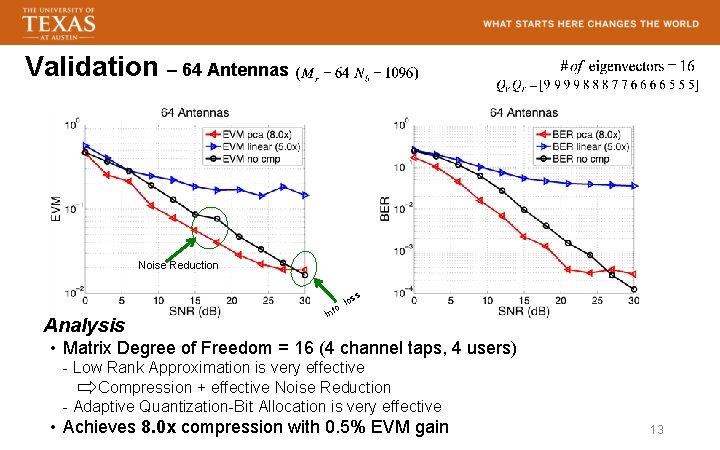
Validation – 64 Antennas Noise Reduction ss Analysis lo fo. In • Matrix Degree of Freedom = 16 (4 channel taps, 4 users) - Low Rank Approximation is very effective Compression + effective Noise Reduction - Adaptive Quantization-Bit Allocation is very effective • Achieves 8. 0 x compression with 0. 5% EVM gain 13
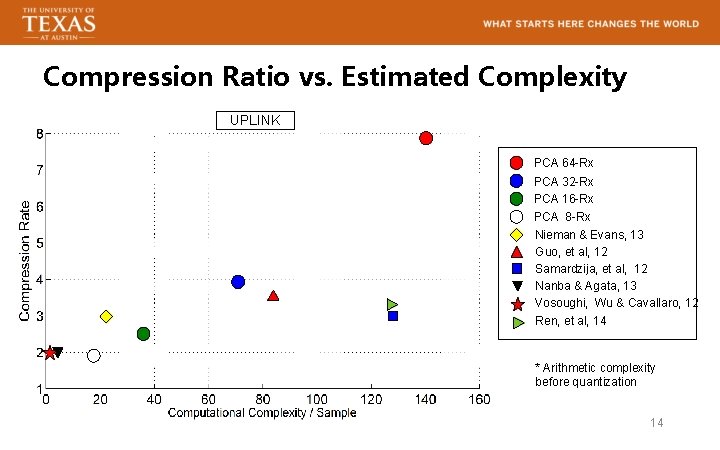
Compression Ratio vs. Estimated Complexity UPLINK PCA 64 -Rx PCA 32 -Rx PCA 16 -Rx PCA 8 -Rx Nieman & Evans, 13 Guo, et al, 12 Samardzija, et al, 12 Nanba & Agata, 13 Vosoughi, Wu & Cavallaro, 12 Ren, et al, 14 * Arithmetic complexity before quantization 14
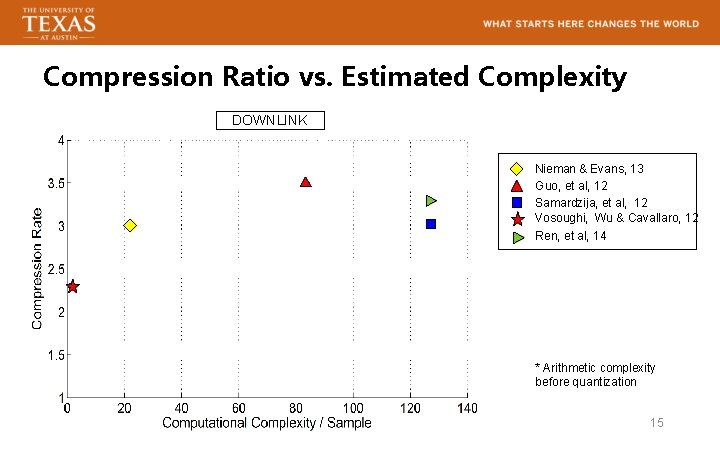
Compression Ratio vs. Estimated Complexity DOWNLINK Nieman & Evans, 13 Guo, et al, 12 Samardzija, et al, 12 Vosoughi, Wu & Cavallaro, 12 Ren, et al, 14 * Arithmetic complexity before quantization 15
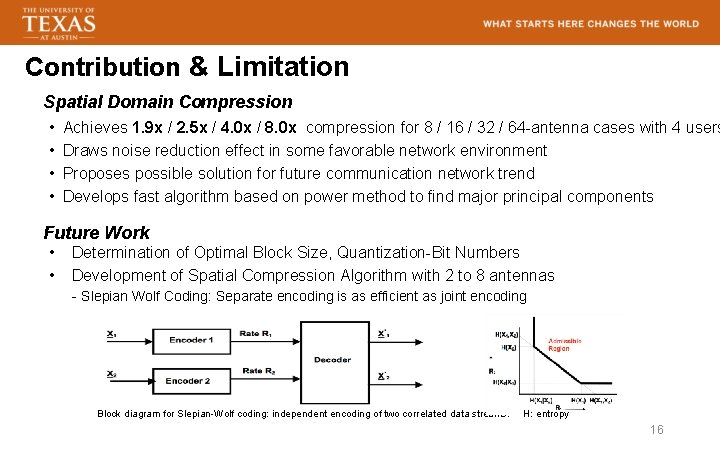
Contribution & Limitation Spatial Domain Compression • • Achieves 1. 9 x / 2. 5 x / 4. 0 x / 8. 0 x compression for 8 / 16 / 32 / 64 -antenna cases with 4 users Draws noise reduction effect in some favorable network environment Proposes possible solution for future communication network trend Develops fast algorithm based on power method to find major principal components Future Work • • Determination of Optimal Block Size, Quantization-Bit Numbers Development of Spatial Compression Algorithm with 2 to 8 antennas - Slepian Wolf Coding: Separate encoding is as efficient as joint encoding Block diagram for Slepian-Wolf coding: independent encoding of two correlated data streams. H: entropy 16

Thank you 18
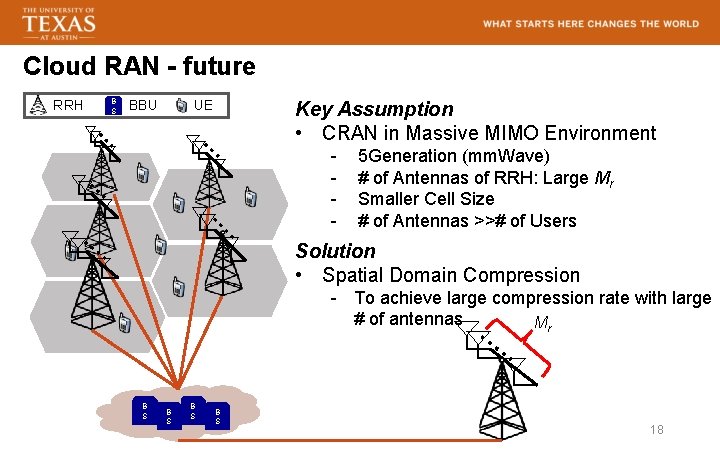
Cloud RAN - future RRH B S BBU UE Key Assumption • CRAN in Massive MIMO Environment - 5 Generation (mm. Wave) # of Antennas of RRH: Large Mr Smaller Cell Size # of Antennas >># of Users Solution • Spatial Domain Compression - To achieve large compression rate with large # of antennas Mr B S B S 18
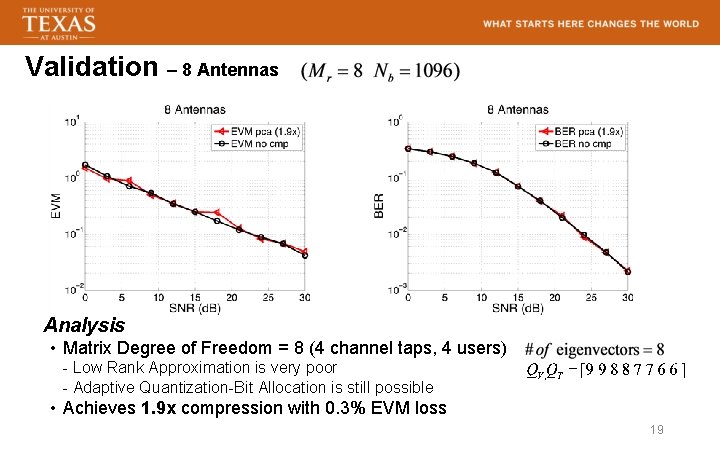
Validation – 8 Antennas Analysis • Matrix Degree of Freedom = 8 (4 channel taps, 4 users) - Low Rank Approximation is very poor - Adaptive Quantization-Bit Allocation is still possible • Achieves 1. 9 x compression with 0. 3% EVM loss 19
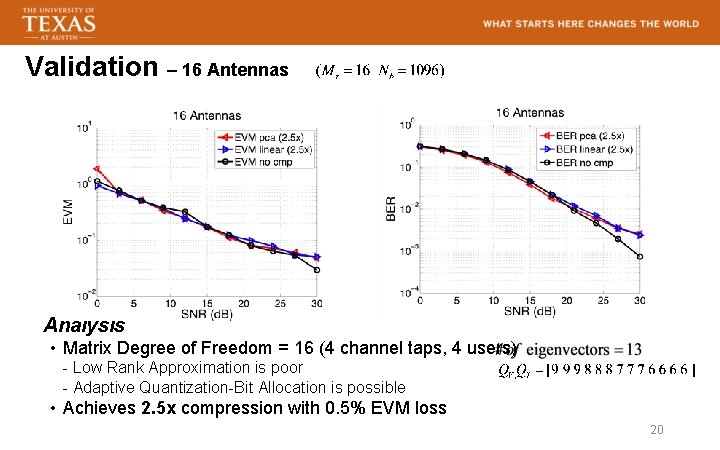
Validation – 16 Antennas Analysis • Matrix Degree of Freedom = 16 (4 channel taps, 4 users) - Low Rank Approximation is poor - Adaptive Quantization-Bit Allocation is possible • Achieves 2. 5 x compression with 0. 5% EVM loss 20
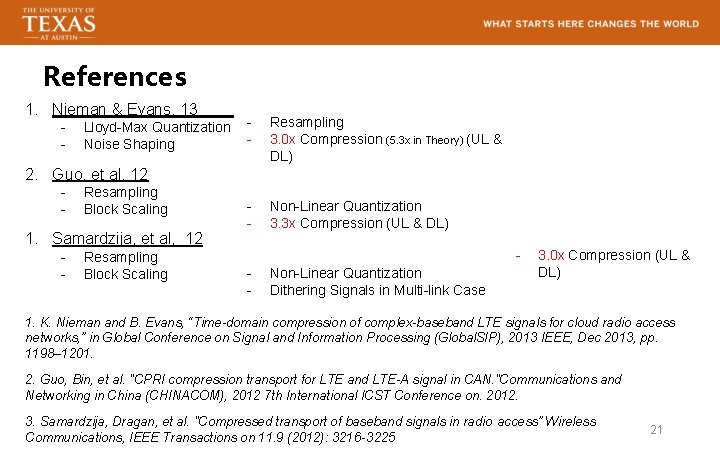
References 1. Nieman & Evans, 13 - Lloyd-Max Quantization Noise Shaping - Resampling 3. 0 x Compression (5. 3 x in Theory) (UL & DL) - Non-Linear Quantization 3. 3 x Compression (UL & DL) 2. Guo, et al, 12 - Resampling Block Scaling 1. Samardzija, et al, 12 - Resampling Block Scaling - Non-Linear Quantization Dithering Signals in Multi-link Case 3. 0 x Compression (UL & DL) 1. K. Nieman and B. Evans, “Time-domain compression of complex-baseband LTE signals for cloud radio access networks, ” in Global Conference on Signal and Information Processing (Global. SIP), 2013 IEEE, Dec 2013, pp. 1198– 1201. 2. Guo, Bin, et al. "CPRI compression transport for LTE and LTE-A signal in CAN. "Communications and Networking in China (CHINACOM), 2012 7 th International ICST Conference on. 2012. 3. Samardzija, Dragan, et al. "Compressed transport of baseband signals in radio access” Wireless Communications, IEEE Transactions on 11. 9 (2012): 3216 -3225 21
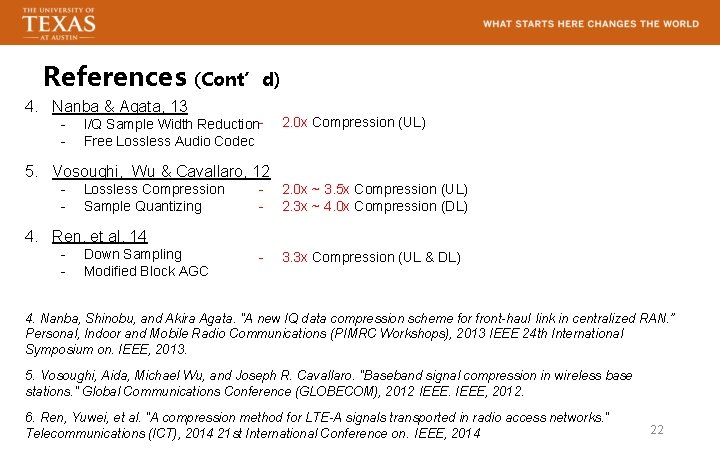
References (Cont’d) 4. Nanba & Agata, 13 - I/Q Sample Width Reduction. Free Lossless Audio Codec 2. 0 x Compression (UL) 5. Vosoughi, Wu & Cavallaro, 12 - Lossless Compression Sample Quantizing - 2. 0 x ~ 3. 5 x Compression (UL) 2. 3 x ~ 4. 0 x Compression (DL) - 3. 3 x Compression (UL & DL) 4. Ren, et al, 14 - Down Sampling Modified Block AGC 4. Nanba, Shinobu, and Akira Agata. "A new IQ data compression scheme for front-haul link in centralized RAN. ” Personal, Indoor and Mobile Radio Communications (PIMRC Workshops), 2013 IEEE 24 th International Symposium on. IEEE, 2013. 5. Vosoughi, Aida, Michael Wu, and Joseph R. Cavallaro. "Baseband signal compression in wireless base stations. " Global Communications Conference (GLOBECOM), 2012 IEEE, 2012. 6. Ren, Yuwei, et al. "A compression method for LTE-A signals transported in radio access networks. " Telecommunications (ICT), 2014 21 st International Conference on. IEEE, 2014 22
- Slides: 22