
Baseball 101 A Primer on the Physics of
Baseball 101: A Primer on the Physics of Baseball Alan M. Nathan Saturday Physics Honors Lecture October 21, 2000 l Introduction l When Ash Meets Cowhide l The Aerodynamics of Baseball l The Art of Pitching l Summary Baseball 101: A Primer on the Physics of Baseball Page 1
REFERENCES l The Physics of Baseball, Robert K. Adair (Harper Collins, New York, 1990), ISBN 0 -06 -096461 -8 l The Sporting Life, Davis and Stephens (Henry Holt and Company, New York, 1997), ISBN 0 -8050 -4540 -6 l http: //www. exploratorium. edu/sports l ME! » a-nathan@uiuc. edu » http: //www. npl. uiuc. edu/~a-nathan/pob Baseball 101: A Primer on the Physics of Baseball Page 2
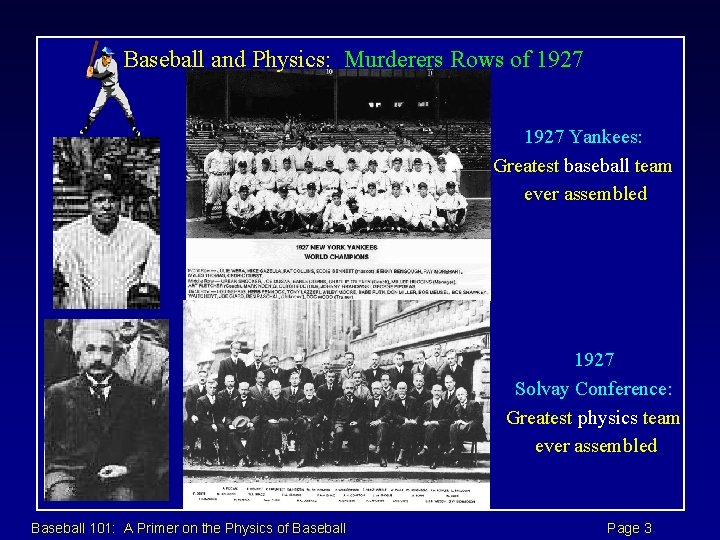
Baseball and Physics: Murderers Rows of 1927 Yankees: Greatest baseball team ever assembled 1927 Solvay Conference: Greatest physics team ever assembled Baseball 101: A Primer on the Physics of Baseball Page 3

Hitting the Baseball “. . . the most difficult thing to do in sports” --Ted Williams, Professor of Hitting BA: SA: OBP: HR: . 344. 634. 483 521 all time leader Baseball 101: A Primer on the Physics of Baseball #521, September 28, 1960 Page 4
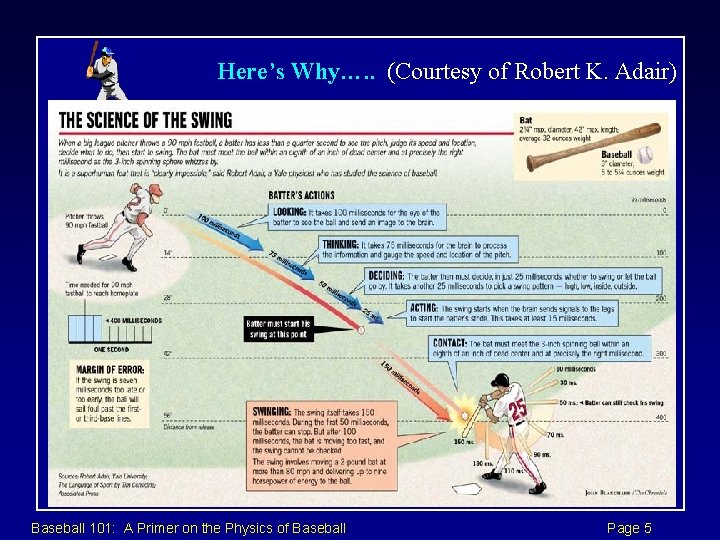
Here’s Why…. . (Courtesy of Robert K. Adair) Baseball 101: A Primer on the Physics of Baseball Page 5
Trivia Timeout l A) B) C) D) Rogers Hornsby is one of only two players to have won the Triple Crown twice. Who is the other player? Hank Aaron Mickey Mantle Carl Yastrzemski Ted Williams correct Baseball 101: A Primer on the Physics of Baseball Page 6
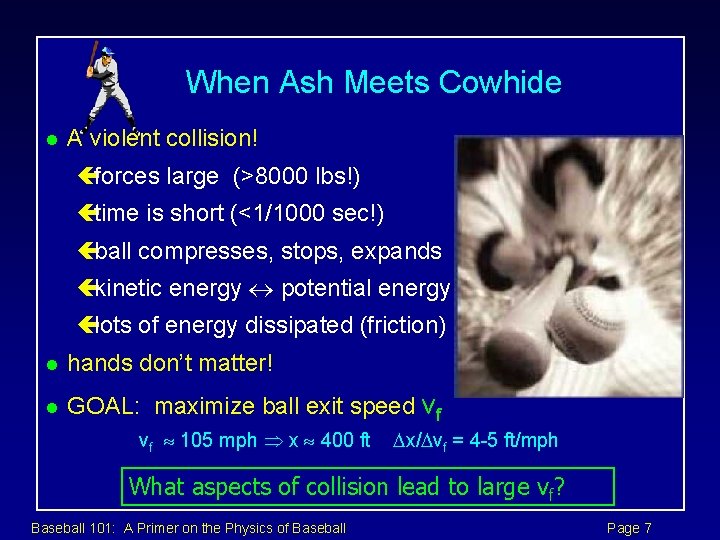
When Ash Meets Cowhide l A violent collision! çforces large (>8000 lbs!) çtime is short (<1/1000 sec!) çball compresses, stops, expands çkinetic energy potential energy çlots of energy dissipated (friction) l hands don’t matter! l GOAL: maximize ball exit speed vf vf 105 mph x 400 ft x/ vf = 4 -5 ft/mph What aspects of collision lead to large vf? Baseball 101: A Primer on the Physics of Baseball Page 7
Speed of Hit Ball: What does it depend on? l The basic stuff (“kinematics”) çspeed of pitched ball çspeed of bat çweight and weight distribution of bat l The really interesting stuff (“dynamics”) ç“bounciness” of ball çvibrations of bat Baseball 101: A Primer on the Physics of Baseball Page 8

What Determines Batted Ball Speed? l How does batted ball speed depend on. . . vf çpitched ball speed? çbat speed? = vball + (1+ ) vbat collision efficiency (property of ball/bat) For typical collision on fat part of bat, =0. 2 1+ = 1. 2 Conclusion: Bat Speed Matters Much More! Question: What properties of ball/bat determine ? Baseball 101: A Primer on the Physics of Baseball Page 9
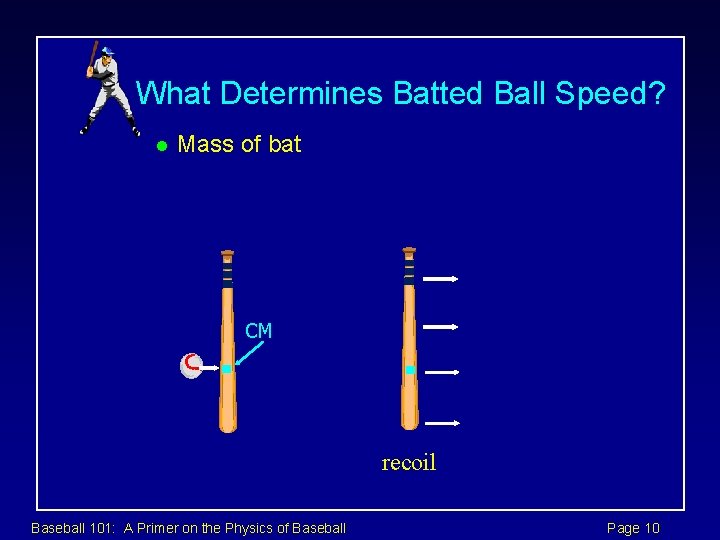
What Determines Batted Ball Speed? l Mass of bat CM . . recoil Baseball 101: A Primer on the Physics of Baseball Page 10
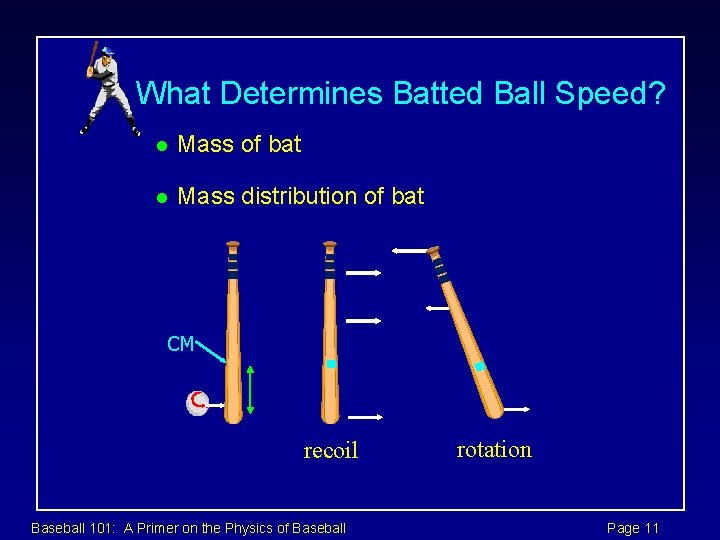
What Determines Batted Ball Speed? l Mass of bat l Mass distribution of bat recoil Baseball 101: A Primer on the Physics of Baseball . . CM rotation Page 11
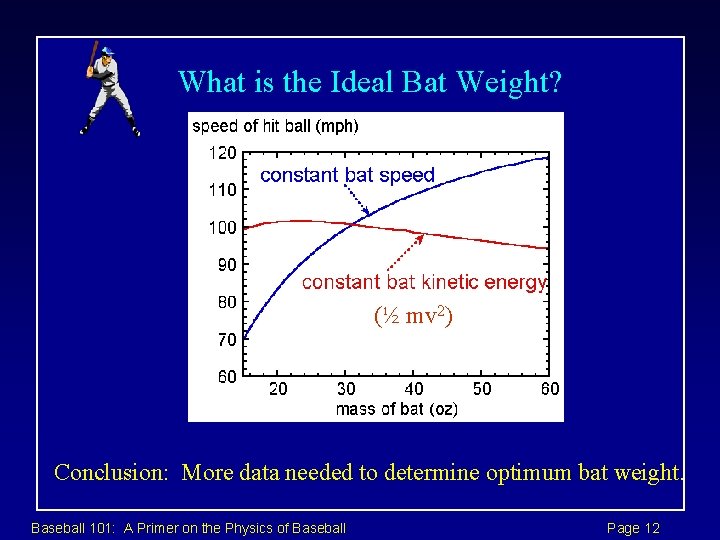
What is the Ideal Bat Weight? (½ mv 2) Conclusion: More data needed to determine optimum bat weight. Baseball 101: A Primer on the Physics of Baseball Page 12
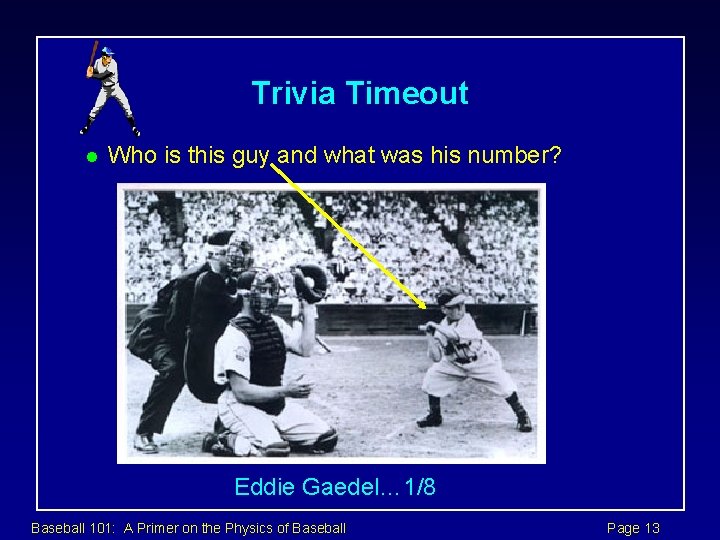
Trivia Timeout l Who is this guy and what was his number? Eddie Gaedel… 1/8 Baseball 101: A Primer on the Physics of Baseball Page 13
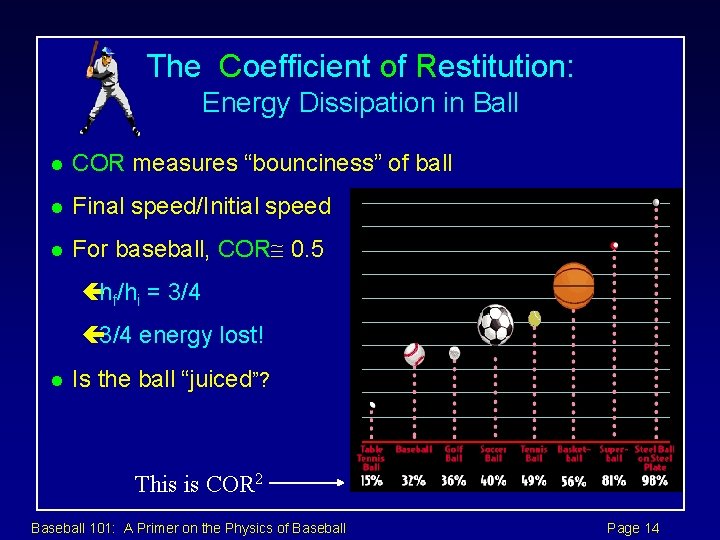
The Coefficient of Restitution: Energy Dissipation in Ball l COR measures “bounciness” of ball l Final speed/Initial speed l For baseball, COR 0. 5 çhf/hi = 3/4 ç 3/4 energy lost! l Is the ball “juiced”? This is COR 2 Baseball 101: A Primer on the Physics of Baseball Page 14
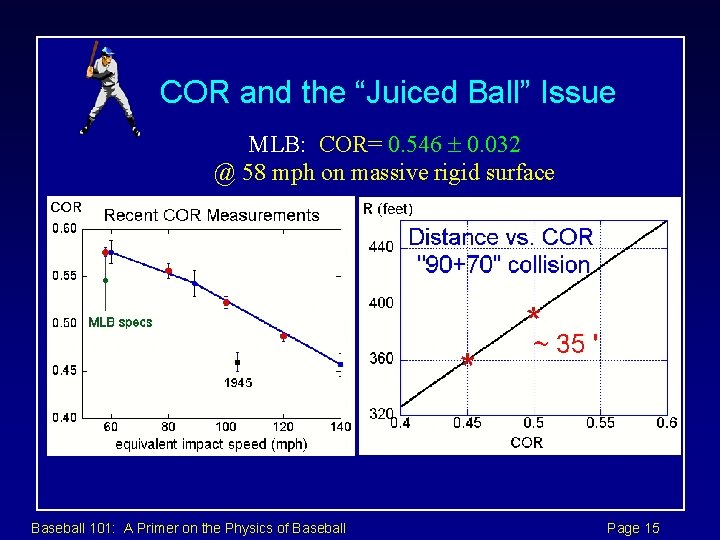
COR and the “Juiced Ball” Issue MLB: COR= 0. 546 0. 032 @ 58 mph on massive rigid surface Baseball 101: A Primer on the Physics of Baseball Page 15
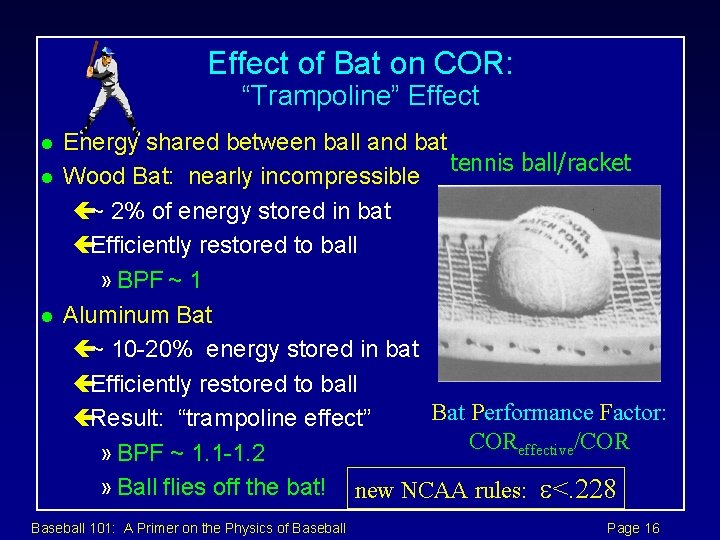
Effect of Bat on COR: “Trampoline” Effect l l l Energy shared between ball and bat tennis ball/racket Wood Bat: nearly incompressible ç~ 2% of energy stored in bat çEfficiently restored to ball » BPF ~ 1 Aluminum Bat ç~ 10 -20% energy stored in bat çEfficiently restored to ball Bat Performance Factor: çResult: “trampoline effect” COReffective/COR » BPF ~ 1. 1 -1. 2 » Ball flies off the bat! new NCAA rules: <. 228 Baseball 101: A Primer on the Physics of Baseball Page 16
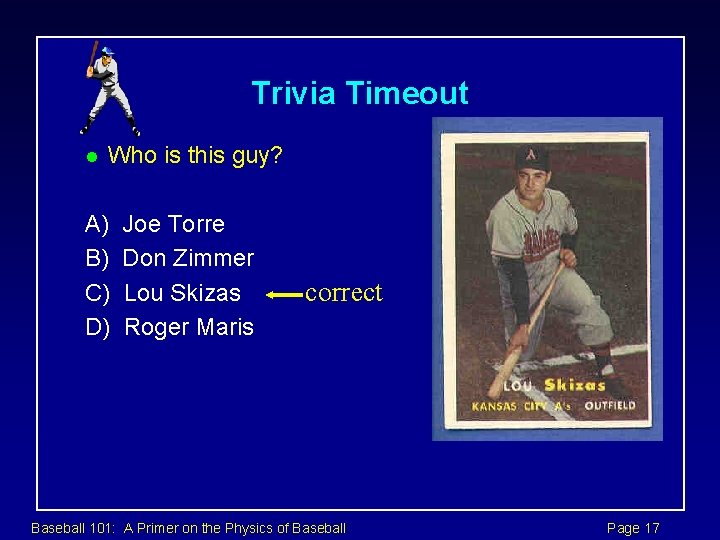
Trivia Timeout l Who is this guy? A) B) C) D) Joe Torre Don Zimmer Lou Skizas Roger Maris correct Baseball 101: A Primer on the Physics of Baseball Page 17
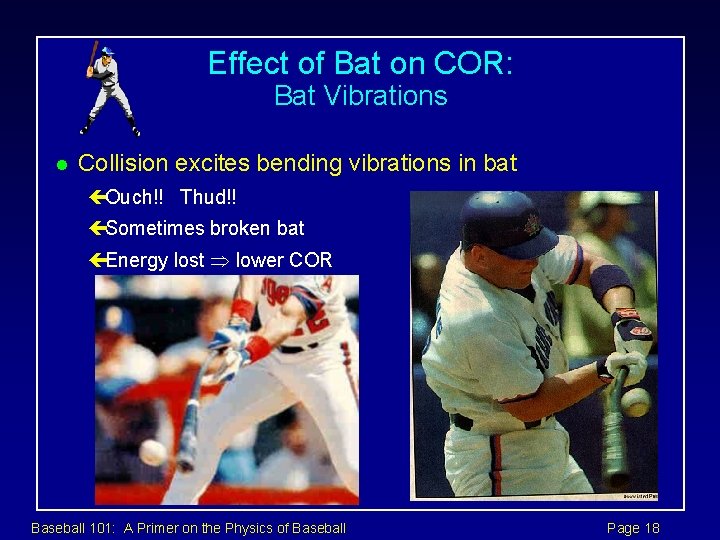
Effect of Bat on COR: Bat Vibrations l Collision excites bending vibrations in bat çOuch!! Thud!! çSometimes broken bat çEnergy lost lower COR Baseball 101: A Primer on the Physics of Baseball Page 18
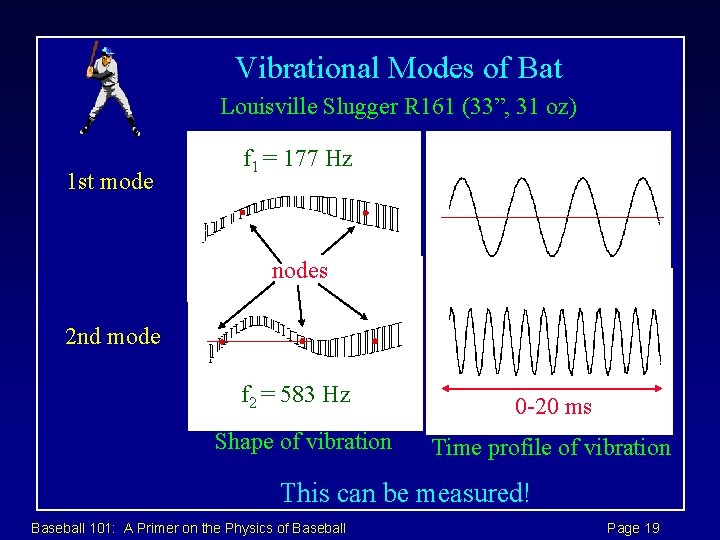
Vibrational Modes of Bat Louisville Slugger R 161 (33”, 31 oz) 1 st mode f 1 = 177 Hz nodes 2 nd mode f 2 = 583 Hz Shape of vibration 0 -20 ms Time profile of vibration This can be measured! Baseball 101: A Primer on the Physics of Baseball Page 19
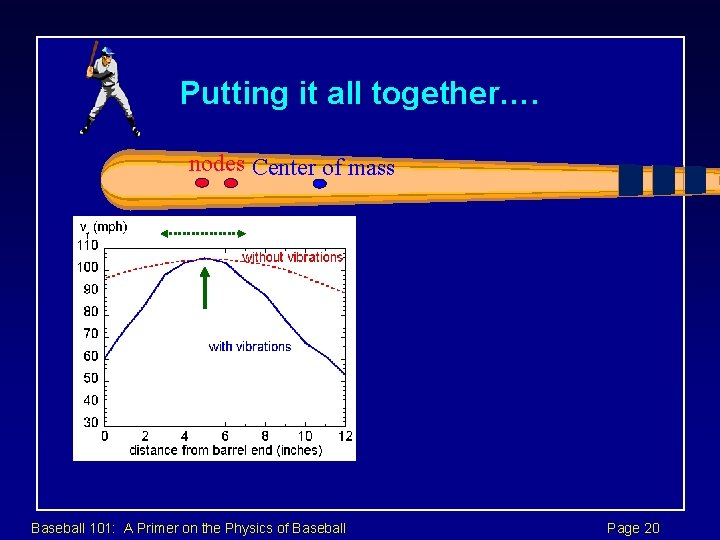
Putting it all together…. nodes Center of mass Baseball 101: A Primer on the Physics of Baseball Page 20
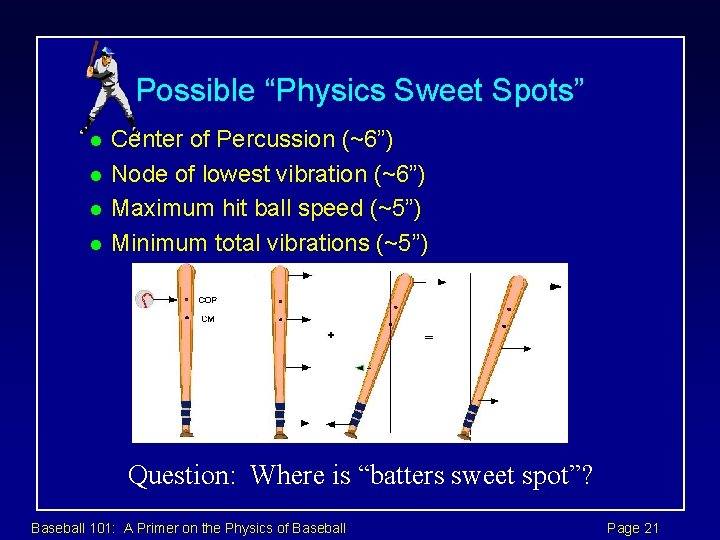
Possible “Physics Sweet Spots” l l Center of Percussion (~6”) Node of lowest vibration (~6”) Maximum hit ball speed (~5”) Minimum total vibrations (~5”) Question: Where is “batters sweet spot”? Baseball 101: A Primer on the Physics of Baseball Page 21
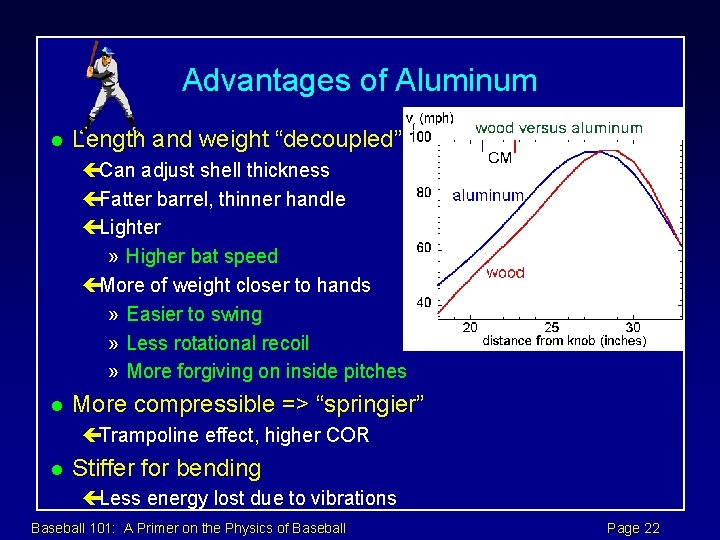
Advantages of Aluminum l Length and weight “decoupled” çCan adjust shell thickness çFatter barrel, thinner handle çLighter » Higher bat speed çMore of weight closer to hands » Easier to swing » Less rotational recoil » More forgiving on inside pitches l More compressible => “springier” çTrampoline effect, higher COR l Stiffer for bending çLess energy lost due to vibrations Baseball 101: A Primer on the Physics of Baseball Page 22
Trivia Timeout l A) B) C) D) Who is the only player to steal five bases in one game? Ricky Henderson Lou Brock Tony Gwynn Ty Cobb correct Baseball 101: A Primer on the Physics of Baseball Page 23
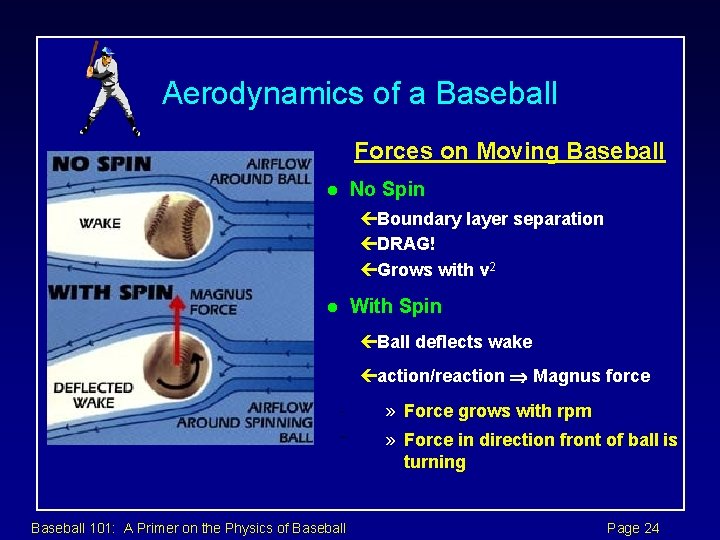
Aerodynamics of a Baseball Forces on Moving Baseball l No Spin çBoundary layer separation çDRAG! çGrows with v 2 l With Spin çBall deflects wake çaction/reaction Magnus force » Force grows with rpm » Force in direction front of ball is turning Baseball 101: A Primer on the Physics of Baseball Page 24
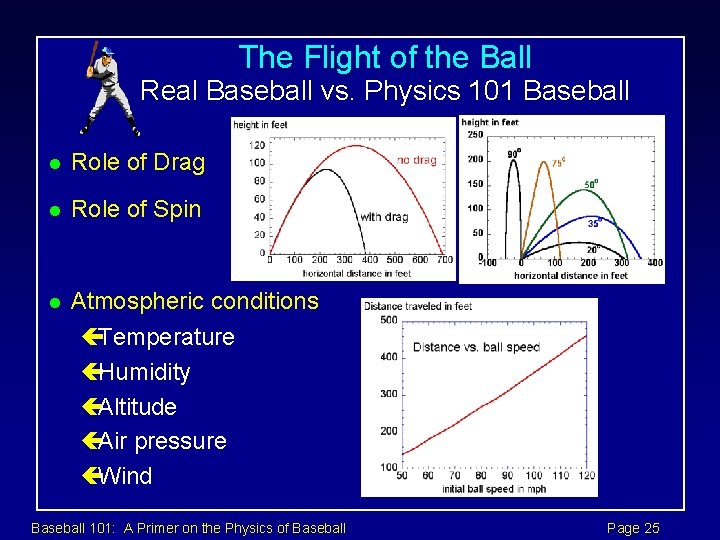
The Flight of the Ball Real Baseball vs. Physics 101 Baseball l Role of Drag l Role of Spin l Atmospheric conditions çTemperature çHumidity çAltitude çAir pressure çWind Baseball 101: A Primer on the Physics of Baseball Page 25
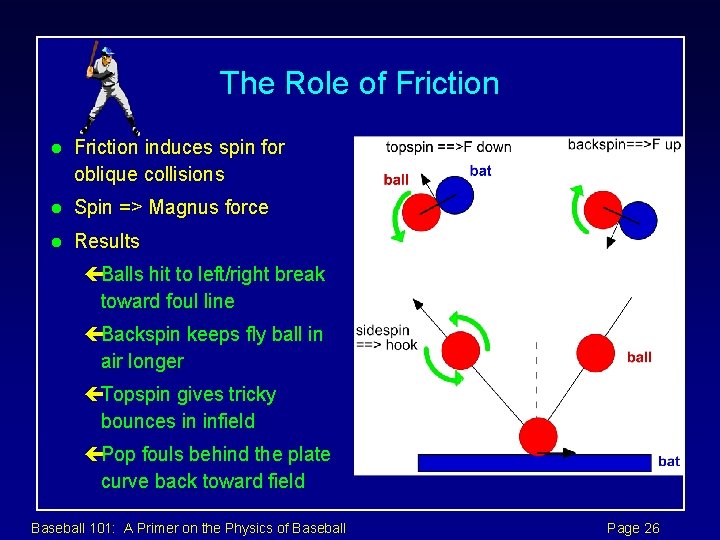
The Role of Friction l Friction induces spin for oblique collisions l Spin => Magnus force l Results çBalls hit to left/right break toward foul line çBackspin keeps fly ball in air longer çTopspin gives tricky bounces in infield çPop fouls behind the plate curve back toward field Baseball 101: A Primer on the Physics of Baseball Page 26
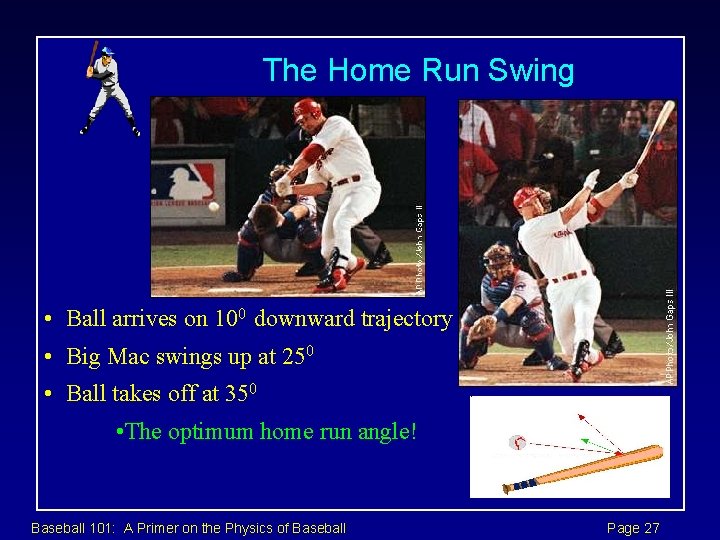
The Home Run Swing • Ball arrives on 100 downward trajectory • Big Mac swings up at 250 • Ball takes off at 350 • The optimum home run angle! Baseball 101: A Primer on the Physics of Baseball Page 27
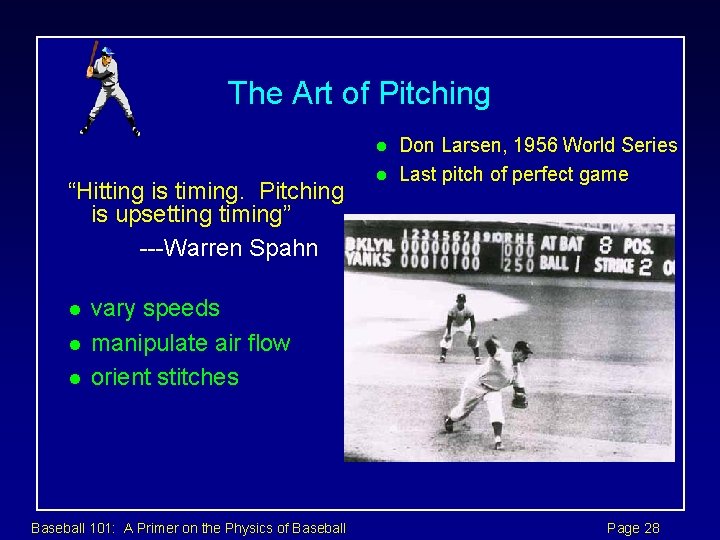
The Art of Pitching l “Hitting is timing. Pitching is upsetting timing” ---Warren Spahn l l Don Larsen, 1956 World Series Last pitch of perfect game vary speeds manipulate air flow orient stitches Baseball 101: A Primer on the Physics of Baseball Page 28
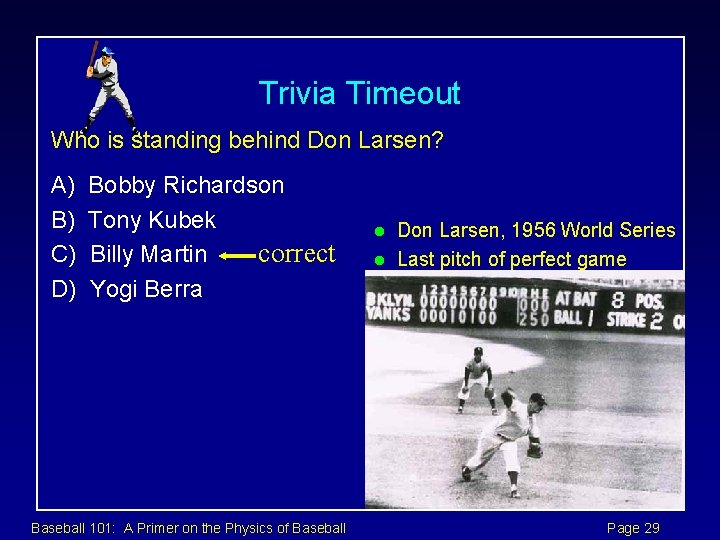
Trivia Timeout Who is standing behind Don Larsen? A) B) C) D) Bobby Richardson Tony Kubek correct Billy Martin Yogi Berra Baseball 101: A Primer on the Physics of Baseball l l Don Larsen, 1956 World Series Last pitch of perfect game Page 29
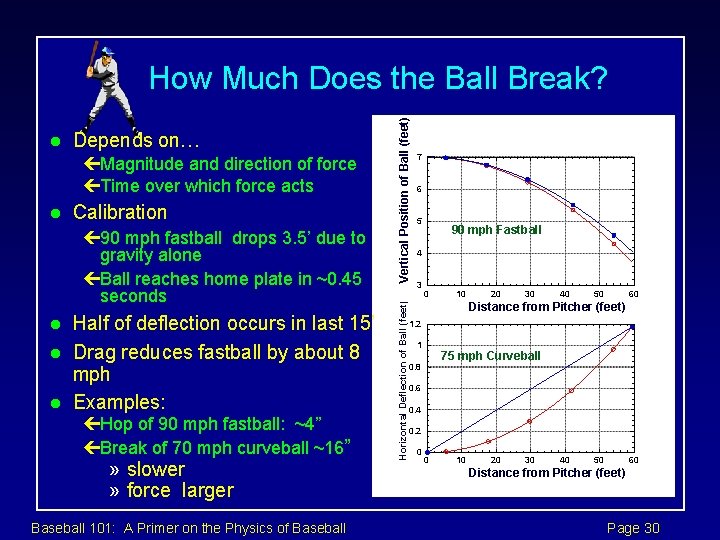
Depends on… çMagnitude and direction of force çTime over which force acts l Calibration ç 90 mph fastball drops 3. 5’ due to gravity alone çBall reaches home plate in ~0. 45 seconds l l l Half of deflection occurs in last 15’ Drag reduces fastball by about 8 mph Examples: çHop of 90 mph fastball: ~4” çBreak of 70 mph curveball ~16” » slower » force larger Baseball 101: A Primer on the Physics of Baseball Horizontal Deflection of Ball (feet) l Vertical Position of Ball (feet) How Much Does the Ball Break? 7 6 5 90 mph Fastball 4 3 0 10 20 30 40 50 60 Distance from Pitcher (feet) 1. 2 1 75 mph Curveball 0. 8 0. 6 0. 4 0. 2 0 0 10 20 30 40 50 60 Distance from Pitcher (feet) Page 30
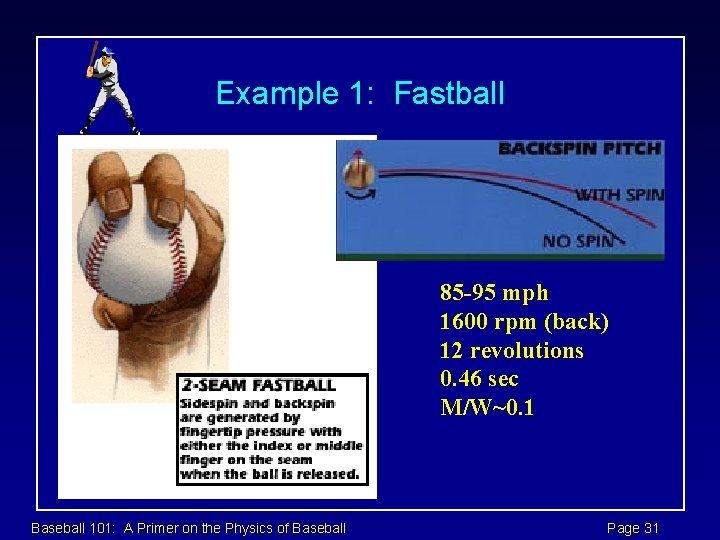
Example 1: Fastball 85 -95 mph 1600 rpm (back) 12 revolutions 0. 46 sec M/W~0. 1 Baseball 101: A Primer on the Physics of Baseball Page 31

Example 2: Split-Finger Fastball 85 -90 mph 1300 rpm (top) 12 revolutions 0. 46 sec M/W~0. 1 Baseball 101: A Primer on the Physics of Baseball Page 32
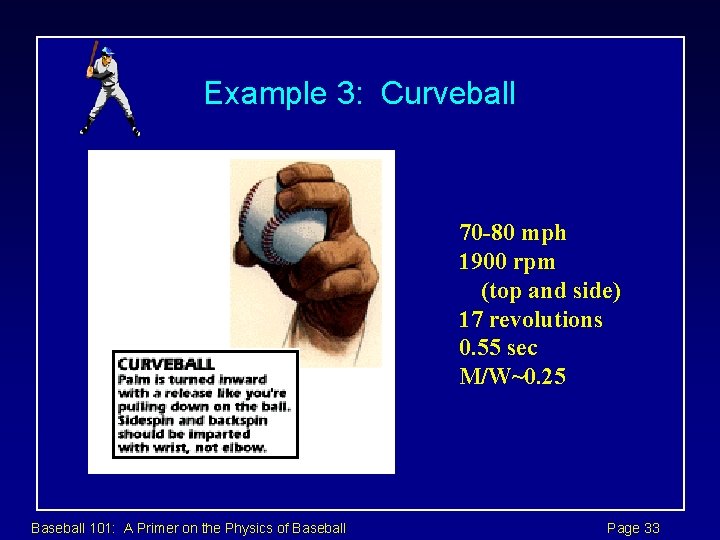
Example 3: Curveball 70 -80 mph 1900 rpm (top and side) 17 revolutions 0. 55 sec M/W~0. 25 Baseball 101: A Primer on the Physics of Baseball Page 33
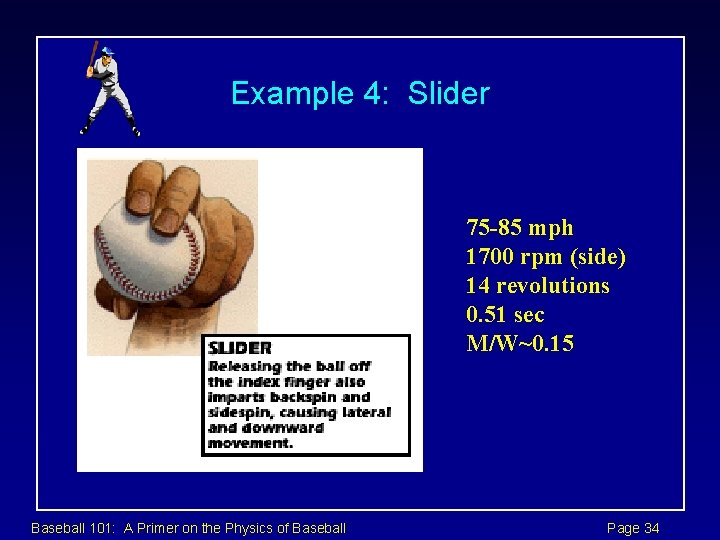
Example 4: Slider 75 -85 mph 1700 rpm (side) 14 revolutions 0. 51 sec M/W~0. 15 Baseball 101: A Primer on the Physics of Baseball Page 34
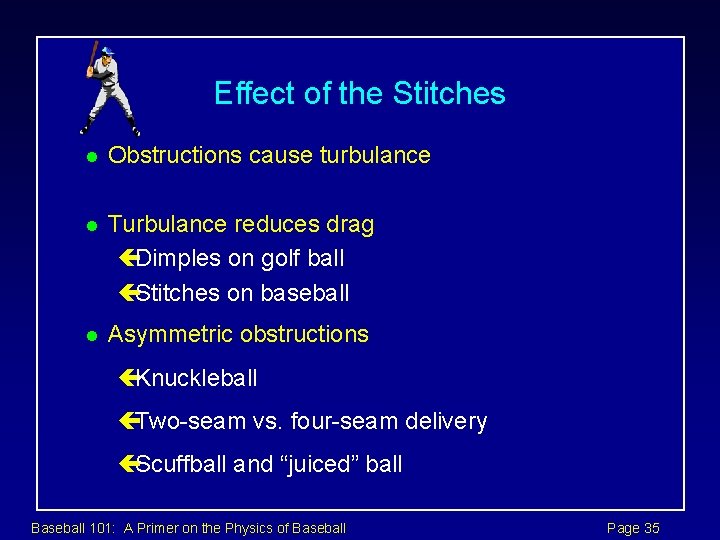
Effect of the Stitches l Obstructions cause turbulance l Turbulance reduces drag çDimples on golf ball çStitches on baseball l Asymmetric obstructions çKnuckleball çTwo-seam vs. four-seam delivery çScuffball and “juiced” ball Baseball 101: A Primer on the Physics of Baseball Page 35
Trivia Timeout Who said. . . l l "Baseball is 90% mental. The other half is physical. " "You can observe a lot by watching. " "If the people don’t want to come out to the park, nobody’s going to stop them. " "No one ever goes to that restaurant any more. It’s too crowded. " Baseball 101: A Primer on the Physics of Baseball Page 36
Summary l Much of baseball can be understood with basic principles of physics çConservation of momentum, angular momentum, energy çDynamics of collisions çTrajectories under influence of forces » gravity, drag, Magnus, …. l There is probably much more that we don’t understand l Don’t let either of these interfere with your enjoyment of the game! Baseball 101: A Primer on the Physics of Baseball Page 37
- Slides: 37