
Base Units of the SI System Quantity Base
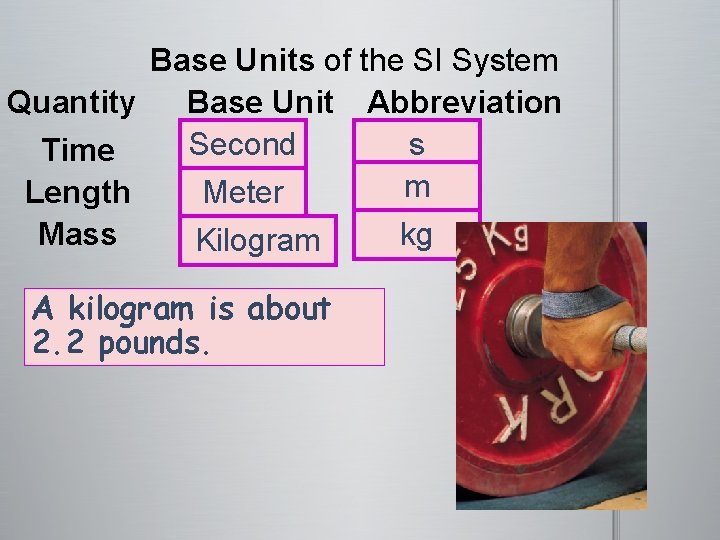
Base Units of the SI System Quantity Base Unit Abbreviation Second s Time m Length Meter Mass kg Kilogram A kilogram is about 2. 2 pounds.
Derived Units: ________________ of base units Combination ü Volume cm 3 (solids) or ml (liquids) The derived unit for volume is the cubic meter, which is represented by a cube whose sides are all one meter in length. For measurements that you are likely to make, the more useful derived unit for volume is the cubic centimeter (cm 3).
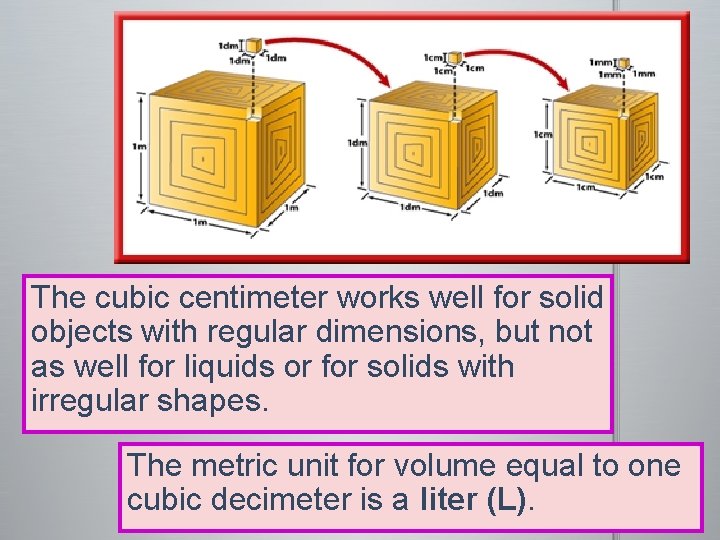
The cubic centimeter works well for solid objects with regular dimensions, but not as well for liquids or for solids with irregular shapes. The metric unit for volume equal to one cubic decimeter is a liter (L).
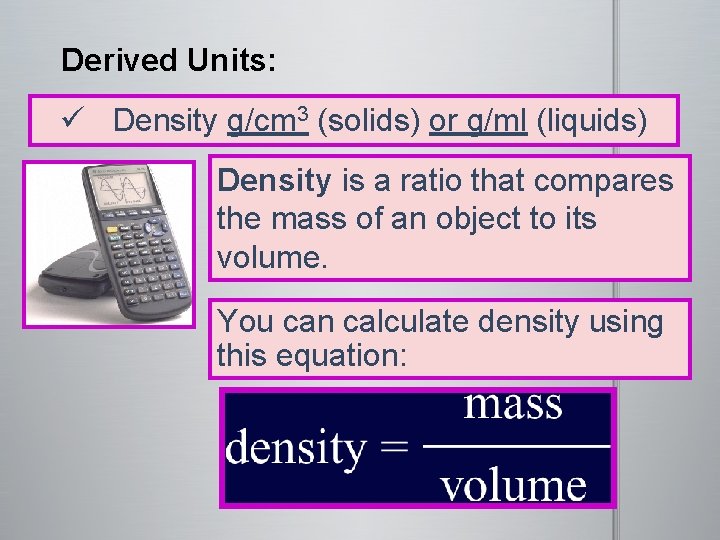
Derived Units: 3 (solids) or g/ml (liquids) ü Density g/cm Density is a ratio that compares the mass of an object to its volume. You can calculate density using this equation:
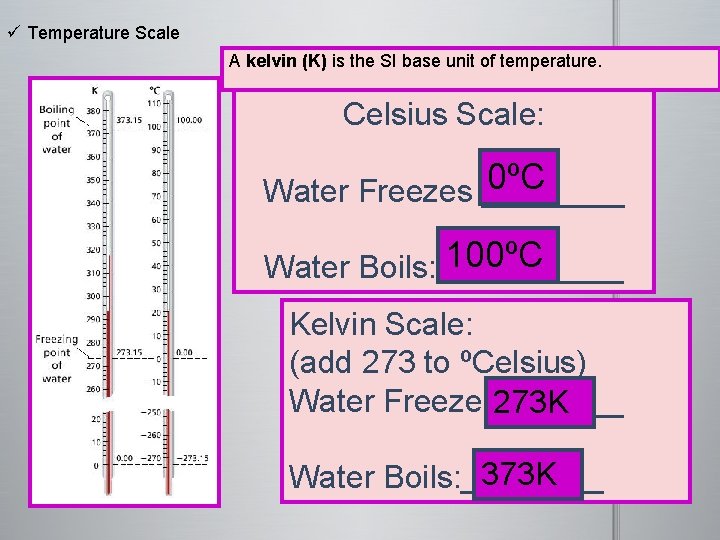
ü Temperature Scale A kelvin (K) is the SI base unit of temperature. Celsius Scale: 0ºC Water Freezes ____ 100ºC Water Boils: _____ Kelvin Scale: (add 273 to ºCelsius) Water Freezes_______ 273 K 373 K Water Boils: ____

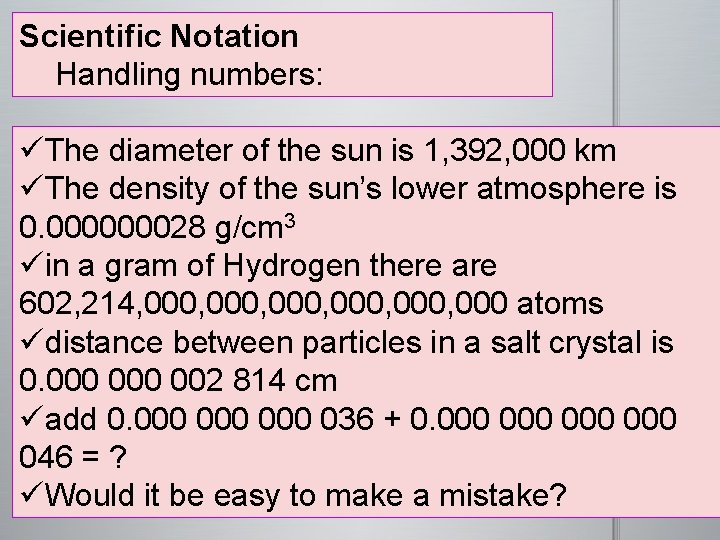
Scientific Notation Handling numbers: üThe diameter of the sun is 1, 392, 000 km üThe density of the sun’s lower atmosphere is 0. 000000028 g/cm 3 üin a gram of Hydrogen there are 602, 214, 000, 000 atoms üdistance between particles in a salt crystal is 0. 000 002 814 cm üadd 0. 000 000 036 + 0. 000 000 046 = ? üWould it be easy to make a mistake?
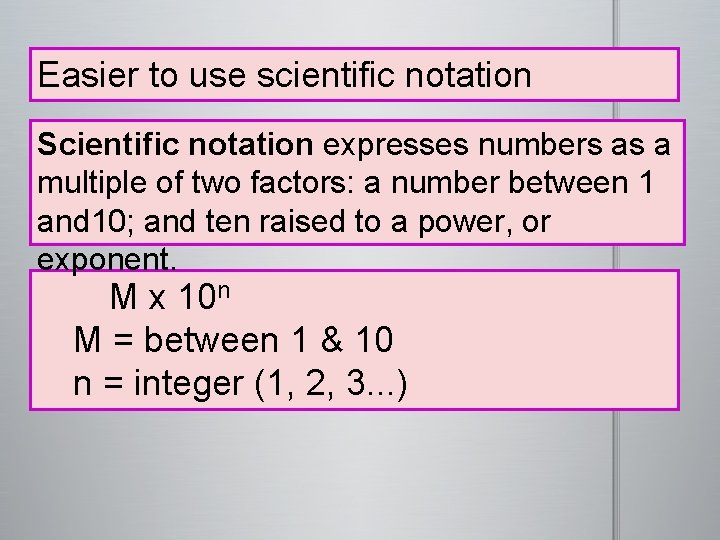
Easier to use scientific notation Scientific notation expresses numbers as a multiple of two factors: a number between 1 and 10; and ten raised to a power, or exponent. M x 10 n M = between 1 & 10 n = integer (1, 2, 3. . . )
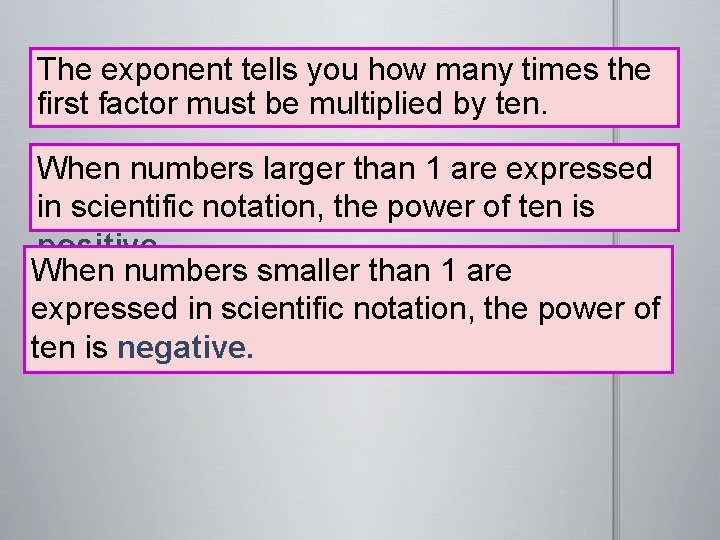
The exponent tells you how many times the first factor must be multiplied by ten. When numbers larger than 1 are expressed in scientific notation, the power of ten is positive. When numbers smaller than 1 are expressed in scientific notation, the power of ten is negative.
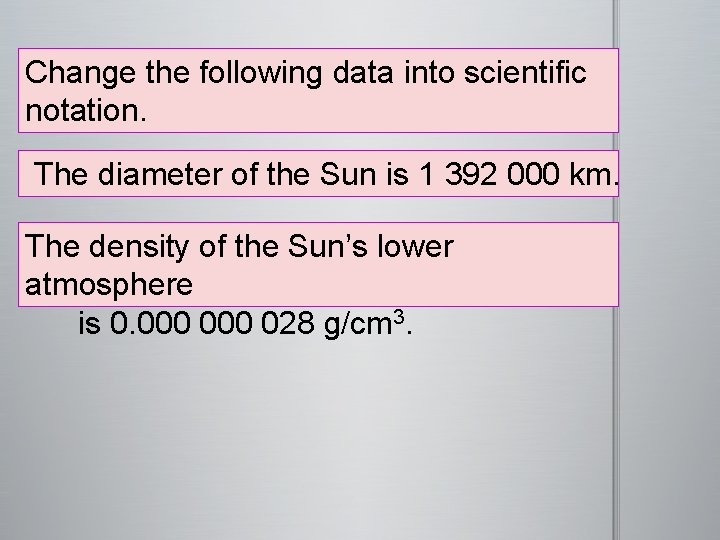
Change the following data into scientific notation. The diameter of the Sun is 1 392 000 km. The density of the Sun’s lower atmosphere is 0. 000 028 g/cm 3.
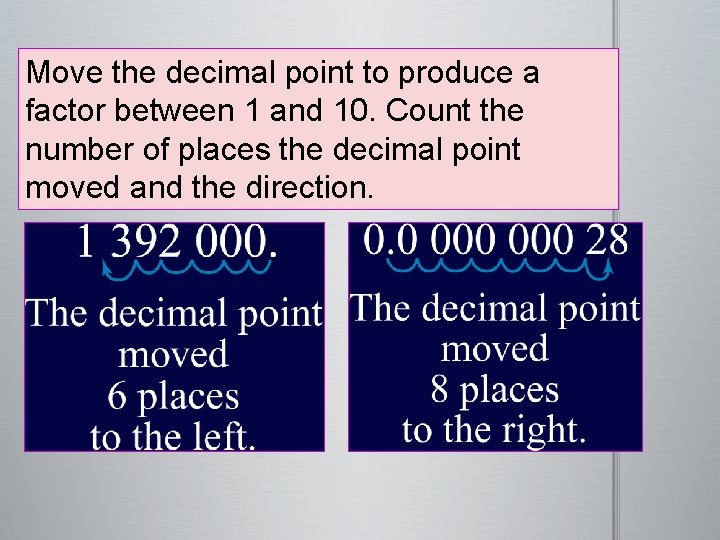
Move the decimal point to produce a factor between 1 and 10. Count the number of places the decimal point moved and the direction.
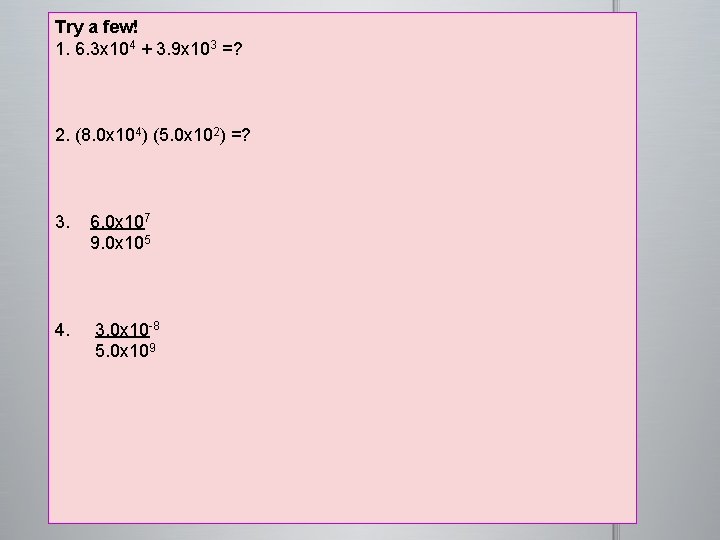
Try a few! 1. 6. 3 x 10⁴ + 3. 9 x 103 =? 2. (8. 0 x 104) (5. 0 x 102) =? 3. 6. 0 x 107 9. 0 x 105 4. 3. 0 x 10 -8 5. 0 x 109
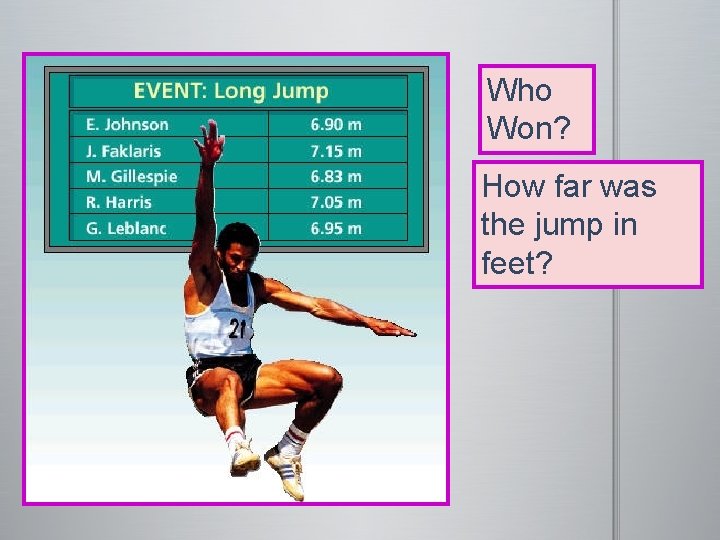
Who Won? How far was the jump in feet?
Dimensional analysis is a method of problem-solving that focuses on the units used to describe matter. • For example, if you want to convert a temperature in degrees Celsius to a temperature in Kelvin, you focus on the relationship between the units in the two temperature scales.
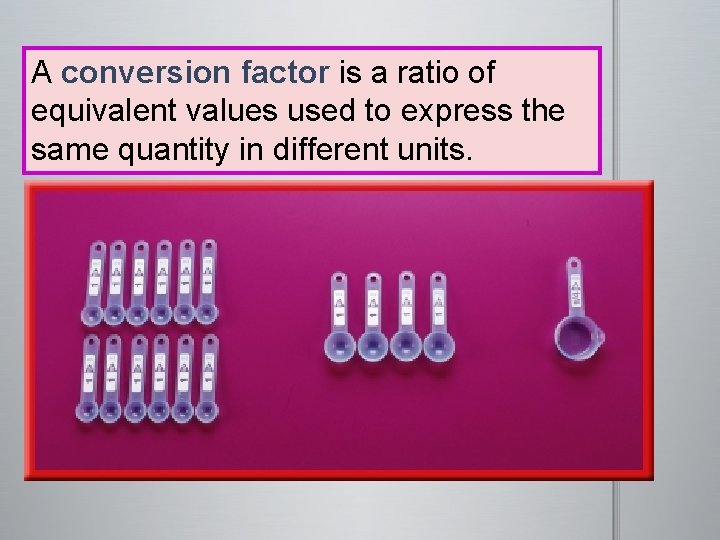
A conversion factor is a ratio of equivalent values used to express the same quantity in different units.

A conversion factor is always equal to 1. Because a quantity does not change when it is multiplied or divided by 1, conversion factors change the units of a quantity without changing its value.
Dimensional Analysis (aka Factor label) 1. Rules a. decide what info is given b. Determine what info you want c. Set up a plan, use conversion (bridge) d. cancel units that are the same in the numerator and denominator e. solve f. check to make sure answer makes sense
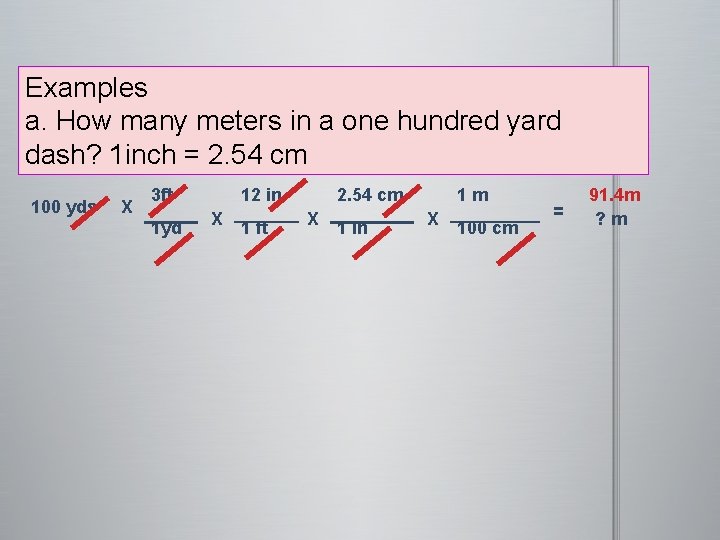
Examples a. How many meters in a one hundred yard dash? 1 inch = 2. 54 cm 100 yds X 3 ft 1 yd 12 in X 1 ft 2. 54 cm X 1 in 1 m X 100 cm 91. 4 m = ? m
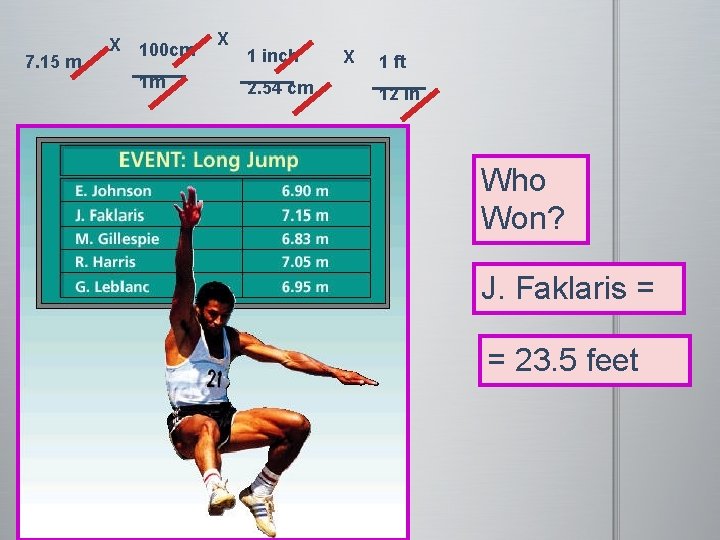
7. 15 m X 100 cm 1 m X 1 inch 2. 54 cm X 1 ft 12 in Who Won? J. Faklaris = = 23. 5 feet
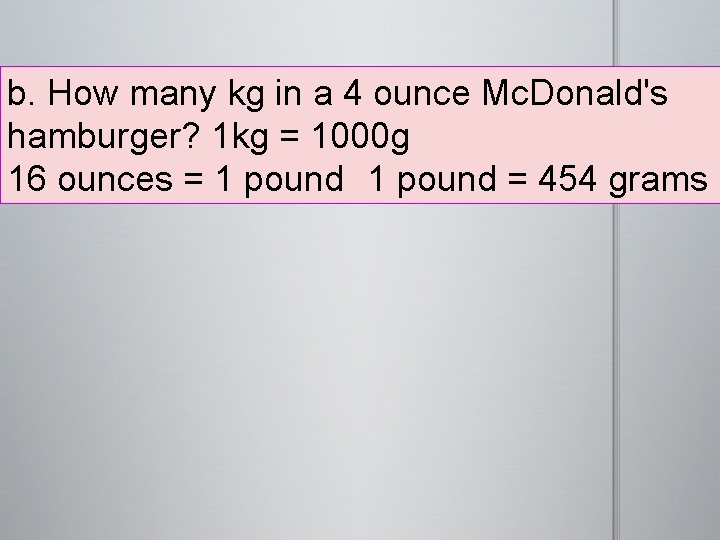
b. How many kg in a 4 ounce Mc. Donald's hamburger? 1 kg = 1000 g 16 ounces = 1 pound = 454 grams
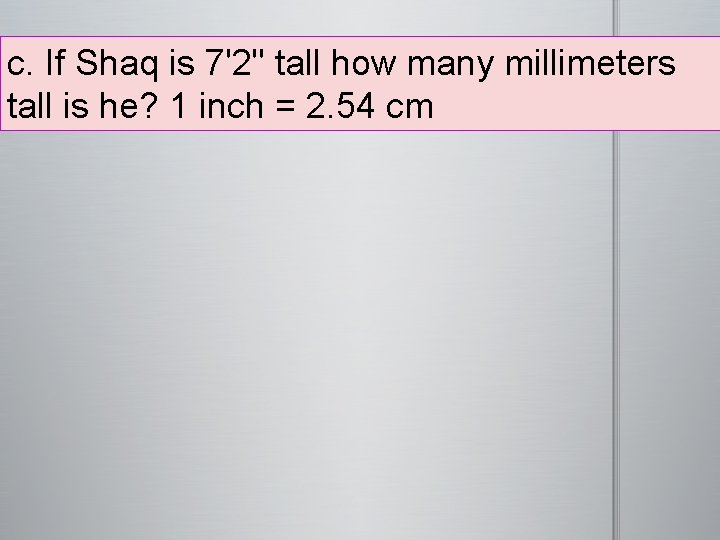
c. If Shaq is 7'2" tall how many millimeters tall is he? 1 inch = 2. 54 cm
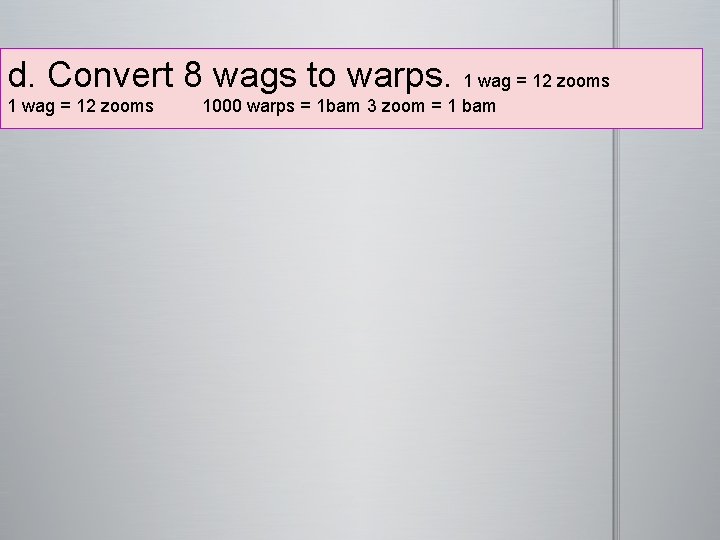
d. Convert 8 wags to warps. 1 wag = 12 zooms 1000 warps = 1 bam 3 zoom = 1 bam
e. A computer switches 60 times in a microsecond, how many times does it switch in a minute? 1000000 microsecond = 1 sec
f. How many milliliters in a 12 fl oz can of soda? 1000 ml = 1 L 1 L = 1. 06 quarts 4 quarts = 1 gal 1 gal = 128 fluid oz.
How Reliable are Measurements? Accuracy & Precision When scientists make measurements, they evaluate both the accuracy and the precision of the measurements. Accuracy refers to how close a measured value is to an accepted value. Precision refers to how close a series of measurements are to one another.
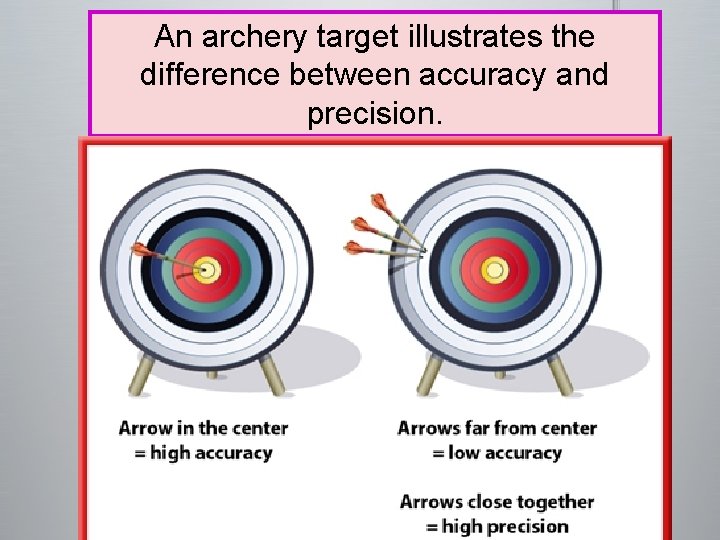
An archery target illustrates the difference between accuracy and precision.
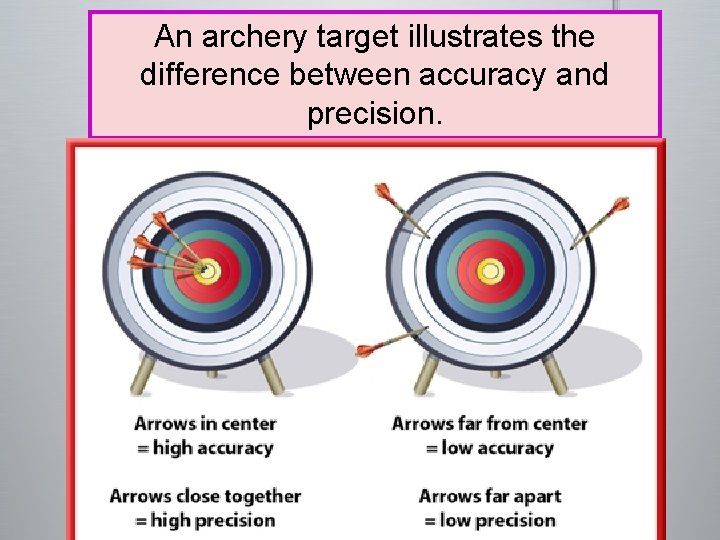
An archery target illustrates the difference between accuracy and precision.
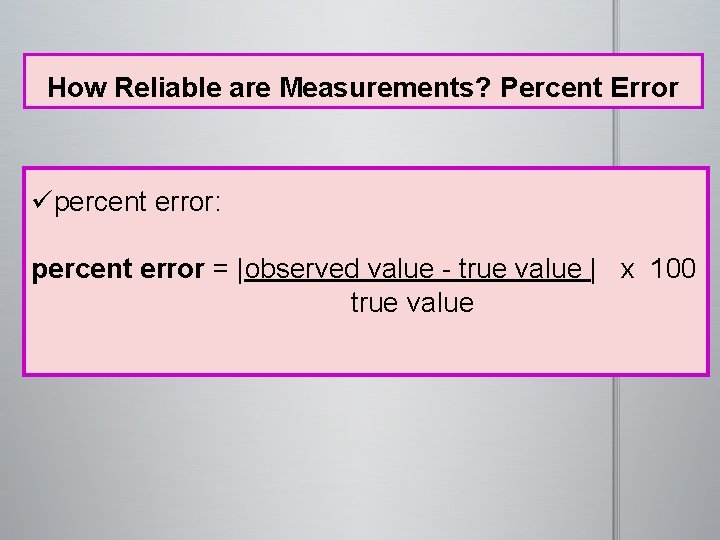
How Reliable are Measurements? Percent Error üpercent error: percent error = |observed value - true value | x 100 true value
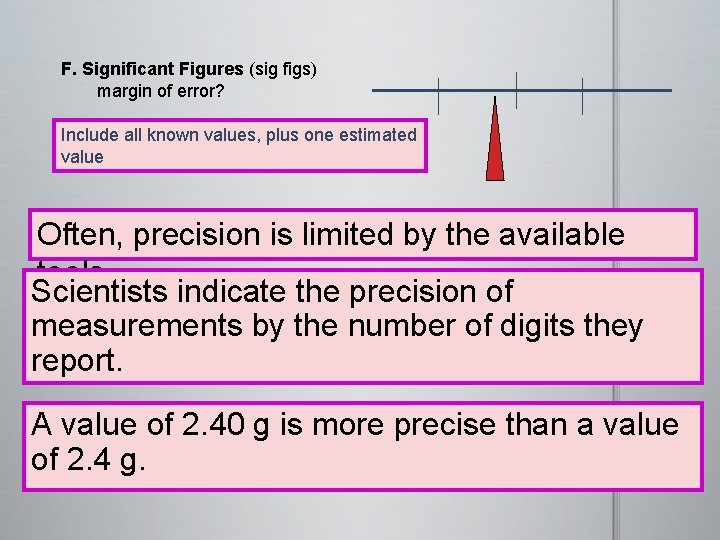
F. Significant Figures (sig figs) margin of error? Include all known values, plus one estimated value Often, precision is limited by the available tools. Scientists indicate the precision of measurements by the number of digits they report. A value of 2. 40 g is more precise than a value of 2. 4 g.
Significant Figures (sig figs) The digits that are reported are called significant figures. Significant figures include all known digits plus one estimated digit.
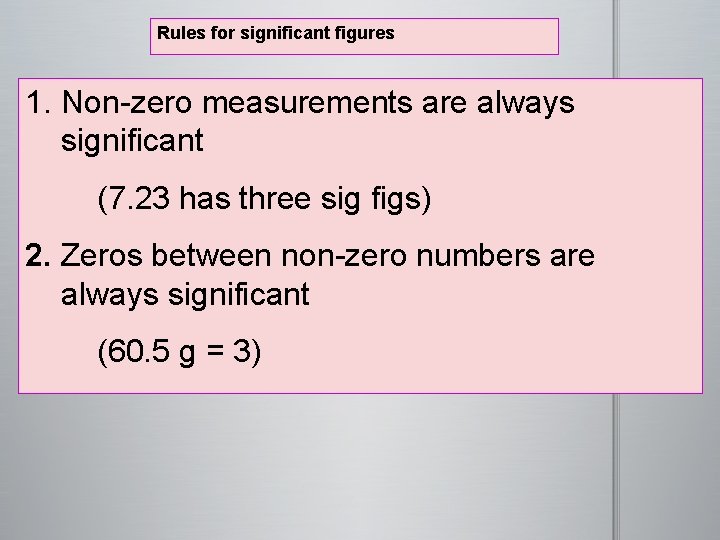
Rules for significant figures 1. Non-zero measurements are always significant (7. 23 has three sig figs) 2. Zeros between non-zero numbers are always significant (60. 5 g = 3)
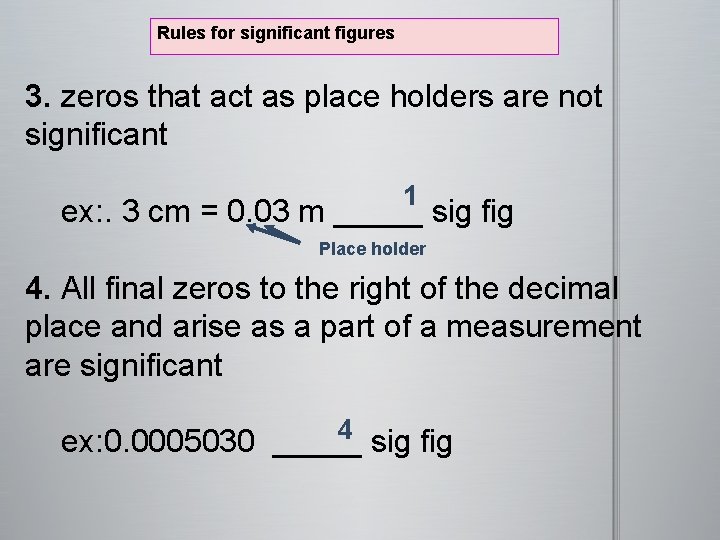
Rules for significant figures 3. zeros that act as place holders are not significant 1 ex: . 3 cm = 0. 03 m _____ sig fig Place holder 4. All final zeros to the right of the decimal place and arise as a part of a measurement are significant 4 ex: 0. 0005030 _____ sig fig
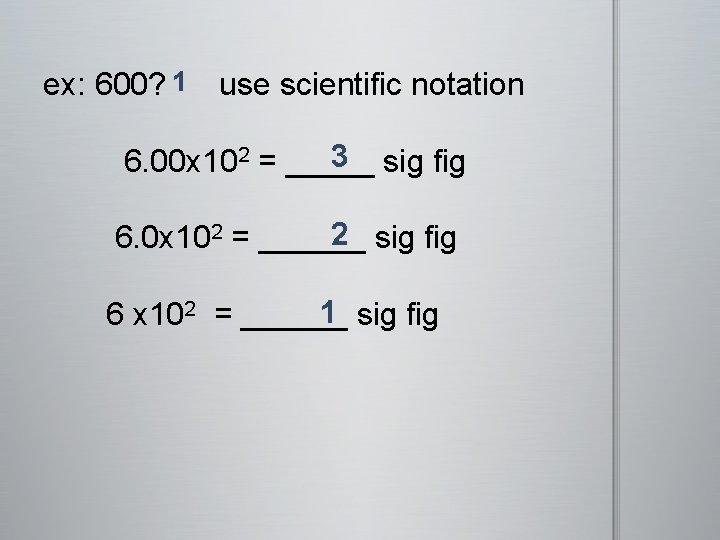
1 ex: 600? use scientific notation 3 6. 00 x 102 = _____ sig fig 2 6. 0 x 102 = ______ sig fig 1 6 x 102 = ______ sig fig
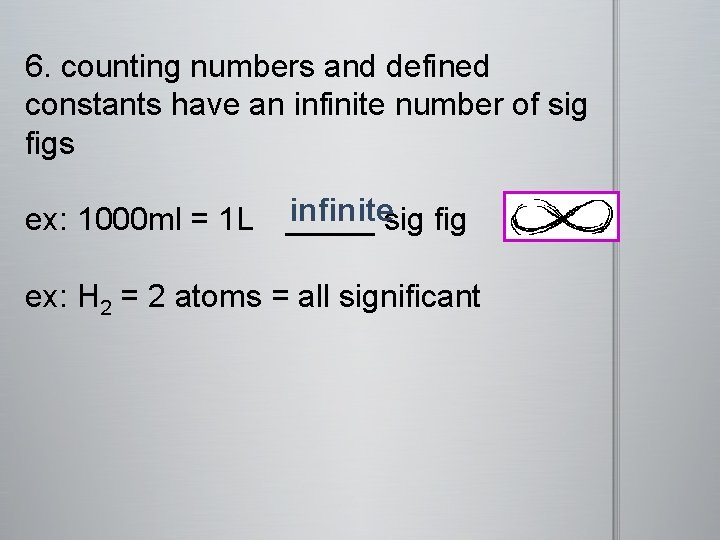
6. counting numbers and defined constants have an infinite number of sig figs infinite ex: 1000 ml = 1 L _____ sig fig ex: H 2 = 2 atoms = all significant
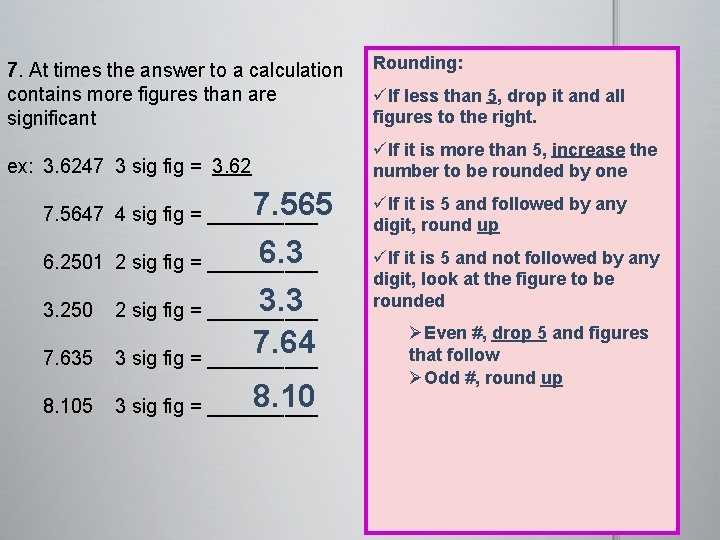
7. At times the answer to a calculation contains more figures than are significant ex: 3. 6247 3 sig fig = 3. 62 7. 5647 4 sig fig = _____ 6. 2501 2 sig fig = _____ 3. 250 2 sig fig = _____ 7. 635 3 sig fig = _____ 8. 105 3 sig fig = _____ 7. 565 6. 3 3. 3 7. 64 8. 10 Rounding: üIf less than 5, drop it and all figures to the right. üIf it is more than 5, increase the number to be rounded by one üIf it is 5 and followed by any digit, round up üIf it is 5 and not followed by any digit, look at the figure to be rounded ØEven #, drop 5 and figures that follow ØOdd #, round up
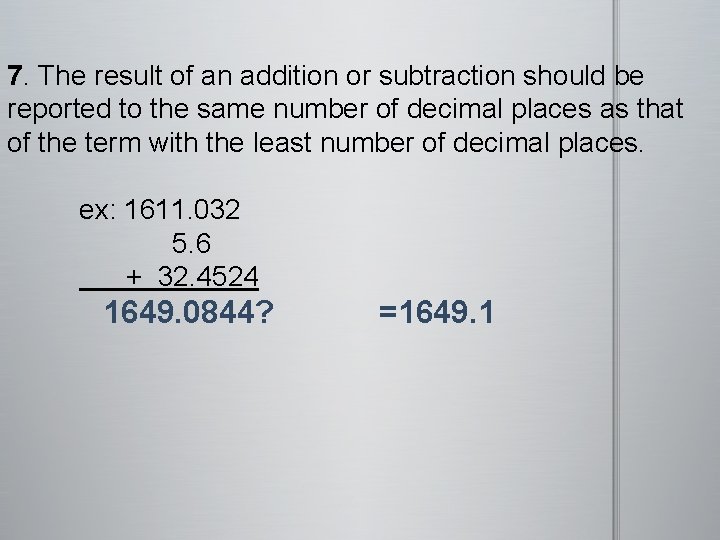
7. The result of an addition or subtraction should be reported to the same number of decimal places as that of the term with the least number of decimal places. ex: 1611. 032 5. 6 + 32. 4524 1649. 0844? =1649. 1
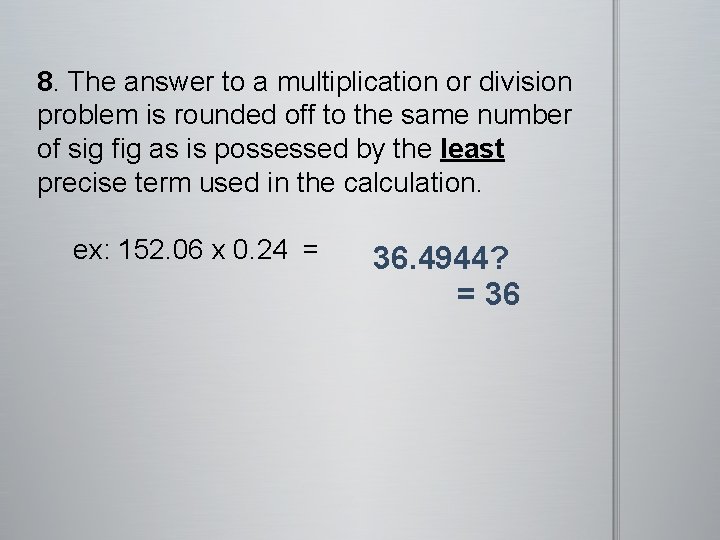
8. The answer to a multiplication or division problem is rounded off to the same number of sig fig as is possessed by the least precise term used in the calculation. ex: 152. 06 x 0. 24 = 36. 4944? = 36
- Slides: 37