
Base layer of asphalt concrete in a road
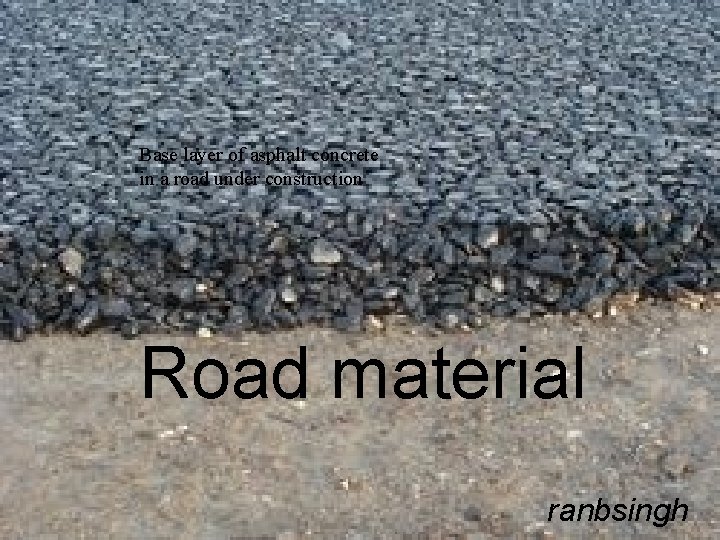
Base layer of asphalt concrete in a road under construction Road material ranbsingh
Road material Some times, roads break after a short time of construction and become an issue for investigation. It is required to examine the material used for the road Generally, two types of materials are used for the pavement and metalling of roads v Concrete Roads v Bituminous Roads ranbsingh
Concrete roads The material for concrete roads is the same as concrete used for flooring and roofing in building construction and are examined to find the ratio of Cement, Sand, and Coarse Aggregates (Stones) Bituminous roads Apart from stones (Coarse Aggregate), the following materials are used in the construction of Bituminous Roads ◙ Bitumen ◙ Asphalt ◙ Coal tar ◙ Bitumen Cutbacks ranbsingh
Bitumen is a mixture of organic liquids that are highly viscous, black, sticky, entirely soluble in carbon disulfide, and composed primarily of highly condensed polycyclic aromatic hydrocarbons. Bitumen is the residual (bottom) fraction obtained by fractional distillation of crude oil. It is the heaviest fraction and the one with the highest boiling point. Most bitumens contain sulphur and several heavy metals such as nickel, vanadium, lead, chromium, mercury and also arsenic, selenium, and other toxic elements. Bitumens can provide good preservation of plants and animal fossils. Bitumen is primarily used for paving roads ranbsingh
Bitumen (contd. ) Bitumen is characteristically solid or semi solid, black or brown in color, sticky and melts or softens on application of heat Bitumen used for roads is usually a high refined product containing 90 to 99% of Bitumen soluble in carbon di-sulfide Bitumen is marketed in various grades suitable for various purposes and the different grades vary in penetration ranbsingh
Bitumen cutbacks Softened Bitumen (Solid Bitumen thinned with volatile distillate such as petrol, kerosene, diesel oil or tar oil) This can be used without heating Bitumen alternatives Bitumen can be made from non-petroleum based renewable resources such as sugar, molasses and rice, corn and potato starches. Bitumen can also be made from waste material by fractional distillation of used motor oils. Non-petroleum based bitumen binders can be made lightcolored. Roads made with lighter-colored pitch absorb less heat from solar radiation, and become less hot than darker surfaces, reducing their contribution to the urban ranbsingh heat island effect.
Asphalt is a sticky, black and highly viscous liquid or semi-solid that is present in most crude petroleums and in some natural deposits. The word 'asphalt' refers to a mixture of mineral aggregate and bitumen. The primary use of asphalt (bitumen) is in road construction, where it is used as the glue or binder for the aggregate particles. Natural deposits of asphalt include Lake Asphalts (say from the Pitch Lake in Trinidad and Tobago) ranbsingh

Tar is a viscous black liquid derived from the destructive distillation of organic matter and is chemically distinct from bitumen. Most tar is produced from coal (coal tar) as a byproduct of coke production, but it can also be produced from petroleum, peat or wood. Asphalt or bitumen can sometimes be confused with tar Bitumen is the binding material in Asphalt. ranbsingh
Pitch is the name for any of a number of highly viscous liquids which appear solid. Pitch has a viscosity approximately 100 billion times that of water. Pitch can be made from petroleum products or plants. Petroleum-derived pitch is also called bitumen. Pitch produced from plants is also known as resin. Products made from plant resin are also known as rosin. ranbsingh
Comparison of bitumen and tar in road work The weathering properties of Bitumen are superior to those of Tar Hot weather will soften a Tar surface more than Bitumen Tar hardens much quicker than Bitumen Tar produces less slippery surface than Bitumen Volume of Tar required is 10% less than that of Bitumen for the same type of work ranbsingh
Structure of road Sub grade or formation of soil foundation. Pavement Foundation : Soling or bottoming hand packed big size stones, and bricks; laid flat The Base : Stone aggregate or road metal, well consolidated The Surfacing: It is the wearing surface. This may be Concrete or Bituminous surfacing ranbsingh
Failure of material (which may result from the lack of control) ØWrong type of Tar or Bitumen : The binder may be too hard or too soft for the surfacing required. ØIncorrect quantity of binder : Too little may result in a surface being brittle and having a tendency to trotting or crumbling. Too much binder may cause smoothing and softens. ØIncorrect proportion of aggregate and filler ranbsingh
Grouting Pouring of binding material in a liquid state on to a consolidated surface of road metal so that the binder penetrates the interstices until every stone is covered with the binder is called Grouting Full grout When the binder is allowed to penetrate to the full depth of the consolidated stone layer. Semi grout When it penetrates only half the consolidated layer. The consolidated thickness is generally 3 inch ranbsingh
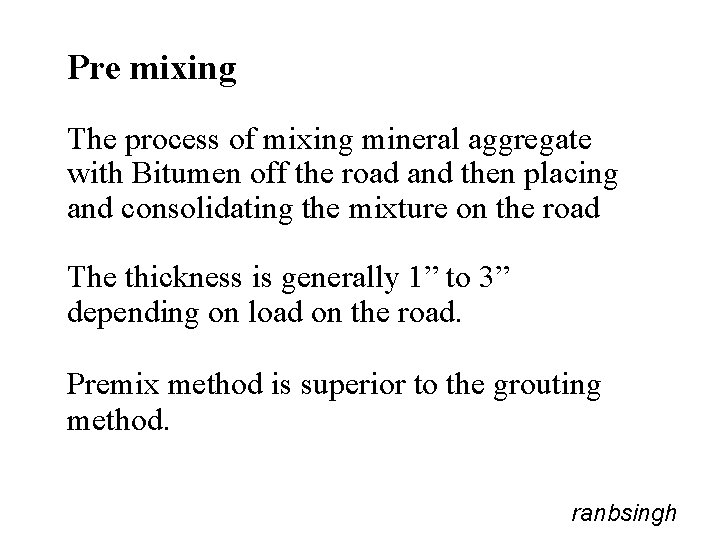
Pre mixing The process of mixing mineral aggregate with Bitumen off the road and then placing and consolidating the mixture on the road The thickness is generally 1” to 3” depending on load on the road. Premix method is superior to the grouting method. ranbsingh
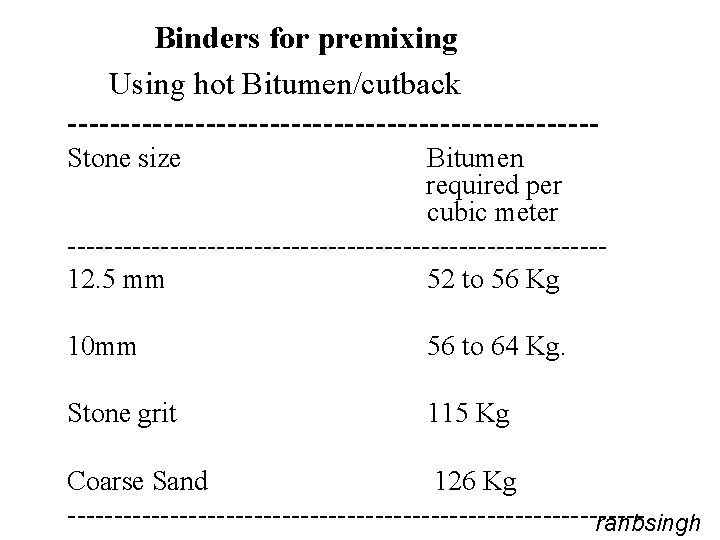
Binders for premixing Using hot Bitumen/cutback -------------------------Stone size Bitumen required per cubic meter -----------------------------12. 5 mm 52 to 56 Kg 10 mm 56 to 64 Kg. Stone grit 115 Kg Coarse Sand 126 Kg -------------------------------ranbsingh
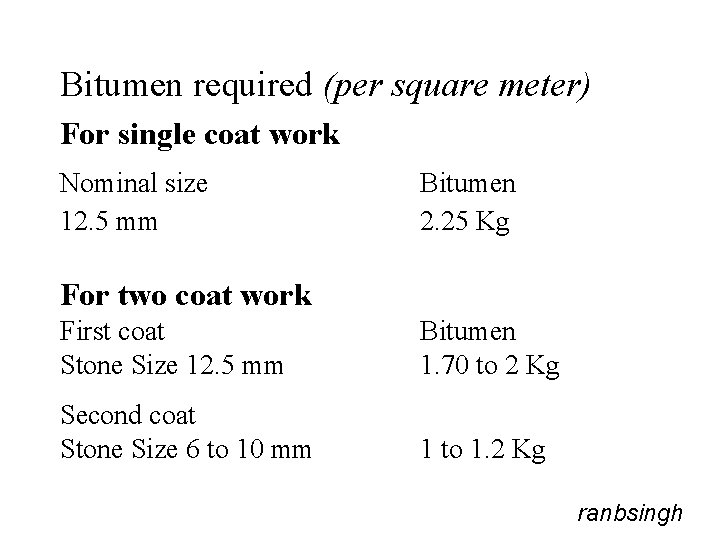
Bitumen required (per square meter) For single coat work Nominal size 12. 5 mm Bitumen 2. 25 Kg For two coat work First coat Stone Size 12. 5 mm Bitumen 1. 70 to 2 Kg Second coat Stone Size 6 to 10 mm 1 to 1. 2 Kg ranbsingh
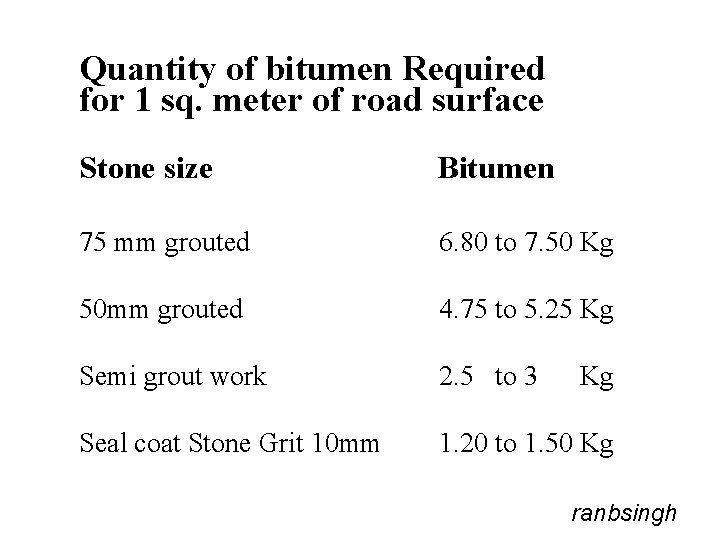
Quantity of bitumen Required for 1 sq. meter of road surface Stone size Bitumen 75 mm grouted 6. 80 to 7. 50 Kg 50 mm grouted 4. 75 to 5. 25 Kg Semi grout work 2. 5 to 3 Seal coat Stone Grit 10 mm 1. 20 to 1. 50 Kg Kg ranbsingh
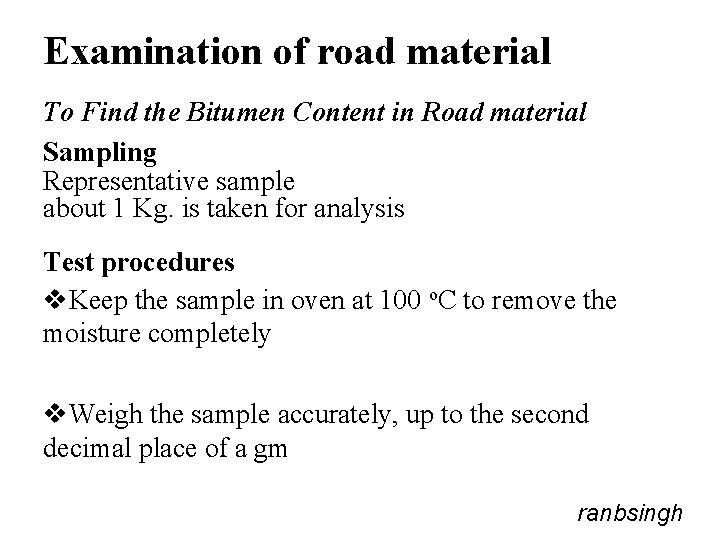
Examination of road material To Find the Bitumen Content in Road material Sampling Representative sample about 1 Kg. is taken for analysis Test procedures v. Keep the sample in oven at 100 o. C to remove the moisture completely v. Weigh the sample accurately, up to the second decimal place of a gm ranbsingh
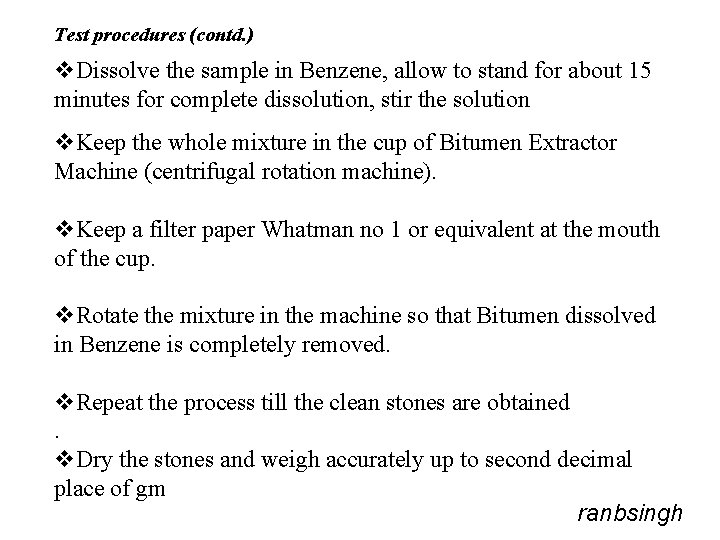
Test procedures (contd. ) v. Dissolve the sample in Benzene, allow to stand for about 15 minutes for complete dissolution, stir the solution v. Keep the whole mixture in the cup of Bitumen Extractor Machine (centrifugal rotation machine). v. Keep a filter paper Whatman no 1 or equivalent at the mouth of the cup. v. Rotate the mixture in the machine so that Bitumen dissolved in Benzene is completely removed. v. Repeat the process till the clean stones are obtained. v. Dry the stones and weigh accurately up to second decimal place of gm ranbsingh
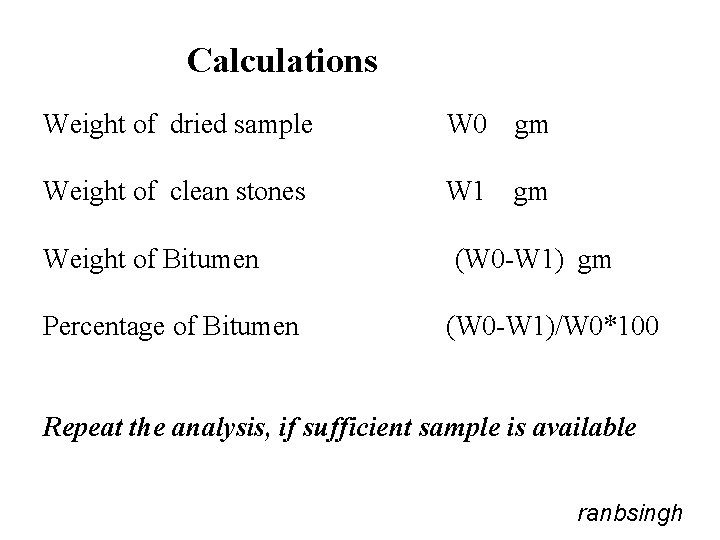
Calculations Weight of dried sample W 0 gm Weight of clean stones W 1 gm Weight of Bitumen Percentage of Bitumen (W 0 -W 1) gm (W 0 -W 1)/W 0*100 Repeat the analysis, if sufficient sample is available ranbsingh
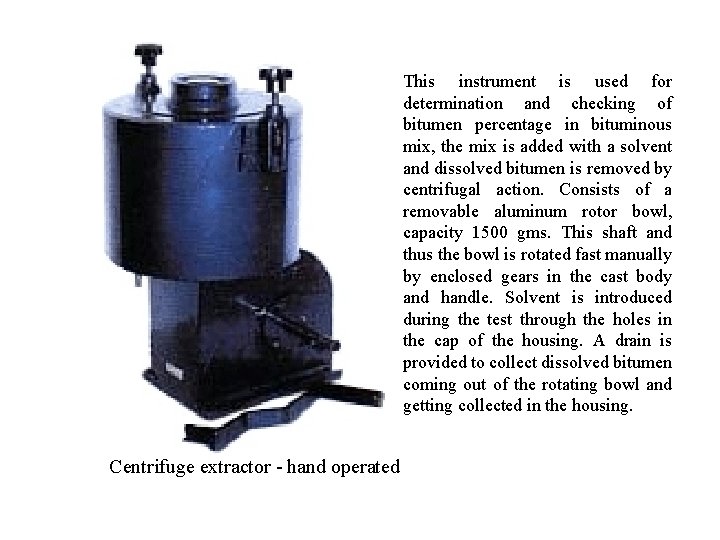
This instrument is used for determination and checking of bitumen percentage in bituminous mix, the mix is added with a solvent and dissolved bitumen is removed by centrifugal action. Consists of a removable aluminum rotor bowl, capacity 1500 gms. This shaft and thus the bowl is rotated fast manually by enclosed gears in the cast body and handle. Solvent is introduced during the test through the holes in the cap of the housing. A drain is provided to collect dissolved bitumen coming out of the rotating bowl and getting collected in the housing. Centrifuge extractor - hand operated
Stones ØThe common name used for stones in building construction is Aggregate ØThe coarse aggregates are called stones and fine aggregates are called sand ØThe stones and sand are demarcated by sieve number 6, having sieve opening of 3. 35 mm ØThe pieces bigger than 3. 35 mm are stones (coarse aggregate) and smaller are sand or fine aggregate ranbsingh
stones (contd. ) ØCoarse aggregate is an important part of building construction particularly for foundation work and in Road construction to be mixed with Bitumen ØMany times bigger pieces are used to save labor charges. Various types of examinations are carried out for stones ØThe most important is the size of stones (coarse aggregate) ranbsingh
Plastic Roads A new technology has been developed to use waste plastic for construction of roads. Plastic is ‘shred’ and mixed with bituminous mix for road construction The frequency of road repairs is reduced as the chances of seepage of rain is minimized due to presence of plastic. It increases the life of roads three times. ranbsingh
- Slides: 24