
Base Details Closing lines essay feedback Question 2010
Base Details “Closing lines” essay feedback
Question 2010 • 13. Choose a poem in which the central concern(s) is/are clarified for you in the closing lines. • Show these closing lines provide an effective clarification of the central concern(s) of the poem.
Intro and beginning • Fine – everyone started by talking about the last few lines and how they clarified theme. Smashing! It was the next bit that was a bit variable…
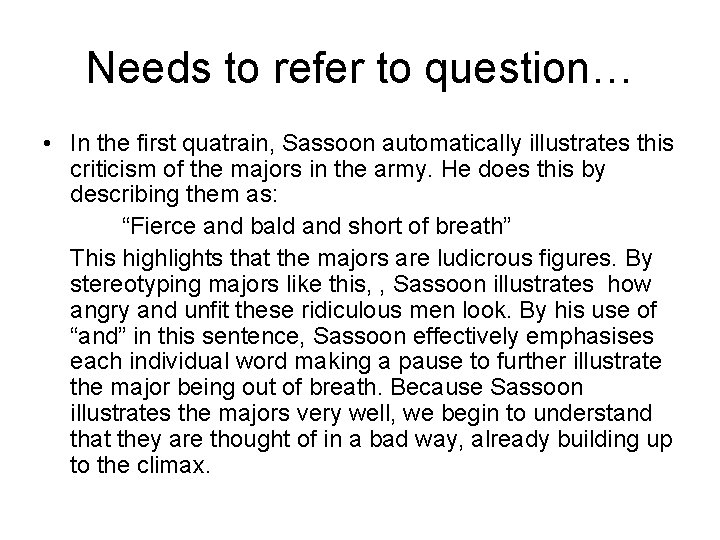
Needs to refer to question… • In the first quatrain, Sassoon automatically illustrates this criticism of the majors in the army. He does this by describing them as: “Fierce and bald and short of breath” This highlights that the majors are ludicrous figures. By stereotyping majors like this, , Sassoon illustrates how angry and unfit these ridiculous men look. By his use of “and” in this sentence, Sassoon effectively emphasises each individual word making a pause to further illustrate the major being out of breath. Because Sassoon illustrates the majors very well, we begin to understand that they are thought of in a bad way, already building up to the climax.
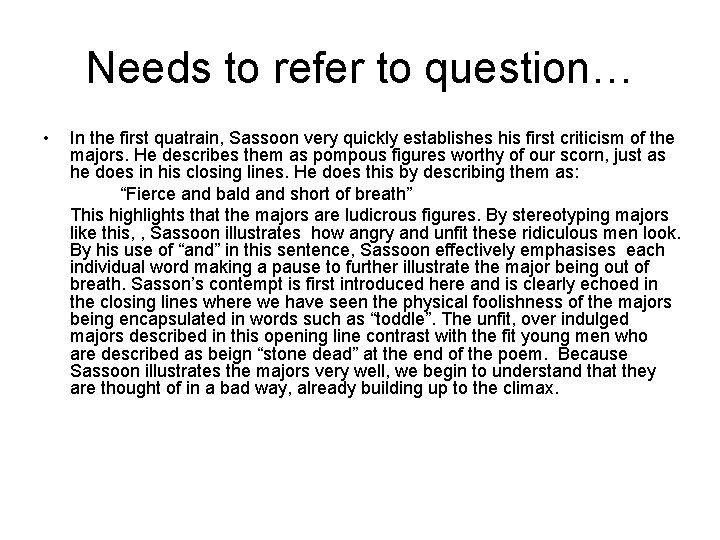
Needs to refer to question… • In the first quatrain, Sassoon very quickly establishes his first criticism of the majors. He describes them as pompous figures worthy of our scorn, just as he does in his closing lines. He does this by describing them as: “Fierce and bald and short of breath” This highlights that the majors are ludicrous figures. By stereotyping majors like this, , Sassoon illustrates how angry and unfit these ridiculous men look. By his use of “and” in this sentence, Sassoon effectively emphasises each individual word making a pause to further illustrate the major being out of breath. Sasson’s contempt is first introduced here and is clearly echoed in the closing lines where we have seen the physical foolishness of the majors being encapsulated in words such as “toddle”. The unfit, over indulged majors described in this opening line contrast with the fit young men who are described as beign “stone dead” at the end of the poem. Because Sassoon illustrates the majors very well, we begin to understand that they are thought of in a bad way, already building up to the climax.
- Slides: 5