
Basalts fine grained volcanic Dolerite sills and dykes
Basalts = fine grained, volcanic Dolerite = sills and dykes, medium grained, ophitic texture Ophitic = intergrowth of plag + prx Gabbro = coarse grained, plutonic
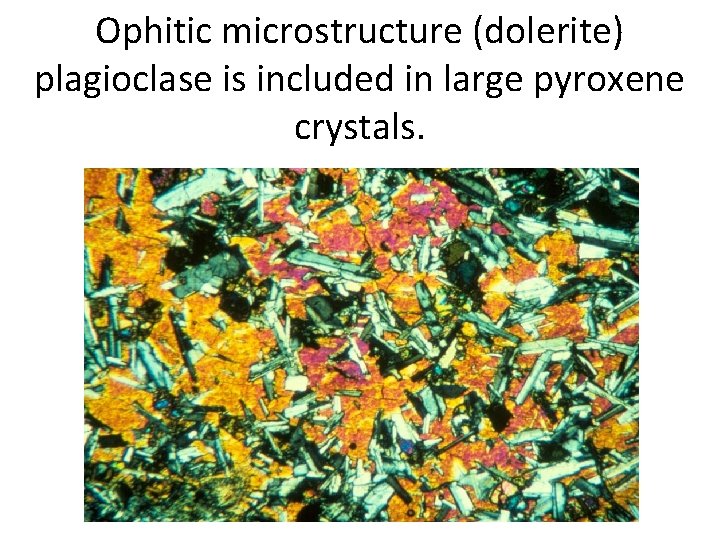
Ophitic microstructure (dolerite) plagioclase is included in large pyroxene crystals.
Basalt • Mafic rock • Mineralogy : prx, plag (calcic, labredorite), Fe. Ti oxides, ol may be present • Fine grained, may be porphyritic
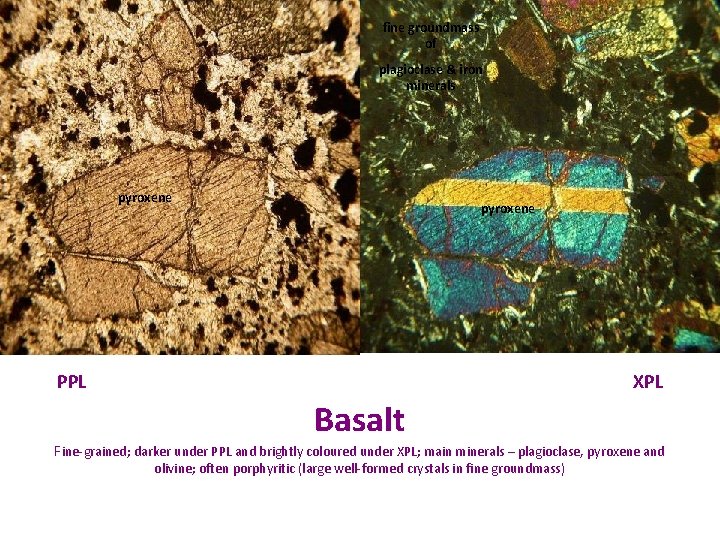
fine groundmass of plagioclase & iron minerals pyroxene PPL XPL Basalt Fine-grained; darker under PPL and brightly coloured under XPL; main minerals – plagioclase, pyroxene and olivine; often porphyritic (large well-formed crystals in fine groundmass)
Gabbro • Coarse, plutonic • Norite = gabbro in which opx is domnant • Troctolite = gabbro composed of calcic plag and olivine with little or no prx
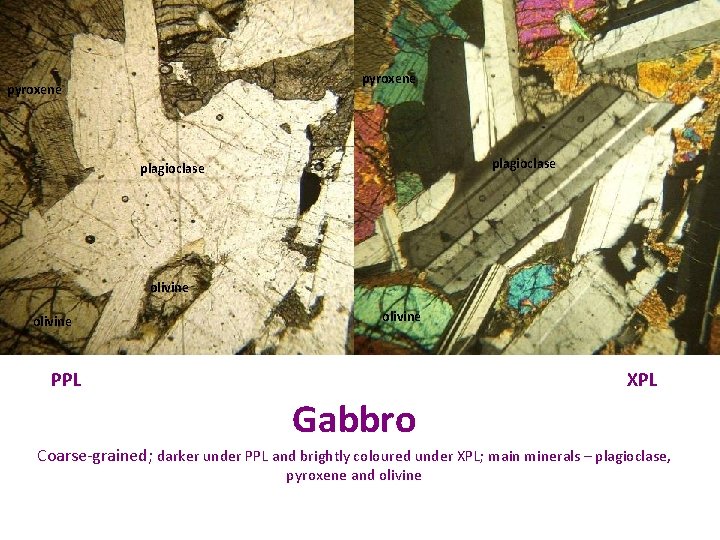
pyroxene plagioclase olivine PPL XPL Gabbro Coarse-grained; darker under PPL and brightly coloured under XPL; main minerals – plagioclase, pyroxene and olivine
Rock Ass • 1. tho basalt-icelandite-dacite-rhyolie • 2. Calc-alkaline basalt-andesite-dacite-rhyolite • 3. Alkali basalt-trchy basalt- potassic basalt
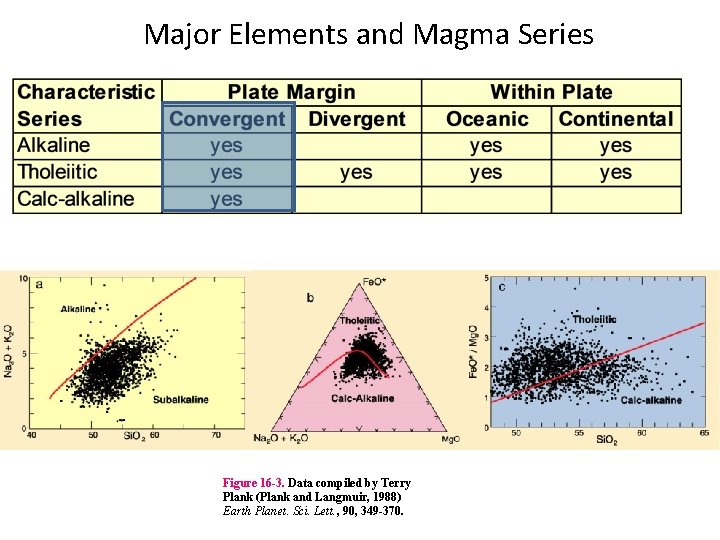
Major Elements and Magma Series Figure 16 -3. Data compiled by Terry Plank (Plank and Langmuir, 1988) Earth Planet. Sci. Lett. , 90, 349 -370.
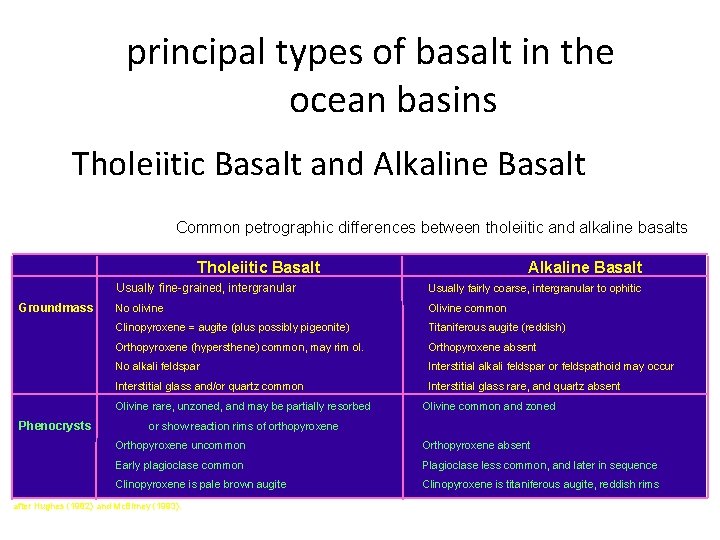
principal types of basalt in the ocean basins Tholeiitic Basalt and Alkaline Basalt Common petrographic differences between tholeiitic and alkaline basalts Tholeiitic Basalt Groundmass Usually fine-grained, intergranular Usually fairly coarse, intergranular to ophitic No olivine Olivine common Clinopyroxene = augite (plus possibly pigeonite) Titaniferous augite (reddish) Orthopyroxene (hypersthene) common, may rim ol. Orthopyroxene absent No alkali feldspar Interstitial alkali feldspar or feldspathoid may occur Interstitial glass and/or quartz common Interstitial glass rare, and quartz absent Olivine rare, unzoned, and may be partially resorbed Phenocrysts Alkaline Basalt Olivine common and zoned or show reaction rims of orthopyroxene Orthopyroxene uncommon Orthopyroxene absent Early plagioclase common Plagioclase less common, and later in sequence Clinopyroxene is pale brown augite Clinopyroxene is titaniferous augite, reddish rims after Hughes (1982) and Mc. Birney (1993).
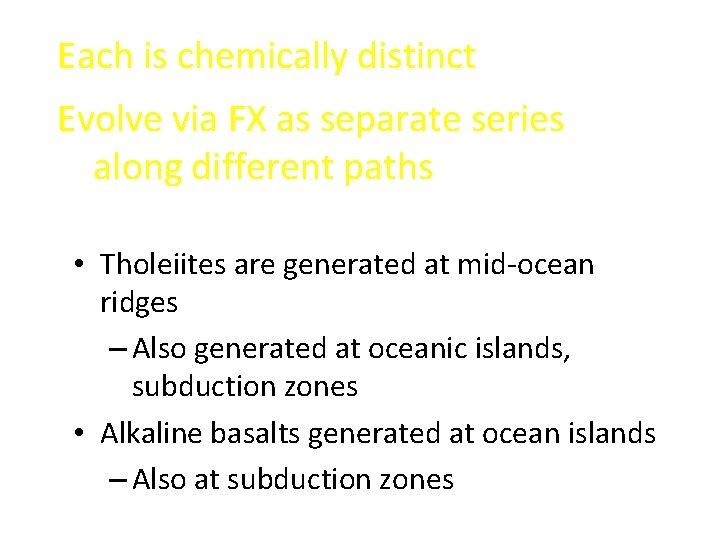
Each is chemically distinct Evolve via FX as separate series along different paths • Tholeiites are generated at mid-ocean ridges – Also generated at oceanic islands, subduction zones • Alkaline basalts generated at ocean islands – Also at subduction zones
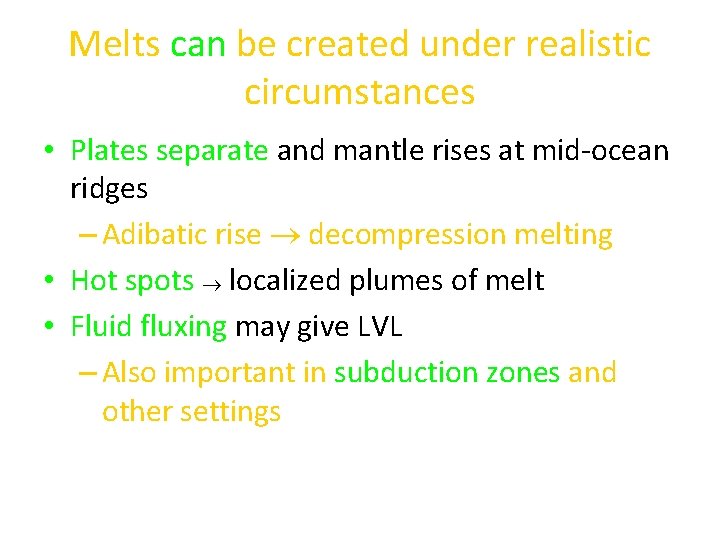
Melts can be created under realistic circumstances • Plates separate and mantle rises at mid-ocean ridges – Adibatic rise ® decompression melting • Hot spots ® localized plumes of melt • Fluid fluxing may give LVL – Also important in subduction zones and other settings
Tectonic setting • • • MORR Subduction Zone Continental Rifting Oceanic intraplate/ ocean island Plume
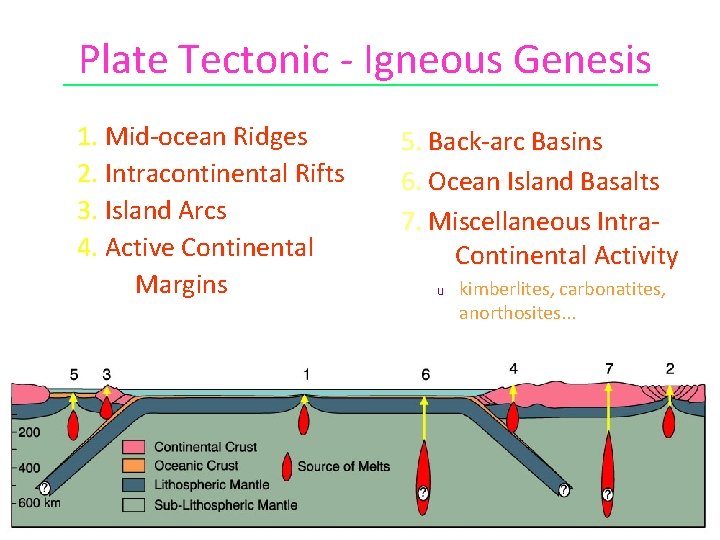
Plate Tectonic - Igneous Genesis 1. Mid-ocean Ridges 2. Intracontinental Rifts 3. Island Arcs 4. Active Continental Margins 5. Back-arc Basins 6. Ocean Island Basalts 7. Miscellaneous Intra. Continental Activity u kimberlites, carbonatites, anorthosites. . .
Petrogenesis • • Partial melting of matle (Ultramafic) High P and CO 2 rich volatile = alkali basalt Low P and H 2 O rich volatile = tho Variation in source mantle comp, P of melting, degrees of partial melting = results in variation in composition of basalts
Primary magmas • Formed at depth and not subsequently modified by FX or Assimilation • Criteria – Highest Mg# (100 Mg/(Mg+Fe)) really ® parental magma – Experimental results of lherzolite melts • Mg# = 66 -75 • Cr > 1000 ppm • Ni > 400 -500 ppm • Multiply saturated
CFB • Formed by plume = Deccan Trap • Reunion hotspot

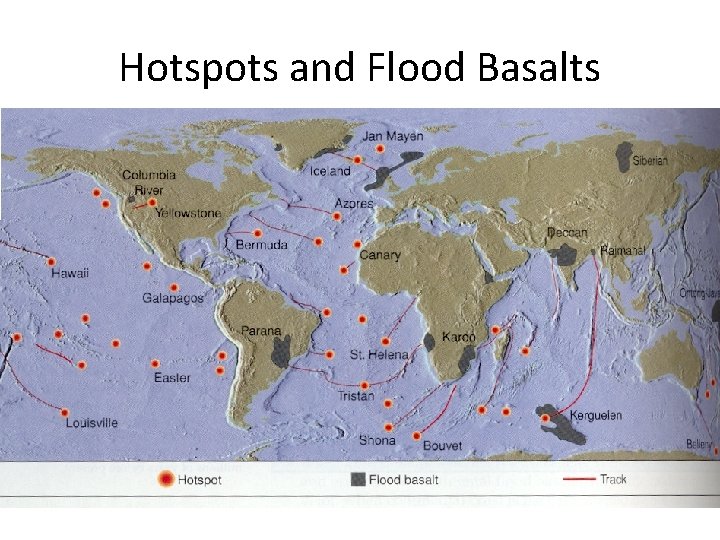
Hotspots and Flood Basalts
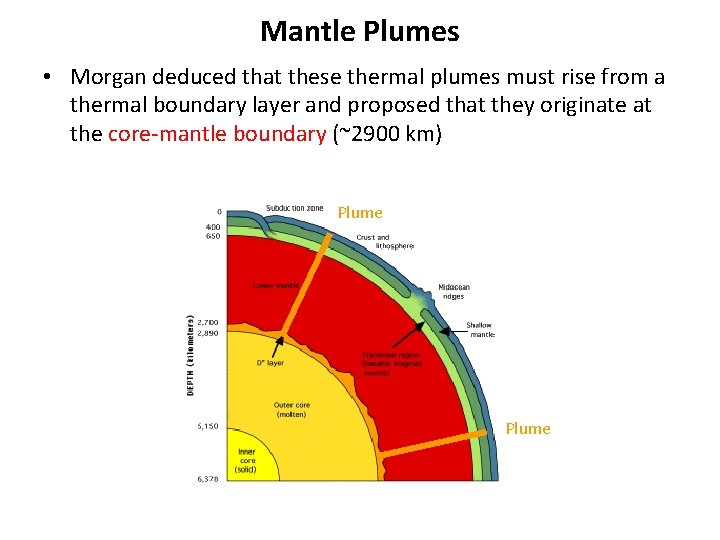
Mantle Plumes • Morgan deduced that these thermal plumes must rise from a thermal boundary layer and proposed that they originate at the core-mantle boundary (~2900 km) Plume
Continental rift basalt • Ex East African Rift system • Alikine and tho
Subduction zone • Arc tho-calc-alkaline-shoshonite
Summary • A chemically homogeneous mantle can yield a variety of basalt types • Alkaline basalts are favored over tholeiites by deeper melting and by low % PM • Fractionation at moderate to high depths can also create alkaline basalts from tholeiites • At low P there is a thermal divide that separates the two series
- Slides: 22