
Basal Insulin in the Modern Era The CDEs

Basal Insulin in the Modern Era The CDE's Role in Improving Utilization and Outcomes MODERATOR Davida F. Kruger, MSN, APNBC, BC-ADM Nurse Practitioner Henry Ford Health System Detroit, Michigan

Program Welcome and Introduction Davida F. Kruger, MSN, APN-BC, BC-ADM Basal Insulin 101 Joshua J. Neumiller, Pharm. D, CDE Overcoming Insulin-Related Barriers Like a Pro Virginia Valentine, APRN, BC-ADM, CDE, FAADE Case Challenges! Maggie A. Powers, Ph. D, RD, CDE
Basal Insulin 101 Joshua J. Neumiller, Pharm. D, CDE Associate Professor Pharmacotherapy Vice Chair Washington State University Spokane, Washington
Antihyperglycemic Therapy in Adults With T 2 D Figure No Longer Available American Diabetes Association ADA. Diabetes Care. 2018; 41(suppl 1): S 73 -S 95. Copyright and all rights reserved. Material from this publication has been used with the permission of American Diabetes Association. 4
Antihyperglycemic Therapy in Adults With T 2 D (cont) From the Standards: Figure No Longer Available "If the A 1 C target is not achieved after approximately 3 months and patient does not have ASCVD, consider a combination of metformin and any 1 of the preferred 6 treatment options: sulfonylurea, thiazolidinedione, DPP-4 inhibitor, SGLT 2 inhibitor, GLP 1 receptor agonist, or basal insulin; the choice of which agent to add is based on drugspecific and patient factors. " American Diabetes Association ADA. Diabetes Care. 2018; 41(suppl 1): S 73 -S 95. Copyright and all rights reserved. Material from this publication has been used with the permission of American Diabetes Association. 5
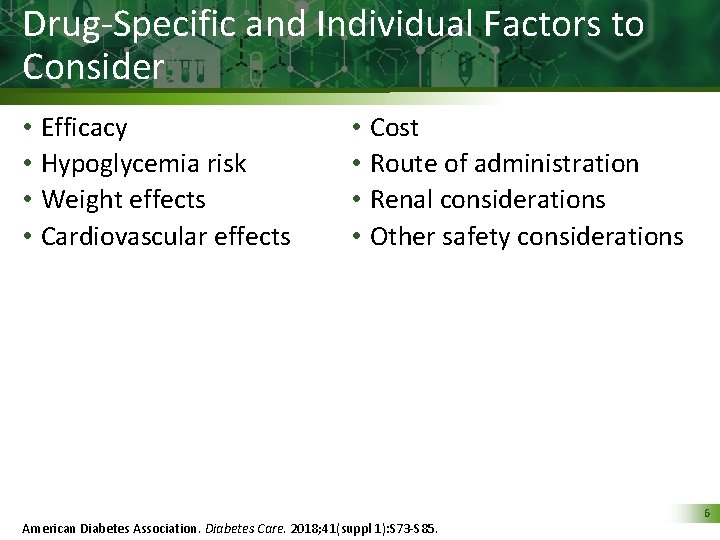
Drug-Specific and Individual Factors to Consider • Efficacy • Hypoglycemia risk • Weight effects • Cardiovascular effects • Cost • Route of administration • Renal considerations • Other safety considerations 6 American Diabetes Association. Diabetes Care. 2018; 41(suppl 1): S 73 -S 85.
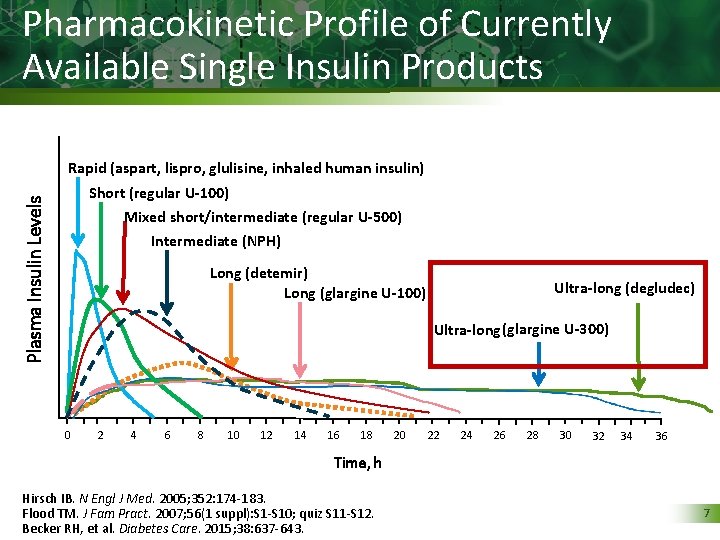
Pharmacokinetic Profile of Currently Available Single Insulin Products Rapid (aspart, lispro, glulisine, inhaled human insulin) Plasma Insulin Levels Short (regular U-100) Mixed short/intermediate (regular U-500) Intermediate (NPH) Long (detemir) Long (glargine U-100) Ultra-long (degludec) Ultra-long (glargine U-300) 0 2 4 6 8 10 12 14 16 18 20 22 24 26 28 30 32 34 36 Time, h Hirsch IB. N Engl J Med. 2005; 352: 174 -183. Flood TM. J Fam Pract. 2007; 56(1 suppl): S 1 -S 10; quiz S 11 -S 12. Becker RH, et al. Diabetes Care. 2015; 38: 637 -643. 7

Ultra-Long-Acting Insulins Potential Benefits in T 2 D • Longer duration of action = true once-daily basal insulins • Flexibility with administration timing • Less volume per injection (concentrated products) • Potential for less glycemic variability • Potential for less hypoglycemia 8 Hirsch IB. N Engl J Med. 2005; 352: 174 -183.
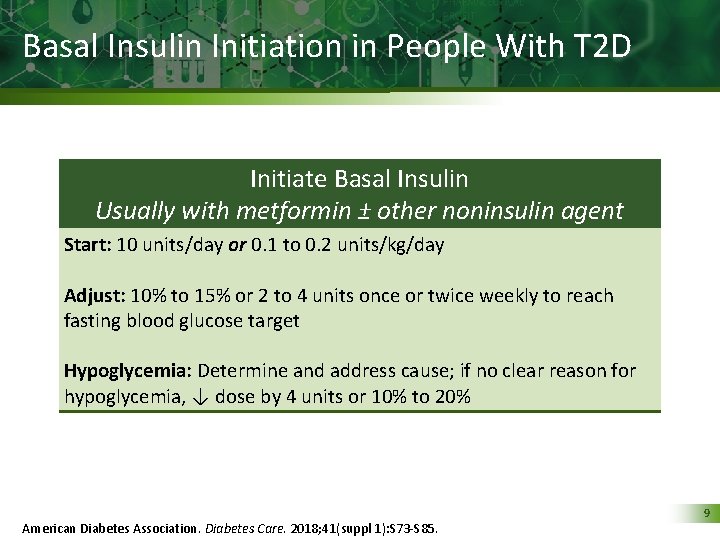
Basal Insulin Initiation in People With T 2 D Initiate Basal Insulin Usually with metformin ± other noninsulin agent Start: 10 units/day or 0. 1 to 0. 2 units/kg/day Adjust: 10% to 15% or 2 to 4 units once or twice weekly to reach fasting blood glucose target Hypoglycemia: Determine and address cause; if no clear reason for hypoglycemia, ↓ dose by 4 units or 10% to 20% 9 American Diabetes Association. Diabetes Care. 2018; 41(suppl 1): S 73 -S 85.
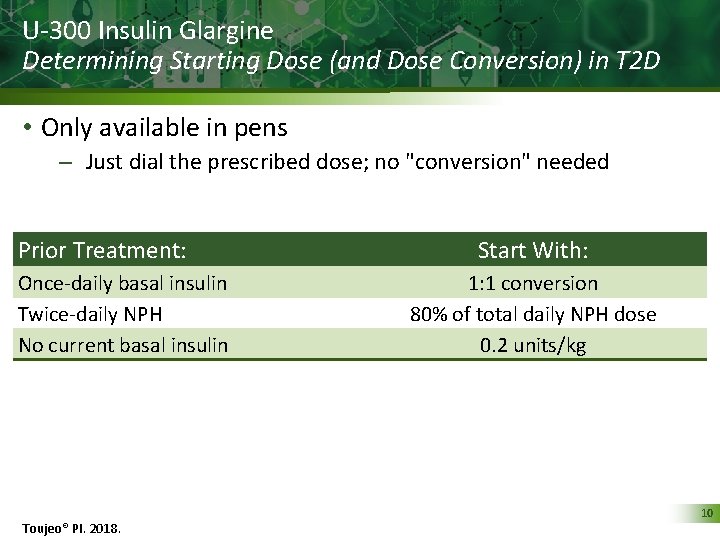
U-300 Insulin Glargine Determining Starting Dose (and Dose Conversion) in T 2 D • Only available in pens – Just dial the prescribed dose; no "conversion" needed Prior Treatment: Once-daily basal insulin Twice-daily NPH No current basal insulin Start With: 1: 1 conversion 80% of total daily NPH dose 0. 2 units/kg 10 Toujeo® PI. 2018.
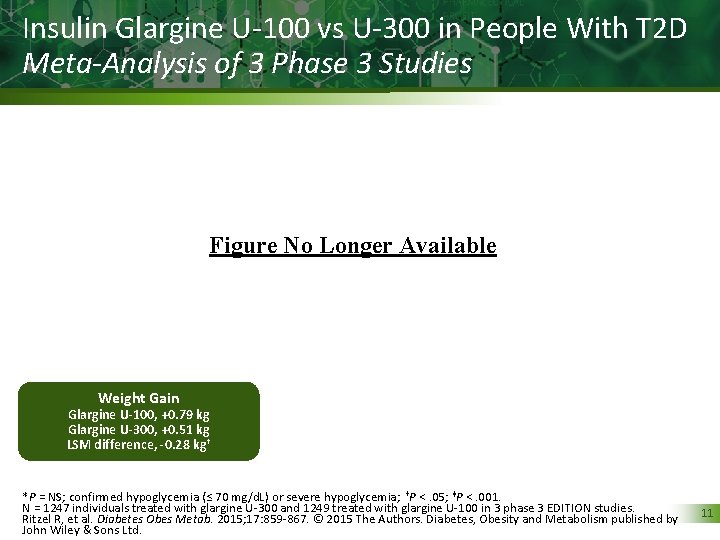
Insulin Glargine U-100 vs U-300 in People With T 2 D Meta-Analysis of 3 Phase 3 Studies Figure No Longer Available Weight Gain Glargine U-100, +0. 79 kg Glargine U-300, +0. 51 kg LSM difference, -0. 28 kg† *P = NS; confirmed hypoglycemia (≤ 70 mg/d. L) or severe hypoglycemia; †P <. 05; ‡P <. 001. N = 1247 individuals treated with glargine U-300 and 1249 treated with glargine U-100 in 3 phase 3 EDITION studies. Ritzel R, et al. Diabetes Obes Metab. 2015; 17: 859 -867. © 2015 The Authors. Diabetes, Obesity and Metabolism published by John Wiley & Sons Ltd. 11
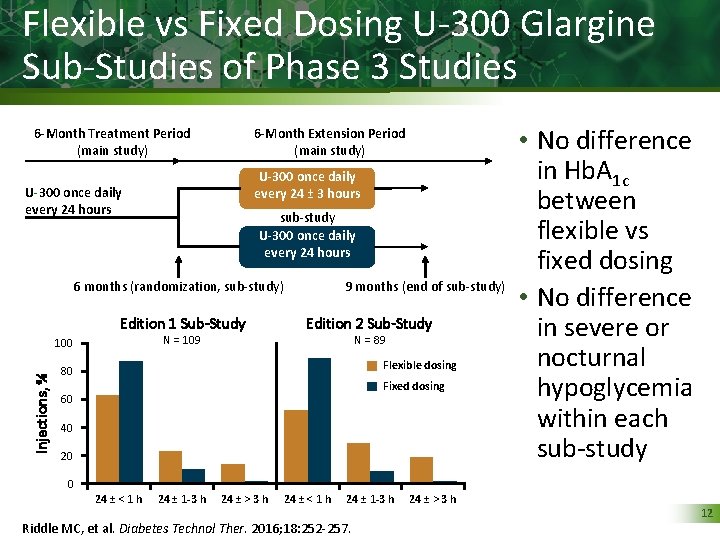
Flexible vs Fixed Dosing U-300 Glargine Sub-Studies of Phase 3 Studies 6 -Month Treatment Period (main study) 6 -Month Extension Period (main study) U-300 once daily every 24 ± 3 hours U-300 once daily every 24 hours sub-study U-300 once daily every 24 hours 6 months (randomization, sub-study) Edition 1 Sub-Study N = 109 Injections, % 100 9 months (end of sub-study) Edition 2 Sub-Study N = 89 Flexible dosing 80 Fixed dosing 60 40 20 • No difference in Hb. A 1 c between flexible vs fixed dosing • No difference in severe or nocturnal hypoglycemia within each sub-study 0 24 ± < 1 h 24 ± 1 -3 h 24 ± > 3 h 24 ± < 1 h 24 ± 1 -3 h Riddle MC, et al. Diabetes Technol Ther. 2016; 18: 252 -257. 24 ± > 3 h 12
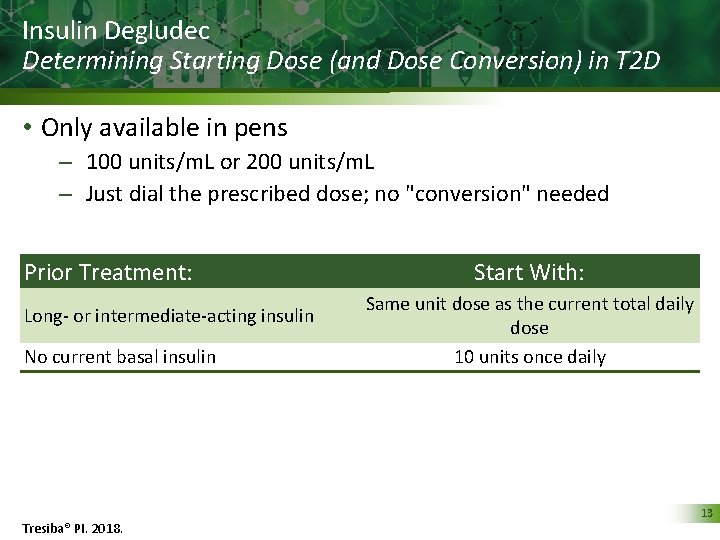
Insulin Degludec Determining Starting Dose (and Dose Conversion) in T 2 D • Only available in pens – 100 units/m. L or 200 units/m. L – Just dial the prescribed dose; no "conversion" needed Prior Treatment: Long- or intermediate-acting insulin No current basal insulin Start With: Same unit dose as the current total daily dose 10 units once daily 13 Tresiba® PI. 2018.
Insulin Degludec Hypoglycemia Figure No Longer Available Pooled hypoglycemia data from 5 phase 3 a trials in T 2 D: 3 trials of basal degludec U-100 vs glargine U-100; 1 trial of basal degludec U-200 vs glargine U-100; 1 trial of basal-bolus degludec U-100 vs glargine U-100 14 Ratner RE, et al. Diabetes Obes Metab. 2013; 15: 175 -184. © 2012 Blackwell Publishing Ltd
Flexible vs Fixed Dosing of Insulin Degludec Figure No Longer Available American Diabetes Association Meneghini L, et al. Diabetes Care. 2013; 36: 858 -864. Copyright and all rights reserved. Material from this publication has been used with the permission of American Diabetes Association. 15
![Ultra-Long-Acting Insulin Comparison U-300 Insulin Glargine[a] Insulin Degludec[b] Solo. Star® • 450 units/pen •](http://slidetodoc.com/presentation_image_h2/1d6ceae478d0f7cea7274f274d974e88/image-16.jpg "Ultra-Long-Acting Insulin Comparison U-300 Insulin Glargine[a] Insulin Degludec[b] Solo. Star® • 450 units/pen •")
Ultra-Long-Acting Insulin Comparison U-300 Insulin Glargine[a] Insulin Degludec[b] Solo. Star® • 450 units/pen • 1 to 80 units • 1 -unit increments U-100 Flex. Touch® • 300 units/pen • 1 to 80 units • 1 -unit increments Max Solo. Star® • 900 units/pen • 2 to 160 units • 2 -unit increments U-200 Flex. Touch® • 600 units/pen • 2 to 160 units • 2 -unit increments a. Toujeo® PI. 2018. b. Tresiba® PI. 2018. 16
Who May Benefit From Ultra-Long-Acting Insulins? • People not receiving a full 24 hours of coverage with their current basal insulin product • People with hectic/erratic schedules • People who require large daily doses of insulin • People experiencing nocturnal hypoglycemia with their current basal insulin 17
Reasons for Switching Insulin Products Medical Switching • Regimen complexity considerations • Adherence • Hypoglycemia • Glycemic control • Weight considerations • Dosing limitations (large insulin doses/injection) Non-Medical Switching • Formulary restrictions/changes • Cost • Care transitions Nguyen E, et al. Curr Med Res Opin. 2016; 32: 1281 -1290; Parkin C, et al. AADE Pract. 2017; 5: 16 -21. 18

Overcoming Insulin. Related Barriers Like a Pro Virginia Valentine, APRN, BCADM, CDE, FAADE APRN-Clinical Nurse Specialist Clinica La Esperanza Albuquerque, New Mexico
Barriers to Insulin Initiation Persons Living With Diabetes • Perception – Insulin as "last resort" – Personal failure • Concerns – – Hypoglycemia Long-term adverse effects Weight gain Social stigma • Fears – Needles – Pain of injecting • Convenience • Cost Brod M, et al. Patient. 2014; 7: 437 -450; Ng CJ, et al. Int J Clin Pract. 2015; 69: 1050 -1070. 20
Barriers to Insulin Initiation Clinicians • Lack of experience – Available insulin therapies – When to intensify therapy – How to intensify therapy • Perception of individual resistance • Inadequate data monitoring • Concerns – Hypoglycemia – Weight gain • General clinical inertia • Lack of education and training resources 21 Brod M, et al. Patient. 2014; 7: 437 -450; Ng CJ, et al. Int J Clin Pract. 2015; 69: 1050 -1070.
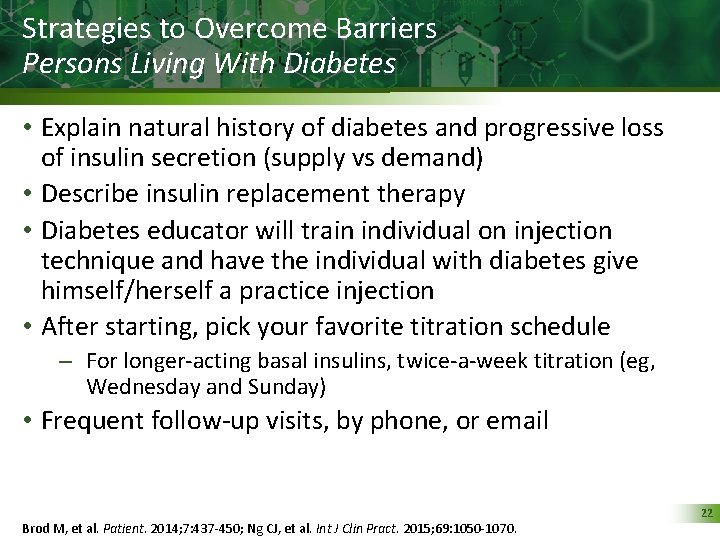
Strategies to Overcome Barriers Persons Living With Diabetes • Explain natural history of diabetes and progressive loss of insulin secretion (supply vs demand) • Describe insulin replacement therapy • Diabetes educator will train individual on injection technique and have the individual with diabetes give himself/herself a practice injection • After starting, pick your favorite titration schedule – For longer-acting basal insulins, twice-a-week titration (eg, Wednesday and Sunday) • Frequent follow-up visits, by phone, or email 22 Brod M, et al. Patient. 2014; 7: 437 -450; Ng CJ, et al. Int J Clin Pract. 2015; 69: 1050 -1070.
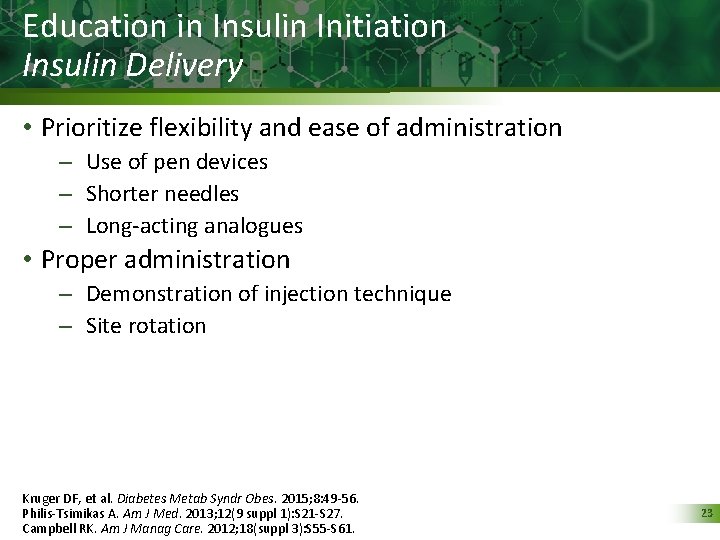
Education in Insulin Initiation Insulin Delivery • Prioritize flexibility and ease of administration – Use of pen devices – Shorter needles – Long-acting analogues • Proper administration – Demonstration of injection technique – Site rotation Kruger DF, et al. Diabetes Metab Syndr Obes. 2015; 8: 49 -56. Philis-Tsimikas A. Am J Med. 2013; 12(9 suppl 1): S 21 -S 27. Campbell RK. Am J Manag Care. 2012; 18(suppl 3): S 55 -S 61. 23
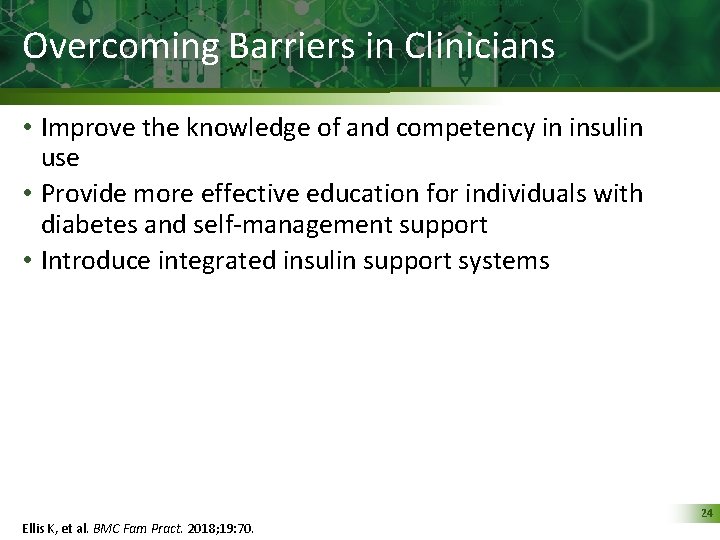
Overcoming Barriers in Clinicians • Improve the knowledge of and competency in insulin use • Provide more effective education for individuals with diabetes and self-management support • Introduce integrated insulin support systems 24 Ellis K, et al. BMC Fam Pract. 2018; 19: 70.
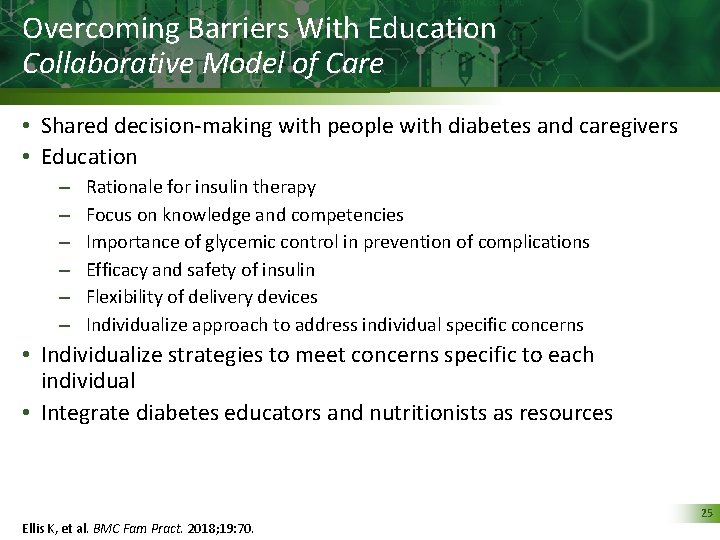
Overcoming Barriers With Education Collaborative Model of Care • Shared decision-making with people with diabetes and caregivers • Education – – – Rationale for insulin therapy Focus on knowledge and competencies Importance of glycemic control in prevention of complications Efficacy and safety of insulin Flexibility of delivery devices Individualize approach to address individual specific concerns • Individualize strategies to meet concerns specific to each individual • Integrate diabetes educators and nutritionists as resources 25 Ellis K, et al. BMC Fam Pract. 2018; 19: 70.

Case Challenges! Maggie A. Powers, Ph. D, RD, CDE Health. Partners Institute Minneapolis, Minnesota
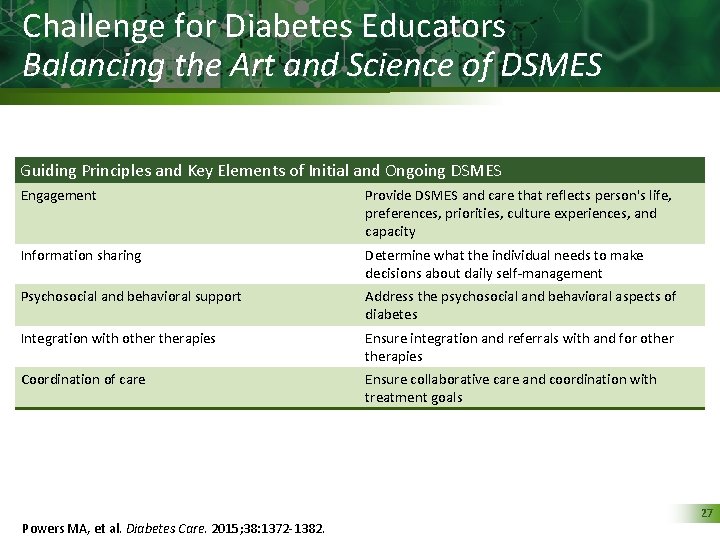
Challenge for Diabetes Educators Balancing the Art and Science of DSMES Guiding Principles and Key Elements of Initial and Ongoing DSMES Engagement Provide DSMES and care that reflects person's life, preferences, priorities, culture experiences, and capacity Information sharing Determine what the individual needs to make decisions about daily self-management Psychosocial and behavioral support Address the psychosocial and behavioral aspects of diabetes Integration with otherapies Ensure integration and referrals with and for otherapies Coordination of care Ensure collaborative care and coordination with treatment goals 27 Powers MA, et al. Diabetes Care. 2015; 38: 1372 -1382.
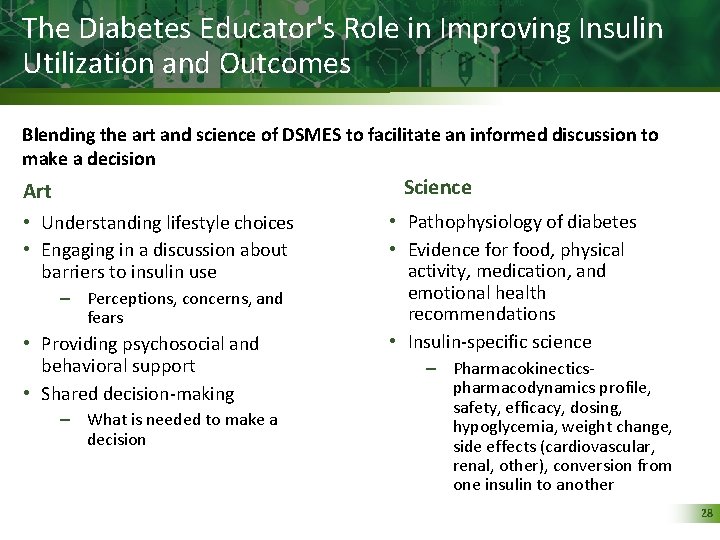
The Diabetes Educator's Role in Improving Insulin Utilization and Outcomes Blending the art and science of DSMES to facilitate an informed discussion to make a decision Science Art • Understanding lifestyle choices • Engaging in a discussion about barriers to insulin use – Perceptions, concerns, and fears • Providing psychosocial and behavioral support • Shared decision-making – What is needed to make a decision • Pathophysiology of diabetes • Evidence for food, physical activity, medication, and emotional health recommendations • Insulin-specific science – Pharmacokinecticspharmacodynamics profile, safety, efficacy, dosing, hypoglycemia, weight change, side effects (cardiovascular, renal, other), conversion from one insulin to another 28
Case Vignette: Part 1 Introduction to EW, a person with T 2 D and SE, a diabetes educator
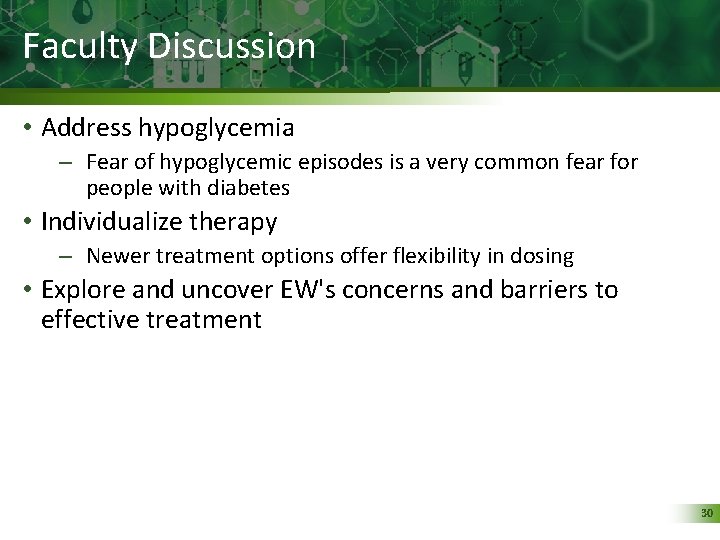
Faculty Discussion • Address hypoglycemia – Fear of hypoglycemic episodes is a very common fear for people with diabetes • Individualize therapy – Newer treatment options offer flexibility in dosing • Explore and uncover EW's concerns and barriers to effective treatment 30
Faculty Discussion (cont) • Utilize diabetes educators if possible • Educate patient along the continuum of care • Offer positive reinforcement for tiny successes and big successes 31
Faculty Discussion (cont) • Longer-acting basal insulins may be advantageous to those with poor medication adherence • Fixed-ratio injectable combinations are available – Insulin degludec/liraglutide – Insulin glargine/lixisenatide – Control fasting and postprandial glucose • Missed dose of insulin degludec can be administered > 8 hours after last dose • Longer-acting basal insulins offer greater flexibility in dosing 32
Case Vignette: Part 2 Factors to consider when changing therapy
Faculty Discussion • Avoid clinical inertia • Advance or change therapy if Hb. A 1 c not at goal 34
Case Vignette: Part 3 Routine follow-up visit, 3 months later
Faculty Discussion • Reinforce and emphasize the positives • Offer encouragement and support 36
Thank you for participating in this activity. Please proceed to answer the post-activity assessment questions and receive credit. Please also take a moment to complete the program evaluation.
- Slides: 37