
Basal ganglia Dr K Shankar Bhat Sr Prof
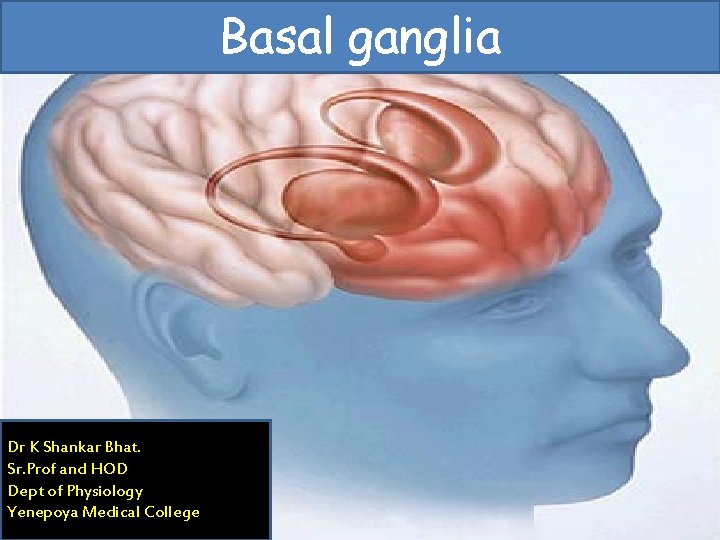
Basal ganglia Dr K Shankar Bhat. Sr. Prof and HOD Dept of Physiology Yenepoya Medical College
Group of nuclei underlying the cortical mantle & are functionally related. • Caudate nucleus. • Putamen nucleus • Globus pallidus( Pallidium / Paleostriatum ). Ø GPE (external segment) Ø GPI (internal segment) • Subthalamic nucleus(Body of Luys). • Substantia nigra. Ø Pars compacta Ø Pars reticulata
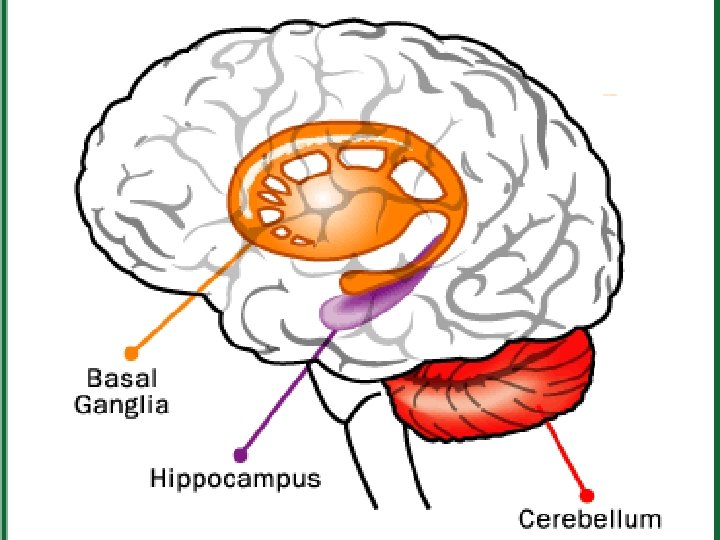
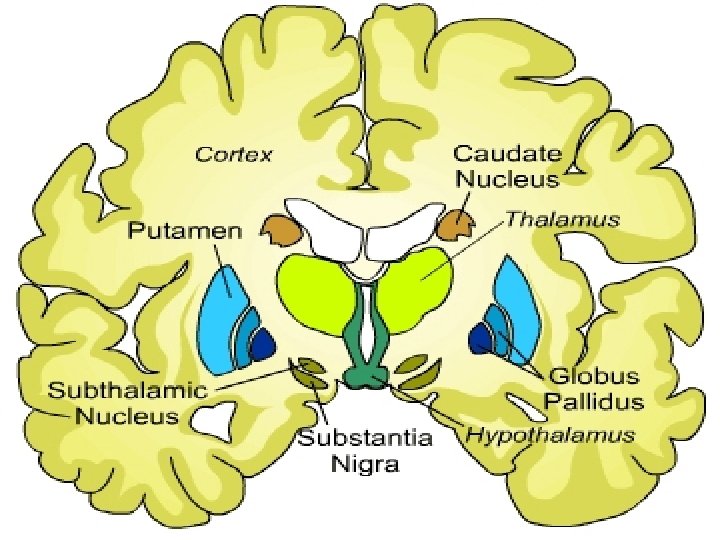

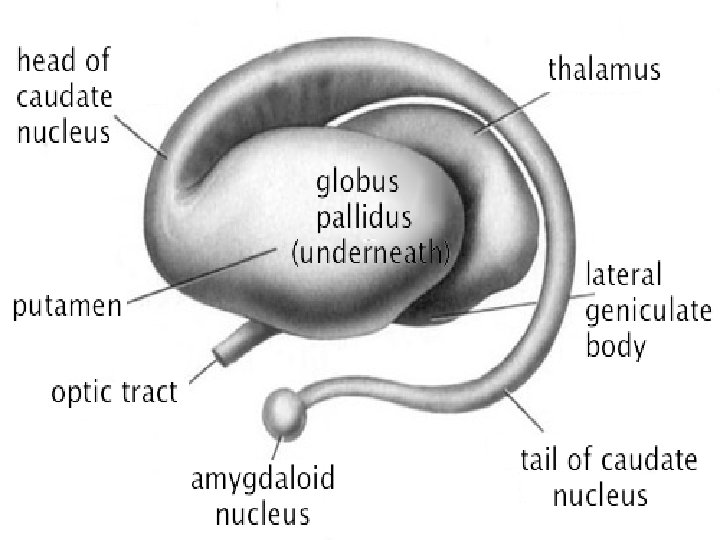
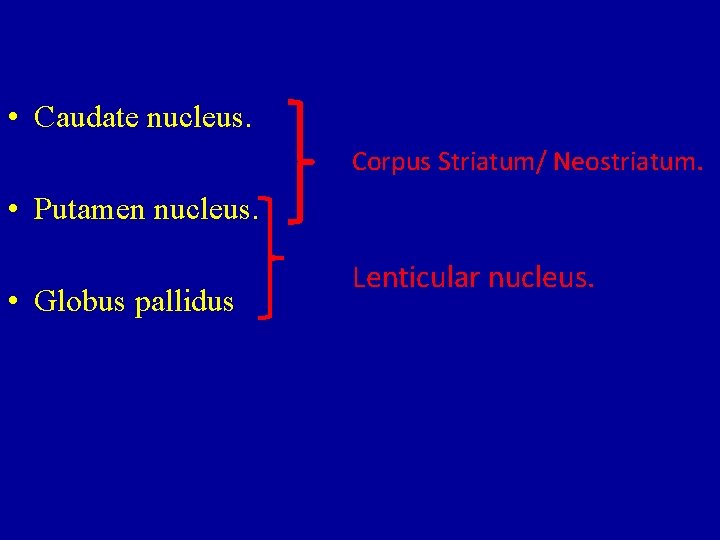
• Caudate nucleus. Corpus Striatum/ Neostriatum. • Putamen nucleus. • Globus pallidus Lenticular nucleus.

Connections :
Afferents:
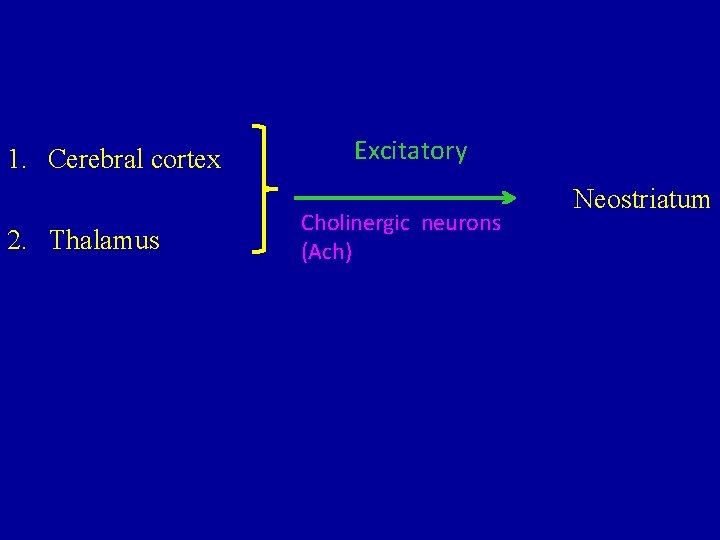
1. Cerebral cortex 2. Thalamus Excitatory Cholinergic neurons (Ach) Neostriatum

Internuclear:
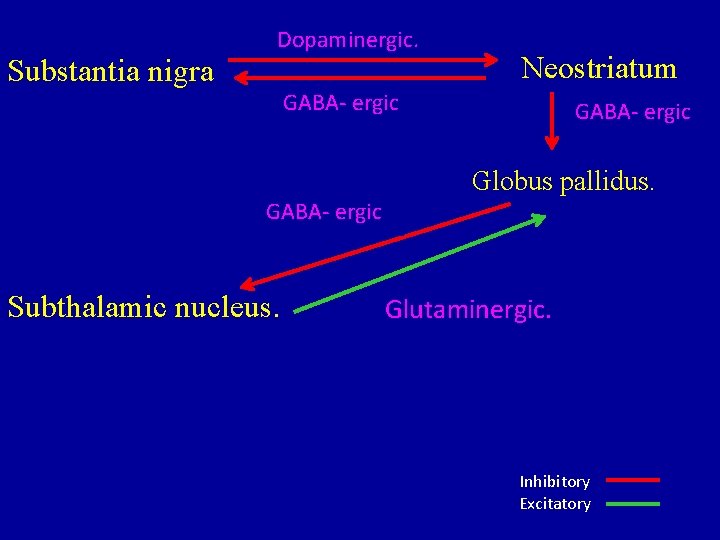
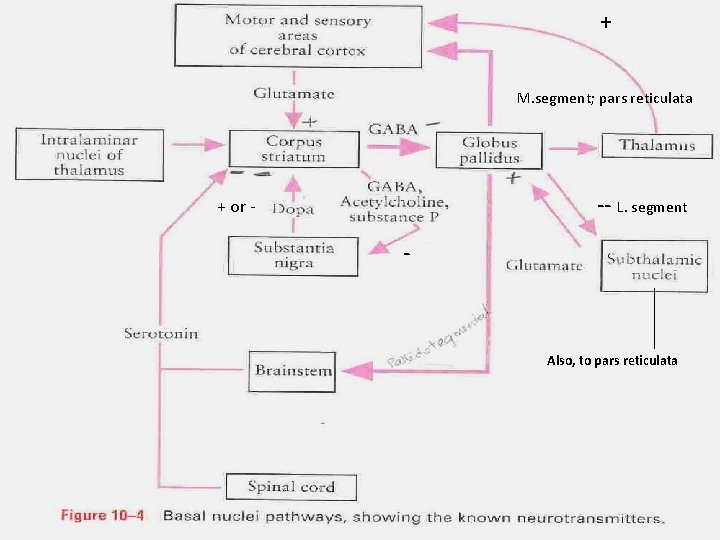
Substantia nigra Dopaminergic. Neostriatum GABA- ergic Subthalamic nucleus. GABA- ergic Globus pallidus. Glutaminergic. Inhibitory Excitatory
Efferent's:
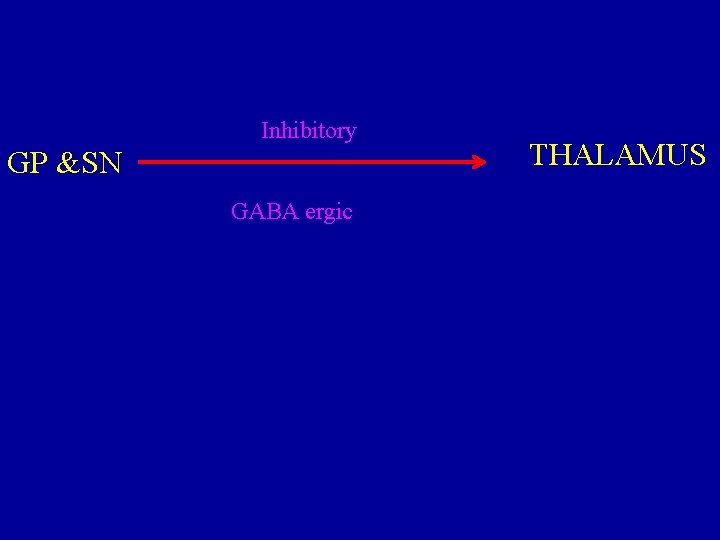
Inhibitory GP &SN GABA ergic THALAMUS
Important connections of Basal ganglia
Main afferents /inputs
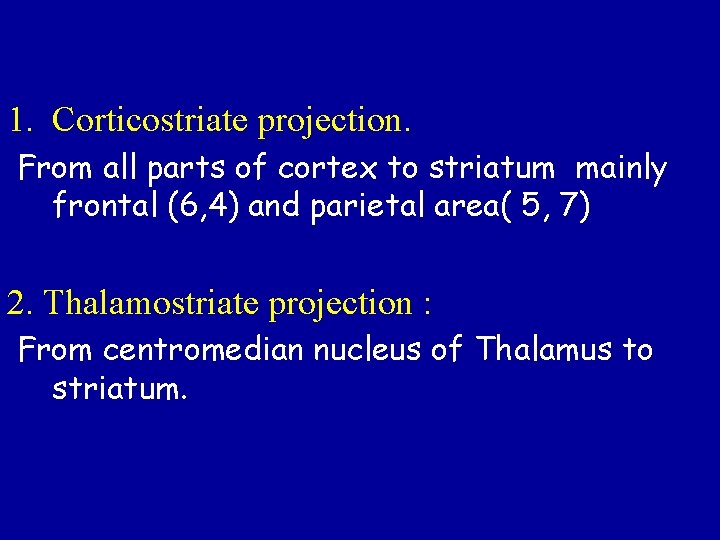
1. Corticostriate projection. From all parts of cortex to striatum mainly frontal (6, 4) and parietal area( 5, 7) 2. Thalamostriate projection : From centromedian nucleus of Thalamus to striatum.
Inter connections of basal ganglia……
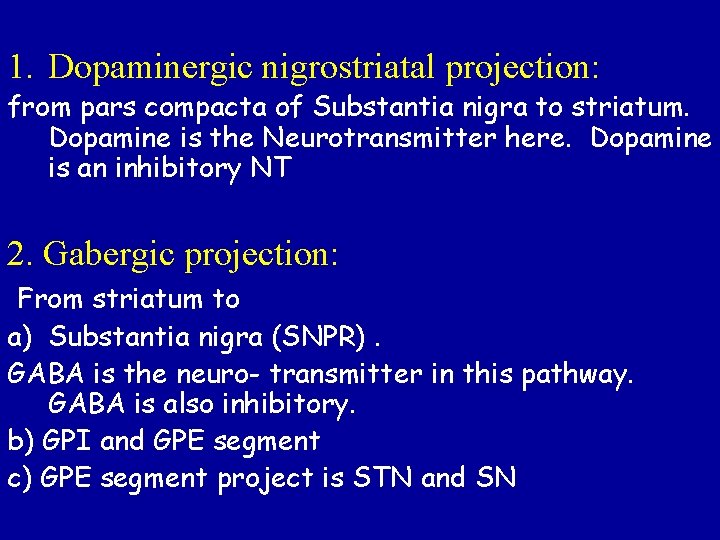
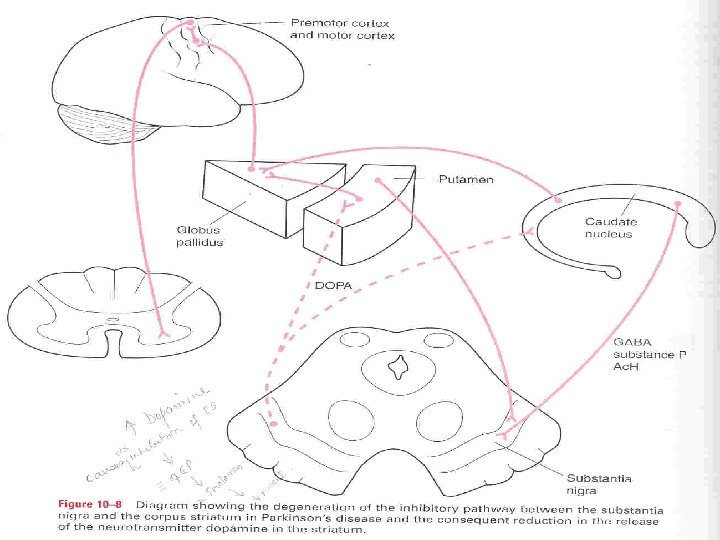
1. Dopaminergic nigrostriatal projection: from pars compacta of Substantia nigra to striatum. Dopamine is the Neurotransmitter here. Dopamine is an inhibitory NT 2. Gabergic projection: From striatum to a) Substantia nigra (SNPR). GABA is the neuro- transmitter in this pathway. GABA is also inhibitory. b) GPI and GPE segment c) GPE segment project is STN and SN
3. Cholinergic projection: It is present in the intrastriatal connections. Ach is the neurotransmitter & it is excitatory. 4. Caudate nucleus & Putamen to Globus pallidus. 5. Globus pallidus to Subthalamic nucleus. 6. Subthalamic nucleus to Globus pallidus and Substantia nigra.
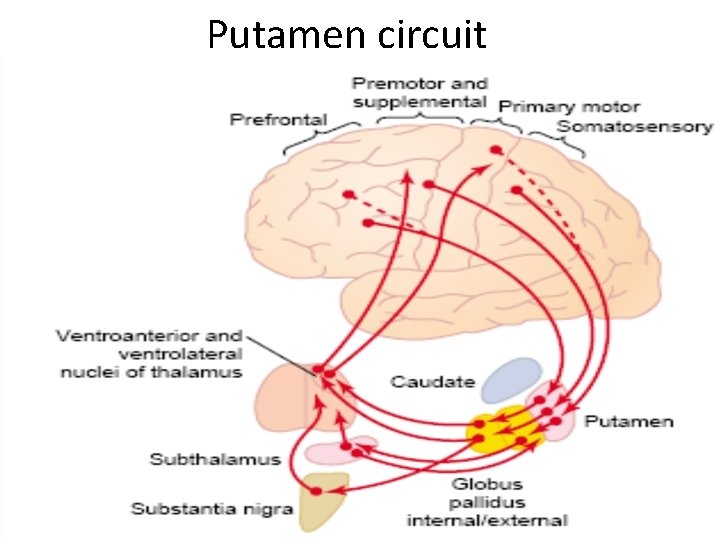
Putamen circuit
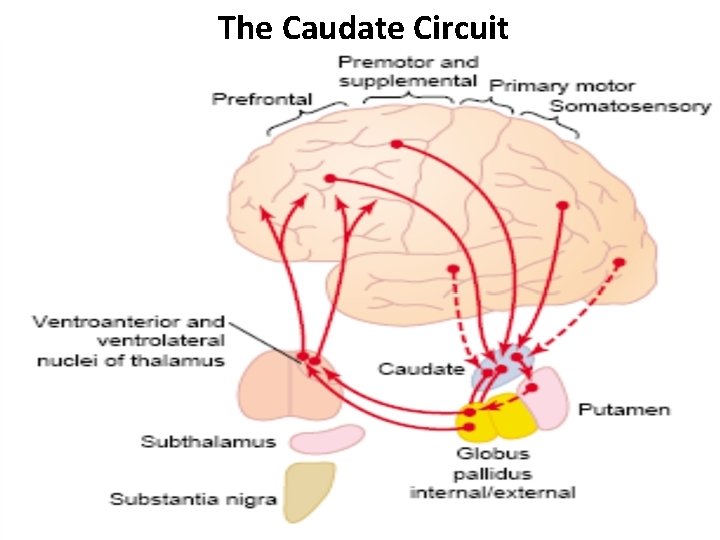
The Caudate Circuit
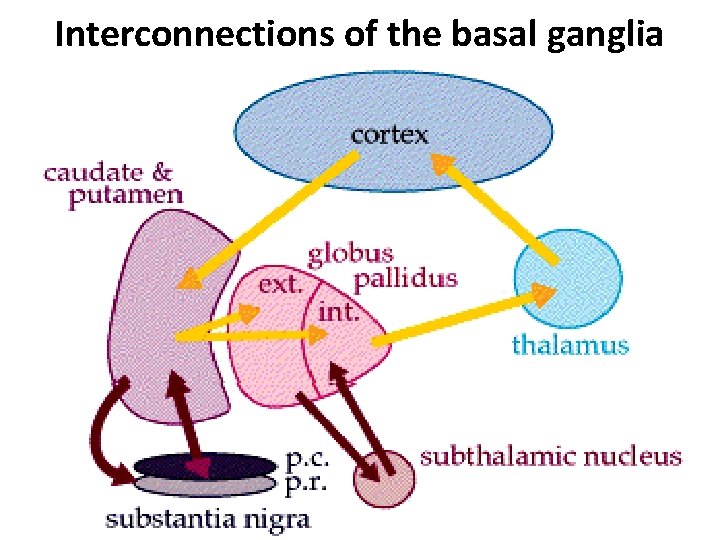
Interconnections of the basal ganglia
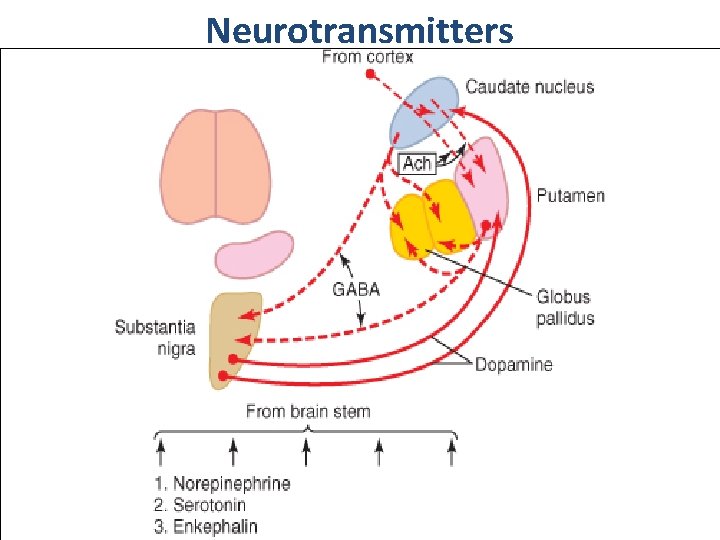
Neurotransmitters
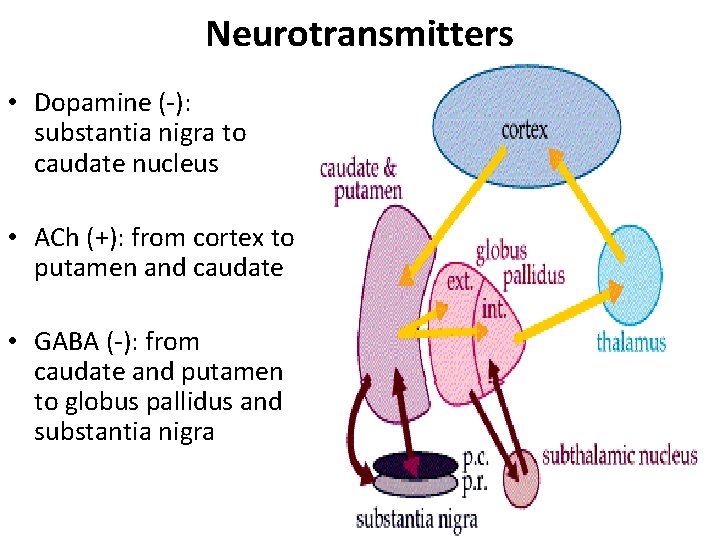
Neurotransmitters • Dopamine (-): substantia nigra to caudate nucleus • ACh (+): from cortex to putamen and caudate • GABA (-): from caudate and putamen to globus pallidus and substantia nigra
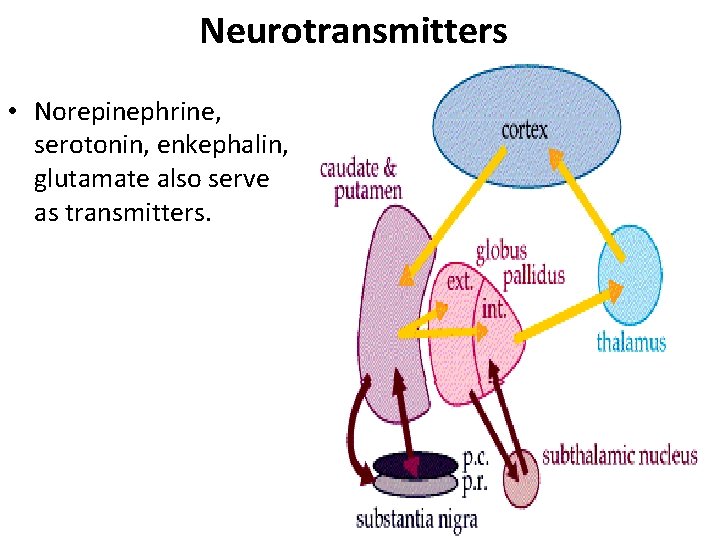
Neurotransmitters • Norepinephrine, serotonin, enkephalin, glutamate also serve as transmitters.
Principal efferent's (outputs) from Basal ganglia:
1. From Globus pallidus (Gpi) via thalamic nuclei to prefrontal & Premotor cortex (VL, VA&CM) (Pallido- Thalamic) (Excitatory – cholinergic) 2. From Substantia nigra to thalamus.
Main feature of basal ganglia connection (feed back circuit)
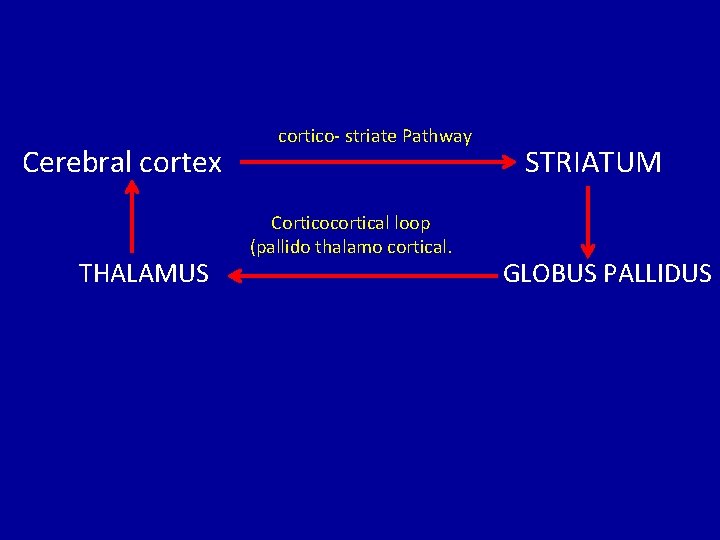
Cerebral cortex THALAMUS cortico- striate Pathway Corticocortical loop (pallido thalamo cortical. STRIATUM GLOBUS PALLIDUS
Functions of basal ganglia
1. Necessary for normal degree of muscle tone & posture. It has inhibitory check over on the tone of the muscles as well as on the motor cortex. So lesion of BG cause rigidity. 2. Planning & programming of movement: Basal ganglia aid the motor cortex in generating commands that control proximal muscle groups during a movement. The process by which an abstract thought is converted into voluntary action. .
3. Control of large subconscious movements. Associated movements, of skeletal muscle such as swinging the arms while walking, panorama of facial expressions associated with emotions. Caudate nucleus, Putamen. . 4. Putamen is concerned with complex pattern of motor activity. Writing the letters of alphabet.
5. Globus pallidus regulates muscle tone. 6. Caudate nucleus plays a major rate in the cognitive control of motor activity, the movements as a result of thought in the mind. 7. Control the timing & Intensity of movements. 8. Intact B. G. Inhibits the appearance of static tremor 9. Subthalamic nucleus maintains movement in a smooth and appropriate state. 10. In lower animals (insects, reptiles, birds) acts like functions of cerebral cortex like command initiation of gross or fine movements.

DISORDERS OF BASAL GANGLIA – clinical manifestations:
Diseases of BG in humans produce characteristic abnormalities of Motor function. 1. 2. 3. 4. 5. Parkinson’s disease/paralysis agitans. Chorea and Athetosis. Huntington’s disease. Hemiballism. Wilsons disease or progressive hepatolenticular degeneration. 6. Kernicturus.
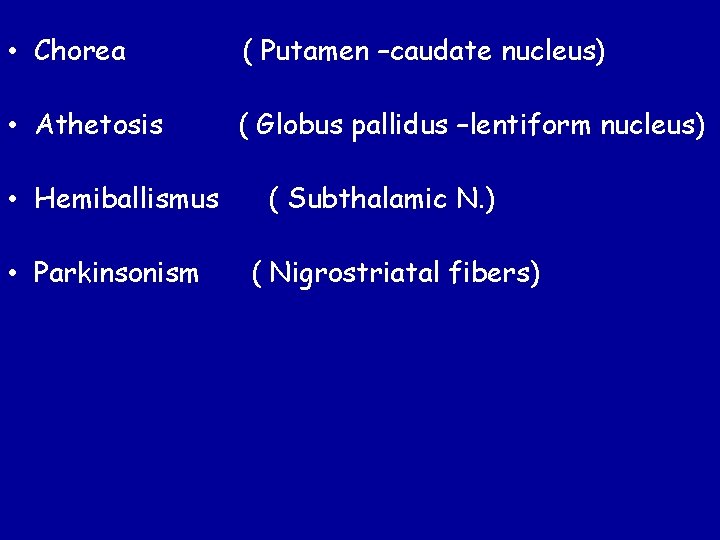
• Chorea ( Putamen –caudate nucleus) • Athetosis ( Globus pallidus –lentiform nucleus) • Hemiballismus • Parkinsonism ( Subthalamic N. ) ( Nigrostriatal fibers)
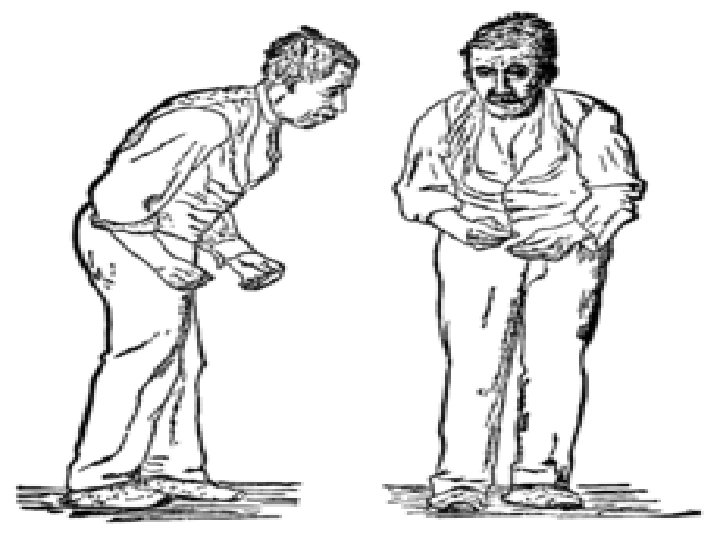
Parkinson’s disease/ Parkinsonism/ Paralysis agitans: Agitans = Shaking: Shaking palsy. Characteristics: • Hyperkinesia: Rigidity & Tremors. • Hypokinesia: Poverty or weakness of movements. Cause: • Degeneration of Substantia nigra or Globus pallidus or both. • Dopamine concentration is reduced in nigrostriatal system.
Signs & symptoms

1. Rigidity: Extrapyramindal rigidity. • Large proximal groups of miscles of the limbs are affected, both protagonists and antagonists are involved. Eg. Triceps, knee flexors & Sternomastoids. Posture : • Flexion attitude , statue like rigidity is due to increase discharge of efferent's to muscle spindles -> increase stretch reflex –> increase muscle tone.
Types of rigidity: a. Lead- pipe rigidity: Passive movement of a limb meets with a plastic dead feeling resistance as if bending a lead pipe. b. Cog- wheal rigidity: Resistance to passive movement regularly or irregularly variable series of catches.
2. Tremor: Regular, rhythmic, alternate contractions of antagonists, protagonist muscles @ 6 -8 times/sec. PILL ROLLING movements = Rhythmic contraction of thumb over first two fingers. Tremor is seen in fingers, hands, lips and tongue.
Resting/static tremor Intention tremor = cerebellar disease. • Cause of tremor is lack of damping effect on stretch reflex by γ efferent's by RF. • Tremor increase in emotional states due to epinephrine secretion. Epinephrine excites RAS. • During sleep no tremor due to decrease activity of RAS.
3. Akinesia/ Hypokinesia: • Weakness or poverty of movement • Difficult in initiating voluntary movement –>Defect in fine movements of the fingers. • Defects in fine variations of speech –> slow monotonous speech
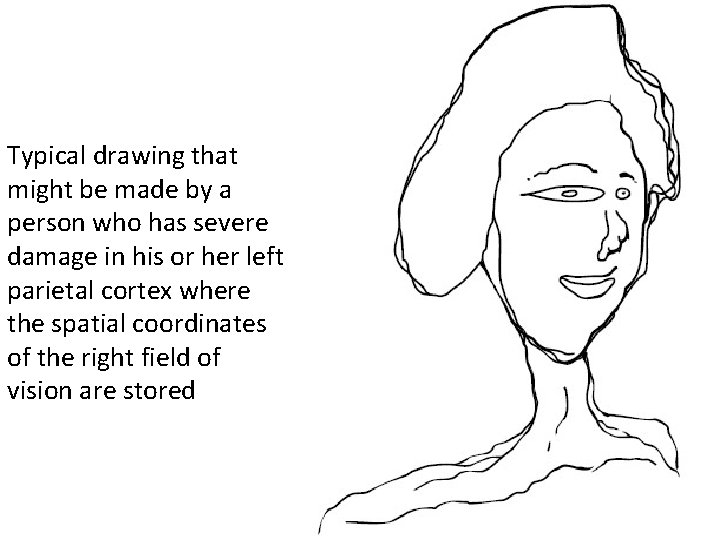
Typical drawing that might be made by a person who has severe damage in his or her left parietal cortex where the spatial coordinates of the right field of vision are stored
• Mask- like face. No emotional movements of facial muscles. • Absence of normal subconscious associated movements. No swinging of arms during walking. • Shuffling gait/festinate gait- walking quickly with short steps. • Weak deep reflexes/tendon jerks.
Treatment: Administration of • L- DOPA (Levo – Dopa) the rigidity and tremors. Dopamine cannot be given as it cannot cross the BBB. • Atropine, an anticholinergic agent can control that tremors of the disease. • Parkinson's disease usually occurs in late middle age commonly in males.
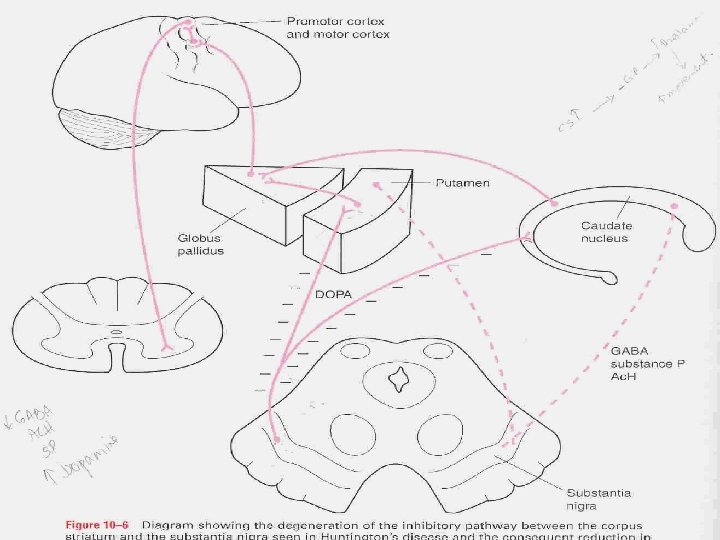
Huntington’s Disease • It is an degenerative autosomal dominant inherited disease with the onset occurring in adult life. • Within the striatum, there is progressive ; particular attrition of the cells that project to the lateral segment of the Globus pallidus. • This leads to disinhibition of the lateral pallidal neurons and inhibition of Subthalamic nucleus. Medial pallidal neurons , therefore , become abnormally underactive and unwanted;
The following signs is present: • Choreiform movements first appear as involuntary movements of the extremities and twitching of the face (facial grimacing). • Later, more muscle groups are involved so the patient becomes immobile and unable to speak or swallow. • Progressive dementia occurs with loss of memory and intellectual capacity. • There is degeneration of the GABA; P-secreting and acetylcholine-secreting.
Wilson Disease (Hepato lenticular Degeneration) • Inheritance of a mutation on chromosome 13. • The mutation prevents the body from eliminating excess copper. • Ceruloplasmin is the protein that binds and removes excess copper and its levels are greatly reduced in this disorder. Too much copper in the system damages the cells of the liver and leads to cirrhosis. • Neurological damage primarily occurs in the Putamen and Globus pallidus, collectively known as the lenticular nucleus.
Symptoms : - • A peculiar type of tremor in the upper extremities, slowness of movement and changes in temperament. • Persons may become exceptionally argumentative. • Overly emotional. • Decrease in mental capabilities. • Kayser-Fleischer rings (a rusty brown discoloration at the rims of the corneas) as the copper begins to affect the nervous system. • The disease first affects the liver, and if treatment is administered early enough, damage to the nervous system is dramatically reduced.
Treatment : • Elimination of copper containing foods such as chocolate and mushrooms. • Chelate excess copper and eliminate it from the body.
Hemiballismus: • very rare movement disorder. • It caused by a lesion of Subthalamic nucleus. Common cause is Haemorrhage within the nucleus. • usually characterized by involuntary flinging motions of the extremities. • The movements are often violent and have wide amplitudes of motion. • The more a patient is active, the more the movements increase. With relaxation comes a decrease in movements.
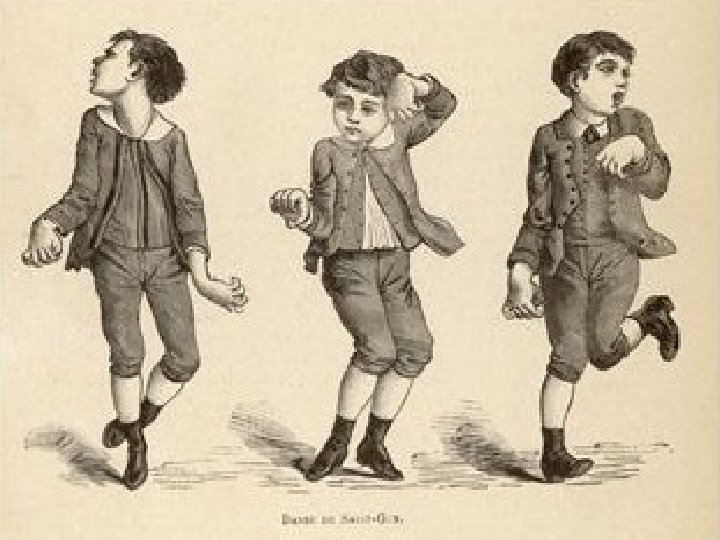
CHOREA: • The word "chorea" comes from the Greek word for dance. • It is due to the presence of selective destructive lesion of D 2 receptor neurons in Caudate nucleus. • The jerky movements of the feet or hands are often similar to dancing or piano playing. • • When chorea is severe, the movements may cause motion of the arms or legs that results in throwing whatever is in the hand or falling to the ground. • Walking may become bizarre, with inserted excessive postures and leg movements.
Chorea is seen frequently in children as a complication of rheumatic fever.
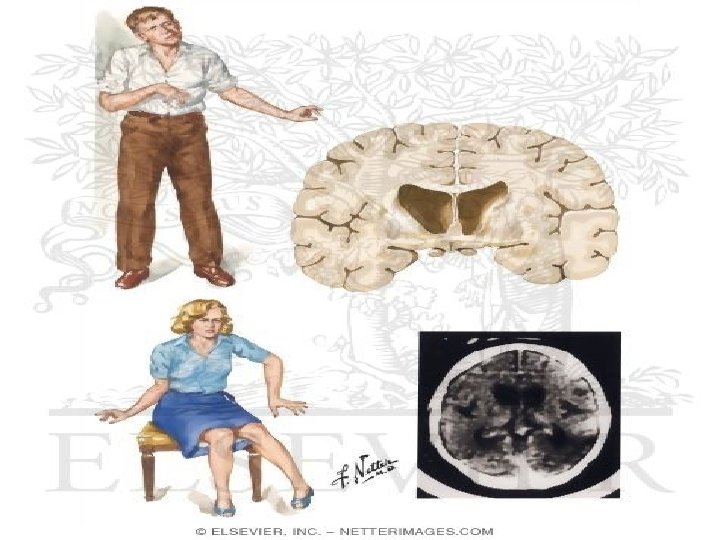
HUNTINGTON’S CHOREA • By George Huntington's chorea is a dominantly inherited disease which is passed down through families by an autosomal dominant form of inheritance. • involuntary movements of the body especially of arms, legs and face. These movements tend to be spastic and ballistic, and they dramatically affect normal functioning. • Cause : Bilateral atrophy of the head of the caudate nucleus and Putamen. • Widespread loss of cholinergic and GABAergic neurons
SYDENHAM’S CHOREA / Saint Vitus Dance • Immunologic disorder. • Associated with Rheumatic fever. • Transient, full recovery. • Disease characterized by rapid, uncoordinated jerking movements affecting primarily the face, feet and hands. • Adult onset of Sydenham‘s Chorea is comparatively rare and most of the adult cases are associated with exacerbation of chorea following childhood Sydenham's Chorea. • Destruction of the cells in the Corpus striatum of the BG.
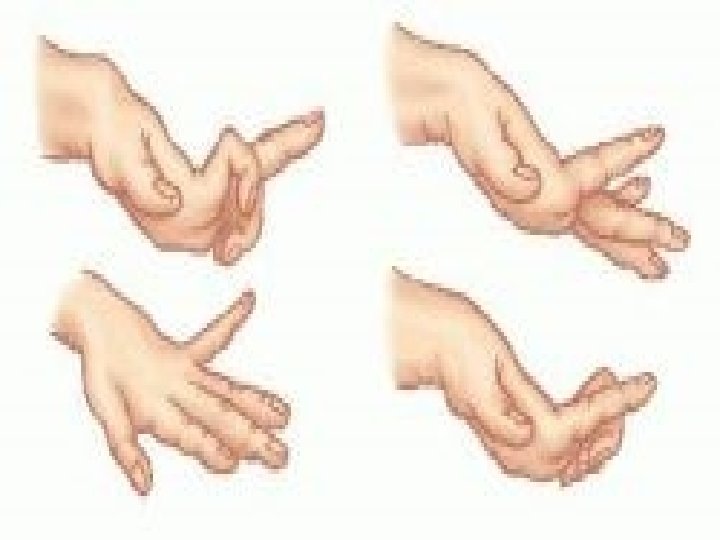
Athetosis • It means unfixed or changeable. • Characterized by inability to fix the muscles of the fingers, toes, tongue etc in one position. • involuntary convoluted, writhing movements of the fingers, arms, legs, and neck. • Movements typical of athetosis are sometimes called athetoid movements. • Condition develop due to the lesion in the Lenticular nucleus.
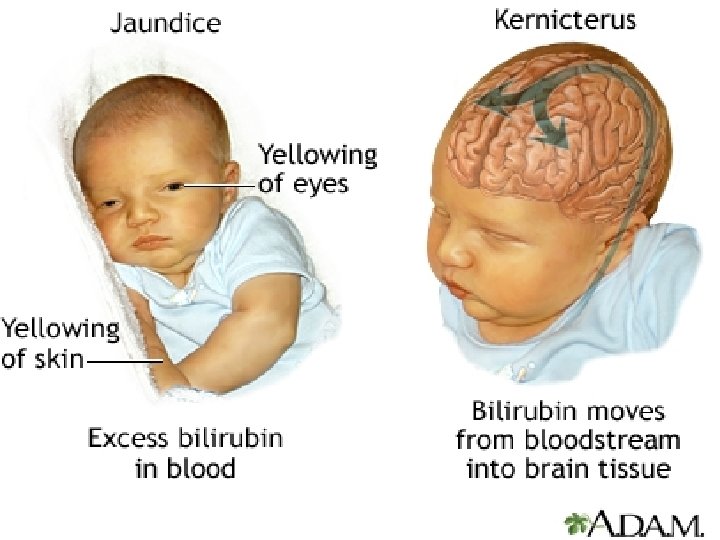
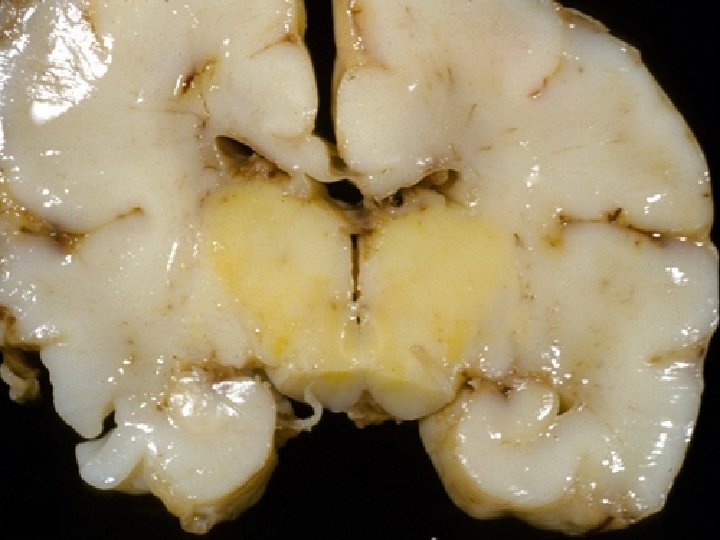
kernicterus: Kernicterus is a form of brain damage caused by excessive jaundice. The substance which causes jaundice, Bilirubin, is so high that it can move out of the blood into brain tissue. Regions most commonly affected include the basal ganglia. If the baby survive , it may show rigidity, Chorea, Athetosis, and mental deficiency.

+ M. segment; pars reticulata -- L. segment + or - - Also, to pars reticulata
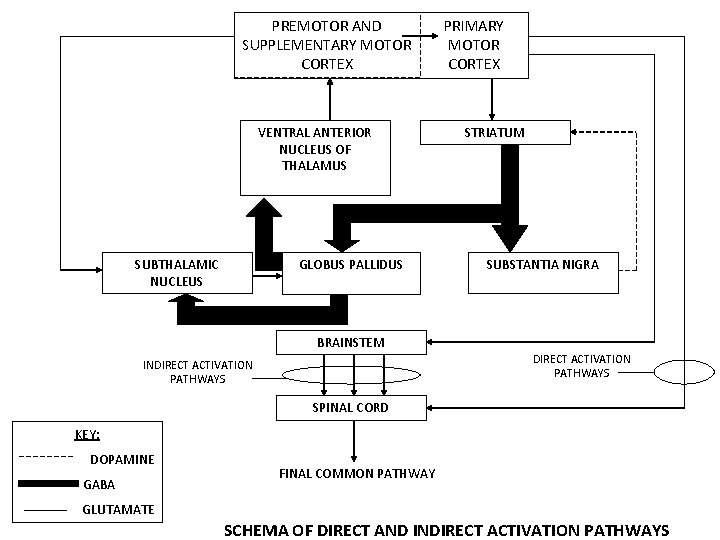
PREMOTOR AND SUPPLEMENTARY MOTOR CORTEX VENTRAL ANTERIOR NUCLEUS OF THALAMUS SUBTHALAMIC NUCLEUS GLOBUS PALLIDUS PRIMARY MOTOR CORTEX STRIATUM SUBSTANTIA NIGRA BRAINSTEM DIRECT ACTIVATION PATHWAYS INDIRECT ACTIVATION PATHWAYS SPINAL CORD KEY: DOPAMINE GABA FINAL COMMON PATHWAY GLUTAMATE SCHEMA OF DIRECT AND INDIRECT ACTIVATION PATHWAYS
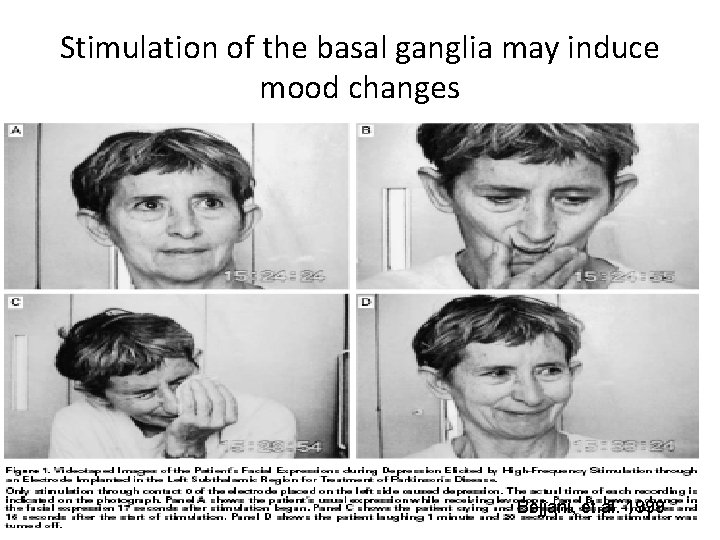
Stimulation of the basal ganglia may induce mood changes Bejjani, et al. 1999
- Slides: 71