
Basal Ganglia Basal Ganglia Subcortical Masses of gray
? ? ? Basal Ganglia
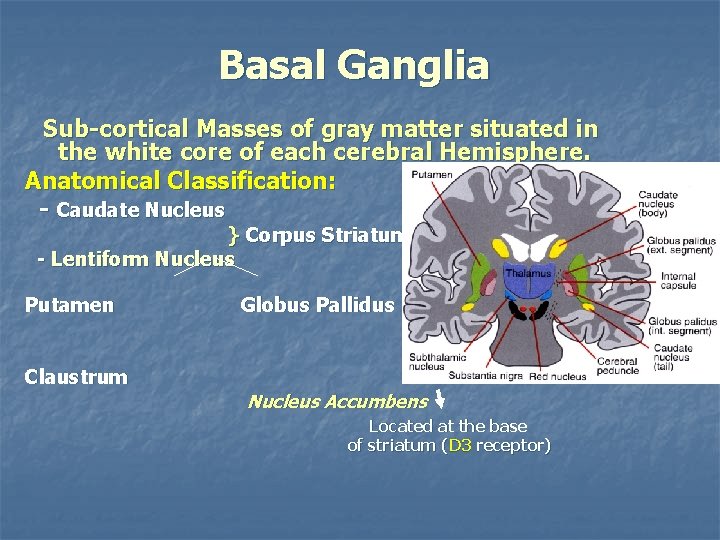
Basal Ganglia Sub-cortical Masses of gray matter situated in the white core of each cerebral Hemisphere. Anatomical Classification: - Caudate Nucleus } Corpus Striatum - Lentiform Nucleus Putamen Claustrum Globus Pallidus Nucleus Accumbens Located at the base of striatum ( D 3 receptor)
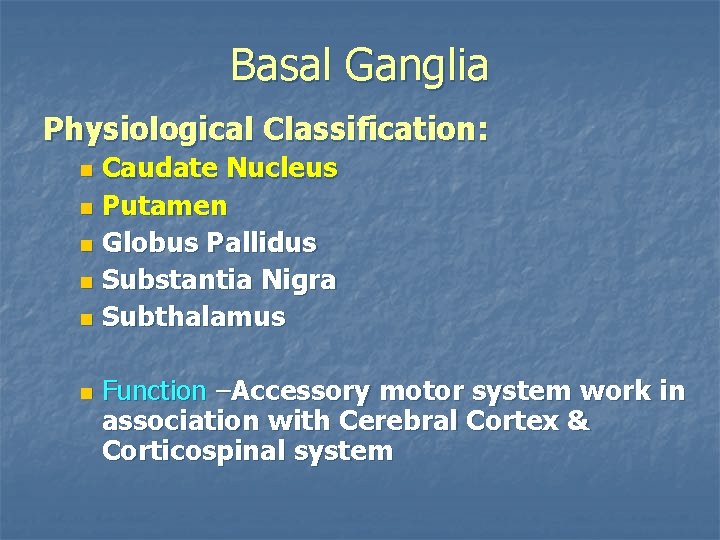
Basal Ganglia Physiological Classification: Caudate Nucleus n Putamen n Globus Pallidus n Substantia Nigra n Subthalamus n n Function –Accessory motor system work in association with Cerebral Cortex & Corticospinal system
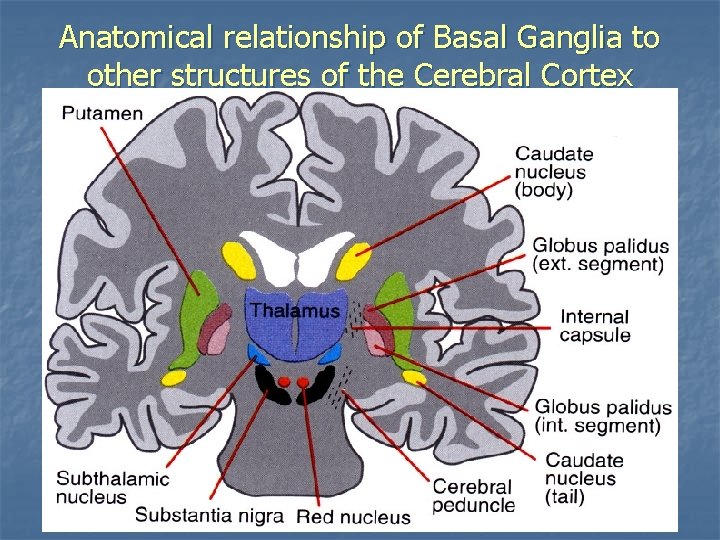
Anatomical relationship of Basal Ganglia to other structures of the Cerebral Cortex
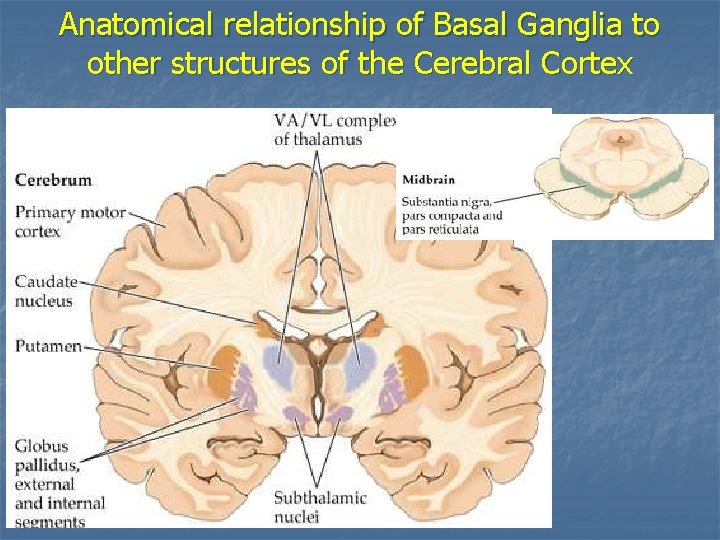
Anatomical relationship of Basal Ganglia to other structures of the Cerebral Cortex
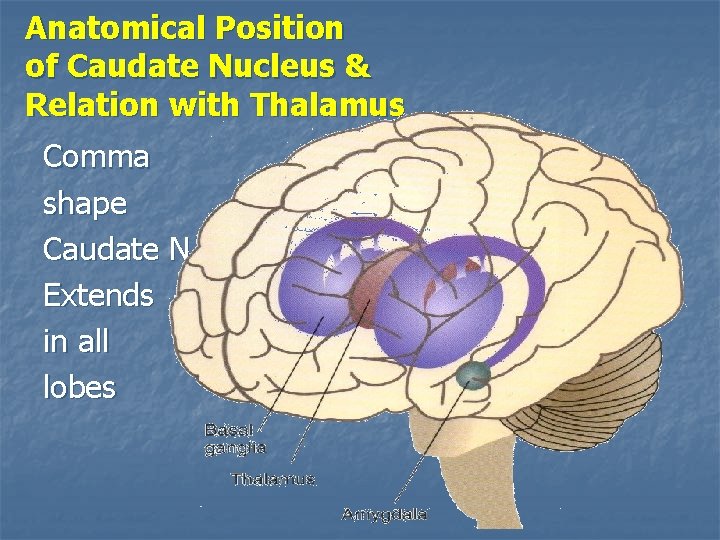
Anatomical Position of Caudate Nucleus & Relation with Thalamus Comma shape Caudate N Extends in all lobes
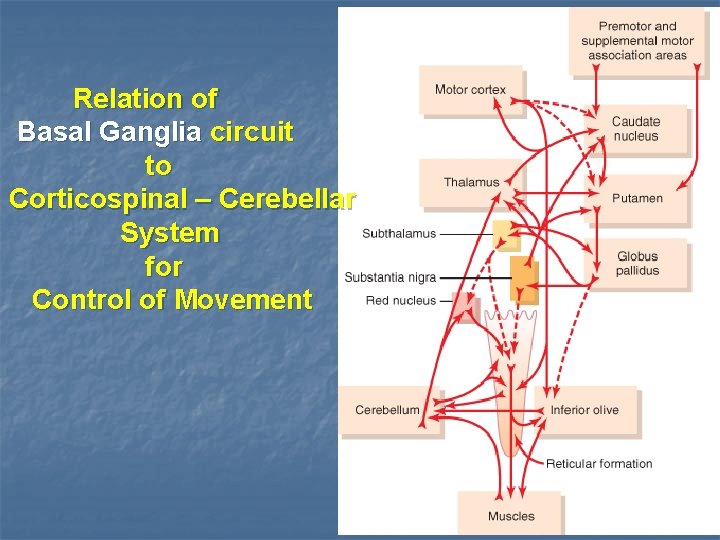
Relation of Basal Ganglia circuit to Corticospinal – Cerebellar System for Control of Movement
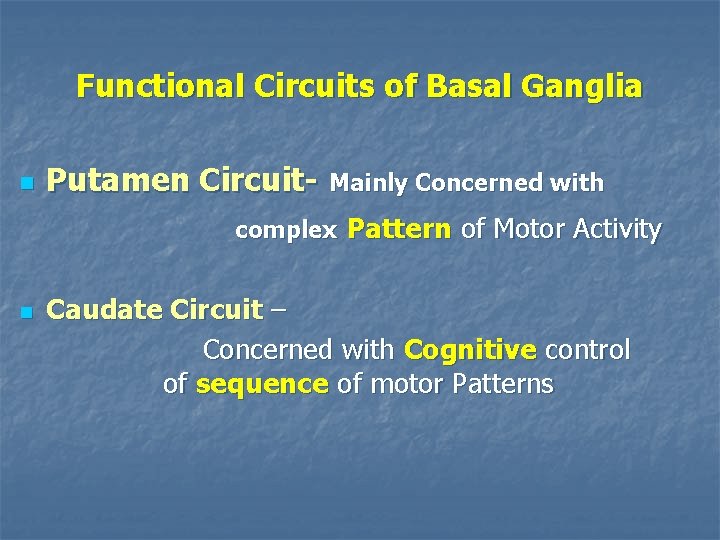
Functional Circuits of Basal Ganglia n Putamen Circuit- Mainly Concerned with complex Pattern of Motor Activity n Caudate Circuit – Concerned with Cognitive control of sequence of motor Patterns
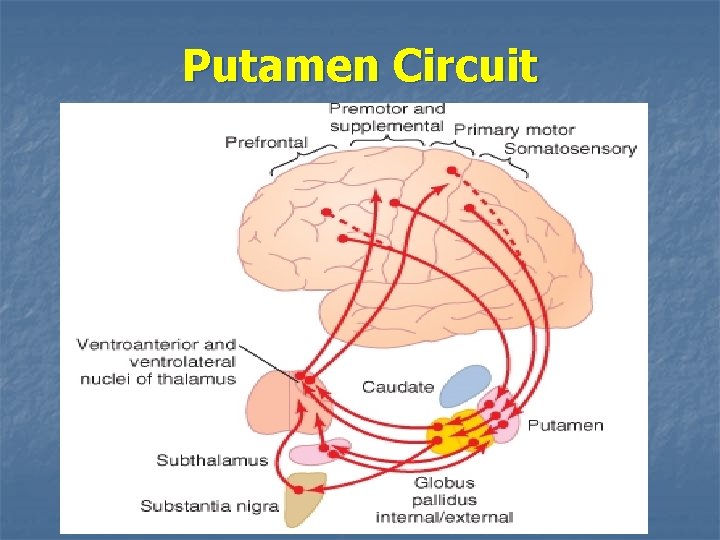
Putamen Circuit
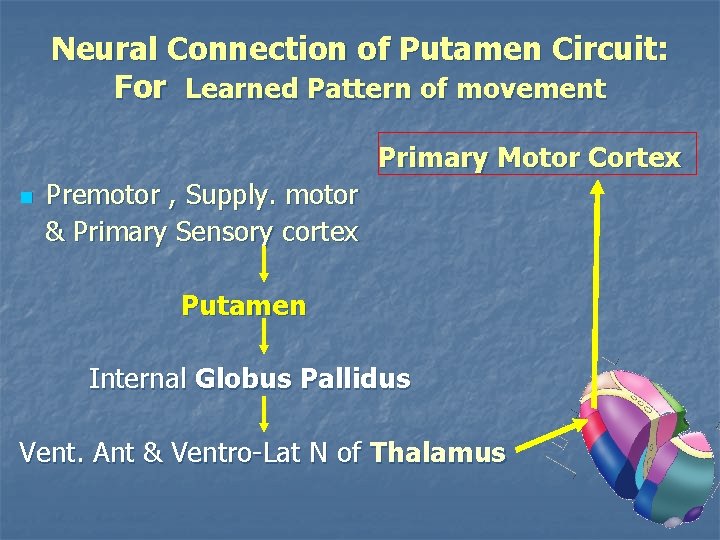
Neural Connection of Putamen Circuit: For Learned Pattern of movement Primary Motor Cortex n Premotor , Supply. motor & Primary Sensory cortex Putamen Internal Globus Pallidus Vent. Ant & Ventro-Lat N of Thalamus
Putamen Circuit n n Function in association with Corticospinal System to Control Complex Pattern of Motor Activity. e. g. -Writing alphabet -Cutting paper with Scissors -Hammering nail -Skilled movements during different Games - Movements of Laryngeal & extra-ocular Muscles
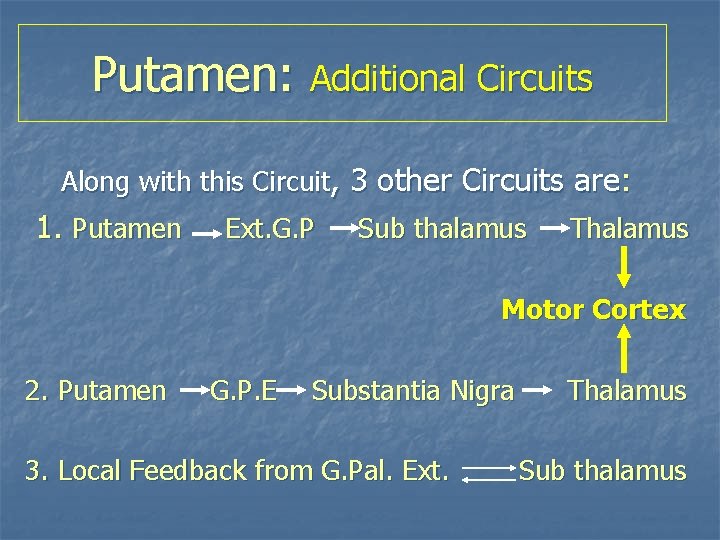
Putamen: Additional Circuits Along with this Circuit, 3 other Circuits are: 1. Putamen Ext. G. P Sub thalamus Thalamus Motor Cortex 2. Putamen G. P. E Substantia Nigra 3. Local Feedback from G. Pal. Ext. Thalamus Sub thalamus
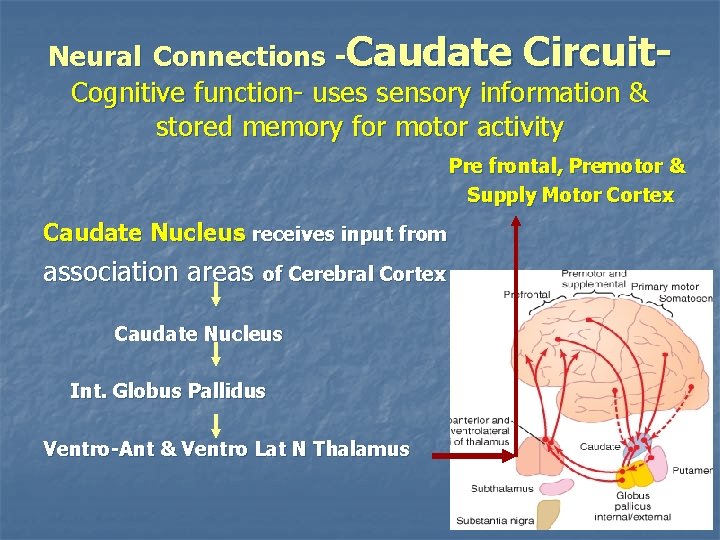
Neural Connections -Caudate Circuit. Cognitive function- uses sensory information & stored memory for motor activity Pre frontal, Premotor & Supply Motor Cortex Caudate Nucleus receives input from association areas of Cerebral Cortex Caudate Nucleus Int. Globus Pallidus Ventro-Ant & Ventro Lat N Thalamus
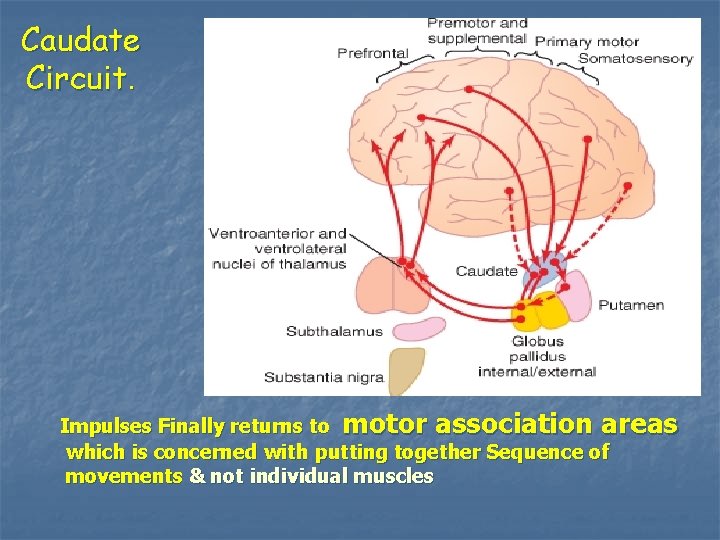
Caudate Circuit. Impulses Finally returns to motor association areas which is concerned with putting together Sequence of movements & not individual muscles
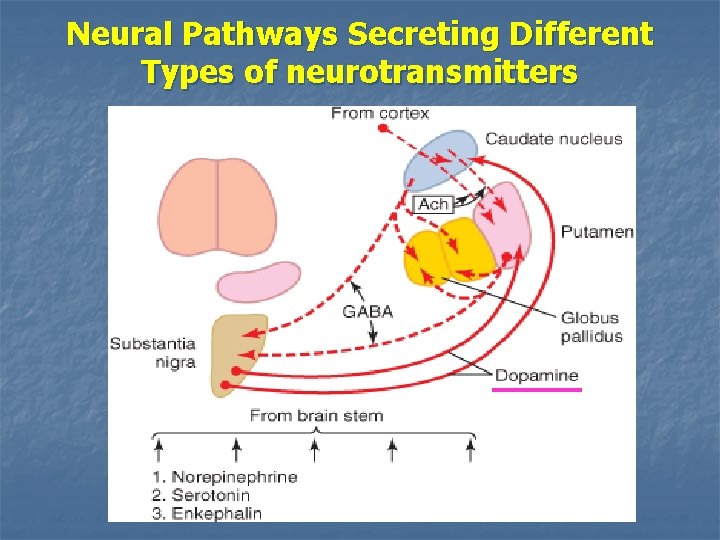
Neural Pathways Secreting Different Types of neurotransmitters
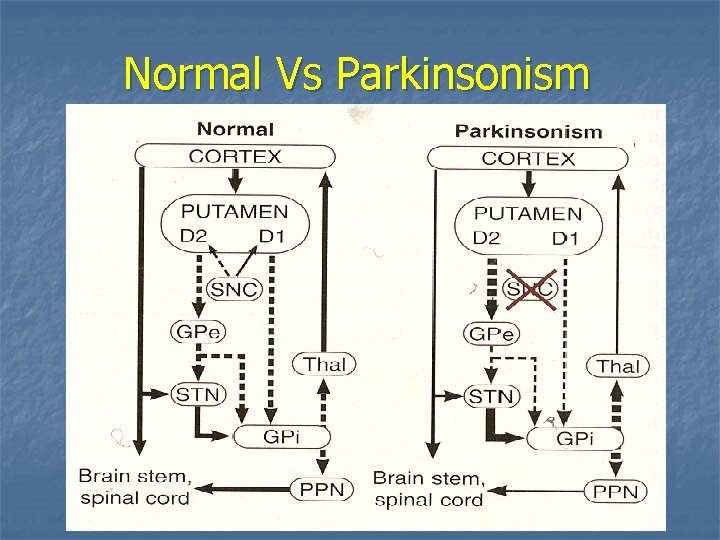
Normal Vs Parkinsonism
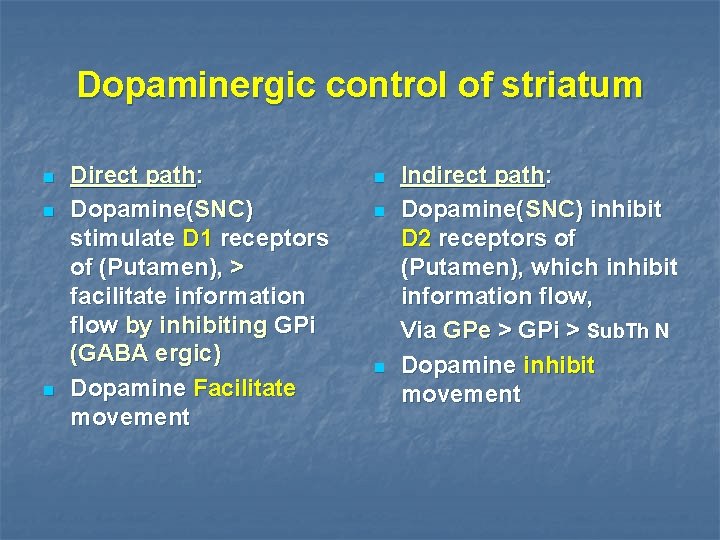
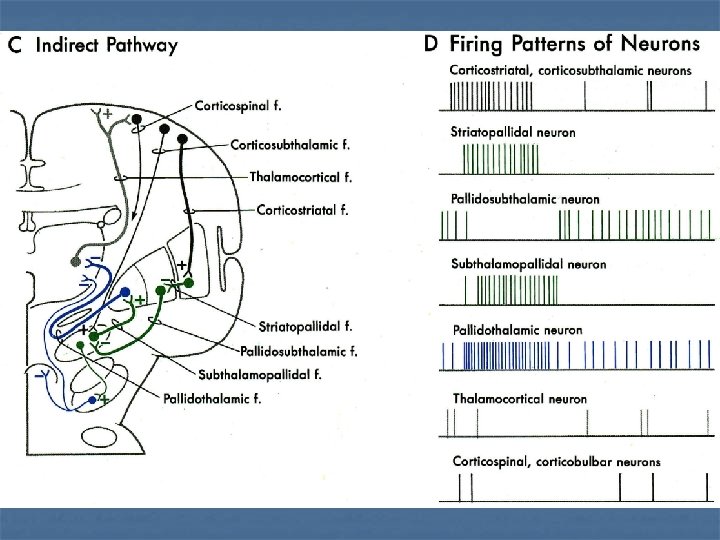
Dopaminergic control of striatum n n n Direct path: Dopamine(SNC) stimulate D 1 receptors of (Putamen), > facilitate information flow by inhibiting GPi (GABA ergic) Dopamine Facilitate movement n n n Indirect path: Dopamine(SNC) inhibit D 2 receptors of (Putamen), which inhibit information flow, Via GPe > GPi > Sub. Th N Dopamine inhibit movement
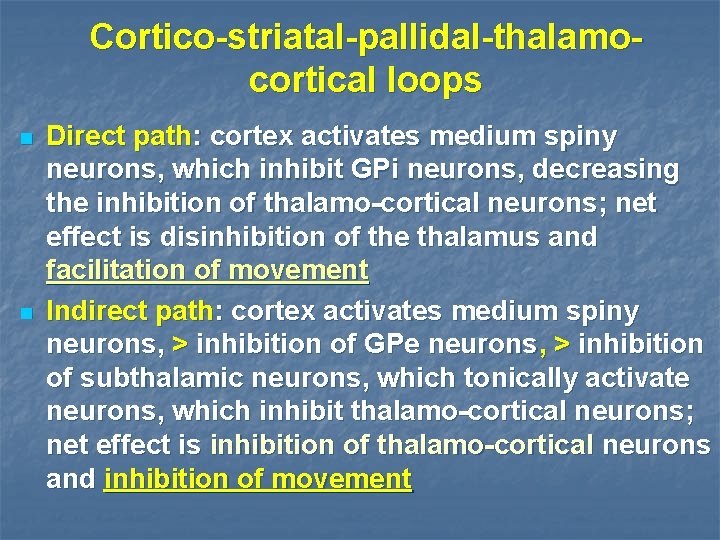
Cortico-striatal-pallidal-thalamocortical loops n n Direct path: cortex activates medium spiny neurons, which inhibit GPi neurons, decreasing the inhibition of thalamo-cortical neurons; net effect is disinhibition of the thalamus and facilitation of movement Indirect path: cortex activates medium spiny neurons, > inhibition of GPe neurons, > inhibition of subthalamic neurons, which tonically activate neurons, which inhibit thalamo-cortical neurons; net effect is inhibition of thalamo-cortical neurons and inhibition of movement
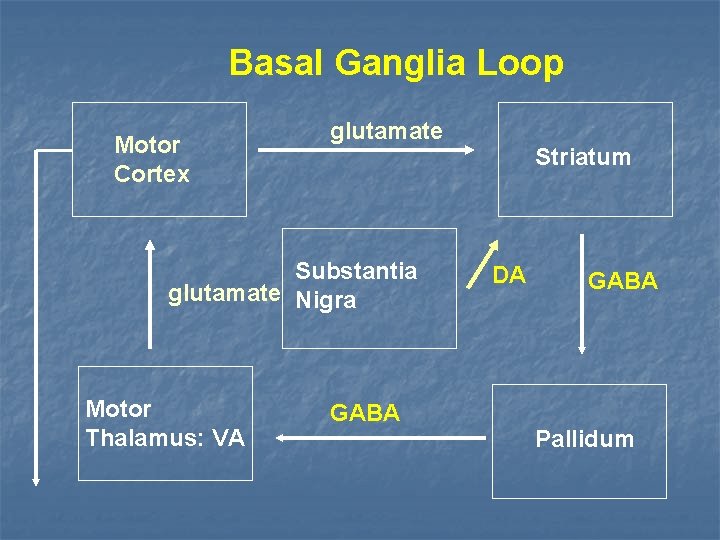
Basal Ganglia Loop Motor Cortex glutamate Substantia glutamate Nigra Motor Thalamus: VA GABA Striatum DA GABA Pallidum
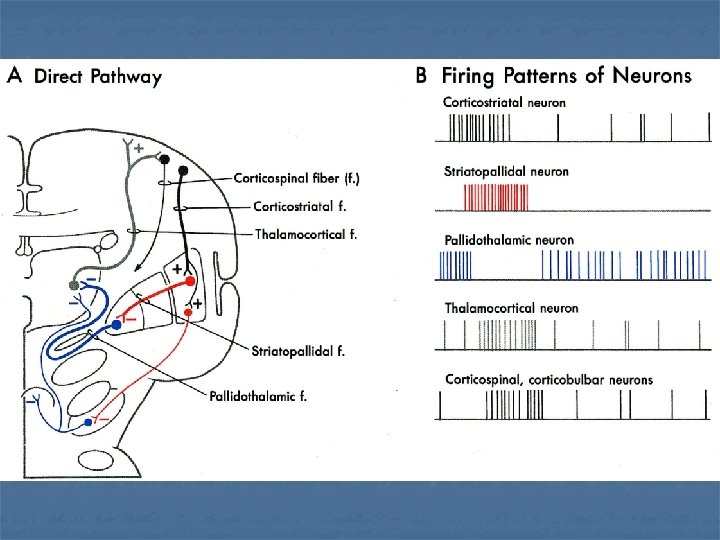
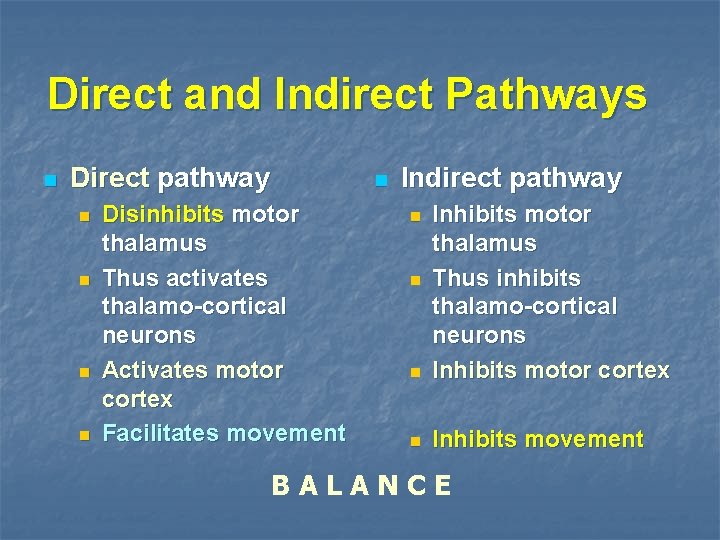
Direct and Indirect Pathways n Direct pathway n n n Disinhibits motor thalamus Thus activates thalamo-cortical neurons Activates motor cortex Facilitates movement Indirect pathway n Inhibits motor thalamus Thus inhibits thalamo-cortical neurons Inhibits motor cortex n Inhibits movement n n BALANCE
Clinical problems in basal ganglia n n n Movement disorders are one aspect; Cognitive and memory impairments may also occur Hypokinesias: Akinesia (difficulty in planning and initiating movements); Bradykinesia (reduction in velocity and amplitude of movement): inappropriate activity in antagonist muscles
Parkinsonison’s Disease (Paralysis Agitans) n n n Lesion- Substantia Nigra > Nigrostriatal dopaminergic N degenerate Fiber to Putamen are severely affected. Symptoms appear when 60 -80% nigrostriatal fibers are lost. Also seen in patients taking Phenothiazines (D 2 Receptor Blockers)
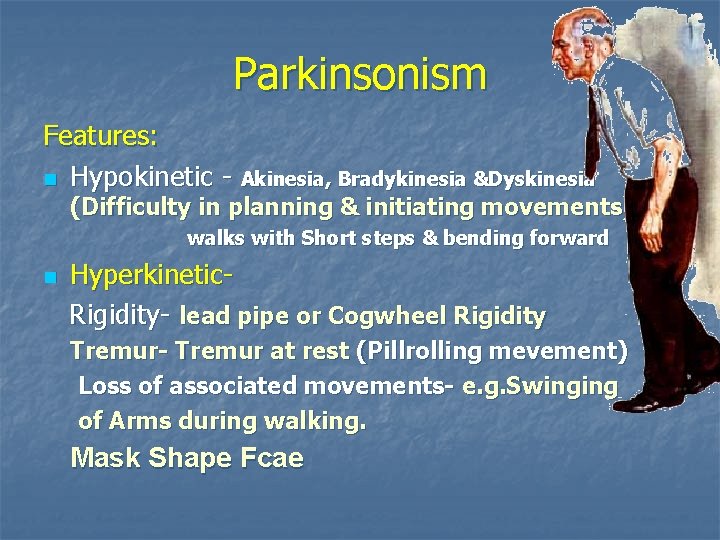
Parkinsonism Features: n Hypokinetic - Akinesia, Bradykinesia &Dyskinesia (Difficulty in planning & initiating movements) walks with Short steps & bending forward n Hyperkinetic. Rigidity- lead pipe or Cogwheel Rigidity Tremur- Tremur at rest (Pillrolling mevement) Loss of associated movements- e. g. Swinging of Arms during walking. Mask Shape Fcae
Treatments for Parkinson’s disease n Pharmacological n n n L-DOPA plus carbidopa to increase dopamine levels; usually initial improvements, but then progressive loss; D 1 receptor agonists can induce tardive dyskinesia. Deprinyl- Enzyme inhibitor Neurosurgical n n n implantation of dopamine-producing cells: very controversial lesions of thalamic or pallidal structures: blocks overactivity of pallido-thalamic projection overstimulation of subthalamus to inhibit subthalamic activity: deep brain stimulation
Clinical problems in basal ganglia n Huntington’s chorea Genetic defect in gene called huntingtin n Loss of about 90% of striatal neurons, especially of indirect pathway: overactivity of direct pathway: uncontrolled movements n Progressive, untreatable, decreased function and dementia n Choreiform movements leading to severe impairment; death within 15 years
hyperkinesias n Choreiform movements: “dance-like movements – Putamen Lesion n Ballismus and hemiballismus; Involuntary, flailing intense & violent movements – usually due to vascular lesions of contralateral subthalamic nucleus n Athetoid movements: continual writhing movements of distal extremity- Lesion is in Globus Pallidus
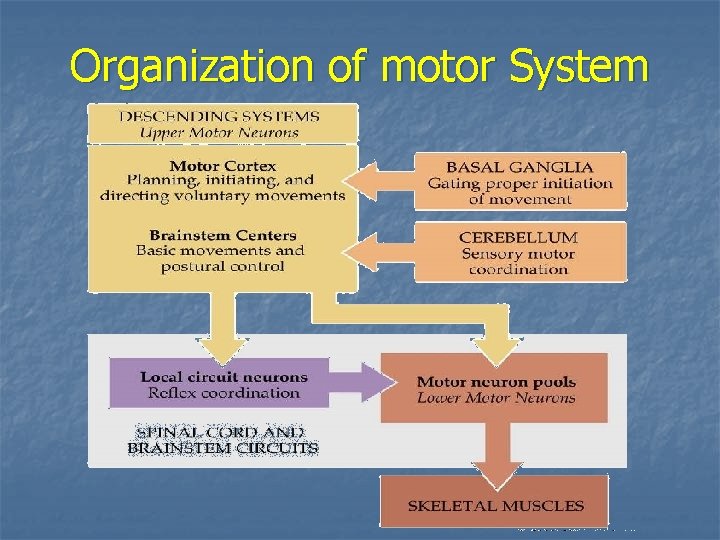
Organization of motor System
- Slides: 29