
Basal Ganglia BASAL GANGLIA Involved in the control
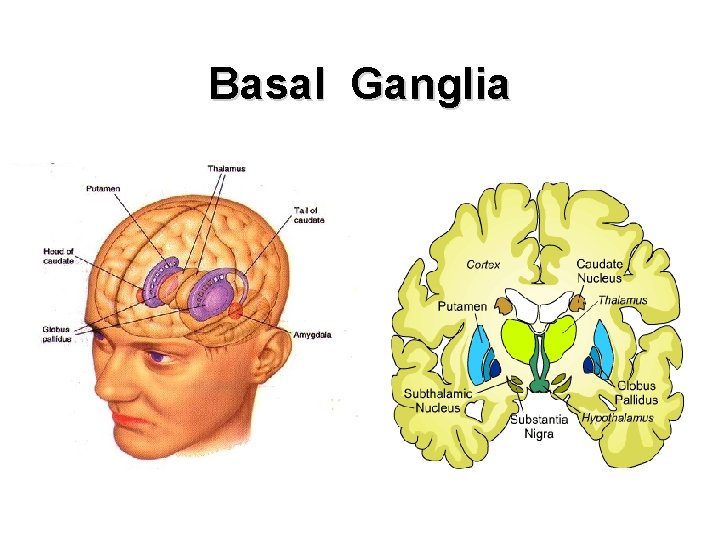
Basal Ganglia

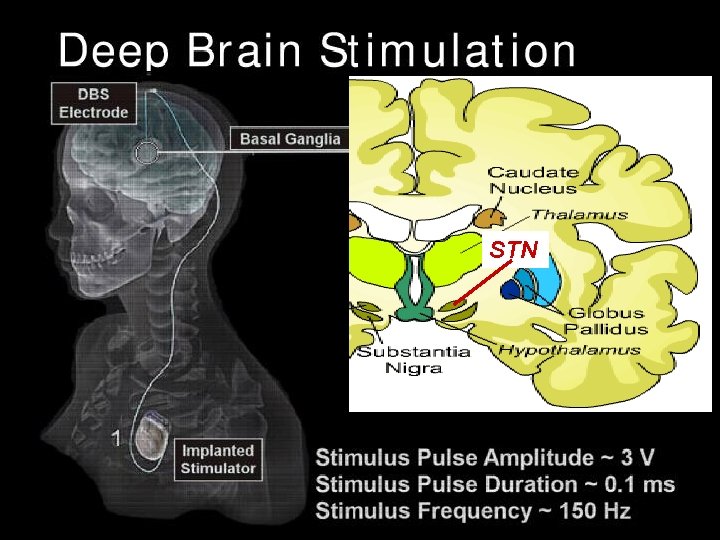
BASAL GANGLIA • Involved in the control of movement • Dysfunction associated with Parkinson’s and Huntington’s disease • Site of surgical procedures -- Deep Brain Stimulation (DBS)
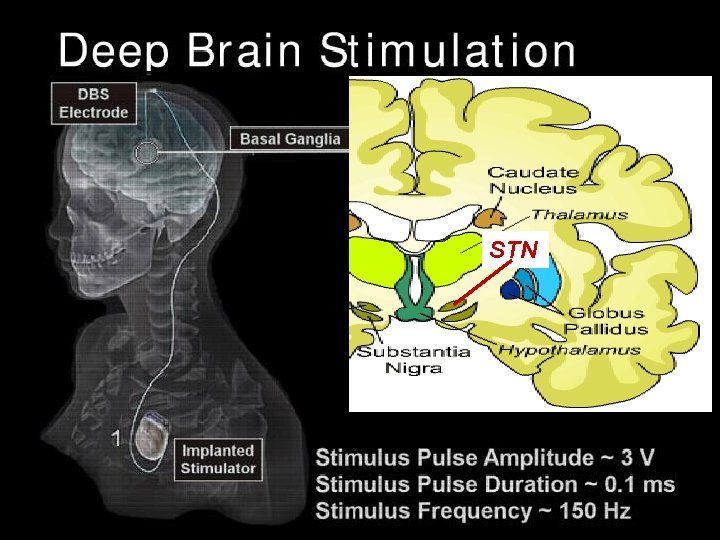
STN
Deep Brain Stimulation (DBS)
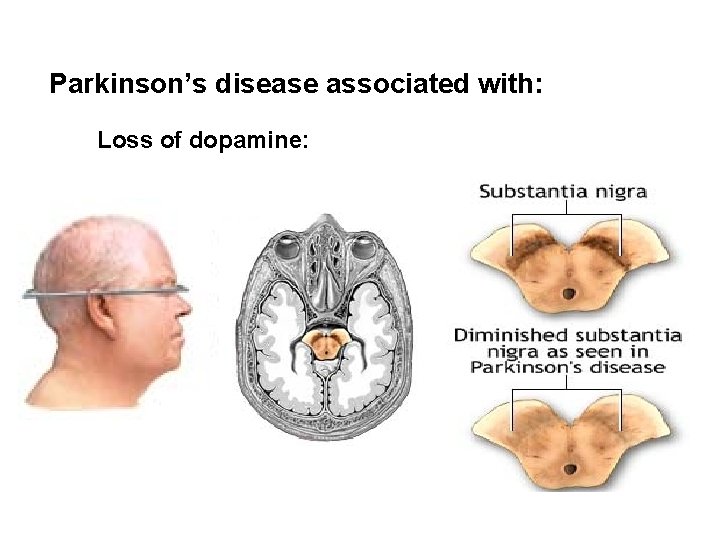
Parkinson’s disease associated with: Loss of dopamine:
Parkinson’s disease associated with changes in firing patterns. Some neurons within basal ganglia exhibit: • Increased synchronization • Increased bursting activity
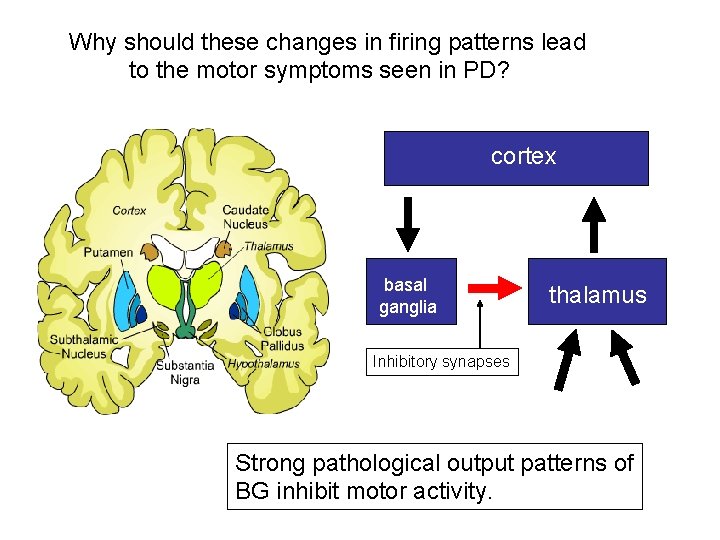
Why should these changes in firing patterns lead to the motor symptoms seen in PD? cortex basal ganglia thalamus Inhibitory synapses Strong pathological output patterns of BG inhibit motor activity.
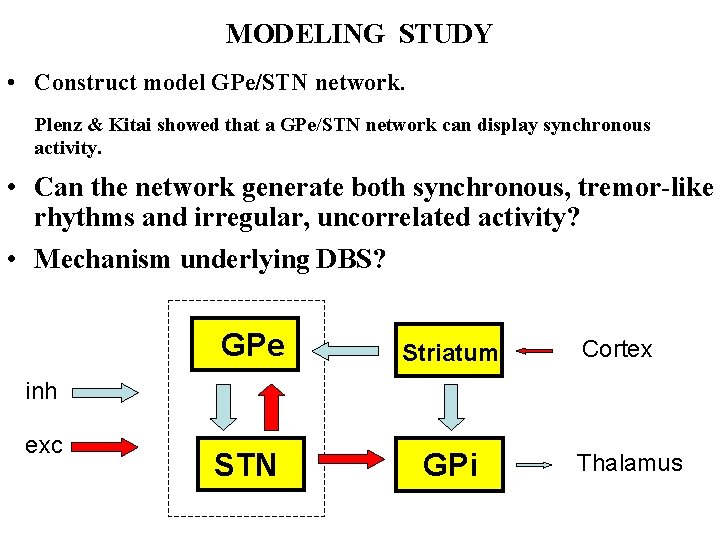
MODELING STUDY • Construct model GPe/STN network. Plenz & Kitai showed that a GPe/STN network can display synchronous activity. • Can the network generate both synchronous, tremor-like rhythms and irregular, uncorrelated activity? • Mechanism underlying DBS? GPe Striatum STN GPi Cortex inh exc Thalamus
MODEL STN NEURON Based on Experiments (Bevan and Wilson)
Firing Properties of STN Cells Experiment Model
Firing Properties of STN/GPE Neurons STN Post Inhibitory Rebound GPE Firing Profiles
STN / GPe NETWORK STRIATUM Can this network exhibit both irregular and correlated activity (same architecture, different parameters) ?
Irregular firing Clustering
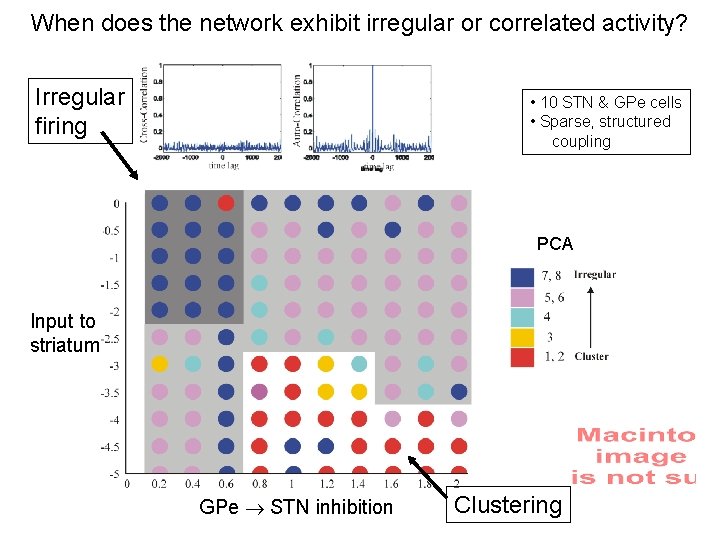
When does the network exhibit irregular or correlated activity? Irregular firing • 10 STN & GPe cells • Sparse, structured coupling I PCA Input to striatum GPe STN inhibition Clustering
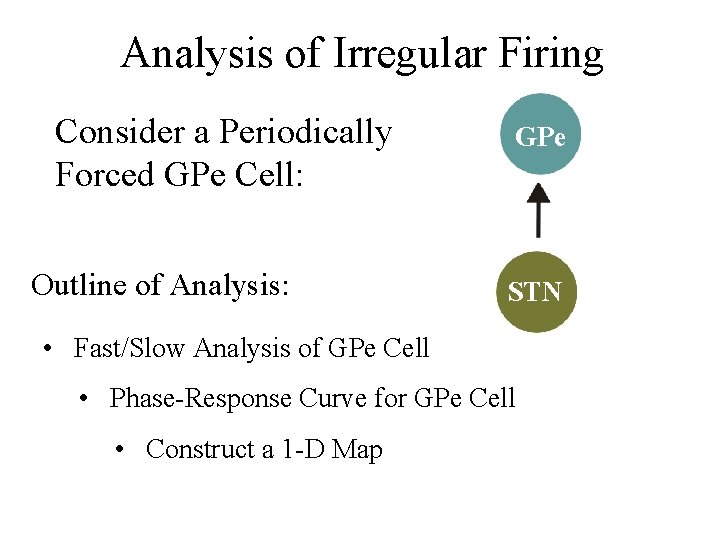
Analysis of Irregular Firing Consider a Periodically Forced GPe Cell: Outline of Analysis: GPe STN • Fast/Slow Analysis of GPe Cell • Phase-Response Curve for GPe Cell • Construct a 1 -D Map
MODEL GPe NEURON We consider Ca as a slow variable.
GPe bifurcation diagram stable periodic orbits Saddle-node of limit cycles Hopf unstable fixed pts bifurcation Stable fixed pts
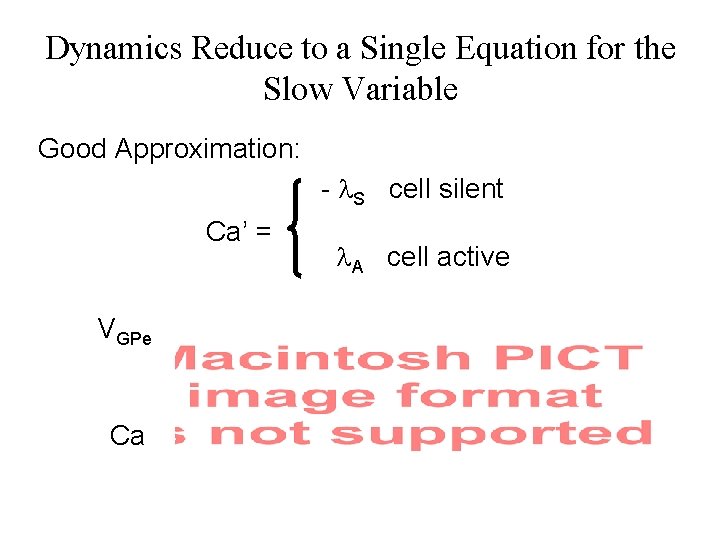
Dynamics Reduce to a Single Equation for the Slow Variable Good Approximation: - l. S cell silent Ca’ = VGPe Ca l. A cell active
A one-dimensional map
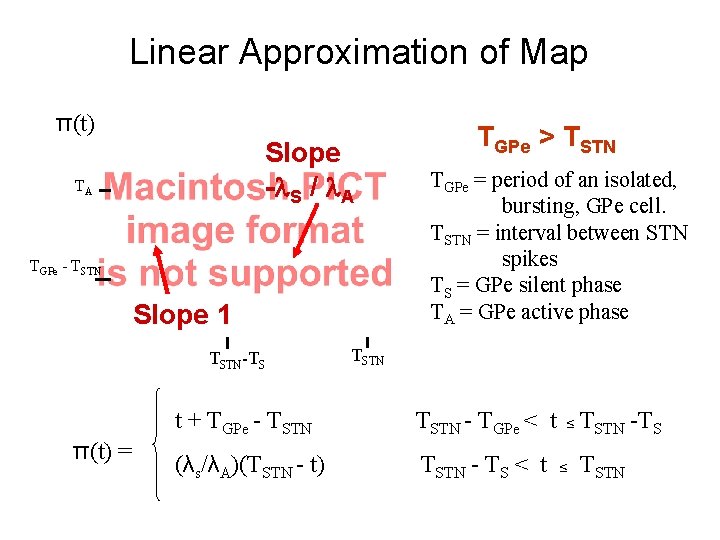
Linear Approximation of Map π(t) Slope -l. S / l. A TA TGPe - TSTN Slope 1 TSTN-TS π(t) = TGPe > TSTN TGPe = period of an isolated, bursting, GPe cell. TSTN = interval between STN spikes TS = GPe silent phase TA = GPe active phase TSTN t + TGPe - TSTN - TGPe < t ≤ TSTN -TS (λs/λA)(TSTN - t) TSTN - TS < t ≤ TSTN
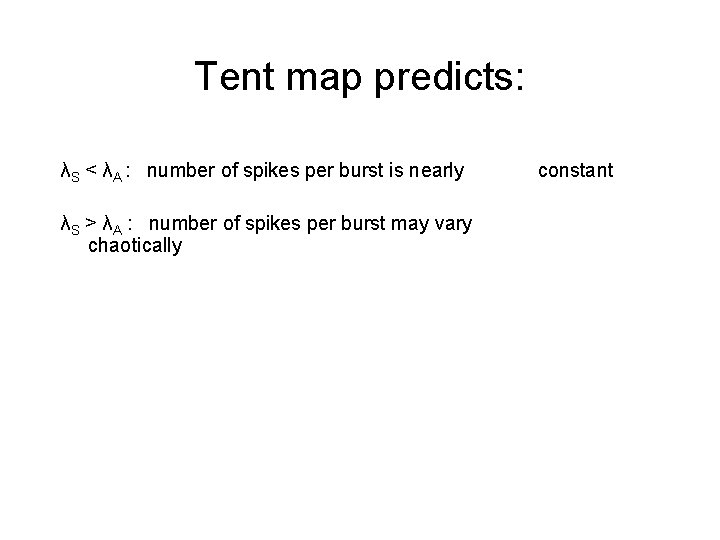
Tent map predicts: λS < λA : number of spikes per burst is nearly λS > λA : number of spikes per burst may vary chaotically constant
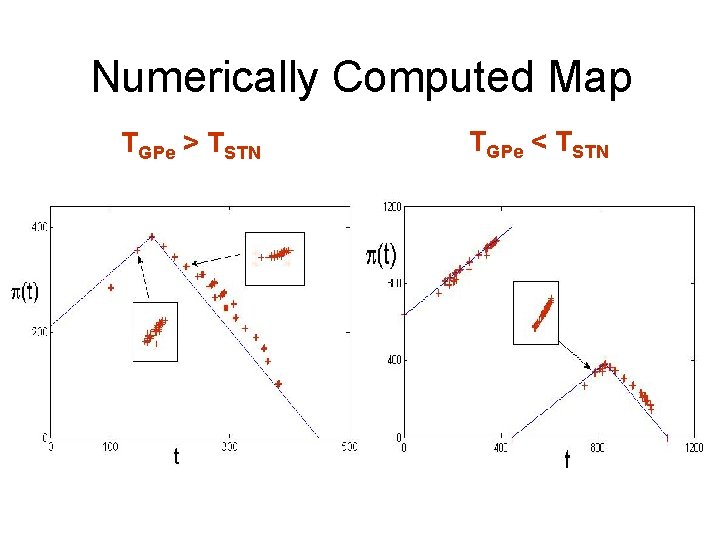
Numerically Computed Map TGPe > TSTN TGPe < TSTN
Poincare Section Remark: This analysis does a very good job in predicting when irregular activity arises in larger networks.
STN
Mechanisms Underlying DBS Mysterious Poorly understood: • Which neurons DBS acts on. • How DBS effects different parts of neurons. • How DBS depends on geometry of neurons. • Whether DBS is excitatory or inhibitory. That is, does DBS increase or decrease output from stimulated structure?
Evidence That DBS is Inhibitory: • Clinical effects similar to ablative surgery • There is increased BG activity during PD Evidence That DBS is Excitatory: • Recent experimental data (Vitek et al. ) Question: How can one explain improvement of PD symptoms if DBS increases GPi output activity?
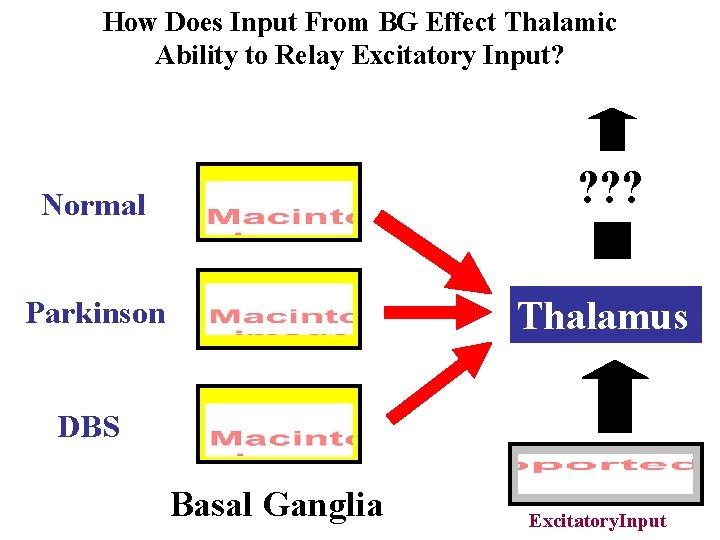
How Does Input From BG Effect Thalamic Ability to Relay Excitatory Input? Normal ? ? ? Parkinson Thalamus DBS Basal Ganglia Excitatory. Input
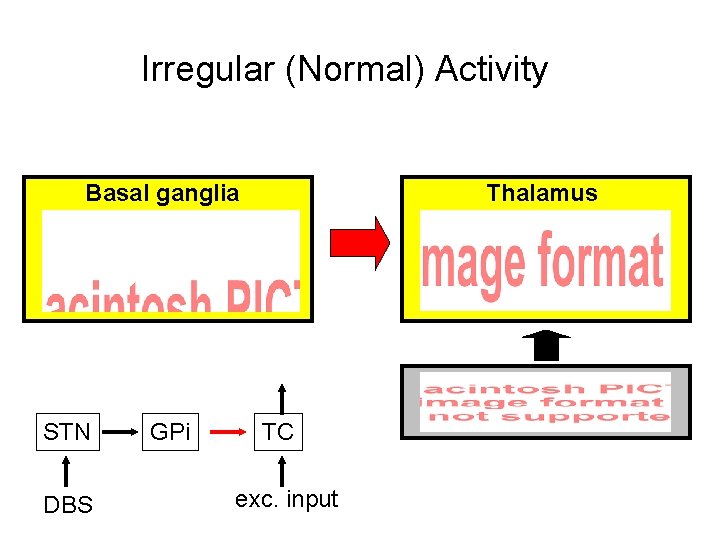
Irregular (Normal) Activity Basal ganglia STN DBS GPi Thalamus TC exc. input
PD: DBS off Basal ganglia DBS off Thalamus
PD: DBS on Basal ganglia DBS on Thalamus
PD: DBS on off Basal ganglia DBS off Thalamus
Data-driven computational study We now consider signal obtained from single-unit GPi recordings from: • control (normal) monkeys • parkinsonian (MPTP) monkeys without DBS • parkinsonian monkeys under sub-therapeutic STN-DBS • parkinsonian monkeys under therapeutic STN-DBS
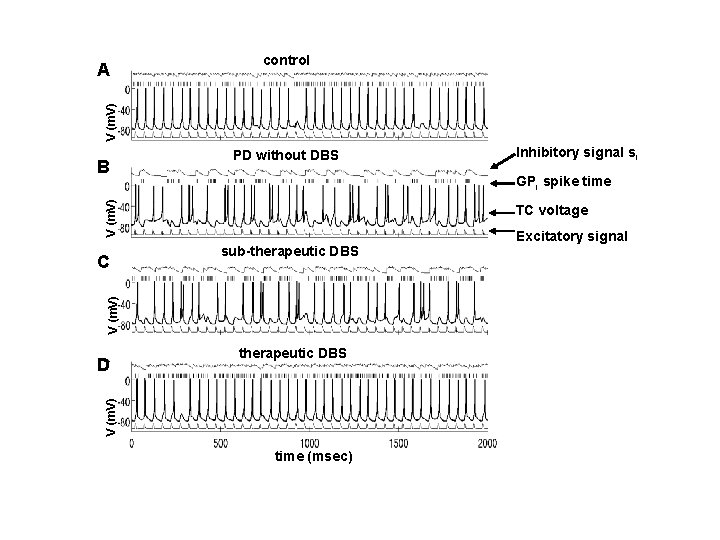
control V (m. V) A TC voltage sub-therapeutic DBS V (m. V) C therapeutic DBS V (m. V) D Inhibitory signal si GPi spike time V (m. V) B PD without DBS time (msec) Excitatory signal
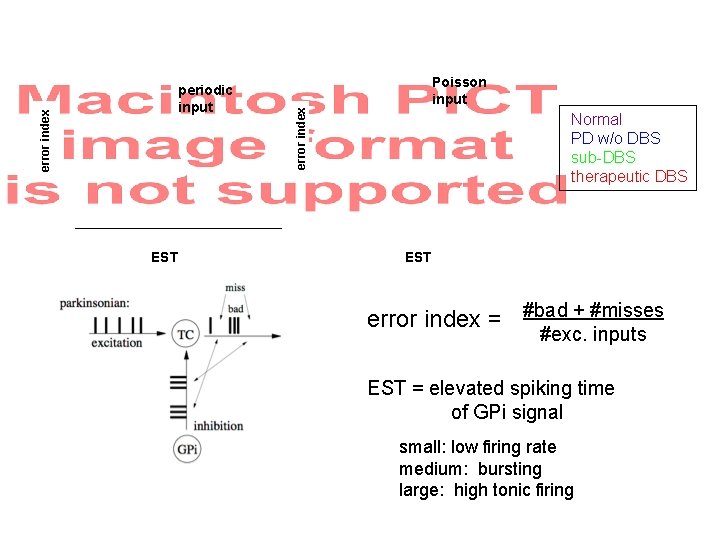
EST Poisson input error index periodic input Normal PD w/o DBS sub-DBS therapeutic DBS EST error index = #bad + #misses #exc. inputs EST = elevated spiking time of GPi signal small: low firing rate medium: bursting large: high tonic firing
Collaborators Charles Wilson Jonathan Rubin Yixin Guo Cameron Mc. Intyre Jerold Vitek Janet Best Choongseok Park
- Slides: 35