
BaryonAntiBaryon Asymmetry Dark Matter and Color Confinement A
Baryon-Anti-Baryon Asymmetry, Dark Matter and Color Confinement, A possible Common Denominator David E. Álvarez Castillo Joint Institute for Nuclear Research Mariana Kirchbach Autonomous University of San Luis Potosí Helmholtz International Summer School on “Matter under Extreme Conditions” August 28, 2018
Outline • Charges in closed spaces • Cot potential as color dipole • Dynamical conformal symmetry and color confinement • Dirac equation with cot potential • Form factors and proton charge • Outlook and perspectives
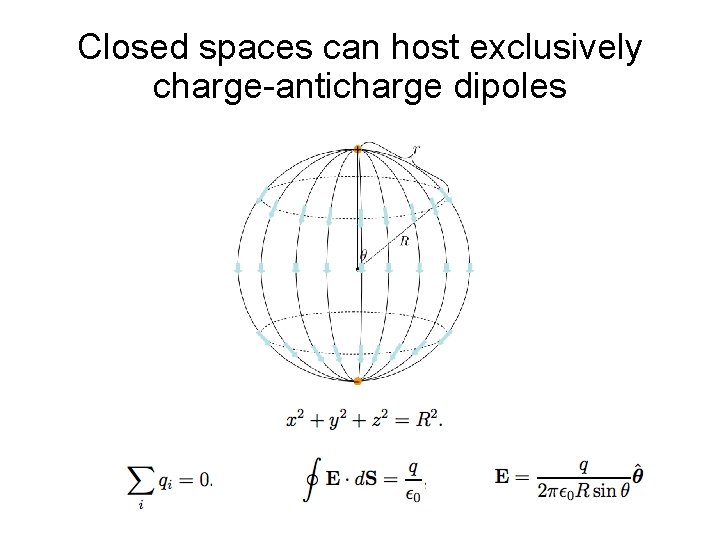
Closed spaces can host exclusively charge-anticharge dipoles
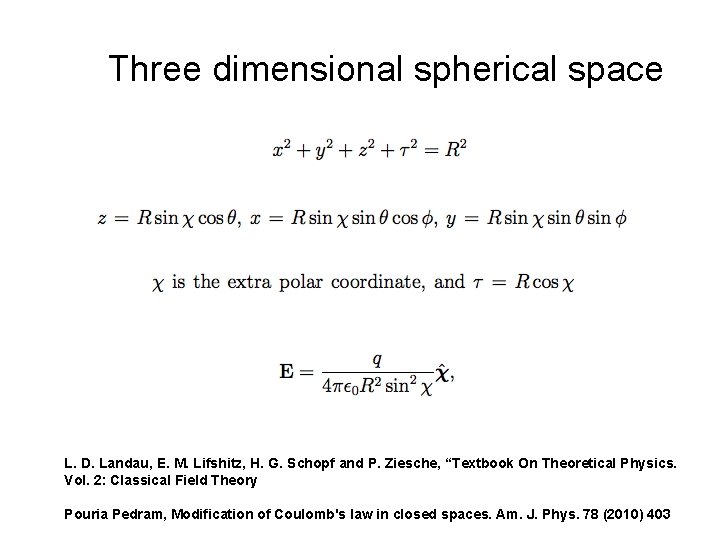
Three dimensional spherical space L. D. Landau, E. M. Lifshitz, H. G. Schopf and P. Ziesche, “Textbook On Theoretical Physics. Vol. 2: Classical Field Theory Pouria Pedram, Modification of Coulomb's law in closed spaces. Am. J. Phys. 78 (2010) 403
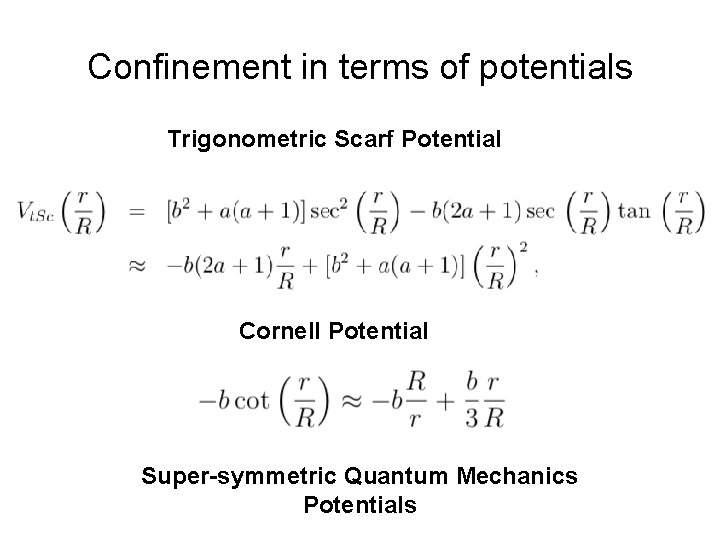
Confinement in terms of potentials Trigonometric Scarf Potential Cornell Potential Super-symmetric Quantum Mechanics Potentials
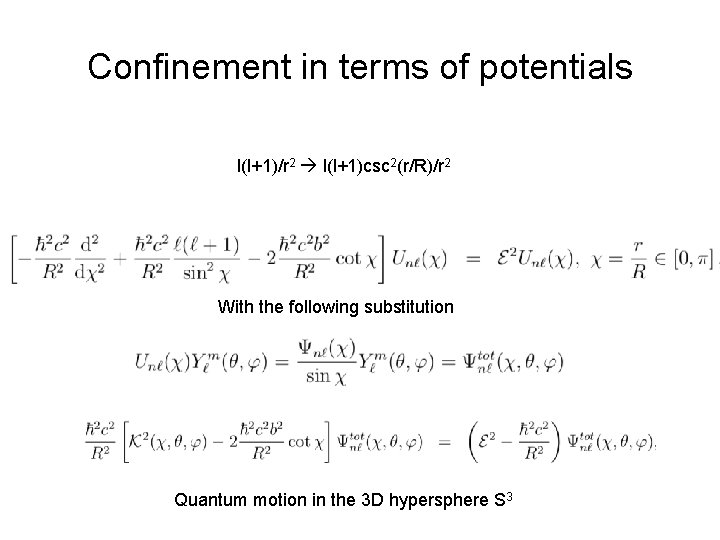
Confinement in terms of potentials l(l+1)/r 2 l(l+1)csc 2(r/R)/r 2 With the following substitution Quantum motion in the 3 D hypersphere S 3
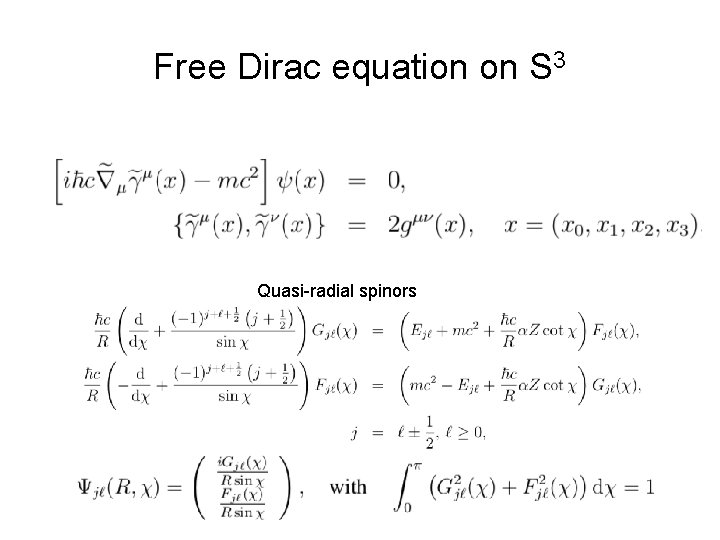
Free Dirac equation on S 3 Quasi-radial spinors
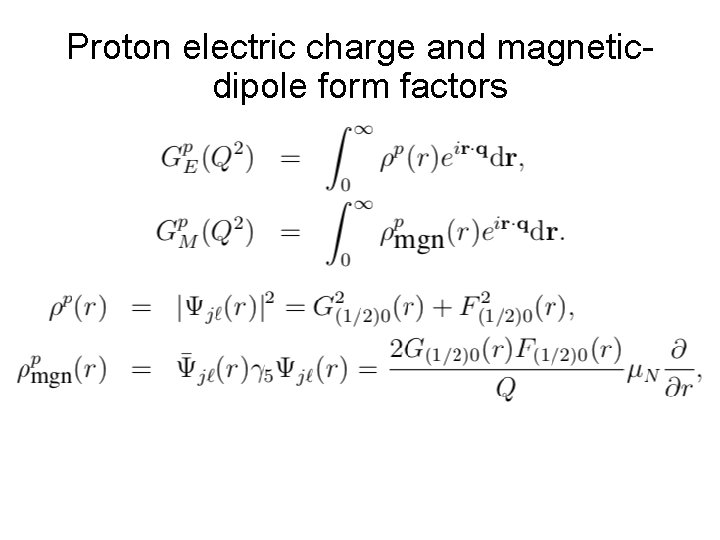
Proton electric charge and magneticdipole form factors
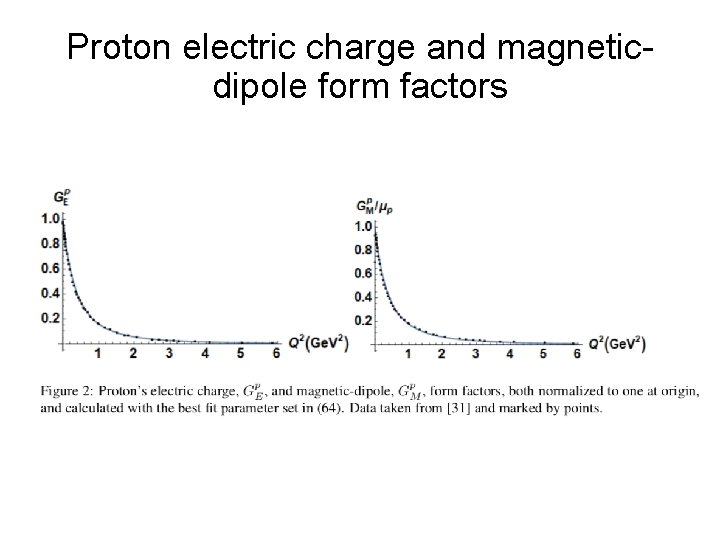
Proton electric charge and magneticdipole form factors
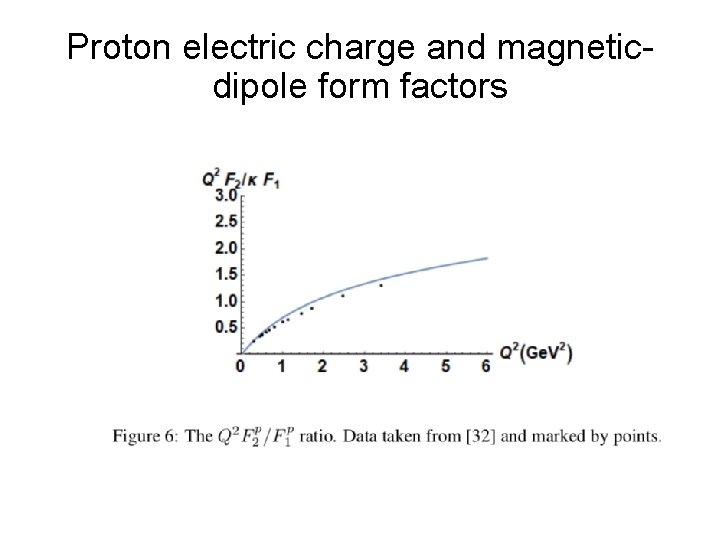
Proton electric charge and magneticdipole form factors
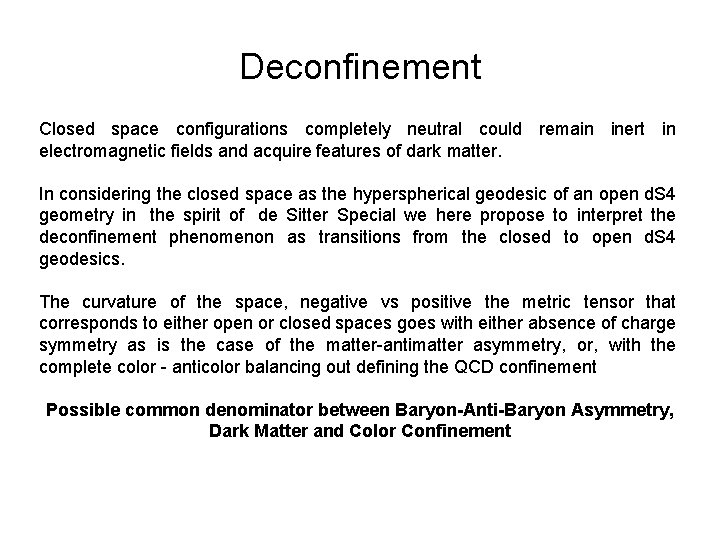
Deconfinement Closed space configurations completely neutral could remain inert in electromagnetic fields and acquire features of dark matter. In considering the closed space as the hyperspherical geodesic of an open d. S 4 geometry in the spirit of de Sitter Special we here propose to interpret the deconfinement phenomenon as transitions from the closed to open d. S 4 geodesics. The curvature of the space, negative vs positive the metric tensor that corresponds to either open or closed spaces goes with either absence of charge symmetry as is the case of the matter-antimatter asymmetry, or, with the complete color - anticolor balancing out defining the QCD confinement Possible common denominator between Baryon-Anti-Baryon Asymmetry, Dark Matter and Color Confinement
References L. D. Landau, E. M. Lifshitz, H. G. Schopf and P. Ziesche, “Textbook On Theoretical Physics. Vol. 2: Classical Field Theory Pouria Pedram, Modification of Coulomb's law in closed spaces. Am. J. Phys. 78 (2010) 403 V. Balasubramanian, M. Berkooz, A. Naqvi and M. J. Strassler, JHEP 0204, 034 (2002) M. Kirchbach and C. B. Compean, Eur. Phys. J. A 52, no. 7, 210 (2016) Addendum: [Eur. Phys. J. A 53, no. 4, 65 (2017)] A. P. Raposo, H. J. Weber, D. E. Alvarez-Castillo and M. Kirchbach, Central Eur. J. Phys. 5, no. 3, 253 (2007) R. Aldrovandi, J. P. Beltran Almeida and J. G. Pereira, Class. Quant. Grav. 24, 1385 (2007) Gracias
- Slides: 12