
Bartleby the Scrivener Affect agency and the rhetorical
“Bartleby the Scrivener”: Affect, agency and the rhetorical trickster Lisa S. Villadsen Section of Rhetoric University of Copenhagen
Early days, first steps An extraordinarily irksome and disturbing text; disconcerting, troubling, enigmatic No apologia for reading literature rhetorically, i. e. , as rhetoric and as a rhetorician Instead: A discussion of the text’s affective power An argument about how text thematizes the issue of rhetorical agency and how that can inform our understanding of the “trickster”
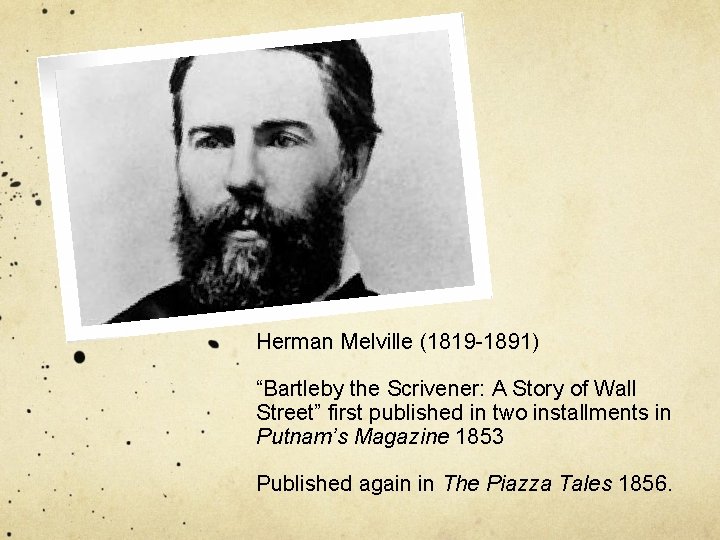
Herman Melville (1819 -1891) “Bartleby the Scrivener: A Story of Wall Street” first published in two installments in Putnam’s Magazine 1853 Published again in The Piazza Tales 1856.
Plot and main character
New York City, mid 1800 s. Bartleby arrives at the law office of Mr. _, the narrator, Master of Chancery, and is hired as a scrivener (copyist) to balance out the irregularities of the two other scriveners, “Turkey” and “Nippers”, and meet increased work load. Bartley at first works hard, then declines to do more and more tasks requested of him until he does nothing at all. “I would prefer not to”. The narrator discovers that Bartleby never leaves the office, but in fact lives there. After putting up with this for a while, the lawyer eventually gives Bartleby notice and tells him to leave the office (which he doesn’t). The lawyer ends up vacating the premises and moving his office to a different location, while Bartleby stays. Bartleby is eventually sent to prison for vagrancy. The lawyer goes to see him and bribes “the grub-man” to give Bartleby better food, but Bartleby will not see him, nor eat, and eventually dies. Afterword about Bartleby’s former employment at “the Dead Letter Office”. Final exclamation: “Ah, Bartleby! Ah humanity!”
Bartleby The lawyer describes him as ”The strangest scrivener I ever heard or saw of”; “young”, “motionless”, “pallidly neat”, “pitiably respectable”, “incurably forlorn”, “unaccountable”, “immovable” Hired for his “singularly sedate” behavior. Critics call him: weird (Reed); “intolerable” (Giles), etc. An ”irritant more than a character to be judged in the conventional sense. ” (Norman, p. 36). ”Bartleby is intolerable: in choosing to do nothing, he is not masking a desire to do nothing, nor is he acting incidiously by hiding his desire; rather, he is wearing it right on the surface. ” (Giles, p. 90).
“I would prefer not to” This signature phrase occurs 23 times (with minor variations) in response to the laywer’s orders, questions, suggestions, attempts at bribery, and threats, etc. (see handout). Always accompanied by complete calmness and composure, no hint of impertinence, disrespect, protest, anger, or impatience. The phrase spreads to both the lawyer’s own and the other copyists’ language.
Critical legacy
Countless literary interpretations due to its at once enigmatic and disturbing nature: What is the story about? What does Bartleby represent? Already in 1981, Burling recorded 175+ articles since 1922. In 1989 Mc. Call talked about “the Bartleby industry” Examples of symbolist readings of Bartleby Spiritual (symbol of Christ, Ghandi, Kierkegaard, and Buddha) Marxist (from victim to protester) Anorexia Socratic Capitalism (Occupy Wall Street)
Rhetoric-related readings
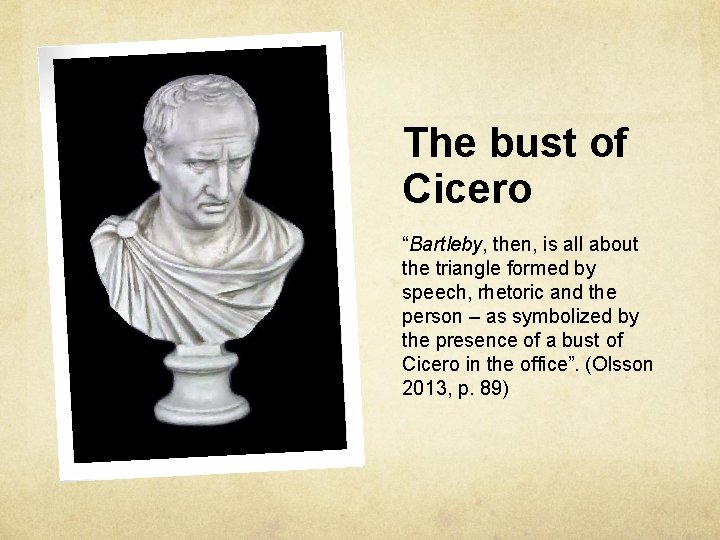
The bust of Cicero “Bartleby, then, is all about the triangle formed by speech, rhetoric and the person – as symbolized by the presence of a bust of Cicero in the office”. (Olsson 2013, p. 89)
o Singleton (1975): Cicero as role model in style and philosophy, (mentions Burke’s dramatistic terminology) o Miscolzce (2013): Ciceronian ethics, “On Duties” o Olsson (2013): On norms of discourse and resistance “[T]he rhetoric of persuasion … finds itself bereft of power [and] the central personification of power … finds itself without persuasive force” (p. 83) “[R]hetoric has been present all along, but it ultimately seems to lose the fight. It is helpless in the face of passive resistance – at the same time as passive resistance apparently suffocates the one resisting” (p. 92, emphasis added). o Villadsen (2017): Let’s look at this “helplessness”: Affective responses, notions of agency, and the figure of the trickster
Why read the text rhetorically?
The text’s challenges to rhetoric Rhetoric is, among other things, about reading audiences so as to be able to influence their attitudes, views, and actions. None of this seems to work in this story. Bartleby’s “performativity of pure passivity” (Cooke, 83) is the very antithesis of rhetoric and what we expect of rhetorical audiences, and it is immensely perplexing. Why does Bartleby so get under our skin? (affect) What is one to do in the face of Bartleby’s reactions? (agency) What does this frustrating text call on us to think about? Issues of rhetorical agency The role of the trickster
Affect “Bartleby is an affect rather than a personality” (Furlani 1997, p. 336)
The lawyer’s reactions Our way into a rhetorical reading of the text goes via the laywer’s, the quintessential rhetorician’s, frustration or affective states. “Nothing so aggravates an earnest person as a passive resistance” From curiosity and sympathy over pity to fear and repulsion. “When readers finish “Bartleby, the Scrivener” for the first time, they may find themselves standing squarely in the lawyer’s shoes, repeating a version of the remarks made by the lawyer early in the story when Bartleby begins to “prefer not to”: “This is very strange, thought I, What had one best do? ” (Miskolcze 2013, p. 43)
It is incomprehensible and vexing to the lawyer that Bartleby “does not seem interested in conquering ‘spokesmanship’” and that he declines interpellation (Olsson 2013, p. 89). His own way of speaking breaks down: From calm speaking voice to shouting. “His reasoning, or argumentative way of speaking gives in to an abrupt, or passionate way of speaking. ” (Olsson, 2013, p. 91)
Basic affect theory, I Massumi: Emotions have a “narrativized” content shaped through specific cultural, social, and political contexts. Affect, in contrast, is like a degree of intensity that is prior to a named or articulated referent (my emphasis). (Affect/emotions distinction) Brennan: Affects emerge across bodies both physically and biologically. It is transmitted between bodies. Not a personal feeling, but the means through which bodies act in context with each other. (Biology more than culture)
Basic affect theory, II Ahmed: Belief and adherence to particular structures are affectively invested in, rather than cognitively weighed. Signs accumulated and build up affect in their circulation to shape our social imaginaries. (The force of affect vis-a-vis argumentation e. g. ) Berlant: “Cruel optimism is… a concept pointing toward a mode of lived immanence, one that grows from a perception about the reasons why people are not Melville’s Bartleby, why they do not prefer to interfere with varieties of immeseration, but instead choose to ride the wave of the system of attachment. ” (Everyone around Bartleby) (emphasis added).
The role of affect in the text As a reader one is sucked into an intense state of frustration over the character of Bartleby and his reactions. The text is unsettling and vexing and it is unclear what the problem is. Bartleby is incongruous. There is no knowing what motivates him, what his intentions are. He states a preference, and is thus pure affect, unimpressionable by the lawyer’s attempts to reason with him, cajole, threaten, entice, etc. The intensity and indeterminacy of the text’s affective content is what drives the plot and explains its appeal.
Agency “Melville’s narrative of a protagonist seemingly bereft of agency, turns out to be a meditation on the resources of human agency” (Singer 2003, p. 233)
Basic agency theory, I Agency: The capacity of the rhetor to act The modernist notion of rhetorical agency is founded on assumptions of understanding and rationality (i. e. , that agents are capable of, and indeed, act in rational ways). Post-structural critiques of the autonomous agent have challenged this. Is it a (ideologically undergirded) illusion? Lucaites: “every rhetorical performance enacts and contains a theory of its own agency – of its own possibilities – as it structures and enacts the relationships between speaker and audience, self and other, action and structure”. Hence… agency becomes not a problem to be solved or trouble to be resolved, but a central object of rhetorical inquiry” (in Geisler 2004, p. 13)
Challenges to common notions of the power of language and reason Bartleby breaks with decorum, both conversational and disciplinary, and disrupts the workings of a system with his passivity. He interrupts rather than contributes (Olsson 2013, p. 85) Bartleby neither can or will answer the questions we ask him in a meaningful manner, but through his insistent repetition he forces us to stop to think, and thus also to think differently and perhaps better. (Gullestad 2012, p. 117) Bartleby cancels out language and reasoning the same way climate change deniers, “fake news” peddlers, and conspiracy proponents do. No appeals to reason, duty, or self-interest bite.
The lawyer’s agency The lawyer sees himself as a man of logic and reason, one who expects all problems to be solveable through deliberation (Gullestad 2012, 97). He tries to define and encompass his own reactions and guide his actions with a wide range of emotions yet fails again and again. Bartleby’s answer blows up the narrator’s approach which is based on expectations and presumptions, but Bartleby is “more a man of preferences than assumptions” Bartleby’s mild manner ”not only disarmed me but unmanned me”, i. e. , he loses agency.
Basic agency theory, II Gunn and Lundberg: Criticize Geisler for using a “possession” metaphor of agency because it reproduces the humanist model of the intentional agent who owns the capacity to make agential choices. Instead they suggest “an uncertain posture towards the flows of agency and agents implied by an open disposition toward the séance” (2005, p. 86) (emphasis added). Gunn and Cloud: Criticize “magical voluntarism”, the notion that human agency is better understood as the ability to control a given phenomenon through the proper manipulation of thoughts and symbols (i. e. language). It fails to recognize material (structural, political, economic, cultural and psychical) recalcitrance, and does not acknowledge the limits of the efficacy of symbolic action. They promote “agency as an open question” (2010, p. 51)
Bartleby’s passive resistance = agency? ”Melville’s emphasis is placed on Bartleby’s withdrawal as process and fact, not as result; he is not psychology but an agency. ” (Furlani 1997, p. 343. My emphasis)
Bartleby’s agency Bartleby does not refuse, he does not express a will, he neither acts nor supplies reasons for his non-acting. ”Although Bartleby is relatively powerless, in his small way, he is quite powerful. It is his power that makes the story possible. ” (Norman 1971, p. 23. Emphasis added) “His passivity might on the surface appear to be derived from a sense of hopelessness, sloth, or melancholia, but we must remember that Bartleby is nothing but surface, and as such, is a pure act of power and free will. To have preferences and the will to act on them, especially in the face of superiors, is the ultimate realization of freedom and selfhood. ” (Giles 2007, p. 89) Bartleby precipates not just his own demise, but also the lawyer’s moral bankruptcy.
Can silence and passivity constitute agency? Mc. Kerrow: “[W]hat it means, rhetorically, to enact agency by not participating, via silence or the overt refusal to engage others” (2014, p. 240 -241) Mc. Kerrow wants to “create a space for what may be perceived as ‘non-action’ as a rhetorical expression” (ibid. , p. 246 -7) Campbell’s definition “rhetorical agency refers to the capacity to act, that is to have the competency to speak or write in a way that will be recognized or heeded by others” Key term is “capacity”; “competence” is, however, problematic Access Motivation
Mc. Kerrow’s emphasis on motive “Silence and the refusal to act are potential acts whereby a citizen expresses disgust with a particular party or process, and thereby indicates, through enactment, her or his motive” (Mc. Kerrow, p. 251). “The attribution of motive as contributing to one’s actions as a citizen may be based on past information about the person’s beliefs and/or actions, as well as nonverbal expressions, or other sources that would corroborate the accuracy of what concludes about the actions of another. ” (ibid. , p. 247 -8) “The refusal to act is as much a rhetorical statement, provided the motive is clear, as in an overt action. ” (ibid. , p. 239) But: Bartleby is incongruous, we have no means of knowing his motivation (cf. Asen).
Basic agency theory, III Campbell: “Agency is perverse, protean, ambiguous, open to reversal” Rand: Polemic as a queer form that resists the assumption of a necessary and predictable relationship between an intending agent and an action’s effects. “[H]ighlights the riskiness, unpredictability, and inevitable contingency of agency” and posits “queerness itself as the condition of possibility for any rhetorical act. ” (2008, p. 297) (emphasis added). Are the queer formal features (“the formula”) of Bartleby’s response the key to understanding how it affects and effects? (Deleuze thinks so!) Problem: It evades formal identification (not acceptance, not a rejection, not a provocation)
Philosophical readings
Philosophical readings Political philosophers like Deleuze, Agamben, Negri and Hardt, Žižek, and Rancière have explored the story for themes of alternative models of community and for political resistance to capitalist hegemony. Their focus is generally on Bartleby, not the laywer. His reactions are seen as a form of resistance. Looking for an active potentiality in his passivity. Its contribution is to consistently refuse to adapt to the usual ways to deal with the politics of our time. It both calls forth and undermines our interpretations. In this it can be seen as a persistent call for finding other ways of thinking politics (Gullestad, p. 118).
Gilles Deleuze “Bartleby; or, The Formula” (1998) What is it about Bartleby’s “formula” that gives it such power over the lawyer? A ‘one-answer-to-fit-allrequests’ while still avoiding the need to have to choose between acceptance and refusal. Deleuze suggests that Bartleby “ravages” language by severing the assumed references to other words and relations with the interlocutor. Austin’s differentiation between constative and performative speech acts is useless when trying to deal with Bartleby. Both the self-referential and the constative are indeterminate. There is no obvious way to answer Bartleby because he evades choosing between acceptance and rejection.
Surface reading: What does the text do? Deleuze og Guattari: Focus on what literature does and not what it is, e. g. , by undermining language from the inside out and thus opening for the possibility of affect. (Gullestad 2012, p. 103). “It means only what it says, literally. And what it says is I would prefer not to. This is the formula of its glory, which every loving reader repeats in turn. ” (Deleuze 1998, p. 68). It leaves us speechless; we understand what Bartleby means, but it’s impossible to answer meaningfully, just like it is impossible to ignore. Our expectations and presumptions are irrelevant vis-à-vis Bartleby’s logic of preferences. We must learn to think differently.
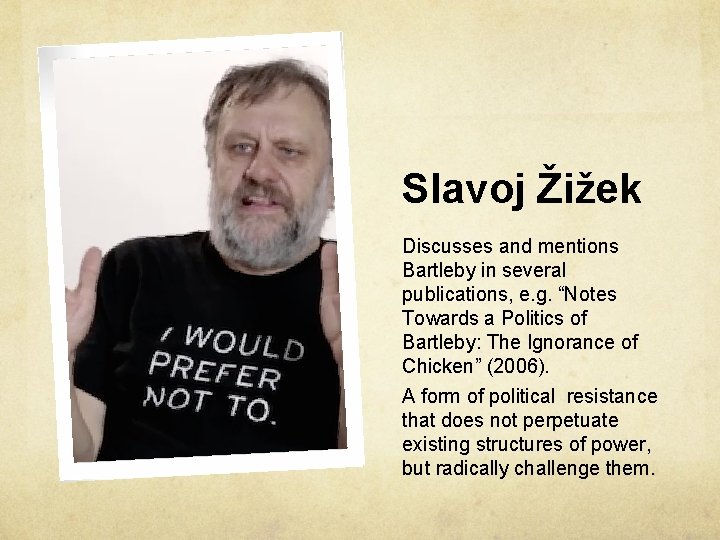
Slavoj Žižek Discusses and mentions Bartleby in several publications, e. g. “Notes Towards a Politics of Bartleby: The Ignorance of Chicken” (2006). A form of political resistance that does not perpetuate existing structures of power, but radically challenge them.
Bartleby as trickster
Trickster In folklore a character with intellect or secret knowledge who plays tricks or otherwise disobeys normal rules and conventional behavior, e. g. , Hermes, Loki, Old Man Coyote. Openly questions and mocks authority, violates principles of natural and social order, playfully disrupts normal life. The trickster is distinct in a story by his acting as a sort of catalyst, in that his antics are the cause of other characters' discomfiture, but he himself is left untouched.
Trickster theory in rhetoric “[A]ll cultural categories produce ‘dirt, ’ which consists of the elements or associations left out, left over, purged, excreted, abstracted, or otherwise disposed of in order to achieve a more perfect order. Thus, the trickster performs a needed service by engaging in ‘dirt work’ that muddies the waters and confounds reified conceptions by crossing established boundaries, stealing symbols back and forth, embodying ambiguity and ambivalence …” (Ivie 2002, p. 280). Tricksters foreground ”the ambiguities of truth and propriety…. challenge conventional assumptions ’about how the world is divided up’, personify human imperfection, the role of acciden and locus of transformation, introduce an element of disorder to prevent the collapse of order” (Ivie and Giner 2015, p. 90) ”The sign of the trickster suggests hybridity, plasticity, flexibility, fluidity, and movement in relationship with (not opposed to) uniformity, constancy, solidity, and stability. Trickster cannot traverse conceptual borders that do no exist. They do not represent a choice of chaos over order. They make order more dynamic and adaptive – less coercive” (ibid. ) (emphasis original).
Bartleby as rhetorical trickster “Considering how Trickster fosters relationships with and between ambiguity and liminality can help enhance our understanding of subversive communication practices, particularly as they function to break down cultural logics…. It exposes the machinations of normativity, revealing their constituent parts and suggesting without dictating more flexible and liberatory norms” (Salinas 2013, p. 144). Bartleby does not refuse, he does not express a will, he neither acts nor supplies reasons for his nonacting. “Bartleby refuses to be understood” (Olsson 2013, p. 87). We must learn to live with the frustration.
Bartleby as rhetorical trickster Fisher on “[a]rt’s affective capacity to challenge hegemonic truth claims” (2013, p. 15). She sees Bartleby as a Hermetic figure; “not a character, subject or hero, but a paradoxical tropic figure, whose primary trait (non-compliance or suspension of communication) is always already embedded in Hermetic ambivalence”. (2013, p. 26) Coming to terms with Bartleby may be one route to figuring out what to do with “argument resistance” in public debate and those who have just “tuned out”, or those who seem too odd, make us uncomfortable or seem non-cooperative. “Such corrigibility in human character depends on something like granting Bartleby’s difference from all other men… as a labor of self-reflection for the ever more tolerant self. ” (Singer 2007, p. 263)
- Slides: 40