
Bart Jansen Independent Set Kernelization for a Refined

Bart Jansen Independent Set Kernelization for a Refined Parameter: Upper and Lower bounds Joint work with Hans Bodlaender TACO Day, Utrecht January 12 th, 2011
Independent Set Kernelization for a Refined Parameter: Upper and Lower bounds § Introduction § § Independent Set Parameters Kernelization Upper bounds § Small kernel for parameter P 3 cover § Reduction rules § Analysis § § Lower bounds § § 2 Ideas for parameter Feedback Vertex Set Effect of introducing vertex weights Conclusion
Our target problem INDEPENDENT SET 3
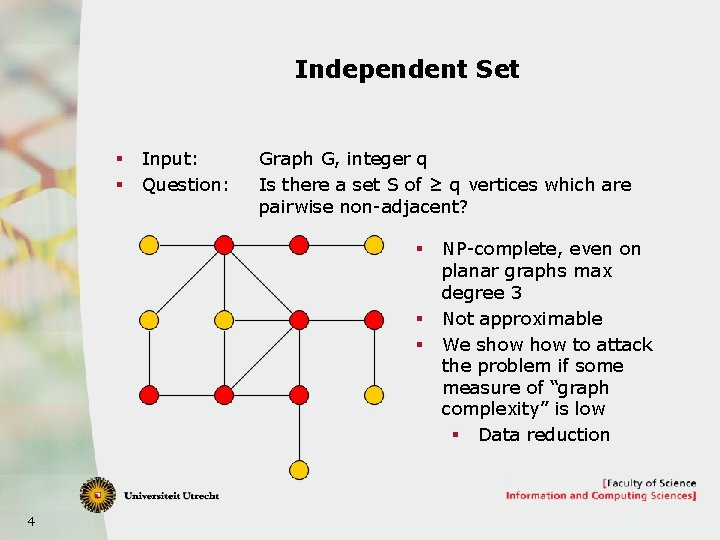
Independent Set § § Input: Question: Graph G, integer q Is there a set S of ≥ q vertices which are pairwise non-adjacent? § § § 4 NP-complete, even on planar graphs max degree 3 Not approximable We show to attack the problem if some measure of “graph complexity” is low § Data reduction
Solutions to vertex deletion problems as complexity measures PARAMETERS 5
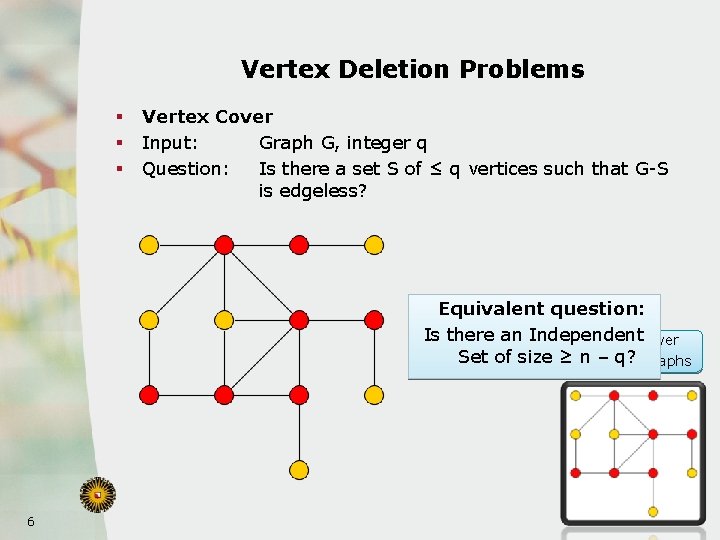
Vertex Deletion Problems § § § Vertex Cover Input: Graph G, integer q Question: Is there a set S of ≤ q vertices such that G-S is edgeless? Equivalent question: Is there an Independent Vertex Cover Set of size ≥ Edgeless n – q? Graphs 6
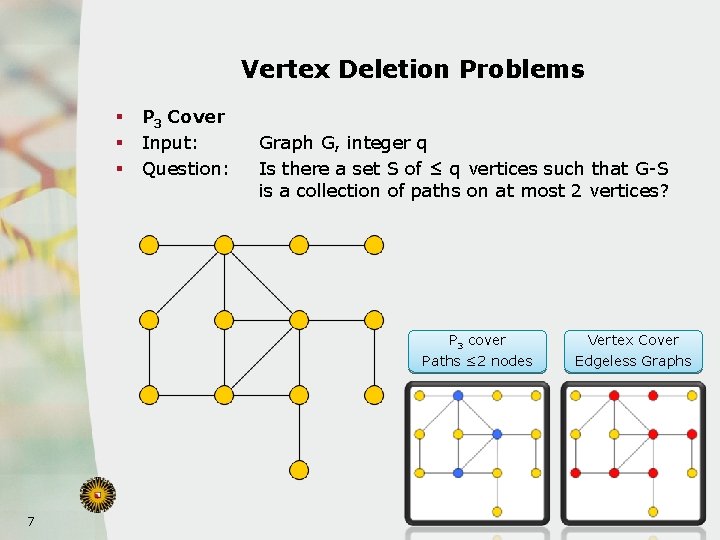
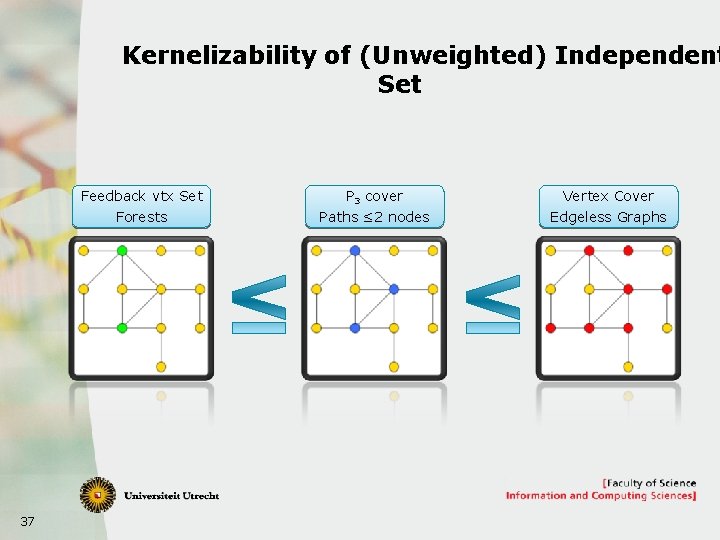
Vertex Deletion Problems § § § 7 P 3 Cover Input: Question: Graph G, integer q Is there a set S of ≤ q vertices such that G-S is a collection of paths on at most 2 vertices? P 3 cover Vertex Cover Paths ≤ 2 nodes Edgeless Graphs
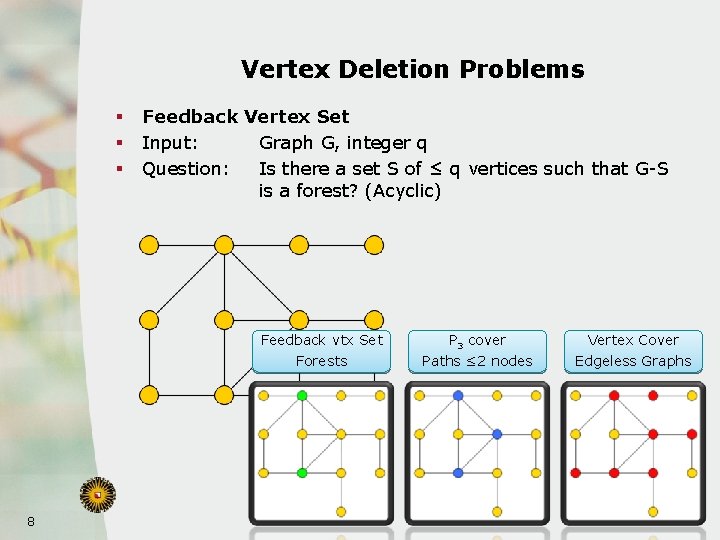
Vertex Deletion Problems § § § 8 Feedback Vertex Set Input: Graph G, integer q Question: Is there a set S of ≤ q vertices such that G-S is a forest? (Acyclic) Feedback vtx Set P 3 cover Vertex Cover Forests Paths ≤ 2 nodes Edgeless Graphs
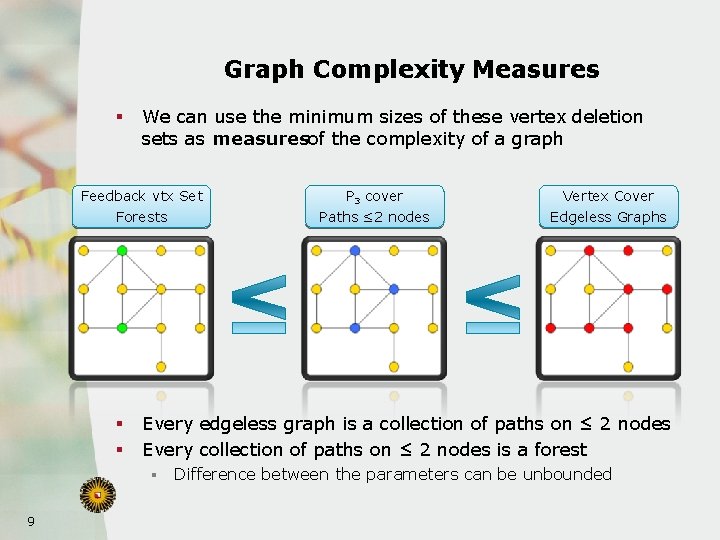
Graph Complexity Measures § We can use the minimum sizes of these vertex deletion sets as measuresof the complexity of a graph Feedback vtx Set P 3 cover Vertex Cover Forests Paths ≤ 2 nodes Edgeless Graphs § § Every edgeless graph is a collection of paths on ≤ 2 nodes Every collection of paths on ≤ 2 nodes is a forest § 9 Difference between the parameters can be unbounded
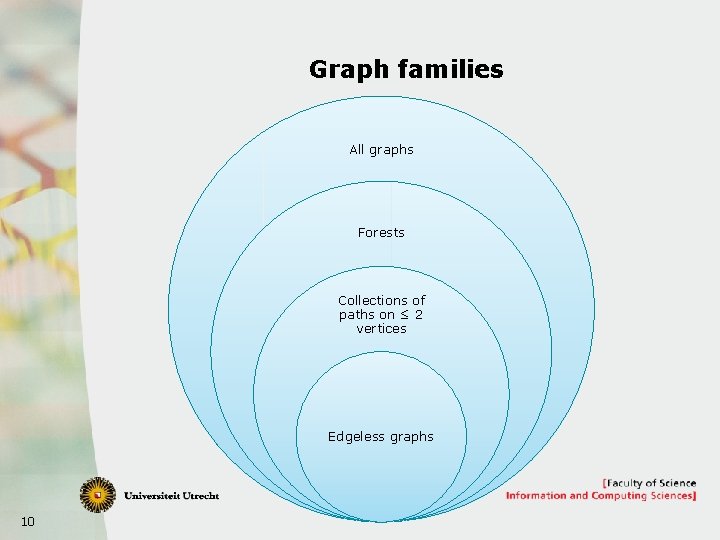
Graph families All graphs Forests Collections of paths on ≤ 2 vertices Edgeless graphs 10
Attacking hard problems with small parameters KERNELIZATION 11
Graph problems with structural parameters § Consider a computational decision problem on graphs § § Parameter value k expresses some measure of the complexity of the graph § § 12 Input: encoding x of a question about graph G, integer k. Question: does graph G have a (…)? Parameter: k size of a minimum Vertex Cover, P 3 Cover, Feedback Vertex Set, etc.
Kernelization for graph problems § A kernelization algorithm takes (x, k) as input and computes an instance (x’, k’) of same problem in polynomial time, such that § § The function f is the size of the kernel § § 13 We want f to be a (small) polynomial Kernelization reduces the size of the graph to something which depends § § § Answer to x is YES answer to x’ is YES k’ ≤ k |x’| ≤ f(k) for some function f only on the complexity measure of the input, not on the size of the input Afterwards solve the smaller instances by some other method
Perspective for this talk § § We want to solve the Independent Setproblem We use the solution values of the vertex deletion problems as complexity measures (parameters) of the input instances § Previous state of the art: § “Does graph G with vertex cover of size k have an independent set of size q? ” § can be transformed in polynomial time into: § 14 § “Does graph G’ with vertex cover of size k’ have an independent set of size q’ ? ” § § where and |G’| ≤ 2 k, k’ ≤ k. Complexity-theoretic evidence that the factor 2 is optimal
Our results: upper bounds § “Does graph G with feedback vertex set of size k have an independent set of size q? ” § § “Does graph G’ with feedback vertex set of size k’ have an independent set of size q’ ? ” § § where and § Our new bound uses more units of a smallermeasure § § |G’| ≤ O(k 3), k’ ≤ k. |G’| ≤ O(|Min. FVS|3) |G’| ≤ 2 |Min. VC| Refinedparameter For simplicity we present the following result: § 15 can be transformed in polynomial time into: Transformation such that |G’| ≤ O(|Min. P 3 Cover(G)|3). The Independent Setproblem parameterized by the size of a feedback vertex set admits a cubic-vertex kernel

CUBIC-VERTEX KERNEL FOR PARAMETER P 3 COVER 16
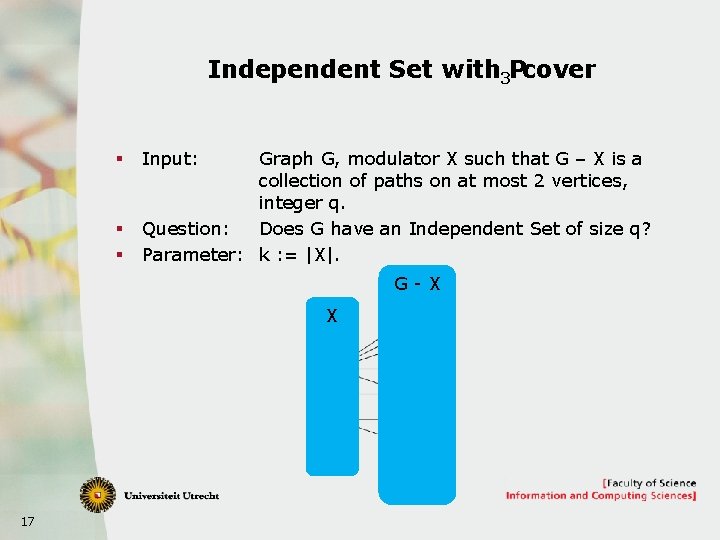
Independent Set with 3 P -cover § § § Input: Graph G, modulator X such that G – X is a collection of paths on at most 2 vertices, integer q. Question: Does G have an Independent Set of size q? Parameter: k : = |X|. G-X X 17
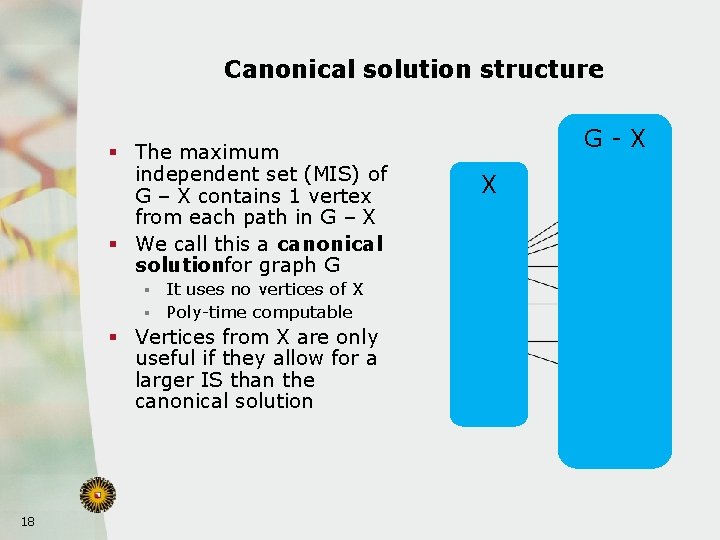
Canonical solution structure § The maximum independent set (MIS) of G – X contains 1 vertex from each path in G – X § We call this a canonical solutionfor graph G § § It uses no vertices of X Poly-time computable § Vertices from X are only useful if they allow for a larger IS than the canonical solution 18 G-X X
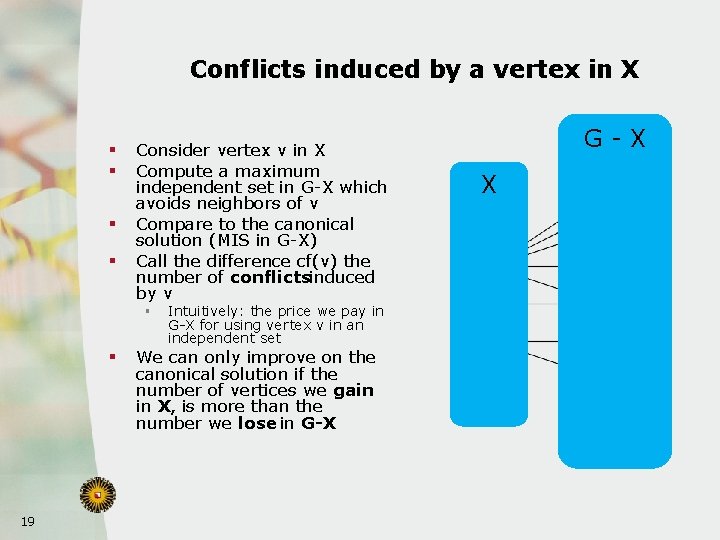
Conflicts induced by a vertex in X § § Consider vertex v in X Compute a maximum independent set in G-X which avoids neighbors of v Compare to the canonical solution (MIS in G-X) Call the difference cf(v) the number of conflictsinduced by v § § 19 Intuitively: the price we pay in G-X for using vertex v in an independent set We can only improve on the canonical solution if the number of vertices we gain in X, is more than the number we lose in G-X X
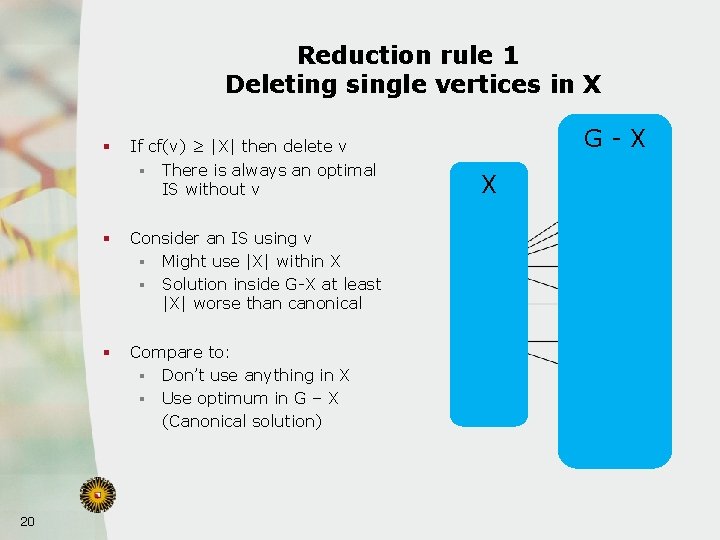
Reduction rule 1 Deleting single vertices in X § 20 If cf(v) ≥ |X| then delete v § There is always an optimal IS without v § Consider an IS using v § Might use |X| within X § Solution inside G-X at least |X| worse than canonical § Compare to: § Don’t use anything in X § Use optimum in G – X (Canonical solution) G-X X
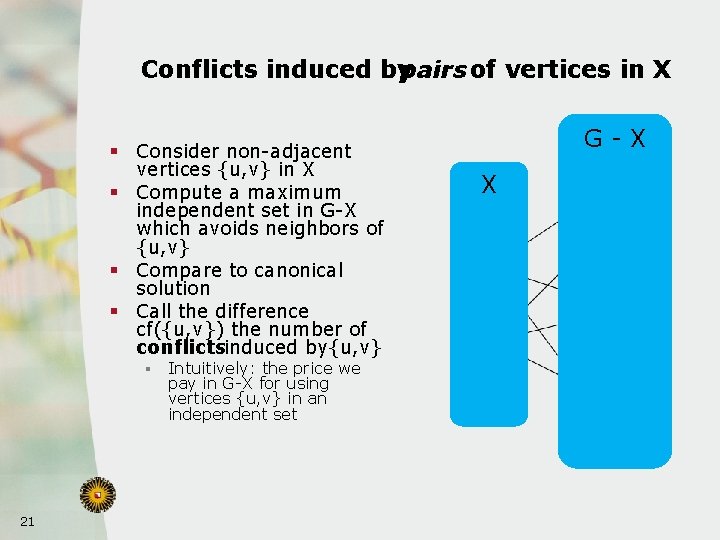
Conflicts induced bypairs of vertices in X § Consider non-adjacent vertices {u, v} in X § Compute a maximum independent set in G-X which avoids neighbors of {u, v} § Compare to canonical solution § Call the difference cf({u, v}) the number of conflictsinduced by{u, v} § 21 Intuitively: the price we pay in G-X for using vertices {u, v} in an independent set G-X X
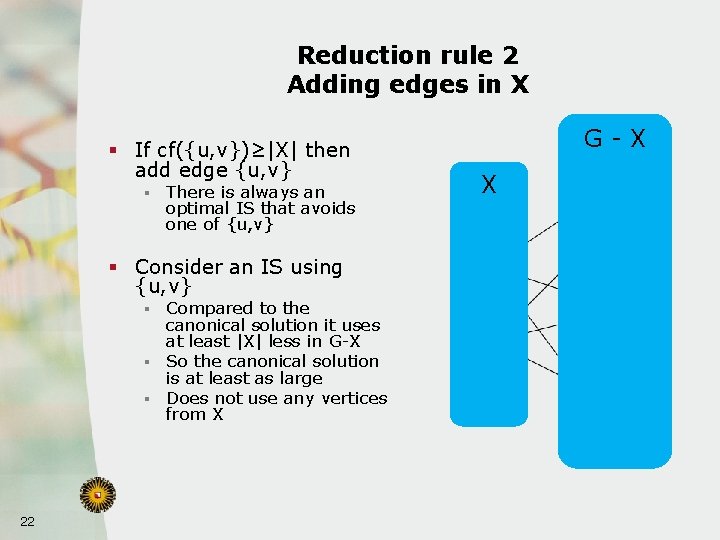
Reduction rule 2 Adding edges in X § If cf({u, v})≥|X| then add edge {u, v} § There is always an optimal IS that avoids one of {u, v} § Consider an IS using {u, v} Compared to the canonical solution it uses at least |X| less in G-X § So the canonical solution is at least as large § Does not use any vertices from X § 22 G-X X
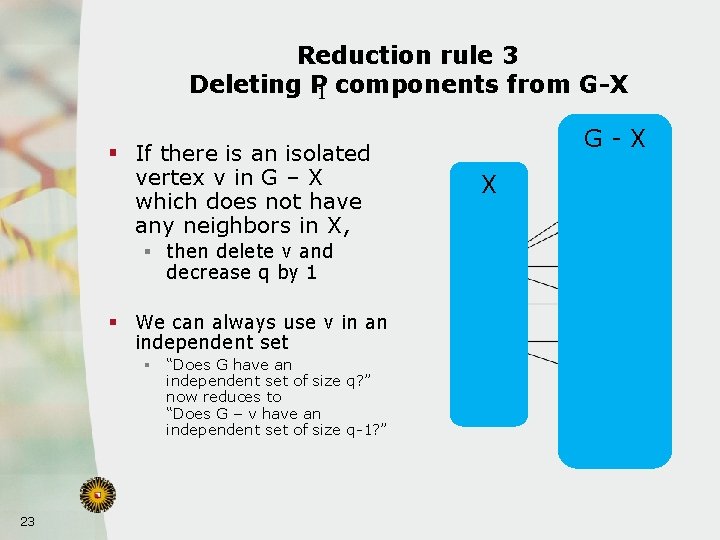
Reduction rule 3 Deleting P 1 components from G-X § If there is an isolated vertex v in G – X which does not have any neighbors in X, § then delete v and decrease q by 1 § We can always use v in an independent set § 23 “Does G have an independent set of size q? ” now reduces to “Does G – v have an independent set of size q-1? ” G-X X
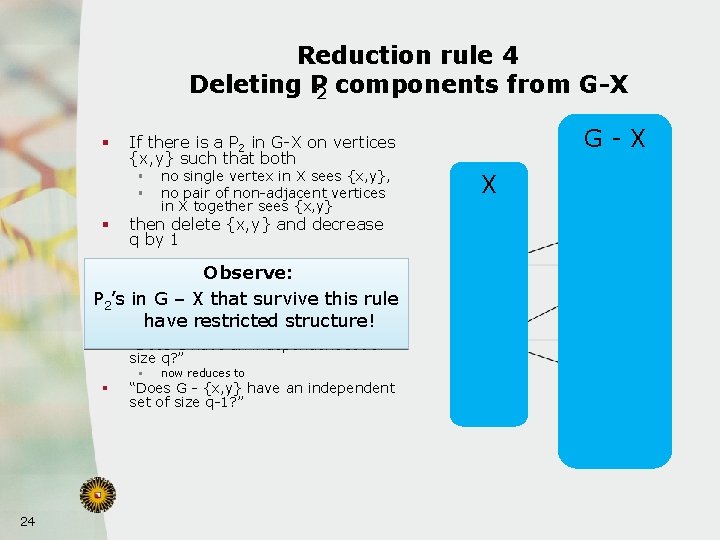
Reduction rule 4 Deleting P 2 components from G-X § § § no single vertex in X sees {x, y}, no pair of non-adjacent vertices in X together sees {x, y} § then delete {x, y} and decrease q by 1 § We can always use one of {x, y} in an Observe: independent set P 2’s in X that set survive this rule § G No– independent in X contains neighbors of x and y simultaneously have restricted structure! § “Does G have an independent set of size q? ” § § 24 G-X If there is a P 2 in G-X on vertices {x, y} such that both now reduces to “Does G - {x, y} have an independent set of size q-1? ” X
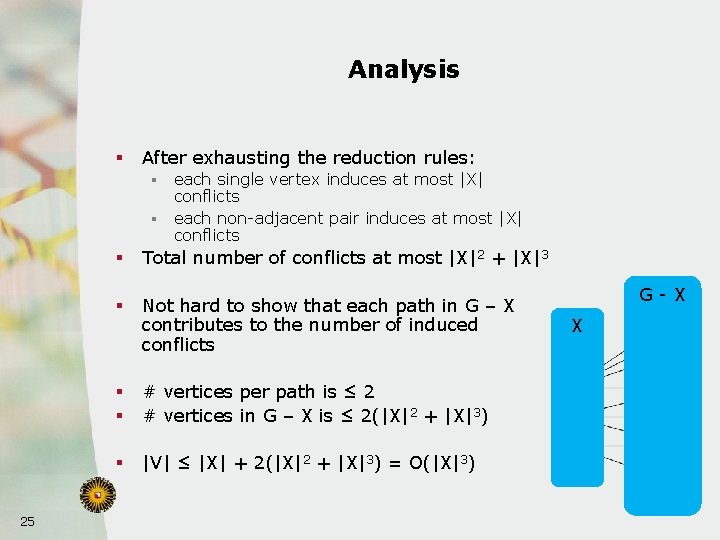
Analysis § After exhausting the reduction rules: § § 25 each single vertex induces at most |X| conflicts each non-adjacent pair induces at most |X| conflicts § Total number of conflicts at most |X|2 + |X|3 § Not hard to show that each path in G – X contributes to the number of induced conflicts § § # vertices per path is ≤ 2 # vertices in G – X is ≤ 2(|X|2 + |X|3) § |V| ≤ |X| + 2(|X|2 + |X|3) = O(|X|3) G-X X
Summing it up § Reduction rules can be applied in polynomial time § What is left of X forms a P 3 Cover for the resulting graph § § 26 Complexity of final instance is not greater than of input instance Independent Set parameterized by the size of a P 3 Cover admits a kernel with O(k 3) vertices
A sketch of the general result CUBIC-VERTEX KERNEL FOR PARAMETER FEEDBACK VERTEX SET 27

Independent Set with Feedback Vertex Set § § Input: Graph G, modulator X such that G – X is a forest, integer q. Question: Does G have an Independent Set of size q? Parameter: k : = |X|. Solve in § § § 2|X|(|V| + |E|) time Try all subsets S of X Skip if S is not independent Otherwise compute MIS in G-X which avoids neighbors of S § Solve MIS in G – X – N(S) § § 28 This is a forest! Return maximum value of |S| + MIS G-X X
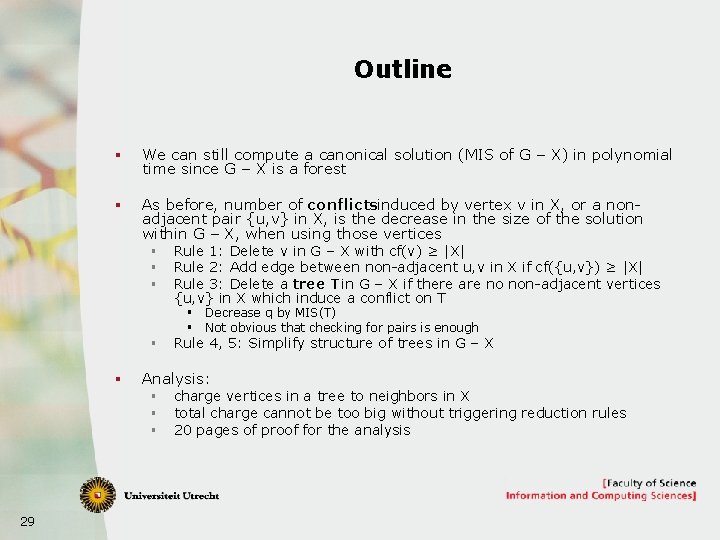
Outline § We can still compute a canonical solution (MIS of G – X) in polynomial time since G – X is a forest § As before, number of conflictsinduced by vertex v in X, or a nonadjacent pair {u, v} in X, is the decrease in the size of the solution within G – X, when using those vertices § § § Rule 1: Delete v in G – X with cf(v) ≥ |X| Rule 2: Add edge between non-adjacent u, v in X if cf({u, v}) ≥ |X| Rule 3: Delete a tree T in G – X if there are no non-adjacent vertices {u, v} in X which induce a conflict on T § Decrease q by MIS(T) § Not obvious that checking for pairs is enough § § Analysis: § § § 29 Rule 4, 5: Simplify structure of trees in G – X charge vertices in a tree to neighbors in X total charge cannot be too big without triggering reduction rules 20 pages of proof for the analysis
The modulator X in the input § We have assumed that we get the modulator X (the deletion set) as part of the input § § § Kernelization claims do not rely on X being a minimumset; the size of the reduced instance is bounded in |X| So we compute a 2 -approximation X, use it instead § § § 30 Might not be the case in practice |G’| is bounded in O(|X|3) |X| is bounded by 2 |Min. FVS(G)| Hence |G’| is bounded by O(|Min. FVS(G)|3)
The weighted variant of the problem NO POLYNOMIAL KERNEL FOR PARAMETER 3 PCOVER 31
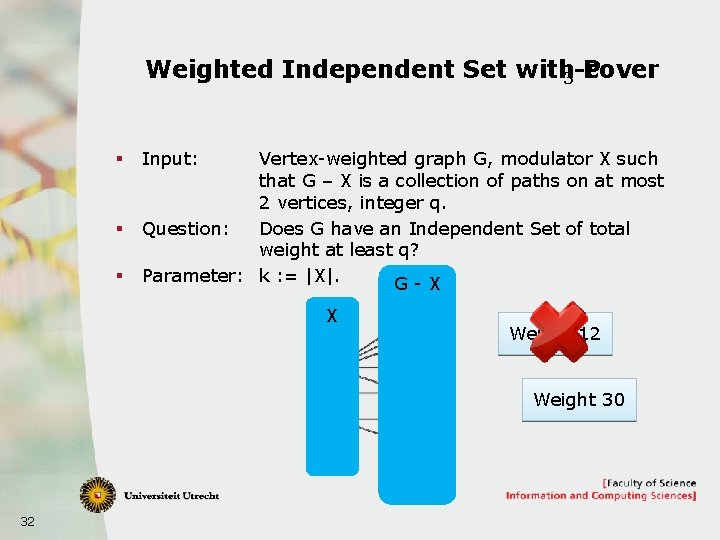
Weighted Independent Set with 3 -cover P § § § Input: Vertex-weighted graph G, modulator X such that G – X is a collection of paths on at most 2 vertices, integer q. Question: Does G have an Independent Set of total weight at least q? Parameter: k : = |X|. G-X X Weight 12 Weight 30 32
Contrasting result § Weighted Independent Set with P 3 -cover does not admit a polynomial kernel § § § Intuition: § 33 (assuming a widely-believed conjecture from complexity theory) Proof uses a variation of many-one reductions There is no answer-preserving polynomial-time procedure that reduces an instance of Weighted Independent Set to some instance whose size is bounded by the size of a P 3 cover § Independent Set parameterized by P 3 cover is the first example where the use of vertex weights does not affect fixed -parameter tractability, but does affect kernelizability § Compare: for Independent Set with parameter Vertex Cover both the weighted and unweighted problem admit small kernels!
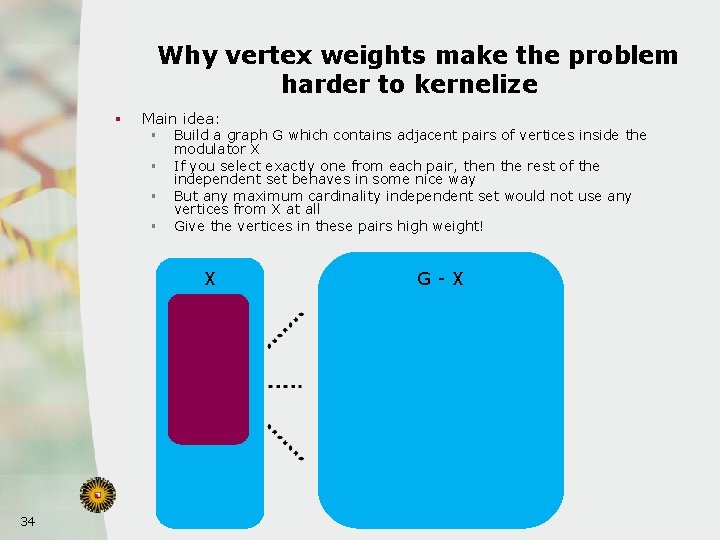
Why vertex weights make the problem harder to kernelize § Main idea: § § Build a graph G which contains adjacent pairs of vertices inside the modulator X If you select exactly one from each pair, then the rest of the independent set behaves in some nice way But any maximum cardinality independent set would not use any vertices from X at all Give the vertices in these pairs high weight! X 34 G-X
CONCLUSION AND DISCUSSION 35
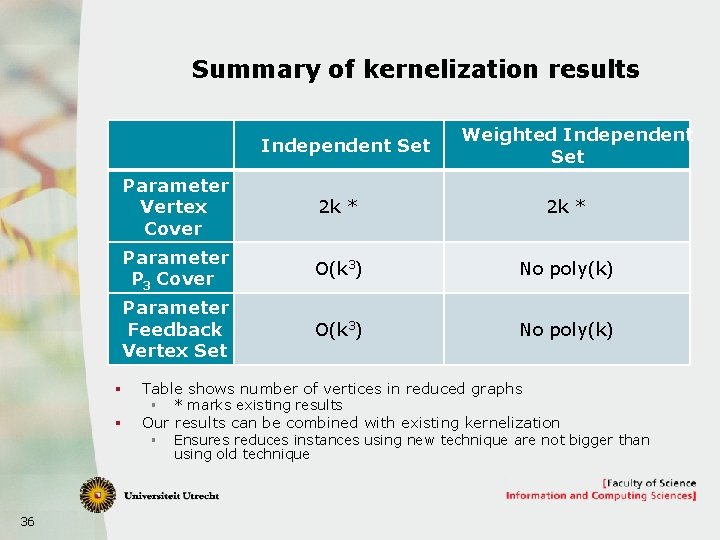
Summary of kernelization results Independent Set Parameter Vertex Cover 2 k * Parameter P 3 Cover O(k 3) No poly(k) Parameter Feedback Vertex Set O(k 3) No poly(k) § Table shows number of vertices in reduced graphs § § * marks existing results Our results can be combined with existing kernelization § 36 Weighted Independent Set Ensures reduces instances using new technique are not bigger than using old technique
Kernelizability of (Unweighted) Independent Set 37 Feedback vtx Set P 3 cover Vertex Cover Forests Paths ≤ 2 nodes Edgeless Graphs
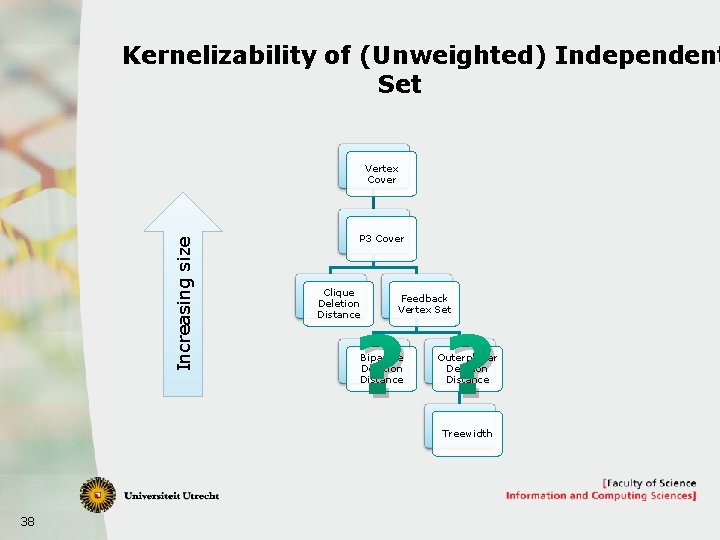
Kernelizability of (Unweighted) Independent Set Increasing size Vertex Cover P 3 Cover Clique Deletion Distance Feedback Vertex Set ? ? Bipartite Deletion Distance Outerplanar Deletion Distance Treewidth 38
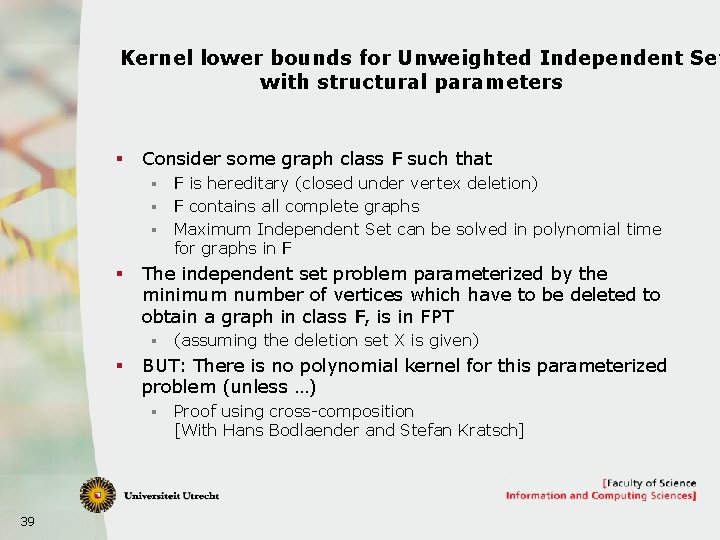
Kernel lower bounds for Unweighted Independent Set with structural parameters § Consider some graph class F such that § § The independent set problem parameterized by the minimum number of vertices which have to be deleted to obtain a graph in class F, is in FPT § § (assuming the deletion set X is given) BUT: There is no polynomial kernel for this parameterized problem (unless …) § 39 F is hereditary (closed under vertex deletion) F contains all complete graphs Maximum Independent Set can be solved in polynomial time for graphs in F Proof using cross-composition [With Hans Bodlaender and Stefan Kratsch]
Implications § The Maximum Independent Set problem parameterized by the number k of vertices which have to be deleted to obtain a § § § 40 Perfect graph, Chordal graph, Interval graph, Cograph, Etc …, is in the class FPT but does not admit a polynomial kernel (unless …)
Conclusion § We have studied Independent Set parameterized by different measures of graph complexity § § Usage of vertex weights affects kernelizability § Hierarchy of parameters (complexity measures) which we can explore § Open problems § § 41 Size of a Vertex Cover, P 3 Cover, Feedback Vertex Set Deletion distance to bipartite/outerplanar graphs Improve the degree of the polynomial: cubic to quadratic?
- Slides: 41