
Barriers to the integration and adoption of ICT
Barriers to the integration and adoption of ICT in Developing Countries 1 Muhammad Saifuddin Khalid Ph. D (HCCI), MSc & BSc (Computer Science) Assistant Professor Research Group: D 4 Learning Department of Learning and Philosophy Aalborg University, Denmark Email: khalid@learning. aau. dk Global Wireless Summit 2014, Aalborg, Denmark Thursday, October 21, 2021
Points of departure 2 � From the Book “The African Mobile Story”, Edited by Prof. Knud Skoby and Idongesit Williams 1. Chapter 7: Mobile ICT and Education Delivery, by Nana Kofi Annan, George Olrelans Ofori. Dwumfou, and Benjamin Kwofie 2. Chapter 9: Harnessing ICT for Local Government Administration in Africa: A Look at the Push-ICT Theory Approach in Nigeria, by Wilson Joseph, Nuhu Diraso Gapsiso, and Musa Usman Global Wireless Summit 2014, Aalborg, Denmark Thursday, October 21, 2021
ICT 4 D: What are we dealing with? 3 �Barriers to the integration and adoption of ICT �Related terms in current literature: Problem in relation to ICT (including Mobile) �Integration �Adoption Causes: �Barriers, obstacles, challenges, and hurdles Effects: �Digital divide �Exclusion and Inclusion Global Wireless Summit 2014, Aalborg, Denmark Thursday, October 21, 2021
Categorization of barriers in education 4 �The trend for more than three decades in the cross- disciplinary field of educational technology or e-Learning macro-meso-micro level barriers of the education system (Balanskat, Blamire, & Kefala, 2006; Tondeur, van Keer, van Braak, & Valcke, 2008) teachers’ extrinsic or first-order barriers (i. e. institutional, incremental) and intrinsic or second-order barriers (i. e. fundamental, personal) (Albirini, 2006; Ertmer, 1999; Snoeyink and Peggy A. Ertmer, 2001) school-level barriers and teacher-level barriers (A. Jones, 2004), direct and indirect barriers (Hew & Brush, 2006) material and non-material barriers (Pelgrum, 2001), other ways of categorization (Bingimlas, 2009; Ertmer, Ottenbreit. Leftwich, Sadik, Sendurur, & Sendurur, 2012; Hew & Brush, 2006) Source: Khalid and Lillian (2013) Global Wireless Summit 2014, Aalborg, Denmark Thursday, October 21, 2021
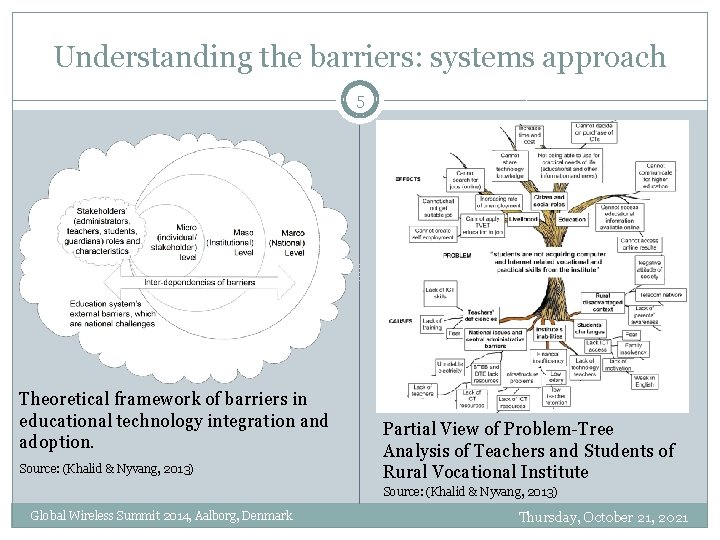
Understanding the barriers: systems approach 5 Theoretical framework of barriers in educational technology integration and adoption. Source: (Khalid & Nyvang, 2013) Partial View of Problem-Tree Analysis of Teachers and Students of Rural Vocational Institute Source: (Khalid & Nyvang, 2013) Global Wireless Summit 2014, Aalborg, Denmark Thursday, October 21, 2021
Understanding the barriers: Percentage by emphasis in literature 6 � Hew and Brush’s (2006) review paper classified the barriers into six main categories as follows: (a) resources (40%), (b) knowledge and skills (23%), (c) institution (14%), (d) attitudes and beliefs (13%), (e) assessment (5%), and (f) subject culture (2%). � In addition, these categories are further classified as direct and indirect. � The four direct barrier categories are: (a) teachers’ attitudes and beliefs towards using technology, (b) teachers’ knowledge and skills, (c) institution, and (d) resources. � Hew and Brush looked for congruency in the findings of Rogers (2000, pp. 459– 461) and mapped Rogers’ 10 barrier categories within the above mentioned 6 categories (Hew & Brush, 2006, p. 241). Except for “funding, ” the barrier categories of Rogers are present in the categorization model of Hew & Brush. Quoted from: Khalid and Lillian (2013) Global Wireless Summit 2014, Aalborg, Denmark Thursday, October 21, 2021
Understanding the barriers: Various approaches 7 TPACK Framework: technology, pedagogy, and content knowledge (Koehler and Mishra, 2009) � From Khalid & Lillian (2013): Resource: availability, accessibility, time, technical support, resource quality, funding, and teacher/trainer. Knowledge and Skills: specific technology, technology-supported pedagogy (replacement, amplification, and transformation), and technology-related-classroom management. Corruption Assessment: (a) pressure to meet higher standards, (b) score high on standardized tests, (c) cover vast scope of material within a limited amount of time, (d) consequences of promotion or graduation, and (e) external requirements of traditional examinations Vision, strategy, and plan: lack of time to make the ICT strategy plan, lack of ICT policy plan, ICT integration leadership, integration support, evaluation of implementation of ICT integration, Global Wireless Summit 2014, Aalborg, Denmark Thursday, October 21, 2021
References 8 � Hew, Khe Foon, and Thomas Brush. “Integrating Technology into K-12 Teaching and Learning: Current Knowledge Gaps and Recommendations for Future Research. ” Educational Technology Research and Development 55, no. 3 (December 5, 2006): 223– 52. doi: 10. 1007/s 11423 -006 -9022 -5. � Khalid, Md. Saifuddin, and Lillian Buus. “A Theoretical Framework Mapping Barriers of Integrating and Adopting Educational Technology. ” Research and Practice in Technology Enhanced Learning, Submitted 2013, Status: Accepted for peer–review. � Khalid, Md. Saifuddin, and Tom Nyvang. “Application of PLA Methods in Educational Technology Research: A Rural Bangladeshi Case. ” In Changing Education Through ICT in Developing Countries, edited by Marianne Georgsen and Pär-Ola Mikael Zander, 107– 30. Aalborg: Aalborg University Press, 2013. http: //vbn. aau. dk/files/160291988/Changing_Education_OA_version. pdf. � Koehler, M. J. , and P. Mishra. “What Is TPACK. ” Contemporary Issues in Technology and Teacher Education, 2009. Global Wireless Summit 2014, Aalborg, Denmark Thursday, October 21, 2021
Discussion 9 Global Wireless Summit 2014, Aalborg, Denmark Thursday, October 21, 2021
- Slides: 9