
Barriers to TB infection control in developing countries

Barriers to TB infection control in developing countries Eltony Mugomeri Mtech Department of Pharmacy National University of Lesotho Maseru, Lesotho Hosted by Prof. Shaheen Mehtar Infection Control Africa Network (ICAN) Stellenbosch University, South Africa www. webbertraining. com March 10, 2016
2 Adherence to tuberculosis infection control guidelines by nurses in Lesotho. Am J Infect Control. 2015 Jul 1; 43(7): 735 -8. doi: 10. 1016/j. ajic. 2015. 03. 016 Eltony Mugomeri Mtech a, Peter Chatanga MSc b, Mamotlatsi Lefunyane BSc c, Vurayai Ruhanya MSc d, George Nyandoro MSc d, Nyasha Chin’ombe Ph. D d 2 a Department of Pharmacy, National University of Lesotho, Maseru, Lesotho b Department of Biology, National University of Lesotho, Maseru, Lesotho c Department of Nursing, National University of Lesotho, Maseru, Lesotho d Department of Medical Microbiology, College of Health Sciences, University of Zimbabwe, Harare, Zimbabwe
Introduction Good infection control lies in basic professional training, provision of written policies, and continuous education of health care workers. Tuberculosis (TB) can easily spread in hospital settings through airborne particles or droplets when an infected person coughs, sneezes, talks, or sings (Motacki, 2011) Infection control guidelines in many Africa are often not followed, resulting in increased TB cases (Dagnra, 2011) There is need for further scrutiny of infection control in these settings. 3
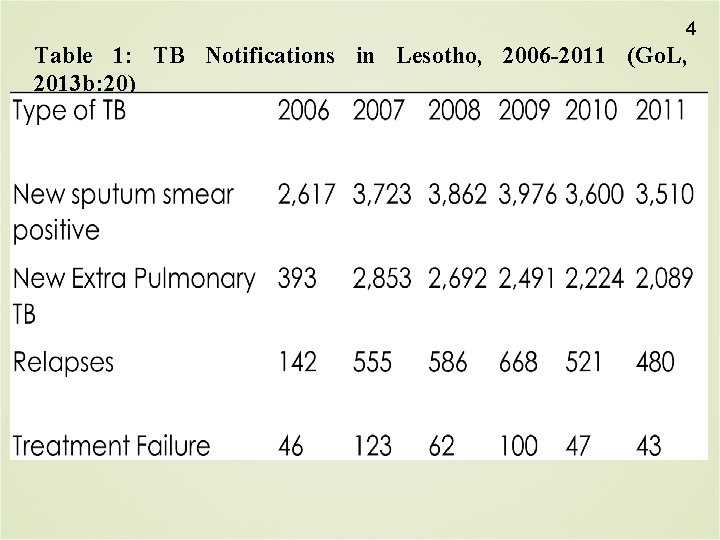
4 Table 1: TB Notifications in Lesotho, 2006 -2011 (Go. L, 2013 b: 20)
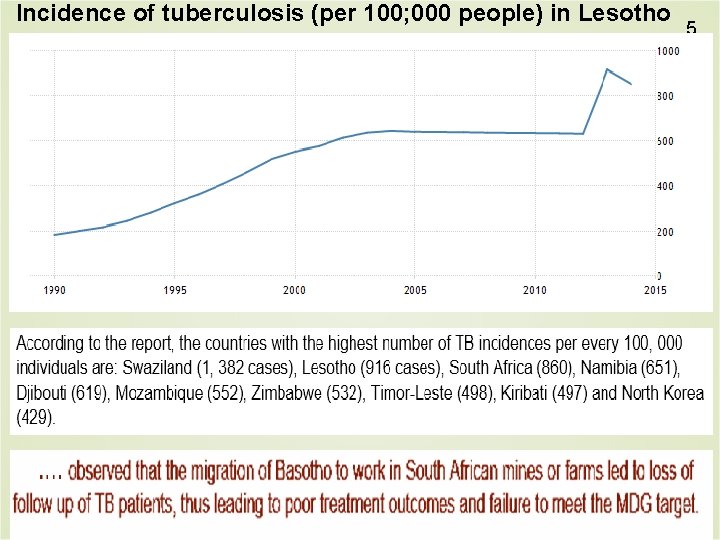
Incidence of tuberculosis (per 100; 000 people) in Lesotho 5
The problem of TB infection control in Lesotho In 2012, the Lesotho Government developed a 5 -year strategic plan for improving TB infection control, combating the spread of TB and intensifying the detection of TB cases (Go. L, 2012) Lesotho adapted the World Health Organization TB infection control guidelines (Go. L, 2010). However, constraints remain. This study assessed the level of adherence to TB infection control guidelines in healthcare settings in Lesotho and the associated factors. 6
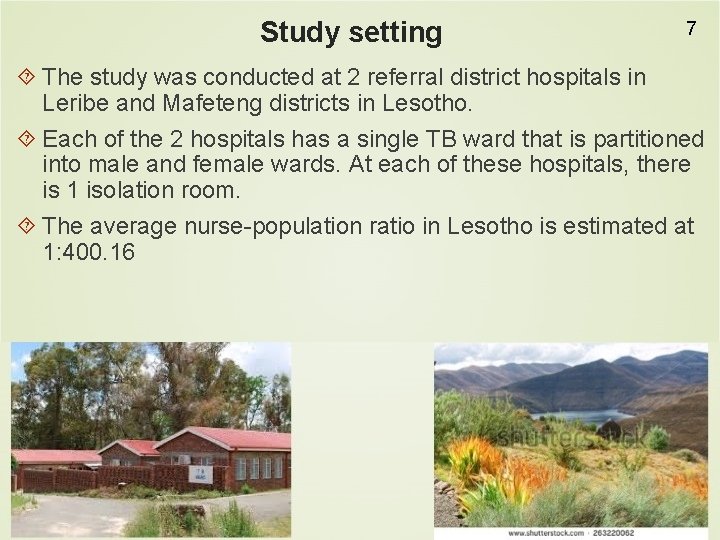
Study setting 7 The study was conducted at 2 referral district hospitals in Leribe and Mafeteng districts in Lesotho. Each of the 2 hospitals has a single TB ward that is partitioned into male and female wards. At each of these hospitals, there is 1 isolation room. The average nurse-population ratio in Lesotho is estimated at 1: 400. 16
Study design and data collection Semi-structured questionnaires administered by the interviewer. 55 nurses systematically sampled from a 120 -member nursing staff in the 2 hospitals included in the study. Inclusion: nurses who had worked in the TB ward and outpatient departments for at least a month. Study approved by the Ministry of Health Research and Ethics Committee of Lesotho on January 17, 2012. 8
Data Analysis & Definitions 9 Logistic regression analysis used to test for the significance (p<0. 05) of the variables associated with nonadherence. Nonadherence to TB infection control guidelines was defined as lack of TB infection control guidelines, inaccessibility of the guidelines, and rare use of guidelines.
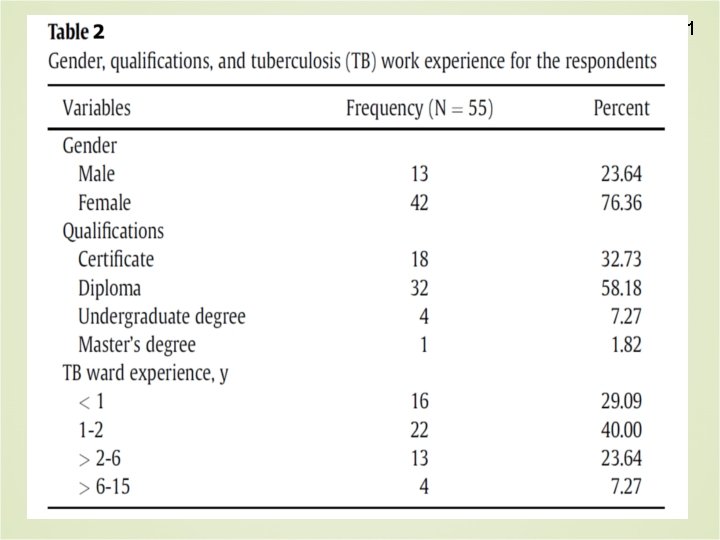
RESULTS 10 Demographic distribution of the respondents The respondents’ ages ranged from 23 -53 years with mean age of 35 years. There were more women than men in the study. In addition, diploma holders constituted the majority of the nurses (Table 2) Being female was significantly (p=0. 03) associated with nonadherence. However, note that gender ratio in this study was unbalanced(see Table 2).
11

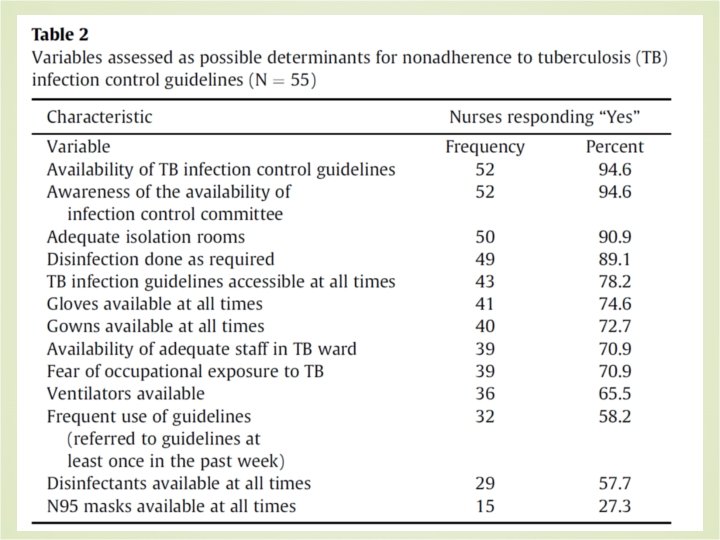
12 Availability, accessibility, and use of infection control guidelines Availability, accessibility, and frequency of use were the main indicators of nonadherence (Table 3) Overall, 43. 6% of respondents were not adhering to the guidelines.
13
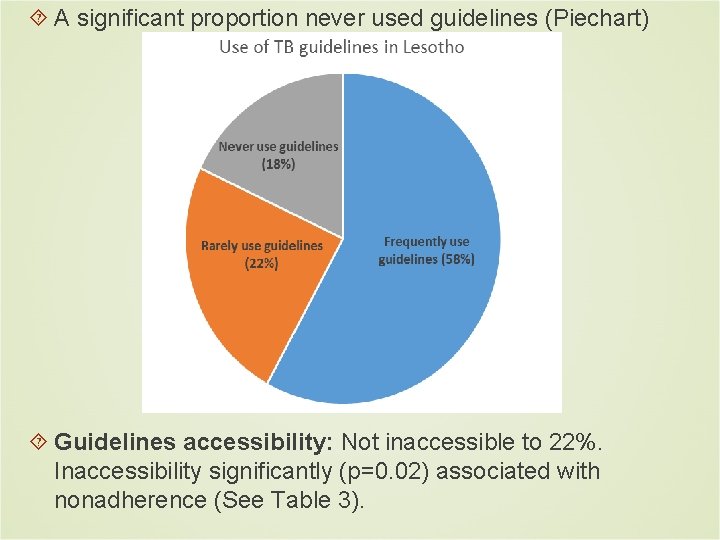
A significant proportion never used guidelines (Piechart) Guidelines accessibility: Not inaccessible to 22%. Inaccessibility significantly (p=0. 02) associated with nonadherence (See Table 3).
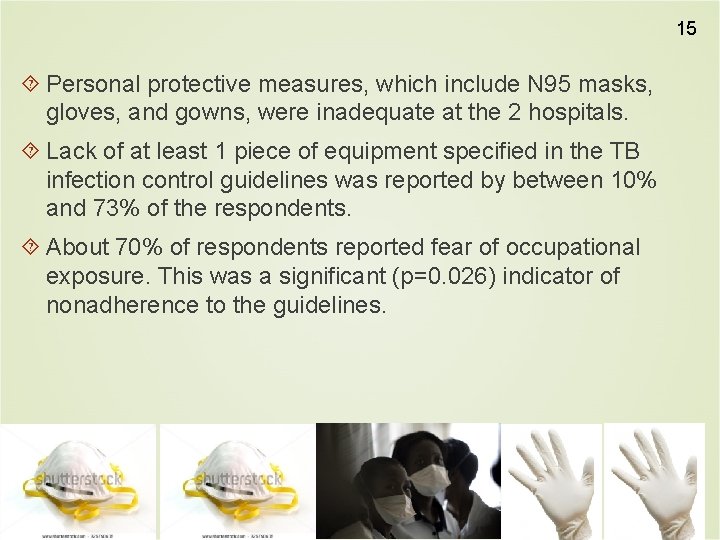
15 Personal protective measures, which include N 95 masks, gloves, and gowns, were inadequate at the 2 hospitals. Lack of at least 1 piece of equipment specified in the TB infection control guidelines was reported by between 10% and 73% of the respondents. About 70% of respondents reported fear of occupational exposure. This was a significant (p=0. 026) indicator of nonadherence to the guidelines.
Constraints hindering adherence to TB guidelines 16 Overall, 8 constraints to adherence to TB guidelines were identified (Fig 1). Lack of equipment (>30%) and inadequate staff (about 30%) were the main indicators of nonadherence. Lack of equipment (p=0. 02) and inadequate staff (p=0. 005) contributed significantly to lack of adherence. Insignificant indicators of nonadherence included lack of clarity of the guidelines and allergies to equipment such as N 95 masks (see Fig 1).
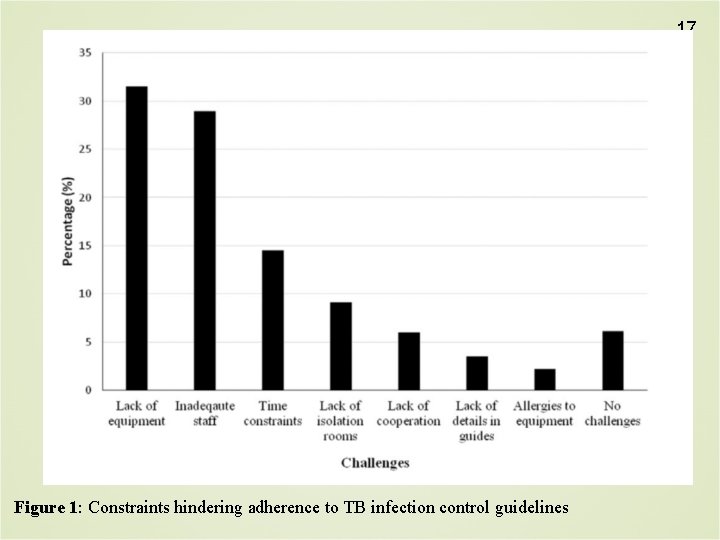
17 Figure 1: Constraints hindering adherence to TB infection control guidelines
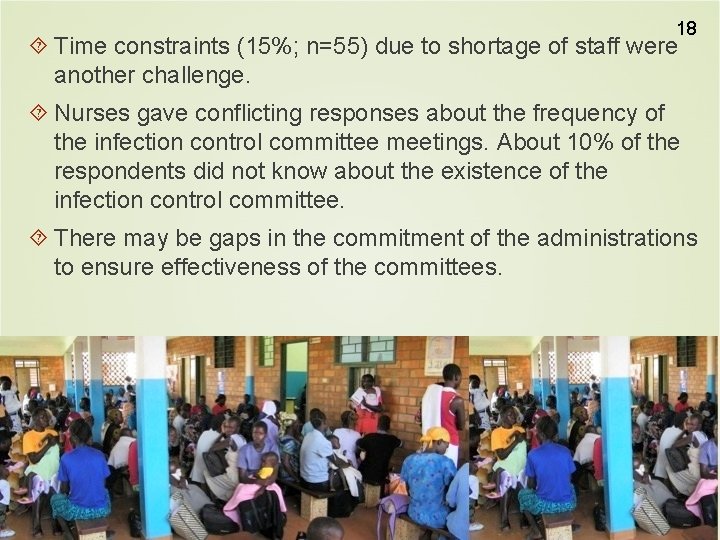
18 Time constraints (15%; n=55) due to shortage of staff were another challenge. Nurses gave conflicting responses about the frequency of the infection control committee meetings. About 10% of the respondents did not know about the existence of the infection control committee. There may be gaps in the commitment of the administrations to ensure effectiveness of the committees.
Staff shortage was strongly reported. About 55% of the respondents indicated that only 1 nurse worked per shift in the night, while about 20% reported that the TB ward was sometimes left unattended at night. However, the nurses reported that day shifts were well attended with at least 3 nurses per shift (nurse-patient ratio of about 1: 10). Most respondents (71%) reported that they educated patients about TB daily. However, 10% said they never educated patients about TB. 19
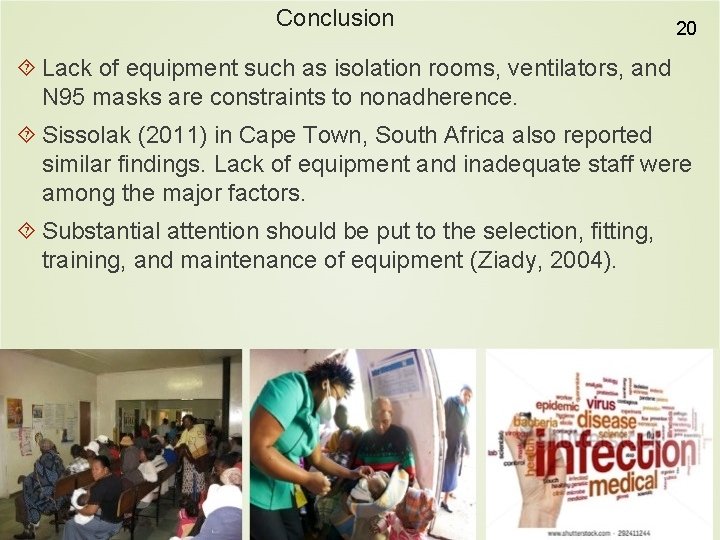
Conclusion 20 Lack of equipment such as isolation rooms, ventilators, and N 95 masks are constraints to nonadherence. Sissolak (2011) in Cape Town, South Africa also reported similar findings. Lack of equipment and inadequate staff were among the major factors. Substantial attention should be put to the selection, fitting, training, and maintenance of equipment (Ziady, 2004).
21 Nurses need to be trained on appropriate use of equipment (Prieskop, 2004) Isolation rooms with negative atmospheric pressure are needed (Gruendemann, 2001). A study in Malawi showed that TB control guidelines were not uniformly implemented (Harries, 2002). Oladoyinbo (2011) in Lesotho revealed that the National TB Control Programme has ineffective monitoring and evaluation tools.

22 -Thank You- emugomeri@yahoo. com

March 16 (Free WHO Teleclass. . . Europe) THE GLOBAL MYCOBACTERIUM CHIMAERA OUTBREAK IN CARDIAC SURGERY Dr. Hugo Sax, University of Zurich Hospitals Sponsored by the World Health Organization March 17 (Free Teleclass) INFECTION PREVENTION AND CONTROL WITH ACCREDITATION CANADA QMENTUM PROGRAM Chingiz Amirov, Canadian Journal of Infection Control Sponsored by GOJO March 31 SUCCESSFUL IMPLEMENTATION OF CATHETER-ASSOCIATED URINARY TRACT INFECTION BUNDLES: LESSONS LEARNED Prof. Sarah L. Krein, University of Michigan April 7 PREVENTING INVASIVE CANDIDA INFECTIONS – WHERE COULD WE DO BETTER?


- Slides: 25