
Barriers to strengthening the Global Reporting Initiative GRI
Barriers to strengthening the Global Reporting Initiative (GRI) Framework: an exploration of the perceptions of consultants, practitioners, and researchers CSIN Conference, 02. Mar. 10 Alberto Fonseca

THE PRESENTATION • The GRI G 3 framework • 3 Common Criticisms • Methodology • Motivational, Structural, and Specific Barriers • Implications for Reporters, Standard-setters, and Stakeholders

AN INFLUENTIAL FRAMEWORK • “Formally” used in 1, 296 reports (2009) • Adopted by more than ¾ of the world’s 250 largest companies • Mentioned in the 2002 WSSD Plan of Implementation • Praised by global leaders • Changed the language and structure of non-financial reporting
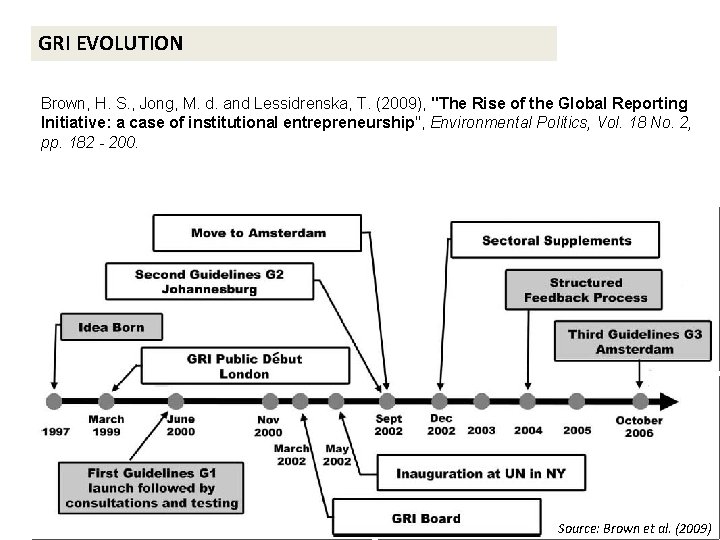
GRI EVOLUTION Brown, H. S. , Jong, M. d. and Lessidrenska, T. (2009), "The Rise of the Global Reporting Initiative: a case of institutional entrepreneurship", Environmental Politics, Vol. 18 No. 2, pp. 182 - 200. Source: Brown et al. (2009)

THE GRI AS AN ORGANIZATION • Multi-stakeholder network (Board of directors, stakeholder council, technical advisory, organizational stakeholder…) • Funded by governments, foundations, companies, individuals, and GRI’s services • Mission is to create conditions for the transparent and reliable exchange of sustainability information through the development and continuous improvement of its Sustainability Reporting Framework. • Main product: GRI G 3 Framework

GRI G 3 FRAMEWORK Standard Disclosures: 1 - Strategy and profile 2 - Management approach 3 – Performance Indicators Economic Environmental Social Human rights Society Product responsibility ? Source: GRI (2006)

GRI G 3 FRAMEWORK Principles for defining contents: Materiality Stakeholder inclusiveness Sustainability context Completeness Principles for defining quality: Balance Clarity Accuracy Timeliness Comparability Reliability Principles for defining boundaries Source: GRI (2006)
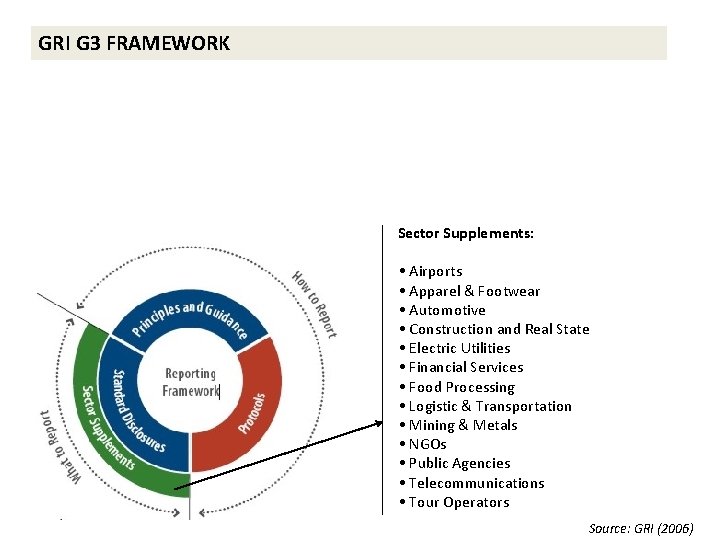
GRI G 3 FRAMEWORK Sector Supplements: • Airports • Apparel & Footwear • Automotive • Construction and Real State • Electric Utilities • Financial Services • Food Processing • Logistic & Transportation • Mining & Metals • NGOs • Public Agencies • Telecommunications • Tour Operators Source: GRI (2006)

GRI G 3 FRAMEWORK Application Level System Approaches: (1) Self-declaration; (2) Assurance, and (3) GRI check ? Source: GRI (2006)
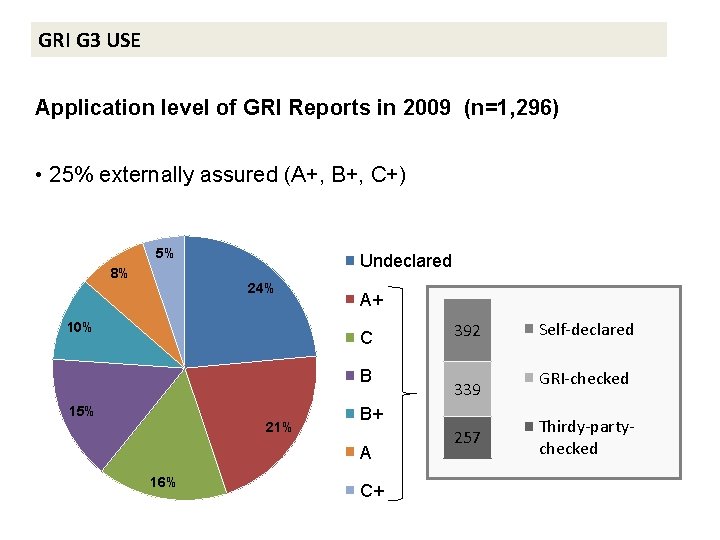
GRI G 3 USE Application level of GRI Reports in 2009 (n=1, 296) • 25% externally assured (A+, B+, C+) 5% 8% Undeclared 24% 10% A+ C B 15% 21% 339 B+ A 16% 392 C+ 257 Self-declared GRI-checked Thirdy-partychecked
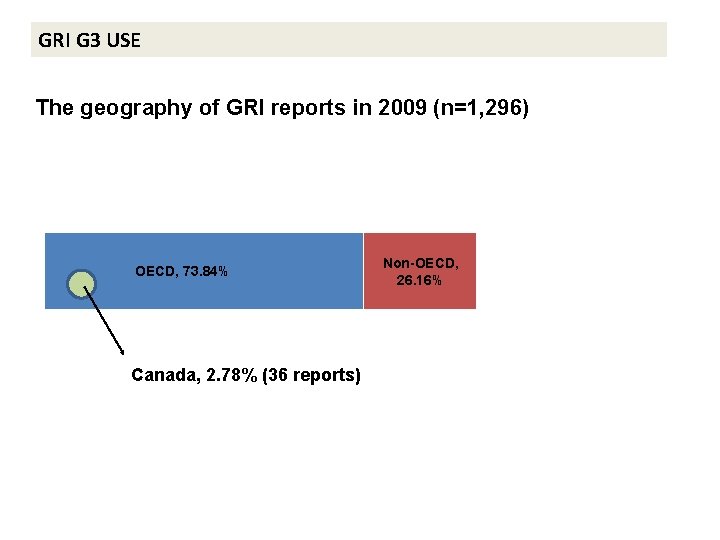
GRI G 3 USE The geography of GRI reports in 2009 (n=1, 296) OECD, 73. 84% Canada, 2. 78% (36 reports) Non-OECD, 26. 16%
GRI G 3 USE Reasons to celebrate: GRI reporting is… • Driving companies to embrace “sustainability” culture • Enabling benchmarking and learning • Enhancing corporate reputation • Promoting stakeholder engagement • Informing investors, employees, NGOs, managers, etc. about something • Generating data for research • Creating a consultancy market
GRI G 3 USE Reasons to think about: GRI reporting is not necessarily. . . • Promoting “sustainability” accountability • Contributing to sustainable development GRI reporting may be… • Legitimizing “unsustainable” behaviour • Misleading sustainability-oriented decisions ?
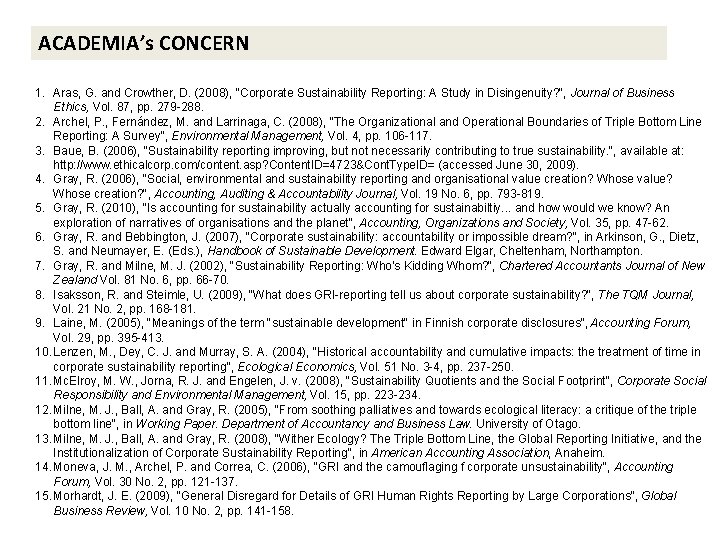
ACADEMIA’s CONCERN 1. Aras, G. and Crowther, D. (2008), "Corporate Sustainability Reporting: A Study in Disingenuity? ", Journal of Business Ethics, Vol. 87, pp. 279 -288. 2. Archel, P. , Fernández, M. and Larrinaga, C. (2008), "The Organizational and Operational Boundaries of Triple Bottom Line Reporting: A Survey", Environmental Management, Vol. 4, pp. 106 -117. 3. Baue, B. (2006), "Sustainability reporting improving, but not necessarily contributing to true sustainability. ", available at: http: //www. ethicalcorp. com/content. asp? Content. ID=4723&Cont. Type. ID= (accessed June 30, 2009). 4. Gray, R. (2006), "Social, environmental and sustainability reporting and organisational value creation? Whose value? Whose creation? ", Accounting, Auditing & Accountability Journal, Vol. 19 No. 6, pp. 793 -819. 5. Gray, R. (2010), "Is accounting for sustainability actually accounting for sustainabiltiy. . . and how would we know? An exploration of narratives of organisations and the planet", Accounting, Organizations and Society, Vol. 35, pp. 47 -62. 6. Gray, R. and Bebbington, J. (2007), "Corporate sustainability: accountability or impossible dream? ", in Arkinson, G. , Dietz, S. and Neumayer, E. (Eds. ), Handbook of Sustainable Development. Edward Elgar, Cheltenham, Northampton. 7. Gray, R. and Milne, M. J. (2002), "Sustainability Reporting: Who's Kidding Whom? ", Chartered Accountants Journal of New Zealand Vol. 81 No. 6, pp. 66 -70. 8. Isaksson, R. and Steimle, U. (2009), "What does GRI-reporting tell us about corporate sustainability? ", The TQM Journal, Vol. 21 No. 2, pp. 168 -181. 9. Laine, M. (2005), "Meanings of the term "sustainable development" in Finnish corporate disclosures", Accounting Forum, Vol. 29, pp. 395 -413. 10. Lenzen, M. , Dey, C. J. and Murray, S. A. (2004), "Historical accountability and cumulative impacts: the treatment of time in corporate sustainability reporting", Ecological Economics, Vol. 51 No. 3 -4, pp. 237 -250. 11. Mc. Elroy, M. W. , Jorna, R. J. and Engelen, J. v. (2008), "Sustainability Quotients and the Social Footprint", Corporate Social Responsibility and Environmental Management, Vol. 15, pp. 223 -234. 12. Milne, M. J. , Ball, A. and Gray, R. (2005), "From soothing palliatives and towards ecological literacy: a critique of the triple bottom line", in Working Paper. Department of Accountancy and Business Law. University of Otago. 13. Milne, M. J. , Ball, A. and Gray, R. (2008), "Wither Ecology? The Triple Bottom Line, the Global Reporting Initiative, and the Institutionalization of Corporate Sustainability Reporting", in American Accounting Association, Anaheim. 14. Moneva, J. M. , Archel, P. and Correa, C. (2006), "GRI and the camouflaging f corporate unsustainability", Accounting Forum, Vol. 30 No. 2, pp. 121 -137. 15. Morhardt, J. E. (2009), "General Disregard for Details of GRI Human Rights Reporting by Large Corporations", Global Business Review, Vol. 10 No. 2, pp. 141 -158.

COMMON CRITICISMS 1. GRI is promoting non-contextualized disclosures • The “Sustainability Context” principle has been overlooked by reporters and external verifiers • Disclosures do not reflect the interactive effects of organizations with the external environment Bellagio Principle 2: “The underlying social, economic and environmental system as a whole and the interactions among its components” Reaction:
COMMON CRITICISMS 2. GRI’s focus on “organizational” performance is insufficient and potentially misleading • Disclosures tend not to be geographically-based • Lack of transparency of facility-level performance • Leads to “controversial” aggregations of data, particularly among MNCs or TNCs Bellagio Principle 3: “Appropriate geographical scope ranging from local to global” Reaction: FLR Facility-level Sustainability Reporting
COMMON CRITICISMS 3. Non-integrated disclosures (silos approach) • What do those 143 indicators indicate? • Where and how significant are the trade-offs? • After all, is the organization contributing or not to sustainability? Bellagio Principle 2: “The underlying social, economic and environmental system as a whole and the interactions among its components” / Bellagio Principle 3: “Implications for decision making, including trade-offs and synergies” Reaction: Alternative frameworks with indices and aggregated indicators
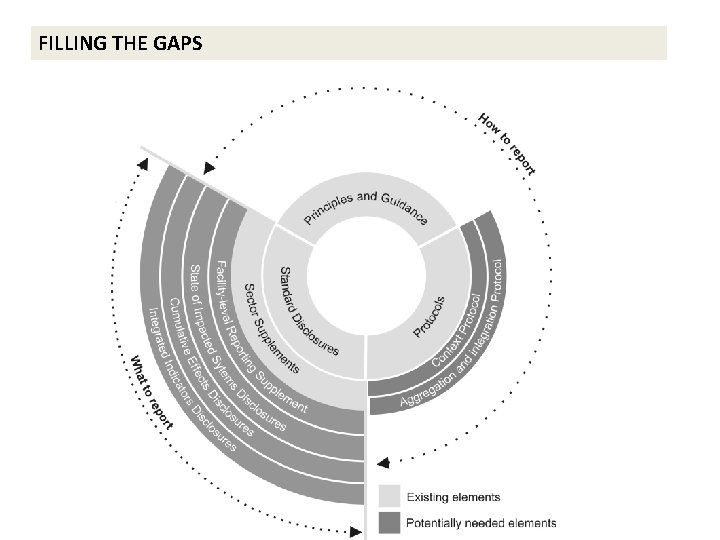
FILLING THE GAPS
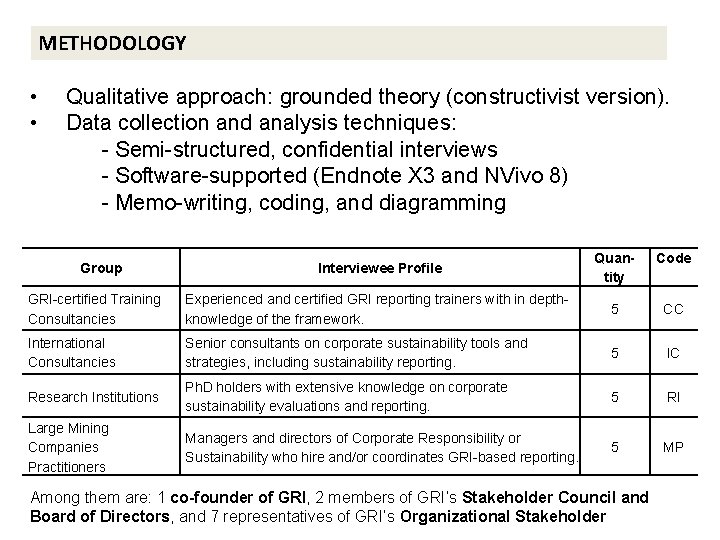
METHODOLOGY • • Qualitative approach: grounded theory (constructivist version). Data collection and analysis techniques: - Semi-structured, confidential interviews - Software-supported (Endnote X 3 and NVivo 8) - Memo-writing, coding, and diagramming Interviewee Profile Quantity Code GRI-certified Training Consultancies Experienced and certified GRI reporting trainers with in depthknowledge of the framework. 5 CC International Consultancies Senior consultants on corporate sustainability tools and strategies, including sustainability reporting. 5 IC Research Institutions Ph. D holders with extensive knowledge on corporate sustainability evaluations and reporting. 5 RI Large Mining Companies Practitioners Managers and directors of Corporate Responsibility or Sustainability who hire and/or coordinates GRI-based reporting. 5 MP Group Among them are: 1 co-founder of GRI, 2 members of GRI’s Stakeholder Council and Board of Directors, and 7 representatives of GRI’s Organizational Stakeholder
MOTIVATIONAL BARRIERS • Voluntary nature of sustainability reporting • Current GRI G 3 framework is already perceived as demanding • GRI’s imbalanced governance (predominance of business organizations) • Path dependence in GRI mission
STRUCTURAL BARRIERS • Consistency among reporting standards (Global Compact, AA 1000 AS, Global Compact, IFC, sector standards…) • Interdependence among framework elements (Supplements, protocols, indicators, and principles…) Example: GRI Application Level (we got A+. Why do more? )
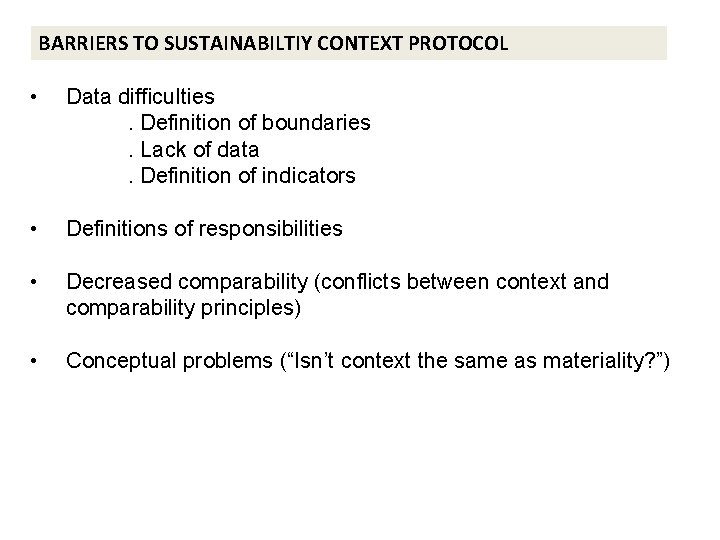
BARRIERS TO SUSTAINABILTIY CONTEXT PROTOCOL • Data difficulties. Definition of boundaries. Lack of data. Definition of indicators • Definitions of responsibilities • Decreased comparability (conflicts between context and comparability principles) • Conceptual problems (“Isn’t context the same as materiality? ”)
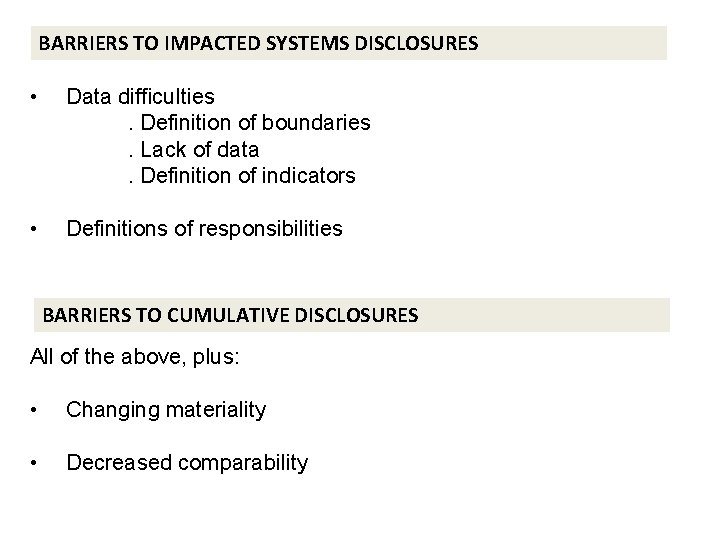
BARRIERS TO IMPACTED SYSTEMS DISCLOSURES • Data difficulties. Definition of boundaries. Lack of data. Definition of indicators • Definitions of responsibilities BARRIERS TO CUMULATIVE DISCLOSURES All of the above, plus: • Changing materiality • Decreased comparability
BARRIERS TO FACILITY-LEVEL SUPPLEMENT • Capacity-building at sites • Lack of interest from local stakeholders • Unclear cost-benefits • Increased information management • Excessive corporate exposure
BARRIERS TO INTEGRATED DISCLOSURES • Conceptual confusion. Integration means different things to different people • Data difficulties. Criteria for weighting indicators. Methods of aggregation. Lack of data. Definition of thresholds, unit of analysis • Definitions of responsibilities • Decreased comparability (conflicts with comparability principle) • Promotion of “unfair” trade-offs. Room for promoting “weak” sustainability
KEY IMPLICATIONS • Many barriers cannot be overcome in the short-term, whereas some can (e. g. ABC Application Level) • GRI, reporters, and industry associations need to recognize current gaps and establish incremental and/or transformational strategies for change • Stakeholders should be consulted not only to identify relevant “issues”, but also facilities, methods of aggregation, boundaries, etc.
KEY IMPLICATIONS • Sustainability reporting is, of course, a learning process. However, it seems to be very demanding and complex to be standardized by a single institution. • GRI is becoming the centrepiece of mutually enforcing reporting tools. Enhanced coordination among these initiatives is needed.

THANK YOU Alberto Fonseca Department of Geography & Environmental Management 1 -519 -804 -4046 adfonsec@uwaterloo. ca
- Slides: 28