
Barriers to Quality Communication Between Interdepartmental Nurses During
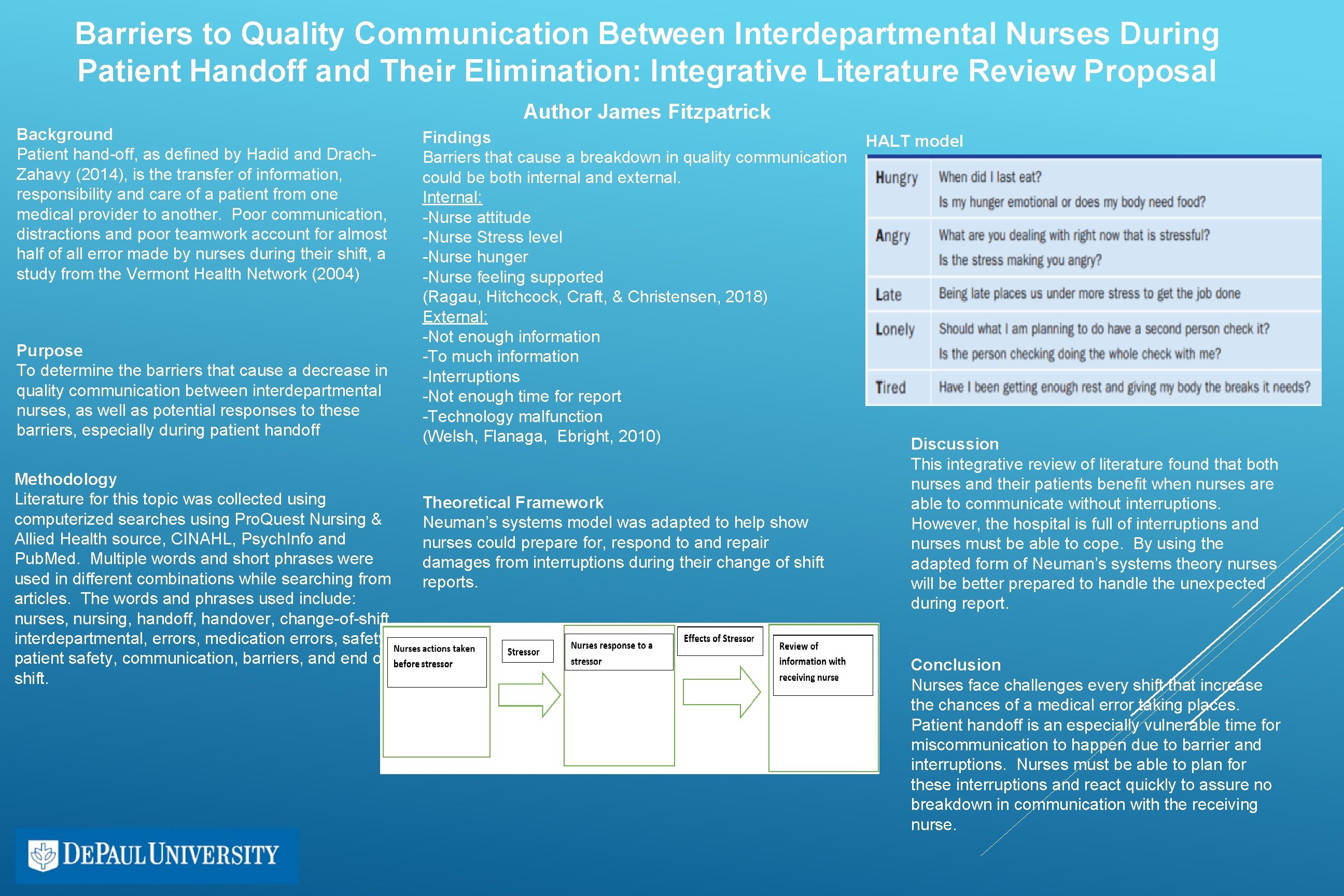
Barriers to Quality Communication Between Interdepartmental Nurses During Patient Handoff and Their Elimination: Integrative Literature Review Proposal Author James Fitzpatrick Background Patient hand-off, as defined by Hadid and Drach. Zahavy (2014), is the transfer of information, responsibility and care of a patient from one medical provider to another. Poor communication, distractions and poor teamwork account for almost half of all error made by nurses during their shift, a study from the Vermont Health Network (2004) Purpose To determine the barriers that cause a decrease in quality communication between interdepartmental nurses, as well as potential responses to these barriers, especially during patient handoff Methodology Literature for this topic was collected using computerized searches using Pro. Quest Nursing & Allied Health source, CINAHL, Psych. Info and Pub. Med. Multiple words and short phrases were used in different combinations while searching from articles. The words and phrases used include: nurses, nursing, handoff, handover, change-of-shift, interdepartmental, errors, medication errors, safety, patient safety, communication, barriers, and end of shift. Findings Barriers that cause a breakdown in quality communication could be both internal and external. Internal: -Nurse attitude -Nurse Stress level -Nurse hunger -Nurse feeling supported (Ragau, Hitchcock, Craft, & Christensen, 2018) External: -Not enough information -To much information -Interruptions -Not enough time for report -Technology malfunction (Welsh, Flanaga, Ebright, 2010) Theoretical Framework Neuman’s systems model was adapted to help show nurses could prepare for, respond to and repair damages from interruptions during their change of shift reports. HALT model Discussion This integrative review of literature found that both nurses and their patients benefit when nurses are able to communicate without interruptions. However, the hospital is full of interruptions and nurses must be able to cope. By using the adapted form of Neuman’s systems theory nurses will be better prepared to handle the unexpected during report. . Conclusion Nurses face challenges every shift that increase the chances of a medical error taking places. Patient handoff is an especially vulnerable time for miscommunication to happen due to barrier and interruptions. Nurses must be able to plan for these interruptions and react quickly to assure no breakdown in communication with the receiving nurse.
- Slides: 1