
Barriers and Challenges to the Adoption of E
Barriers and Challenges to the Adoption of E health Standards in Africa Funmi Adebesin, Paula Kotzé, Darelle Van Greunen & Rosemary Foster 03 July 2013
Background • E-health: Cost-effective and secure use of ICT to support healthcare • Benefits of e-health: Improved clinical decision-making Improved legibility Reduction in medical errors Availability of information at different locations o Cost reduction o o • Barriers to adoption: Lack of interoperability Cost of acquisition Resistance to change Security, privacy and confidentiality concerns o Lack of technical skills o o
Interoperability and e-health • E-health interoperability: Ability of HISs to work together within and across organizational boundaries to facilitate effective delivery of healthcare for individuals and communities • Interoperability is impossible without standardization • Standard: an agreed-upon, repeatable way of doing something • E-health standards are developed by standards development organizations (SDOs)

Overview of Standards Development Organizations
E-health standards landscape • Several parallel standards development activities • Literarily, 100 s of e-health standards have been published • ISO/TC 215 has published nearly 120 health informatics standards since its creation in 1998 • Selecting appropriate set of interoperability standards can be daunting for a low resource country
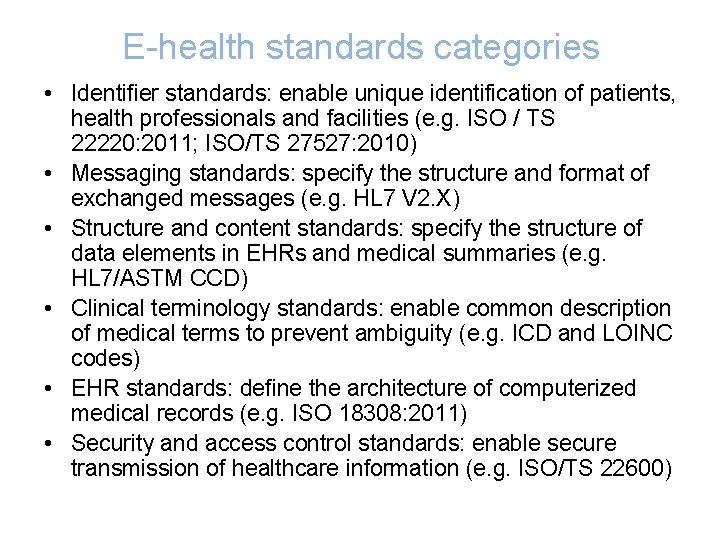
E-health standards categories • Identifier standards: enable unique identification of patients, health professionals and facilities (e. g. ISO / TS 22220: 2011; ISO/TS 27527: 2010) • Messaging standards: specify the structure and format of exchanged messages (e. g. HL 7 V 2. X) • Structure and content standards: specify the structure of data elements in EHRs and medical summaries (e. g. HL 7/ASTM CCD) • Clinical terminology standards: enable common description of medical terms to prevent ambiguity (e. g. ICD and LOINC codes) • EHR standards: define the architecture of computerized medical records (e. g. ISO 18308: 2011) • Security and access control standards: enable secure transmission of healthcare information (e. g. ISO/TS 22600)
Why e-health standards adoption is slow in Africa
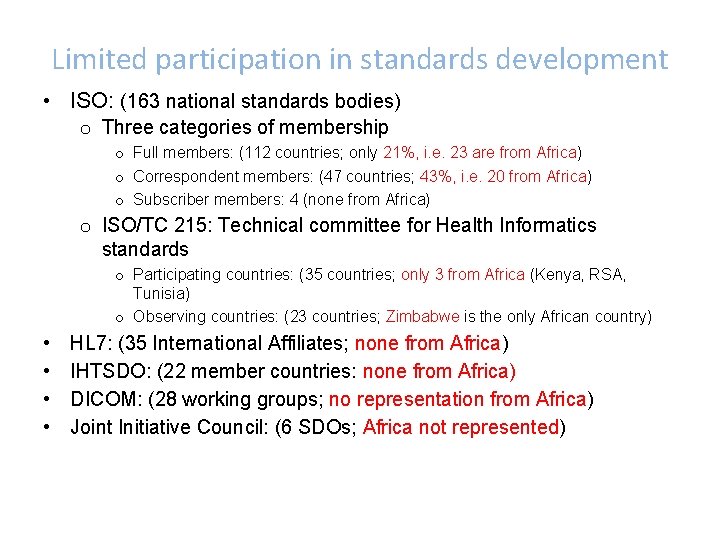
Limited participation in standards development • ISO: (163 national standards bodies) o Three categories of membership o Full members: (112 countries; only 21%, i. e. 23 are from Africa) o Correspondent members: (47 countries; 43%, i. e. 20 from Africa) o Subscriber members: 4 (none from Africa) o ISO/TC 215: Technical committee for Health Informatics standards o Participating countries: (35 countries; only 3 from Africa (Kenya, RSA, Tunisia) o Observing countries: (23 countries; Zimbabwe is the only African country) • • HL 7: (35 International Affiliates; none from Africa) IHTSDO: (22 member countries: none from Africa) DICOM: (28 working groups; no representation from Africa) Joint Initiative Council: (6 SDOs; Africa not represented)
Limited health informatics expertise • Contributing factors o Little or no health informatics courses at undergraduate levels o Little or no health informatics courses at postgraduate levels o Health informatics generally not part of nursing and medical students’ training o Little or no short courses or training on e-health standards
Lack of foundational infrastructures • Basic ICT infrastructures are limited or nonexistent • Registries for patient and health professionals are absent • Absence of common terminology services • Lack of network connectivity to support secure exchange of health information
Little or no guidelines for implementation of standards • Many of the published standards do not come with implementation guidelines • Localization of standards are generally required to cater for domestic needs
Overcoming the barriers • Harmonization of existing standards to address confliction and contradictions • Transformation of standard development process • Human resource capacity building through formal education and training; short courses and continuing education • Prioritizing investments in foundational infrastructures to support secure health information exchange • Active government participation in standardization through appropriate policies and legislations
- Slides: 13