
Barriers and bridges to risk assessment and management
Barriers and bridges to risk assessment and management of contaminated sites in urban areas Upper Silesia case study Janusz Krupanek Instytut Ekologii Terenów Uprzemysłowionych
1. Overview of Upper Silesia contamination problem

Upper Silesia region
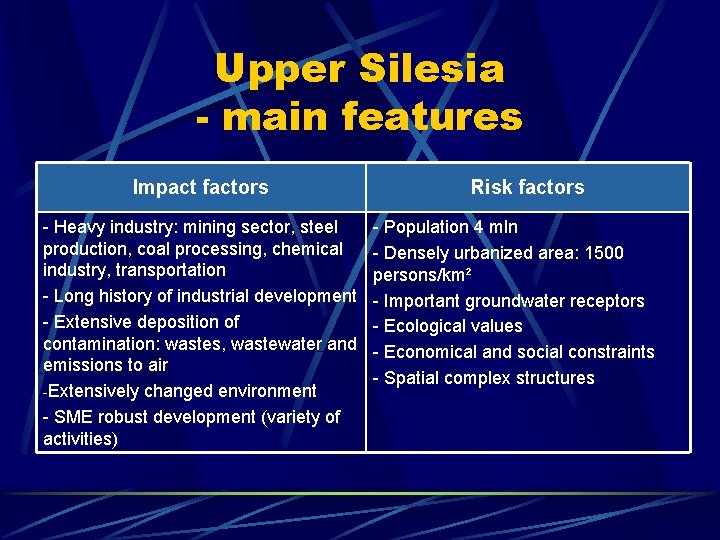
Upper Silesia - main features Impact factors - Heavy industry: mining sector, steel production, coal processing, chemical industry, transportation - Long history of industrial development - Extensive deposition of contamination: wastes, wastewater and emissions to air -Extensively changed environment - SME robust development (variety of activities) Risk factors - Population 4 mln - Densely urbanized area: 1500 persons/km² - Important groundwater receptors - Ecological values - Economical and social constraints - Spatial complex structures
2. Inventory, assessment and understanding of the problem

Basic assessment criteria Impact Economical activity profiles l Environmental management profiles l Risk Pathways characteristics l Vulnerability of receptors l Uncertainty l Information availability and reliability methodological constraints

Identification of contamination sources Source category Confirmed Potential e. g Tarnowskie Góry, Orzeł Biały nonferrous plants 450 objects under investigation – Silesian Voivodship Marshal office Main industry and communal utilities (operating, liquidated) e. g Czechowice Dziedzice refinery plant More than 150 main industry facilities (operating) and around 50 closed Small and medium industry facilities (operating, liquidated) Lack of organized information More than 7000 potentially hazardous firms - phonebook entries, State Statistical Office Environmental sector communal facilities Selected high impact facilities Around 2500 facilities and firms Contaminated land (soils, quaternary layers) Not delimited, maps of contamination A Few dozen square km of contaminated soil lack of organized information A few dozen facilities Lack of asssessment Widely spread Postindustrial sites Military sites Individual activities (commercial, consumers)

Characterisation of contamination sources Information Data available Data source Localization and size of the facility - Sozological, hydrogeological maps, regional statistics National Statistical Office, phonebooks, Environmental Protection Inspectorate Activity characteristics - Regional statistics State Statistical Office, Voivodship and Marshal Offices Technology used - EIA, environmental audit, IPPC Firms, County offices, Environmental Protection Inspectorate History of operation (time, scale, profile) - EIA archives County offices, Voivodship and Marshal Offices Scale and type of environmental impact (wastes, emissions, contaminants), - EIA, - Sozological map - IPPC /EPER information Firms, County offices, Environmental Protection Inspectorate, facility management office, State Statistical Office Environmental mangement and risk containment - EIA, EMAS, obligatory information Environmental Protection Inspectorate, Certifying bodies, Facility management office
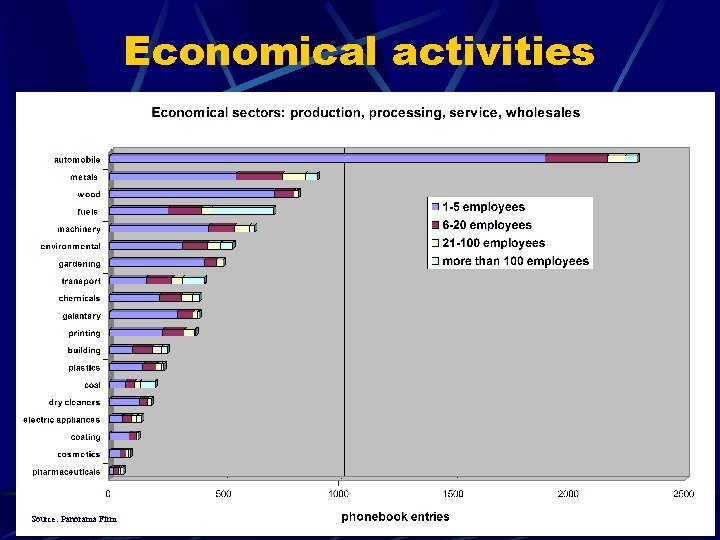
Economical activities Source: Panorama Firm
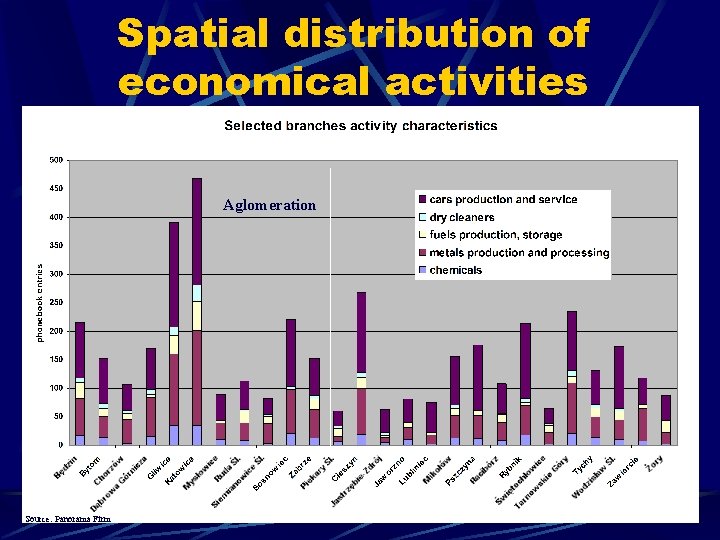
Spatial distribution of economical activities Aglomeration Source: Panorama Firm

Main industries Potential Health Hazard Number of facilities Causes PCBs, heavy metals 65 handling of processes, wastes Heavy metals, PAHs, organics 19 emissions, handling of processes, wastes Energy sector Heavy metals, PAHs, PCBs 60 emissions, handling of processes, wastes Chemical production Organics and inorganics 13 handling of processes, accidents, wastes Organics, heavy metals, biological 30 handling of processes, wastes Sector Mining industry Metal processing industry Environmental sector

Waste management facilities Lanfills of communal wastes Communal mixed agricultural Lanfills of industrial wastes Chemical Energy Metal Mining other
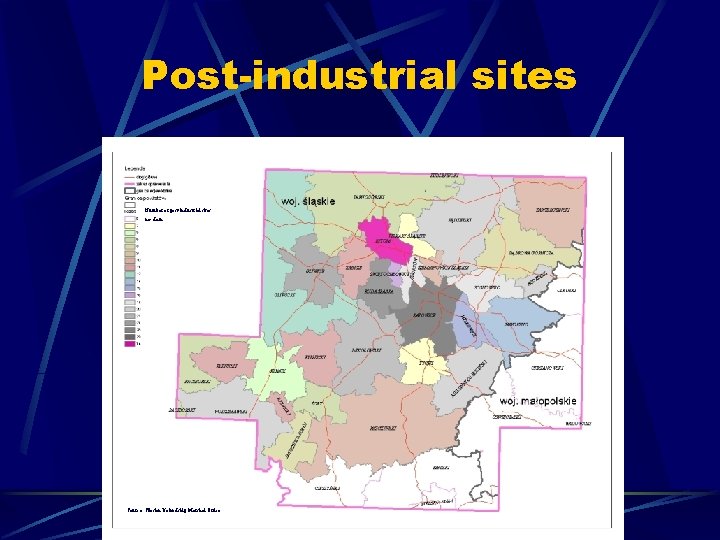
Post-industrial sites Number of post-industrial sites no- data Source: Silesian Voivodship Marshal Office
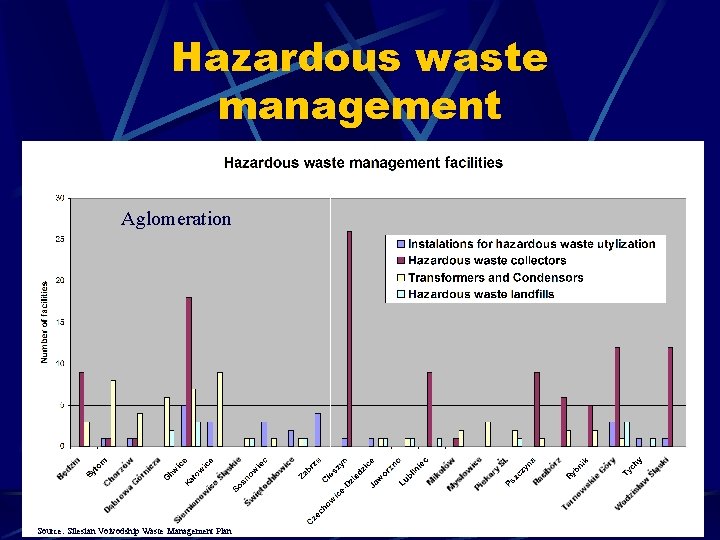
Hazardous waste management Aglomeration Source: Silesian Voivodship Waste Management Plan
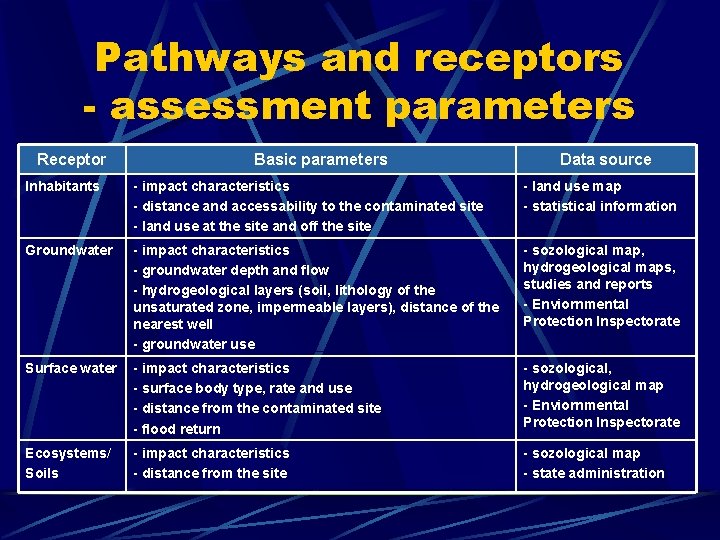
Pathways and receptors - assessment parameters Receptor Basic parameters Data source Inhabitants - impact characteristics - distance and accessability to the contaminated site - land use at the site and off the site - land use map - statistical information Groundwater - impact characteristics - groundwater depth and flow - hydrogeological layers (soil, lithology of the unsaturated zone, impermeable layers), distance of the nearest well - groundwater use - sozological map, hydrogeological maps, studies and reports - Enviornmental Protection Inspectorate Surface water - impact characteristics - surface body type, rate and use - distance from the contaminated site - flood return - sozological, hydrogeological map - Enviornmental Protection Inspectorate Ecosystems/ Soils - impact characteristics - distance from the site - sozological map - state administration
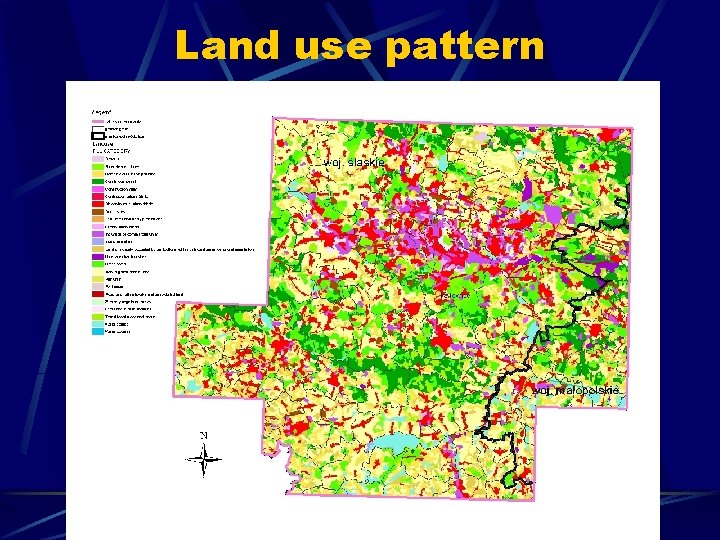
Land use pattern
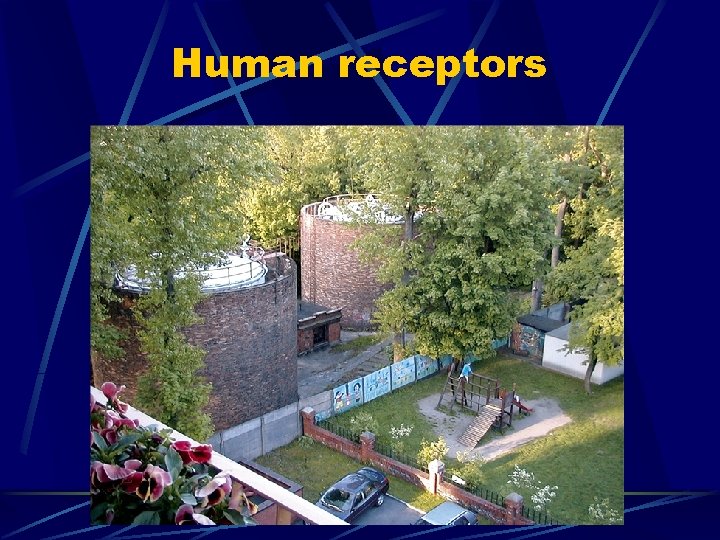
Human receptors
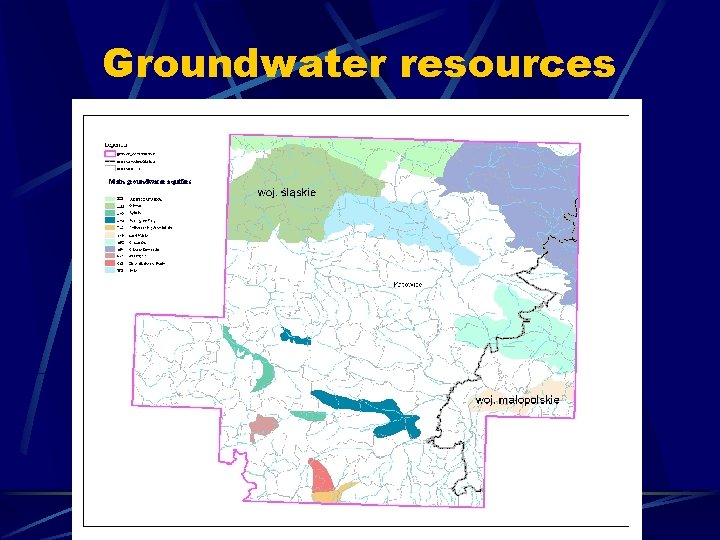
Groundwater resources Main groundwater aquifers
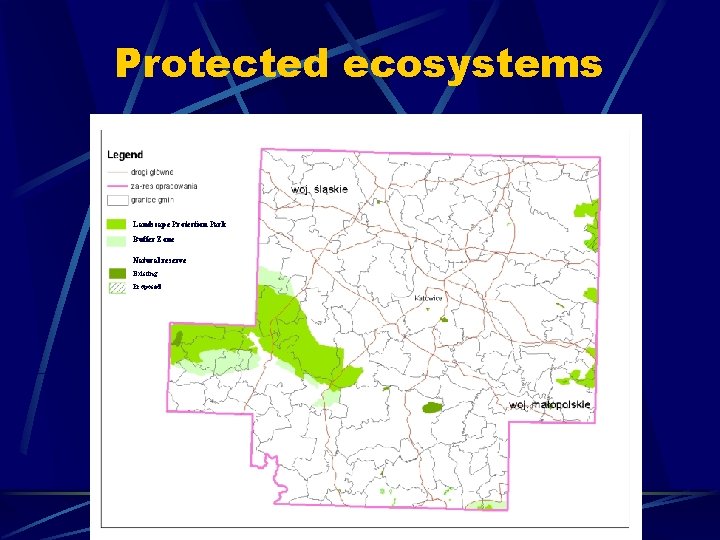
Protected ecosystems Landscape Protection Park Buffer Zone Natural reserve Existing Proposed
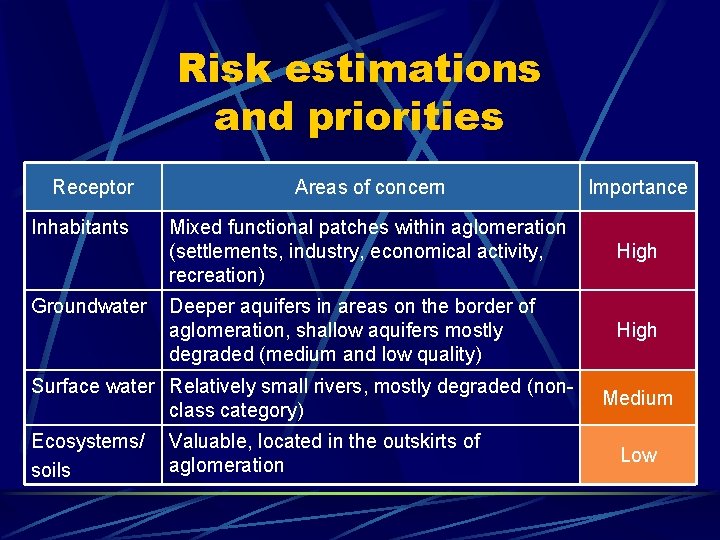
Risk estimations and priorities Receptor Inhabitants Groundwater Areas of concern Importance Mixed functional patches within aglomeration (settlements, industry, economical activity, recreation) High Deeper aquifers in areas on the border of aglomeration, shallow aquifers mostly degraded (medium and low quality) High Surface water Relatively small rivers, mostly degraded (nonclass category) Ecosystems/ soils Valuable, located in the outskirts of aglomeration Medium Low

3. Legal, institutional, environmental, social and economical aspects
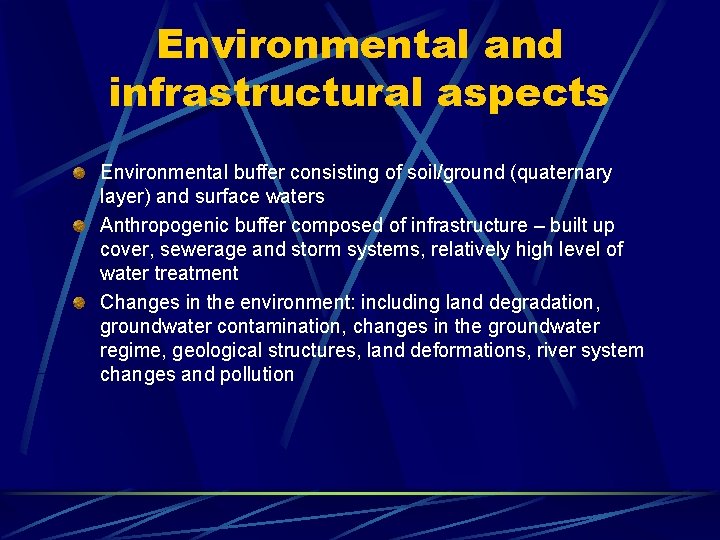
Environmental and infrastructural aspects Environmental buffer consisting of soil/ground (quaternary layer) and surface waters Anthropogenic buffer composed of infrastructure – built up cover, sewerage and storm systems, relatively high level of water treatment Changes in the environment: including land degradation, groundwater contamination, changes in the groundwater regime, geological structures, land deformations, river system changes and pollution
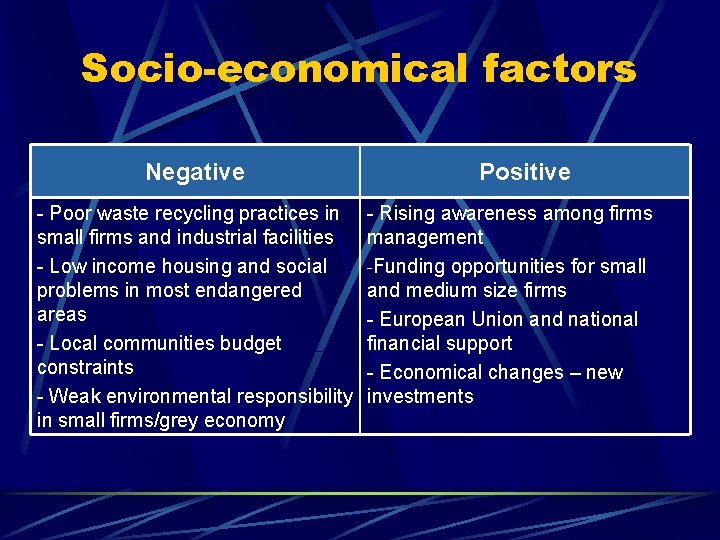
Socio-economical factors Negative - Poor waste recycling practices in small firms and industrial facilities - Low income housing and social problems in most endangered areas - Local communities budget constraints - Weak environmental responsibility in small firms/grey economy Positive - Rising awareness among firms management -Funding opportunities for small and medium size firms - European Union and national financial support - Economical changes – new investments
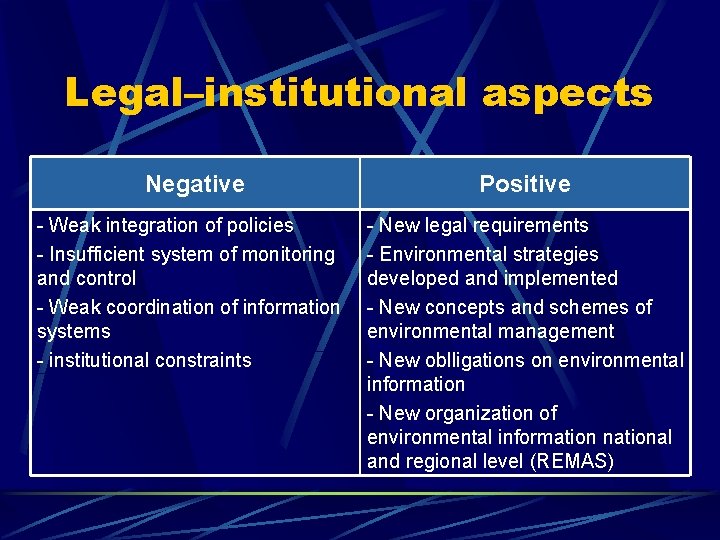
Legal–institutional aspects Negative Positive - Weak integration of policies - Insufficient system of monitoring and control - Weak coordination of information systems - institutional constraints - New legal requirements - Environmental strategies developed and implemented - New concepts and schemes of environmental management - New oblligations on environmental information - New organization of environmental information national and regional level (REMAS)
4. Management options and approaches
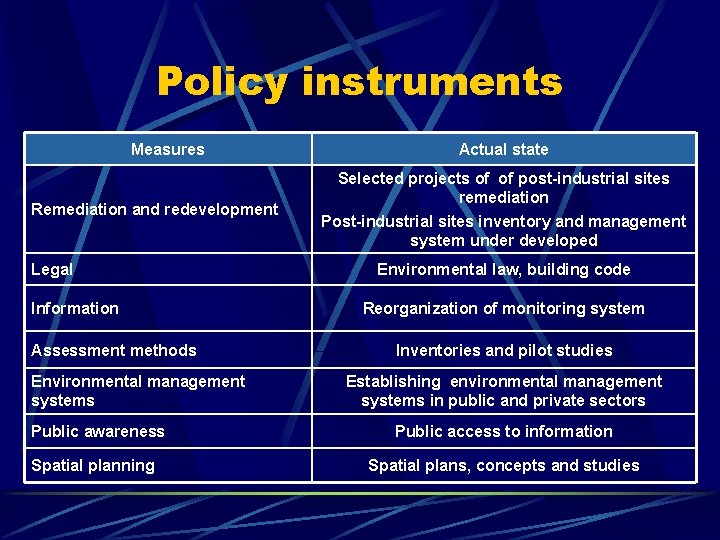
Policy instruments Measures Remediation and redevelopment Legal Information Assessment methods Environmental management systems Public awareness Spatial planning Actual state Selected projects of of post-industrial sites remediation Post-industrial sites inventory and management system under developed Environmental law, building code Reorganization of monitoring system Inventories and pilot studies Establishing environmental management systems in public and private sectors Public access to information Spatial plans, concepts and studies
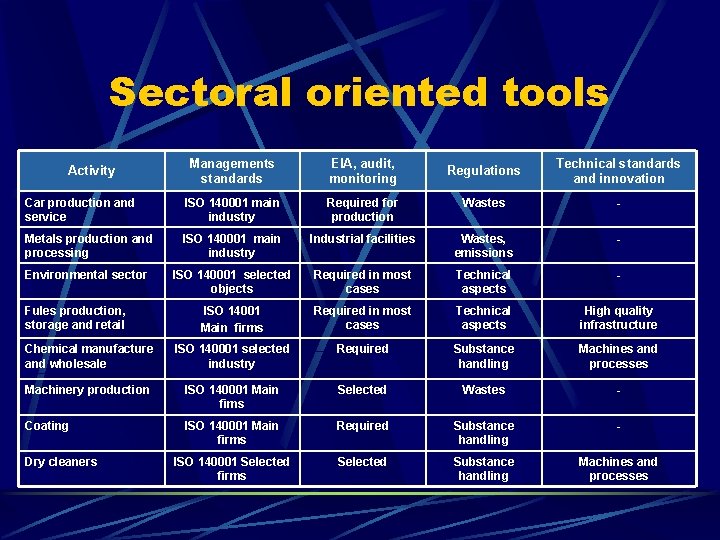
Sectoral oriented tools Managements standards EIA, audit, monitoring Regulations Technical standards and innovation Car production and service ISO 140001 main industry Required for production Wastes - Metals production and processing ISO 140001 main industry Industrial facilities Wastes, emissions - Environmental sector ISO 140001 selected objects Required in most cases Technical aspects - ISO 14001 Main firms Required in most cases Technical aspects High quality infrastructure Chemical manufacture and wholesale ISO 140001 selected industry Required Substance handling Machines and processes Machinery production ISO 140001 Main fims Selected Wastes - Coating ISO 140001 Main firms Required Substance handling - ISO 140001 Selected firms Selected Substance handling Machines and processes Activity Fules production, storage and retail Dry cleaners
Conclusions
Possibilities and actions Rising awareness of the problems and integration of the efforts on local and regional level Strengthening understanding of the problem with respect to economical activities and risks – regional and local model of assessment and management Improvement in the monitoring, information and control system Development of institutional capacity and support systems Implementation of procedures for cost-efficient risk assessment and management

Thank you for attention
- Slides: 30