
Barometric Pressure Air is made up of molecules
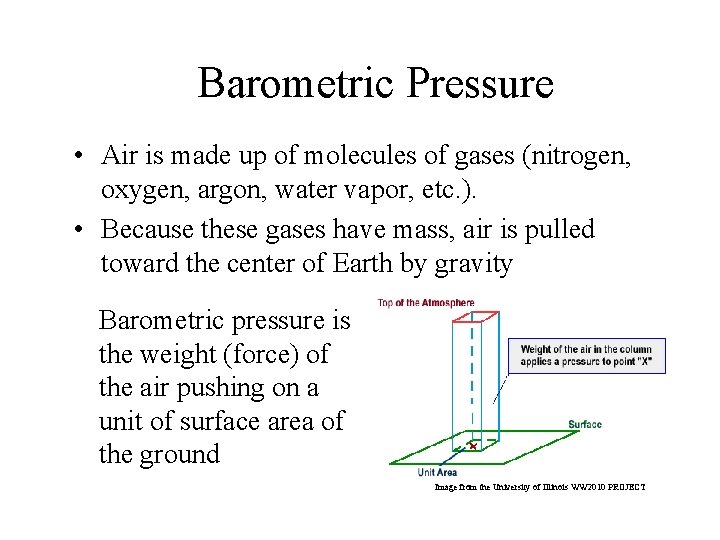
Barometric Pressure • Air is made up of molecules of gases (nitrogen, oxygen, argon, water vapor, etc. ). • Because these gases have mass, air is pulled toward the center of Earth by gravity Barometric pressure is the weight (force) of the air pushing on a unit of surface area of the ground Image from the University of Illinois WW 2010 PROJECT
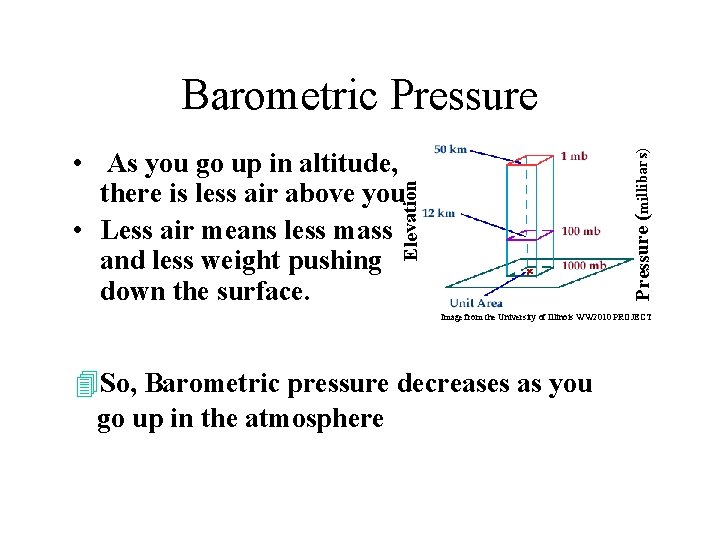
Barometric Pressure Elevation Pressure (millibars) • As you go up in altitude, there is less air above you. • Less air means less mass and less weight pushing down the surface. Image from the University of Illinois WW 2010 PROJECT 4 So, Barometric pressure decreases as you go up in the atmosphere
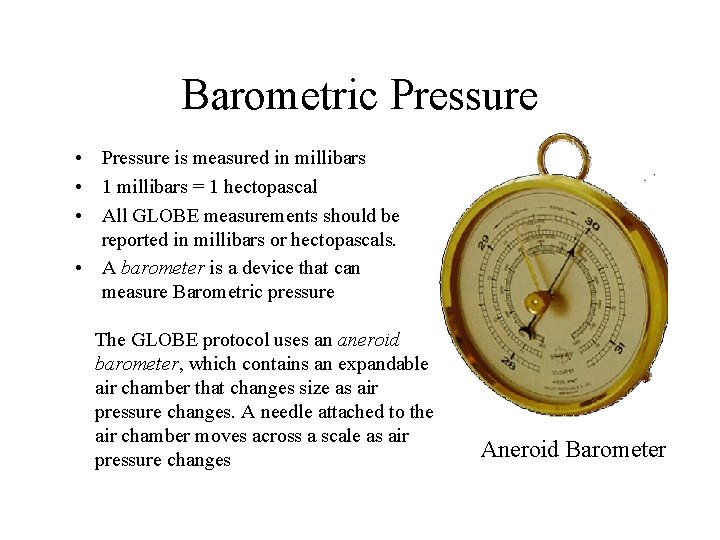
Barometric Pressure • Pressure is measured in millibars • 1 millibars = 1 hectopascal • All GLOBE measurements should be reported in millibars or hectopascals. • A barometer is a device that can measure Barometric pressure The GLOBE protocol uses an aneroid barometer, which contains an expandable air chamber that changes size as air pressure changes. A needle attached to the air chamber moves across a scale as air pressure changes Aneroid Barometer

Why Measure Barometric Pressure? • Daily observations will help students see how changes in pressure are related to changes in weather, cloud type, and cloud cover • Pressure observations tell us the mass of the atmosphere between us and the sun, which is needed to measure aerosol optical thickness and Barometric water vapor
Significant Values • Standard sea level pressure is 1013 mb – 960 mb is typical for extremely stormy conditions – 1050 mb is typical for strong high pressure systems • Barometric pressure decreases about 10 mb for every 100 meters higher you go in altitude – For example, at 1, 000 meters above sea level your normal pressure range would be roughly 860 to 950 mb • For GLOBE, it is recommended that you report the sea level pressure -- the pressure adjusted to sea level • You can also choose to report station pressure -the real pressure at your altitude, if you wish.

How to Measure Barometric Pressure • The GLOBE protocol uses a standard aneroid barometer or an altimeter mounted on a wall in the classroom • Barometric pressure should be measured daily within one hour of local solar noon or at about the same time as the Haze measurement • The barometer should be calibrated every 6 months
- Slides: 6