
Baroclinic Instability Properties Based on Chapter 8 of
Baroclinic Instability: Properties Based on Chapter 8 of Holton’s An Introduction to Dynamic Meteorology Chapter 8 - Instability MT 454

Class Slide ? 8. 2 Baroclinic Instability MT 454
Class Slide 8. 2 Baroclinic Instability MT 454
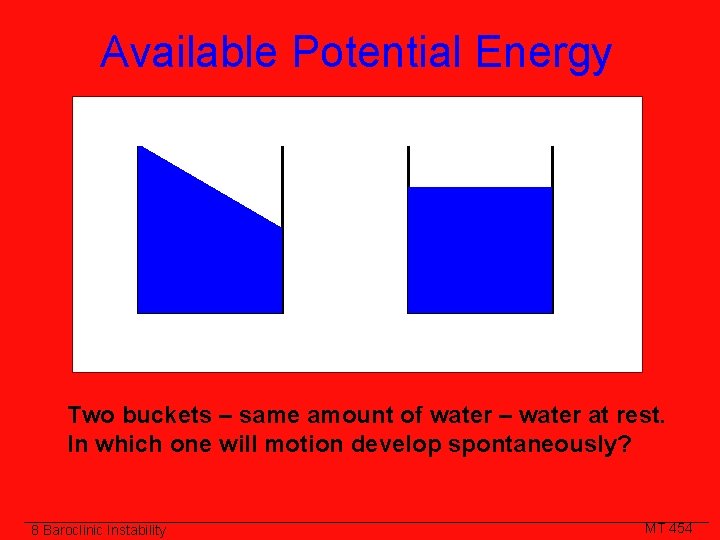
Available Potential Energy Two buckets – same amount of water – water at rest. In which one will motion develop spontaneously? 8 Baroclinic Instability MT 454
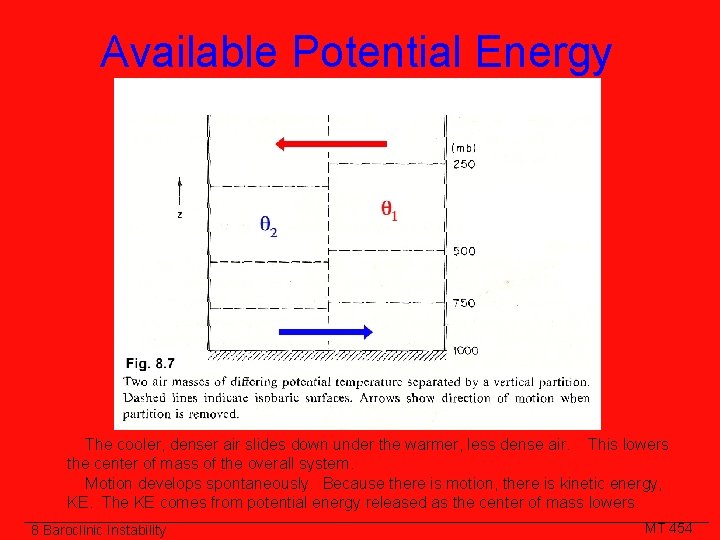
Available Potential Energy The cooler, denser air slides down under the warmer, less dense air. This lowers the center of mass of the overall system. Motion develops spontaneously. Because there is motion, there is kinetic energy, KE. The KE comes from potential energy released as the center of mass lowers. 8 Baroclinic Instability MT 454
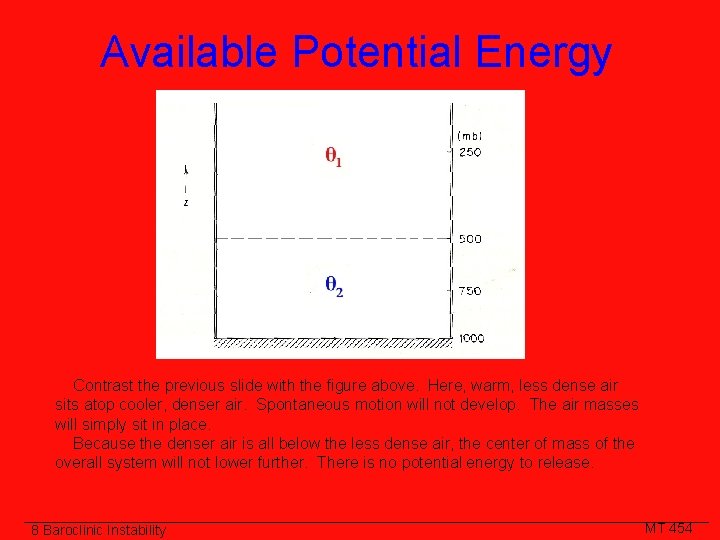
Available Potential Energy Contrast the previous slide with the figure above. Here, warm, less dense air sits atop cooler, denser air. Spontaneous motion will not develop. The air masses will simply sit in place. Because the denser air is all below the less dense air, the center of mass of the overall system will not lower further. There is no potential energy to release. 8 Baroclinic Instability MT 454
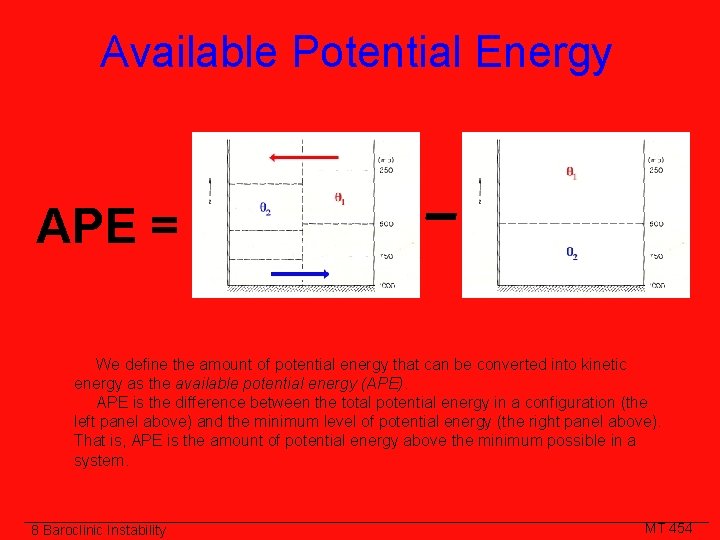
Available Potential Energy APE = We define the amount of potential energy that can be converted into kinetic energy as the available potential energy (APE). APE is the difference between the total potential energy in a configuration (the left panel above) and the minimum level of potential energy (the right panel above). That is, APE is the amount of potential energy above the minimum possible in a system. 8 Baroclinic Instability MT 454

Class Slide 8. 2 Baroclinic Instability MT 454

Class Slide 8. 2 Baroclinic Instability MT 454
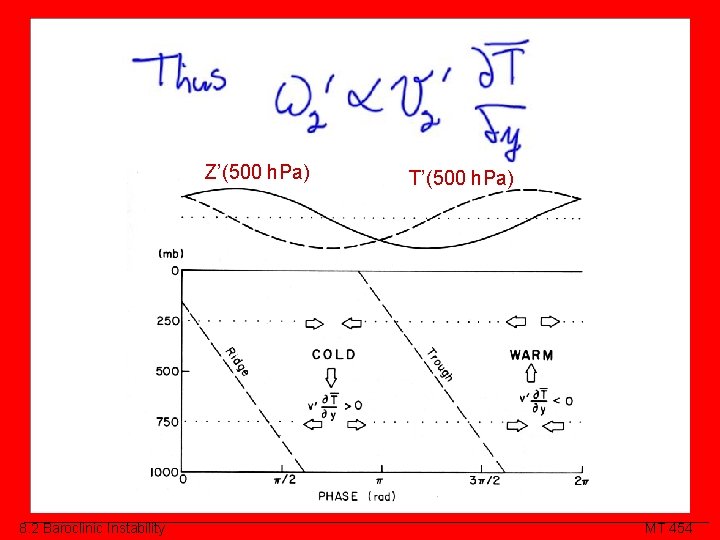
Class Slide Z’(500 h. Pa) T’(500 h. Pa) (See Figure 8. 4 from Chapter 8 of Holton) (Then compare with Figures 8. 3 – 8. 6 from Chapter 8 Wallace and Hobbs) 8. 2 Baroclinic Instability MT 454
Class Slide (Then compare with Figures 3. 3 – 3. 17 from Chapter 3 Wallace and Hobbs) 8. 2 Baroclinic Instability MT 454
Class Slide (Then compare with Figures 3. 3 – 3. 17 from Chapter 3 Wallace and Hobbs) 8. 2 Baroclinic Instability MT 454
Class Slide (Then compare with Figures 3. 3 – 3. 17 from Chapter 3 Wallace and Hobbs) 8. 2 Baroclinic Instability MT 454

Relationships between Baroclinic Instability and a Developing System Note: ²The developing system has the upper-level trough at 250 h. Pa to the west of the low center at 850 h. Pa – just like the two-layer model’s unstable wave. ²There is warm-air advection ahead of the 850 h. Pa low center and with it, rising motion. There is cold-air advection behind the 850 h. Pa low center and with it, sinking motion. ²Thus, there is warm air rising and cold air sinking. This is lowering the center of mass of the overall system, releasing potential energy, which becomes kinetic energy (i. e. , the winds strengthen). In other words, APE is converted to KE. 8. 2 Baroclinic Instability MT 454
Moisture Effects 8 Baroclinic Instability MT 454
Moisture Effects 8 Baroclinic Instability MT 454
Baroclinic Instability END Chapter 8 - Instability MT 454
- Slides: 17