
Bariumion tagging for 136 Xe double beta decay
Barium-ion tagging for 136 Xe double -beta decay studies with EXO 136 Xe 136 Ba++ + 2 e- + 0 n ? Ba Thomas Brunner for the EXO collaboration TIPP 2014 – June 5, 2014
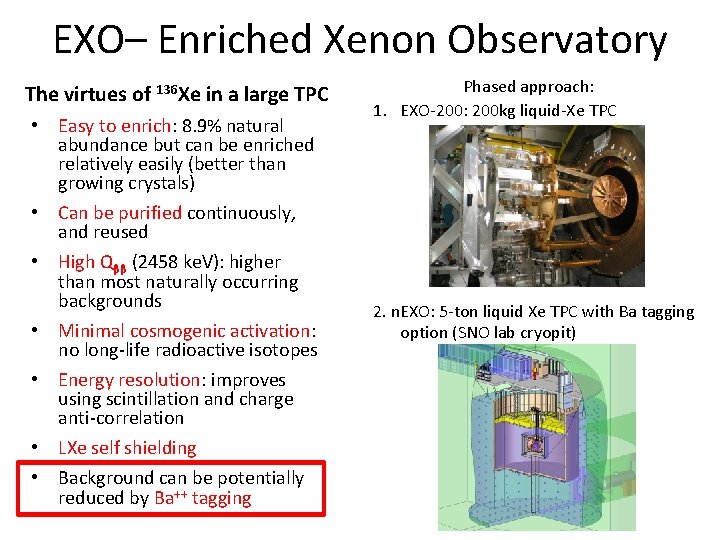
EXO– Enriched Xenon Observatory The virtues of 136 Xe in a large TPC • Easy to enrich: 8. 9% natural abundance but can be enriched relatively easily (better than growing crystals) • Can be purified continuously, and reused • High Qββ (2458 ke. V): higher than most naturally occurring backgrounds • Minimal cosmogenic activation: no long-life radioactive isotopes • Energy resolution: improves using scintillation and charge anti-correlation • LXe self shielding • Background can be potentially reduced by Ba++ tagging Phased approach: 1. EXO-200: 200 kg liquid-Xe TPC 2. n. EXO: 5 -ton liquid Xe TPC with Ba tagging option (SNO lab cryopit)
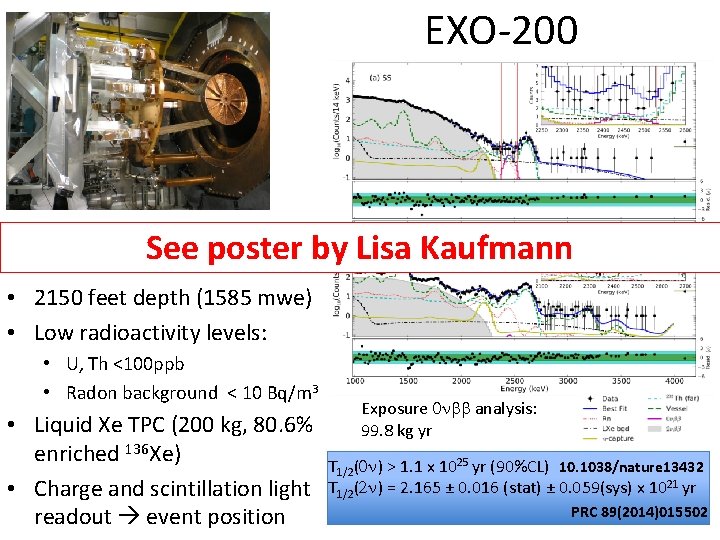
EXO-200 • Located at WIPP mine NM, See poster by USA • 2150 feet depth (1585 mwe) • Low radioactivity levels: • U, Th <100 ppb • Radon background < 10 Bq/m 3 • Liquid Xe TPC (200 kg, 80. 6% enriched 136 Xe) • Charge and scintillation light readout event position Lisa Kaufmann Exposure 0 nbb analysis: 99. 8 kg yr T 1/2(0 n) > 1. 1 x 1025 yr (90%CL) 10. 1038/nature 13432 T 1/2(2 n) = 2. 165 ± 0. 016 (stat) ± 0. 059(sys) x 1021 yr PRC 89(2014)015502
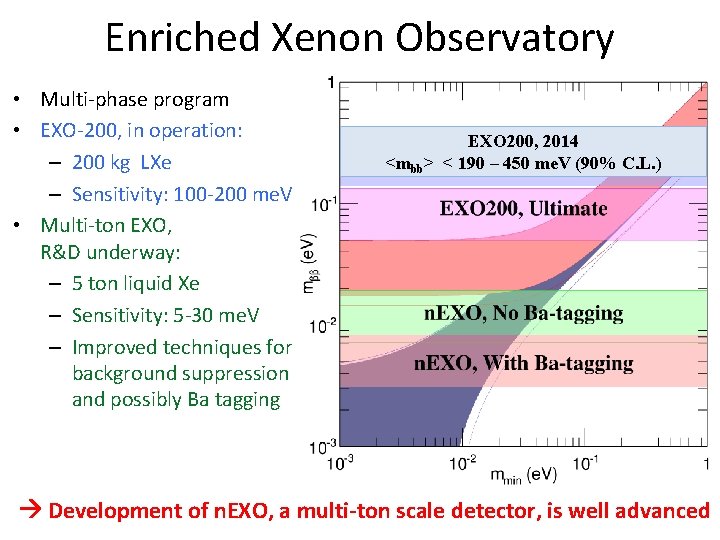
Enriched Xenon Observatory • Multi-phase program • EXO-200, in operation: – 200 kg LXe – Sensitivity: 100 -200 me. V • Multi-ton EXO, R&D underway: – 5 ton liquid Xe – Sensitivity: 5 -30 me. V – Improved techniques for background suppression and possibly Ba tagging EXO 200, 2014 <mbb> < 190 – 450 me. V (90% C. L. ) Development of n. EXO, a multi-ton scale detector, is well advanced
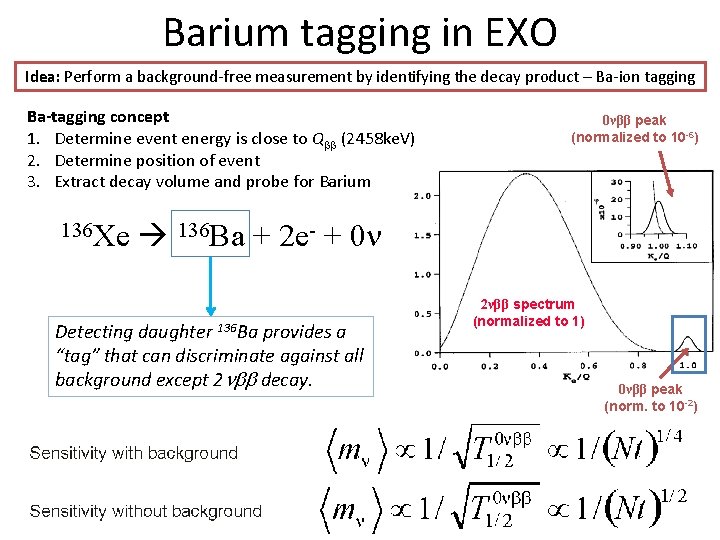
Barium tagging in EXO Idea: Perform a background-free measurement by identifying the decay product – Ba-ion tagging Ba-tagging concept 1. Determine event energy is close to Qbb (2458 ke. V) 2. Determine position of event 3. Extract decay volume and probe for Barium 136 Xe 0νββ peak (normalized to 10 -6) 136 Ba + 2 e- + 0 n Detecting daughter 136 Ba provides a “tag” that can discriminate against all background except 2 nbb decay. 2νββ spectrum (normalized to 1) 0νββ peak (norm. to 10 -2)
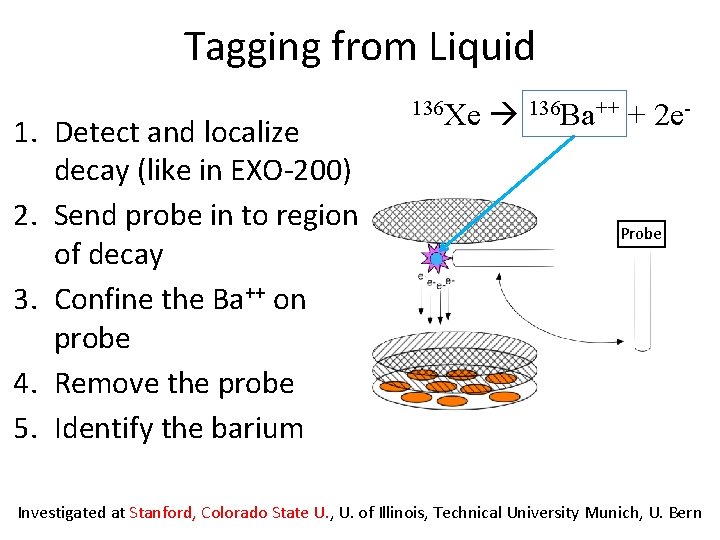
Tagging from Liquid 1. Detect and localize decay (like in EXO-200) 2. Send probe in to region of decay 3. Confine the Ba++ on probe 4. Remove the probe 5. Identify the barium 136 Xe 136 Ba++ + 2 e- Probe Identification Investigated at Stanford, Colorado State U. , U. of Illinois, Technical University Munich, U. Bern
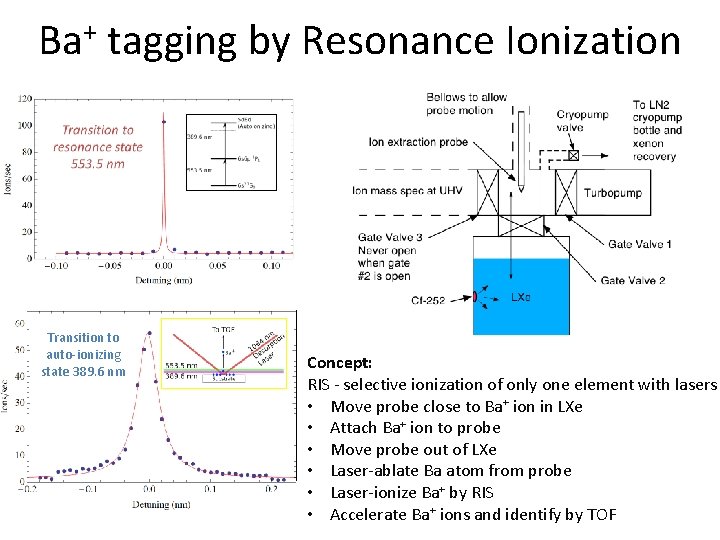
Ba+ tagging by Resonance Ionization Transition to auto-ionizing state 389. 6 nm Concept: RIS - selective ionization of only one element with lasers • Move probe close to Ba+ ion in LXe • Attach Ba+ ion to probe • Move probe out of LXe • Laser-ablate Ba atom from probe • Laser-ionize Ba+ by RIS • Accelerate Ba+ ions and identify by TOF
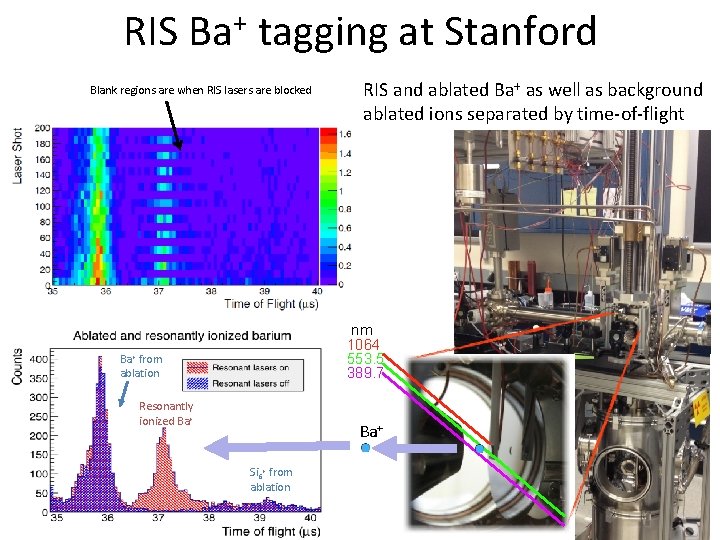
RIS + Ba tagging at Stanford Blank regions are when RIS lasers are blocked RIS and ablated Ba+ as well as background ablated ions separated by time-of-flight nm 1064 553. 5 389. 7 Ba+ from ablation Resonantly ionized Ba+ Si 6+ from ablation
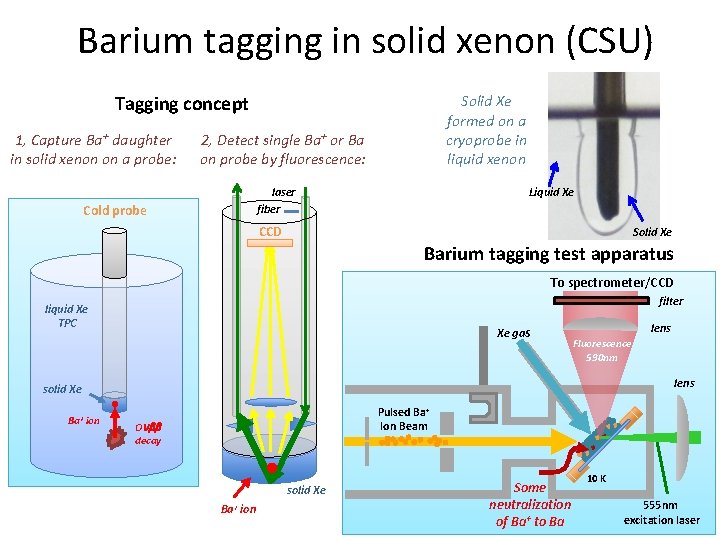
Barium tagging in solid xenon (CSU) Tagging concept 1, Capture Ba+ daughter in solid xenon on a probe: Solid Xe formed on a cryoprobe in liquid xenon 2, Detect single Ba+ or Ba on probe by fluorescence: laser fiber Cold probe Liquid Xe CCD Solid Xe Barium tagging test apparatus To spectrometer/CCD filter liquid Xe TPC Xe gas lens Fluorescence 590 nm lens solid Xe Ba+ ion Pulsed Ba+ Ion Beam Onbb decay solid Xe Ba+ ion Some neutralization of Ba+ to Ba 10 K 555 nm excitation laser
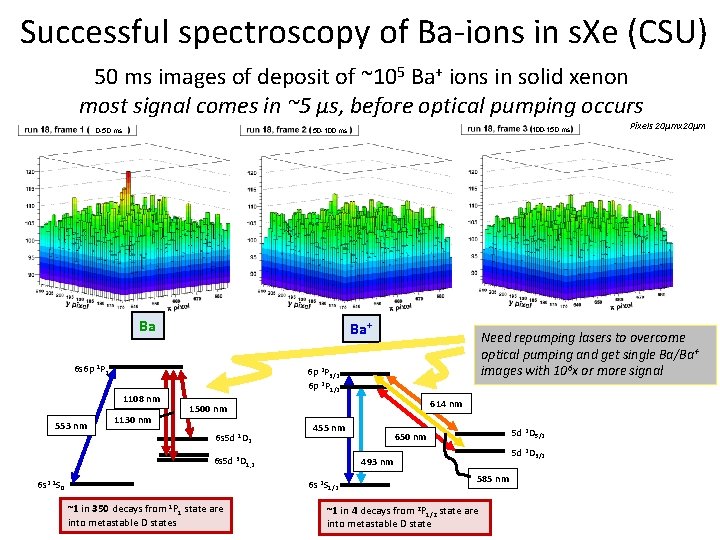
Successful spectroscopy of Ba-ions in s. Xe (CSU) 50 ms images of deposit of ~105 Ba+ ions in solid xenon most signal comes in ~5 µs, before optical pumping occurs Ba Ba+ 6 s 6 p 1 P 1 1108 nm 553 nm 100 -150 ms 50 -100 ms 0 -50 ms 1130 nm Need repumping lasers to overcome optical pumping and get single Ba/Ba+ images with 106 x or more signal 6 p 2 P 3/2 6 p 2 P 1/2 614 nm 1500 nm 6 s 5 d 1 D 2 455 nm 6 s 5 d 3 D 1, 2 6 s 2 1 S 0 ~1 in 350 decays from 1 P 1 state are into metastable D states 5 d 2 D 5/2 650 nm 5 d 2 D 3/2 493 nm 6 s 2 S 1/2 Pixels 20µmx 20µm 585 nm ~1 in 4 decays from 2 P 1/2 state are into metastable D state
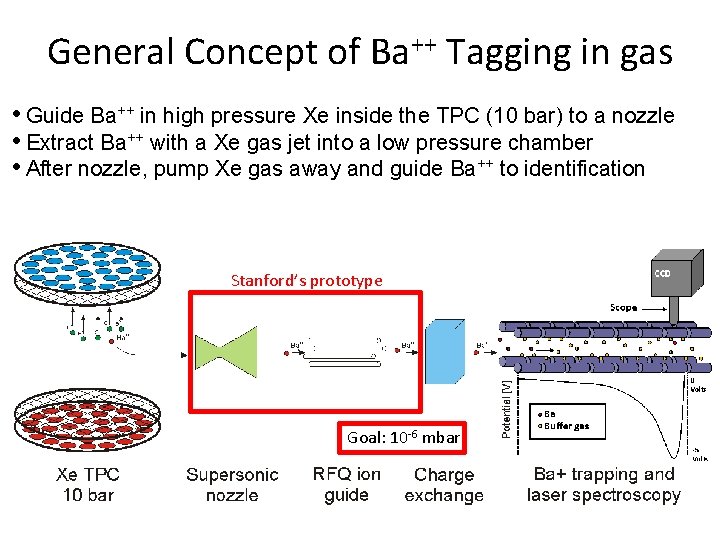
General Concept of Ba++ Tagging in gas • Guide Ba++ in high pressure Xe inside the TPC (10 bar) to a nozzle • Extract Ba++ with a Xe gas jet into a low pressure chamber • After nozzle, pump Xe gas away and guide Ba++ to identification Stanford’s prototype Goal: 10 -6 mbar
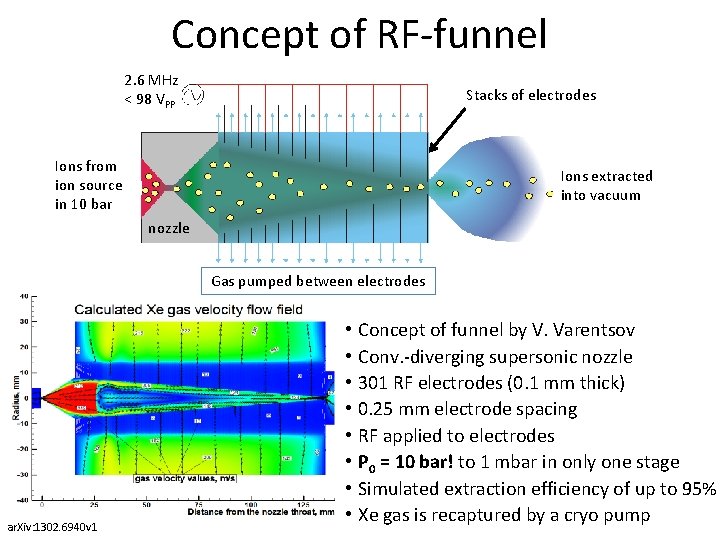
Concept of RF-funnel 2. 6 MHz < 98 VPP Stacks of electrodes Ions from ion source in 10 bar Ions extracted into vacuum nozzle Gas pumped between electrodes ar. Xiv: 1302. 6940 v 1 • Concept of funnel by V. Varentsov • Conv. -diverging supersonic nozzle • 301 RF electrodes (0. 1 mm thick) • 0. 25 mm electrode spacing • RF applied to electrodes • P 0 = 10 bar! to 1 mbar in only one stage • Simulated extraction efficiency of up to 95% • Xe gas is recaptured by a cryo pump
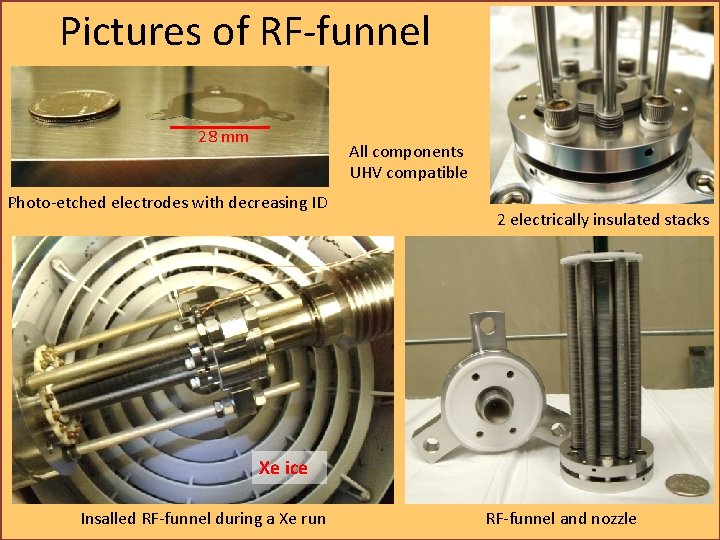
Pictures of RF-funnel 28 mm All components UHV compatible Photo-etched electrodes with decreasing ID 2 electrically insulated stacks Xe ice Insalled RF-funnel during a Xe run RF-funnel and nozzle
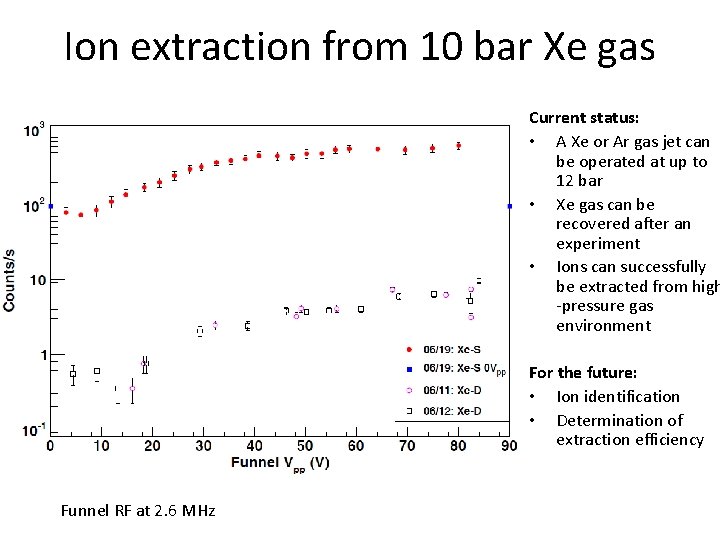
Ion extraction from 10 bar Xe gas Current status: • A Xe or Ar gas jet can be operated at up to 12 bar • Xe gas can be recovered after an experiment • Ions can successfully be extracted from high -pressure gas environment For the future: • Ion identification • Determination of extraction efficiency Funnel RF at 2. 6 MHz
g. Xe l. Xe Conclusion • Development of n. EXO, a multi-ton scale detector, well advanced • Several groups are working on techniques for Ba-ion extraction from Xe, for the n. EXO collaboration • Successful spectroscopy of Ba-ions in Xe ice (CSU). • Investigating of Ba-ion properties on surfaces. • First RIS Ba-ion identification. • Positive ion extraction from high pressure Xe gas and Ar gas.
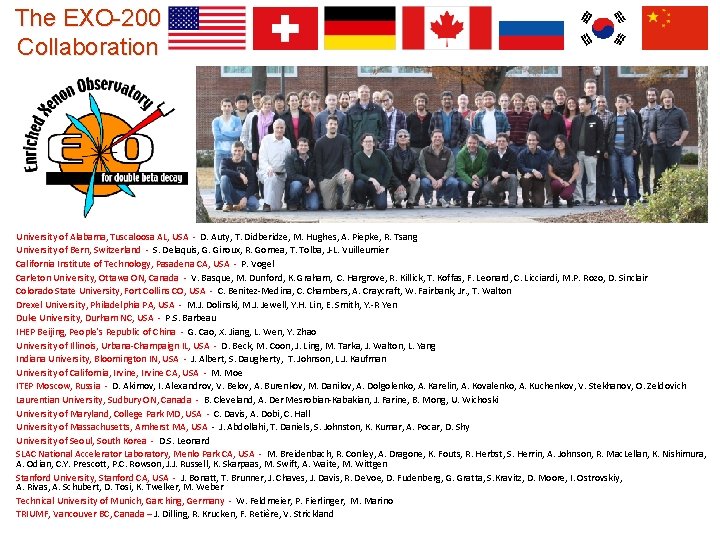
The EXO-200 Collaboration University of Alabama, Tuscaloosa AL, USA - D. Auty, T. Didberidze, M. Hughes, A. Piepke, R. Tsang University of Bern, Switzerland - S. Delaquis, G. Giroux, R. Gornea, T. Tolba, J-L. Vuilleumier California Institute of Technology, Pasadena CA, USA - P. Vogel Carleton University, Ottawa ON, Canada - V. Basque, M. Dunford, K. Graham, C. Hargrove, R. Killick, T. Koffas, F. Leonard, C. Licciardi, M. P. Rozo, D. Sinclair Colorado State University, Fort Collins CO, USA - C. Benitez-Medina, C. Chambers, A. Craycraft, W. Fairbank, Jr. , T. Walton Drexel University, Philadelphia PA, USA - M. J. Dolinski, M. J. Jewell, Y. H. Lin, E. Smith, Y. -R Yen Duke University, Durham NC, USA - P. S. Barbeau IHEP Beijing, People’s Republic of China - G. Cao, X. Jiang, L. Wen, Y. Zhao University of Illinois, Urbana-Champaign IL, USA - D. Beck, M. Coon, J. Ling, M. Tarka, J. Walton, L. Yang Indiana University, Bloomington IN, USA - J. Albert, S. Daugherty, T. Johnson, L. J. Kaufman University of California, Irvine CA, USA - M. Moe ITEP Moscow, Russia - D. Akimov, I. Alexandrov, V. Belov, A. Burenkov, M. Danilov, A. Dolgolenko, A. Karelin, A. Kovalenko, A. Kuchenkov, V. Stekhanov, O. Zeldovich Laurentian University, Sudbury ON, Canada - B. Cleveland, A. Der Mesrobian-Kabakian, J. Farine, B. Mong, U. Wichoski University of Maryland, College Park MD, USA - C. Davis, A. Dobi, C. Hall University of Massachusetts, Amherst MA, USA - J. Abdollahi, T. Daniels, S. Johnston, K. Kumar, A. Pocar, D. Shy University of Seoul, South Korea - D. S. Leonard SLAC National Accelerator Laboratory, Menlo Park CA, USA - M. Breidenbach, R. Conley, A. Dragone, K. Fouts, R. Herbst, S. Herrin, A. Johnson, R. Mac. Lellan, K. Nishimura, A. Odian, C. Y. Prescott, P. C. Rowson, J. J. Russell, K. Skarpaas, M. Swift, A. Waite, M. Wittgen Stanford University, Stanford CA, USA - J. Bonatt, T. Brunner, J. Chaves, J. Davis, R. De. Voe, D. Fudenberg, G. Gratta, S. Kravitz, D. Moore, I. Ostrovskiy, A. Rivas, A. Schubert, D. Tosi, K. Twelker, M. Weber Technical University of Munich, Garching, Germany - W. Feldmeier, P. Fierlinger, M. Marino TRIUMF, Vancouver BC, Canada – J. Dilling, R. Krucken, F. Retière, V. Strickland

Backup slides
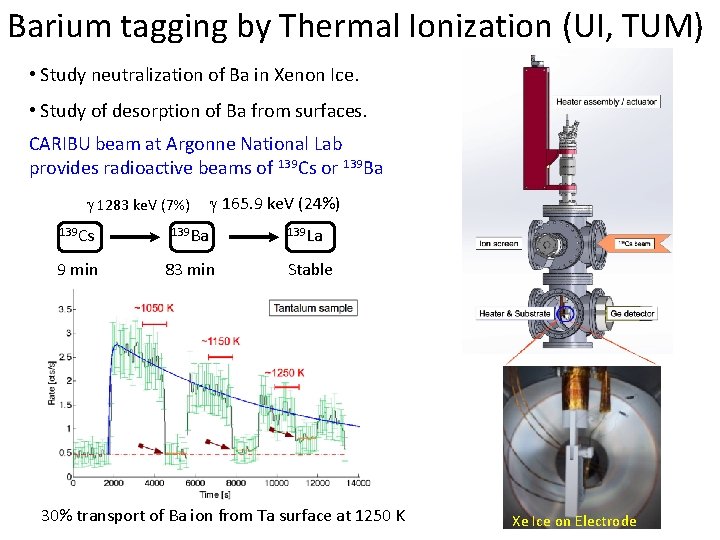
Barium tagging by Thermal Ionization (UI, TUM) • Study neutralization of Ba in Xenon Ice. • Study of desorption of Ba from surfaces. CARIBU beam at Argonne National Lab provides radioactive beams of 139 Cs or 139 Ba g 165. 9 ke. V (24%) g 1283 ke. V (7%) 139 Cs 139 Ba 9 min 83 min Cs Ba 139 La La Stable 30% transport of Ba ion from Ta surface at 1250 K Xe Ice on Electrode
- Slides: 18