
Bariatric Procedures Complications and Follow up Spire Bushey
Bariatric Procedures, Complications and Follow up Spire Bushey Hospital Mr Pratik Sufi Consultant Bariatric & Upper GI Surgeon
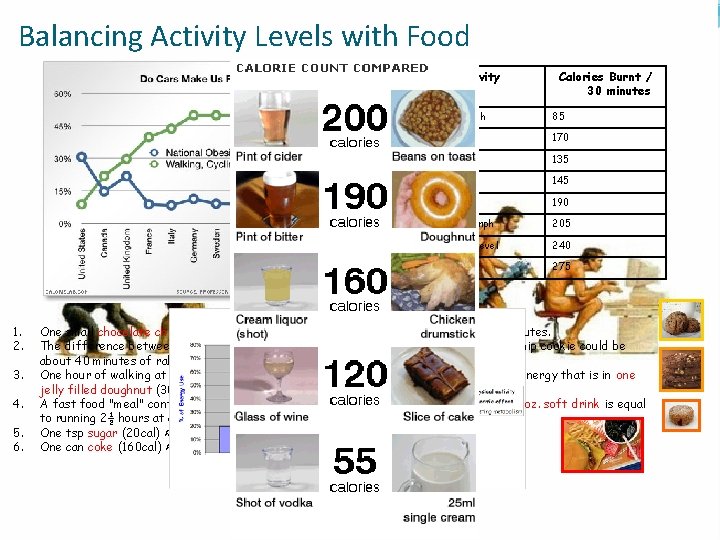
Balancing Activity Levels with Food Physical Activity 1. 2. 3. 4. 5. 6. Calories Burnt / 30 minutes Walking leisurely @ 2 mph 85 Walking briskly @ 4 mph 170 Gardening 135 Raking leaves 145 Dancing 190 Bicycling leisurely @ 10 mph 205 Swimming laps, medium level 240 Jogging @ 5 mph 275 One small chocolate chip cookie (50 calories) is equivalent to walking briskly for 10 minutes. The difference between a large gourmet chocolate chip cookie and a small chocolate chip cookie could be about 40 minutes of raking leaves (200 calories). One hour of walking at a moderate pace (20 min/mile) uses about the same amount of energy that is in one jelly filled doughnut (300 calories). A fast food "meal" containing a double patty cheeseburger, extra-large fries and a 24 oz. soft drink is equal to running 2½ hours at a 10 min/mile pace (1500 calories). One tsp sugar (20 cal) ≈ 4 min walk One can coke (160 cal) ≈ 30 min walk
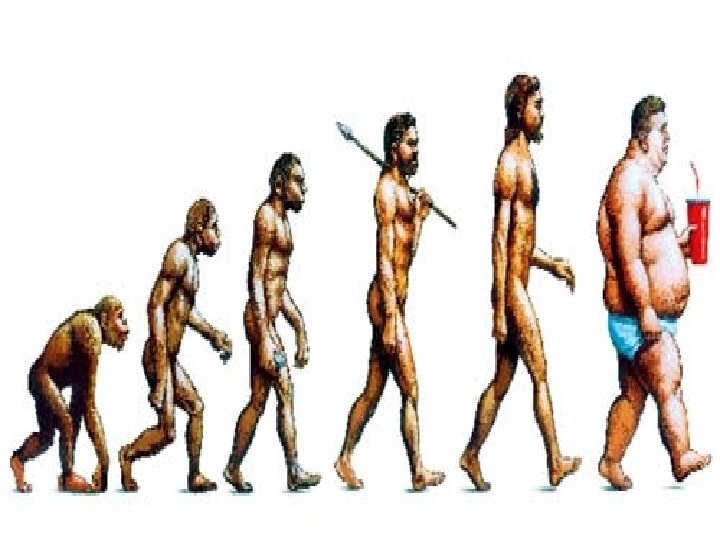
Dietary Change
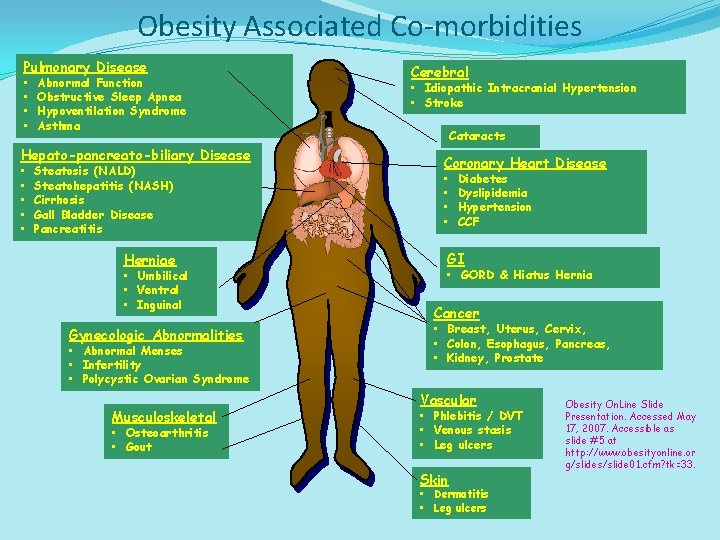
Obesity Associated Co-morbidities Pulmonary Disease • • Abnormal Function Obstructive Sleep Apnea Hypoventilation Syndrome Asthma Hepato-pancreato-biliary Disease • • • Steatosis (NALD) Steatohepatitis (NASH) Cirrhosis Gall Bladder Disease Pancreatitis Herniae • Umbilical • Ventral • Inguinal Gynecologic Abnormalities • Abnormal Menses • Infertility • Polycystic Ovarian Syndrome Musculoskeletal • Osteoarthritis • Gout Cerebral • Idiopathic Intracranial Hypertension • Stroke Cataracts Coronary Heart Disease • • Diabetes Dyslipidemia Hypertension CCF GI • GORD & Hiatus Hernia Cancer • Breast, Uterus, Cervix, • Colon, Esophagus, Pancreas, • Kidney, Prostate Vascular • Phlebitis / DVT • Venous stasis • Leg ulcers Skin • Dermatitis • Leg ulcers Obesity On. Line Slide Presentation. Accessed May 17, 2007. Accessible as slide #5 at http: //www. obesityonline. or g/slides/slide 01. cfm? tk=33.
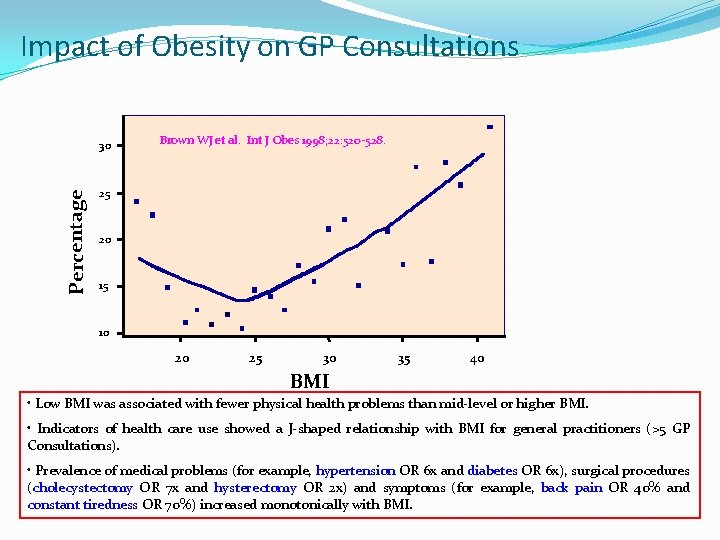
Impact of Obesity on GP Consultations Percentage 30 Brown WJ et al. Int J Obes 1998; 22: 520 -528. 25 20 15 10 20 25 30 35 40 BMI • Low BMI was associated with fewer physical health problems than mid-level or higher BMI. • Indicators of health care use showed a J-shaped relationship with BMI for general practitioners (>5 GP Consultations). • Prevalence of medical problems (for example, hypertension OR 6 x and diabetes OR 6 x), surgical procedures (cholecystectomy OR 7 x and hysterectomy OR 2 x) and symptoms (for example, back pain OR 40% and constant tiredness OR 70%) increased monotonically with BMI.
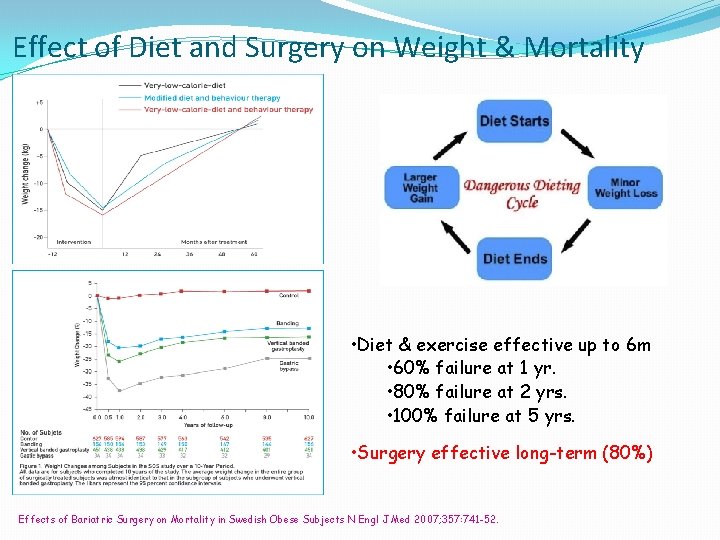
Effect of Diet and Surgery on Weight & Mortality • Diet & exercise effective up to 6 m • 60% failure at 1 yr. • 80% failure at 2 yrs. • 100% failure at 5 yrs. • Surgery effective long-term (80%) Effects of Bariatric Surgery on Mortality in Swedish Obese Subjects N Engl J Med 2007; 357: 741 -52.
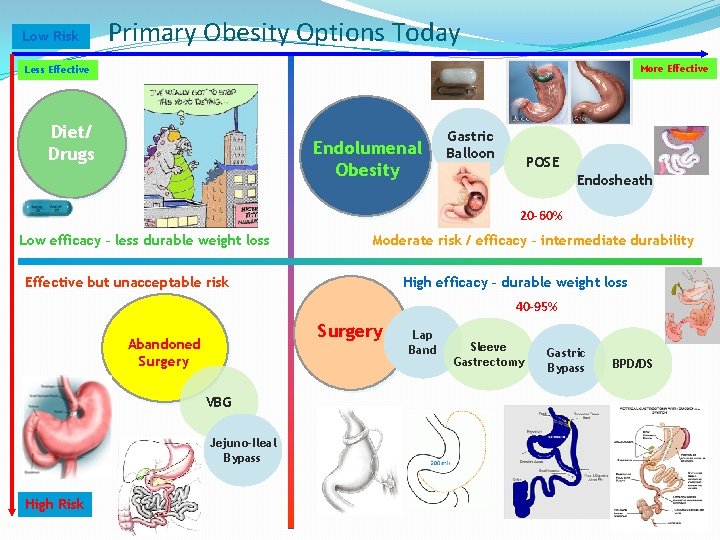
Low Risk Primary Obesity Options Today More Effective Less Effective Diet/ Drugs Endolumenal Obesity Gastric Balloon POSE Endosheath 20 -60% Low efficacy – less durable weight loss Moderate risk / efficacy – intermediate durability Effective but unacceptable risk High efficacy – durable weight loss 40 -95% Surgery Abandoned Surgery VBG Jejuno-Ileal Bypass High Risk Lap Band Sleeve Gastrectomy Gastric Bypass BPD/DS
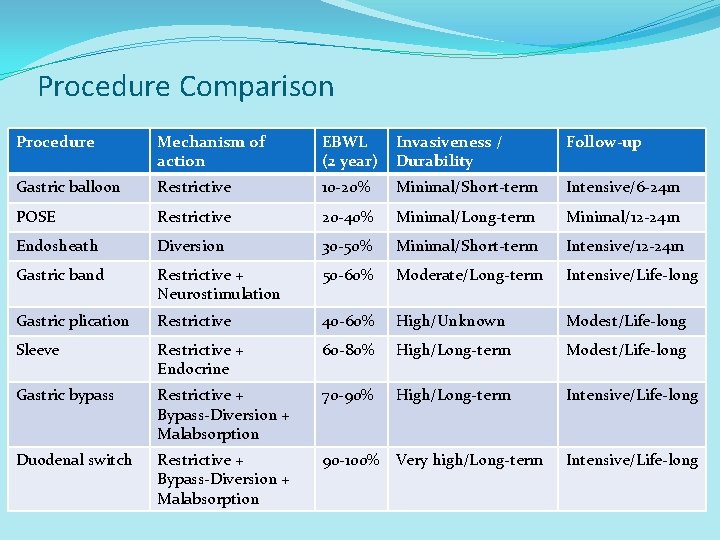
Procedure Comparison Procedure Mechanism of action EBWL (2 year) Invasiveness / Durability Follow-up Gastric balloon Restrictive 10 -20% Minimal/Short-term Intensive/6 -24 m POSE Restrictive 20 -40% Minimal/Long-term Minimal/12 -24 m Endosheath Diversion 30 -50% Minimal/Short-term Intensive/12 -24 m Gastric band Restrictive + Neurostimulation 50 -60% Moderate/Long-term Intensive/Life-long Gastric plication Restrictive 40 -60% High/Unknown Modest/Life-long Sleeve Restrictive + Endocrine 60 -80% High/Long-term Modest/Life-long Gastric bypass Restrictive + Bypass-Diversion + Malabsorption 70 -90% High/Long-term Intensive/Life-long Duodenal switch Restrictive + Bypass-Diversion + Malabsorption 90 -100% Very high/Long-term Intensive/Life-long
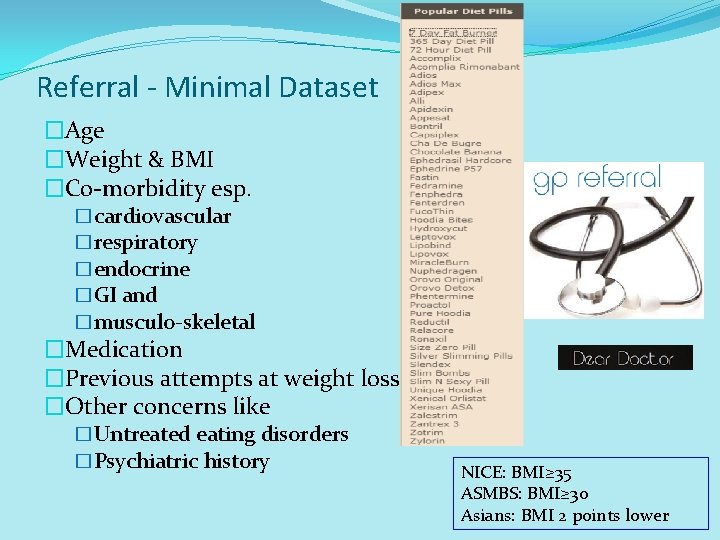
Referral - Minimal Dataset �Age �Weight & BMI �Co-morbidity esp. �cardiovascular �respiratory �endocrine �GI and �musculo-skeletal �Medication �Previous attempts at weight loss �Other concerns like �Untreated eating disorders �Psychiatric history NICE: BMI≥ 35 ASMBS: BMI≥ 30 Asians: BMI 2 points lower
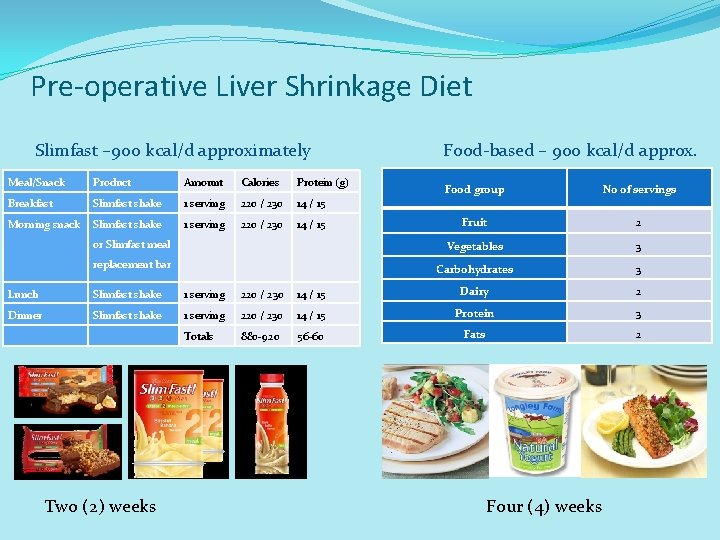
Pre-operative Liver Shrinkage Diet Slimfast – 900 kcal/d approximately Meal/Snack Product Amount Calories Protein (g) Breakfast Slimfast shake 1 serving 220 / 230 14 / 15 Morning snack Slimfast shake 1 serving 220 / 230 14 / 15 Food-based – 900 kcal/d approx. Food group No of servings Fruit 2 or Slimfast meal Vegetables 3 replacement bar Carbohydrates 3 Lunch Slimfast shake 1 serving 220 / 230 14 / 15 Dairy 2 Dinner Slimfast shake 1 serving 220 / 230 14 / 15 Protein 3 Totals 880 -920 56 -60 Fats 2 Two (2) weeks Four (4) weeks
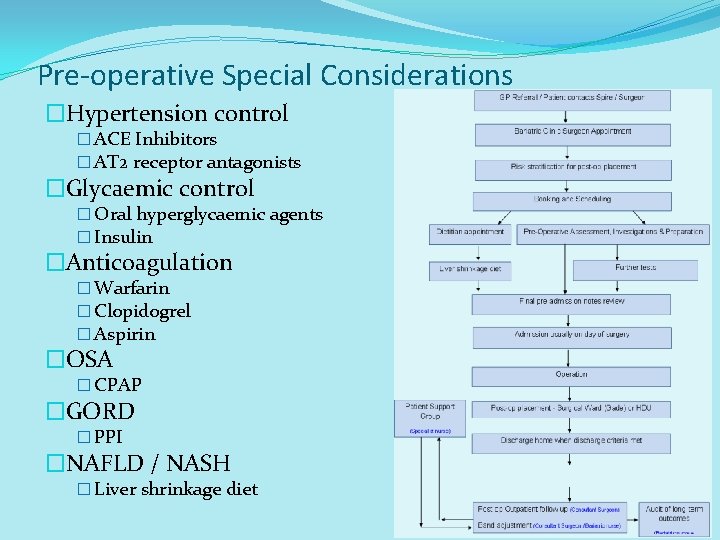
Pre-operative Special Considerations �Hypertension control � ACE Inhibitors � AT 2 receptor antagonists �Glycaemic control � Oral hyperglycaemic agents � Insulin �Anticoagulation � Warfarin � Clopidogrel � Aspirin �OSA � CPAP �GORD � PPI �NAFLD / NASH � Liver shrinkage diet
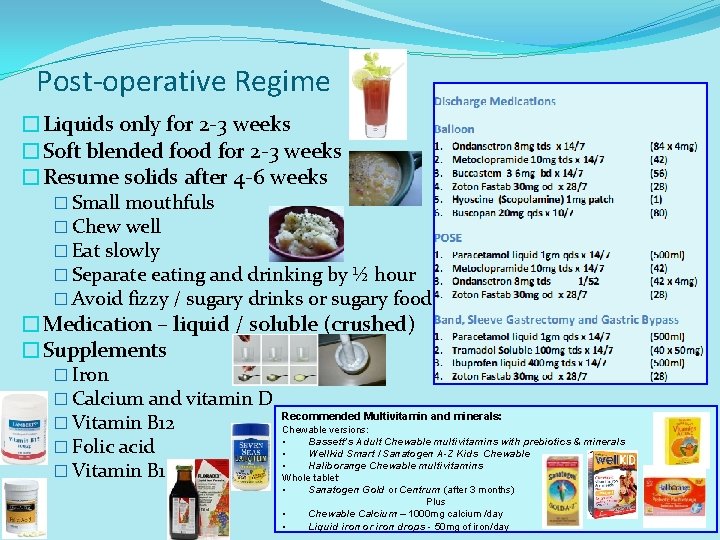
Post-operative Regime �Liquids only for 2 -3 weeks �Soft blended food for 2 -3 weeks �Resume solids after 4 -6 weeks � Small mouthfuls � Chew well � Eat slowly � Separate eating and drinking by ½ hour � Avoid fizzy / sugary drinks or sugary food �Medication – liquid / soluble (crushed) �Supplements � Iron � Calcium and vitamin D � Vitamin B 12 � Folic acid � Vitamin B 1 Recommended Multivitamin and minerals: Chewable versions: • Bassett’s Adult Chewable multivitamins with prebiotics & minerals • Wellkid Smart / Sanatogen A-Z Kids Chewable • Haliborange Chewable multivitamins Whole tablet: • Sanatogen Gold or Centrum (after 3 months) Plus • Chewable Calcium – 1000 mg calcium /day • Liquid iron or iron drops - 50 mg of iron/day
Post-operative – Suitable Fluids D 0 -W 2 �Milk - Aim for at least two pints (1. 2 L) of milk or a milk alternative a day �Milk can be flavoured with Nesquick or low calorie hot chocolate �Slimming drinks e. g. Slimfast or chemist/supermarket own brand �Complan or Build-up shakes or soups �Yogurt drinks and smoothies �Still mineral water, if taking the flavoured types make sure they are low sugar �Still low-sugar squashes �Smooth soups e. g. cream of tomato or chicken; or oxtail �Tea and coffee without sugar �Unsweetened pure fruit juice
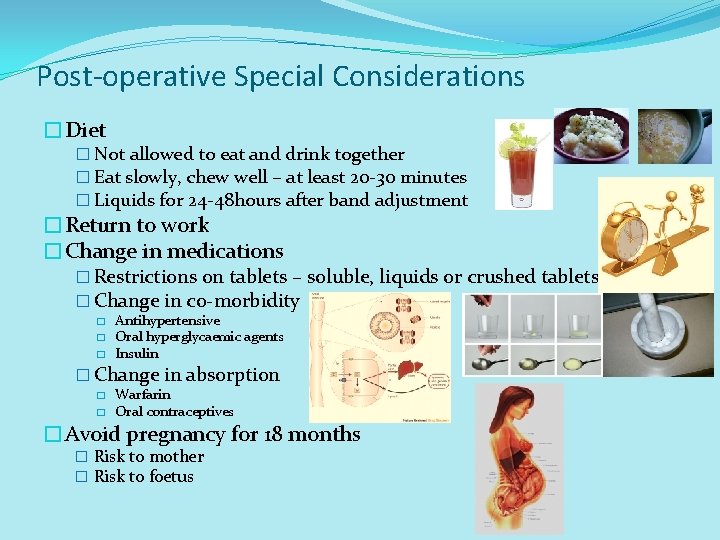
Post-operative Special Considerations �Diet � Not allowed to eat and drink together � Eat slowly, chew well – at least 20 -30 minutes � Liquids for 24 -48 hours after band adjustment �Return to work �Change in medications � Restrictions on tablets – soluble, liquids or crushed tablets � Change in co-morbidity � � � Antihypertensive Oral hyperglycaemic agents Insulin � Change in absorption � � Warfarin Oral contraceptives �Avoid pregnancy for 18 months � Risk to mother � Risk to foetus
Long-term Follow-up � Pins and needles (B 12, B 1) � Frequent falls (B 12, B 1, Fe) � Tiredness (anaemia, hypoglycaemia) � Generalised pain (PTH) � Abdominal pain (ulcer, gallstones / hernia / kidney stones) � Reflux / regurgitation/ N&V / persistent cough (band slippage, over-tight band, ulcer, hiatus hernia) Calcium supplements- 1000 mg calcium / day. Liquid or effervescent tablets Ferrous Sulphate/ ferrous fumarate or sodium feredetate – drops, syrup or sugar free elixir. 50 mg of iron/day Hydroxocobalamin Vitamin B 12 injections – 1 mg every 3 months
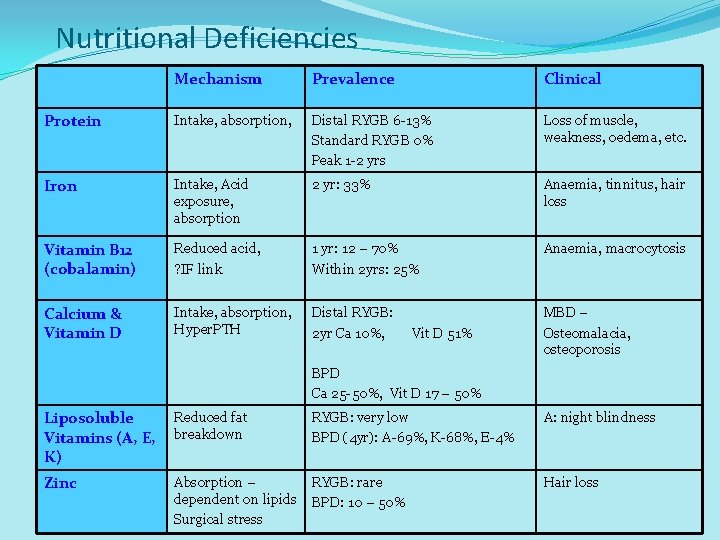
Nutritional Deficiencies Mechanism Prevalence Clinical Protein Intake, absorption, Distal RYGB 6 -13% Standard RYGB 0% Peak 1 -2 yrs Loss of muscle, weakness, oedema, etc. Iron Intake, Acid exposure, absorption 2 yr: 33% Anaemia, tinnitus, hair loss Vitamin B 12 (cobalamin) Reduced acid, ? IF link 1 yr: 12 – 70% Within 2 yrs: 25% Anaemia, macrocytosis Calcium & Vitamin D Intake, absorption, Hyper. PTH Distal RYGB: 2 yr Ca 10%, MBD – Osteomalacia, osteoporosis Vit D 51% BPD Ca 25 -50%, Vit D 17 – 50% Liposoluble Vitamins (A, E, K) Reduced fat breakdown RYGB: very low BPD (4 yr): A-69%, K-68%, E-4% A: night blindness Zinc Absorption – dependent on lipids Surgical stress RYGB: rare BPD: 10 – 50% Hair loss
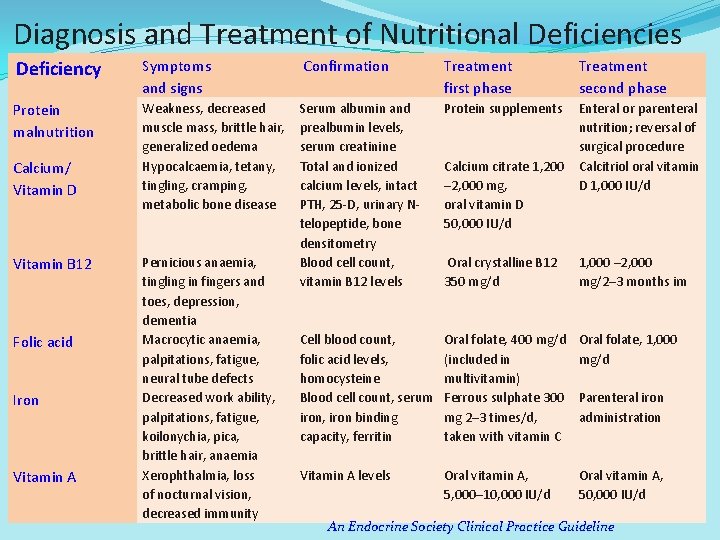
Diagnosis and Treatment of Nutritional Deficiencies Deficiency Symptoms and signs Confirmation Treatment first phase Protein malnutrition Weakness, decreased muscle mass, brittle hair, generalized oedema Hypocalcaemia, tetany, tingling, cramping, metabolic bone disease Serum albumin and prealbumin levels, serum creatinine Total and ionized calcium levels, intact PTH, 25 -D, urinary Ntelopeptide, bone densitometry Blood cell count, vitamin B 12 levels Protein supplements Enteral or parenteral nutrition; reversal of surgical procedure Calcium citrate 1, 200 Calcitriol oral vitamin – 2, 000 mg, D 1, 000 IU/d oral vitamin D 50, 000 IU/d Oral crystalline B 12 350 mg/d 1, 000 – 2, 000 mg/2– 3 months im Cell blood count, folic acid levels, homocysteine Blood cell count, serum iron, iron binding capacity, ferritin Vitamin A levels Oral folate, 400 mg/d (included in multivitamin) Ferrous sulphate 300 mg 2– 3 times/d, taken with vitamin C Oral vitamin A, 5, 000– 10, 000 IU/d Oral folate, 1, 000 mg/d Parenteral iron administration Oral vitamin A, 50, 000 IU/d Calcium/ Vitamin D Vitamin B 12 Folic acid Iron Vitamin A Pernicious anaemia, tingling in fingers and toes, depression, dementia Macrocytic anaemia, palpitations, fatigue, neural tube defects Decreased work ability, palpitations, fatigue, koilonychia, pica, brittle hair, anaemia Xerophthalmia, loss of nocturnal vision, decreased immunity Treatment second phase An Endocrine Society Clinical Practice Guideline
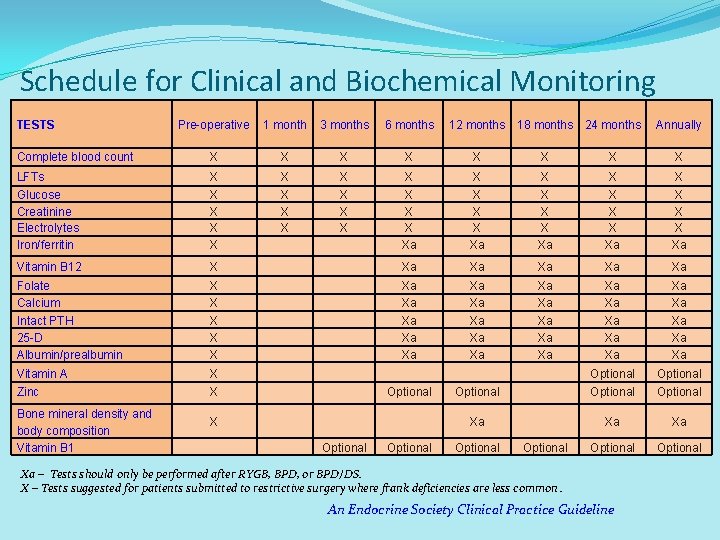
Schedule for Clinical and Biochemical Monitoring TESTS Pre-operative 1 month 3 months 6 months 12 months 18 months 24 months Annually Complete blood count X X LFTs X X Glucose Creatinine Electrolytes Iron/ferritin X X X Xa X X X Xa Vitamin B 12 X Xa Xa Xa Folate Calcium Intact PTH 25 -D Albumin/prealbumin X X X Xa Xa Xa Xa Xa Vitamin A Xa Xa Xa Optional Zinc X Optional Xa Xa Optional Bone mineral density and body composition Vitamin B 1 X Xa Optional Xa – Tests should only be performed after RYGB, BPD, or BPD/DS. X – Tests suggested for patients submitted to restrictive surgery where frank deficiencies are less common. An Endocrine Society Clinical Practice Guideline
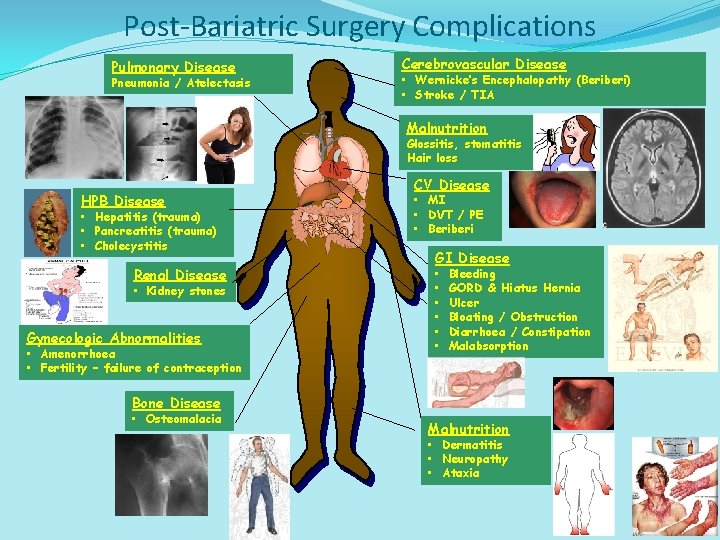
Post-Bariatric Surgery Complications Pulmonary Disease Pneumonia / Atelectasis Cerebrovascular Disease • Wernicke’s Encephalopathy (Beriberi) • Stroke / TIA Malnutrition Glossitis, stomatitis Hair loss HPB Disease • Hepatitis (trauma) • Pancreatitis (trauma) • Cholecystitis Renal Disease • Kidney stones Gynecologic Abnormalities • Amenorrhoea • Fertility – failure of contraception CV Disease • MI • DVT / PE • Beriberi GI Disease • • • Bleeding GORD & Hiatus Hernia Ulcer Bloating / Obstruction Diarrhoea / Constipation Malabsorption Bone Disease • Osteomalacia Malnutrition • Dermatitis • Neuropathy • Ataxia
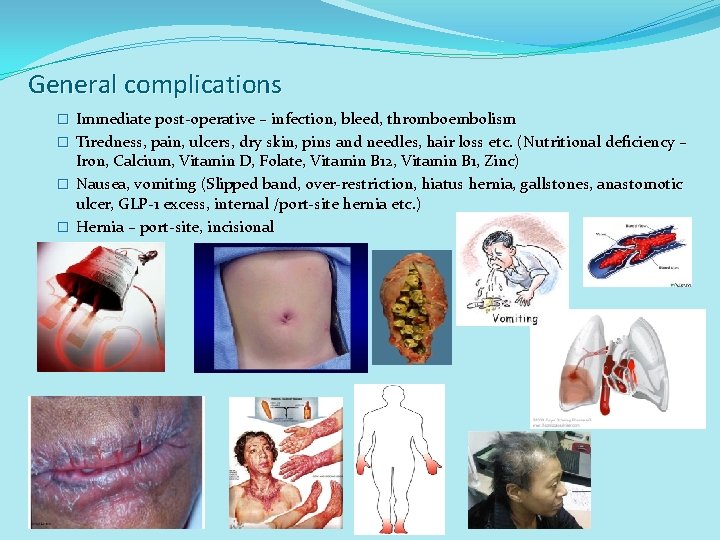
General complications � Immediate post-operative – infection, bleed, thromboembolism � Tiredness, pain, ulcers, dry skin, pins and needles, hair loss etc. (Nutritional deficiency – Iron, Calcium, Vitamin D, Folate, Vitamin B 12, Vitamin B 1, Zinc) � Nausea, vomiting (Slipped band, over-restriction, hiatus hernia, gallstones, anastomotic ulcer, GLP-1 excess, internal /port-site hernia etc. ) � Hernia – port-site, incisional
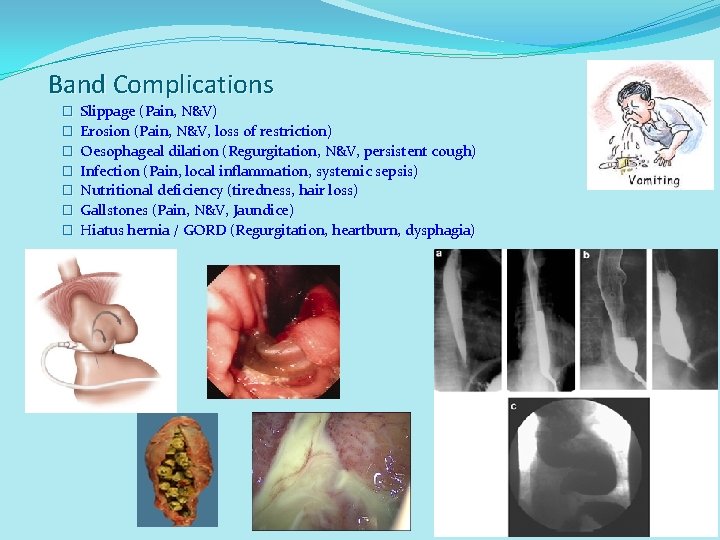
Band Complications � � � � Slippage (Pain, N&V) Erosion (Pain, N&V, loss of restriction) Oesophageal dilation (Regurgitation, N&V, persistent cough) Infection (Pain, local inflammation, systemic sepsis) Nutritional deficiency (tiredness, hair loss) Gallstones (Pain, N&V, Jaundice) Hiatus hernia / GORD (Regurgitation, heartburn, dysphagia)
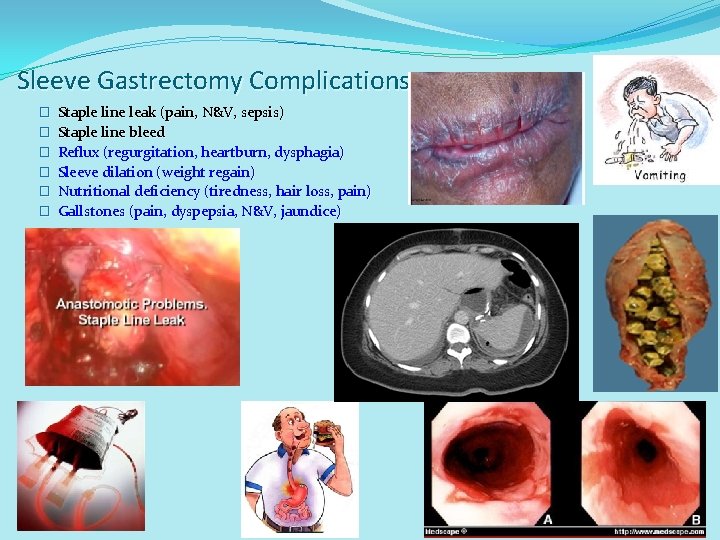
Sleeve Gastrectomy Complications � � � Staple line leak (pain, N&V, sepsis) Staple line bleed Reflux (regurgitation, heartburn, dysphagia) Sleeve dilation (weight regain) Nutritional deficiency (tiredness, hair loss, pain) Gallstones (pain, dyspepsia, N&V, jaundice)
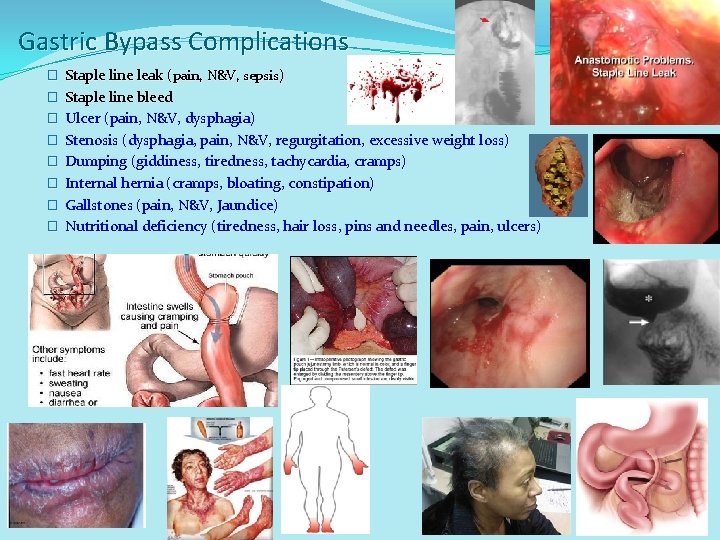
Gastric Bypass Complications � Staple line leak (pain, N&V, sepsis) � Staple line bleed � Ulcer (pain, N&V, dysphagia) � Stenosis (dysphagia, pain, N&V, regurgitation, excessive weight loss) � Dumping (giddiness, tiredness, tachycardia, cramps) � Internal hernia (cramps, bloating, constipation) � Gallstones (pain, N&V, Jaundice) � Nutritional deficiency (tiredness, hair loss, pins and needles, pain, ulcers)
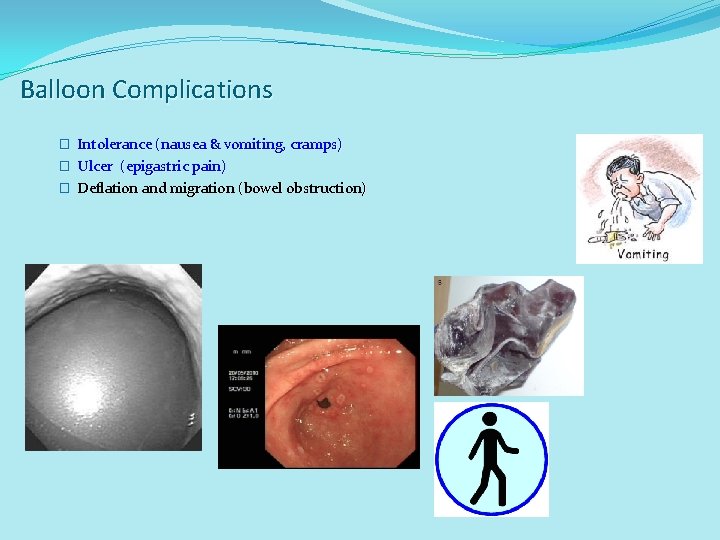
Balloon Complications � Intolerance (nausea & vomiting, cramps) � Ulcer (epigastric pain) � Deflation and migration (bowel obstruction)
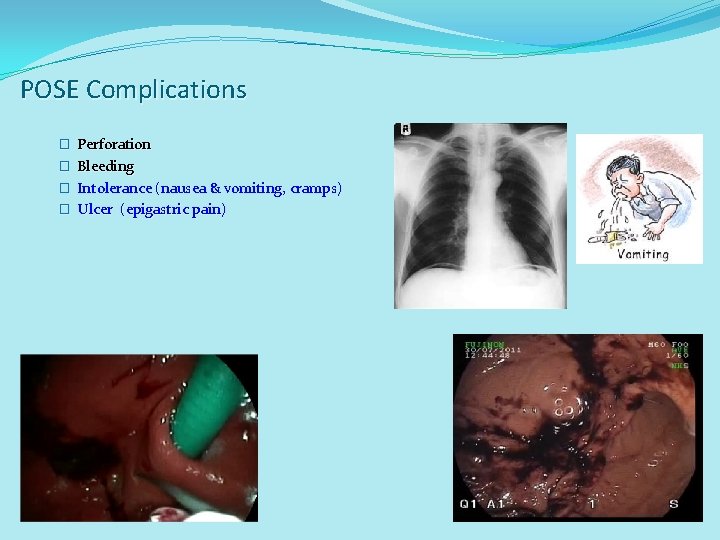
POSE Complications � Perforation � Bleeding � Intolerance (nausea & vomiting, cramps) � Ulcer (epigastric pain)
Pain �Gallstones �Pancreatitis �Anastomotic ulcer �Perforation / Anastomotic leak �Gastric band erosion �Slipped gastric band �Dumping syndrome �Anastomotic stricture �Small bowel obstruction �Gastro-gastric fistula
Nausea & Vomiting �Pregnancy! �Gastroenteritis �Gastric balloon intolerance �Over-restricted gastric band �Anastomotic ulcer �Anastomotic / Sleeve gastrectomy stricture �Gallstones / Pancreatitis �Hiatus hernia �Internal hernia / Small bowel obstruction
Diarrhoea �Gastroenteritis �Bacterial overgrowth �Clostridium difficile �Fat malabsorption �Dumping syndrome �Lactose intolerance
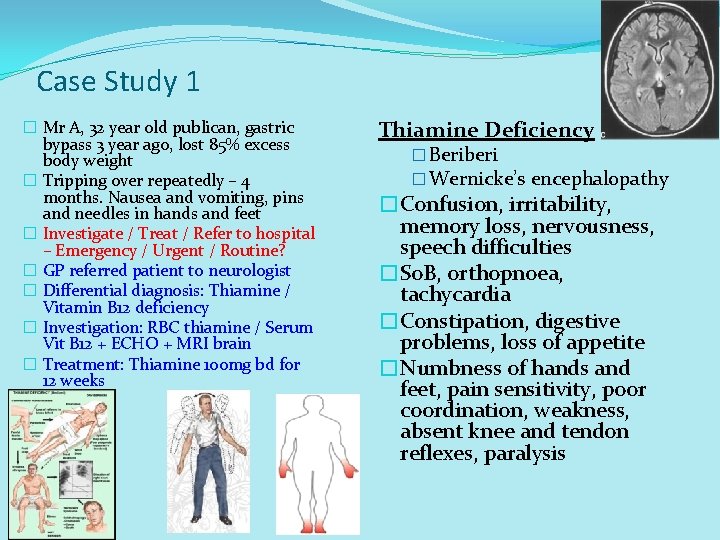
Case Study 1 � Mr A, 32 year old publican, gastric bypass 3 year ago, lost 85% excess body weight � Tripping over repeatedly – 4 months. Nausea and vomiting, pins and needles in hands and feet � Investigate / Treat / Refer to hospital – Emergency / Urgent / Routine? � GP referred patient to neurologist � Differential diagnosis: Thiamine / Vitamin B 12 deficiency � Investigation: RBC thiamine / Serum Vit B 12 + ECHO + MRI brain � Treatment: Thiamine 100 mg bd for 12 weeks Thiamine Deficiency � Beriberi � Wernicke’s encephalopathy �Confusion, irritability, memory loss, nervousness, speech difficulties �So. B, orthopnoea, tachycardia �Constipation, digestive problems, loss of appetite �Numbness of hands and feet, pain sensitivity, poor coordination, weakness, absent knee and tendon reflexes, paralysis
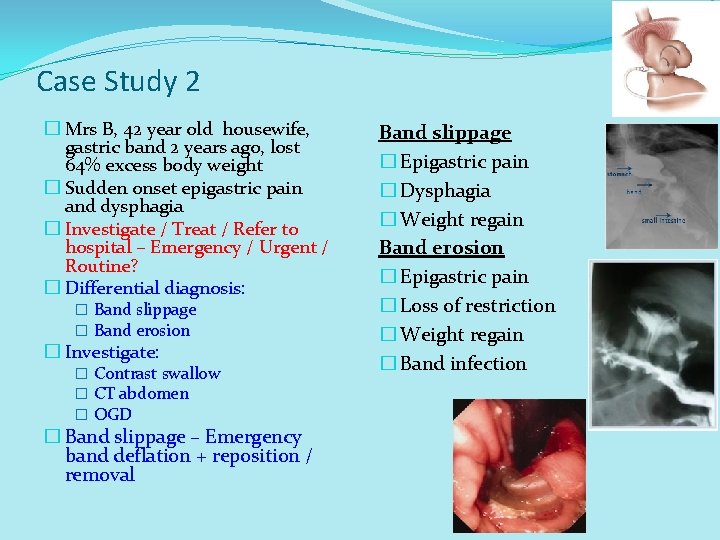
Case Study 2 � Mrs B, 42 year old housewife, gastric band 2 years ago, lost 64% excess body weight � Sudden onset epigastric pain and dysphagia � Investigate / Treat / Refer to hospital – Emergency / Urgent / Routine? � Differential diagnosis: � Band slippage � Band erosion � Investigate: � Contrast swallow � CT abdomen � OGD � Band slippage – Emergency band deflation + reposition / removal Band slippage � Epigastric pain � Dysphagia � Weight regain Band erosion � Epigastric pain � Loss of restriction � Weight regain � Band infection
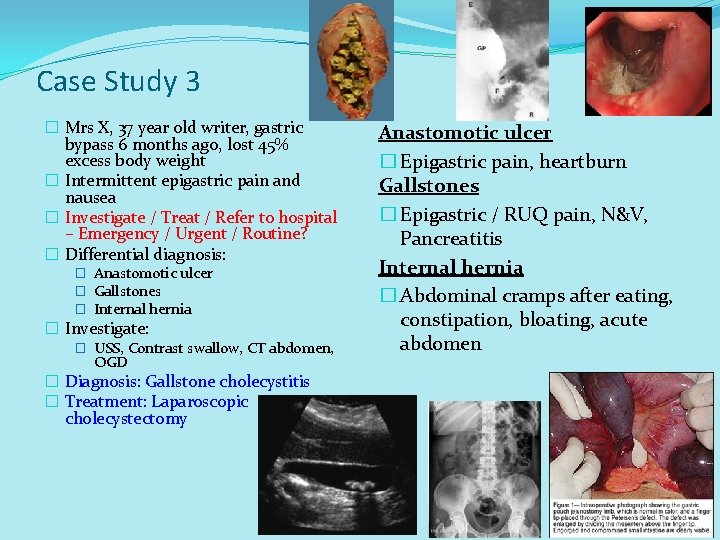
Case Study 3 � Mrs X, 37 year old writer, gastric bypass 6 months ago, lost 45% excess body weight � Intermittent epigastric pain and nausea � Investigate / Treat / Refer to hospital – Emergency / Urgent / Routine? � Differential diagnosis: � Anastomotic ulcer � Gallstones � Internal hernia � Investigate: � USS, Contrast swallow, CT abdomen, OGD � Diagnosis: Gallstone cholecystitis � Treatment: Laparoscopic cholecystectomy Anastomotic ulcer � Epigastric pain, heartburn Gallstones � Epigastric / RUQ pain, N&V, Pancreatitis Internal hernia � Abdominal cramps after eating, constipation, bloating, acute abdomen
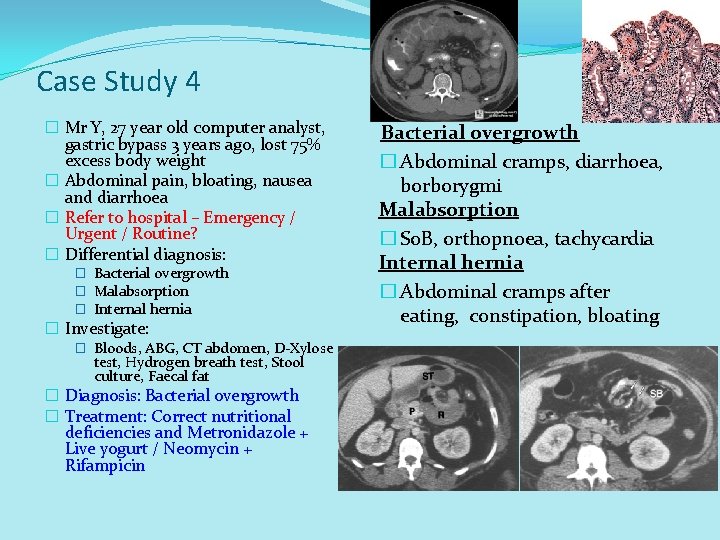
Case Study 4 � Mr Y, 27 year old computer analyst, gastric bypass 3 years ago, lost 75% excess body weight � Abdominal pain, bloating, nausea and diarrhoea � Refer to hospital – Emergency / Urgent / Routine? � Differential diagnosis: � Bacterial overgrowth � Malabsorption � Internal hernia � Investigate: � Bloods, ABG, CT abdomen, D-Xylose test, Hydrogen breath test, Stool culture, Faecal fat � Diagnosis: Bacterial overgrowth � Treatment: Correct nutritional deficiencies and Metronidazole + Live yogurt / Neomycin + Rifampicin Bacterial overgrowth � Abdominal cramps, diarrhoea, borborygmi Malabsorption � So. B, orthopnoea, tachycardia Internal hernia � Abdominal cramps after eating, constipation, bloating
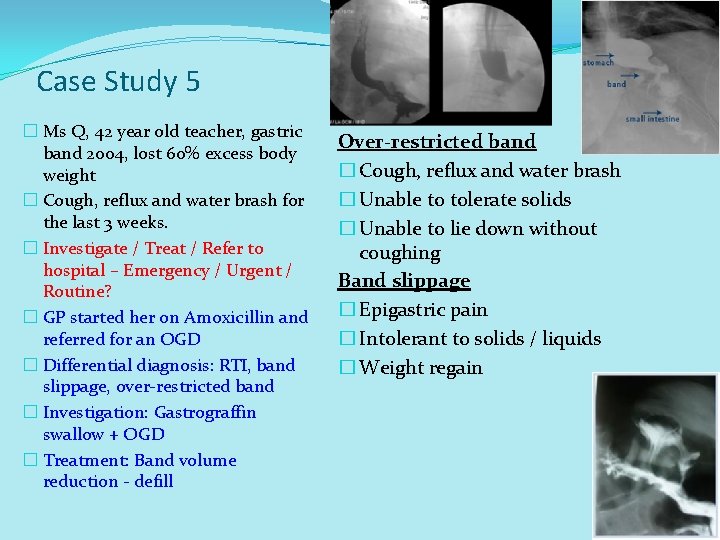
Case Study 5 � Ms Q, 42 year old teacher, gastric band 2004, lost 60% excess body weight � Cough, reflux and water brash for the last 3 weeks. � Investigate / Treat / Refer to hospital – Emergency / Urgent / Routine? � GP started her on Amoxicillin and referred for an OGD � Differential diagnosis: RTI, band slippage, over-restricted band � Investigation: Gastrograffin swallow + OGD � Treatment: Band volume reduction - defill Over-restricted band � Cough, reflux and water brash � Unable to tolerate solids � Unable to lie down without coughing Band slippage � Epigastric pain � Intolerant to solids / liquids � Weight regain
Take Home Message �Bariatric surgery is a cost-effective treatment for obesity which leads to resolution of co-morbidities, improved quality of life and increased life expectancy �However, patients need lifelong follow-up after surgery in order to avoid harm – this can be performed by their surgical team and by the primary care. �Patients can present with nausea, vomiting, dysphagia, reflux, abdominal pain and neurological symptoms. �Common things are common! �Nutritional deficiencies are common and easily preventable.

Thank you!
- Slides: 35