
Barcelona 12 15 May 2003 Statistical Framework for
Barcelona 12 -15 May 2003 Statistical Framework for Establishing Target Reliability Levels and Classifying Major Event Days Mark Mc. Granaghan EPRI PEAC Corporation mmcgranaghan@epri-peac. com Mc. Granaghan US Session 2 Block 4 Question 12 1
Barcelona 12 -15 May 2003 Background • Deregulation and, in some instances, re-regulation have caused a renewed interest in distribution reliability • Several issues are leading to increased regulatory scrutiny of distribution reliability: – Emerging trend of decoupling price/revenue from cost of distribution service for a certain period of time (“regulatory period”) which allows regulated entities to earn higher profit by reducing cost – Concern regarding excessive budget cutting in the “wires” business to recover huge losses experienced in the energy trading and other businesses – Perception of decreased reliability during severe weather events • In December 2002, EPRI PDM initiated a project to review the current situation in distribution reliability performance indicators for utilities in United States Mc. Granaghan US Session 2 Block 4 Question 12 2
Barcelona 12 -15 May 2003 Characterizing Reliability • Most common indices (IEEE P 1366) – SAIFI, SAIDI • Statistical variations are critical • Target levels must include control ranges based on statistical variation characteristics • Handling of “Major Event Days” is a critical factor Mc. Granaghan US Session 2 Block 4 Question 12 3
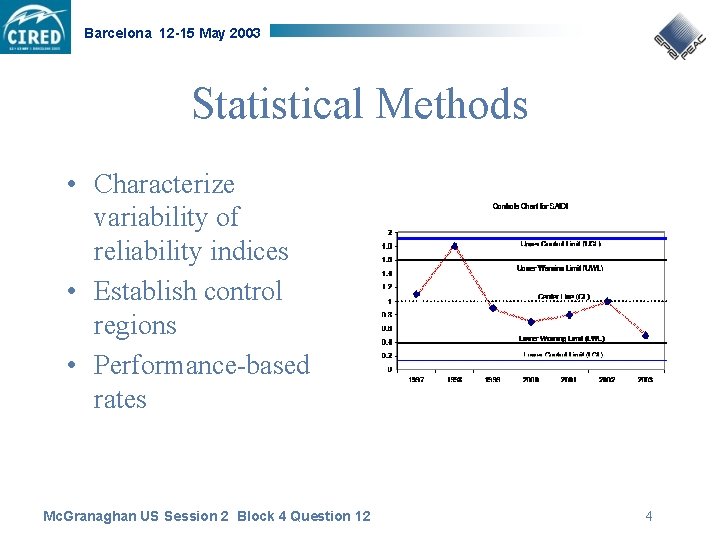
Barcelona 12 -15 May 2003 Statistical Methods • Characterize variability of reliability indices • Establish control regions • Performance-based rates Mc. Granaghan US Session 2 Block 4 Question 12 4
Barcelona 12 -15 May 2003 Defining Major Events • “Major Event” is defined as an event (typically weather related) that exceeds reasonable design and or operational limits of the electric power system • Widespread service interruption during a major event can significantly influence the yearly distribution reliability indices • Inconsistencies in the definition of “Major Events” has been a bottleneck in comparing reliability statistics among different utilities • IEEE is proposing a statistically-based definition of “Major Event” as part of IEEE P 1366 Draft Full-Use Guide for Electric Power Distribution Reliability Indices Mc. Granaghan US Session 2 Block 4 Question 12 5
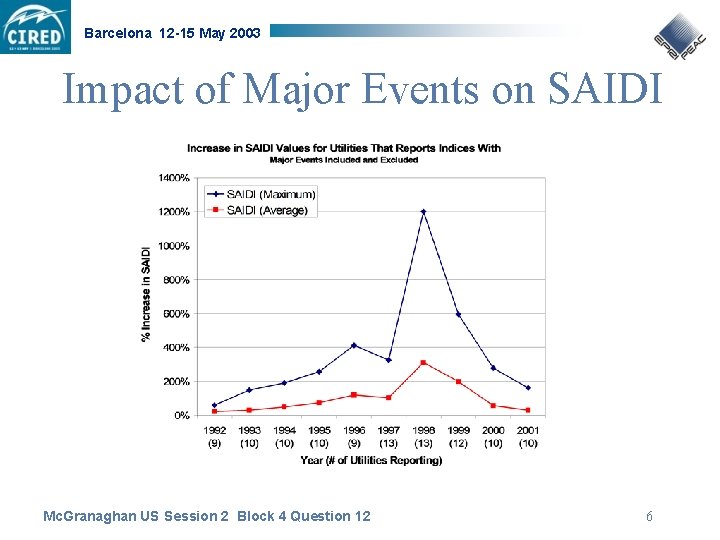
Barcelona 12 -15 May 2003 Impact of Major Events on SAIDI Mc. Granaghan US Session 2 Block 4 Question 12 6
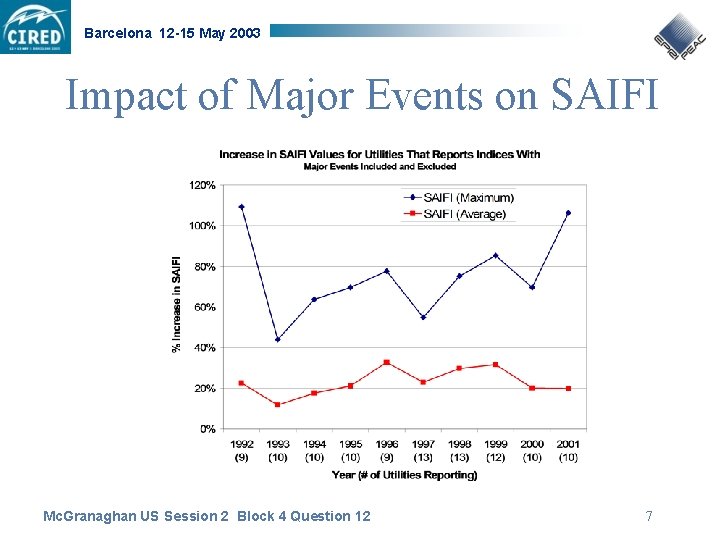
Barcelona 12 -15 May 2003 Impact of Major Events on SAIFI Mc. Granaghan US Session 2 Block 4 Question 12 7
Barcelona 12 -15 May 2003 Pitfalls in Comparing Reliability Performance • Definition & Data Classification – – Major Events Planned vs Unplanned Events Momentary interruptions vs outages Distribution/Transmission • Service Territory – Geography, weather, vegetation, animals, load density • Data Collection Process – Monitoring vs other methods of data collection • System Design – Overhead vs underground, voltage levels, networks, protection, etc. Mc. Granaghan US Session 2 Block 4 Question 12 8
Barcelona 12 -15 May 2003 Comparing Utility Reliability Indices • Consistency in definition of reliability indices and accountability of major events through standardization will promote uniformity among utilities • Need uniformity on an international basis • Collaborative project to compare methods for characterizing reliability, identify preferred statistical methods, benchmark with actual data Mc. Granaghan US Session 2 Block 4 Question 12 9
- Slides: 9