
BANKRUPTCY ISSUES FOR COUNTIES Sandra S Hamilton 616
BANKRUPTCY ISSUES FOR COUNTIES Sandra S. Hamilton (616) 608 -1141 shamilton@clarkhill. com MMTA Winter Workshop January, 2018
BANKRUPTCY ISSUES AND COUNTIES § The Petition – A bankruptcy case is commenced by filing a petition with a United States Bankruptcy Court. The date on which the petition is filed is know as the “petition date. ” Activities which arose prior to the filing of the petition are known as “pre -petition” while activities occurring after the filing of the petition are referred to as “postpetition. ” The entity filing for bankruptcy is known as the “debtor. ” The county seeking payment of its taxes or other fines, fees or charges, etc. , is known as a “creditor. ” § Bankruptcy Code – Bankruptcies are governed by federal law – the Federal Bankruptcy Code – contained in Title 11 of the United States Code referred to in these materials as the “Bankruptcy Code. ” In the event of a conflict between the Bankruptcy Code and state law (including state laws relating to real and personal property taxes), the provisions of the Bankruptcy Code will prevail due to the Federal Supremacy Doctrine arising out of the United States Constitution. 2 clarkhill. com
BANKRUPTCY ISSUES AND COUNTIES (CONT. ) Bankruptcy Chapters – A bankruptcy case can be commenced and administered under any one of several chapters. § Chapter 7 – This is a liquidating bankruptcy where a bankruptcy trustee is appointed and essentially all of the debtor’s assets are liquidated, with the proceeds going to pay creditors in accordance with a priority system contained in the Bankruptcy Code. § Chapter 9 – This chapter is used for the “Adjustment of Debts of a Municipality”. This provision incorporates by reference a significant portion of the Bankruptcy Code provisions that pertain to Chapter 11 reorganizations. Unfortunately, it has been receiving a lot of attention recently, as it is starting to be considered and used by more and more municipalities throughout the country, with Detroit, Michigan leading the way. 3 clarkhill. com
BANKRUPTCY ISSUES AND COUNTIES (CONT. ) Bankruptcy Chapters (cont. ) § Chapter 11 – This chapter is used primarily for reorganizing businesses. Typically, no trustee is appointed but the debtor company itself becomes a “debtor in possession” carrying out the functions of a trustee. If the business is able to successfully have a plan of reorganization confirmed by the bankruptcy court, it may come out of bankruptcy as a reorganized company without having its assets liquidated. § Chapter 12 – This chapter is used for reorganizations by farmers. § Chapter 13 – This chapter is used for reorganizations by individuals with regular incomes and who are under a certain level of indebtedness. This chapter includes individuals who own unincorporated small businesses as sole proprietors or possibly in a partnership. 4 clarkhill. com
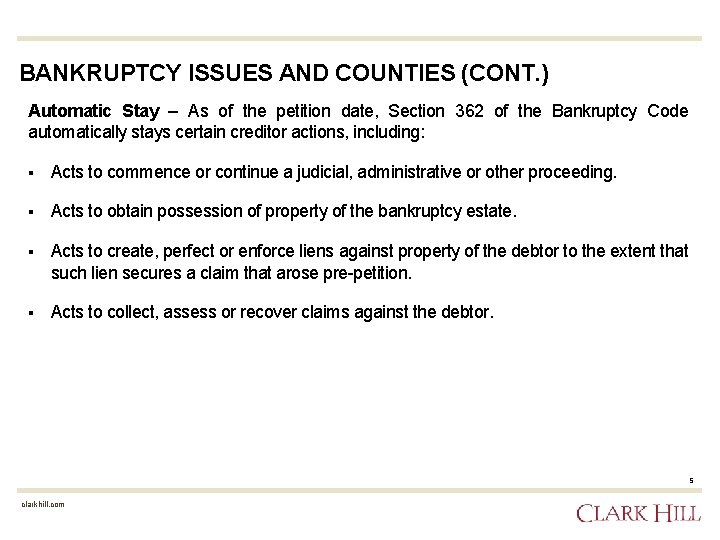
BANKRUPTCY ISSUES AND COUNTIES (CONT. ) Automatic Stay – As of the petition date, Section 362 of the Bankruptcy Code automatically stays certain creditor actions, including: § Acts to commence or continue a judicial, administrative or other proceeding. § Acts to obtain possession of property of the bankruptcy estate. § Acts to create, perfect or enforce liens against property of the debtor to the extent that such lien secures a claim that arose pre-petition. § Acts to collect, assess or recover claims against the debtor. 5 clarkhill. com
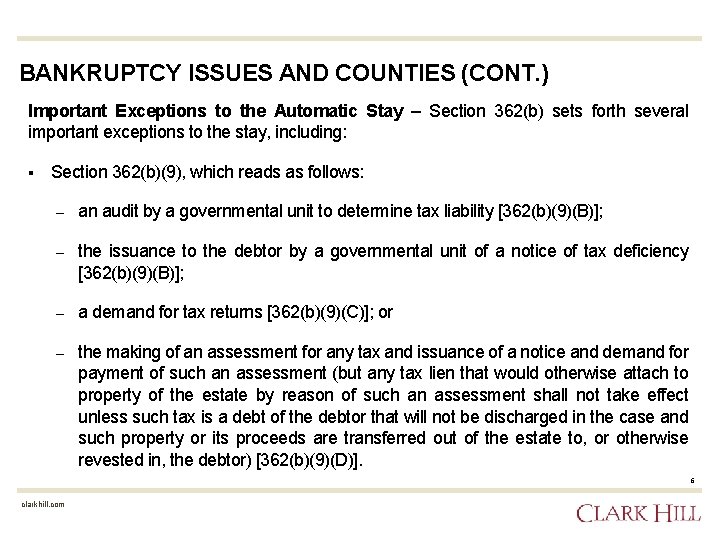
BANKRUPTCY ISSUES AND COUNTIES (CONT. ) Important Exceptions to the Automatic Stay – Section 362(b) sets forth several important exceptions to the stay, including: § Section 362(b)(9), which reads as follows: – an audit by a governmental unit to determine tax liability [362(b)(9)(B)]; – the issuance to the debtor by a governmental unit of a notice of tax deficiency [362(b)(9)(B)]; – a demand for tax returns [362(b)(9)(C)]; or – the making of an assessment for any tax and issuance of a notice and demand for payment of such an assessment (but any tax lien that would otherwise attach to property of the estate by reason of such an assessment shall not take effect unless such tax is a debt of the debtor that will not be discharged in the case and such property or its proceeds are transferred out of the estate to, or otherwise revested in, the debtor) [362(b)(9)(D)]. 6 clarkhill. com
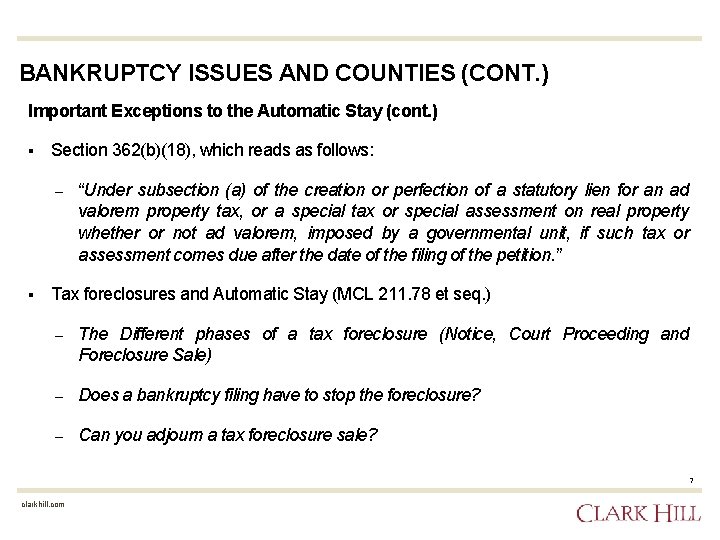
BANKRUPTCY ISSUES AND COUNTIES (CONT. ) Important Exceptions to the Automatic Stay (cont. ) § Section 362(b)(18), which reads as follows: – § “Under subsection (a) of the creation or perfection of a statutory lien for an ad valorem property tax, or a special tax or special assessment on real property whether or not ad valorem, imposed by a governmental unit, if such tax or assessment comes due after the date of the filing of the petition. ” Tax foreclosures and Automatic Stay (MCL 211. 78 et seq. ) – The Different phases of a tax foreclosure (Notice, Court Proceeding and Foreclosure Sale) – Does a bankruptcy filing have to stop the foreclosure? – Can you adjourn a tax foreclosure sale? 7 clarkhill. com
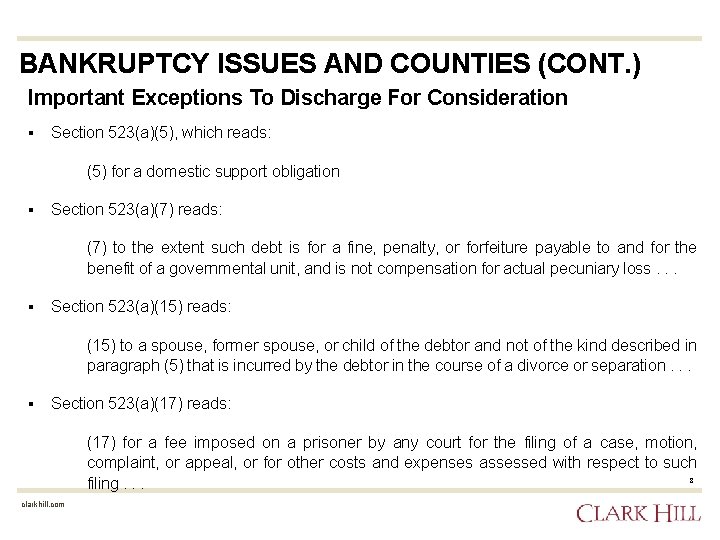
BANKRUPTCY ISSUES AND COUNTIES (CONT. ) Important Exceptions To Discharge For Consideration § Section 523(a)(5), which reads: (5) for a domestic support obligation § Section 523(a)(7) reads: (7) to the extent such debt is for a fine, penalty, or forfeiture payable to and for the benefit of a governmental unit, and is not compensation for actual pecuniary loss. . . § Section 523(a)(15) reads: (15) to a spouse, former spouse, or child of the debtor and not of the kind described in paragraph (5) that is incurred by the debtor in the course of a divorce or separation. . . § Section 523(a)(17) reads: (17) for a fee imposed on a prisoner by any court for the filing of a case, motion, complaint, or appeal, or for other costs and expenses assessed with respect to such 8 filing. . . clarkhill. com
BANKRUPTCY ISSUES AND COUNTIES (CONT. ) Proof of Claim § See attached copy of the standard form Proof of Claim to be used when making a claim in any bankruptcy proceeding (TAB 1). § Preparing a Proof of Claim. 9 clarkhill. com
STATUS OF PROPERTY TAX CLAIMS IN BANKRUPTCY CASES Background – In order to determine the status of a particular tax, it is necessary to briefly review the personal property tax system as set up by state statute. § Tax Day — On December 31 of each year, the determination is made as to what property (and its value) is subject to taxation by a particular jurisdiction for the subsequent year. This is known as the "tax day. " M. C. L. § 211. 2; M. S. A. § 7. 2. The Michigan General Property Tax Act goes on to provide that personal property taxes become a "debt due" on that tax day. M. C. L. § 211. 40; M. S. A. § 7. 81. § Lien (Levy) Day – While personal property taxes are a "debt due" as of the Tax Day, they do not become a secured debt until a lien is created to secure the payment of the taxes. Pursuant to M. C. L. § 211. 40; M. S. A. § 7. 81, a lien is created on the first day of December, upon such other date as may be provided by city or village charter, or on the day provided for in M. C. L. § 211. 40 a. Several cites have changed the date upon which a lien is deemed created to an earlier day in the year. 10 clarkhill. com
STATUS OF PROPERTY TAX CLAIMS IN BANKRUPTCY CASES (CONT. ) Background (cont. ) § M. C. L. 211. 40 a – Section 40 a represents an effort by the Michigan Legislature to accelerate the Lien Day in the event of bankruptcy or other similar occurrences (see attached copy of this section). The Act provides that the treasurer may designate the Tax Day (December 31 of the prior year) as the Lien Day for a particular taxpayer by recording an affidavit with the Register of Deeds office. The affidavit may be recorded upon the occurrence of any of the following: – The owner or person otherwise assessed has filed a bankruptcy petition under the Federal Bankruptcy Code. – A secured lender has brought an action to foreclose on or to enforce an interest secured by the property assessed. – For personal property only, the owner, the person otherwise assessed, or other person has liquidated or is attempting to liquidate the personal property assessed. 11 clarkhill. com
STATUS OF PROPERTY TAX CLAIMS IN BANKRUPTCY CASES (CONT. ) Background (cont. ) § M. C. L. 211. 40 a (cont. ) – The property assessed is subject to receivership under state or federal law. – The owner or person otherwise assessed has assigned the property assessed for the benefit of his or her creditors. – The property assessed has been seized or purchased by federal, state, or local authorities. – A judicial action has been commenced that may impair the ability of the taxing authority to collect any tax due in the absence of a lien on the real or personal property assessed. 12 clarkhill. com
STATUS OF PROPERTY TAX CLAIMS IN BANKRUPTCY CASES (CONT. ) Secured Taxes § Taxing authorities should always take the position that real and personal property taxes are secured claims in the bankruptcy rather than priority claims. Although at times a joint classification may be appropriate. § The United States Supreme Court has held that an over secured tax claim (local property tax claims are virtually always over secured) is entitled to continue to accrue interest (not penalty or fees) after the petition date. In re: Ron Pair Enterprises, Inc. , 489 U. S. 235 (1989). See 11 USC § 511. 13 clarkhill. com
STATUS OF PROPERTY TAX CLAIMS IN BANKRUPTCY CASES (CONT. ) Unsecured Priority Taxes § If for some reason property tax claims are found to be unsecured, they will still be entitled to priority status. § Section 507(a)(8) of the Bankruptcy Code creates an eighth priority for unsecured prepetition tax claims: – clarkhill. com (8) Eighth, allowed unsecured claims of governmental units, only to the extent that such claims are for: o a tax on or measured by income or gross receipts for a taxable year ending on or before the date of the filing of the petition o a property tax assessed before the commencement of the case and last payable without penalty after one year before the date of the filing of the petition; o a tax required to be collected or withheld and for which the debtor is liable in whatever capacity. 14
STATUS OF PROPERTY TAX CLAIMS IN BANKRUPTCY CASES (CONT. ) Practice Pointers § Promptly after receiving a notice of bankruptcy, taxing authorities should file a proof of claim as a secured creditor with the bankruptcy court for all pre-petition tax claims. § Larger corporate filings bring into question whether a claim should be filed with a dual status (secured and priority). § Monitor activity during the pendency of the bankruptcy. – clarkhill. com Cash collateral Agreement/Orders – It is very common for the secured lenders and debtors to negotiate a cash collateral agreement at the beginning of a bankruptcy case. These agreements often attempt to give the lender super priority lien status post-petition which could be to the detriment of the local taxing authority, in a corporate/business bankruptcy situation. Taxing authorities should become involved early in the bankruptcy case and file appropriate objections to such agreements if it appears that they attempt to challenge the taxing authority's state law granted priority/lien status. 15
STATUS OF PROPERTY TAX CLAIMS IN BANKRUPTCY CASES (CONT. ) Practice Pointers (cont. ) § Monitor activity during the pendency of the bankruptcy (cont. ) – Sale of Assets – Often times, the creditors of a bankruptcy estate, including taxing authorities, will receive a notice of a request to the bankruptcy court to approve the sale of some or all of the debtor's real and/or personal property under 11 U. S. C. § 363, et. al. Since local taxing authorities normally will have a claim secured by that property, upon receipt of such a notice, the taxing authority should immediately take action to ensure that the debtor and trustee know that the property is secured by the tax claim and seek court authorization to promptly distribute the amount of the secured tax claim to the taxing authority to prevent interest charges from accumulating. If appropriate payment or designation is not made regarding the taxing authority's claim, then an objection may have to be filed to the sale. Whether or not the taxes are paid upon the closing of the sale, most bankruptcy sales are conducted "free and clear of liens" under Section 363(f) of the Bankruptcy Code. As a result the tax lien is automatically transferred from the property to the sale proceeds which may, in some cases, be held in escrow by the trustee or Debtor for an extended period of time. Taxing authorities must recognize, however, that the property is then no longer subject to a tax lien. clarkhill. com 16
STATUS OF PROPERTY TAX CLAIMS IN BANKRUPTCY CASES (CONT. ) Practice Pointers (cont. ) § Monitor activity during the pendency of the bankruptcy (cont. ) – Plans of Reorganization – In Chapter 11, 12 and 13 cases, creditors such as taxing authorities may receive notice that the debtor is seeking confirmation of a plan of reorganization. The plan itself (often a lengthy document) will describe how various types of claims, including tax claims, are to be treated under the plan. The plan should be reviewed to assure that the tax claims are being appropriately treated. Tax claims can lose their secured status if the taxing authority fails to object to a plan of reorganization which does not specifically provide that tax liens are secured and retained. In re: Pierce Packing Company, 169 B. R. 290 (Bankr. D. Mont. 1994). 17 clarkhill. com
TREATMENT OF PROPERTY TAX CLAIMS UNDER DIFFERENT CHAPTERS Lien Subordination § Section 724(b) of the Bankruptcy Code effectively allows a Chapter 7 bankruptcy trustee to subordinate certain tax liens, including property tax liens, in order to pay administrative expenses and certain other priority creditor claims: – Property in which the estate has an interest and that is subject to a lien that is not avoidable under this title (other than to the extent that there is a properly perfected unavoidable tax lien arising in connection with an ad valorem tax on real or personal property of the estate) and that secures an allowed claim for a tax, or proceeds of such property, shall be distributed o First, to any holder of an allowed claim secured by a lien on such property that not avoidable under this title and that is senior to such tax lien; 18 clarkhill. com
TREATMENT OF PROPERTY TAX CLAIMS UNDER DIFFERENT CHAPTERS (CONT. ) Lien Subordination (cont. ) § Section 724(b) o Second, to any holder of a claim of a kind specified in section 507(a)(1) (except that such expenses, other than claims for wages, salaries, or commissions that arise after the date of the filing of the petition, shall be limited to expenses incurred under chapter 7 of this title and shall not include expenses incurred under chapter 11 of this title), 507(a)(2), 507(a)(3), 507(a)(4), 507(a)(5), 507(a)(6) or 507(a)(7) of this title, to the extent of the amount of such allowed tax claim that is secured by such tax lien; o Third, to the holder of such tax lien, to any extent that such holder’s allowed tax claim that is secured by such tax lien exceeds any amount distributed under paragraph (2) of this subsection; 19 clarkhill. com
TREATMENT OF PROPERTY TAX CLAIMS UNDER DIFFERENT CHAPTERS (CONT. ) Lien Subordination § Section 724(b) (cont. ) o Fourth, to any holder of an allowed claim secured by a lien on such property that is not avoidable under this title and that is junior to such tax lien; o Fifth, to the holder of such tax lien, to the extent that such holder’s allowed claim secured by such tax lien is not paid under paragraph (3) of this subsection; and o Sixth, to the estate. 20 clarkhill. com
TREATMENT OF PROPERTY TAX CLAIMS UNDER DIFFERENT CHAPTERS (CONT. ) Lien Subordination § Keep in mind that Section 724(b) only applies to Chapter 7 bankruptcies. Thus, if a company is struggling to reorganize in Chapter 11, it may be in the creditor’s best interest to assist the company in its efforts to reorganize in order to avoid the possibility that the case will be converted to a Chapter 7 liquidation where the trustee could employ Section 724(b). § In addition under § 724(e): Before subordinating a tax lien on real or personal property of the estate the trustee shall – exhaust the unencumbered assets of the estate; and – In a manner consistent with Section 506(c), recover from property securing an allowed secured claim the reasonable, necessary costs and expenses of preserving or disposing of such property. 21 clarkhill. com
TREATMENT OF PROPERTY TAX CLAIMS UNDER DIFFERENT CHAPTERS (CONT. ) Abandonment – In a Chapter 7 case, if the Trustee determines the real or personal property has little value and does not want to administer the asset, the Trustee may file a Notice of Abandonment for the property which means the Trustee is releasing his/her interest in the property and the taxing authority or Secured Creditor can take action to obtain possession and sell the property to apply the proceeds to its indebtedness. If the sale does not result in satisfaction of the tax due, the taxing authority will be left with an unsecured claim for the balance of its debt. 22 clarkhill. com
TREATMENT OF PROPERTY TAX CLAIMS UNDER DIFFERENT CHAPTERS (CONT. ) Interest Rates – In 2005, Congress added an entirely new section to the Code which provided that the applicable non-bankruptcy statutory rate of interest be paid on tax claims. 11 U. S. C. § 511, entitled Rate of Interest on Tax Claims, reads in full: § If any provision of this title requires the payment of interest on a tax claim or on an administrative expense tax, or the payment of interest to enable a creditor to receive the present value of the allowed amount of a tax claim, the rate of interest shall be the rate determined under applicable nonbankruptcy law. § In the case of taxes paid under a confirmed plan under this title, the rate of interest shall be determined as of the calendar month in which the plan is confirmed. § Often debtors will seek to set the interest rate at an amount less than state or local law has in effect. The creditor should object to such attempts. 23 clarkhill. com
TREATMENT OF PROPERTY TAX CLAIMS UNDER DIFFERENT CHAPTERS (CONT. ) Chapter 7 – Since this is a liquidation type of bankruptcy, the proceeds of the liquidation are distributed as follows: § Secured claims, including secured property tax claims, receive payment out of the proceeds of their collateral (i. e. , the real property or personal property) prior to the use of those proceeds for payments to other claimants. § Priority unsecured tax claims enjoy an eighth priority status and are paid following the satisfaction of secured claims and the prior seven levels of priority claims. – It is not unusual to find that the liquidation proceeds are insufficient to allow any payment whatsoever to eighth priority tax claims. In Chapter 7 cases, administrative expense claims are not always fully paid. – The eighth priority status is afforded only to taxes. Other types of unsecured claims (electrical service, cable television, etc. ) are not considered taxes and would be treated as general unsecured claims having no priority status. clarkhill. com 24
TREATMENT OF PROPERTY TAX CLAIMS UNDER DIFFERENT CHAPTERS (CONT. ) Chapter 11 – Since this is a reorganization proceeding, the Bankruptcy Code spells out how certain types of claims may be treated in the reorganization process. § Secured claims, including secured tax claims, can be paid out over an extended period of time provided that the claims receive interest. The interest rate provided need not necessarily be the interest rate prescribed by state statute. Secured property tax claims are normally paid out over the same period as is required for unsecured priority tax claims (as described below), but they may also be stretched out over a longer period. § Unsecured priority tax claims are required by the Bankruptcy Code to be paid in deferred cash payments, with interest, over a period not exceeding five years after the date of the order for relief under the Code. Section 1129(a)(9)(C) of the Bankruptcy Code. 25 clarkhill. com
TREATMENT OF PROPERTY TAX CLAIMS UNDER DIFFERENT CHAPTERS (CONT. ) Chapter 11 (cont. ) § Administrative (post-petition) claims are required to be paid in full in cash upon the effective date of the Court-approved plan of reorganization. As a practical matter, during the pendency of a Chapter 11 case, most courts require debtors to pay all postpetition taxes when due and prohibit debtors from letting post-petition taxes become delinquent. Chapter 13 – Claims in a Chapter 13 are handled similarly to a Chapter 11, but the maximum plan period is five (5) years. 26 clarkhill. com
SPECIAL PROBLEMS Limitations on Amount of Tax Claim § Section 502(b)(3) of the Bankruptcy Code disallows any claim for property taxes to the extent that the claim exceeds the value of the estate's interest in the property. As a result, a taxing authority may not receive distributions from a bankruptcy estate on a personal property tax claim to the extent the claim exceeds the value of the personal property. § For example, if lack of maintenance for some other event has caused the value of personal property to greatly decrease, it may be that the outstanding property tax claim would exceed the value of the property. The taxing authority cannot claim a right to receive distributions for either secured or priority property tax claims in an amount in excess of the current value of the property. 27 clarkhill. com
SPECIAL PROBLEMS (CONT. ) Assessment Challenges § A debtor in bankruptcy has a great deal of flexibility in challenging both current and past assessments under Section 505(a) of the Bankruptcy Code: – Except as provided in paragraph (2) of this subsection, the court may determine the amount or legality of any tax, any fine or penalty relating to a tax, or any addition to tax, whether or not previously assessed, whether or not paid, and whether or not contested before and adjudicated by a judicial or administrative tribunal of competent jurisdiction. 28 clarkhill. com
SPECIAL PROBLEMS (CONT. ) Assessment Challenges (cont. ) § The court may not so determine: – the amount or legality of a tax, fine, penalty, or addition to tax if such amount of legality was contested before and adjudicated by a judicial or administrative tribunal of competent jurisdiction before the commencement of the case under this title or; – any right of the estate to a tax refund, before the earlier of: – clarkhill. com o 120 days after the trustee properly requests such refund from the governmental unit from which such refund is claimed; or o a determination by such governmental unit of such request. the amount of legality of any amount arising in connection with an advalorem tax on real or personal property of the estate, if the applicable period for contesting or redetermining that amount under applicable non-bankruptcy law has expired. 29
QUESTIONS? Sandra S. Hamilton (616) 608 -1141 shamilton@clarkhill. com 30 clarkhill. com

THANK YOU Disclaimer: This information is not intended to be legal advice and may not be used as legal advice. Legal advice must be tailored to the specific circumstances of each case. Every effort has been made to assure this information is up-to-date. It is not intended to be a full and exhaustive explanation of the law in any area. It should not be used to replace the advice of your own legal counsel.
- Slides: 31