
Banking Operational Footprints Measuring Geographical Presence Claire Brennecke
Banking Operational Footprints: Measuring Geographical Presence Claire Brennecke Vivian Hwa FDIC January 2019

DISCLAIMER This presentation presents preliminary materials circulated to stimulate discussion and critical comment. The analysis, conclusions, and opinions set forth here are those of the author(s) alone and do not necessarily reflect the views of the Federal Deposit Insurance Corporation.

Why geography? • Recent literature focuses on where banking operations are in relation to existing and/or potential customers: interested in the who, how and where • Credit availability, funding risk, credit risk, market competition and impact on local economies • Branching, M&A, out of territory lending, brokered deposits (wholesale) • Homeownership rates, small business formation, unemployment, demographic characteristics
What publicly available data is there? • CRA (small business lending, small farm loans) • “Small loans” limited to <$1 mil • Reporting banks (>$250 b or $>1 b BHC) submit data annually • CBSA level • HMDA (single family mortgages) • Originations and applications • Property location (by tract, not address) • Generally very good coverage (monthly, virtually every mortgage making bank) • SOD (deposit data) • Total deposits per branch as assigned by bank • Annual • Also Call Report, GSA, Fed’s SLOOS
What have people done in the literature? • Various research approaches assume or proxy: Ø Deposits=Depositor Ø Deposits=Borrowers Ø Reporters=All Banks (ignoring very small banks or specialty banks) Ø Reported=All Items (subset of loans represent entire loan portfolio, or mortgages=all Real Estate backed loans)
What have people done in the literature? • Used SOD • (Deng & Elyasiani JMCB 2008; Goetz, Laeven & Levine JFE 2016; Ashcraft JMCB 2006) • Use HMDA (looking at mortgages) • (Favara & Imbs, AER 2015; Loutskina & Strahan JF 2009, RFS 2011) • Use CRA (looking at small business loans, or “consumer lending”) • (Brevoort & Hannan, JMCB 2006)
Our Contribution • Establish previously unknown and unreported facts about banking business geography based on unique set of customer address level data from failed banks. • Provide qualitative and quantitative descriptions of limitations of publicly existing data and potential sources of measurement error. • Establish a framework for researchers to approach issues and better articulate how bank geography matters in the context of their research questions.
Project Goals • Deposits • Describe the extent to which SOD fails at capturing bank geography • E. g. Does SOD say where depositors are actually located? • Describe correlations between geography and other deposit characteristics • E. g. Can we assume that deposit characteristics are proportionally distributed across geography? • Loans • Compare lending geography across common publicly available sources (i. e. CRA, HMDA, SOD) and failed bank data • E. g. Can mortgage or small business lending geographies proxy for broader portfolio geography? To what extent? • Loans and Deposits • More broadly, how are lending and deposit geographies related?
Our Approach Thus Far • We compare data from failed banks to publicly available data sources • Failed bank data contains actual addresses and both sides of balance sheet • Compare geocoded locations of deposit accounts to last SOD before failure based on different geographical aggregation (i. e. state, MSA and zip)
Starting Sample • We start with data from a group of 50 banks that failed between 2010 and 2013 • Selected banks for which aggregate failed bank deposits statistics most closely matched SOD statistics and where the failed bank data was most reliable. • Start with just deposit side
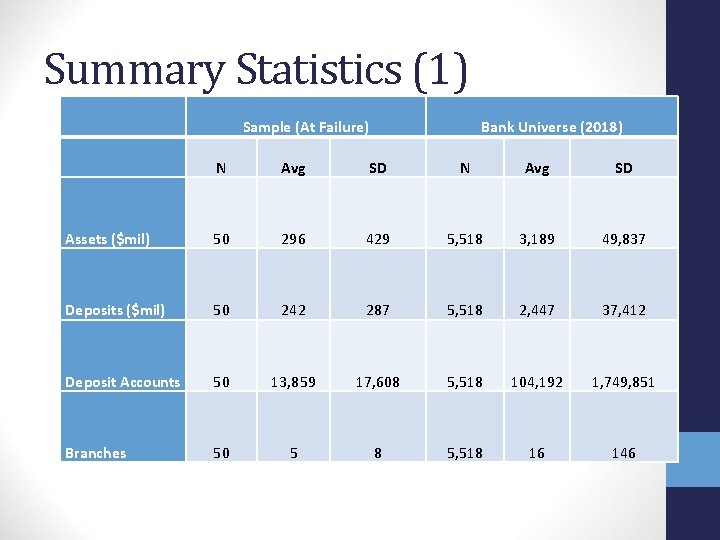
Summary Statistics (1) Sample (At Failure) Bank Universe (2018) N Avg SD Assets ($mil) 50 296 429 5, 518 3, 189 49, 837 Deposits ($mil) 50 242 287 5, 518 2, 447 37, 412 Deposit Accounts 50 13, 859 17, 608 5, 518 104, 192 1, 749, 851 Branches 50 5 8 5, 518 16 146
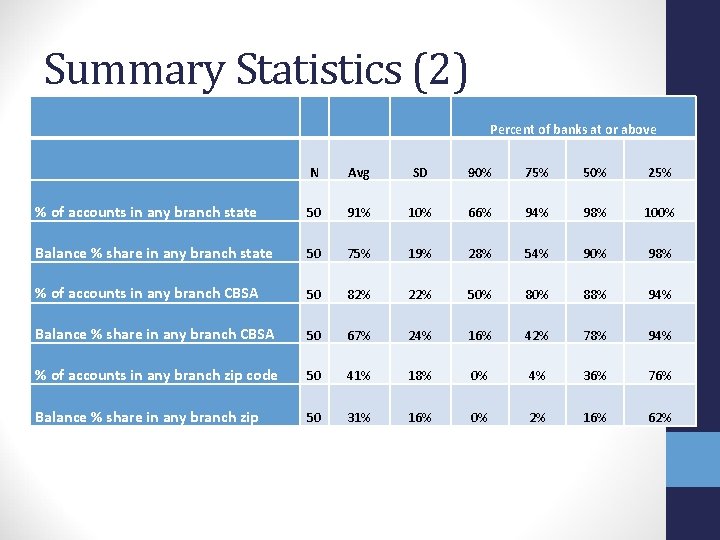
Summary Statistics (2) Percent of banks at or above N Avg SD 90% 75% 50% 25% % of accounts in any branch state 50 91% 10% 66% 94% 98% 100% Balance % share in any branch state 50 75% 19% 28% 54% 90% 98% % of accounts in any branch CBSA 50 82% 22% 50% 88% 94% Balance % share in any branch CBSA 50 67% 24% 16% 42% 78% 94% % of accounts in any branch zip code 50 41% 18% 0% 4% 36% 76% Balance % share in any branch zip 50 31% 16% 0% 2% 16% 62%
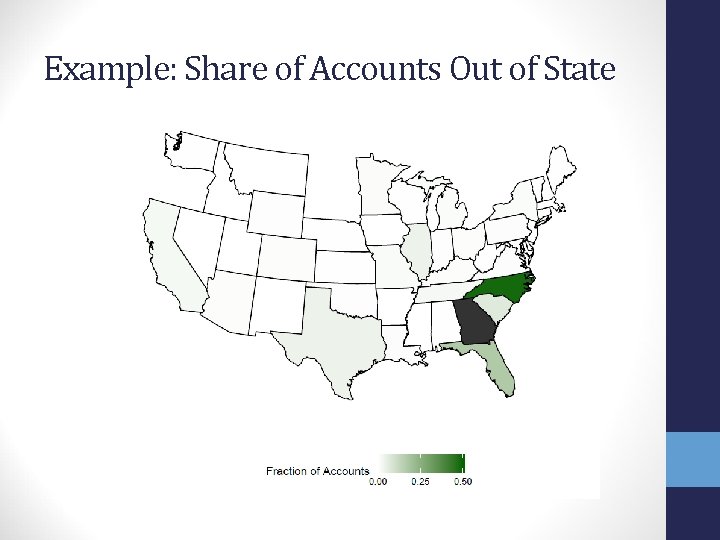
Example: Share of Accounts Out of State
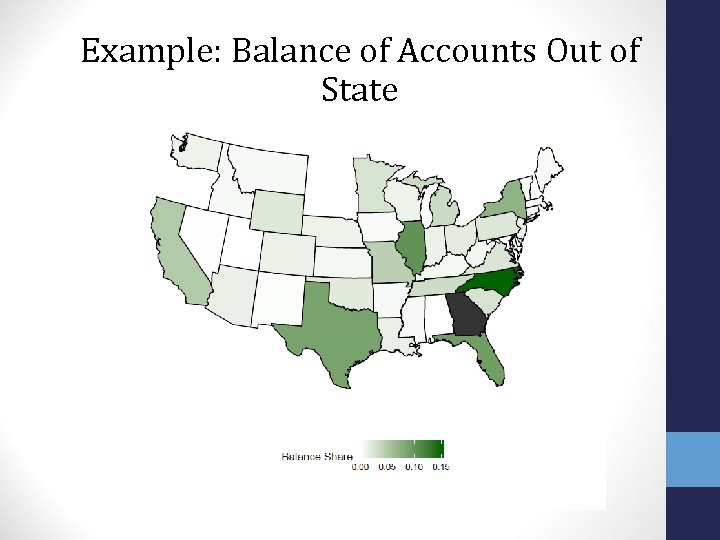
Example: Balance of Accounts Out of State
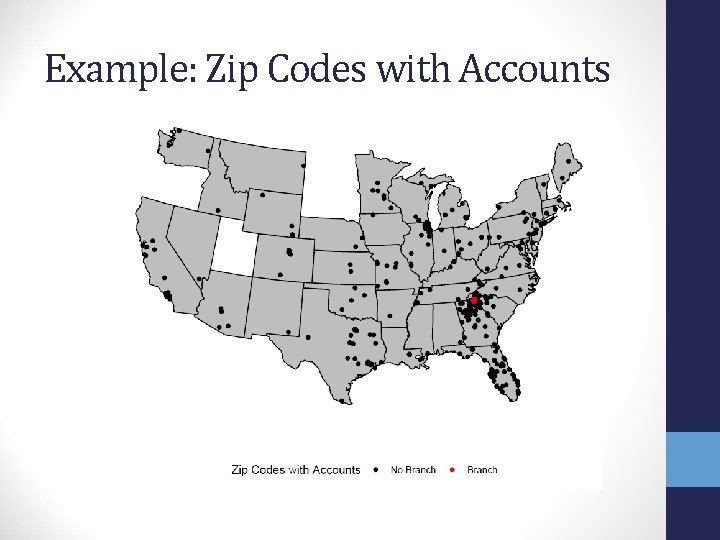
Example: Zip Codes with Accounts
Takeaways from Deposits • Using SOD at the state level to measure depositor location works well on average • Works less well for balances vs. accounts • This suggests that the largest accounts are actually located out of state • However, there is a large spread on state level coverage (i. e. large standard deviation, low min) • More granular aggregation is worse (e. g. zip code level coverage is worse than CBSA which is worse than state level)
Next Steps/Future Work • • • Expand to loan side (HMDA, CRA, failed bank loan data) Expand sample Include demographic information Include more banking data Provide stylized facts about bank geography Suggest tests of findings to conduct on live bank data
- Slides: 17