
BANKING CRISIS MANAGEMENT THE SINGLE RESOLUTION MECHANISM AND
BANKING CRISIS MANAGEMENT: THE SINGLE RESOLUTION MECHANISM AND FIRST CASES Professor Concetta Brescia Morra
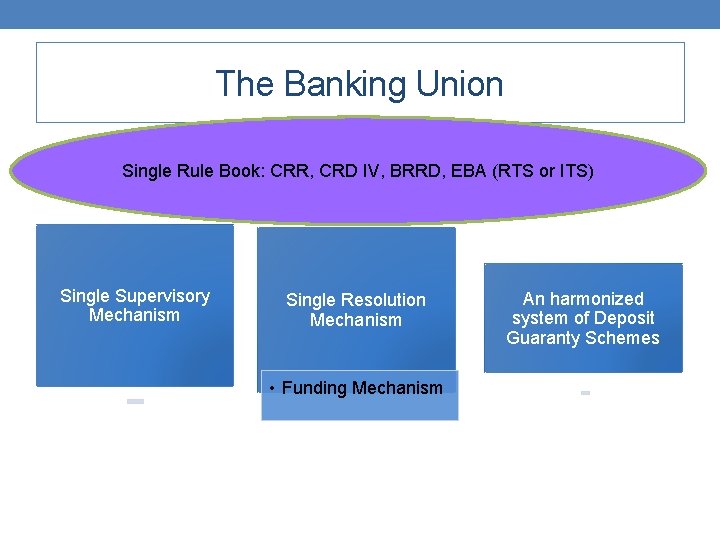
The Banking Union Single Rule Book: CRR, CRD IV, BRRD, EBA (RTS or ITS) Single Supervisory Mechanism Single Resolution Mechanism • Funding Mechanism An harmonized system of Deposit Guaranty Schemes
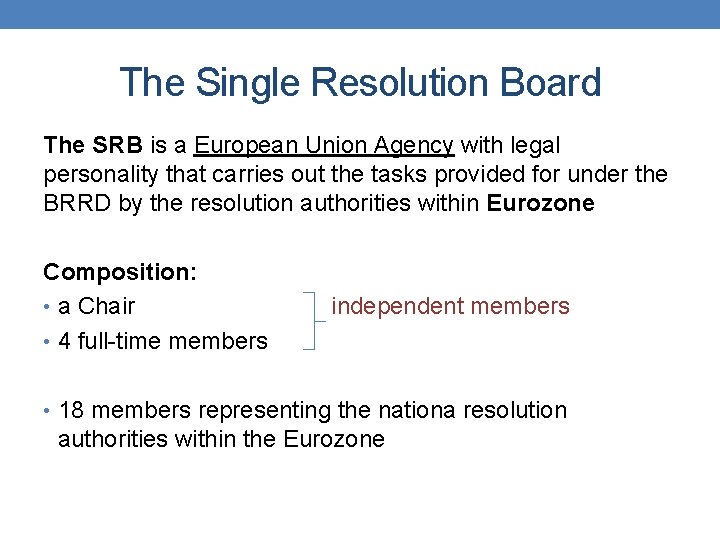
The Single Resolution Board The SRB is a European Union Agency with legal personality that carries out the tasks provided for under the BRRD by the resolution authorities within Eurozone Composition: • a Chair • 4 full-time members independent members • 18 members representing the nationa resolution authorities within the Eurozone
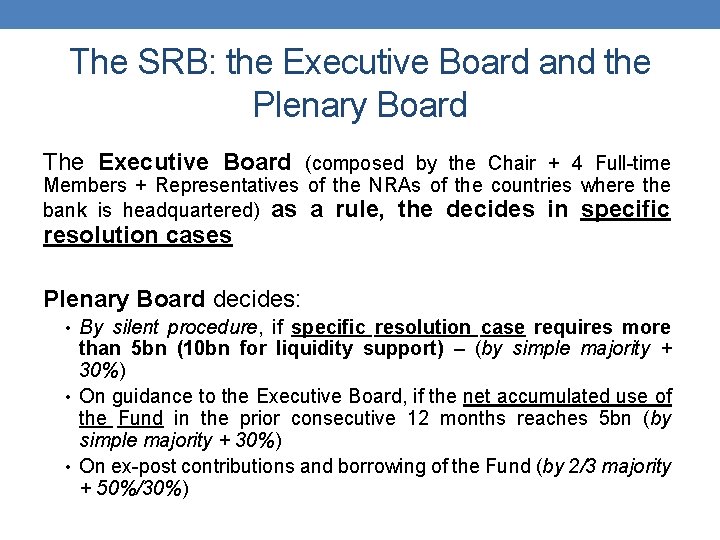
The SRB: the Executive Board and the Plenary Board The Executive Board (composed by the Chair + 4 Full-time Members + Representatives of the NRAs of the countries where the bank is headquartered) as a rule, the decides in specific resolution cases Plenary Board decides: • By silent procedure, if specific resolution case requires more than 5 bn (10 bn for liquidity support) – (by simple majority + 30%) • On guidance to the Executive Board, if the net accumulated use of the Fund in the prior consecutive 12 months reaches 5 bn (by simple majority + 30%) • On ex-post contributions and borrowing of the Fund (by 2/3 majority + 50%/30%)
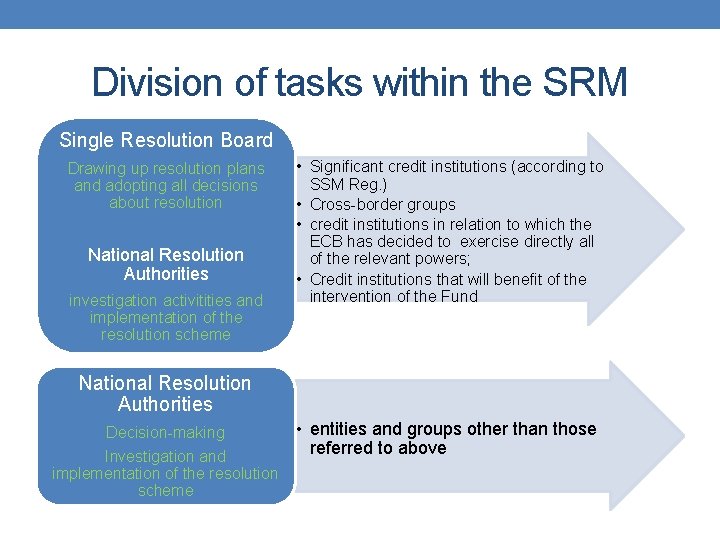
Division of tasks within the SRM Single Resolution Board Drawing up resolution plans and adopting all decisions about resolution National Resolution Authorities investigation activitities and implementation of the resolution scheme • Significant credit institutions (according to SSM Reg. ) • Cross-border groups • credit institutions in relation to which the ECB has decided to exercise directly all of the relevant powers; • Credit institutions that will benefit of the intervention of the Fund National Resolution Authorities Decision-making Investigation and implementation of the resolution scheme • entities and groups other than those referred to above

The consistent functioning of the SRM The SRB • has overall responsibility for the effective and consistent functioning of the SRM; • issue guidelines and general instructions for carrying out tasks entrusted to NRAs; • it is informed in advance by NRAs of the measures they intend to adopt, can give opinions and is updated on their implementation • may request information on the application of the resolution schemes by NRAs and may issue warnings; • may at any time decide to exercise directly all of the relevant powers under the SRM Regulation
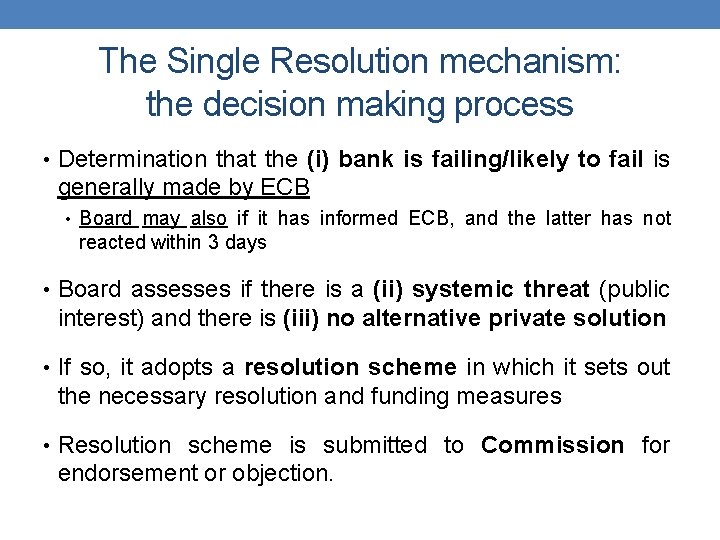
The Single Resolution mechanism: the decision making process • Determination that the (i) bank is failing/likely to fail is generally made by ECB • Board may also if it has informed ECB, and the latter has not reacted within 3 days • Board assesses if there is a (ii) systemic threat (public interest) and there is (iii) no alternative private solution • If so, it adopts a resolution scheme in which it sets out the necessary resolution and funding measures • Resolution scheme is submitted to Commission for endorsement or objection.
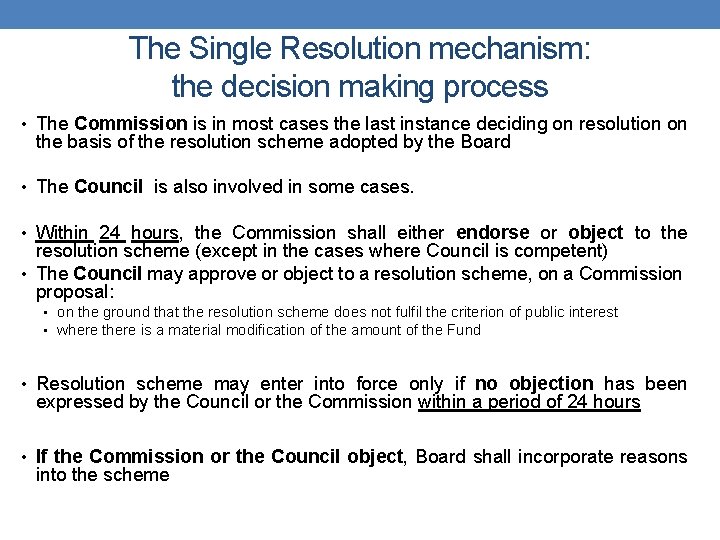
The Single Resolution mechanism: the decision making process • The Commission is in most cases the last instance deciding on resolution on the basis of the resolution scheme adopted by the Board • The Council is also involved in some cases. • Within 24 hours, the Commission shall either endorse or object to the resolution scheme (except in the cases where Council is competent) • The Council may approve or object to a resolution scheme, on a Commission proposal: • on the ground that the resolution scheme does not fulfil the criterion of public interest • where there is a material modification of the amount of the Fund • Resolution scheme may enter into force only if no objection has been expressed by the Council or the Commission within a period of 24 hours • If the Commission or the Council object, Board shall incorporate reasons into the scheme
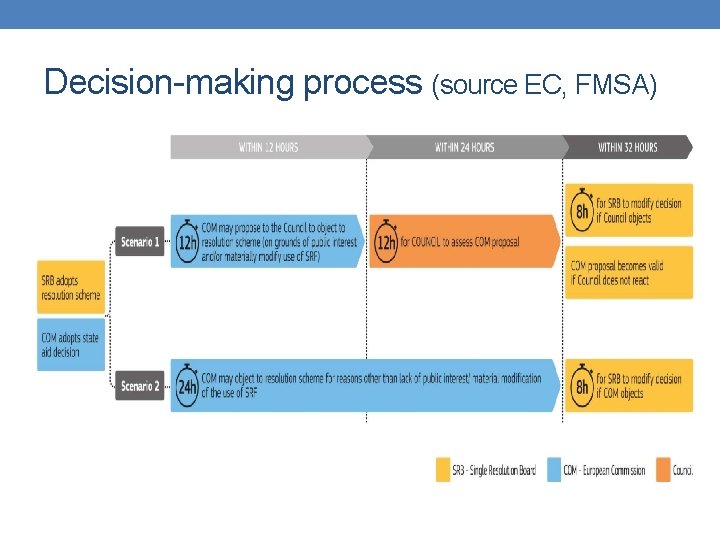
Decision-making process (source EC, FMSA)
Implementation of the resolution scheme • Resolution scheme sets out the resolution tools and provides, where necessary, for the use of a certain amount of the Fund. • Board instructs NRAs to implement the scheme. • Board adopts general instructions to the attention of NRAs.
The Single Resolution Fund • A Single Resolution Fund sourced from the banking sector (all banks in the participating MSs contribute to the Fund) can provide mid-term funding if needed (regulated also by the Intergovernmental Agreement – IGA - dated 14 May 2014) • The fund could borrow from the market (on 8 December 2015, ECOFIN Ministers endorsed a harmonized Loan Facility Agreement). • During a transitional period of 8 years, the Fund comprises national compartments corresponding to each participating MS in the SRM • Target level of the Fund is set at European level (at least 1% of the amount of deposits of all credit institutions authorized in all the participating MS by 2023 – about 55 billions of euro) • Individual contributions are calculated at European level but are collected at national level under the IGA and transferred to the Fund • Contributions comprise a flat part and a risk adjusted part
12 First cases: 4 Italian banks On the 22 of November 2015 the Italian Government and the Bank of Italy put into resolution four banks: Banca Marche, Banca Popolare dell’Etruria e del Lazio, Cassa di risparmio di Ferrara The four banks were already under special administration when were initiated the resolution proceedings These were small or medium-sized banks whose total market share comes to about 1 per cent of systemwide deposits in Italy
13 First cases: 4 Italian banks The solution adopted for the resolution consists of the following elements: 1) For each of the four banks, the “good” and “bad” portions of the balance sheet were separated. 2) All the balance-sheet assets, except loans classed as “bad debts” (i. e. , those whose recovery is most doubtful) were assigned to a “bridge bank”; the latter has on the liability side deposits, current accounts and ordinary bonds of the bank under resolution 3) The injection of capital to the good (bridge) bank was provided by the Resolution Fund. It amounted approximately to 9 per cent of total risk -weighted assets. • The RF was set up according the BRRD provision; it is financed by contributions from the entire Italian banking system; it is administered by the Bank of Italy’s Resolution Unit (the Italian Resolution Authorities).
14 First cases: 4 Italian banks 4) The good bank is provisionally managed, under the supervision of the Resolution Unit, by specially designated administrators (the same person in all banks). The administrators undertake the express commitment to sell the good (bridge) bank rapidly to the highest bidder by transparent, market-based procedures, and reimburse the Resolution Fund with the proceeds. 5) A “bad bank”, common for all four banks (not a licensed bank, in spite of its name) took possession of all the bad debts remaining after the absorption of the losses by • writing off shares and subordinated bonds and, for any excess • drawing on the Resolution Fund (the Resolution Fund’s financial outlays for the four banks amounted to nearly 3. 6 billion. The liquidity required by the Resolution Fund in order to become immediately operational has been advanced by three major banks - Intesa San Paolo, Unicredit and UBI - at market rates and with maximum maturity of 18 months)
15 First cases: 4 Italian banks 6) The original four banks become residual empty boxes that were immediately liquidated 7) The good banks will have continued the activity of the old ones having been cleaned and recapitalized (currently they have been sold in 2017; 3 of them were acquired by UBI bank; the last one was sold to Banca Popolare dell’Emilia Romagna for 1 euro) 8) The bad bank will cease to exist as soon as it will have sold or recovered the bad loans 9) The bank’s cumulative losses, valued in a very conservative way, were absorbed first by shareholders and subordinated bonds (burden sharing principle was fully respected)
16 First cases: Banco Popular • The ECB decided that Banco Popular Español S. A. (Banco Popular) was “failing or likely to fail” on 6 June 2017 and notified the SRB accordingly. • The SRB and the Spanish National Resolution Authority – FROB – have decided that was in the public interest to put into resolution the bank • The resolution scheme entered into force, following the endorsement by the European Commission, to protect all depositors of Banco Popular and to ensure financial stability avoiding the use of public funds
17 First cases: Banco Popular • The resolution scheme provided for the transfer of all shares and capital instruments of Banco Popular to Banco Santander S. A (Santander) • the shares, including the entire business of Banco Popular and its subsidiaries, have been transferred to Santander Group as of 7 June 2017; the price of the sale was 1 euro • This means that Banco Popular could have continued to operate under normal business conditions as a solvent and liquid member of the Santander Group with immediate effect
18 First cases: BPVI and Veneto Banca • The ECB in its capacity as supervisory authority, on 23 June 2017 declared that Banca Popolare di Vicenza (BPVI) and Veneto Banca were failing or likely to fail and • The SRB, the competent resolution authority, decided that resolution action was not warranted in the public interest in either case • The European Commission approved, under EU rules on State Aids, Italian measures to facilitate the liquidation of BPVI and Veneto Banca under national insolvency law • These measures involved the sale of some of the two banks' businesses to be integrated into Intesa Sanpaolo.
19 First cases: BPVI and Veneto Banca • The SRB assessed that, while the conditions for resolution action of Article 18(1)(a) and (b) of Regulation (EU) No 806/2014 (the “SRMR”) were met, the condition of Article 18(1)(c) was not satisfied and accordingly the Bank will be subject to winding up under Italian insolvency proceedings and the Banca d’Italia, in its capacity as National Resolution Authority will implement the SRB decision. • Article 18(1)(a) of the SRMR: “Failing or likely to fail” was confirmed by the ECB on 23 June 2017 • Article 18(1)(b) of the SRMR: “Alternative private measures and supervisory actions”. The SRB concluded that no such measures or actions could have prevented the failure of the Bank within a reasonable timeframe. The SRB reached this conclusion taking into account several elements, including the Bank’s inability to raise sufficient additional private capital, the weaknesses and lack of credibility of its business plans, and the ineffectiveness of the application of the power to write down or convert the Bank’s capital instruments to remedy the breach of the capital requirements.
20 First cases: BPVI and Veneto Banca Article 18(1)(c) of the SRMR: “Public interest”. The SRB concluded that, given the particular characteristics of the Bank and its specific financial and economic situation, resolution action with respect to the Bank was not necessary in the public interest, in accordance with Article 18(1)(c) in conjunction with Article 18(5) of the SRMR. This conclusion is based on the following grounds: • The functions performed by the Bank, e. g. deposit-taking, lending activities and payment services, were not critical since they are provided to a limited number of third parties and can be replaced in an acceptable manner and within a reasonable timeframe; • The failure of the Bank was not likely to result in significant adverse effects on financial stability taking into account, in particular, the low financial and operational interconnections with other financial institutions; and
21 First cases: BPVI and Veneto Banca • Normal Italian insolvency proceedings would have achieved the resolution objectives to the same extent as resolution, since such proceedings would also ensure a comparable degree of protection for depositors, investors, other customers, clients’ funds and assets (The Italian jurisdiction provides for special insolvency proceedings for banks since 1936) • this decision comply with the BRRD general principles: • A failing institution should in principle be liquidated under normal insolvency proceedings. • However, liquidation under normal insolvency proceedings might jeopardise financial stability, interrupt the provision of critical functions, and affect the protection of depositors. • In such a case it is highly likely that there would be a public interest in placing the institution under resolution and applying resolution tools rather than resorting to normal insolvency proceedings
22 First cases: BPVI and Veneto Banca • On 24 June 2017, Italy notified to the Commission its plans to grant State aid to wind-down BPVI and Veneto Banca. The measures will have enabled the sale of parts of the two banks' activities to Intesa, including the transfer of employees. • In particular, the Italian State granted the following measures: • Cash injections of about € 4. 785 billion; and • State guarantees of a maximum of about € 12 billion, notably on Intesa's financing of the liquidation mass. The State guarantees would be called upon notably, if the liquidation mass is insufficient to pay back Intesa for its financing of the liquidation mass. • Both guarantees and cash injections are backed up by the Italian State's senior claims on the assets in the liquidation mass. • Correspondingly, it is likely that the net costs to the Italian State will be much lower than the nominal amounts of the measures provided.
23 First cases: BPVI and Veneto Banca • The Commission found these measures to be in line with EU State aid rules (2013 Banking Communication) because: • Existing shareholders and subordinated debt holders have fully contributed to the costs, reducing the cost of the intervention for the Italian State. • Both aid recipients, BPVI and Banca Veneto, will be wound up in an orderly fashion and exit the market, while the transferred activities will be restructured and significantly downsized by Intesa, which in combination will limit distortions of competition arising from the aid. • The subsequent deep integration by Intesa will return the sold parts to viability. The Commission also confirmed that the measures do not constitute aid to Intesa, because it was selected after an open, fair and transparent sales process, fully managed by Italian authorities, ensuring that the activities were sold at the best offer available.
- Slides: 23