
Banking and Financial Institutions Guy Hargreaves ACF104 Wechat
Banking and Financial Institutions Guy Hargreaves ACF-104 Wechat: Guyhargreaves
Recap of yesterday �Understand commercial bank balance sheets and general principles of bank balance sheet management �Compare off and on balance sheet products and structures �Understand key considerations for the practice of good banking 2
The business of commercial banking
Goals of today �Appreciate the key drivers to the business of commercial banking �Review how commercial banks generate financial returns �Describe the key metrics used in commercial bank financial management 4
Theory in practice �Recall commercial banks perform three basic high level functions: 1. Size transformation 2. Maturity transformation 3. Risk transformation �This is theory – how in practice to commercial banks actually generate net profit? 5
Size transformation �For a commercial bank this means: � Estimating market appetite for credit � Underwriting and distributing syndicated loans in size � Using balance sheet to take on the liquidity risk of making a loan larger than its deposit base �Customers want loans and other banking products and services tailored to their own size 6
Maturity transformation �For a commercial bank this means: � Using its “Capital Structure” to manage maturity risk � Underwriting balance sheet maturity “Gaps” �Very long dated maturity demands can be challenging for commercial banks � Banks prefer 3 -5 year maturities for loans 7
Risk transformation �Savers and depositors want to invest in diversified portfolios of credit risk � $100 invested in a single “A” rated corporate can have very a different investment outcome compared with $1 invested in each of 100 “A” rated corporates � Bank portfolios are very diverse which means savers can have confidence in banks � Capital regulations and access to central bank liquidity also helps risk transformation 8
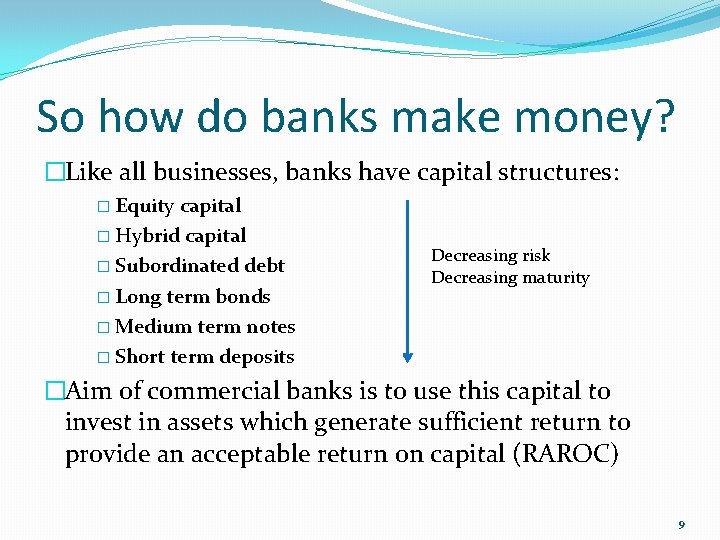
So how do banks make money? �Like all businesses, banks have capital structures: � Equity capital � Hybrid capital � Subordinated debt � Long term bonds � Medium term notes � Short term deposits Decreasing risk Decreasing maturity �Aim of commercial banks is to use this capital to invest in assets which generate sufficient return to provide an acceptable return on capital (RAROC) 9
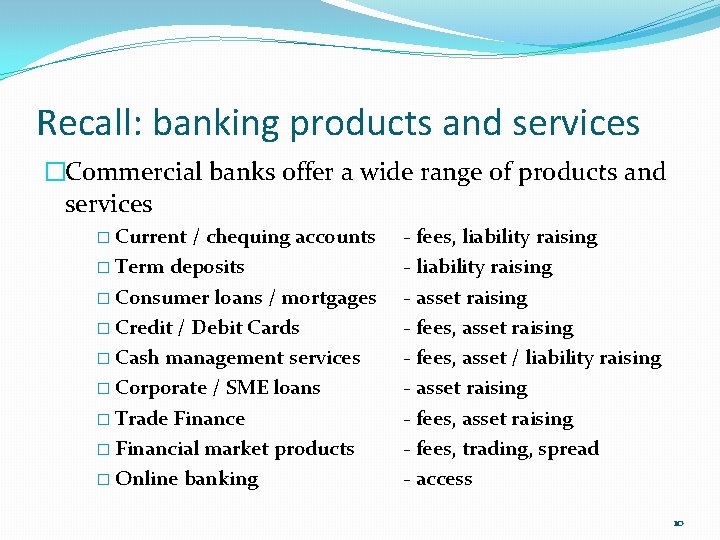
Recall: banking products and services �Commercial banks offer a wide range of products and services � Current / chequing accounts � Term deposits � Consumer loans / mortgages � Credit / Debit Cards � Cash management services � Corporate / SME loans � Trade Finance � Financial market products � Online banking - fees, liability raising - asset raising - fees, asset / liability raising - asset raising - fees, trading, spread - access 10
The cost of capital �The cost of commercial bank capital is an important input into the economics of the business of banking �Weighted Average Cost of Capital (WACC) is a closely managed metric for banks � Banks with high WACC need to invest in higher returning assets to generate acceptable returns � Higher returning assets are riskier � Riskier assets require more regulatory capital to be held => can become circular 11
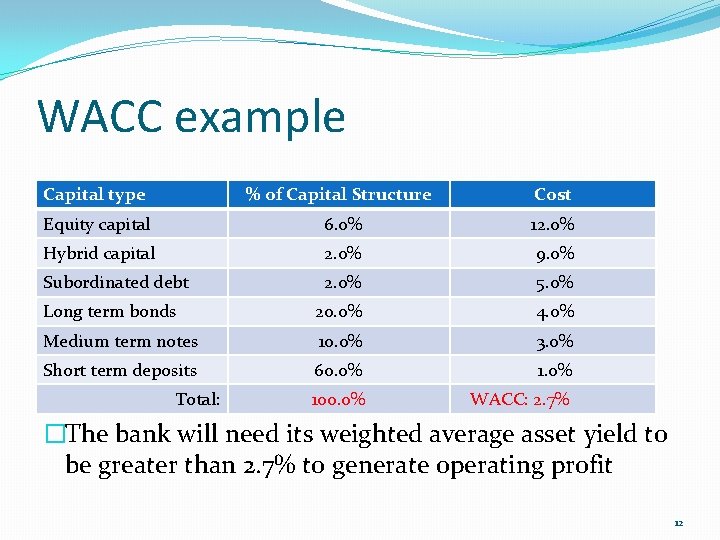
WACC example Capital type % of Capital Structure Cost Equity capital 6. 0% 12. 0% Hybrid capital 2. 0% 9. 0% Subordinated debt 2. 0% 5. 0% Long term bonds 20. 0% 4. 0% Medium term notes 10. 0% 3. 0% Short term deposits 60. 0% 100. 0% WACC: 2. 7% Total: �The bank will need its weighted average asset yield to be greater than 2. 7% to generate operating profit 12
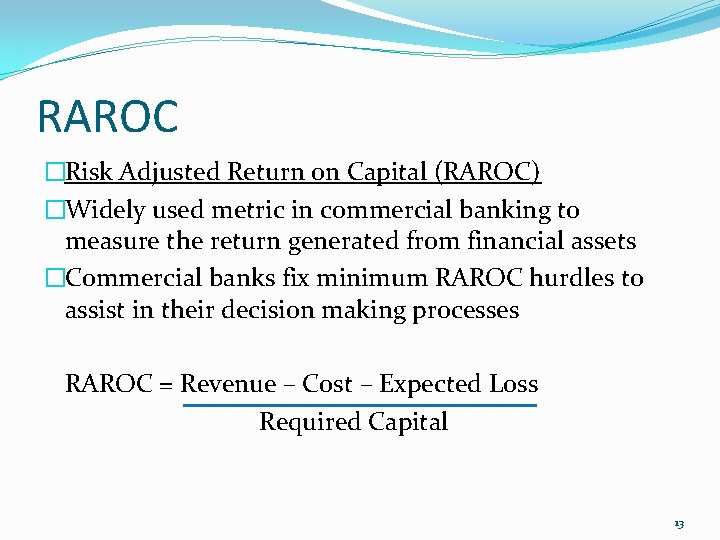
RAROC �Risk Adjusted Return on Capital (RAROC) �Widely used metric in commercial banking to measure the return generated from financial assets �Commercial banks fix minimum RAROC hurdles to assist in their decision making processes RAROC = Revenue – Cost – Expected Loss Required Capital 13
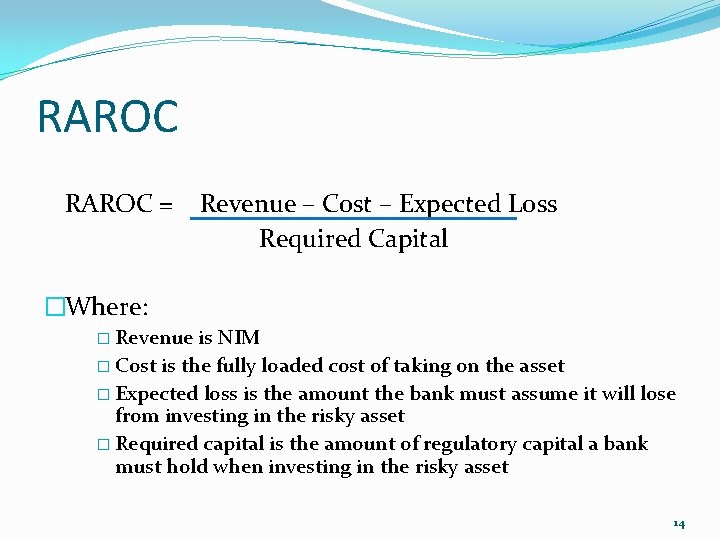
RAROC = Revenue – Cost – Expected Loss Required Capital �Where: � Revenue is NIM � Cost is the fully loaded cost of taking on the asset � Expected loss is the amount the bank must assume it will lose from investing in the risky asset � Required capital is the amount of regulatory capital a bank must hold when investing in the risky asset 14
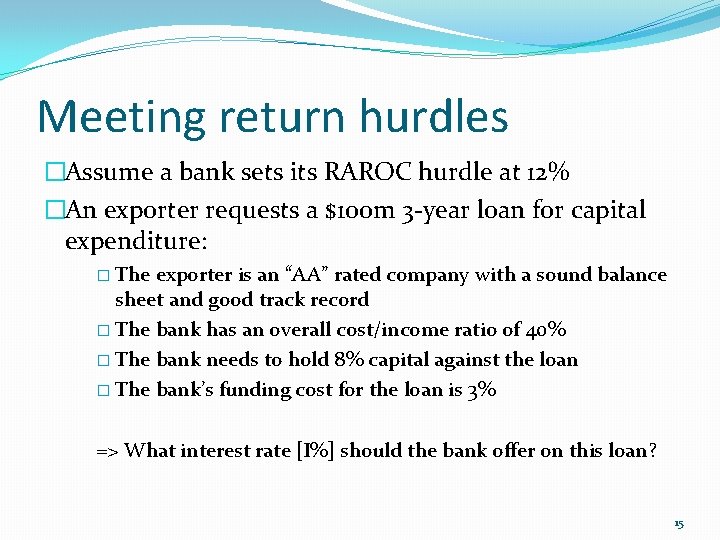
Meeting return hurdles �Assume a bank sets its RAROC hurdle at 12% �An exporter requests a $100 m 3 -year loan for capital expenditure: � The exporter is an “AA” rated company with a sound balance sheet and good track record � The bank has an overall cost/income ratio of 40% � The bank needs to hold 8% capital against the loan � The bank’s funding cost for the loan is 3% => What interest rate [I%] should the bank offer on this loan? 15
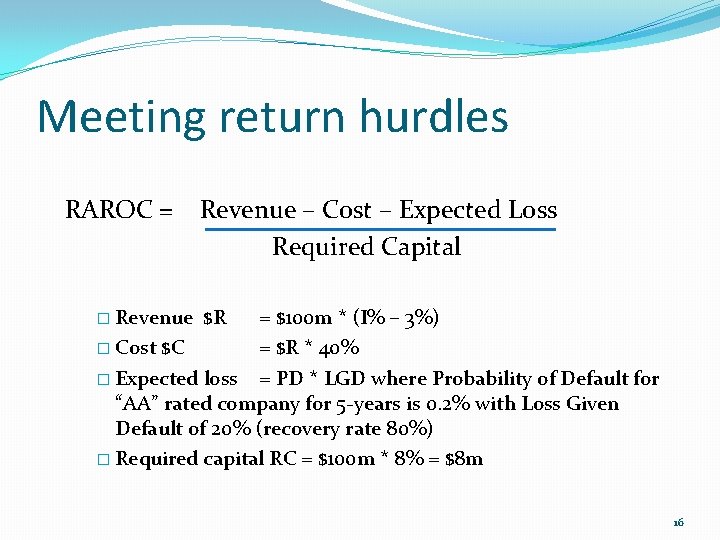
Meeting return hurdles RAROC = � Revenue – Cost – Expected Loss Required Capital $R = $100 m * (I% – 3%) � Cost $C = $R * 40% � Expected loss = PD * LGD where Probability of Default for “AA” rated company for 5 -years is 0. 2% with Loss Given Default of 20% (recovery rate 80%) � Required capital RC = $100 m * 8% = $8 m 16
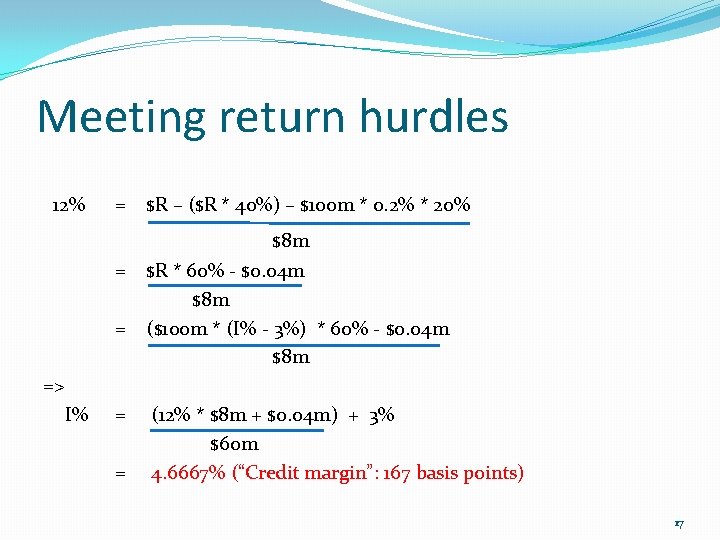
Meeting return hurdles 12% = $R – ($R * 40%) – $100 m * 0. 2% * 20% $8 m = $R * 60% - $0. 04 m $8 m = ($100 m * (I% - 3%) * 60% - $0. 04 m $8 m => I% = = (12% * $8 m + $0. 04 m) + 3% $60 m 4. 6667% (“Credit margin”: 167 basis points) 17
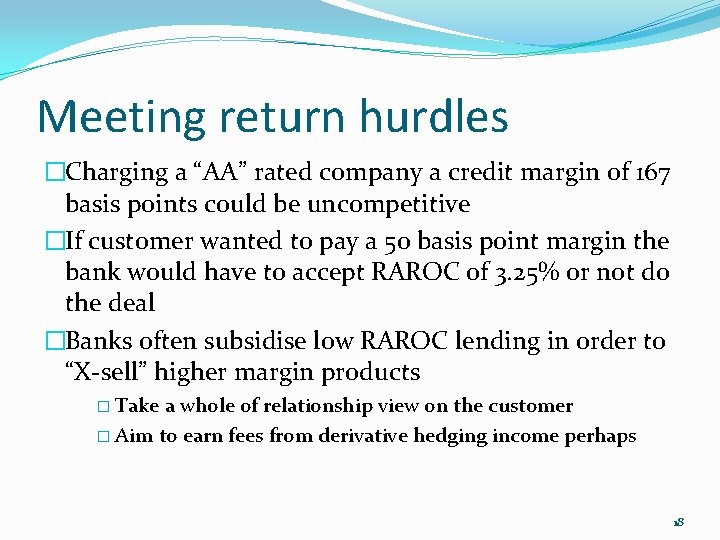
Meeting return hurdles �Charging a “AA” rated company a credit margin of 167 basis points could be uncompetitive �If customer wanted to pay a 50 basis point margin the bank would have to accept RAROC of 3. 25% or not do the deal �Banks often subsidise low RAROC lending in order to “X-sell” higher margin products � Take a whole of relationship view on the customer � Aim to earn fees from derivative hedging income perhaps 18
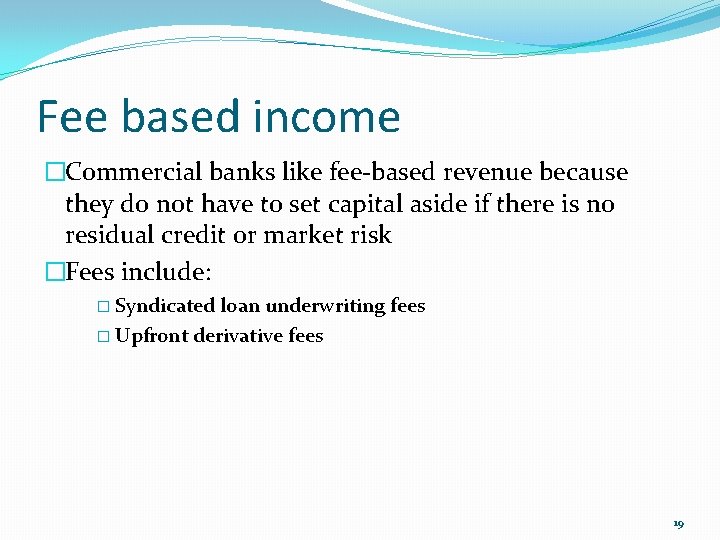
Fee based income �Commercial banks like fee-based revenue because they do not have to set capital aside if there is no residual credit or market risk �Fees include: � Syndicated loan underwriting fees � Upfront derivative fees 19
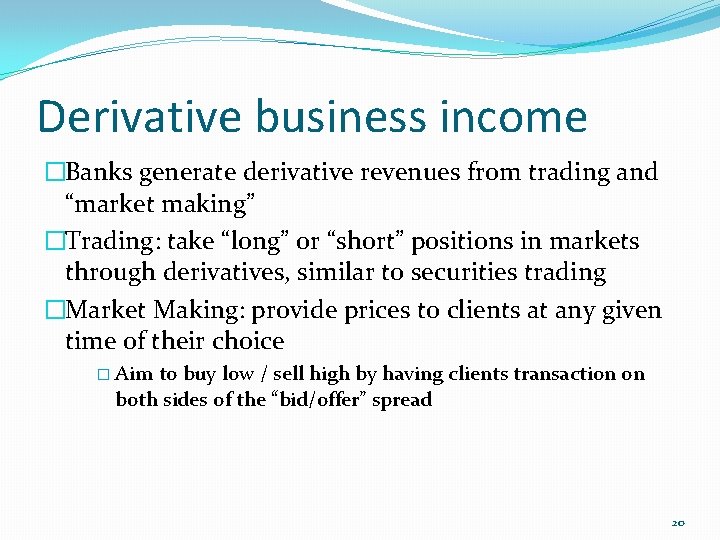
Derivative business income �Banks generate derivative revenues from trading and “market making” �Trading: take “long” or “short” positions in markets through derivatives, similar to securities trading �Market Making: provide prices to clients at any given time of their choice � Aim to buy low / sell high by having clients transaction on both sides of the “bid/offer” spread 20
Foreign Exchange income �Bank FX divisions generate income from trading and market making �FX markets are extremely efficient and bid/offer spreads are very narrow �Volumes are HUGE though! �Complex FX derivatives are high margin generators for banks �FX market was first to embrace e-markets platforms and many customers can plug directly into markets these days 21
The retail banking business �The principles behind making money in the retail business are similar to wholesale banking �Retail bankers are allocated capital and look to make loans, funded by deposits, to generate acceptable RAROC �Portfolio diversification is easier given there are many smaller customers in the portfolio 22
The mortgage business �By far the largest retail commercial banking business in many economies �Mortgage NIM often in the range of 1 -3% �RAROC, cost/income, efficiency are key drivers �Mortgage product is very similar across many banks 23
Credit and debit cards �Credit cards offer the holder an unsecured line of credit that can be drawn to pay for goods and services �Debit cards are accounts that must have positive fund balances before they can used to pay for goods and services �Retailers that accept credit cards charged fees of up to 3% for each transaction �Customers that don’t repay their cards monthly often subject to huge interest rates eg 16% 24
Trade finance �Trade finance products are typically short term, uncommitted and secured � RAROC is high because banks don’t have to set aside capital against “undrawn commitments” � Off-balance sheet products like Letters of Credit (LCs) can have favourable capital treatment � Secured against trade flows eg crude oil cargos (LGD significantly reduced �Economics of trade finance often highly reliant on commodity prices � With crude prices halving, if volumes remain unchanged trade finance volumes will half 25
Key bank financial metrics �Loan / Deposit ratio – measure of how much of banks loan book is being funded by deposits �Tier 1 ratio – ratio of permanent capital to “risk weighted assets” (RWAs) �Leverage Ratio – ratio of Tier 1 capital to total assets �Liquidity Coverage Ratio – ratio of outflows over a critical timeframe (eg 30 days) to high quality liquid assets �Net Stable Funding Ratio – ratio of “stable funding” to long term assets �Efficiency ratio – equivalent to the operating margin – ratio of operating revenue (EBIT) to total revenue �ROE or ROA – traditional return metrics �Credit quality – loan loss ratios 26
- Slides: 26