
Bank of Papua New Guinea BPNG Nonbank Supervision
Bank of Papua New Guinea (BPNG) Non-bank Supervision Practices and Regulation presented by Boas Irima, Unit Manager, Banks & Finance Companies Unit Banking Supervision Department, BPNG for Pacific Financial Inclusion Working Group Meeting 26 January 2012

Presentation Outline q q Overview of PNG Financial System BPNG Organisation Structure Supervisory Approach The Way Ahead

Overview of PNG Financial System q Central Banking Act 1973, as amended in 2000, gives BPNG power to formulate and implement monetary policy, regulate and supervise the financial system and ensure an efficient national and international payments system. q BPNG supervises all depository corporations; commercial banks, financial companies, microfinance institutions, savings and loans societies, and financial corporations (i. e. superannuation funds and life insurance companies and brokers).
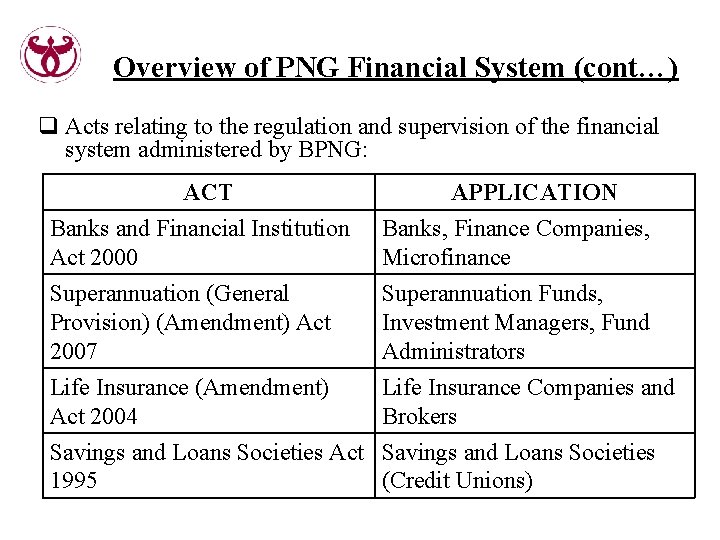
Overview of PNG Financial System (cont…) q Acts relating to the regulation and supervision of the financial system administered by BPNG: ACT Banks and Financial Institution Act 2000 APPLICATION Banks, Finance Companies, Microfinance Superannuation (General Provision) (Amendment) Act 2007 Superannuation Funds, Investment Managers, Fund Administrators Life Insurance (Amendment) Act 2004 Life Insurance Companies and Brokers Savings and Loans Societies Act Savings and Loans Societies 1995 (Credit Unions)
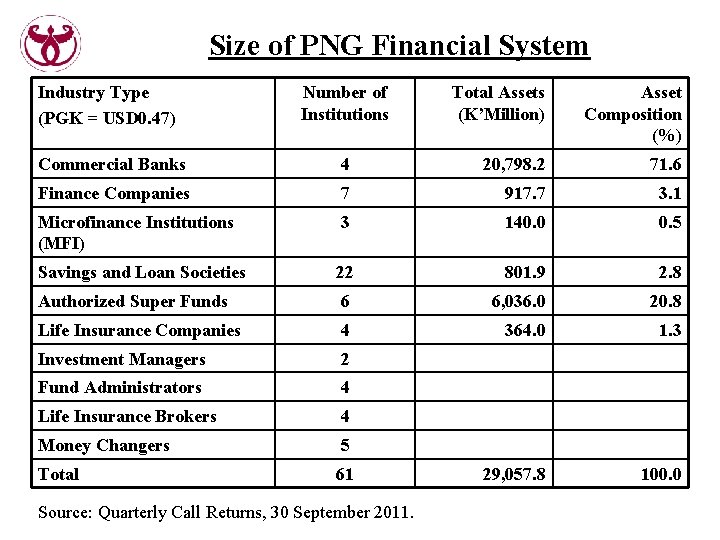
Size of PNG Financial System Industry Type (PGK = USD 0. 47) Number of Institutions Total Assets (K’Million) Asset Composition (%) Commercial Banks 4 20, 798. 2 71. 6 Finance Companies 7 917. 7 3. 1 Microfinance Institutions (MFI) 3 140. 0 0. 5 Savings and Loan Societies 22 801. 9 2. 8 Authorized Super Funds 6 6, 036. 0 20. 8 Life Insurance Companies 4 364. 0 1. 3 Investment Managers 2 Fund Administrators 4 Life Insurance Brokers 4 Money Changers 5 Total 61 29, 057. 8 100. 0 Source: Quarterly Call Returns, 30 September 2011.
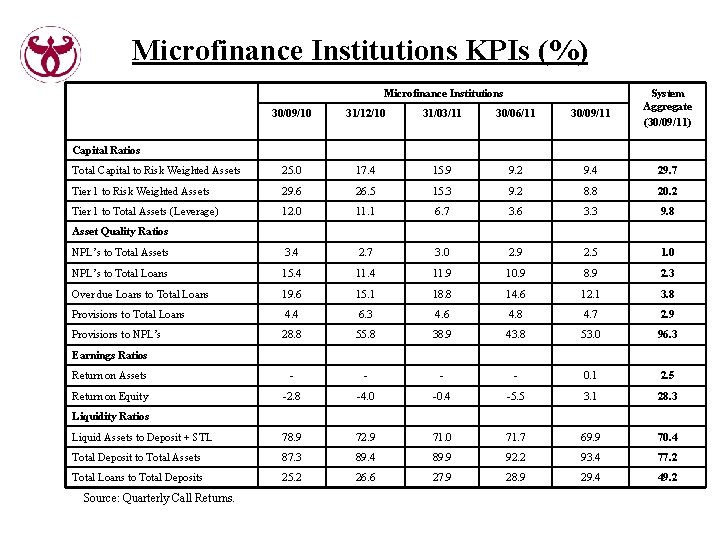
Microfinance Institutions KPIs (%) Microfinance Institutions System Aggregate (30/09/11) 30/09/10 31/12/10 31/03/11 30/06/11 30/09/11 Total Capital to Risk Weighted Assets 25. 0 17. 4 15. 9 9. 2 9. 4 29. 7 Tier 1 to Risk Weighted Assets 29. 6 26. 5 15. 3 9. 2 8. 8 20. 2 Tier 1 to Total Assets (Leverage) 12. 0 11. 1 6. 7 3. 6 3. 3 9. 8 NPL’s to Total Assets 3. 4 2. 7 3. 0 2. 9 2. 5 1. 0 NPL’s to Total Loans 15. 4 11. 9 10. 9 8. 9 2. 3 Over due Loans to Total Loans 19. 6 15. 1 18. 8 14. 6 12. 1 3. 8 Provisions to Total Loans 4. 4 6. 3 4. 6 4. 8 4. 7 2. 9 Provisions to NPL’s 28. 8 55. 8 38. 9 43. 8 53. 0 96. 3 Return on Assets - - 0. 1 2. 5 Return on Equity -2. 8 -4. 0 -0. 4 -5. 5 3. 1 28. 3 Liquid Assets to Deposit + STL 78. 9 72. 9 71. 0 71. 7 69. 9 70. 4 Total Deposit to Total Assets 87. 3 89. 4 89. 9 92. 2 93. 4 77. 2 Total Loans to Total Deposits 25. 2 26. 6 27. 9 28. 9 29. 4 49. 2 Capital Ratios Asset Quality Ratios Earnings Ratios Liquidity Ratios Source: Quarterly Call Returns.
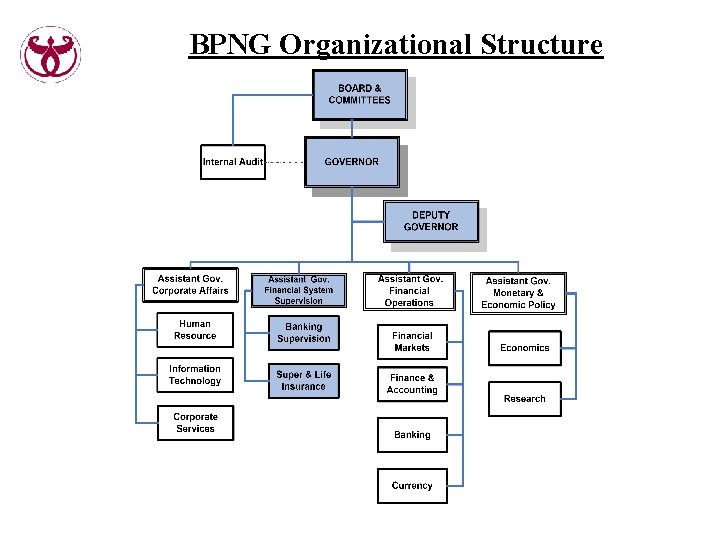
BPNG Organizational Structure
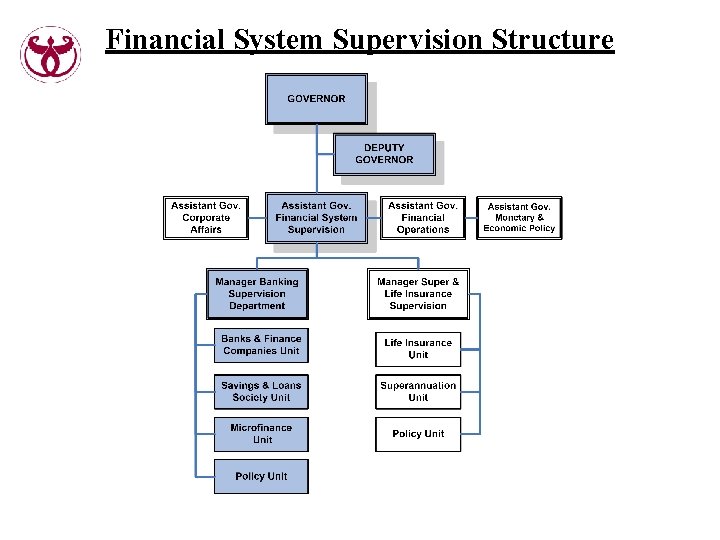
Financial System Supervision Structure
Supervisory Approach Following financial sector reform in 2000, BPNG introduced: q Stringent supervision of financial institutions by enforcing the Acts q Issuance of a number of prudential standards, directives and regulations under the Acts q Enhance supervisory techniques of supervised institutions
Supervisory Approach (cont…) Two Supervisory Methods: q On-site Inspections i. Assessment of risk during visits to supervised institutions, covering liquidity, operational, credit and market risks. Include review of risk governance, board, management, strategy/planning and capital ii. Determination of appropriate supervisory response iii. Issue Report of Examination (ROE)
Supervisory Approach (cont…) q Off-site Monitoring i. Assessment of risk through information received from supervised institutions such as financial returns, correspondences and discussions at prudential meetings. Include review of supervised institutions responses to matters requiring attention from on-site inspections ii. Determination of appropriate supervisory response iii. Follow through on matters requiring attention until these are closed off In addition BPNG also does: q q Licensing and Policy Work Enforcement and Compliance
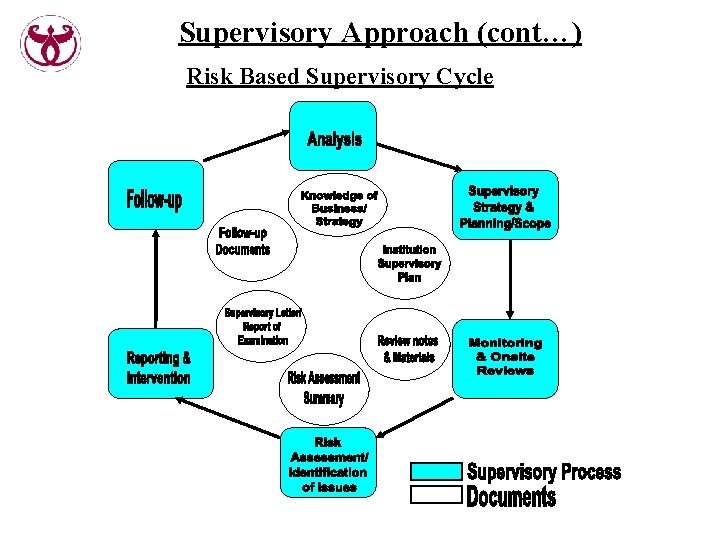
Supervisory Approach (cont…) Risk Based Supervisory Cycle
Supervisory Approach (cont…) CAMELS rating system used to rate financial institutions, an acronym for: q C – Capital Adequacy q A – Asset Quality q M – Management q E – Earnings q L – Liquidity q S – Sensitivity to Market Risk A rating between 1 -5 is used on each acronym as well as overall with number 1=Very Good to 5 = Poor.
Supervisory Approach (cont…) Ratings assigned, used for: q Off-site monitoring of trends and severity of problems q Prioritising on-site inspections Eg. On-site reviews are done every two years for well managed institutions (CAMELS 1 -2 rated institutions). For institutions rated 3 -5, reviews are done more frequently q Determining the appropriate supervisory responses and enforcement actions
The Way Ahead q Explore separate regulatory framework for MFIs q Microfinance unit to eventually take on MFI supervision q Review of the Savings and Loans Societies Act

Questions? ? ?
- Slides: 16