
Bandwidth Avoiding Stencil Computations By Kaushik Datta Sam
Bandwidth Avoiding Stencil Computations By Kaushik Datta, Sam Williams, Kathy Yelick, and Jim Demmel, and others Berkeley Benchmarking and Optimization Group UC Berkeley March 13, 2008 http: //bebop. cs. berkeley. edu kdatta@cs. berkeley. edu
Outline • • • Stencil Introduction Grid Traversal Algorithms Serial Performance Results Parallel Performance Results Conclusion

Outline • • • Stencil Introduction Grid Traversal Algorithms Serial Performance Results Parallel Performance Results Conclusion
What are stencil codes? • For a given point, a stencil is a pre-determined set of nearest neighbors (possibly including itself) • A stencil code updates every point in a regular grid with a constant weighted subset of its neighbors (“applying a stencil”) 2 D Stencil 3 D Stencil
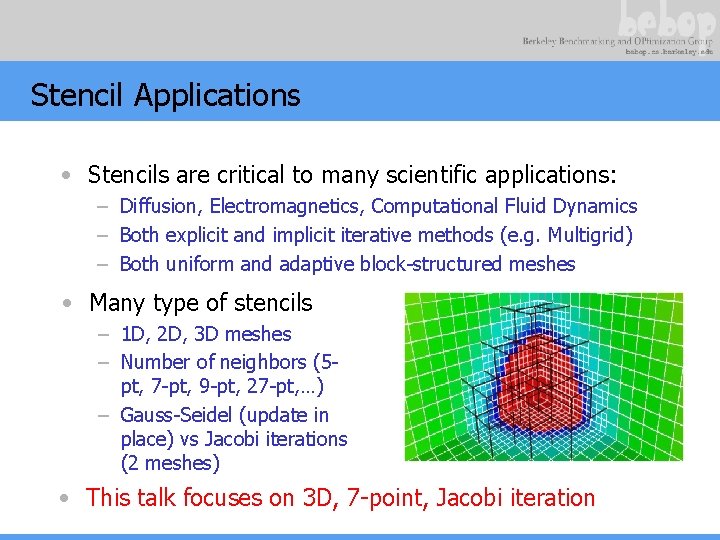
Stencil Applications • Stencils are critical to many scientific applications: – Diffusion, Electromagnetics, Computational Fluid Dynamics – Both explicit and implicit iterative methods (e. g. Multigrid) – Both uniform and adaptive block-structured meshes • Many type of stencils – 1 D, 2 D, 3 D meshes – Number of neighbors (5 pt, 7 -pt, 9 -pt, 27 -pt, …) – Gauss-Seidel (update in place) vs Jacobi iterations (2 meshes) • This talk focuses on 3 D, 7 -point, Jacobi iteration
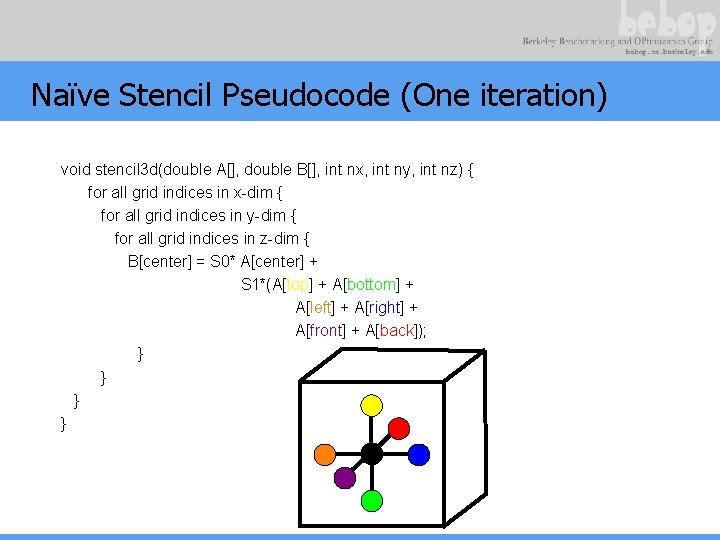
Naïve Stencil Pseudocode (One iteration) void stencil 3 d(double A[], double B[], int nx, int ny, int nz) { for all grid indices in x-dim { for all grid indices in y-dim { for all grid indices in z-dim { B[center] = S 0* A[center] + S 1*(A[top] + A[bottom] + A[left] + A[right] + A[front] + A[back]); } }
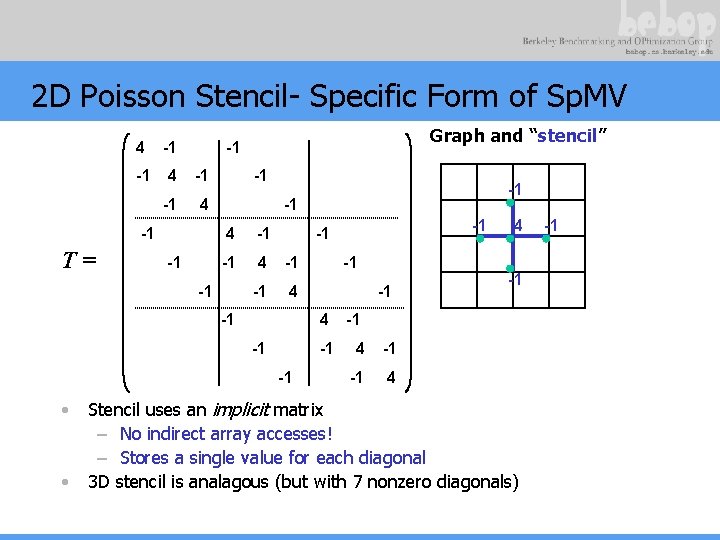
2 D Poisson Stencil- Specific Form of Sp. MV 4 -1 -1 4 -1 T= Graph and “stencil” -1 -1 4 -1 -1 -1 • -1 4 -1 -1 4 Stencil uses an implicit matrix – No indirect array accesses! – Stores a single value for each diagonal 3 D stencil is analagous (but with 7 nonzero diagonals) -1
Reduce Memory Traffic! • Stencil performance usually limited by memory bandwidth • Goal: Increase performance by minimizing memory traffic – Even more important for multicore! • Concentrate on getting reuse both: – within an iteration – across iterations (Ax, A 2 x, …, Akx) • Only interested in final result

Outline • • • Stencil Introduction Grid Traversal Algorithms Serial Performance Results Parallel Performance Results Conclusion
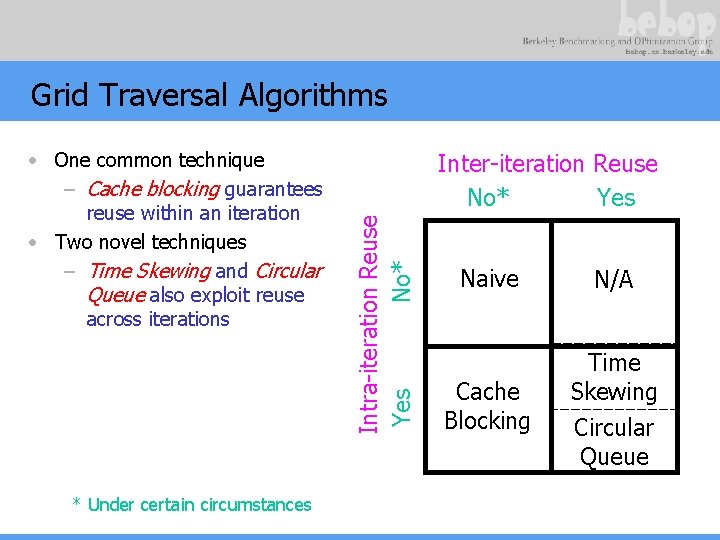
Grid Traversal Algorithms * Under certain circumstances Inter-iteration Reuse No* Yes Intra-iteration Reuse Yes No* • One common technique – Cache blocking guarantees reuse within an iteration • Two novel techniques – Time Skewing and Circular Queue also exploit reuse across iterations Naive N/A Cache Blocking Time Skewing Circular Queue

Grid Traversal Algorithms * Under certain circumstances Inter-iteration Reuse No* Yes Intra-iteration Reuse Yes No* • One common technique – Cache blocking guarantees reuse within an iteration • Two novel techniques – Time Skewing and Circular Queue also exploit reuse across iterations Naive N/A Cache Blocking Time Skewing Circular Queue
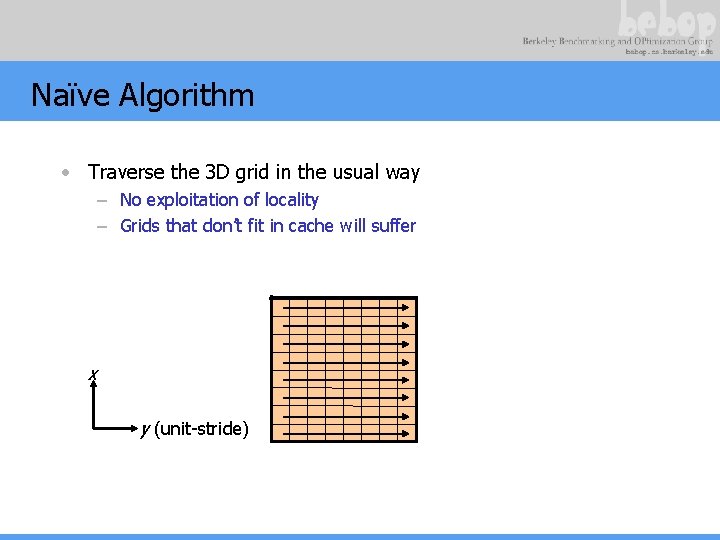
Naïve Algorithm • Traverse the 3 D grid in the usual way – No exploitation of locality – Grids that don’t fit in cache will suffer x y (unit-stride)
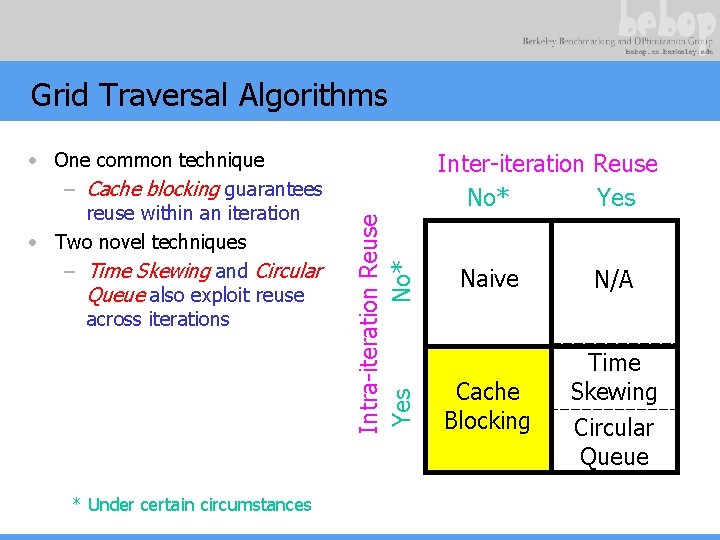
Grid Traversal Algorithms * Under certain circumstances Inter-iteration Reuse No* Yes Intra-iteration Reuse Yes No* • One common technique – Cache blocking guarantees reuse within an iteration • Two novel techniques – Time Skewing and Circular Queue also exploit reuse across iterations Naive N/A Cache Blocking Time Skewing Circular Queue
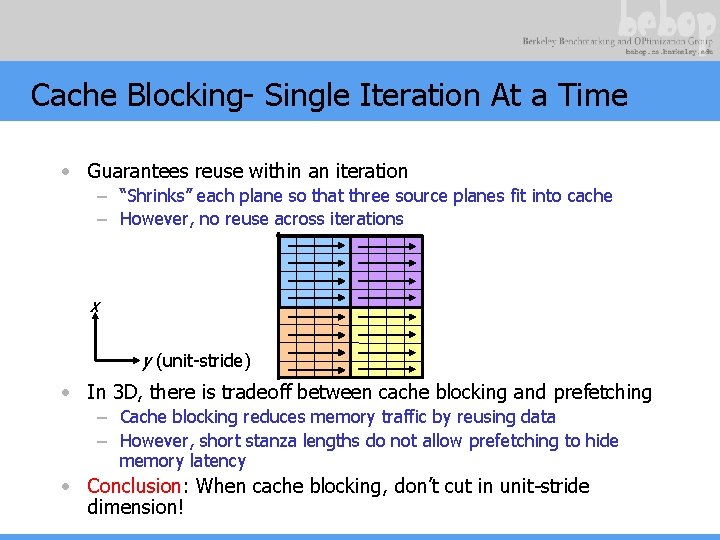
Cache Blocking- Single Iteration At a Time • Guarantees reuse within an iteration – “Shrinks” each plane so that three source planes fit into cache – However, no reuse across iterations x y (unit-stride) • In 3 D, there is tradeoff between cache blocking and prefetching – Cache blocking reduces memory traffic by reusing data – However, short stanza lengths do not allow prefetching to hide memory latency • Conclusion: When cache blocking, don’t cut in unit-stride dimension!
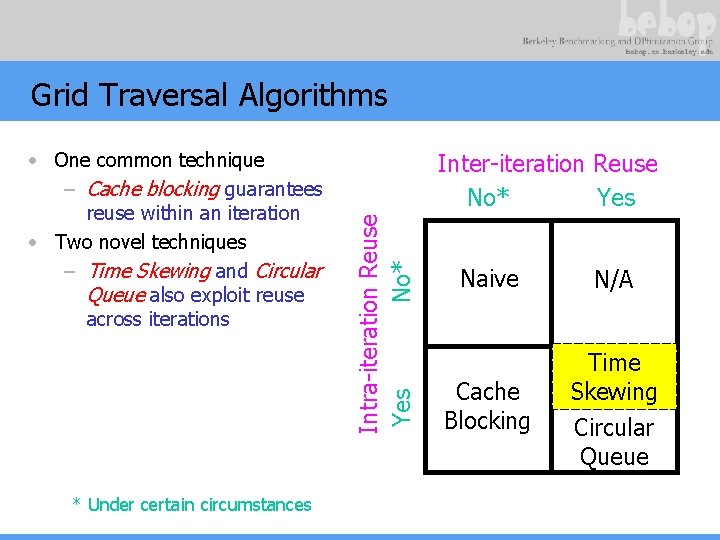
Grid Traversal Algorithms * Under certain circumstances Inter-iteration Reuse No* Yes Intra-iteration Reuse Yes No* • One common technique – Cache blocking guarantees reuse within an iteration • Two novel techniques – Time Skewing and Circular Queue also exploit reuse across iterations Naive N/A Cache Blocking Time Skewing Circular Queue
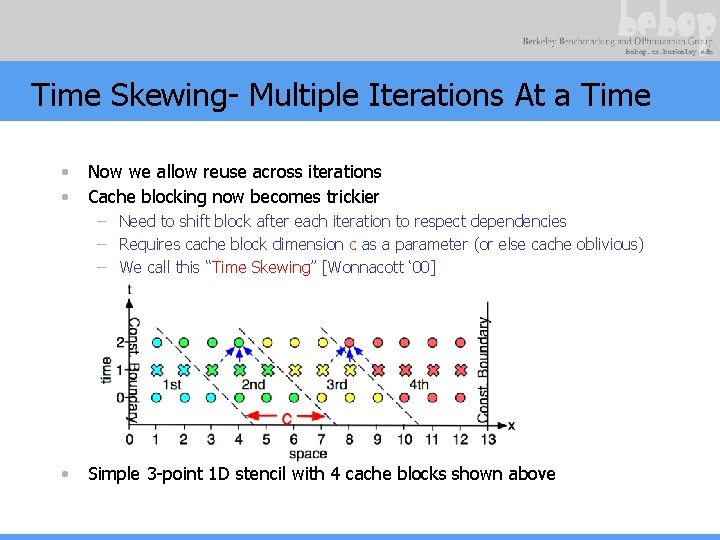
Time Skewing- Multiple Iterations At a Time • • Now we allow reuse across iterations Cache blocking now becomes trickier – Need to shift block after each iteration to respect dependencies – Requires cache block dimension c as a parameter (or else cache oblivious) – We call this “Time Skewing” [Wonnacott ‘ 00] • Simple 3 -point 1 D stencil with 4 cache blocks shown above
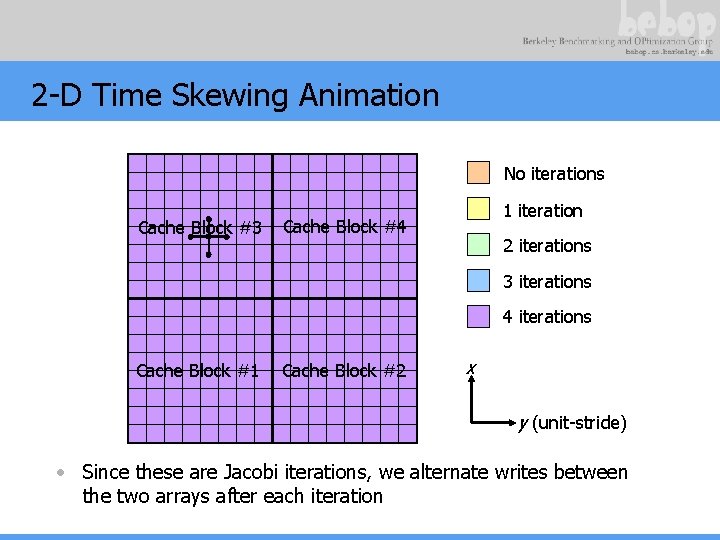
2 -D Time Skewing Animation No iterations Cache Block #3 1 iteration Cache Block #4 2 iterations 3 iterations 4 iterations Cache Block #1 Cache Block #2 x y (unit-stride) • Since these are Jacobi iterations, we alternate writes between the two arrays after each iteration
Time Skewing Analysis • Positives – Exploits reuse across iterations – No redundant computation – No extra data structures • Negatives – Inherently sequential – Need to find optimal cache block size • Can use exhaustive search, performance model, or heuristic – As number of iterations increases: • Cache blocks can “fall” off the grid • Work between cache blocks becomes more imbalanced
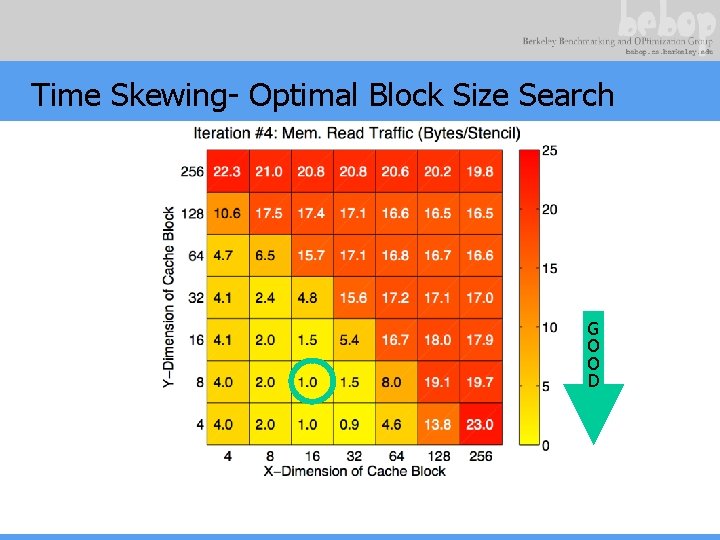
Time Skewing- Optimal Block Size Search G O O D
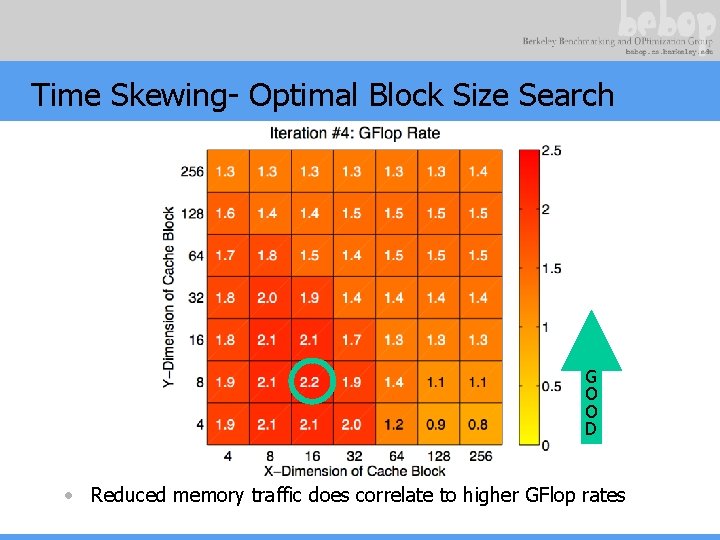
Time Skewing- Optimal Block Size Search G O O D • Reduced memory traffic does correlate to higher GFlop rates
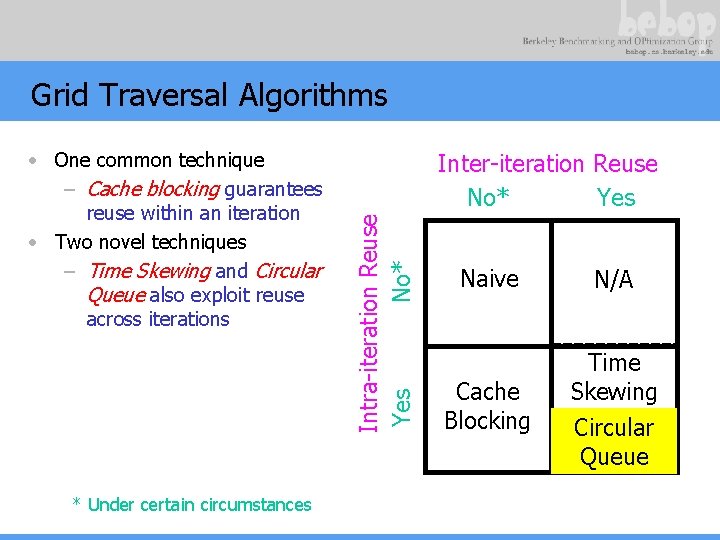
Grid Traversal Algorithms * Under certain circumstances Inter-iteration Reuse No* Yes Intra-iteration Reuse Yes No* • One common technique – Cache blocking guarantees reuse within an iteration • Two novel techniques – Time Skewing and Circular Queue also exploit reuse across iterations Naive N/A Cache Blocking Time Skewing Circular Queue
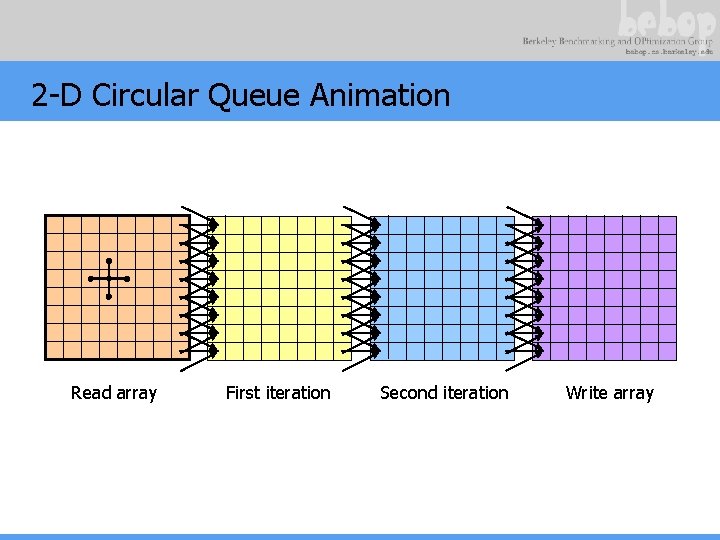
2 -D Circular Queue Animation Read array First iteration Second iteration Write array
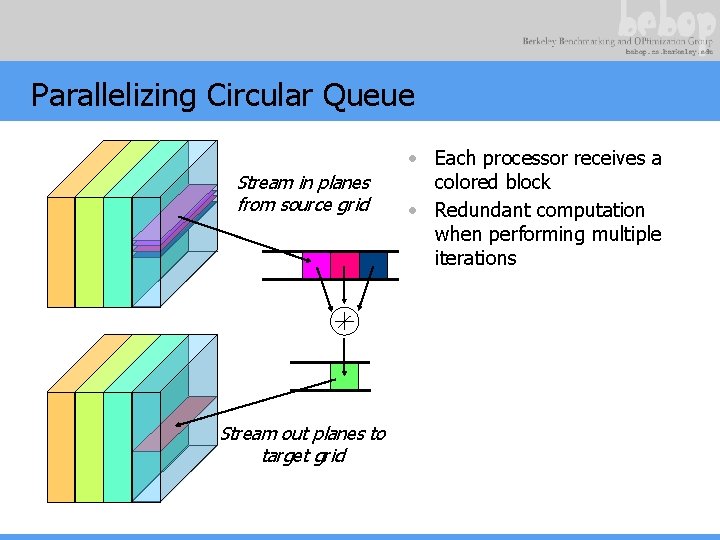
Parallelizing Circular Queue Stream in planes from source grid Stream out planes to target grid • Each processor receives a colored block • Redundant computation when performing multiple iterations
Circular Queue Analysis • Positives – Exploits reuse across iterations – Easily parallelizable – No need to alternate the source and target grids after each iteration • Negatives – Redundant computation • Gets worse with more iterations – Need to find optimal cache block size • Can use exhaustive search, performance model, or heuristic – Extra data structure needed • However, minimal memory overhead
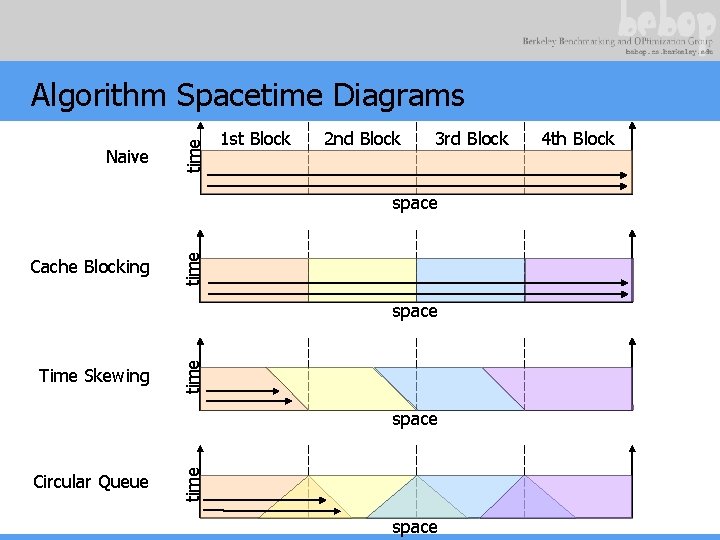
Naive time Algorithm Spacetime Diagrams 1 st Block 2 nd Block 3 rd Block Cache Blocking time space Time Skewing time space Circular Queue time space 4 th Block
Outline • • • Stencil Introduction Grid Traversal Algorithms Serial Performance Results Parallel Performance Results Conclusion
Serial Performance • Single core of 1 socket x 4 core Intel Xeon (Kentsfield) • Single core of 1 socket x 2 core AMD Opteron
Outline • • • Stencil Introduction Grid Traversal Algorithms Serial Performance Results Parallel Performance Results Conclusion
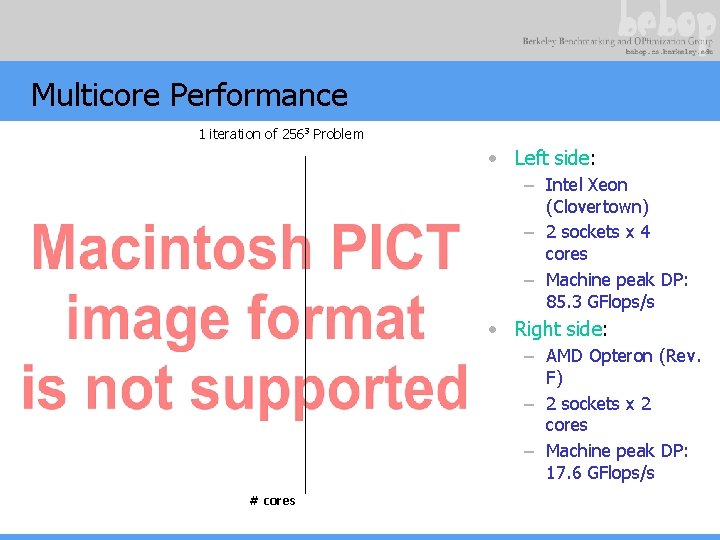
Multicore Performance 1 iteration of 2563 Problem • Left side: – Intel Xeon (Clovertown) – 2 sockets x 4 cores – Machine peak DP: 85. 3 GFlops/s • Right side: – AMD Opteron (Rev. F) – 2 sockets x 2 cores – Machine peak DP: 17. 6 GFlops/s # cores
Outline • • • Stencil Introduction Grid Traversal Algorithms Serial Performance Results Parallel Performance Results Conclusion
Stencil Code Conclusions • Need to autotune! – Choosing appropriate algorithm AND block sizes for each architecture is not obvious – Can be used with performance model – My thesis work : ) • Appropriate blocking and streaming stores most important for x 86 multicore – Streaming stores reduces mem. traffic from 24 B/pt. to 16 B/pt. • Getting good performance out of x 86 multicore chips is hard! – Applied 6 different optimizations, all of which helped at some point

Backup Slides
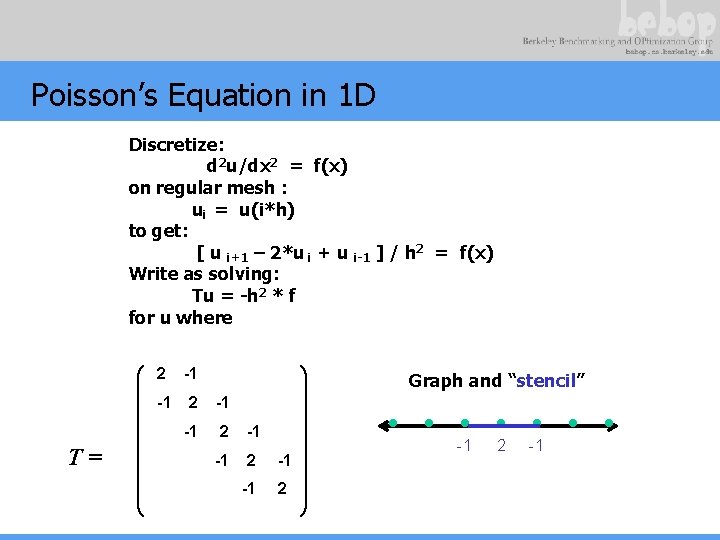
Poisson’s Equation in 1 D Discretize: d 2 u/dx 2 = f(x) on regular mesh : ui = u(i*h) to get: [ u i+1 – 2*u i + u i-1 ] / h 2 = f(x) Write as solving: Tu = -h 2 * f for u where T= 2 -1 -1 2 Graph and “stencil” -1 2 -1
Cache Blocking with Time Skewing Animation x z (unit-stride) y
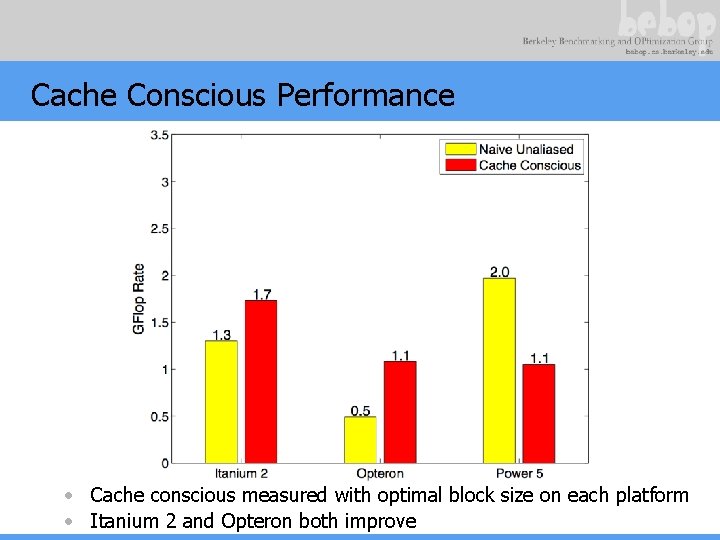
Cache Conscious Performance • Cache conscious measured with optimal block size on each platform • Itanium 2 and Opteron both improve
Cell Processor • Power. PC core that controls 8 simple SIMD cores (“SPE”s) • Memory hierarchy consists of: – Registers – Local memory – External DRAM • Application explicitly controls memory: – Explicit DMA operations required to move data from DRAM to each SPE’s local memory – Effective for predictable data access patterns • Cell code contains more low-level intrinsics than prior code

Excellent Cell Processor Performance • Double-Precision (DP) Performance: 7. 3 GFlops/s • DP performance still relatively weak – Only 1 floating point instruction every 7 cycles – Problem becomes computation-bound when cache-blocked • Single-Precision (SP) Performance: 65. 8 GFlops/s! – Problem now memory-bound even when cache-blocked • If Cell had better DP performance or ran in SP, could take further advantage of cache blocking
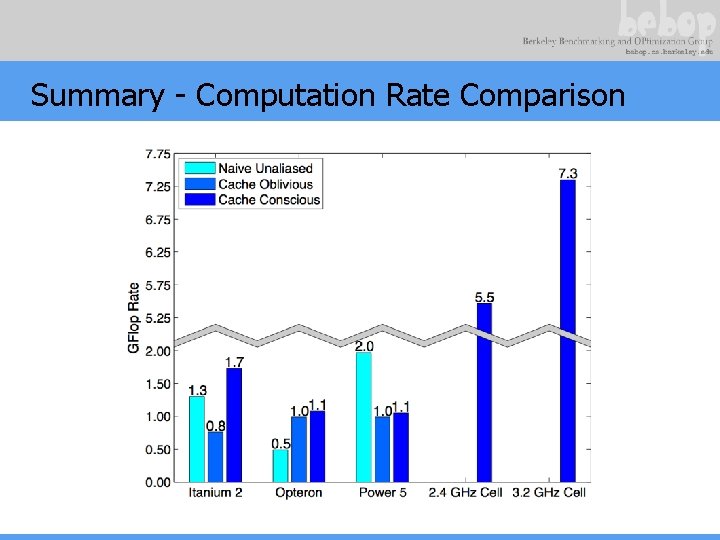
Summary - Computation Rate Comparison
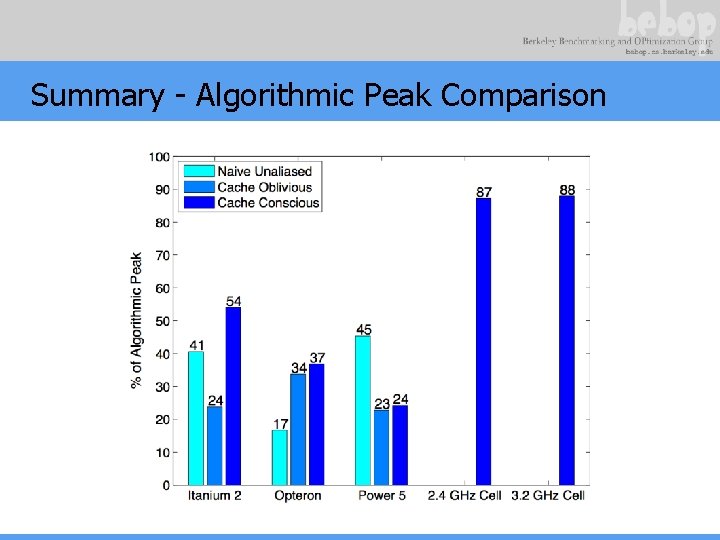
Summary - Algorithmic Peak Comparison

Outline • • • Stencil Introduction Grid Traversal Algorithms Serial Performance Results Parallel Performance Results Conclusion
- Slides: 40