
Banduras social learning theory emphasises the key role

Bandura's social learning theory emphasises the key role of selfefficacy in motivation. Using his model, explain the role of self-efficacy in young people's learning. Samantha Blackmore – 100062757 Fig. 1: http: //career. iresearchnet. com/career-
What is self-efficacy? • Self-efficacy: Toward a Unifying Theory of Behavioural Change (Bandura, 1977) • Self-efficacy is the personal expectation or judgment concerning one's capability to accomplish a task. • Student’s’ self-efficacy has a vital role in their academic achievement by influencing their performance on any given task. • Self-efficacy is not the same as self-concept.
First Activity – considering the influence of self-efficacy on motivation Positive Thoughts Negative Thoughts • • Write down statements of why you believe you cannot be successful in this class and other negative thoughts about yourself. • • Make a big show of discarding these negative thoughts. Rip these papers and throw them in the bin. Write down positive statements of things you like about yourself and why you can be successful in this class. Carry these statements around with you throughout the day. You can also read them from time to time. “We talk about our thoughts as if we can visualize them. We hold our thoughts. We take stances on issues, we lean this way or that way. This all makes our thoughts more real to us. ” (Petty, 2012)
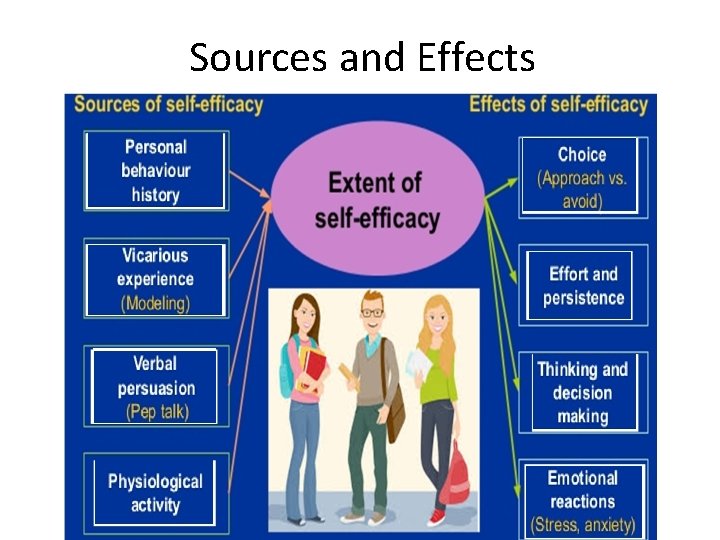
Sources and Effects

Vicarious Experience (modelling) • Bandura’s Bobo Doll experiment – children modelling adults – Aggressive behaviour learnt from observation • Schunk & Hanson – Children modelling other children – Mathematical skills learnt from observation • If they can do it, so can I! Fig. 2 - Bandura, A. (1988) Self-efficacy conception of anxiety. Anxiety Research. 1
Task Two– Assess your self-efficacy Instructions : Read each of the following statements and consider to what extent you agree with them. 1. I have performed origami paper folding successfully in the past. 2. I believe I can succeed at any origami task I attempt. 3. I am confident that I can perform effectively on different origami tasks. 4. Compared to other people, I can fold origami very well. 5. When facing difficulties in origami, I am certain that I will overcome them. 6. Even when origami skills are new or difficult, I can perform well.
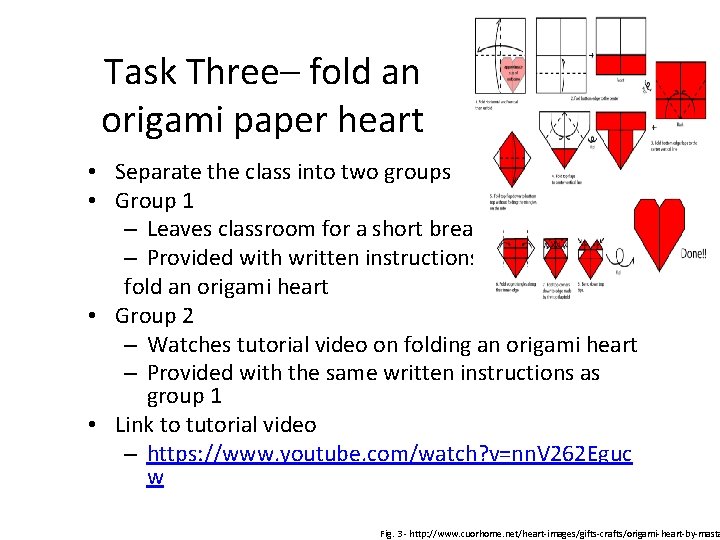
Task Three– fold an origami paper heart • Separate the class into two groups • Group 1 – Leaves classroom for a short break – Provided with written instructions to fold an origami heart • Group 2 – Watches tutorial video on folding an origami heart – Provided with the same written instructions as group 1 • Link to tutorial video – https: //www. youtube. com/watch? v=nn. V 262 Eguc w Fig. 3 - http: //www. cuorhome. net/heart-images/gifts-crafts/origami-heart-by-masta
Ways to encourage selfefficacy • Use moderately difficult tasks that challenge the students, yet are still viewed as attainable • Use peer models • Capitalize on students' interests • Give frequent, focused feedback • Use specific, short-term goals • Have students note their progress • Compare student performance to the goals set for that student, rather than comparing against others
Conclusion • Self-efficacy is greatly influenced by a person's expectations and self-judgement. • Self-efficacy comes from personal history, observations of others, verbal persuasion, physiological state. • Self-efficacy effects choices of activities and environments, effort, persistence, quality of thinking and emotional responses to challenges. • High self-efficacy creates motivation and allows a stronger engagement during learning. When people expect to succeed, they perform better.
References • • • Bandura, A. (1988) Self-efficacy conception of anxiety. Anxiety Research. v 1, p 77 -98. Bandura, A. (1989) Human agency in social cognitive theory. American Psychologist, v 44, p 1175 -1184. Margolis, H. , & Mc. Cabe, P. (2006) Improving Self-Efficacy and Motivation: What to Do, What to Say. Intervention in School and Clinic. v 41, issue 4, p 218 -227. Mayer, M. E. (2008) Excerpt from Learning and Instruction. p. 504 -510. Merrill, an imprint of Pearson Education Inc. Ozer, E. M. , & Bandura, A. (1990) Mechanisms governing empowerment effects: A self-efficacy analysis. Journal of Personality and Social Psychology, v 58, p 472 -486. Pajares, F. Current Directions in Self-efficacy Research. Advances in motivation and achievement. v 10, p 1 -49. Greenwich, CT: JAI Press. Petty, R. & Brinol, P. (2012) Knowing our attitudes and how to change them. Psychological Science v 23, p 294 -297. Reeve, J. (2009) Understanding motivation and emotion, 5 th Ed. University of Iowa, John Wiley & Sons, Inc. p 233 – 240. Schunk, D. H. , & Pajares F. (2002) The Development of Academic Self. Efficacy. Development of Achievement Motivation.
- Slides: 10