
Band structure of strongly correlated materials from the
Band structure of strongly correlated materials from the Dynamical Mean Field perspective n K Haule Rutgers University n Collaborators : J. H. Shim & Gabriel Kotliar n Tallahassee, 2008
Outline Dynamical Mean Field Theory in combination with band structure ¡ LDA+DMFT results for 115 materials (Ce. Ir. In 5) ¡ ¡ ¡ Local Ce 4 f - spectra and comparison to AIPES) Momentum resolved spectra and comparison to ARPES Optical conductivity Two hybridization gaps and its connection to optics Fermi surface in DMFT References: • J. H. Shim, KH, and G. Kotliar, Science 318, 1618 (2007).
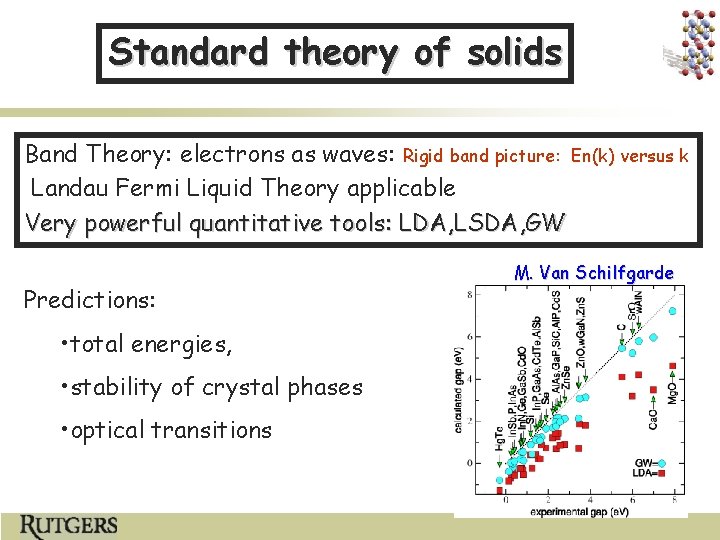
Standard theory of solids Band Theory: electrons as waves: Rigid band picture: En(k) versus k Landau Fermi Liquid Theory applicable Very powerful quantitative tools: LDA, LSDA, GW Predictions: • total energies, • stability of crystal phases • optical transitions M. Van Schilfgarde
Strong correlation – Standard theory fails n n n Fermi Liquid Theory does NOT work. Need new concepts to replace rigid bands picture! Breakdown of the wave picture. Need to incorporate a real space perspective (Mott). Non perturbative problem.
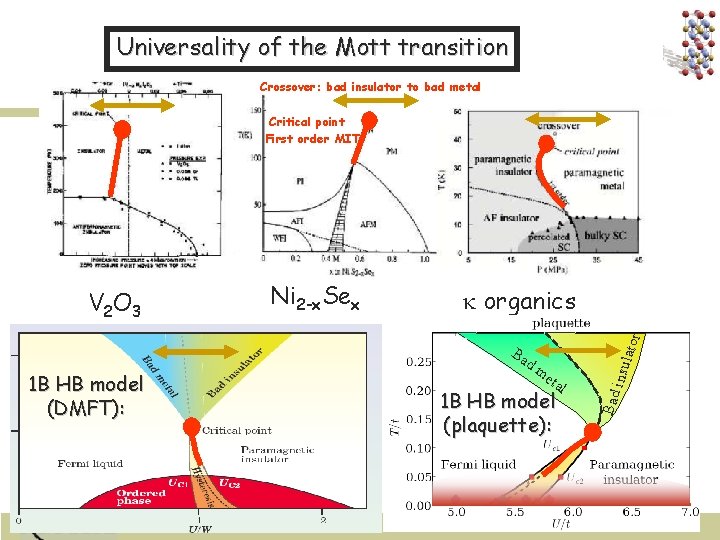
Universality of the Mott transition Crossover: bad insulator to bad metal Critical point First order MIT Ba d lator k organics me tal 1 B HB model (plaquette): insu 1 B HB model (DMFT): Ni 2 -x. Sex Bad V 2 O 3
Basic questions to address n How to computed spectroscopic quantities (single particle spectra, optical conductivity phonon dispersion…) from first principles? n How to relate various experiments into a unifying picture. n New concepts, new techniques…. . DMFT maybe simplest approach to meet this challenge
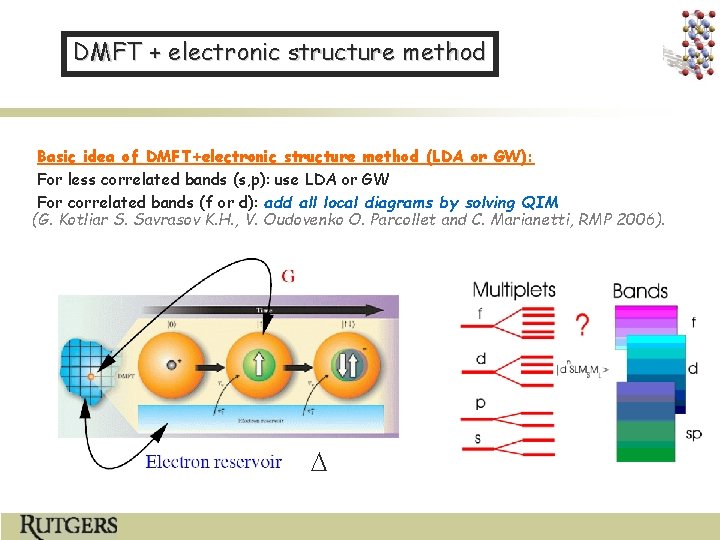
DMFT + electronic structure method Basic idea of DMFT+electronic structure method (LDA or GW): For less correlated bands (s, p): use LDA or GW For correlated bands (f or d): add all local diagrams by solving QIM (G. Kotliar S. Savrasov K. H. , V. Oudovenko O. Parcollet and C. Marianetti, RMP 2006). D
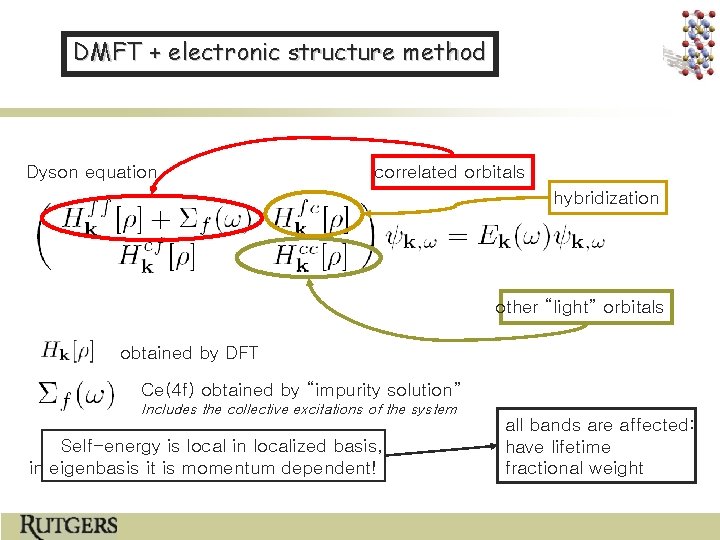
DMFT + electronic structure method Dyson equation correlated orbitals hybridization other “light” orbitals obtained by DFT Ce(4 f) obtained by “impurity solution” Includes the collective excitations of the system Self-energy is local in localized basis, in eigenbasis it is momentum dependent! all bands are affected: have lifetime fractional weight
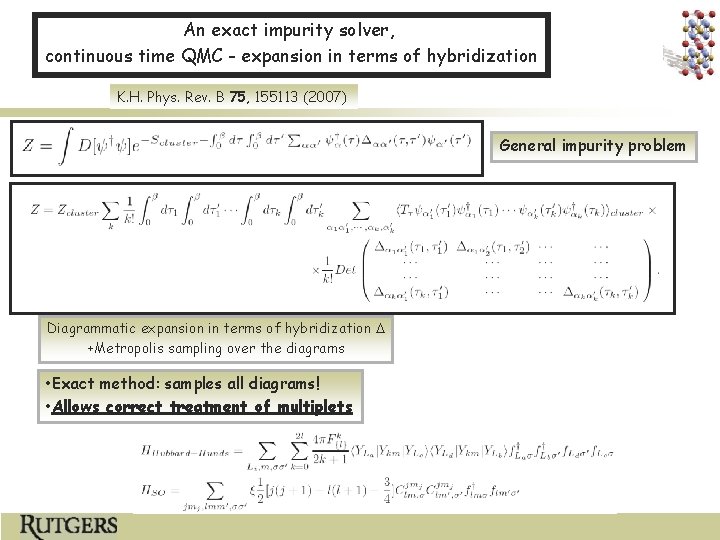
An exact impurity solver, continuous time QMC - expansion in terms of hybridization K. H. Phys. Rev. B 75, 155113 (2007) General impurity problem Diagrammatic expansion in terms of hybridization D +Metropolis sampling over the diagrams • Exact method: samples all diagrams! • Allows correct treatment of multiplets
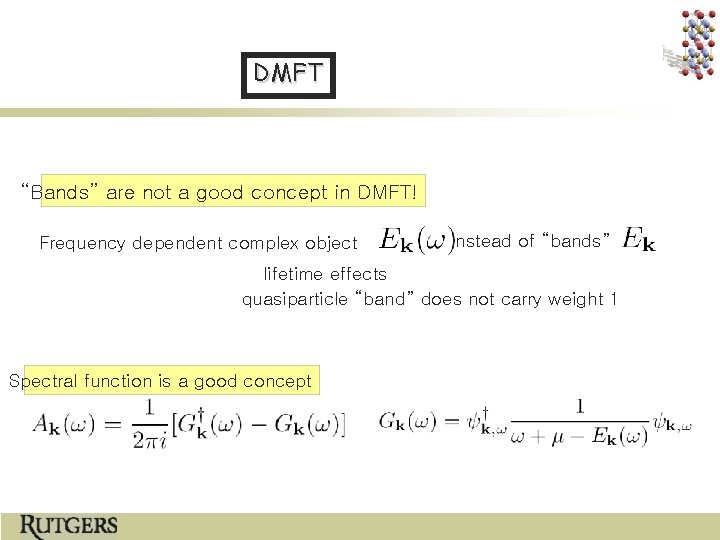
DMFT “Bands” are not a good concept in DMFT! Frequency dependent complex object instead of “bands” lifetime effects quasiparticle “band” does not carry weight 1 Spectral function is a good concept
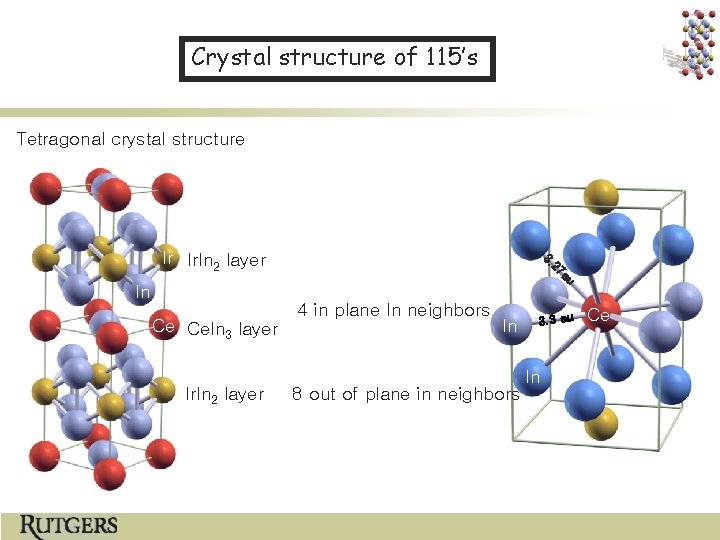
Crystal structure of 115’s Tetragonal crystal structure Ir Ir. In 2 layer 3. 27 au In Ce Ce. In 3 layer Ir. In 2 layer 4 in plane In neighbors In 8 out of plane in neighbors 3. 3 au In Ce
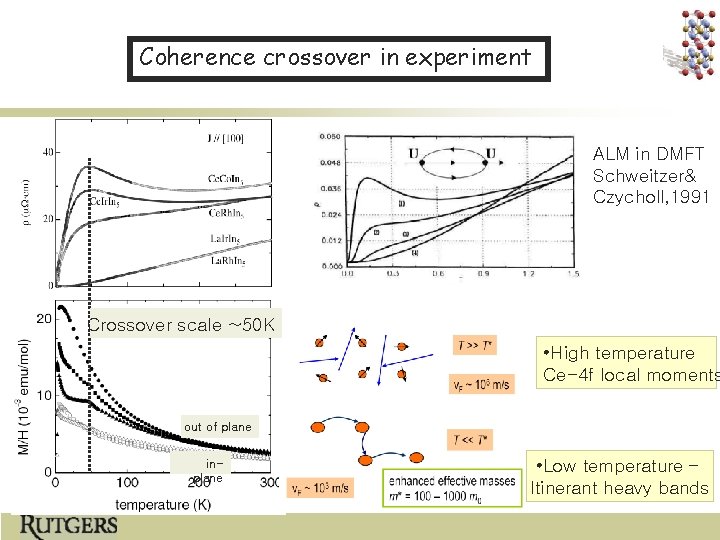
Coherence crossover in experiment ALM in DMFT Schweitzer& Czycholl, 1991 Crossover scale ~50 K • High temperature Ce-4 f local moments out of plane inplane • Low temperature – Itinerant heavy bands
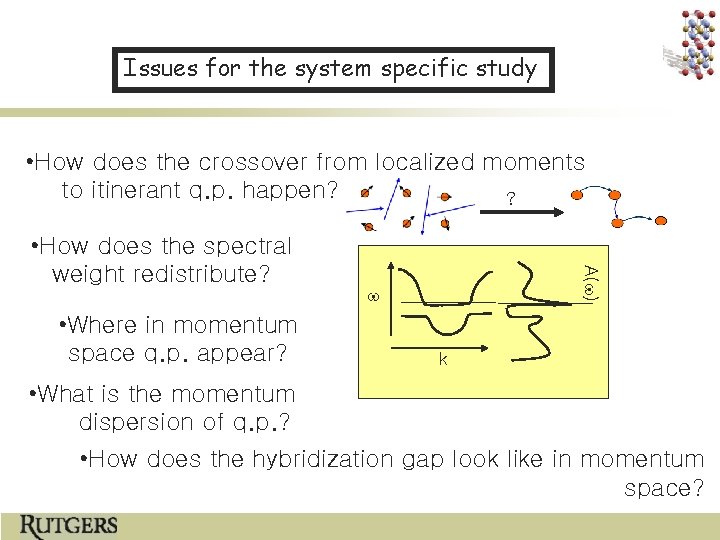
Issues for the system specific study • How does the crossover from localized moments to itinerant q. p. happen? ? • Where in momentum space q. p. appear? A(w) • How does the spectral weight redistribute? w k • What is the momentum dispersion of q. p. ? • How does the hybridization gap look like in momentum space?
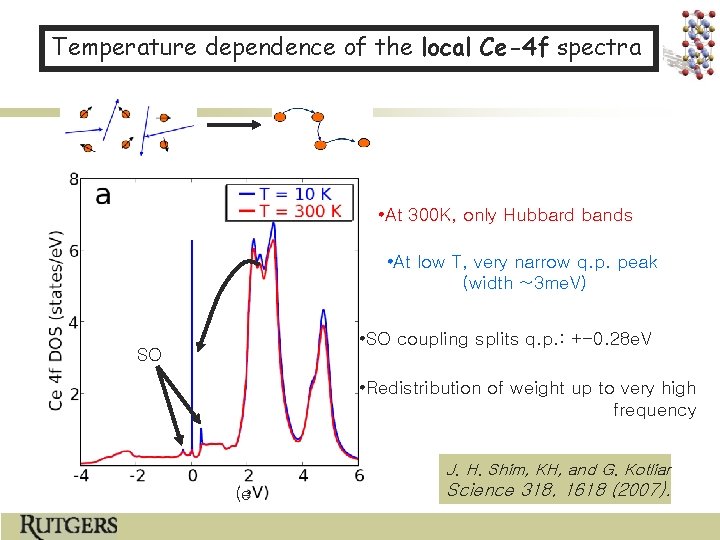
Temperature dependence of the local Ce-4 f spectra • At 300 K, only Hubbard bands • At low T, very narrow q. p. peak (width ~3 me. V) • SO coupling splits q. p. : +-0. 28 e. V SO • Redistribution of weight up to very high frequency J. H. Shim, KH, and G. Kotliar (e Science 318, 1618 (2007).
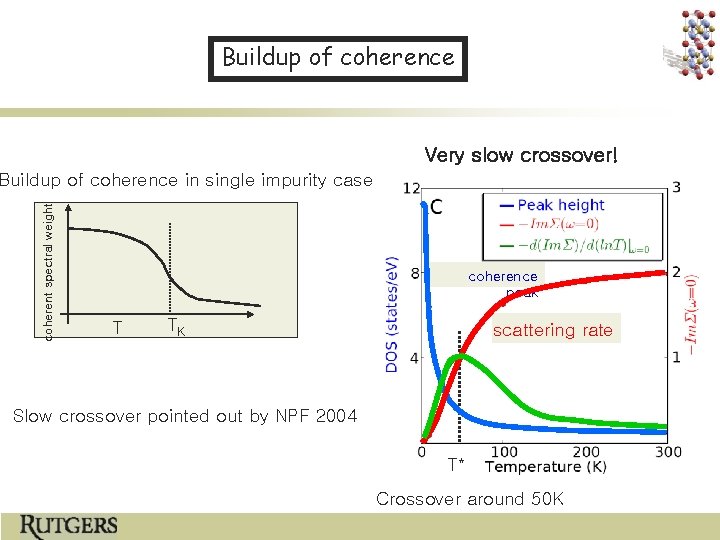
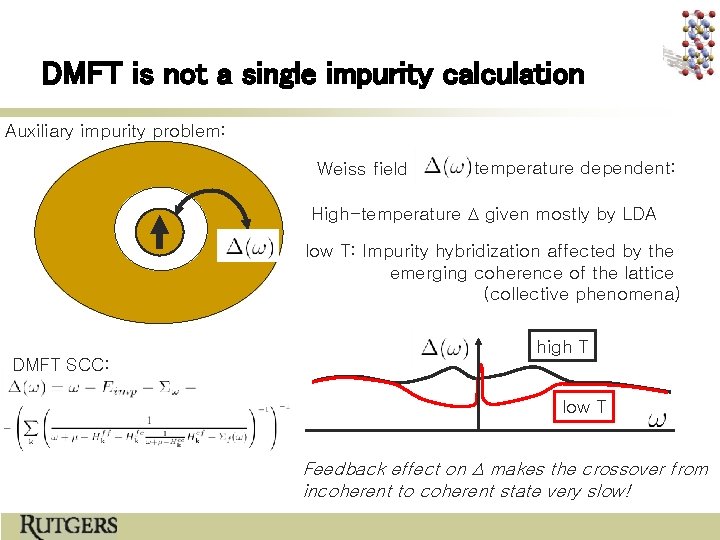
Buildup of coherence Very slow crossover! coherent spectral weight Buildup of coherence in single impurity case coherence peak T TK scattering rate Slow crossover pointed out by NPF 2004 T* Crossover around 50 K
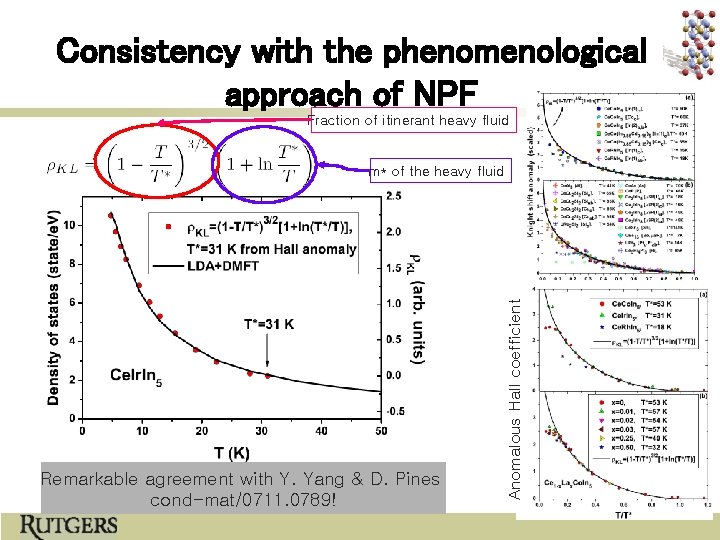
Consistency with the phenomenological approach of NPF Fraction of itinerant heavy fluid Remarkable agreement with Y. Yang & D. Pines cond-mat/0711. 0789! Anomalous Hall coefficient m* of the heavy fluid
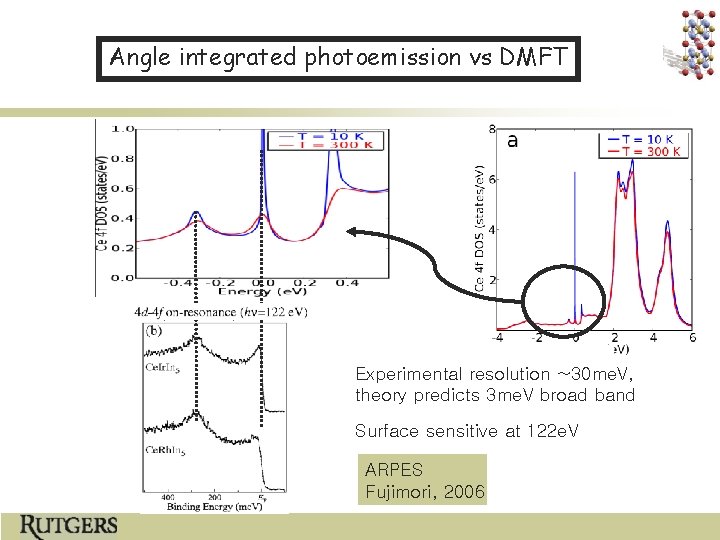
Angle integrated photoemission vs DMFT Experimental resolution ~30 me. V, theory predicts 3 me. V broad band Surface sensitive at 122 e. V ARPES Fujimori, 2006
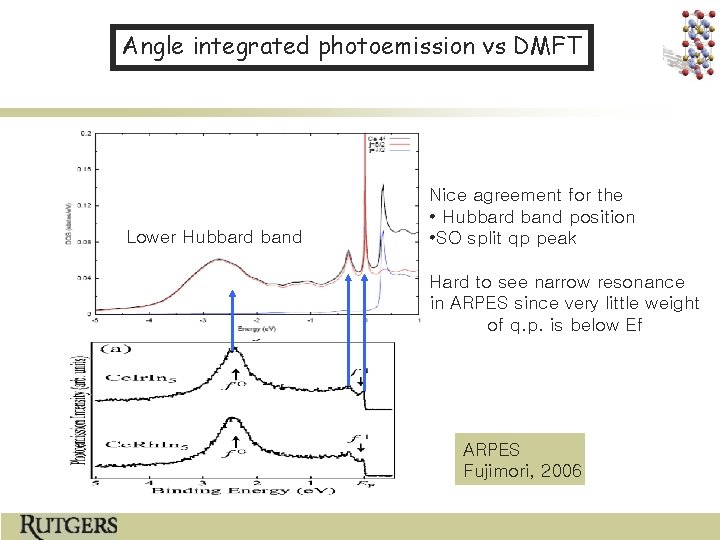
Angle integrated photoemission vs DMFT Lower Hubbard band Nice agreement for the • Hubbard band position • SO split qp peak Hard to see narrow resonance in ARPES since very little weight of q. p. is below Ef ARPES Fujimori, 2006
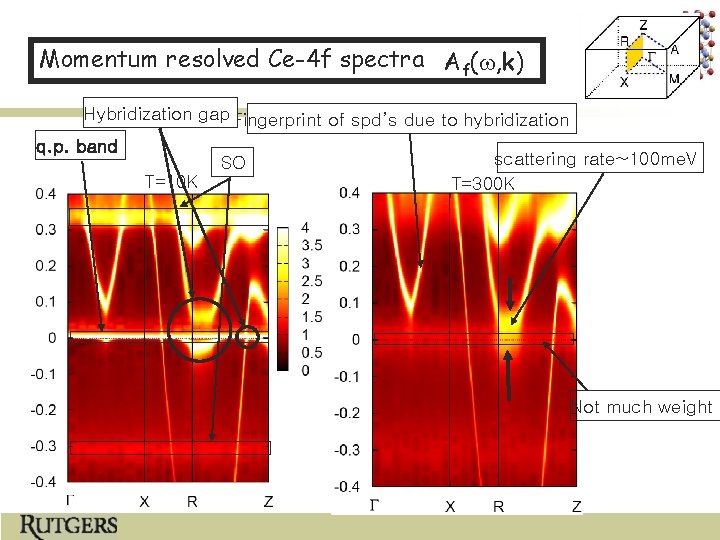
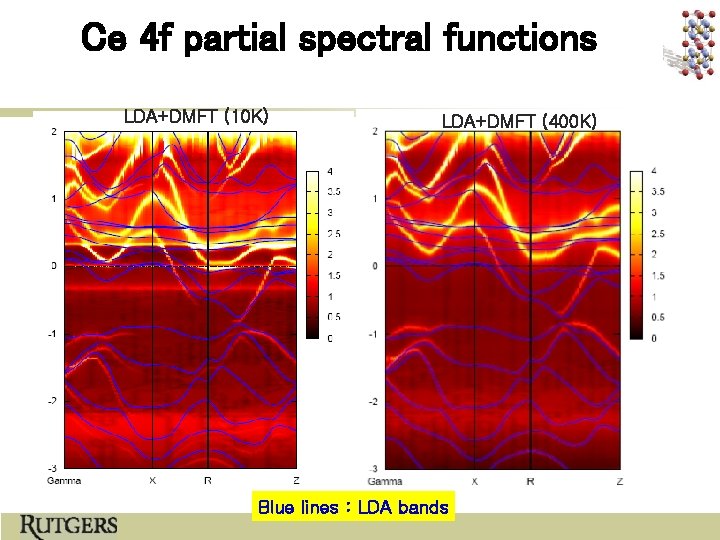
Momentum resolved Ce-4 f spectra Af(w, k) Hybridization gap Fingerprint of spd’s due to hybridization q. p. band scattering rate~100 me. V SO T=10 K T=300 K Not much weight
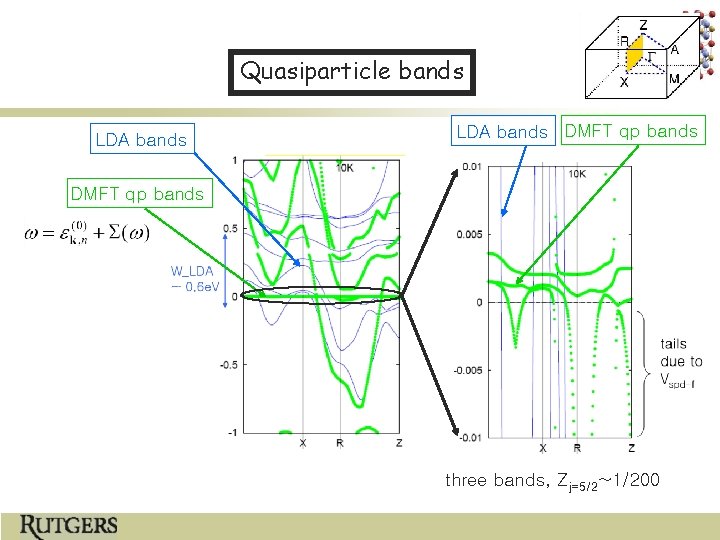
Quasiparticle bands LDA bands DMFT qp bands three bands, Zj=5/2~1/200
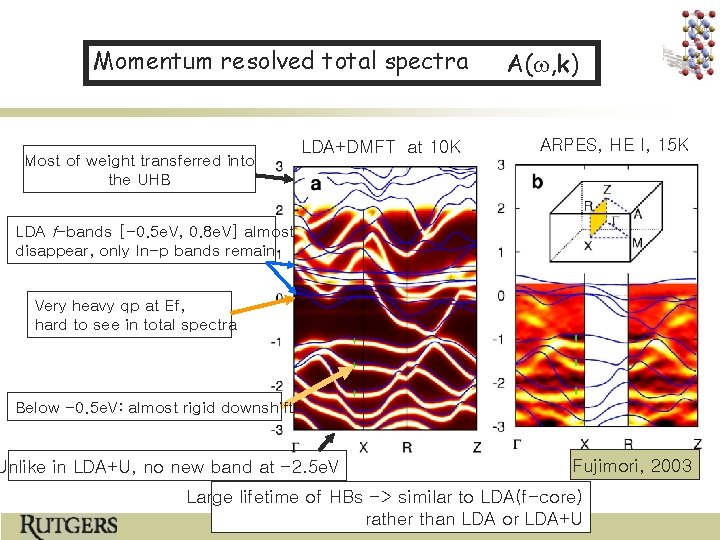
Momentum resolved total spectra Most of weight transferred into the UHB LDA+DMFT at 10 K A(w, k) ARPES, HE I, 15 K LDA f-bands [-0. 5 e. V, 0. 8 e. V] almost disappear, only In-p bands remain Very heavy qp at Ef, hard to see in total spectra Below -0. 5 e. V: almost rigid downshift Unlike in LDA+U, no new band at -2. 5 e. V Fujimori, 2003 Large lifetime of HBs -> similar to LDA(f-core) rather than LDA or LDA+U
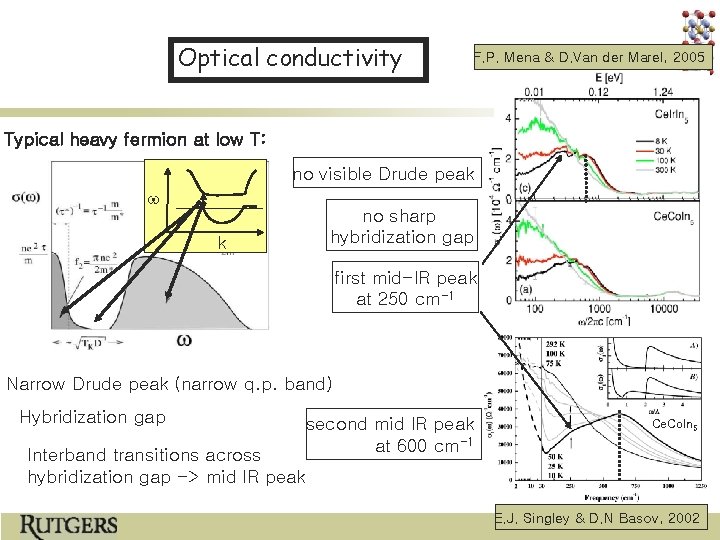
Optical conductivity F. P. Mena & D. Van der Marel, 2005 Typical heavy fermion at low T: no visible Drude peak w k no sharp hybridization gap first mid-IR peak at 250 cm-1 Narrow Drude peak (narrow q. p. band) Hybridization gap Interband transitions across hybridization gap -> mid IR peak second mid IR peak at 600 cm-1 Ce. Co. In 5 E. J. Singley & D. N Basov, 2002
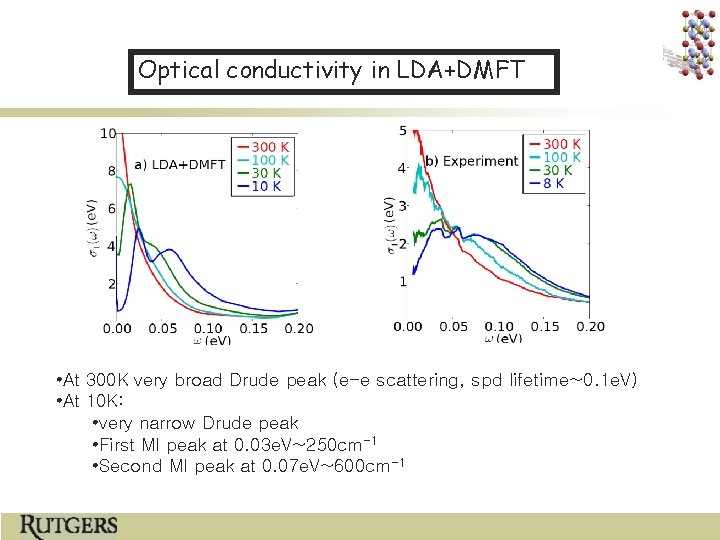
Optical conductivity in LDA+DMFT • At 300 K very broad Drude peak (e-e scattering, spd lifetime~0. 1 e. V) • At 10 K: • very narrow Drude peak • First MI peak at 0. 03 e. V~250 cm-1 • Second MI peak at 0. 07 e. V~600 cm-1
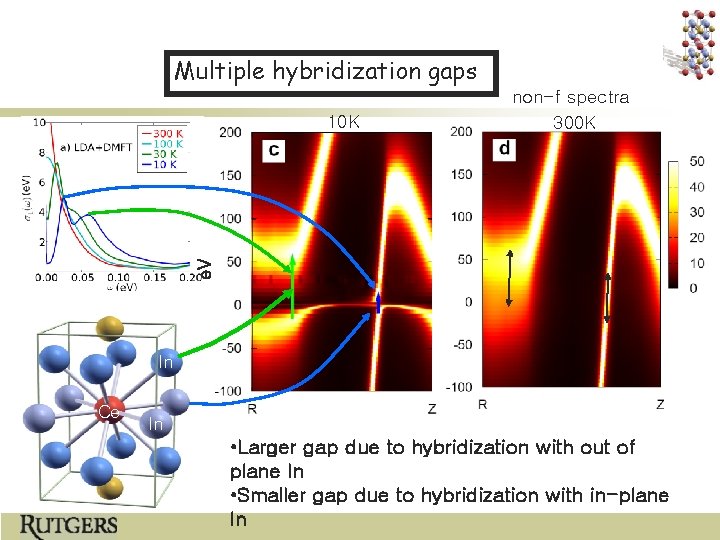
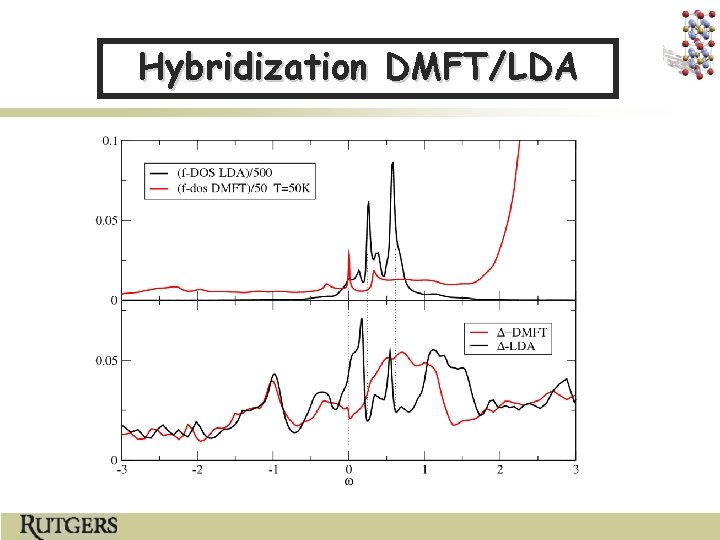
Multiple hybridization gaps e. V 10 K non-f spectra 300 K In Ce In • Larger gap due to hybridization with out of plane In • Smaller gap due to hybridization with in-plane In
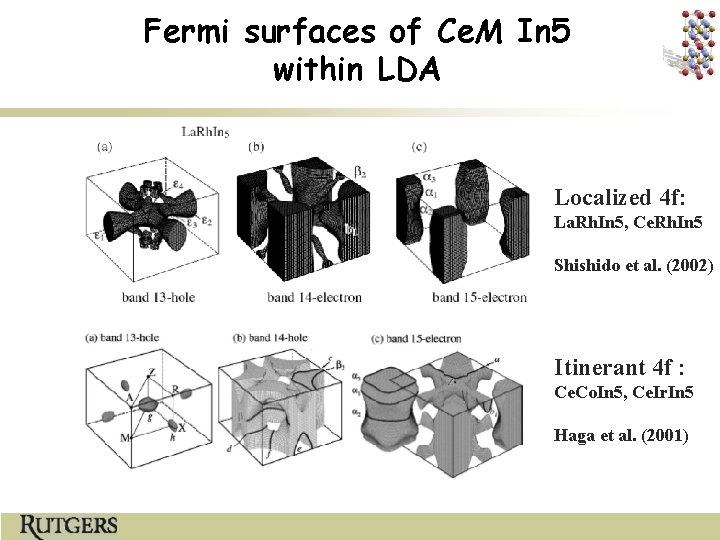
Fermi surfaces of Ce. M In 5 within LDA Localized 4 f: La. Rh. In 5, Ce. Rh. In 5 Shishido et al. (2002) Itinerant 4 f : Ce. Co. In 5, Ce. Ir. In 5 Haga et al. (2001)
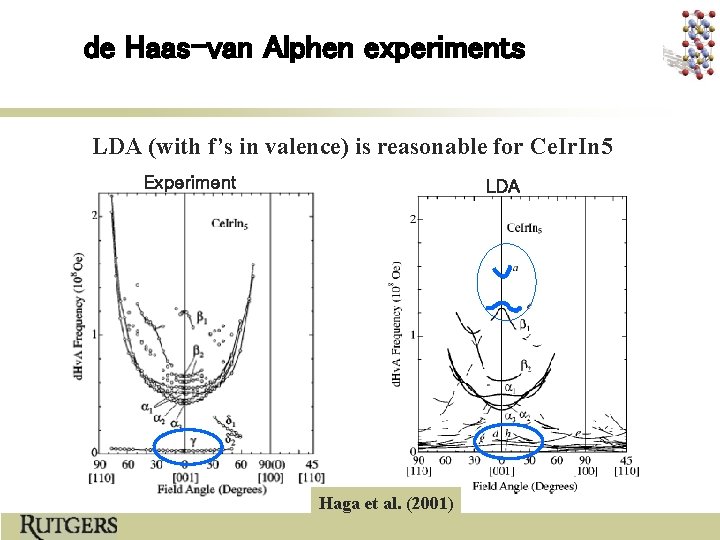
de Haas-van Alphen experiments LDA (with f’s in valence) is reasonable for Ce. Ir. In 5 Experiment LDA Haga et al. (2001)
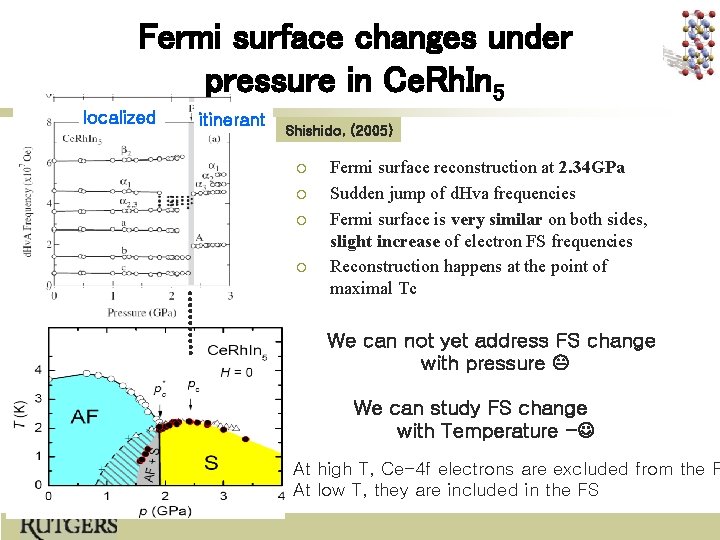
Fermi surface changes under pressure in Ce. Rh. In 5 localized itinerant Shishido, (2005) ¡ ¡ Fermi surface reconstruction at 2. 34 GPa Sudden jump of d. Hva frequencies Fermi surface is very similar on both sides, slight increase of electron FS frequencies Reconstruction happens at the point of maximal Tc We can not yet address FS change with pressure We can study FS change with Temperature - At high T, Ce-4 f electrons are excluded from the F At low T, they are included in the FS
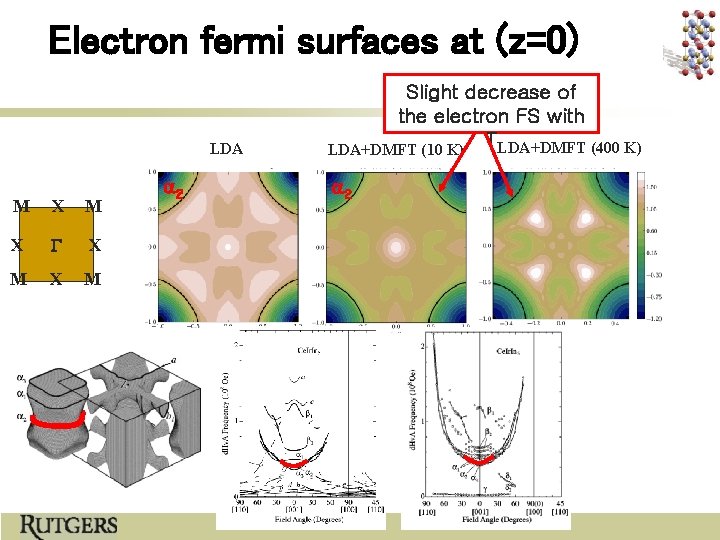
Electron fermi surfaces at (z=0) LDA M X G X M a 2 Slight decrease of the electron FS with TLDA+DMFT (400 K) LDA+DMFT (10 K) a 2
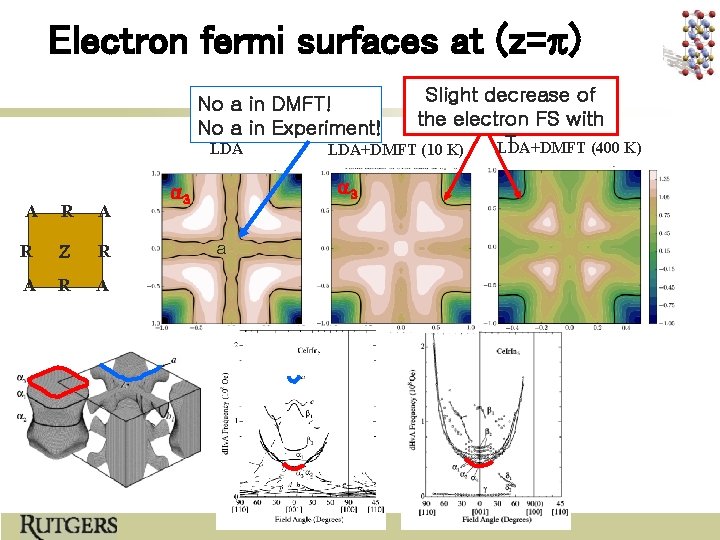
Electron fermi surfaces at (z=p) Slight decrease of the electron FS with T LDA+DMFT (400 K) LDA+DMFT (10 K) No a in DMFT! No a in Experiment! LDA A R Z R A a 3 a
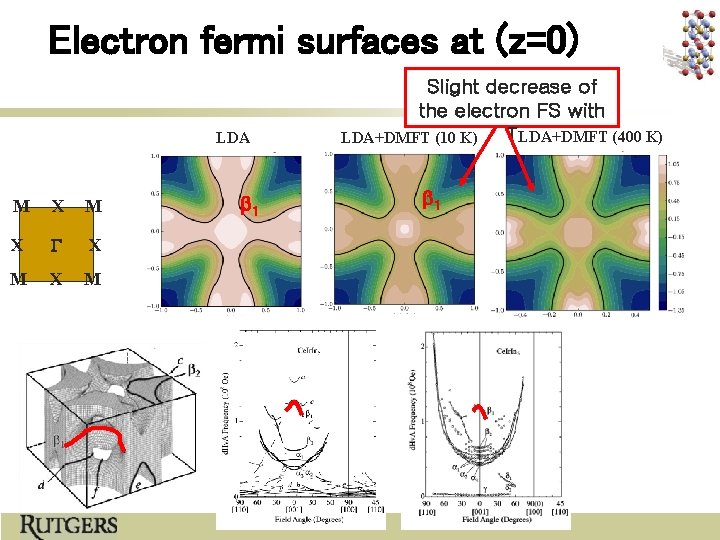
Electron fermi surfaces at (z=0) Slight decrease of the electron FS with TLDA+DMFT (400 K) LDA+DMFT (10 K) LDA M X G X M b 1 b 2 c b 2
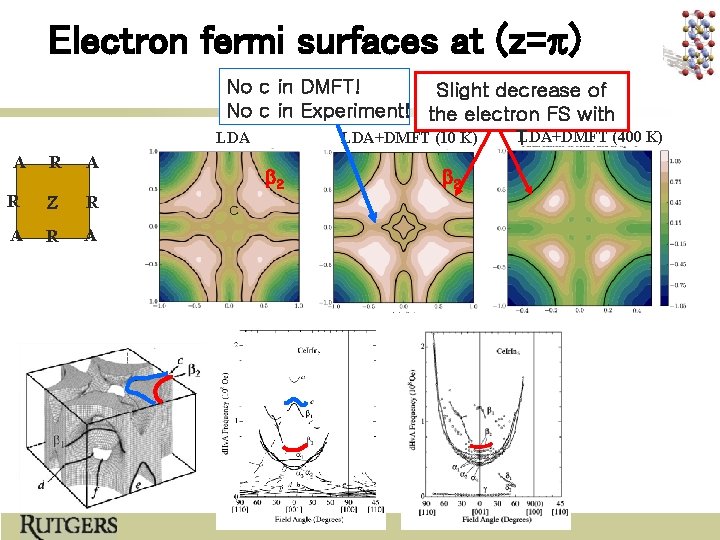
Electron fermi surfaces at (z=p) No c in DMFT! Slight decrease of No c in Experiment! the electron FS with LDA+DMFT (10 K) LDA TLDA+DMFT (400 K) A R Z R A b 2 c b 2
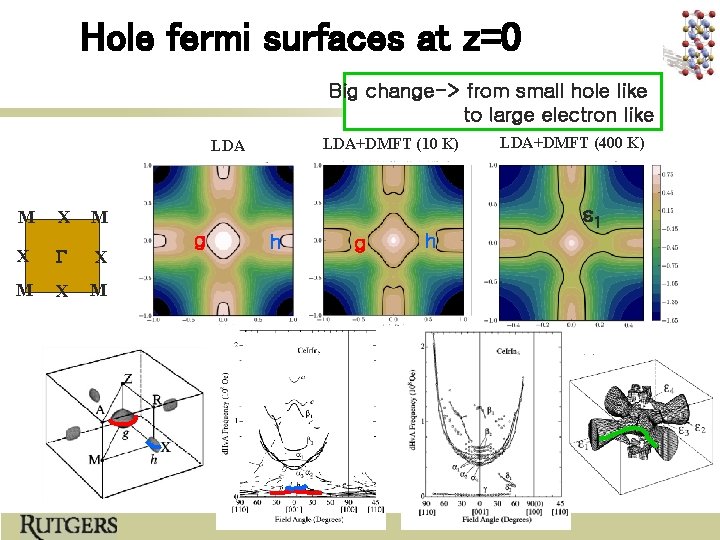
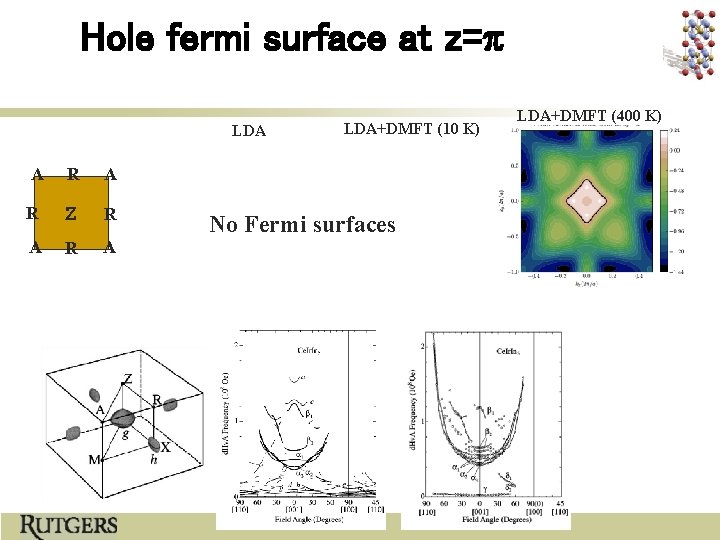
Hole fermi surfaces at z=0 Big change-> from small hole like to large electron like LDA+DMFT (10 K) LDA M X e 1 M X G X M g LDA+DMFT (400 K) h g h
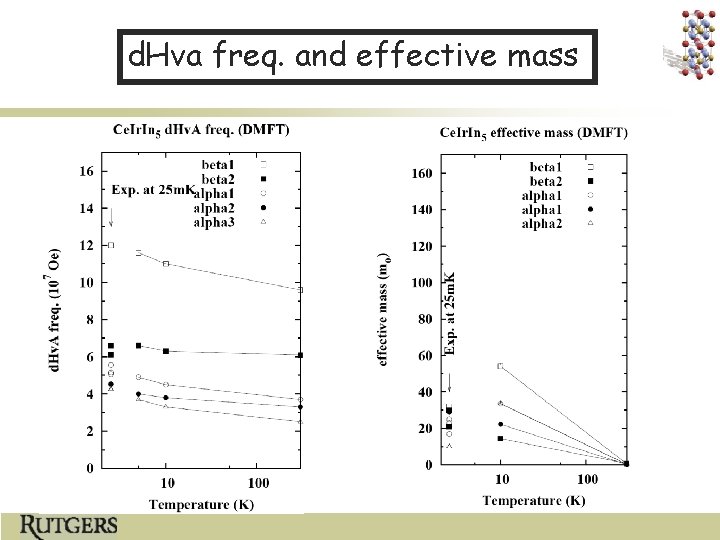
d. Hva freq. and effective mass
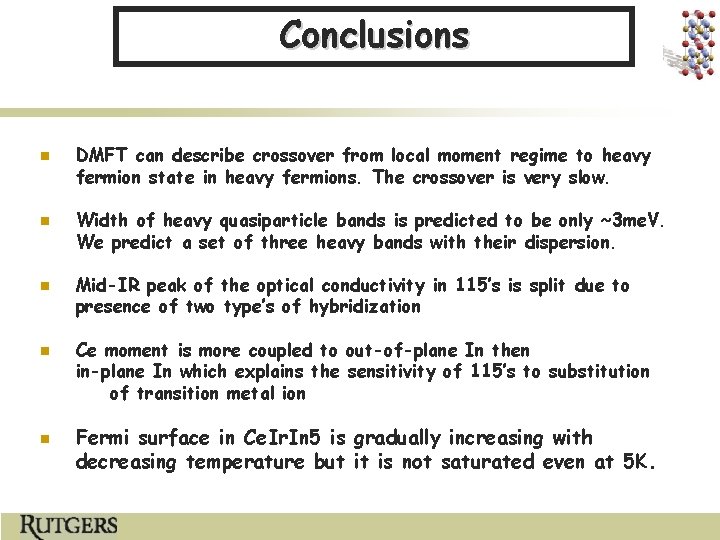
Conclusions n n n DMFT can describe crossover from local moment regime to heavy fermion state in heavy fermions. The crossover is very slow. Width of heavy quasiparticle bands is predicted to be only ~3 me. V. We predict a set of three heavy bands with their dispersion. Mid-IR peak of the optical conductivity in 115’s is split due to presence of two type’s of hybridization Ce moment is more coupled to out-of-plane In then in-plane In which explains the sensitivity of 115’s to substitution of transition metal ion Fermi surface in Ce. Ir. In 5 is gradually increasing with decreasing temperature but it is not saturated even at 5 K.

Thank you!
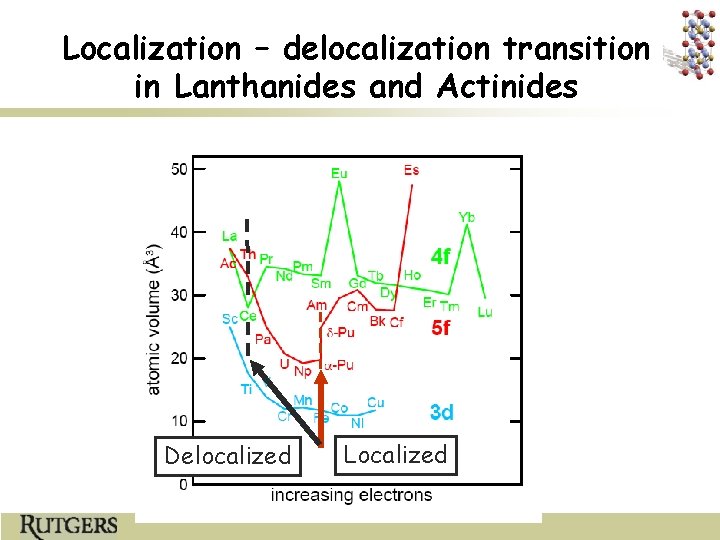
Localization – delocalization transition in Lanthanides and Actinides Delocalized Localized
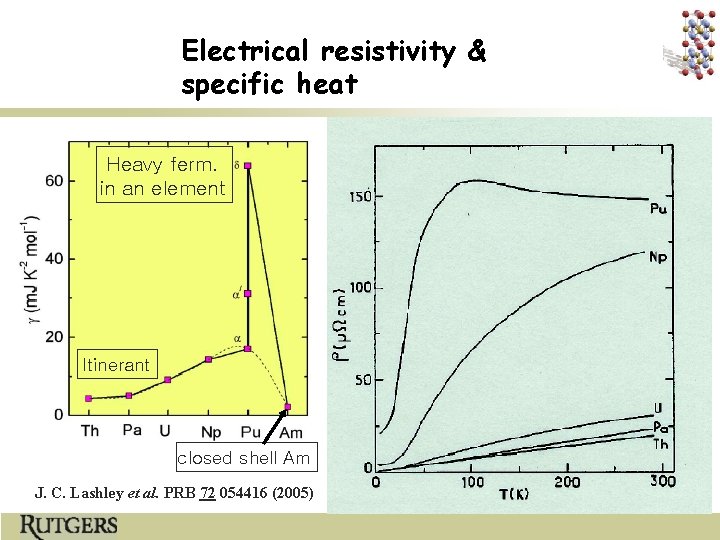
Electrical resistivity & specific heat Heavy ferm. in an element Itinerant closed shell Am J. C. Lashley et al. PRB 72 054416 (2005)
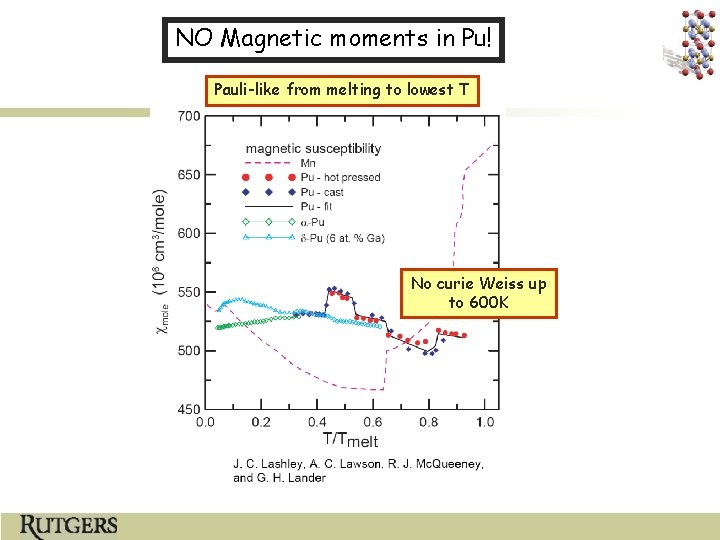
NO Magnetic moments in Pu! Pauli-like from melting to lowest T No curie Weiss up to 600 K
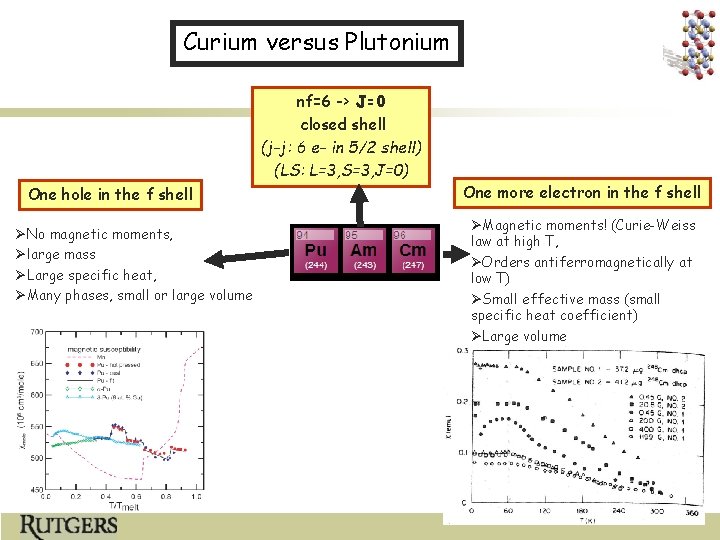
Curium versus Plutonium nf=6 -> J=0 closed shell (j-j: 6 e- in 5/2 shell) (LS: L=3, S=3, J=0) One hole in the f shell ØNo magnetic moments, Ølarge mass ØLarge specific heat, ØMany phases, small or large volume One more electron in the f shell ØMagnetic moments! (Curie-Weiss law at high T, ØOrders antiferromagnetically at low T) ØSmall effective mass (small specific heat coefficient) ØLarge volume
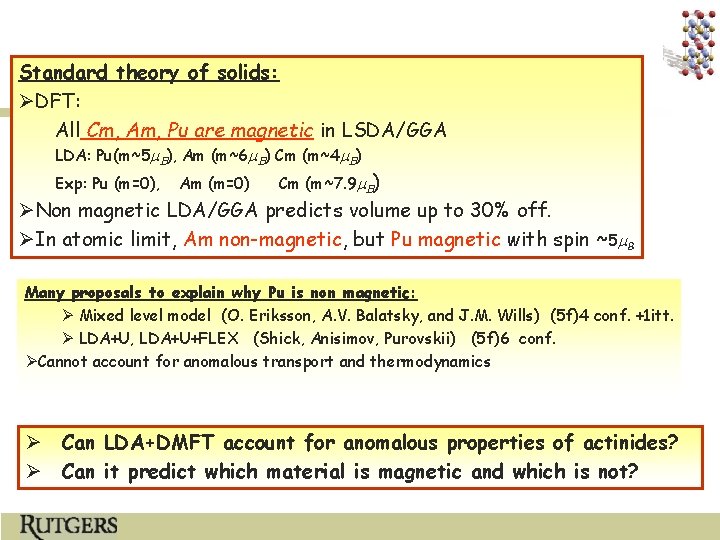
Standard theory of solids: ØDFT: All Cm, Am, Pu are magnetic in LSDA/GGA LDA: Pu(m~5 m. B), Am (m~6 m. B) Cm (m~4 m. B) Exp: Pu (m=0), Am (m=0) Cm (m~7. 9 m. B) ØNon magnetic LDA/GGA predicts volume up to 30% off. ØIn atomic limit, Am non-magnetic, but Pu magnetic with spin ~5 m. B Many proposals to explain why Pu is non magnetic: Ø Mixed level model (O. Eriksson, A. V. Balatsky, and J. M. Wills) (5 f)4 conf. +1 itt. Ø LDA+U, LDA+U+FLEX (Shick, Anisimov, Purovskii) (5 f)6 conf. ØCannot account for anomalous transport and thermodynamics Ø Can LDA+DMFT account for anomalous properties of actinides? Ø Can it predict which material is magnetic and which is not?
Starting from magnetic solution, Curium develops antiferromagnetic long range order below Tc above Tc has large moment (~7. 9 m. B close to LS coupling) Plutonium dynamically restores symmetry -> becomes paramagnetic J. H. Shim, K. H. , G. Kotliar, Nature 446, 513 (2007).
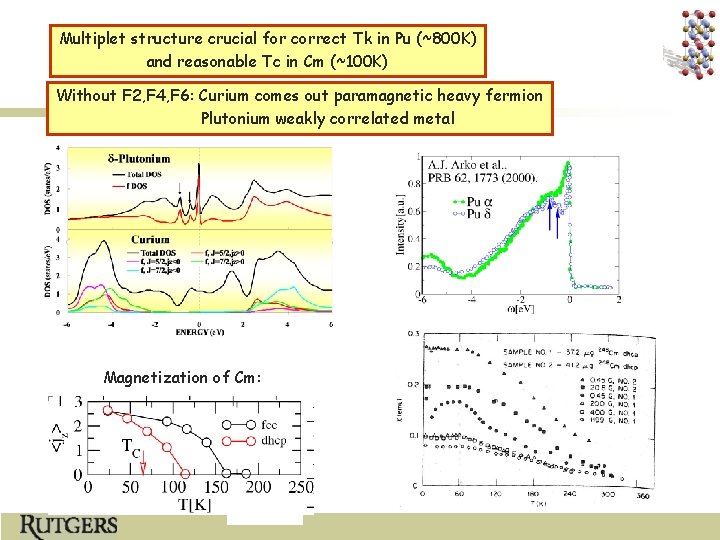
Multiplet structure crucial for correct Tk in Pu (~800 K) and reasonable Tc in Cm (~100 K) Without F 2, F 4, F 6: Curium comes out paramagnetic heavy fermion Plutonium weakly correlated metal Magnetization of Cm:
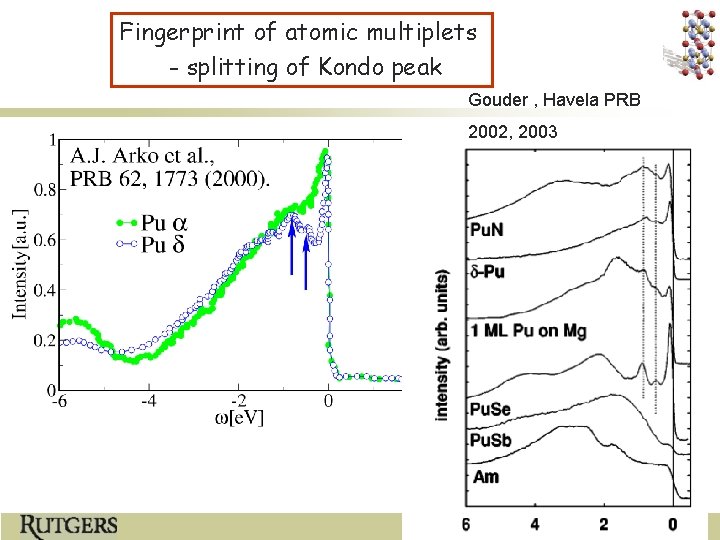
Fingerprint of atomic multiplets - splitting of Kondo peak Gouder , Havela PRB 2002, 2003
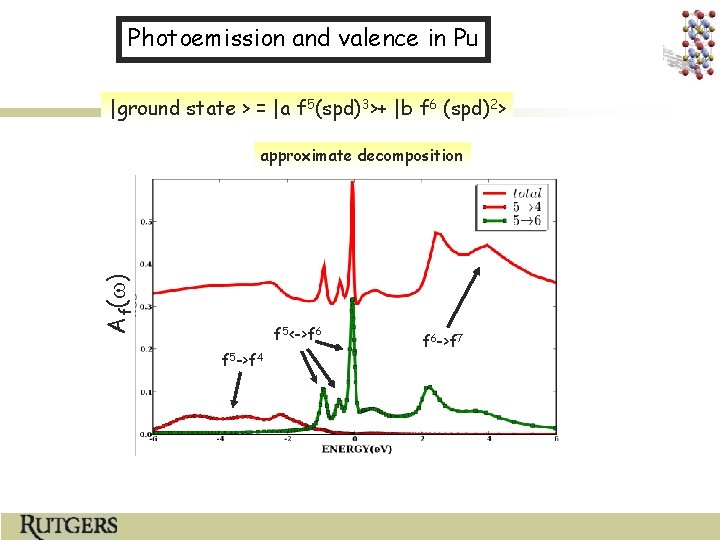
Photoemission and valence in Pu |ground state > = |a f 5(spd)3>+ |b f 6 (spd)2> Af(w) approximate decomposition f 5<->f 6 f 5 ->f 4 f 6 ->f 7
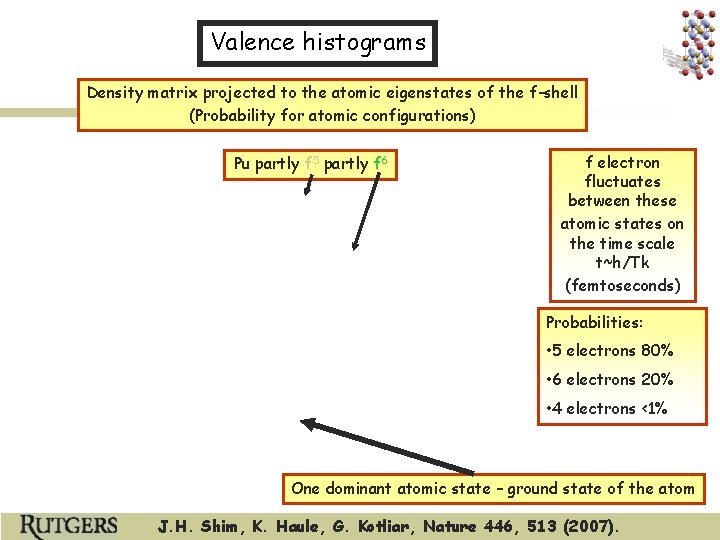
Valence histograms Density matrix projected to the atomic eigenstates of the f-shell (Probability for atomic configurations) Pu partly f 5 partly f 6 f electron fluctuates between these atomic states on the time scale t~h/Tk (femtoseconds) Probabilities: • 5 electrons 80% • 6 electrons 20% • 4 electrons <1% One dominant atomic state – ground state of the atom J. H. Shim, K. Haule, G. Kotliar, Nature 446, 513 (2007).
Fermi surfaces Increasing temperature from 10 K to 300 K: q Gradual decrease of electron FS q. Most of FS parts show similar trend q. Big change might be expected in the G plane – small hole like FS pockets (g, h) merge into electron FS e 1 (present in LDA-f-core but not in LDA) q. Fermi surface a and c do not appear in DMFT results
ARPES of Ce. Ir. In 5 Fujimori et al. (2006)
Ce 4 f partial spectral functions LDA+DMFT (10 K) LDA+DMFT (400 K) Blue lines : LDA bands
Hole fermi surface at z=p LDA A R Z R A LDA+DMFT (10 K) No Fermi surfaces LDA+DMFT (400 K)
Hybridization DMFT/LDA
DMFT is not a single impurity calculation Auxiliary impurity problem: Weiss field temperature dependent: High-temperature D given mostly by LDA low T: Impurity hybridization affected by the emerging coherence of the lattice (collective phenomena) high T DMFT SCC: low T Feedback effect on D makes the crossover from incoherent to coherent state very slow!
Phase diagram of Ce. In 3 and 115’s Ce. XIn 5 Ce. In 3 layering Ce. Co. In 5 N. D. Mathur et al. , Nature (1998) Tc[K] Ce. In 3 Ce. Co. In 5 Ce. Rh. In 5 Ce. Ir. In 5 Pu. Co. G 5 Na 0. 2 K 2. 3 K 2. 1 K 0. 4 K 18. 3 K n/a ~50 K ~370 K 300 400 750 100 Tcrossover Cv/T[m. J/mol. K^2] Ce. Rh. In 5 1000 1 Ce. Ir. In 5 Ce. Co. In 5 Tcrossover α Tc
Iron based high-Tc superconductors 3. 2 K, JACS-2006 a=3. 964 A, c=8. 512 A Sm. Fx. O 1 -x. Fe. As 43 K, cm/0803. 3603 a=3. 940 A, c=8. 496 A Ce. Fx. O 1 -x. Fe. As 41 K, cm/0803. 3790 a=3. 996 A, c=8. 648 A La. Fx. O 1 -x. Fe. As 26 K, cm/ JACS-2008 a=4. 036 A, c=8. 739 A La 1 -x. Srx. OFe. As Fe, Ni As, P 25 K, cm/0803. 3021, a=4. 035 A, c = 8. 771 A La. Cax. O 1+x. Fe. As 0 K La, Sm, Ce La. Fx. O 1 -x. Ni. As 2. 75 K, cm/0803. 2572 a=4. 119 A , c=8. 180 A La 1 -x. Srx. ONi. As 3. 7 K, cm/0803. 3978 a=4. 045 A, c=8. 747 A x~5 -20% Smaller c Higher Tc La. OFe. P O • 2 D square lattice of Fe • Fe - magnetic moment • As-plays the role of O in cuprates
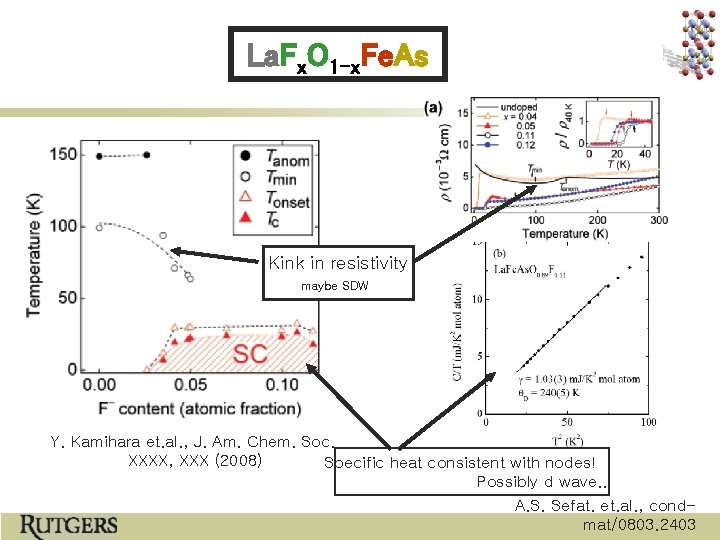
La. Fx. O 1 -x. Fe. As Kink in resistivity maybe SDW Y. Kamihara et. al. , J. Am. Chem. Soc. XXXX, XXX (2008) Specific heat consistent with nodes! Possibly d wave. . A. S. Sefat. et. al. , condmat/0803. 2403
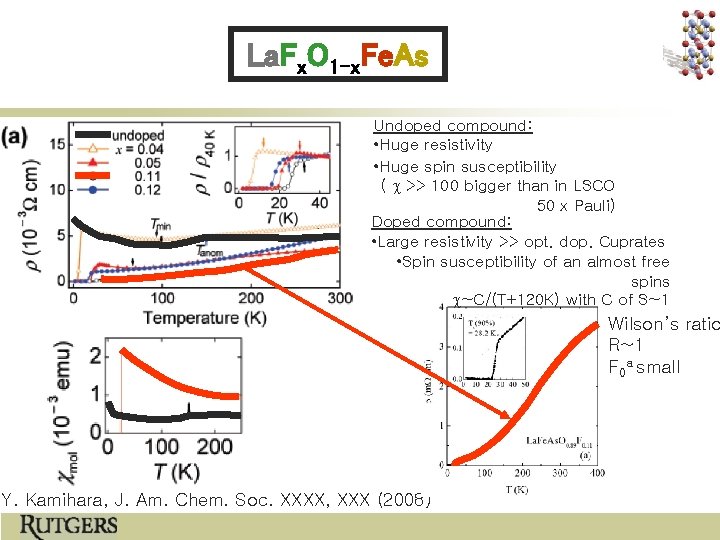
La. Fx. O 1 -x. Fe. As Undoped compound: • Huge resistivity • Huge spin susceptibility ( >> 100 bigger than in LSCO 50 x Pauli) Doped compound: • Large resistivity >> opt. dop. Cuprates • Spin susceptibility of an almost free spins ~C/(T+120 K) with C of S~1 Wilson’s ratio R~1 F 0 a small Y. Kamihara, J. Am. Chem. Soc. XXXX, XXX (2008)
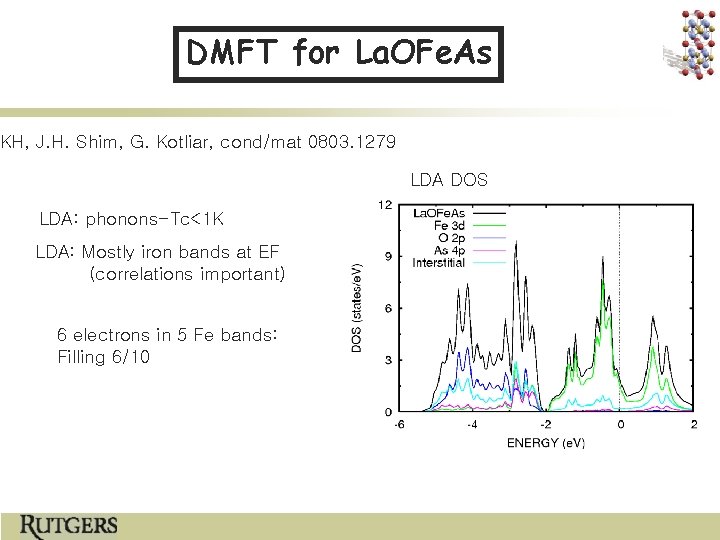
DMFT for La. OFe. As KH, J. H. Shim, G. Kotliar, cond/mat 0803. 1279 LDA DOS LDA: phonons-Tc<1 K LDA: Mostly iron bands at EF (correlations important) 6 electrons in 5 Fe bands: Filling 6/10
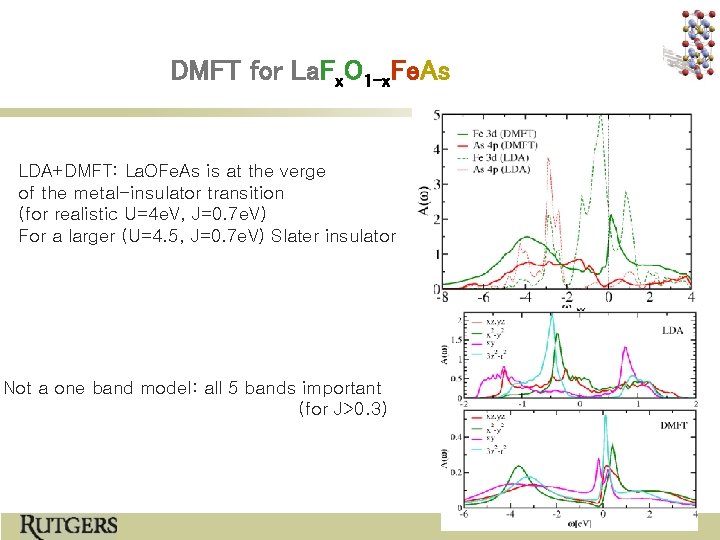
DMFT for La. Fx. O 1 -x. Fe. As LDA+DMFT: La. OFe. As is at the verge of the metal-insulator transition (for realistic U=4 e. V, J=0. 7 e. V) For a larger (U=4. 5, J=0. 7 e. V) Slater insulator Not a one band model: all 5 bands important (for J>0. 3)
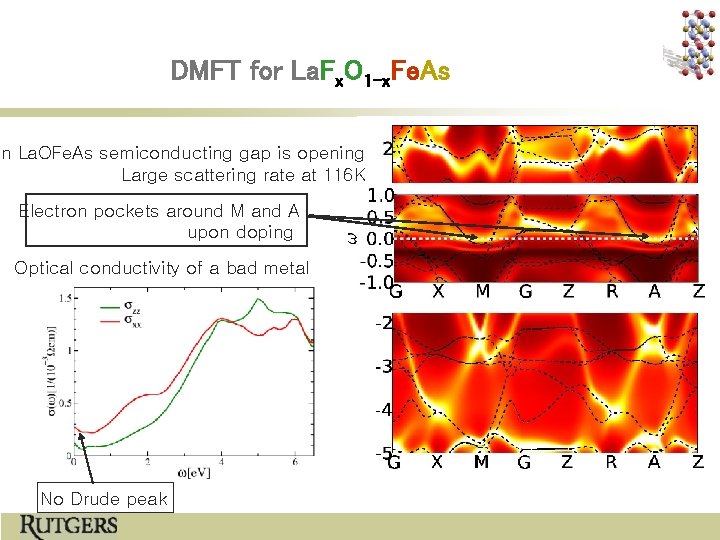
DMFT for La. Fx. O 1 -x. Fe. As In La. OFe. As semiconducting gap is opening Large scattering rate at 116 K Electron pockets around M and A upon doping Optical conductivity of a bad metal No Drude peak
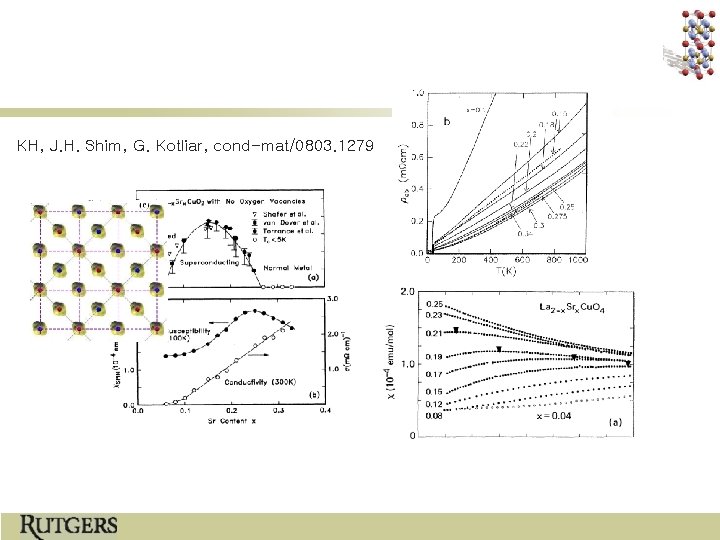
KH, J. H. Shim, G. Kotliar, cond-mat/0803. 1279
- Slides: 59