
Banana Genus Musa Family Musaceae Musa acuminata Bananas
Banana Genus: Musa Family: Musaceae
�Musa acuminata – Bananas �Edible fruits �Musa balbisiana – Plantains �cooking �Musa paradisiaca
History of Cultivation �Papua New Guinea, SE Asia – 5000 BC, and possibly 8000 BC �Cameroon in Africa – 100 AD, Madagascar 400 AD �Middle East – 900 AD (Spread of Islam) �Consumption increased during Ramadan �Americas in 1600 from the Portuguese
Cultivation �Wild Bananas contained large seeds and were primarily of trisomy origin. (Parthenocarpic now) �The plant produces 2 shoots at a time �A large shoot for immediate fruiting �A “sucker” for 6 -8 months later
�Large plantations in tropical areas are the major producers of bananas (Dole, Del Monte, Chiquita) �Life of a plantation is 25 years or more �Transplanting of corms and “sucker” needed for propagation
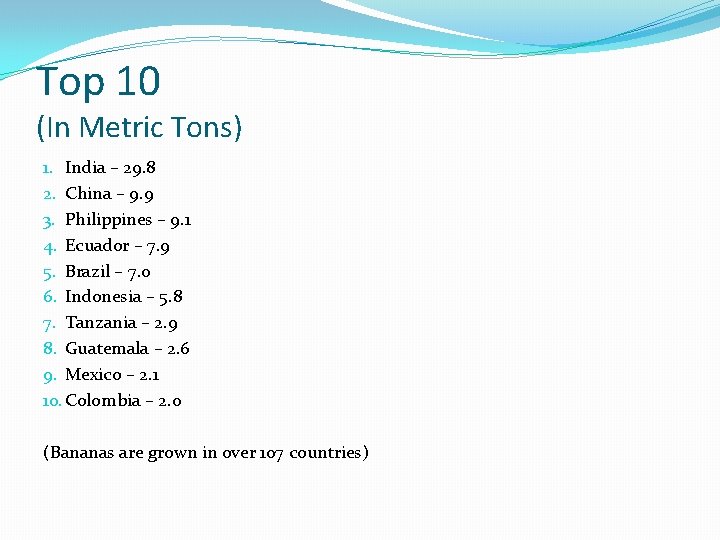
Top 10 (In Metric Tons) 1. India – 29. 8 2. China – 9. 9 3. Philippines – 9. 1 4. Ecuador – 7. 9 5. Brazil – 7. 0 6. Indonesia – 5. 8 7. Tanzania – 2. 9 8. Guatemala – 2. 6 9. Mexico – 2. 1 10. Colombia – 2. 0 (Bananas are grown in over 107 countries)
Characteristics �Usually elongated and curved �Soft flesh; rich in starch with a rind covering it. �Variable in size, color, and firmness �Red, yellow, or purple when ripe �Green before ripening � Ethylene causes ripening � Most supermarkets artificially ripen bananas � Brown paper bag with an apple or tomato.
Uses �Leaves are large, flexible, and waterproof. They are often used as disposable food containers, “plates”, or wrappings for food �The flower is used as a vegetable similar to that of an artichoke �Plant is used as fiber in making yarn, textures, and paper �The trunk and fruits of the plant are eaten �Like a potato, the fruits can be fried, cooked or steamed.
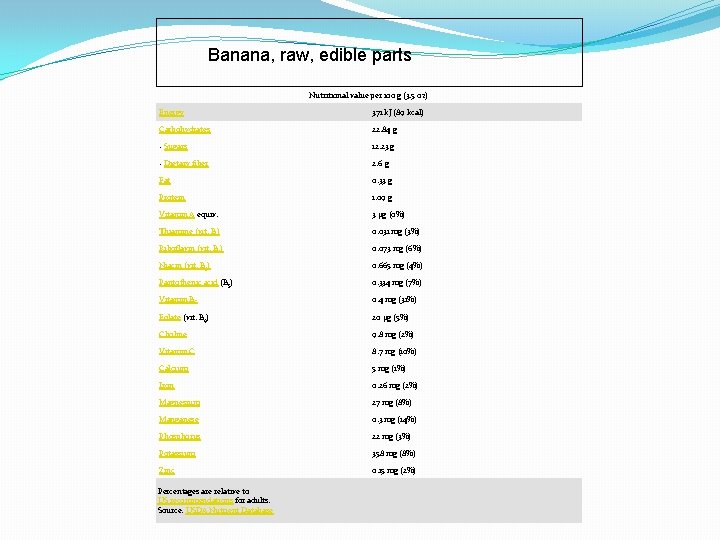
Banana, raw, edible parts Nutritional value per 100 g (3. 5 oz) Energy 371 k. J (89 kcal) Carbohydrates 22. 84 g - Sugars 12. 23 g - Dietary fiber 2. 6 g Fat 0. 33 g Protein 1. 09 g Vitamin A equiv. 3 μg (0%) Thiamine (vit. B 1) 0. 031 mg (3%) Riboflavin (vit. B 2) 0. 073 mg (6%) Niacin (vit. B 3) 0. 665 mg (4%) Pantothenic acid (B 5) 0. 334 mg (7%) Vitamin B 6 0. 4 mg (31%) Folate (vit. B 9) 20 μg (5%) Choline 9. 8 mg (2%) Vitamin C 8. 7 mg (10%) Calcium 5 mg (1%) Iron 0. 26 mg (2%) Magnesium 27 mg (8%) Manganese 0. 3 mg (14%) Phosphorus 22 mg (3%) Potassium 358 mg (8%) Zinc 0. 15 mg (2%) Percentages are relative to US recommendations for adults. Source: USDA Nutrient Database
Source �http: //en. wikipedia. org/wiki/Banana
- Slides: 10